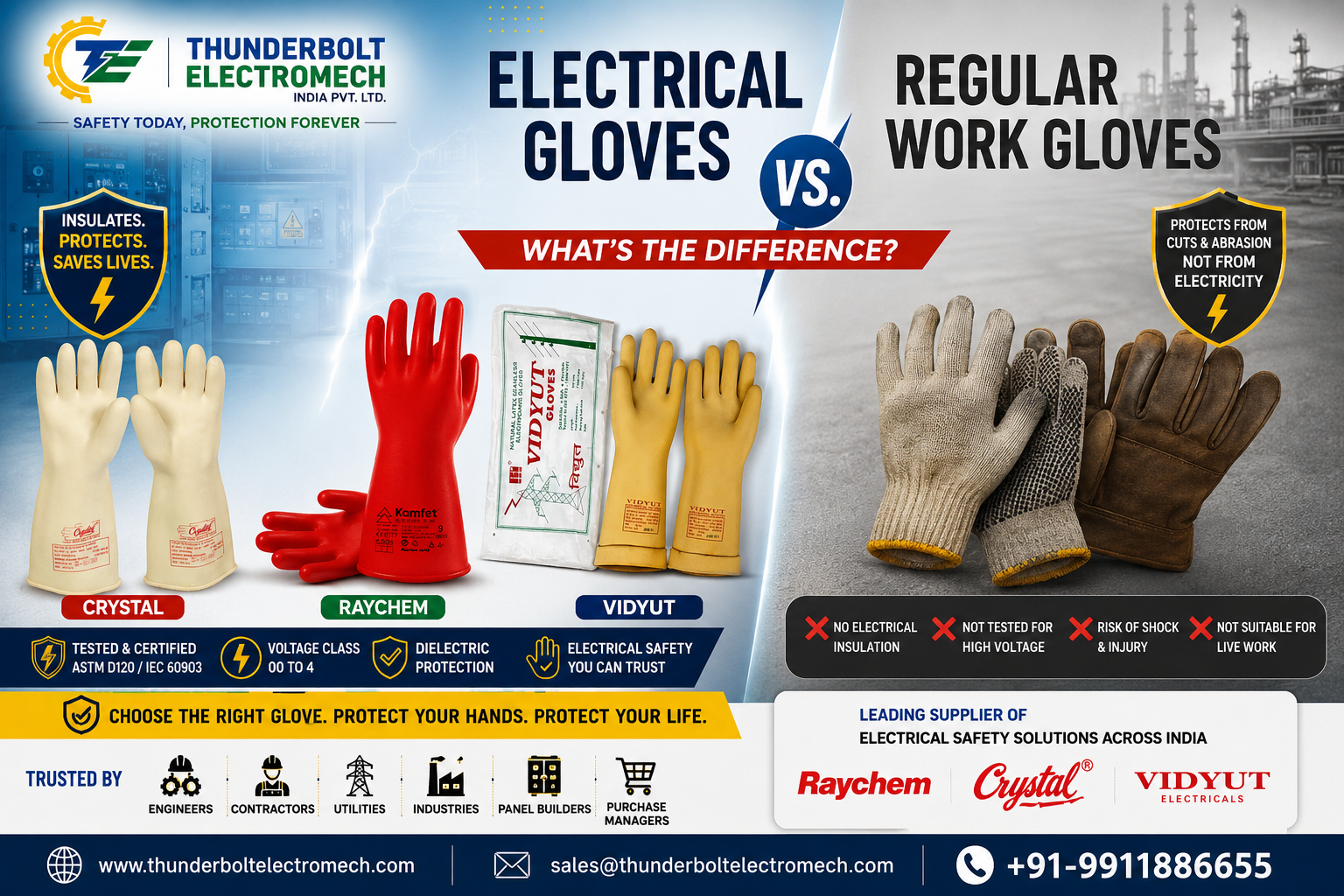
Quick Answer: Electrical gloves and regular work gloves serve completely different purposes. Regular work gloves protect hands from cuts, abrasions, sharp edges, and mechanical injuries, but they do not provide electrical insulation. Electrical insulating gloves are manufactured from specially formulated dielectric rubber and tested according to ASTM D120 and IEC 60903 standards to protect workers from electric shock during live electrical work.
If you are working on electrical panels, transformers, switchgear, substations, overhead lines, or energized equipment, wearing ordinary leather or fabric gloves can be extremely dangerous. Choosing the correct Electrical Hand Gloves Supplier is just as important as selecting the right voltage class. A reliable supplier provides certified gloves, test certificates, proper storage guidance, and voltage ratings suitable for your application.
Thunderbolt Electromech is a leading Electrical Hand Gloves Supplier in India, offering Raychem Electrical Hand Gloves, Vidyut Electrical Hand Gloves, and Crystal Electrical Hand Gloves for engineers, contractors, utilities, industries, and maintenance professionals. The company also supplies electrical safety products across Delhi NCR, including electrical rubber mats, danger plates, lockout devices, discharge rods, rescue hooks, and other industrial safety equipment.
Introduction
Electricity cannot be seen. It cannot be heard. Yet it remains one of the biggest hazards inside factories, substations, electrical rooms, manufacturing plants, and power utilities.
Many workplace accidents happen because people believe that any thick glove can stop electricity. Unfortunately, this assumption is completely wrong.
A heavy leather glove may stop a sharp metal edge from cutting your hand. A mechanic glove may provide excellent grip. An anti-vibration glove may improve comfort. None of these gloves are designed to prevent electrical current from passing through your body.
When electrical current finds a path through the human body, even a fraction of a second can result in severe burns, nerve damage, cardiac arrest, or fatal electrocution.
That is why industries across India insist on using certified dielectric gloves whenever technicians perform work on energized equipment.
Whether you maintain transformer yards, industrial switchboards, solar power plants, electrical panels, railway substations, or HT/LT installations, selecting the right Electrical Hand Gloves Supplier, Electrical Safety Hand Gloves Supplier, or Electrical Hand Gloves Supplier Delhi NCR directly impacts worker safety and regulatory compliance.
This guide explains the engineering difference between ordinary work gloves and certified electrical insulating gloves while helping procurement managers choose the right protection for every voltage level.
Electrical Hand Gloves Supplier:The Fatal Myth: Why Regular Leather or Work Gloves Fail Against Electricity
One of the most dangerous misconceptions in industrial maintenance is the belief that thick gloves automatically provide electrical protection.
This myth often develops because leather appears durable and dry. Workers naturally assume that if a glove feels thick, electricity cannot pass through it.
Engineering tells a different story.
Leather, cotton, canvas, nylon, polyester, and synthetic work gloves are designed primarily for mechanical protection. Their job is to reduce injuries caused by:
- Sharp sheet metal
- Rough surfaces
- Abrasion
- Splinters
- Heat
- Minor impacts
- Hand fatigue
Electrical current behaves differently.
Electricity always searches for the easiest conductive path. Sweat, moisture, dirt, conductive dust, oil contamination, and tiny metal particles can transform an ordinary glove into a conductor.
A leather glove soaked with perspiration loses its insulating capability almost immediately.
Certified electrical gloves, however, are manufactured using specially compounded dielectric rubber that resists electrical current even under demanding working conditions when properly maintained.
This is why utilities, EPC contractors, and electrical inspectors never permit regular work gloves during live electrical maintenance.
Mechanical Protection (EN 388) vs Dielectric Protection (ASTM D120 / IEC 60903)
Many procurement teams accidentally compare gloves only by thickness or durability.
Instead, they should compare the certification standard.
EN 388 Work Gloves
EN 388 evaluates protection against mechanical hazards such as:
- Abrasion resistance
- Blade cut resistance
- Tear resistance
- Puncture resistance
- Impact protection
These gloves are excellent for fabrication workshops, warehouses, construction sites, and mechanical maintenance.
However, EN 388 does not certify electrical insulation.
ASTM D120 / IEC 60903 Electrical Gloves
Electrical insulating gloves undergo completely different testing.
They are tested for:
- Dielectric strength
- Leakage current
- High-voltage withstand capability
- Rubber integrity
- Aging resistance
- Ozone resistance
- Flexibility
- Material defects
Every voltage class is tested at voltages much higher than its maximum working voltage to ensure an adequate safety margin.
For example:
- Class 00: Maximum use voltage 500 V AC; test voltage 2.5 kV.
- Class 0: Maximum use voltage 1,000 V AC; test voltage 5 kV.
- Class 1: Maximum use voltage 7,500 V AC; test voltage 10 kV.
- Class 2: Maximum use voltage 17,000 V AC; test voltage 20 kV.
- Class 3: Maximum use voltage 26,500 V AC; test voltage 30 kV.
- Class 4: Maximum use voltage 36,000 V AC; test voltage 40 kV.
A certified Electrical Insulating Hand Gloves Supplier should provide gloves that comply with these standards and include appropriate testing documentation.
How Sweat, Dirt & Moisture Make Regular Gloves Conductive
Human perspiration contains dissolved salts.
These salts are electrically conductive.
During summer maintenance or work inside hot electrical rooms, technicians often sweat heavily. Sweat is absorbed into leather, cotton, and fabric gloves, creating a conductive pathway.
Additional contaminants make the situation worse:
- Carbon dust
- Cement dust
- Metallic particles
- Transformer oil residue
- Moisture
- Rainwater
- Chemical deposits
The glove that appeared safe in the morning can become hazardous after only a few hours of work.
Electrical insulating gloves are manufactured from specialized dielectric rubber designed to maintain electrical resistance. Even so, they require routine inspection because cuts, punctures, or contamination can compromise protection.
This is why safety officers recommend:
- Inspect gloves before every use.
- Keep gloves clean and dry.
- Never use damaged gloves.
- Store gloves away from oils, sunlight, and ozone sources.
- Follow periodic laboratory testing schedules.
Customer Pain Points Before Buying Electrical Hand Gloves
Industrial buyers frequently encounter the following challenges:
1. Choosing leather gloves instead of dielectric gloves
Many first-time buyers assume leather equals electrical protection.
Solution: Use certified dielectric rubber gloves with leather protectors when performing energized work.
2. Selecting the wrong voltage class
Buying Class 2 gloves for Class 0 applications increases hand fatigue and reduces dexterity.
Solution: Match the glove class to the system voltage rather than choosing the highest available rating.
3. Purchasing low-cost uncertified gloves
Some inexpensive gloves resemble certified products but lack proper testing.
Solution: Buy from an ISI Certified Electrical Hand Gloves Supplier that provides test certificates and compliance documentation.
4. Ignoring inspection requirements
Electrical gloves gradually deteriorate because of ozone exposure, UV light, improper storage, and daily use.
Solution: Conduct daily visual inspections and periodic laboratory testing according to applicable standards and company safety procedures.
5. Buying gloves without considering maintenance
Electrical gloves require proper storage, air testing, and cleaning.
Solution: Train workers on inspection procedures and replace gloves immediately if defects are found.
Engineering Research: Why Dielectric Rubber Saves Lives
Electrical current flows when a voltage difference exists between two conductive points.
The human body contains water, electrolytes, and blood, making it a conductor.
Dielectric rubber interrupts this flow by providing a material with very high electrical resistance. This significantly reduces the likelihood of current passing through the wearer when the glove is intact and used within its rated voltage.
Research in electrical safety consistently emphasizes that the effectiveness of insulating gloves depends on three factors:
- Selecting the correct voltage class.
- Keeping the glove free from cuts, punctures, and contamination.
- Performing regular inspection and testing.
Even a tiny puncture can compromise insulation, which is why pre-use inspections are mandatory in many industrial safety programs.
Comparison Table: Electrical Gloves vs Regular Work Gloves
| Feature | Electrical Insulating Gloves | Regular Work Gloves |
| Primary Purpose | Protection from electric shock | Protection from cuts and abrasion |
| Material | Dielectric rubber | Leather, fabric, synthetic fibers |
| Electrical Protection | Yes | No |
| Voltage Rating | Class 00 to Class 4 | Not applicable |
| Standard | ASTM D120 / IEC 60903 | EN 388 |
| Live Electrical Work | Suitable when correctly selected and maintained | Unsafe |
| Periodic Testing | Required | Usually not required |
| Daily Inspection | Mandatory | Recommended |
| Moisture Resistance | Designed for dielectric performance | Performance degrades with moisture |
| Typical Users | Electricians, utilities, substations, panel maintenance | Mechanics, fabricators, warehouse staff |
Electrical Hand Gloves Supplier: Technical Comparison: Electrical Gloves vs. Regular Work Gloves
Selecting the right hand protection is one of the most critical safety decisions in any electrical maintenance activity. Engineers, safety officers, contractors, and procurement managers often compare gloves based on thickness, durability, or price. However, these factors alone do not determine whether a glove can safely protect workers from electrical hazards.
The primary difference lies in purpose. Regular work gloves are designed to protect against mechanical risks such as cuts, abrasions, punctures, and impacts. Electrical insulating gloves are engineered specifically to prevent electrical current from passing through the human body. They are manufactured using specially compounded dielectric rubber and undergo rigorous electrical testing according to ASTM D120 and IEC 60903 standards.
For electrical work, relying on ordinary leather or fabric gloves can lead to severe injury or fatal electrocution. Choosing a trusted Electrical Hand Gloves Supplier, Electrical Safety Hand Gloves Supplier, or Electrical Hand Gloves Supplier Delhi NCR ensures that your workforce receives certified products suitable for the voltage levels encountered in daily operations.
Whether you maintain electrical panels, transformers, substations, overhead distribution systems, renewable energy plants, or industrial switchgear, understanding the differences between electrical gloves and regular work gloves helps improve safety, compliance, and productivity.
Complete Comparison Table: Electrical Gloves vs. Regular Work Gloves
| Feature | Electrical Insulating Gloves | Regular Work Gloves |
| Primary Purpose | Protection against electric shock | Protection against cuts, abrasion & impact |
| Standard | ASTM D120 / IEC 60903 | EN 388 |
| Material | Dielectric natural rubber or synthetic insulating rubber | Leather, cotton, polyester, nitrile, canvas |
| Electrical Protection | Yes | No |
| Voltage Rating | Class 00 to Class 4 | Not Rated |
| Live Electrical Work | Suitable | Unsafe |
| Cut Resistance | Moderate (requires leather protector) | High |
| Abrasion Resistance | Moderate | High |
| Moisture Effect | Maintains insulation when properly maintained | Moisture increases conductivity |
| Oil Resistance | Limited (depends on glove type) | Good |
| UV Resistance | Designed for electrical applications | Depends on material |
| Arc Flash Protection | Used with leather protectors and arc-rated PPE | Not suitable |
| Inspection Requirement | Before every use | Visual inspection only |
| Air Inflation Test | Mandatory | Not Required |
| Laboratory Re-testing | Every 6 months (or per company policy and applicable standards) | Not Required |
| Typical Users | Electricians, Utilities, Power Plants, Panel Builders | Mechanics, Fabricators, Construction Workers |
| Service Life | Depends on inspection, testing, storage & usage | Depends on wear and tear |
Why Electrical Gloves Are Different
Dielectric Rubber Blocks Electrical Current
The rubber used in electrical gloves has very high electrical resistance. When a worker accidentally touches an energized conductor, the glove acts as an insulating barrier that reduces the likelihood of current passing through the body, provided the glove is undamaged and used within its voltage rating.
Regular work gloves have no such capability.
Mechanical Strength Alone Is Not Enough
Many workers believe that thicker gloves provide better electrical protection.
Unfortunately, this is false.
Leather, canvas, Kevlar®, nitrile-coated, PVC-coated, and fabric gloves are excellent for:
- Metal fabrication
- Construction
- Warehouse handling
- Heavy equipment
- Mechanical maintenance
None of these materials are intended to provide dielectric protection for energized electrical work.
Tiny Damage Can Become a Major Hazard
Electrical gloves should always be inspected carefully before every shift.
Look for:
- Pin holes
- Cuts
- Surface cracks
- UV damage
- Chemical contamination
- Oil residue
- Ozone cracks
Even a microscopic puncture can compromise the glove’s insulating performance.
Electrical Hand Gloves Supplier: Understanding Electrical Voltage Classes
Electrical gloves are divided into six internationally recognized classes based on maximum working voltage.
Selecting the correct class ensures maximum worker protection while maintaining comfort and dexterity.
Using a higher class than necessary often results in:
- Reduced finger movement
- Lower productivity
- Worker fatigue
- Poor grip
Choosing too low a class creates a serious electrical safety risk.
Class 00 Electrical Gloves
Maximum AC Working Voltage
500 Volts AC
Test Voltage
2.5 kV
Typical Applications
- Residential electrical work
- Meter installations
- Control panels
- Instrumentation
- PLC maintenance
- Building electrical maintenance
Most commercial electricians working on low-voltage systems use Class 00 gloves.
Class 0 Electrical Gloves
Maximum AC Working Voltage
1,000 Volts AC
Test Voltage
5 kV
Typical Applications
- MCC Panels
- Industrial LT Panels
- Commercial buildings
- Factory distribution boards
- Generator control panels
Class 0 gloves are among the most commonly purchased products from an Electrical Hand Gloves Dealer Delhi because they are suitable for a wide range of industrial low-voltage maintenance tasks.
Class 1 Electrical Gloves
Maximum AC Working Voltage
7,500 Volts AC
Test Voltage
10 kV
Typical Applications
- Distribution transformers
- Ring Main Units
- HT switchgear
- Utility maintenance
- Electrical substations
Utility companies frequently use Class 1 gloves during switching operations and preventive maintenance.
Class 2 Electrical Gloves
Maximum AC Working Voltage
17,000 Volts AC
Test Voltage
20 kV
Typical Applications
- Medium voltage feeders
- Distribution substations
- Industrial HT equipment
- Utility maintenance
These gloves provide additional protection for engineers working on medium-voltage installations.
Class 3 Electrical Gloves
Maximum AC Working Voltage
26,500 Volts AC
Test Voltage
30 kV
Typical Applications
- Large industrial plants
- Utility substations
- High voltage installations
- Power distribution networks
These gloves are generally selected for specialized electrical maintenance where higher voltage protection is required.
Class 4 Electrical Gloves
Maximum AC Working Voltage
36,000 Volts AC
Test Voltage
40 kV
Typical Applications
- Transmission systems
- Grid substations
- Utility transmission maintenance
- High voltage switching operations
Class 4 gloves offer the highest standard protection for live-line maintenance performed by trained professionals.
Voltage Selection Guide
Choosing the right voltage class should always begin with the maximum system voltage—not by selecting the highest-rated glove available.
| Electrical System | Recommended Glove Class |
| Control Panels | Class 00 |
| Building Electrical Systems | Class 00 |
| LT Industrial Panels | Class 0 |
| Motor Control Centres | Class 0 |
| Distribution Transformers | Class 1 |
| Ring Main Units | Class 1 |
| Medium Voltage Feeders | Class 2 |
| Industrial HT Systems | Class 2 |
| Large Power Plants | Class 3 |
| Transmission Maintenance | Class 4 |
Factors to Consider
Before purchasing electrical gloves, evaluate:
- Operating voltage
- Maximum fault conditions
- Indoor or outdoor application
- Environmental conditions
- Worker comfort
- Dexterity requirements
- Frequency of maintenance
- Compliance with ASTM D120 or IEC 60903
A knowledgeable Electrical Insulating Hand Gloves Supplier can assist in selecting the appropriate glove class for each application.
Color Coding Guide
Manufacturers commonly use color labels to help identify voltage classes during inspections and safety audits.
| Class | Label Color | Maximum AC Voltage |
| Class 00 | Beige | 500 V |
| Class 0 | Red | 1,000 V |
| Class 1 | White | 7,500 V |
| Class 2 | Yellow | 17,000 V |
| Class 3 | Green | 26,500 V |
| Class 4 | Orange | 36,000 V |
Although color coding helps with quick identification, workers should always verify the markings printed on the glove before use, as labeling practices may vary by manufacturer and applicable standards.
Why Correct Voltage Selection Improves Safety
Choosing gloves that exceed the required voltage rating may seem safer, but it can introduce practical issues.
Higher-rated gloves are generally:
- Thicker
- Heavier
- Less flexible
- More tiring during extended use
Reduced dexterity can make precision tasks such as tightening terminals, replacing control wiring, or operating small electrical components more difficult.
Conversely, selecting a glove with an insufficient voltage rating can expose workers to unacceptable electrical risk.
The best practice is to match the glove class to the actual electrical system and task.
Real Industrial Use Case #1
A manufacturing facility in North India scheduled preventive maintenance on a 415 V motor control center.
One technician arrived wearing heavy-duty leather work gloves designed for mechanical maintenance. Another technician used certified Class 0 electrical insulating gloves with leather protector gloves.
During cable tightening, a live conductor unexpectedly came into contact with the workers’ hands.
The technician wearing certified electrical gloves completed the task safely because the gloves were rated for the operating voltage and had been inspected before use.
The leather glove, despite being thick and durable, would not have provided dielectric protection if it had contacted an energized conductor.
Following the incident review, the plant updated its procurement policy to source certified gloves only from an experienced Electrical Hand Gloves Supplier Delhi, implemented mandatory pre-use inspections, and trained maintenance personnel on voltage-class selection. The facility also standardized the use of certified electrical PPE across all electrical maintenance activities, reducing the risk of preventable electrical injuries.
Real Industrial Use Case #2 – Electrical Panel Maintenance
An automobile manufacturing plant in Delhi NCR scheduled preventive maintenance on multiple 415 V motor control centres.
Previously, technicians used ordinary industrial leather gloves because they offered good grip.
During a safety audit, the company’s electrical safety consultant identified this as a serious compliance issue.
The procurement department replaced them with Class 0 certified electrical insulating gloves sourced from a trusted Electrical Hand Gloves Supplier Delhi NCR. Leather protector gloves were added to protect the insulating rubber from mechanical damage.
Within weeks, maintenance teams reported better confidence during energized testing, improved compliance with plant safety procedures, and a reduction in the risk of electrical incidents. The company also introduced mandatory glove inspections before every shift and scheduled periodic dielectric testing as part of its preventive maintenance program.
Real Industrial Use Case #3 – Utility Transformer Maintenance
A regional power utility was carrying out routine maintenance on 11 kV distribution transformers before the monsoon season.
Earlier procurement focused mainly on price, resulting in inconsistent glove quality and incomplete certification records.
The utility standardized its PPE by sourcing certified Raychem, Vidyut, and Crystal Electrical Hand Gloves through a reliable Electrical Hand Gloves Supplier. Teams working on medium-voltage equipment were equipped with appropriately rated gloves, leather protectors, and inspection procedures.
The change simplified safety audits, improved compliance, reduced glove replacement caused by improper handling, and strengthened worker confidence during switching and transformer maintenance operations.
Electrical Hand Gloves Supplier: Complete 3-Layer Electrical Protection System, Inspection & Procurement Guide
Electrical safety is never achieved by wearing only a pair of rubber gloves. Professional electrical maintenance follows a complete protection system consisting of cotton liners, dielectric rubber insulating gloves, and leather protector gloves. Together, these layers protect technicians from electric shock, mechanical damage, heat, and premature glove failure.
For engineers, safety officers, electrical contractors, EPC companies, utilities, and purchase managers, understanding this system helps reduce accidents, extend glove life, and comply with international electrical safety standards.
Electrical Hand Gloves Supplier: The Complete 3-Layer Electrical Protection System
Buying ISI Certified Electrical Hand Gloves is only the first step. The real challenge is ensuring workers use them correctly.
Many electrical accidents occur because workers wear:
- Rubber gloves without leather protectors
- Leather gloves without dielectric gloves
- Rubber gloves with pinholes
- Expired electrical gloves
- Wrong voltage class gloves
A professional Electrical Hand Gloves Supplier helps customers select not only the correct voltage class but also the complete protective system.
Thunderbolt Electromech supplies electrical insulating gloves from trusted brands including:
- Raychem Electrical Hand Gloves
- Vidyut Electrical Hand Gloves
- Crystal Electrical Hand Gloves
These products are suitable for:
- Electrical panels
- Switchgear
- Transformers
- HT substations
- LT distribution panels
- Solar power plants
- Industrial maintenance
- Utility companies
Why Three Layers Are Necessary
Think of electrical gloves like a safety helmet.
A helmet protects your head.
But electricians also wear goggles, safety shoes, and arc flash clothing.
Similarly, electrical gloves require additional protection.
Layer 1
Cotton liner
↓
Layer 2
Rubber insulating glove
↓
Layer 3
Leather protector glove
Each layer performs a different engineering function.
Removing one layer significantly reduces protection.
Layer 1 — Cotton Liners
Cotton liners look simple.
They are actually extremely important.
Without them, sweat builds inside the dielectric glove.
Sweat contains:
- Sodium
- Potassium
- Chloride ions
These ions increase electrical conductivity.
Although the glove itself remains insulating, excessive moisture reduces comfort and increases contamination inside the glove.
Advantages of Cotton Liners
✔ Absorb perspiration
✔ Reduce skin irritation
✔ Improve comfort
✔ Prevent fungal growth
✔ Increase working duration
✔ Reduce odor
✔ Extend glove life
Engineering Insight
Workers performing panel maintenance during Indian summers often operate in ambient temperatures above 40°C.
Without liners:
- sweating increases
- glove removal becomes frequent
- contamination increases
Cotton liners significantly improve compliance because technicians remain comfortable throughout the shift.
Where Cotton Liners Are Recommended
- HT maintenance
- LT panel servicing
- Solar farms
- Transformer yards
- Cable jointing
- Utilities
- Metro rail maintenance
- Process industries
Layer 2 — Rubber Insulating Gloves
This is the heart of electrical protection.
Rubber insulating gloves prevent electric current from passing through the technician’s body.
These gloves are manufactured using specially formulated dielectric rubber.
They undergo high-voltage testing before being approved for field use.
Functions of Rubber Gloves
- Prevent electrical shock
- Prevent current flow
- Protect during accidental contact
- Provide insulation
- Maintain flexibility
Why Natural Rubber?
Natural rubber provides
- excellent dielectric strength
- elasticity
- flexibility
- ozone resistance
- high tear strength
Modern insulating gloves may also include synthetic rubber blends for improved durability.
Common Applications
- MCC panels
- PCC panels
- Switchboards
- RMU maintenance
- Transformer terminals
- Cable termination
- Busbar maintenance
- Solar inverter maintenance
- HT breaker operation
Layer 3 — Leather Protector Gloves
Many workers believe leather gloves provide electrical insulation.
They do not.
Leather gloves protect the rubber glove—not the worker from electricity.
Functions
Leather protectors prevent:
- punctures
- cuts
- abrasion
- scratches
- cable edge damage
- tool damage
- accidental tearing
Example
Imagine tightening a cable lug inside a transformer panel.
The sharp cable lug edge contacts the rubber glove.
Without leather protection:
the rubber develops a tiny cut.
The cut may not be visible.
During the next live maintenance job,
That tiny cut becomes the path for electrical current.
Engineering Recommendation
Leather protector gloves should always extend beyond the rubber glove cuff.
This ensures complete coverage.
Complete 3-Layer Comparison Table
| Layer | Material | Purpose | Replace Frequency |
| Cotton liner | Cotton | Sweat absorption | As required |
| Rubber glove | Dielectric rubber | Electrical insulation | Based on testing |
| Leather protector | Leather | Mechanical protection | When worn |
Why Workers Skip Leather Gloves
Field studies show technicians skip leather protectors because they feel bulky.
Unfortunately, this dramatically reduces glove lifespan.
Typical glove damage comes from:
- cable tray edges
- gland plates
- cable lugs
- busbars
- steel panels
- bolts
- conduit edges
Leather gloves absorb these mechanical impacts.
Electrical Hand Gloves Supplier: Daily Inspection Before Every Use
Electrical gloves should never be worn directly after removing them from the storage bag.
They require inspection first.
This process usually takes less than two minutes.
Those two minutes may save a life.
Daily Inspection Checklist
Check for:
✔ Cuts
✔ Cracks
✔ Pinholes
✔ Swelling
✔ Hardening
✔ UV damage
✔ Oil contamination
✔ Chemical exposure
✔ Abrasion
✔ Surface discoloration
✔ Expired testing date
Visual Inspection Table
| Inspection Item | Acceptable | Reject If |
| Surface | Smooth | Cracked |
| Flexibility | Flexible | Hard |
| Color | Uniform | Discolored |
| Cuff | Straight | Torn |
| Finger area | Smooth | Cuts |
| Interior | Dry | Moisture |
Air Inflation Test
One of the simplest and most effective field inspections is the air inflation test.
It requires no electrical equipment.
Step 1
Roll the glove cuff.
This traps air inside.
Step 2
Compress gently.
Step 3
Rotate slowly.
Listen carefully.
Step 4
Look for
- bubbles
- escaping air
- deformation
- leaks
Why Air Testing Matters
A pinhole invisible to the eye becomes obvious during inflation.
Large utilities require this test before every shift.
Common Air Test Defects
- needle punctures
- ozone cracks
- manufacturing defects
- accidental cuts
- age-related leaks
Storage Guidelines
Improper storage destroys more electrical gloves than actual field work.
Never Store Gloves
❌ Folded
❌ Crushed
❌ Under tools
❌ Near heaters
❌ Inside vehicle dashboards
❌ Near ozone generators
❌ Beside transformers
❌ Near welding equipment
❌ In direct sunlight
Correct Storage
Store gloves:
- flat
- inside storage bags
- cool area
- dry location
- away from oils
- away from chemicals
- away from UV light
Temperature Recommendation
Recommended storage:
10°C–35°C
Avoid excessive heat.
Ozone Damage
Electric motors generate ozone.
Ozone attacks rubber molecules.
Over time this causes:
- tiny cracks
- stiffness
- dielectric reduction
Always keep gloves away from running motors and switchgear rooms when not in use.
Six-Month Laboratory Testing
Daily inspection is not enough.
Industry practice requires periodic laboratory testing of insulating gloves to verify they still meet their rated dielectric performance. Many organizations follow a six-month retest interval for gloves in service, though users should always follow the applicable standard, manufacturer instructions, and local regulations.
Laboratory Tests Include
- Dielectric withstand test
- Leakage current measurement
- Visual inspection
- Air inflation verification
- Dimensional checks
Example Testing Schedule
| Month | Activity |
| Month 0 | Purchase & certification |
| Daily | Visual inspection + air inflation |
| 6 Months | Laboratory electrical test |
| 12 Months | Repeat testing |
| After Damage | Remove from service and inspect/test before reuse |
Procurement Checklist for Engineers & Purchase Managers
Selecting the right supplier involves more than comparing price.
Technical Procurement Checklist
✔ Correct voltage class (Class 00 to Class 4)
✔ ASTM D120 / IEC 60903 or applicable certification
✔ Recent test certificate
✔ Manufacturer traceability
✔ Available leather protector gloves
✔ Cotton liner compatibility
✔ Proper storage recommendations
✔ Batch identification
✔ Size availability
✔ Pan-India supply support
Common Buying Mistakes
1. Buying by Price Alone
Low-cost gloves without proper certification may not provide the expected level of electrical protection.
Solution: Verify certifications, test reports, and supplier credibility.
2. Choosing the Wrong Voltage Class
Higher classes are thicker and can reduce dexterity, while lower classes may not be suitable for the working voltage.
Solution: Match the glove class to the maximum system voltage and perform a risk assessment.
3. Ignoring Leather Protectors
Rubber gloves alone are vulnerable to cuts and abrasion.
Solution: Always use compatible leather protector gloves when required by the glove design and work practice.
4. Skipping Daily Inspection
Many glove failures begin as tiny defects.
Solution: Make visual inspection and air inflation testing mandatory before every use.
5. Poor Storage
Heat, sunlight, ozone, oils, and chemicals significantly shorten glove life.
Solution: Store gloves correctly in protective bags in a cool, dry location.
Cost vs Lifecycle Analysis
A certified electrical glove system costs more initially than ordinary work gloves, but the lifecycle value is much higher because it reduces the likelihood of electrical injuries, unplanned downtime, and equipment damage.
| Parameter | Certified Electrical Gloves | Regular Work Gloves |
| Electrical insulation | Yes | No |
| Periodic testing | Yes | No |
| Suitable for live electrical work | Yes | No |
| Mechanical protection (with leather protector) | High | Moderate |
| Compliance with electrical safety standards | Yes | No |
| Overall lifecycle value | High | Low for energized work |
Engineering Reference Table
| Application | Recommended Voltage Class | Additional Protection |
| Meter reading | Class 00 | Cotton liner + leather protector as appropriate |
| LT panel maintenance | Class 0 | Cotton liner + leather protector |
| Distribution transformer work | Class 1 | Complete 3-layer system |
| Medium-voltage switchgear | Class 2 | Complete 3-layer system |
| Industrial substations | Class 3 | Full PPE and arc-flash protection |
| Transmission maintenance | Class 4 | Complete live-line PPE system |
A reliable Electrical Hand Gloves Supplier helps customers select the correct class, compatible accessories, and maintenance practices rather than simply supplying gloves. For engineers, contractors, utilities, and industrial maintenance teams, investing in a complete glove protection system improves worker safety, supports compliance, and reduces long-term operational risk.
Electrical Hand Gloves Supplier: Why Choose Thunderbolt Electromech for Certified Electrical Safety Gloves
Selecting an Electrical Hand Gloves Supplier is about far more than comparing prices. Electrical insulating gloves are life-saving personal protective equipment (PPE). A poor-quality glove, an incorrect voltage class, or an expired test certificate can expose technicians to severe electrical hazards.
For engineers, electrical contractors, utilities, EPC companies, manufacturing plants, and purchase managers, the right supplier provides more than products—they provide technical guidance, certification support, fast delivery, and after-sales assistance.
Thunderbolt Electromech is a trusted supplier of electrical safety products across India. The company supplies electrical insulating gloves from leading brands including Raychem, Crystal, and Vidyut, helping industries choose gloves suitable for low-voltage, medium-voltage, and high-voltage applications.
Why Engineers Choose Thunderbolt Electromech
Industrial customers require suppliers who understand electrical safety—not simply distributors who stock products.
Thunderbolt Electromech focuses on supplying products used in:
- Power distribution companies
- Electrical panel manufacturers
- Switchgear manufacturers
- Transformer maintenance
- Solar EPC companies
- Metro rail projects
- Data centers
- Chemical plants
- Cement plants
- Steel plants
- Textile industries
- Government electrical departments
Instead of recommending one glove for every application, Thunderbolt assists customers in selecting gloves based on:
- Working voltage
- Safety standards
- Work environment
- Maintenance frequency
- Dexterity requirements
- Application type
This technical approach helps reduce procurement mistakes while improving worker safety.
Wide Product Availability
Thunderbolt Electromech offers electrical insulating gloves suitable for numerous industrial applications.
Available product categories include:
✔ Class 00 Gloves
✔ Class 0 Gloves
✔ Class 1 Gloves
✔ Class 2 Gloves
✔ Class 3 Gloves
✔ Class 4 Gloves
✔ Rubber Insulating Gloves
✔ Cotton Inner Gloves
✔ Leather Protector Gloves
✔ Complete Electrical PPE Solutions
Industries Served
Electrical gloves supplied by Thunderbolt are widely used in:
- Power generation plants
- Electrical substations
- Transformer maintenance
- Renewable energy projects
- Solar farms
- Wind power installations
- Railway electrification
- Industrial automation
- Manufacturing facilities
- Oil & gas plants
- Utilities
- Commercial buildings
- Infrastructure projects
Raychem Electrical Hand Gloves
Raychem is recognized in the electrical industry for manufacturing reliable electrical safety products designed for demanding industrial environments.
These gloves are commonly selected for:
- Electrical panel servicing
- Transformer maintenance
- Switchgear operation
- Cable jointing
- Utility maintenance
- Preventive maintenance shutdowns
Key Features
✔ Excellent dielectric insulation
✔ Flexible natural rubber construction
✔ High tear resistance
✔ Comfortable ergonomic design
✔ Suitable for repeated industrial use
✔ Tested for electrical insulation performance
Typical Applications
- LT Panels
- HT Panels
- MCC Panels
- PCC Panels
- Distribution Transformers
- Ring Main Units
- Solar Inverters
- Battery Banks
- Industrial Switchyards
Engineering Advantages
Raychem gloves are appreciated for maintaining flexibility while providing dependable electrical insulation, allowing technicians to perform precision tasks without excessive hand fatigue.
Crystal Electrical Hand Gloves
Crystal electrical insulating gloves are widely used across manufacturing industries and electrical maintenance teams where dependable electrical protection is required.
These gloves are suitable for:
- Industrial maintenance
- Electrical installations
- Factory shutdowns
- Panel maintenance
- Utility field work
Key Benefits
✔ Good flexibility
✔ Comfortable grip
✔ Reliable insulation
✔ Suitable for indoor and outdoor work
✔ Available in multiple voltage classes
Recommended Applications
- Electrical contractors
- OEM panel builders
- Maintenance contractors
- Industrial plants
- Commercial electrical installations
Why Contractors Choose Crystal
Contractors often value Crystal gloves because they balance comfort, flexibility, and durability, making them suitable for long maintenance shifts.
Vidyut Electrical Hand Gloves
Vidyut electrical gloves are commonly used by power utilities and industrial maintenance organizations.
These gloves are designed for applications involving energized electrical systems where certified insulating PPE is required.
Key Features
✔ Dielectric rubber insulation
✔ Excellent flexibility
✔ High-quality finish
✔ Suitable for preventive maintenance
✔ Available in different electrical classes
Common Applications
- Live electrical work (where permitted under site procedures)
- Distribution transformers
- HT switchyards
- Utility maintenance
- Electrical testing
- Preventive inspections
Brand Comparison Table
| Feature | Raychem | Crystal | Vidyut |
| Industrial reputation | Excellent | Very Good | Very Good |
| Flexibility | Excellent | Good | Good |
| Electrical insulation | Excellent | Excellent | Excellent |
| Industrial maintenance | Excellent | Excellent | Excellent |
| Panel maintenance | Yes | Yes | Yes |
| Transformer applications | Yes | Yes | Yes |
| Utility use | Yes | Yes | Yes |
How Thunderbolt Supports Procurement Teams
Procurement departments often face challenges beyond selecting the correct glove.
Typical questions include:
- Which voltage class should we purchase?
- How many gloves should we keep as spare inventory?
- Which gloves suit our maintenance schedule?
- Which gloves are appropriate for transformer maintenance?
- Which gloves are suitable for solar plants?
- Can one glove class cover all applications?
Thunderbolt assists customers by helping evaluate:
- Application voltage
- Frequency of use
- Maintenance schedules
- Required certifications
- Quantity planning
- Bulk supply requirements
This helps organizations make more informed purchasing decisions.
Delhi NCR Supply Network
Thunderbolt Electromech serves customers throughout Delhi NCR and supplies products across India.
Regular supply locations include:
- Delhi
- Noida
- Greater Noida
- Ghaziabad
- Gurugram
- Faridabad
- Sonipat
- Bahadurgarh
- Manesar
- Neemrana
- Bhiwadi
Pan-India dispatches support projects in states such as Uttar Pradesh, Haryana, Rajasthan, Punjab, Gujarat, Maharashtra, Karnataka, Tamil Nadu, Telangana, Andhra Pradesh, Odisha, West Bengal, Chhattisgarh, and others.
Trust Signals
Engineers and purchase managers generally evaluate suppliers based on several factors beyond price.
Thunderbolt Electromech offers:
- Wide range of electrical safety products
- Multiple trusted glove brands
- Technical product guidance
- Bulk supply capability
- Support for industrial and infrastructure projects
- Pan-India delivery
- Delhi NCR stock availability
- Assistance with product selection
Contact Details
Thunderbolt Electromech
📞 Phone: +91-9911886655
🌐 Website: https://thunderboltelectromech.com
📧 Email: info@thunderboltelectromech.com
Frequently Asked Questions
1. What is the difference between electrical gloves and regular work gloves?
Electrical gloves provide dielectric insulation against electric shock. Regular work gloves primarily protect against abrasion, cuts, and mechanical hazards.
2. Can leather gloves protect against electricity?
No. Leather gloves are not electrical insulators and should only be used as protector gloves over certified rubber insulating gloves.
3. Which glove class is suitable for 415V electrical panels?
Class 00 or Class 0 may be appropriate depending on the application and site requirements. Always follow your organization’s electrical safety procedures and applicable standards.
4. How often should electrical gloves be tested?
Inspect gloves before every use. In-service laboratory testing is commonly performed every six months, subject to the applicable standards and manufacturer recommendations.
5. Why do electrical gloves expire?
Rubber naturally ages due to ozone, UV exposure, heat, contamination, and mechanical wear, reducing long-term performance.
6. Can electrical gloves be washed?
Yes. Clean them with mild soap and water, then allow them to dry naturally away from direct heat and sunlight.
7. Can insulating gloves be repaired?
Gloves that fail inspection or electrical testing should generally be removed from service. Follow the manufacturer’s guidance rather than attempting repairs.
8. Why are leather protectors necessary?
They shield the insulating rubber glove from cuts, punctures, and abrasion during work.
9. Can one pair of gloves be used for every voltage?
No. The glove class should match the maximum working voltage and the applicable safety standards.
10. What is the purpose of cotton liners?
They absorb perspiration, improve comfort, and help reduce moisture buildup inside the insulating glove.
11. How should electrical gloves be stored?
Store them flat in protective bags away from sunlight, ozone, excessive heat, oils, and chemicals.
12. Can insulating gloves be used outdoors?
Yes, provided they are appropriate for the task, inspected before use, and protected from unnecessary environmental damage.
13. What causes insulating gloves to fail?
Common causes include punctures, cuts, ozone cracking, oil contamination, UV exposure, improper storage, and age.
14. What certifications should I look for?
Look for compliance with relevant standards such as ASTM D120 or IEC 60903, along with manufacturer documentation and test certificates where applicable.
15. Which industries use electrical insulating gloves?
Utilities, manufacturing, oil & gas, renewable energy, infrastructure, railways, EPC contractors, data centers, and industrial maintenance teams.
16. What size glove should I choose?
Select a size that provides a secure fit while allowing adequate dexterity. Gloves that are too loose or too tight can reduce safety and productivity.
17. Do electrical gloves protect against arc flash?
Electrical insulating gloves protect against electric shock. Arc-flash protection requirements are separate and may require additional PPE depending on the hazard assessment.
18. Can insulating gloves contact oils or solvents?
Avoid prolonged exposure, as many oils and solvents can degrade rubber materials.
19. How do I verify that gloves are genuine?
Purchase from authorized suppliers, inspect manufacturer markings, review documentation, and request applicable test certificates.
20. Why buy electrical hand gloves from Thunderbolt Electromech?
Thunderbolt Electromech supplies trusted brands, offers technical product selection support, serves customers across Delhi NCR and India, and provides solutions for engineers, contractors, utilities, industries, and purchase managers seeking reliable electrical safety products.
Conclusion
Choosing the right Electrical Hand Gloves Supplier is a critical safety decision. Certified insulating gloves, selected according to the correct voltage class and used with cotton liners and leather protectors, help reduce electrical risks while improving compliance and productivity. Whether your project involves panel maintenance, substations, transformers, utilities, or renewable energy, sourcing quality products from trusted brands such as Raychem, Crystal, and Vidyut supports safer operations.
Contact Thunderbolt Electromech Today
If you’re an engineer, EPC contractor, utility company, industrial maintenance manager, panel builder, or purchase manager, Thunderbolt Electromech can help you select the right electrical insulating gloves for your application.
Thunderbolt Electromech Offers:
- Raychem Electrical Hand Gloves
- Crystal Electrical Hand Gloves
- Vidyut Electrical Hand Gloves
- Class 00 to Class 4 Electrical Gloves
- Electrical Safety PPE Solutions
- Bulk Industrial Supply
- Delhi NCR Stock
- Pan-India Delivery
- Technical Product Selection Support
Call: +91-9911886655
Choose the right protection before every electrical job—because reliable PPE is an investment in worker safety, operational continuity, and long-term reliability.