
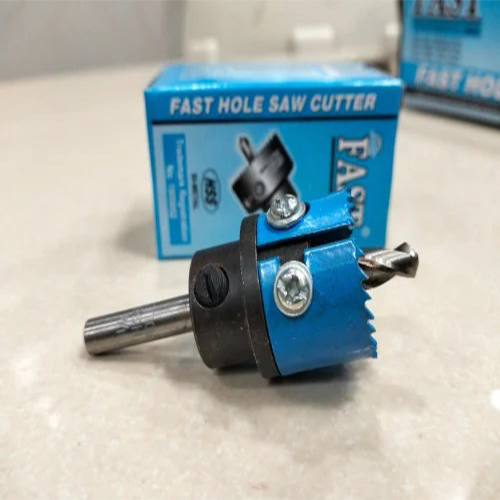
Description
“The 50mm TCT Fast Hole Saw is built for high-production industrial environments. While standard bi-metal saws often burn out or jam when drilling 3mm+ stainless steel or cast iron, our Carbide-tipped system slices through with Triple-Edge Cutting Geometry to reduce vibration and motor strain.
This cutter is a ‘one-pass’ solution, delivering a mirror-smooth finish that requires zero filing. Whether you are an industrial electrician installing switchgear, a plumber routing waste pipes, or a metal fabricator working on 4×4 accessories, the integrated pilot bit with SmoothStart™ technology ensures 100% accuracy without ‘walking’ on smooth surfaces.”
TCT vs. Bi-Metal: The Performance Shift
Historically, installers used Bi-Metal saws for general tasks. However, 2025 trends show a definitive move toward TCT (Tungsten Carbide Tipped) cutters for anything involving metal. Why? Because TCT maintains its hardness even at temperatures exceeding $1000^\circ\text{C}$. For a 50mm hole, which removes a significant amount of material, TCT prevents the “blueing” (heat damage) of the metal and extends tool life significantly.
Sustainability & Cordless Efficiency
With the dominance of cordless tools on-site, battery life is vital. A hole saw only cuts the perimeter ring (the kerf), requiring 45% less torque than a solid drill bit. This allows your cordless drill to last longer per charge and reduces the mechanical wear on your expensive power tools.
Comparison & Technical Charts
Performance Comparison: 50mm Hole Saw Types
| Feature | TCT (Fast Cutter) | Bi-Metal (M42) | Diamond Grit |
| Ideal For | Stainless, Iron, Alloys | Wood, PVC, Mild Steel | Tile, Glass, Ceramics |
| Cutting Speed | Ultra-Fast | Moderate | Slow (Grinding) |
| Finish Quality | Precision / Burr-Free | Standard | Chip-Free |
| Heat Resistance | Superior ($1000^\circ\text{C}$) | High ($600^\circ\text{C}$) | High |
| Tool Life | 500+ Holes | 100-150 Holes | Material Specific |
Recommended RPM Chart (50mm Cutter)
Maintaining the correct RPM is critical to prevent carbide chipping.
| Material | Recommended RPM | Coolant Required? |
| Stainless Steel (316) | 200 – 300 RPM | Yes (Cutting Oil) |
| Mild Steel Plate | 400 – 550 RPM | Recommended |
| Cast Iron | 250 – 400 RPM | No (Dry) |
| Aluminum / Brass | 600 – 800 RPM | Optional |
| Hardwood / PVC | 900 – 1100 RPM | No |


Reviews
There are no reviews yet.