


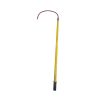

Description
The Dielectric Barrier: FRP vs. Standard Materials
In an emergency, the natural instinct is to grab a victim, which often leads to the rescuer becoming part of the circuit. Standard materials like wood or common plastics can conduct electricity at high voltages if they contain moisture. Fiberglass Reinforced Plastic (FRP) used in 11kV hooks is specifically formulated with a closed-cell foam core to guarantee zero conductivity, providing a literal “life-line” during a rescue.
Rapid Intervention: The “Golden Seconds”
Electrical shock can cause muscle tetany, meaning a victim cannot “let go” of the source. The wide 18-inch hook opening is designed to easily loop around a victim’s waist or underarms, allowing for a swift, forceful withdrawal.9 In 2026, safety protocols emphasize that every facility with 415V to 11kV equipment should have a rescue hook mounted on a high-visibility shadow board for immediate access.
Comparison & Technical Charts
Rescue Hook vs. Discharge Rod: Key Differences
It is common for technicians to confuse these two tools, but they serve entirely different safety functions.
| Feature | Electrical Rescue Hook | Static Discharge Rod |
| Primary Purpose | To retrieve a person from a live source. | To remove residual charge from equipment. |
| Hook Material | Coated/Insulated Steel (Body Hook). | Bare Copper or Aluminum (Grounding Hook). |
| Grounding Cable | No (Isolation only). | Yes (Required for discharge). |
| Target Voltage | 11kV to 33kV (Typical). | Up to 110kV+. |
| Usage Time | Emergency (Rescue). | Post-De-energization (Maintenance). |
11kV Rescue Hook Specifications
| Parameter | Specification |
| Max System Voltage | $11,000\text{V (11kV)}$ |
| Withstand Voltage | $100\text{kV per 300mm}$ |
| Total Length | 6 Feet (1.8 Meters) |
| Pole Diameter | 32 mm |
| Hook Opening | 15 – 18 Inches |
| Weight | Approx. 1.8 – 2.1 kg |
| Operating Temp | $-40^\circ\text{C to } +75^\circ\text{C}$ |

Reviews
There are no reviews yet.