Quick Answer: The best Heat Shrink Sleeve Supplier in India is not simply the supplier offering the lowest price. Engineers and purchase managers should evaluate certifications, material quality, shrink ratio options, UV resistance, flame-retardant performance, delivery capability, technical support, and stock availability. For industrial applications such as electrical panels, cable joints, transformers, busbars, solar plants, and underground cable networks, a supplier that stocks the complete WOER Heat Shrink Sleeve range and provides application guidance is usually the safest long-term choice.
If you are buying for a factory, EPC project, utility, or panel manufacturing unit, ask these five questions before placing an order:
- Is the sleeve certified for electrical insulation and flame retardancy?
- Is the material suitable for indoor, outdoor, underground, or busbar use?
- Does the supplier offer the correct shrink ratio (2:1, 3:1, or 4:1)?
- Can the supplier provide bulk quantities with fast delivery in Delhi NCR and across India?
- Does the supplier provide technical sizing support and product traceability?
A reliable Heat Shrink Sleeve Supplier Delhi NCR should answer all five questions clearly.
Introduction
Heat shrink sleeves look simple. A tube shrinks when heated and grips a cable, wire, busbar, or joint. Yet this small component often determines whether an electrical connection survives ten years outdoors or fails during the first monsoon.
Procurement teams frequently focus on cable size and ignore sleeve quality. Maintenance engineers discover the mistake later: cracked insulation, moisture ingress, UV damage, loose cable joints, or busbar tracking. Replacing a failed sleeve inside an operating plant costs far more than selecting the right product initially.
India’s electrical infrastructure is expanding rapidly through renewable energy projects, metro rail systems, data centers, industrial automation, and transmission upgrades. As a result, demand for Industrial Heat Shrink Sleeve, Electrical Heat Shrink Sleeve, and Heat Shrink Sleeve for Cable Joint applications has increased sharply.
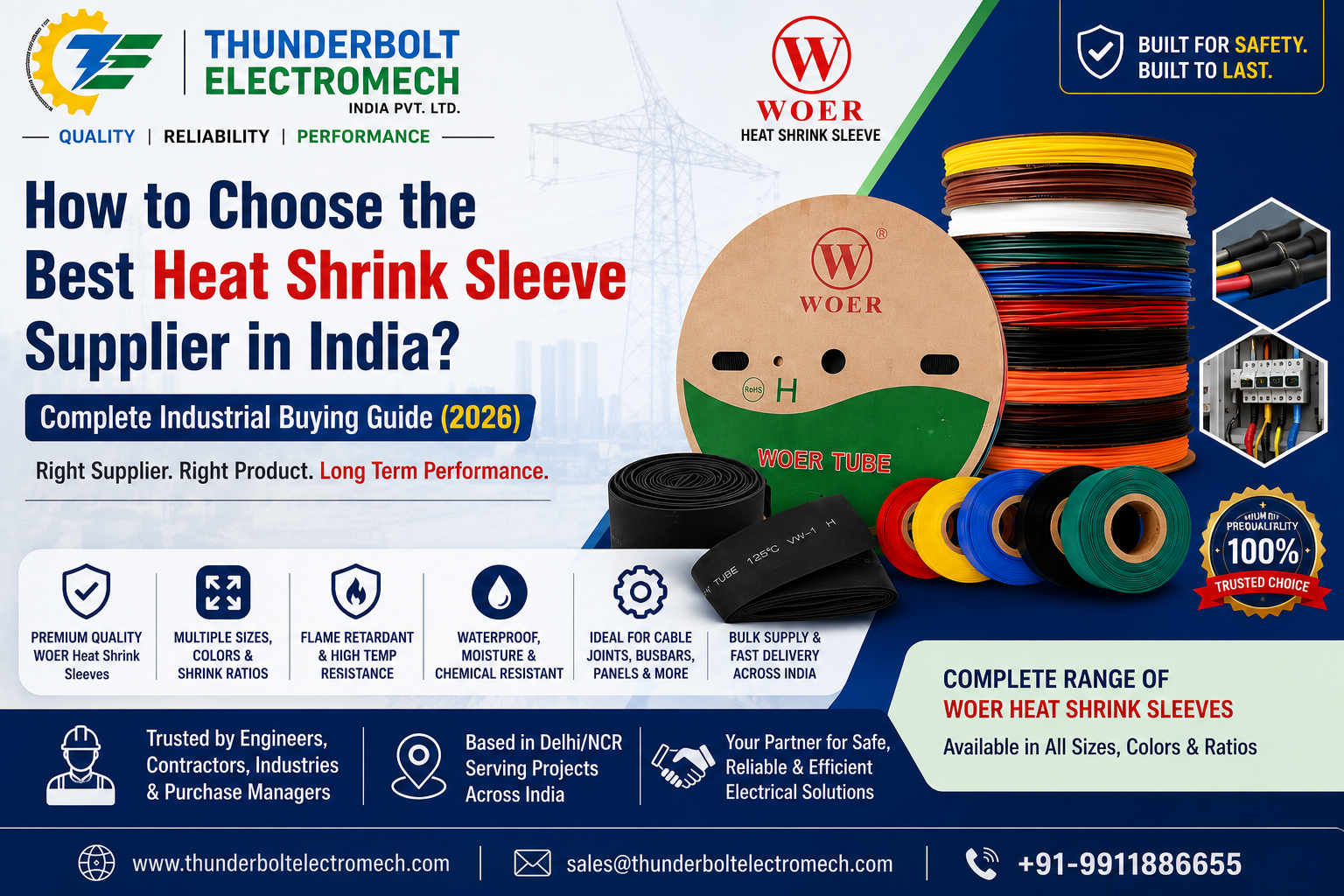
Thunderbolt Electromech supplies the complete WOER Heat Shrink Sleeve range, including:
- Thin Wall Heat Shrink Sleeve
- Dual Wall Heat Shrink Sleeve
- Medium Wall Heat Shrink Sleeve
- Heavy Wall Heat Shrink Sleeve
- Busbar Heat Shrink Sleeve
- Flame Retardant Heat Shrink Sleeve
- Heat Shrink Tubing for Electrical Panels
- Heat Shrink Accessories and Jointing Solutions
This guide is written for engineers, contractors, industries, utilities, OEMs, and purchase managers who want a technical yet practical method for selecting the right supplier.
Heat Shrink Sleeve Supplier – Why Supplier Selection Matters More Than Price
Many buyers search “Heat Shrink Sleeve Supplier Near Me” and choose the cheapest quotation. That approach creates hidden risks.
What a Good Supplier Provides
A professional Heat Shrink Tube Supplier should provide:
- Material test data
- Voltage insulation information
- Shrink ratio guidance
- Temperature range
- UV resistance details
- Flame-retardant certification
- Chemical resistance data
- Storage recommendations
- Batch traceability
- Delivery commitment
What a Poor Supplier Usually Lacks
- No technical datasheet
- Unknown polymer composition
- Inconsistent wall thickness
- No certification
- Limited sizes
- Delayed delivery
- No after-sales support
Engineering Insight
Field failures often originate from undersized sleeves or low-grade polyolefin. A sleeve that shrinks excessively becomes thin at sharp cable edges, reducing dielectric strength. Correct sizing is therefore an engineering decision, not a purchasing formality.
Customer Problem & Solution Table
| Customer Problem | Root Cause | Recommended Solution |
| Sleeve cracks after one summer | Non-UV stabilized material | Use UV-resistant WOER sleeve |
| Moisture enters cable joint | Single-wall sleeve used outdoors | Use Dual Wall Heat Shrink Sleeve |
| Sleeve slips after shrinking | Wrong shrink ratio | Select correct ratio and recovered diameter |
| Busbar flashover marks appear | Ordinary sleeve used on busbar | Use Busbar Heat Shrink Sleeve |
| Underground joint fails | No adhesive sealing | Use adhesive-lined dual-wall sleeve |
| Delivery delays halt production | Supplier lacks inventory | Choose a supplier with stocked sizes |
Heat Shrink Sleeve Supplier – Understanding Heat Shrink Technology
Heat shrink sleeves are typically manufactured from cross-linked polyolefin. During production the tube is expanded; when heat is applied later, it returns toward its original diameter.
Shrink Ratio Explained
- 2:1 – shrinks to half its supplied diameter.
- 3:1 – shrinks to one-third.
- 4:1 – shrinks to one-quarter.
Higher ratios accommodate greater diameter variation but generally cost more.
Which Shrink Ratio Should I Choose?
| Application | Recommended Ratio |
| Uniform wire bundles | 2:1 |
| Connectors and terminals | 3:1 |
| Irregular cable joints | 3:1 or 4:1 |
| Repair sleeves | 4:1 |
| Underground sealing | 3:1 adhesive-lined |
Practical Rule
Choose a sleeve whose supplied diameter is slightly larger than the largest component and whose recovered diameter is smaller than the smallest section to be sealed.
How Do I Calculate the Correct Heat Shrink Sleeve Size?
Use this field method:
Step 1 – Measure the largest diameter
Example: cable joint outer diameter = 18 mm.
Step 2 – Add installation clearance
18 mm × 1.2 ≈ 22 mm.
Step 3 – Select supplied diameter
Choose the next standard size above 22 mm, e.g., 25 mm.
Step 4 – Check recovered diameter
For a 3:1 sleeve:
25 mm ÷ 3 ≈ 8.3 mm.
Since 8.3 mm is smaller than the cable body diameter, the sleeve will shrink tightly.
This calculation is one of the most common technical queries received by every Heat Shrink Sleeve Supplier India.
What Size Heat Shrink Sleeve Do I Need?
Quick Reference Chart
| Cable OD | Recommended 2:1 | Recommended 3:1 |
| 3–5 mm | 6 mm | 6 mm |
| 5–8 mm | 10 mm | 9 mm |
| 8–12 mm | 16 mm | 12 mm |
| 12–18 mm | 25 mm | 19 mm |
| 18–25 mm | 32 mm | 25 mm |
| 25–40 mm | 52 mm | 38 mm |
Always verify the manufacturer’s recovered diameter.
Heat Shrink Sleeve Supplier – Which Material Is Best for Industrial Applications?
Different environments require different sleeve constructions.
Material Selection Table
| Environment | Best Material |
| Indoor electrical panel | Thin Wall Polyolefin |
| Outdoor cable tray | UV-Stabilized Polyolefin |
| Underground cable joint | Dual Wall Adhesive-Lined |
| Coastal installation | UV & moisture-resistant dual wall |
| Chemical plant | Chemical-resistant polyolefin |
| Busbar insulation | Busbar Heat Shrink Sleeve |
| Solar plant | UV-resistant flame-retardant sleeve |
Which Material Is Suitable for Outdoor Use?
For outdoor installations, select:
- UV-stabilized polyolefin
- Black color for maximum UV protection
- Operating temperature typically -55°C to +125°C
- Flame-retardant grade when used in electrical enclosures
WOER outdoor grades are widely used in solar EPC projects and utility installations because they maintain flexibility and color stability under prolonged sunlight exposure.
Is WOER Heat Shrink Sleeve Good?
Yes. WOER is a recognized manufacturer of heat shrink products used in electrical, industrial, telecom, renewable energy, automotive, and infrastructure applications.
Why Engineers Prefer WOER
- Consistent wall thickness
- Reliable shrink performance
- Wide size range
- Flame-retardant options
- UV-resistant grades
- Adhesive-lined sealing products
- Busbar insulation sleeves
- International manufacturing standards
For buyers searching “Which Heat Shrink Sleeve brand is best?”, the correct answer depends on the application, but WOER is widely considered a dependable industrial-grade option rather than a low-cost commodity product.
Engineering Comparison: Single Wall vs Dual Wall Heat Shrink Sleeve
| Feature | Single Wall | Dual Wall |
| Electrical insulation | Good | Excellent |
| Waterproof sealing | No | Yes |
| Adhesive lining | No | Yes |
| Outdoor suitability | Moderate | Excellent |
| Underground use | Not recommended | Recommended |
| Cable joint sealing | Limited | Excellent |
| Cost | Lower | Higher |
Real Industrial Use Case #1 – Solar Power Plant, Rajasthan
A solar EPC contractor used ordinary thin-wall sleeves on DC connector transitions. After two summers, UV exposure caused cracking and moisture ingress. Several strings showed intermittent faults during early morning operation.
The failed sleeves were replaced with WOER UV-resistant dual-wall heat shrink sleeves. The adhesive lining sealed the connection, and subsequent thermographic inspections showed stable temperatures with no moisture-related failures.
Lesson: Outdoor renewable projects should prioritize UV resistance and adhesive sealing over initial price.
Heat Shrink Sleeve Supplier: How to Select the Correct Heat Shrink Sleeve Size
One of the biggest reasons Heat Shrink Sleeves fail is not poor material quality—it is incorrect sizing. Many buyers assume that choosing a sleeve with the same diameter as the cable is sufficient. In reality, engineers must consider the cable’s largest diameter before shrinking, the recovered diameter after shrinking, and the shrink ratio.
A professional Heat Shrink Sleeve Supplier should help customers select the correct sleeve instead of simply asking for an inside diameter.
Why Correct Sizing Matters
A sleeve that is too small cannot slide over the cable joint or connector.
A sleeve that is too large may not recover tightly enough, leaving air gaps where moisture can enter.
Proper sizing ensures:
- Complete environmental sealing
- High dielectric strength
- Better strain relief
- Improved mechanical protection
- Longer service life
Heat Shrink Sleeve Size Selection Guide
| Cable Outer Diameter | Recommended Heat Shrink Sleeve (Before Shrink) | Shrink Ratio |
| 3–5 mm | 6 mm | 2:1 |
| 5–8 mm | 10 mm | 2:1 |
| 8–12 mm | 16 mm | 2:1 |
| 12–18 mm | 25 mm | 2:1 |
| 18–30 mm | 40 mm | 3:1 |
| 30–50 mm | 60 mm | 3:1 |
| 50–80 mm | 100 mm | 3:1 or 4:1 |
A reliable Heat Shrink Sleeve Supplier India will normally recommend selecting a sleeve that comfortably fits over the largest connector before shrinking while ensuring adequate recovery after heating.
How to Calculate the Correct Heat Shrink Sleeve Size
Industrial engineers generally use three simple rules.
Step 1: Measure the largest diameter that the sleeve must pass over.
Step 2: Select a sleeve whose expanded diameter is larger than this measurement.
Step 3: Ensure the recovered diameter is smaller than the cable after shrinking.
Example:
- Cable OD: 14 mm
- Cable lug barrel: 19 mm
- Recommended sleeve: 25 mm 3:1 WOER Heat Shrink Sleeve
This provides sufficient installation clearance while ensuring tight recovery after heating.
Heat Shrink Sleeve Supplier: Single Wall vs Dual Wall Heat Shrink Sleeves
Many procurement teams ask:
“Should I buy Single Wall or Dual Wall Heat Shrink Sleeves?”
The answer depends entirely on the application.
Single Wall Heat Shrink Sleeve
Single-wall sleeves contain only one insulating layer.
Advantages include:
- Lower cost
- Faster installation
- Excellent electrical insulation
- Lightweight
- Flexible
- Ideal for indoor electrical panels
Common applications:
- PLC wiring
- Control panels
- Distribution boards
- Wire identification
- Harness protection
Dual Wall Heat Shrink Sleeve
Dual-wall sleeves contain:
- Outer cross-linked polyolefin
- Inner adhesive layer
During heating, the adhesive melts and seals around the cable.
Advantages include:
- Waterproof
- Dustproof
- Oil resistant
- Chemical resistant
- Better strain relief
- Corrosion protection
Ideal applications:
- Underground cable joints
- Outdoor solar projects
- Marine installations
- Telecom infrastructure
- Wind power
- Railway signalling
Thunderbolt Electromech supplies the complete range of WOER Heat Shrink Sleeves, including dual-wall solutions for demanding industrial environments.
Engineering Comparison Table
| Feature | Single Wall | Dual Wall |
| Electrical Insulation | Excellent | Excellent |
| Waterproof | No | Yes |
| Chemical Resistance | Medium | High |
| Mechanical Strength | Medium | High |
| Outdoor Use | Good | Excellent |
| Underground Use | Limited | Excellent |
| Moisture Protection | Low | Excellent |
| Cost | Lower | Higher |
Are Heat Shrink Sleeves Waterproof?
This is one of the highest-volume buying questions on Google.
The answer is:
Single-wall sleeves are water-resistant but not fully waterproof.
Dual-wall adhesive-lined sleeves create a sealed connection that blocks moisture from entering the cable joint.
The adhesive fills microscopic gaps around:
- Cable insulation
- Connector barrels
- Cable lugs
- Joint sleeves
This sealing action protects against:
- Rainwater
- Humidity
- Mud
- Underground moisture
- Industrial chemicals
- Salt spray
For outdoor electrical infrastructure, dual-wall sleeves are generally the preferred choice.
Can Heat Shrink Sleeves Be Used Underground?
Yes—but only if the correct product is selected.
Underground cable systems face continuous exposure to:
- Moisture
- Soil pressure
- Chemical attack
- Temperature changes
- Mechanical stress
For these conditions, engineers typically recommend:
- Dual Wall Heat Shrink Sleeve
- Adhesive-lined Heat Shrink Sleeve
- Thick-wall Heat Shrink Sleeve (for heavy-duty applications)
Using standard thin-wall tubing underground can lead to moisture ingress and premature cable failure.
Which Heat Shrink Sleeve Is Suitable for Cable Joints?
Cable joints experience greater mechanical and environmental stress than ordinary wire insulation.
For this reason, professional installers generally select:
- Dual-wall adhesive-lined sleeves
- Medium-wall sleeves
- Heavy-wall sleeves (for power distribution)
- WOER cable joint heat shrink systems
These products provide:
- Electrical insulation
- Mechanical reinforcement
- Moisture sealing
- UV protection
- Long-term reliability
Which Heat Shrink Sleeve Is Suitable for Busbars?
Busbars require insulation capable of handling elevated temperatures and electrical stresses.
Busbar heat shrink sleeves are specifically designed for:
- Copper busbars
- Aluminium busbars
- Switchgear
- Transformer connections
- MCC panels
- HT/LT panels
Key benefits include:
- High dielectric strength
- Flame retardancy
- Arc tracking resistance
- Enhanced operator safety
- Reduced phase-to-phase flashover risk
Which Heat Shrink Sleeve Is Flame Retardant?
Flame-retardant sleeves are widely used in:
- Electrical panels
- Railways
- Power plants
- Data centres
- OEM equipment
- Industrial automation
WOER flame-retardant heat shrink sleeves are manufactured using cross-linked polyolefin compounds that are engineered to self-extinguish when the ignition source is removed, helping to reduce flame propagation.
When selecting a Heat Shrink Sleeve Supplier Delhi or Heat Shrink Sleeve Supplier Delhi NCR, always ask for:
- Flame-retardant rating
- Operating temperature range
- Shrink ratio
- Voltage rating
- Compliance documentation
- Material datasheet
These documents help ensure the product matches your application and project specifications.
Real Industrial Use Case #2 – Solar EPC Project
A Delhi NCR EPC contractor was installing outdoor DC cable joints for a 25 MW solar plant. Initially, single-wall sleeves were used because they were less expensive. After one monsoon season, several joints showed moisture ingress, corrosion, and increased maintenance.
The contractor replaced them with WOER dual-wall adhesive-lined heat shrink sleeves supplied by Thunderbolt Electromech. The adhesive created a sealed barrier against rainwater and humidity, significantly improving joint reliability and reducing repeat maintenance.
The project demonstrated that selecting the correct sleeve type based on environmental conditions can lower lifecycle costs and improve long-term system performance.
Heat Shrink Sleeve Supplier: Which Heat Shrink Sleeve Brand Is Best?
One of the most common questions engineers and purchase managers ask before placing a bulk order is:
“Which Heat Shrink Sleeve brand is best?”
There is no single brand that is ideal for every application. The right choice depends on the installation environment, operating temperature, voltage level, required certifications, and project budget.
For industrial applications in India, WOER Heat Shrink Sleeve has become a preferred choice because of its consistent manufacturing quality, wide product portfolio, and proven performance in power distribution, renewable energy, railway, telecom, automotive, and electrical panel industries.
Thunderbolt Electromech supplies the complete range of WOER Heat Shrink Sleeves, enabling customers to source everything from standard thin-wall tubing to specialized busbar insulation and heavy-duty cable protection from one supplier.
Why Engineers Prefer WOER Heat Shrink Sleeves
Unlike generic heat shrink products that are often manufactured for low-cost consumer applications, WOER products are designed for demanding industrial environments.
Major advantages include:
- Uniform wall thickness
- Consistent shrink performance
- High dielectric strength
- Excellent UV resistance
- Flame-retardant grades
- Wide operating temperature range
- Reliable recovery after heating
- Multiple shrink ratios
- Large size availability
- Stable long-term outdoor performance
For industries where equipment failure can result in expensive downtime, product consistency is often more valuable than the lowest purchase price.
WOER Product Selection Guide
| Application | Recommended WOER Product |
| Electrical Panels | Thin Wall Heat Shrink Sleeve |
| Cable Joint Insulation | Dual Wall Adhesive Sleeve |
| Underground Cable | Heavy Wall Heat Shrink Sleeve |
| Solar Power Plants | UV Resistant Dual Wall Sleeve |
| Busbar Insulation | Busbar Heat Shrink Sleeve |
| Transformer Connections | Medium Wall Sleeve |
| Automotive Wiring | Thin Wall Flexible Sleeve |
| Telecom Cables | Dual Wall Waterproof Sleeve |
A knowledgeable Heat Shrink Sleeve Supplier India should recommend products based on operating conditions rather than simply offering the cheapest available option.
Heat Shrink Sleeve Supplier: UV Resistance and Outdoor Performance
Outdoor electrical systems operate under far harsher conditions than indoor installations. Continuous sunlight, ultraviolet radiation, rain, dust, pollution, and temperature fluctuations gradually degrade ordinary insulation materials.
A high-quality Industrial Heat Shrink Sleeve is formulated with UV stabilizers that help maintain flexibility, insulation performance, and mechanical integrity over long service periods.
Why UV Resistance Matters
In outdoor installations such as:
- Solar power plants
- Rooftop PV systems
- Telecom towers
- Wind farms
- Railway signalling
- Highway electrical infrastructure
constant UV exposure can cause low-grade sleeves to:
- Become brittle
- Crack
- Fade
- Lose elasticity
- Split during thermal expansion
These failures allow moisture to enter cable joints, increasing the risk of insulation breakdown and corrosion.
Outdoor Performance Comparison
| Feature | Standard Sleeve | WOER UV Resistant Sleeve |
| UV Resistance | Low | High |
| Outdoor Lifespan | Shorter | Extended |
| Crack Resistance | Moderate | Excellent |
| Color Stability | Moderate | Excellent |
| Moisture Protection | Good | Excellent |
| Industrial Reliability | Moderate | High |
For outdoor electrical infrastructure, investing in UV-resistant sleeves generally reduces maintenance frequency and replacement costs over the system’s lifecycle.
Heat Shrink Sleeve Price: What Actually Determines the Cost?
A common misconception is that heat shrink sleeves are priced only by diameter or length. In reality, several technical factors influence the final cost.
Factors Affecting Heat Shrink Sleeve Price
- Material quality
- Shrink ratio (2:1, 3:1, 4:1)
- Single-wall or dual-wall construction
- Adhesive lining
- Operating temperature range
- Flame-retardant properties
- UV stabilization
- Wall thickness
- Size
- Quantity ordered
Large industrial projects often achieve lower unit costs through bulk procurement.
When comparing quotations from a Heat Shrink Sleeve Dealer Delhi or Heat Shrink Sleeve Wholesale Delhi, evaluate the technical specifications alongside the price rather than selecting solely on cost.
What Certifications Should Heat Shrink Sleeves Have?
Many procurement teams focus on price while overlooking compliance documentation. However, certifications help verify that a product has been manufactured and tested to recognized quality and safety requirements.
Depending on the application, relevant certifications and compliance declarations may include:
- RoHS Compliance – Restricts hazardous substances in electrical products.
- UL Recognition/Certification (for applicable product lines) – Indicates compliance with recognized safety requirements.
- REACH Compliance – Addresses chemical safety and environmental regulations.
- Flame-Retardant Ratings (where applicable) – Helps assess fire performance for electrical installations.
- Manufacturer Test Reports – Provide electrical, mechanical, and dimensional test results.
- Material Data Sheets (TDS/MSDS where applicable) – Useful for engineering evaluation and documentation.
For projects involving utilities, EPC contractors, or government tenders, always request the relevant technical documentation before finalizing the purchase.
Procurement Guide for Engineers & Purchase Managers
A successful procurement process is not simply about purchasing tubing—it is about selecting a solution that minimizes failures throughout the equipment’s operational life.
Before placing an order, verify:
✓ Application (Indoor/Outdoor)
✓ Cable diameter
✓ Cable joint diameter
✓ Required shrink ratio
✓ Voltage level
✓ Operating temperature
✓ UV exposure
✓ Chemical exposure
✓ Flame-retardant requirement
✓ Waterproof requirement
✓ Busbar application
✓ Quantity requirement
✓ Delivery schedule
✓ Technical documentation
✓ Bulk pricing
✓ After-sales support
Working with an experienced Heat Shrink Tube Supplier can reduce installation errors, improve project efficiency, and ensure compatibility with your electrical systems.
Customer Problems and Practical Solutions
| Customer Problem | Engineering Solution |
| Sleeve slips after shrinking | Choose the correct shrink ratio and recovered diameter. |
| Water enters cable joint | Use dual-wall adhesive-lined sleeves for sealed protection. |
| Sleeve cracks outdoors | Select UV-resistant industrial-grade products. |
| Sleeve burns during installation | Use a controlled heat source and follow manufacturer guidelines. |
| Wrong size ordered | Measure the largest component diameter before selection. |
| Frequent joint failures | Verify cable preparation, heating technique, and sleeve specification. |
Engineering Insight: Why Heat Distribution Matters
One overlooked factor in heat shrink installation is uniform heating.
Applying concentrated heat to one area can create uneven recovery, internal stresses, or trapped air pockets. Using a controlled heat source and moving it evenly around the sleeve allows gradual, consistent shrinkage.
For adhesive-lined sleeves, even heating also helps the adhesive flow uniformly around the cable and connector, creating a better environmental seal.
Real Industrial Use Case #3 – Metro Rail Electrical Panels
A metro rail contractor required insulation for hundreds of control panel cable terminations across multiple stations. The installation environment demanded flame-retardant materials, compact dimensions, and long-term reliability.
Thunderbolt Electromech supplied the appropriate WOER thin-wall flame-retardant heat shrink sleeves for panel wiring. Their consistent recovery characteristics reduced installation time and provided neat cable identification and insulation throughout the project.
The result was a standardized installation process, improved workmanship, and simplified maintenance during future inspections.
Heat Shrink Sleeve Supplier: Why Choose Thunderbolt Electromech for Industrial Projects
Selecting the right Heat Shrink Sleeve Supplier is not just about finding the lowest price. For engineers, EPC contractors, OEMs, panel builders, industries, and purchase managers, a dependable supplier must deliver technically correct products, maintain consistent inventory, provide fast delivery, and support projects from enquiry through installation.
Thunderbolt Electromech has built its reputation by supplying high-quality electrical accessories across India. Along with a complete range of WOER Heat Shrink Sleeves, the company serves customers in power generation, transmission, distribution, renewable energy, railways, telecom, infrastructure, manufacturing, oil & gas, commercial buildings, and industrial automation.
Whether you need a few metres for maintenance work or bulk quantities for a large EPC project, Thunderbolt Electromech offers reliable solutions backed by technical guidance and responsive service.
Complete WOER Heat Shrink Sleeve Range Available
Thunderbolt Electromech supplies the complete range of WOER Heat Shrink Sleeves to meet diverse industrial requirements.
Thin Wall Heat Shrink Sleeve
Suitable for:
- Electrical panels
- PLC wiring
- Control cables
- Wire harnesses
- Electronics
- Communication equipment
Benefits:
- Flexible
- Excellent insulation
- Lightweight
- Fast installation
- Wide colour availability
Dual Wall Heat Shrink Sleeve
Recommended for:
- Cable joints
- Outdoor electrical systems
- Solar plants
- Telecom towers
- Underground cables
Advantages:
- Adhesive-lined construction
- Waterproof sealing
- Dust protection
- Corrosion resistance
- Mechanical reinforcement
Medium Wall Heat Shrink Sleeve
Ideal for:
- Power distribution
- Industrial switchgear
- Cable terminations
- Utility projects
Provides:
- High insulation
- Mechanical protection
- Environmental sealing
- Reliable outdoor performance
Heavy Wall Heat Shrink Sleeve
Designed for:
- Underground cable systems
- Utility substations
- Mining projects
- Heavy industrial applications
Key features:
- Thick insulation wall
- Excellent impact resistance
- Long service life
- Moisture protection
Busbar Heat Shrink Sleeve
Suitable for:
- Busbars
- Switchboards
- MCC panels
- Distribution panels
- Transformers
Benefits include:
- Increased insulation clearance
- Phase identification
- Arc resistance
- Enhanced operator safety
Flame Retardant Heat Shrink Sleeve
Recommended for:
- Railways
- Data centres
- Commercial buildings
- Industrial electrical installations
- OEM equipment
Provides:
- Self-extinguishing characteristics (for applicable grades)
- Electrical insulation
- Heat resistance
- Improved fire safety
Why Engineers Prefer Thunderbolt Electromech
Thunderbolt Electromech focuses on supplying products that meet real industrial requirements rather than offering one-size-fits-all solutions.
Technical Support
Customers receive guidance on:
- Sleeve sizing
- Shrink ratio selection
- Cable joint applications
- Busbar insulation
- Outdoor installations
- Waterproofing requirements
- Voltage considerations
- Product selection
Bulk Supply Capability
Thunderbolt supports:
- EPC projects
- Government tenders
- OEM production
- Electrical contractors
- Panel manufacturers
- Renewable energy companies
- Industrial maintenance teams
Bulk quantities are available with dependable delivery schedules across India.
Pan India Delivery
Thunderbolt Electromech supplies customers throughout:
- Delhi
- Delhi NCR
- Noida
- Greater Noida
- Gurugram
- Faridabad
- Ghaziabad
- Jaipur
- Chandigarh
- Lucknow
- Ahmedabad
- Mumbai
- Pune
- Hyderabad
- Bengaluru
- Chennai
- Kolkata
- And other industrial cities across India.
This nationwide reach makes Thunderbolt a reliable Heat Shrink Sleeve Supplier India for organizations operating in multiple locations.
Why Customers Choose Thunderbolt Electromech
✔ Complete range of WOER Heat Shrink Sleeves
✔ Competitive bulk pricing
✔ Fast dispatch for industrial orders
✔ Technical product guidance
✔ Support for EPC contractors
✔ Solutions for OEM manufacturers
✔ Suitable products for electrical panels, cable joints, transformers, busbars, and renewable energy projects
✔ Pan India supply network
✔ Responsive customer support
Contact Thunderbolt Electromech
Phone: +91-9911886655
Website: thunderboltelectromech.com
Email: sales@thunderboltelectromech.com (Update if your preferred email differs.)
Location: Delhi NCR, India
Frequently Asked Questions
1. Which Heat Shrink Sleeve is best for electrical panels?
Thin-wall flame-retardant heat shrink sleeves are generally suitable for electrical panels because they provide electrical insulation while maintaining flexibility and a compact profile.
2. Which shrink ratio should I choose?
- 2:1 – Standard wire insulation and harnesses.
- 3:1 – Cable joints and connectors with varying diameters.
- 4:1 – Irregular shapes, repairs, and applications requiring greater recovery.
3. Is WOER Heat Shrink Sleeve a good brand?
WOER is widely recognized in industrial markets for its broad product range, consistent quality, and solutions for electrical, automotive, telecom, railway, and renewable energy applications.
4. Are Heat Shrink Sleeves waterproof?
Single-wall sleeves are generally water-resistant, while dual-wall adhesive-lined sleeves provide a much higher level of moisture sealing when installed correctly.
5. Can Heat Shrink Sleeves be used underground?
Yes. Dual-wall or heavy-wall heat shrink sleeves are commonly selected for underground cable protection because they offer better sealing and mechanical durability.
6. Which Heat Shrink Sleeve is suitable for busbars?
Busbar heat shrink sleeves are specifically designed to insulate copper and aluminium busbars in switchgear, panels, and transformers.
7. What is the operating temperature of Heat Shrink Sleeves?
The operating temperature depends on the product grade. Always refer to the manufacturer’s technical data sheet for the specific sleeve you intend to use.
8. Are Heat Shrink Sleeves UV resistant?
Industrial-grade UV-stabilized sleeves are available for long-term outdoor exposure, making them suitable for solar, telecom, and infrastructure projects.
9. Can Heat Shrink Sleeves be reused?
No. Once shrunk, they are intended for permanent installation. Removal generally requires cutting and replacement.
10. What heating tool should I use?
A temperature-controlled heat gun is typically recommended to achieve uniform shrinkage while reducing the risk of overheating.
11. How do I calculate the correct sleeve size?
Measure the largest diameter the sleeve must pass over and ensure the recovered diameter will fit tightly around the cable after shrinking.
12. What causes Heat Shrink Sleeves to crack?
Possible causes include using low-quality material, prolonged UV exposure without UV-resistant products, excessive heating during installation, or selecting an unsuitable sleeve for the application.
13. Which Heat Shrink Sleeve is best for solar projects?
UV-resistant, dual-wall adhesive-lined sleeves are often preferred for outdoor solar installations because they combine insulation with environmental sealing.
14. What certifications should I ask for?
Depending on the application, request relevant documentation such as RoHS or REACH compliance declarations, applicable UL recognition/certification, and manufacturer technical data sheets and test reports.
15. Can I order custom sizes?
Yes. Many suppliers, including Thunderbolt Electromech, can assist with custom sizing or special project requirements, subject to product availability and minimum order quantities.
16. How long do Heat Shrink Sleeves last outdoors?
The service life depends on factors such as material grade, UV exposure, installation quality, and environmental conditions. UV-stabilized industrial sleeves typically provide much longer outdoor durability than general-purpose products.
17. Does Thunderbolt Electromech provide bulk discounts?
Bulk pricing is generally available for contractors, OEMs, panel builders, EPC companies, and industrial buyers. Contact the sales team for project-specific quotations.
18. Which industries use Heat Shrink Sleeves?
Common sectors include power transmission and distribution, renewable energy, electrical panel manufacturing, railways, telecom, automotive, oil & gas, mining, infrastructure, and industrial automation.
19. Can Heat Shrink Sleeves be used on aluminium conductors?
Yes, provided the sleeve size and material are appropriate for the application and installed according to the manufacturer’s recommendations.
20. Why should I buy from Thunderbolt Electromech instead of a local trader?
Thunderbolt Electromech offers a complete WOER product range, technical assistance, bulk supply capability, Pan India delivery, and support tailored to industrial and infrastructure projects rather than only retail sales.
Conclusion
Selecting the right Heat Shrink Sleeve Supplier is an engineering decision that directly affects electrical safety, system reliability, and long-term maintenance costs. While price is an important consideration, factors such as shrink ratio, material quality, UV resistance, flame-retardant properties, waterproof performance, and compliance documentation are equally critical.
For applications ranging from electrical panels and cable joints to transformers, busbars, solar power systems, and industrial automation, using the correct WOER Heat Shrink Sleeve helps improve insulation integrity, reduce moisture ingress, and extend equipment life.
Thunderbolt Electromech supplies the complete range of WOER Heat Shrink Sleeves with technical guidance, competitive pricing, and Pan India delivery. Whether you are an engineer designing a new installation, an EPC contractor managing a large project, or a purchase manager sourcing materials for ongoing operations, choosing the right product and supplier can significantly improve project performance and lifecycle value.
Contact Thunderbolt Electromech Today
If you need assistance selecting the right Industrial Heat Shrink Sleeve, Heat Shrink Sleeve for Cable Joint, Heat Shrink Sleeve for Busbar, Dual Wall Heat Shrink Sleeve, or Flame Retardant Heat Shrink Sleeve, our technical team is ready to help.
📞 Phone: +91-9911886655
🌐 Website: www.thunderboltelectromech.com
📧 Email: info@thunderboltelectromech.com
Request a quotation today for bulk orders, OEM requirements, EPC projects, or customized heat shrink sleeve solutions anywhere in India.