By Thunderbolt Electromech India Pvt. Ltd. — Delhi-based Danger Plate Supplier of Powder Coated, Aluminium & Sticker Danger Plates
📞 +91-9911886655 | ✉️ info@thunderboltelectromech.com | 🌐 thunderboltelectromech.com | 📍 Shop No. 3538, Sitaram Bazar Rd, Bazar Sirkiwalan, Chawri Bazar, Chandni Chowk, Delhi – 110006
Quick Answer: Every electrical panel carrying more than 250V needs a permanently fixed danger plate — a 200×150mm plate for LT panels up to 415V/440V, stepping up to 200×250mm for 11kV, 33kV, and higher HT panels. It must show the skull-and-crossbones symbol, the word “danger” in Hindi or English plus the local district language, and the panel’s actual working voltage. Mount it on the panel door or the most visible external face — one plate covers everything inside an enclosure, so you don’t need to plate every breaker or contactor separately. Material should match the environment: powder-coated MS steel for most panel rooms, aluminium for coastal or high-humidity sites, and stickers only for secondary, equipment-level tagging rather than the main panel notice.
Introduction
Walk down any panel row in an Indian factory and you’ll see the same pattern repeat: some panels have a crisp, correctly sized danger plate bolted right where an operator’s eye lands first. Others have a faded sticker half-hidden behind a cable gland, or nothing at all beyond a “high voltage” scrawled in marker on the door. Both panels might carry the exact same 415V or 11kV, and both carry the exact same legal exposure — but only one of them is actually doing the job the regulation intends.
This guide focuses specifically on the panel-level decision: what a danger plate for an electrical panel needs to show, where it belongs on the panel itself, which size and material fit which panel type, and the mistakes that turn a compliant-looking plate into a compliance gap the day an inspector actually checks it. For the full regulatory background — IS 2551, the CEA 2023 Regulations, and danger plate requirements across every voltage class — see Thunderbolt’s Danger Plate Supplier for electrical panels pillar guide. This piece goes narrower and deeper: the panel itself, not the whole regulatory landscape around it.
Why Does an Electrical Panel Need a Danger Plate?
An electrical panel concentrates exactly the hazard a danger plate exists to warn against — live busbars, breakers, and terminals sitting behind a door that anyone on the factory floor can open. Under Regulation 20 of the CEA (Measures Relating to Safety and Electric Supply) Regulations, 2023, any installation exceeding 250V must carry a permanent danger notice, and a panel is explicitly one of the named categories this covers — alongside motors, generators, transformers, and the apparatus used to control or regulate them.
The practical reason this matters more for panels than for some other equipment: a panel door is designed to be opened. Unlike a sealed transformer bushing or an overhead line support most people never touch, a panel invites contact by design — someone needs to reach inside it for maintenance, switching, or inspection on a routine basis. The danger plate is what tells that person, before they touch the handle, what they’re actually opening.
Danger Plate for Electrical Panel: What Should It Show?
A compliant panel danger plate carries four required elements, and missing any one of them is a genuine compliance gap, not a cosmetic shortfall:
The skull-and-crossbones symbol, sized and positioned per IS 2551’s own layout diagrams — this is the one element designed to communicate instantly regardless of the reader’s language or literacy.
The word “danger” in Hindi or English, plus the local language of the district the panel sits in — a detail multi-site facilities frequently get wrong by shipping one uniform design nationwide.
The panel’s actual working voltage, not a rounded or generic figure. A plate printed with a generic “11,000 volts” specimen figure left unchanged from a template, on a panel actually running at a different tap-adjusted voltage, is a mismatch worth catching before an inspector does.
Manufacturer identification marking, positioned so it doesn’t interfere with the primary warning — a genuine traceability requirement under IS 2551, not decorative branding.
Types of Panel Danger Plates
Panels in Indian industrial and commercial settings typically draw from three plate formats, and each suits a different point in a panel’s lifecycle:
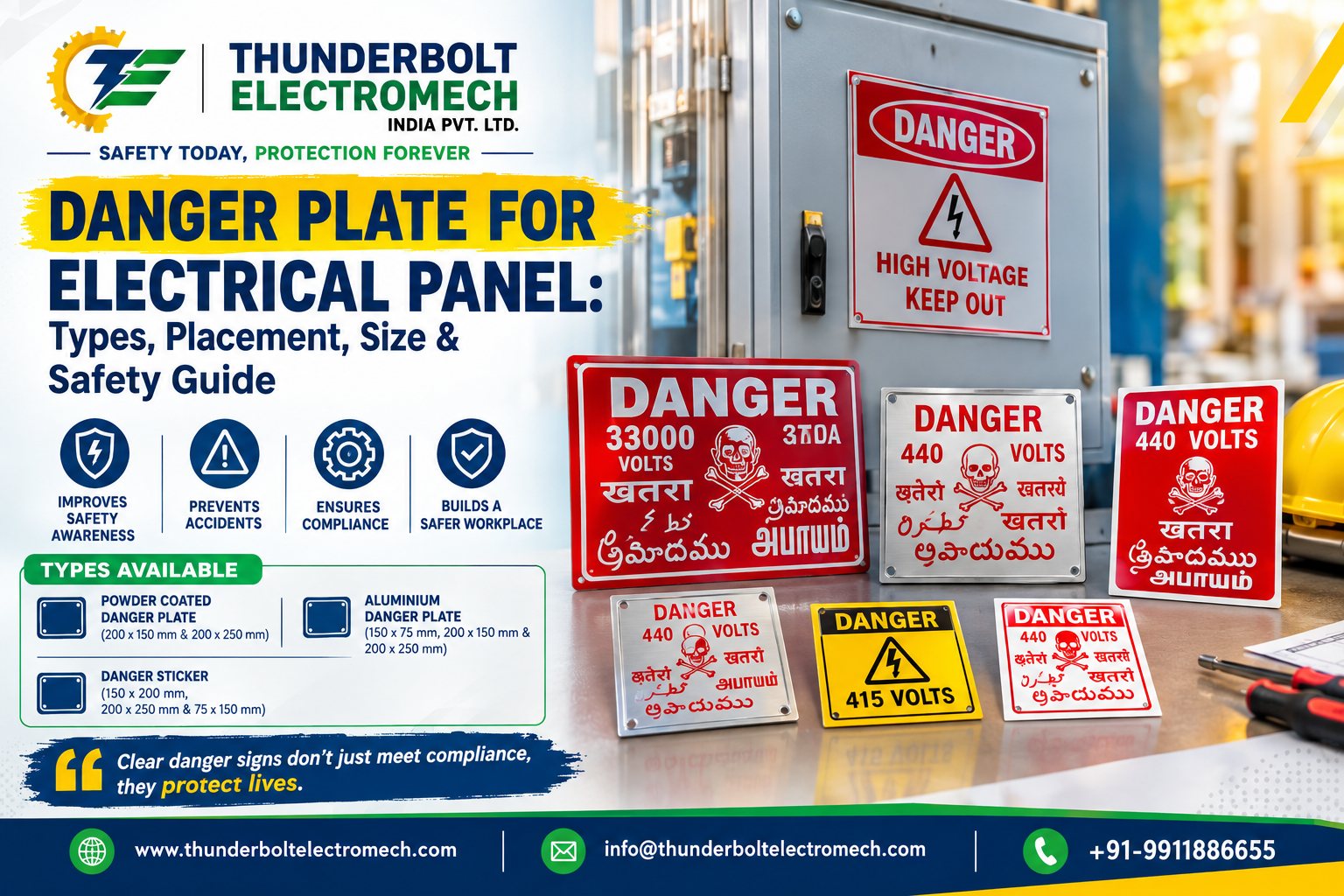
Powder-coated MS steel plates — the standard choice for the primary statutory notice on any panel door. Thunderbolt’s Powder Coated Danger Plate 200 x 150 mm is built from 1.6mm mild steel rated across 415V to 66kV applications, with pre-drilled corner holes for direct panel-door mounting.
Aluminium plates — a lighter, naturally corrosion-resistant option, available from Thunderbolt in 150×75mm, 200×150mm, and 200×250mm, suited to panels in coastal or high-humidity industrial zones where rust risk on MS steel is a genuine long-term concern.
Adhesive danger stickers — available in 150×200mm, 200×250mm, and 75×150mm, appropriate for secondary, equipment-level tagging inside a panel (individual compartments, sub-assemblies) rather than as the main statutory notice on the panel’s external door.
A sizing note worth flagging directly: IS 2551’s smallest official plate size is 200×150mm. The 150×75mm aluminium format and the 75×150mm sticker both fall below that official minimum. They’re genuinely useful for secondary, internal labelling — but if a specific panel’s external door is the one location legally required to carry the full statutory notice, the smaller formats shouldn’t be the only signage relied on there.
LT and HT Panel Danger Plates
The physical plate doesn’t change shape between LT and HT panels — only the size tier and the printed voltage figure do.
LT panels — covering 230V, 415V, and 440V distribution boards, motor control centres, and general factory-floor panels — use the 200×150mm format. This is the highest-volume plate size any panel-focused supplier moves, simply because LT panels vastly outnumber HT installations in a typical facility.
HT panels — 11kV, 22kV, 33kV, and 66kV switchgear, VCB panels, and HT distribution boards — use the larger 200×250mm format, sized identically regardless of whether the panel runs at 11kV or 66kV; only the printed figure changes.
The practical difference in how these get ordered: LT panel plates tend to be a batch, standard-spec purchase tied to panel production volume, while HT panel plates are often a smaller-quantity, higher-urgency order tied to a specific substation or switchgear commissioning date with a hard inspection deadline attached.
Where Should a Danger Plate Be Installed on an Electrical Panel?
This is the question most buying guides skip, and it’s exactly where a compliant plate can still fail its actual purpose through poor placement.
Mount it on the door, not the frame.
The door is what someone physically opens to reach live components — that’s the point of contact the plate needs to intercept, not a side panel or the enclosure’s rear face.
Position it at eye level for a standing adult, not wherever there happens to be flat metal.
A plate mounted low near the panel’s base, below cable glands or gland plates, gets visually lost against the panel’s other hardware.
One plate per enclosure, not per component inside it.
Per the regulation’s own proviso, a single notice on the enclosure’s external face covers everything inside it — a panel builder doesn’t need to plate every breaker or contactor within a multi-compartment panel, just the door or a clearly visible point on the frame.
For multi-door and multi-compartment panels, plate every externally accessible door separately.
The “one notice per enclosure” rule applies to a single sealed enclosure — a panel with several independently openable compartments, each capable of exposing live parts on its own, needs a notice at each independent access point, not just the main front door.
Keep the plate clear of obstructions added later.
Cable trunking, added nameplates, or a newly mounted meter box installed after the panel’s original commissioning can end up partially covering a previously well-placed plate — worth checking during any panel modification, not just at initial installation.
Danger Sign Size and Visibility
IS 2551 fixes plate size to voltage class, not to viewing distance — and that’s a detail worth understanding rather than assuming the standard size always “just works.”
International sign-visibility guidance under the ANSI Z535 series uses a straightforward rule of thumb: roughly one inch of letter height for every ten feet of intended viewing distance, with a recommended 25% size increase for low-light or high-distraction environments (Source: Seton, “ANSI Z535 Safety Sign Standards & Guide” — Direct source found). Converted roughly to metric, that’s about 2.5cm of letter height per 3 metres of viewing distance — and the standard’s own broader guidance notes that letter size may need to increase further specifically to alert someone sooner than the bare minimum safe viewing distance, not just to make text technically legible up close (Source: 310sign.ca, “ANSI Z535 Information” — Direct source found).
Here’s why this matters specifically for panels: a plate mounted on a panel door that an operator stands directly in front of — arm’s length away — is well within the legibility range a 200×150mm plate’s lettering comfortably provides. But a panel viewed from several metres away — a large busbar panel behind a safety railing, or an HT switchgear panel seen from a walkway rather than approached directly — may sit at a viewing distance where the standard plate’s lettering falls below what visibility guidance would recommend for that distance. IS 2551 doesn’t require a larger plate for this scenario, since its sizing is tied to voltage class alone. In practice, this is exactly the situation where a supplementary larger sign or a secondary plate positioned closer to the actual walkway — not a replacement for the statutory notice, but an addition to it — closes a real gap the base standard doesn’t address.
Materials for Electrical Panel Danger Plates
Choosing between powder-coated MS, aluminium, and stickers for a panel specifically comes down to two questions: where does the panel sit, and how often does its enclosure get opened and handled?
Powder-coated MS steel remains the standard default for panel doors in general industrial settings — indoor or outdoor, it handles routine handling (a door opened and closed hundreds of times over a panel’s service life) without the coating chipping or the plate deforming, and it matches IS 2551’s base metal and thickness specification directly.
Aluminium suits panels in coastal, chemical-processing, or persistently humid environments, where MS steel’s corrosion risk outpaces its cost advantage over the panel’s service life — a real consideration for outdoor panel enclosures near coastal ports or process plants with corrosive atmospheres.
Stickers work well for labelling inside a panel — individual compartment doors, small sub-panels, or equipment mounted within the main enclosure — but a sticker on a panel’s primary, frequently handled main door wears faster than a rigid plate, since repeated opening and closing stresses an adhesive-backed sticker’s edges in a way a bolted plate simply doesn’t experience.
Danger Plate Symbols, Voltage Marking and Language
The skull-and-crossbones symbol on a panel danger plate isn’t a stylistic flourish — its size and position are fixed under IS 2551’s own layout diagrams, specifically because a panel might be approached by someone who doesn’t read the language printed alongside it. A visiting contractor, a new hire on their first week, or a delivery worker walking past an open panel room all need to register the hazard from the symbol alone, before they’ve had time to read any text.
Voltage marking on a panel plate should reflect the panel’s actual commissioned voltage, not a generic template figure. This matters more on HT panels than LT ones, since HT installations can run at a nominal figure that differs slightly from the plate’s specimen voltage if a supplier ships a generic “11,000 volts” design without confirming the site’s actual tap setting.
Language requirements apply panel-by-panel across a multi-site rollout, not as a single national specification. A facilities team standardising panel signage across factories in different states needs the correct local-language text at each site — a Tamil Nadu plant’s panels need Tamil alongside Hindi/English, not the same Hindi/English design shipped to every location regardless of where it’s installed.
Indoor vs Outdoor Electrical Panel Danger Plates
Indoor panels — inside control rooms, panel rooms, and switchgear rooms — face limited UV and moisture exposure, giving more flexibility on material; a well-mounted sticker can perform adequately for years in a genuinely sheltered indoor location, though powder-coated MS remains the more durable default even indoors given how frequently a main panel door gets opened.
Outdoor panels — rooftop AC unit enclosures, outdoor DBs, solar combiner boxes, and any panel mounted without a sheltering structure — face direct sun, monsoon rain, and in coastal regions, salt air, all of which accelerate material degradation. For these, powder-coated MS steel or aluminium are the only practical choices; a sticker’s adhesive edge lifts under repeated moisture exposure far sooner than a rigid plate’s fixing bolts loosen, making stickers a poor fit for any outdoor panel’s primary notice.
Common Panel Safety Sign Mistakes
Mistake 1 — Mounting the plate on the frame instead of the door.
The door is the actual point of contact for anyone accessing the panel; a frame-mounted plate misses the moment it matters most.
Mistake 2 — Using a sticker as the primary notice on a frequently opened panel door.
Adhesive degrades faster than a bolted plate under repeated handling, and a peeling or faded sticker on a main panel door reads as neglect during any inspection.
Mistake 3 — Shipping one uniform Hindi/English design across a multi-state panel rollout.
Misses the local-language requirement at any site outside the Hindi/English belt, and is one of the most common findings during multi-site safety audits.
Mistake 4 — Leaving a generic specimen voltage figure unchanged from a template.
A plate printed “11,000 volts” on a panel actually running a different tap-adjusted figure is a mismatch an Electrical Inspector will catch immediately.
Mistake 5 — Plating only the main door on a multi-compartment panel.
Independently accessible compartments each capable of exposing live parts need their own notice, not just the panel’s primary front door.
Mistake 6 — Letting later modifications obscure the plate.
Added trunking, meter boxes, or nameplates installed after commissioning can partially cover a previously compliant plate — worth checking whenever a panel is modified, not just at initial build.
Mistake 7 — Assuming the statutory plate size is automatically legible at any viewing distance.
As covered above, IS 2551’s fixed sizing doesn’t account for panels viewed from several metres away — a genuine gap worth addressing with supplementary signage where it applies.
How to Select the Right Danger Plate Supplier
For panel-specific orders — whether a panel OEM’s standard production spec or a one-off HT switchgear commissioning — a capable supplier should be able to:
- Confirm which plate size and format suits a panel’s actual voltage class without needing the buyer to specify LT or HT first
- Supply consistent 1.6mm MS thickness and accurate voltage-figure customisation across every batch, not just the first sample approved
- Handle multi-language printing for panel rollouts spanning more than one state
- Offer aluminium and sticker formats alongside powder-coated MS, so a panel builder isn’t forced into one material regardless of the panel’s actual environment
For the broader question of evaluating a danger plate supplier’s documentation, batch consistency, and pricing structure beyond panels specifically, see Thunderbolt’s Danger Plate Supplier for electrical panels pillar guide. And for the wider range of certified safety products a panel actually needs beyond signage — rubber mats, discharge rods, rescue hooks — Thunderbolt’s guide on electrical safety products for control panels covers the full category list control panels and distribution boards typically require.
Real Use Cases
Use case 1 — A Delhi panel OEM standardising signage across production.
A panel fabrication workshop shipping 40-50 LT panels a month had been sourcing danger plates ad hoc — sometimes a sticker, sometimes whatever plate a local vendor had in stock — resulting in visibly inconsistent signage across panels going to the same client. Standardising on a single 200×150mm powder-coated MS specification, ordered against monthly production volume rather than per-shipment, fixed the consistency problem and reduced per-unit cost through predictable bulk ordering.
Use case 2 — A multi-compartment HT panel missed on a secondary door.
A utility contractor commissioning an 11kV switchgear panel had plated the main front door correctly but overlooked a secondary rear-access compartment on the same panel, independently openable for cable termination access. A pre-commissioning safety walkthrough flagged the gap before energisation, and a matching plate was added to the secondary door — a fix that would have been considerably more disruptive to catch after the panel was live and in service.
Use case 3 — An outdoor rooftop panel signage failure.
A commercial building’s rooftop AC panel enclosure had been fitted with an adhesive danger sticker rather than a rigid plate, chosen for its lower upfront cost. Within a year, sun and monsoon exposure had lifted the sticker’s edges and faded its lettering to near-illegibility. Replacing it with an aluminium danger plate — chosen specifically for the site’s rooftop UV and moisture exposure — resolved the recurring degradation the sticker had shown within its first year.
Electrical Panel Safety Checklist
Before signing off on a panel’s danger plate specification, confirm:
- Correct size selected against the panel’s actual voltage class — 200×150mm for LT, 200×250mm for HT
- Skull-and-crossbones symbol present and correctly proportioned per IS 2551 layout
- Printed voltage figure matches the panel’s actual commissioned rating, not a template default
- Hindi or English plus the correct local district language included
- Plate mounted on the door itself, at a visible height, clear of later-added obstructions
- Every independently accessible compartment on multi-door panels has its own notice
- Material matched to environment — powder-coated MS or aluminium for outdoor and frequently handled panels, stickers reserved for secondary internal tagging
- Manufacturer identification marking present and legible
- For panels viewed from a distance beyond arm’s reach, supplementary signage considered alongside the statutory plate
Frequently Asked Questions
Does every compartment in a multi-door panel need its own danger plate?
Yes, where each compartment is independently accessible and can expose live parts on its own — the “one notice per enclosure” rule applies to a single sealed enclosure, not to every openable door on a panel with multiple independent access points.
Can I use the same danger plate design across LT and HT panels?
No — the size differs (200×150mm for LT, 200×250mm for HT) and the printed voltage figure must match each panel’s actual rating, not a single generic design applied everywhere.
Is a sticker good enough for a panel’s main door?
For an occasionally accessed panel indoors, a well-mounted sticker can work adequately, but a rigid powder-coated MS or aluminium plate holds up far better under the repeated opening and closing a main panel door typically experiences over its service life.
Where exactly should the plate go if the panel door is small or crowded with other labels?
Prioritise the most visible clear space at approximate eye level on the door itself — if genuinely no space exists on the door, the next best position is directly adjacent to it on the frame, chosen so it’s the first thing seen before the door is opened.
Do I need a bigger plate if my panel is viewed from a distance rather than approached directly?
IS 2551 doesn’t require a larger statutory plate for this situation, but visibility best practice suggests supplementary signage where a panel sits several metres from the nearest walkway — a genuine gap in the base standard’s sizing logic worth addressing directly.
What’s the biggest mistake panel builders make with danger plates?
Treating the plate as a checkbox item sourced from whichever vendor has stock that week, rather than specifying it consistently against the panel’s actual voltage class and mounting it where it will actually be seen before the door is opened.
Conclusion
A danger plate on an electrical panel does one specific job: it has to be seen, understood, and acted on in the moment before someone opens a door that could kill them. This guide worked through what separates a plate that merely exists from one that actually does that job — correct sizing against the panel’s real voltage class, placement on the door itself rather than wherever flat metal happens to be available, material matched to how often the door gets handled and what environment it sits in, and a genuine understanding that IS 2551’s fixed sizing doesn’t automatically account for every viewing distance a panel might be seen from. Thunderbolt Electromech India Pvt. Ltd. supplies powder-coated MS, aluminium, and sticker-format danger plates sized specifically for LT and HT panel applications — 150×75mm through 200×250mm — ready for same-batch consistency whether you need one plate for a single panel or a few hundred for an ongoing production run. Call +91-9911886655 or write to info@thunderboltelectromech.com to get your next panel’s signage specified correctly the first time.