
By Thunderbolt Electromech India Pvt. Ltd. — Delhi-based Danger Plate Supplier & Danger Plate of Powder Coated, Aluminium & Sticker Danger Plates
📞 +91-9911886655 | ✉️ info@thunderboltelectromech.com | 🌐 thunderboltelectromech.com | 📍 Shop No. 3538, Sitaram Bazar Rd, Bazar Sirkiwalan, Chawri Bazar, Chandni Chowk, Delhi – 110006
Suggested Tags: Danger Plate Supplier, Danger Plate Manufacturer, IS 2551, Electrical Danger Sign, LT HT Danger Plate, Danger Plate Delhi, Danger Notice Plate
Quick Answer: A danger plate is a legally mandated warning sign — not an optional safety accessory — required under Regulation 20 of the CEA (Measures Relating to Safety and Electric Supply) Regulations, 2023, which replaced the older Rule 35 of the Indian Electricity Rules, 1956. Any installation carrying voltage above 250V must display one, in Hindi or English plus the local district language, bearing the skull-and-crossbones symbol, permanently fixed on every motor, generator, transformer, panel, and similar apparatus.
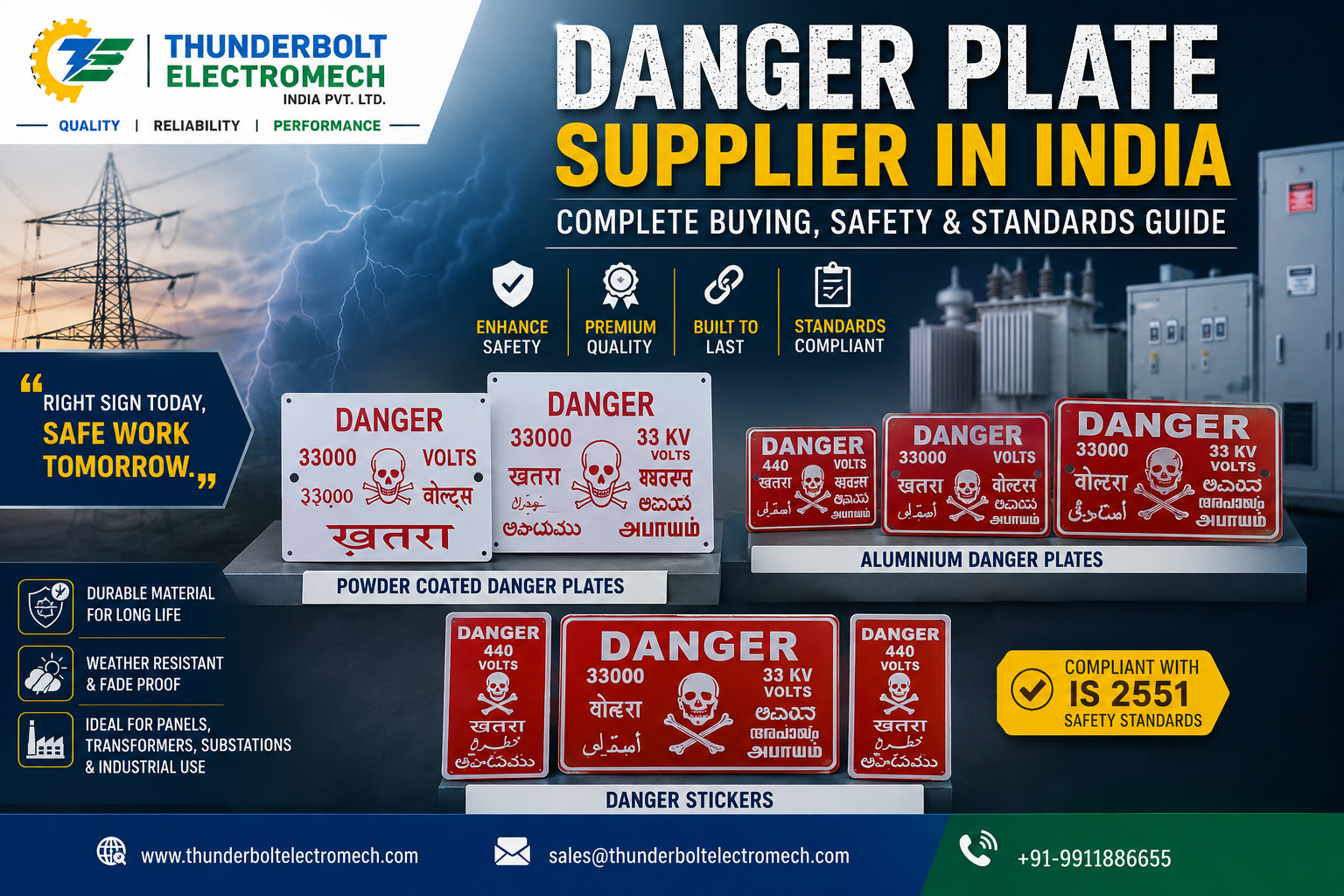
The design itself is standardised under IS 2551:1982, which specifies exactly two official sizes — 200 × 150mm for medium-voltage installations and 250 × 200mm for high and extra-high voltage installations — made from 1.6mm mild steel, finished in signal red and white. In practice today, most suppliers, Thunderbolt Electromech included, use powder-coated MS steel or aluminium rather than the original vitreous-enamel finish the 1982 standard describes, and this substitution is worth understanding before you order — we cover exactly why further down.
For a fast decision: use a 200 × 150mm plate for LT installations up to 415V/440V, step up to 250 × 200mm (listed by most Indian suppliers, including us, as 200 × 250mm) for 11kV, 22kV, 33kV, and 66kV HT installations, and confirm your local Electrical Inspector’s material preference before finalising a bulk order.
Introduction
Most people walk past a danger plate every day without a second thought — a red-and-white sign with a skull on it, bolted to a transformer or a panel door. What almost nobody outside the electrical safety world knows is that this small sign sits on top of a fairly specific legal requirement, a 40-year-old dimensional standard, and a material specification that most plates sold in India today don’t technically follow to the letter. That gap between what the law describes and what the market actually sells is exactly where a buyer needs clarity, and it’s exactly what most supplier pages skip past in favour of “we sell danger plates, buy now.”
This guide doesn’t skip it. Whether you’re searching for a danger plate manufacturer, a danger board manufacturer for a bulk panel-production order, or simply trying to understand what an electrical danger plate actually has to look like to be legally valid, the answer is more specific — and more interesting — than most people expect. This guide walks through what a danger plate legally has to be, where the requirement comes from, which voltage classes need which size, why material choice is more nuanced than it looks, and how to actually evaluate a danger plate supplier in India rather than just picking the first listing that comes up.
What Is a Danger Plate?
A danger plate is a permanently fixed warning sign required on electrical equipment and installations above a defined voltage threshold, combining a standardised skull-and-crossbones symbol with the word “danger” written in Hindi, English, and the local district language. It is not the same thing as a general safety sticker or a generic hazard sign — it’s a specific, regulated electrical danger sign with a defined design, size, and material history tracing back to the Indian Electricity Rules of 1956.
Functionally, it does one job: it tells anyone approaching a piece of live equipment, in a language they can read, that touching it can kill them. That’s the entire purpose, and every design choice in the governing standard — the red-and-white contrast, the universally recognisable skull symbol, the multi-language text — exists to make that message unmissable to someone who may not read English, may be in a hurry, or may be approaching the equipment in poor light.
Why Is a Danger Plate Legally Required in India?
This isn’t a “best practice” recommendation — it’s a statutory requirement, and the exact wording matters more than most buyers realise.
Regulation 20 of the CEA (Measures Relating to Safety and Electric Supply) Regulations, 2023 states that the owner of every installation of voltage exceeding 250V must affix, permanently and in a conspicuous position, a danger notice in Hindi or English and the local language of the district, with a sign of skull and bones of a design as per the relevant standard (IS 2551). This regulation superseded the earlier Rule 35 of the Indian Electricity Rules, 1956, which used near-identical language but applied to “every medium, high and extra high voltage installation” without stating a single numeric threshold as explicitly.
The current regulation specifies three distinct trigger conditions, and buyers rarely see all three laid out together:
- Any installation exceeding 250V — covers every motor, generator, transformer, and other electrical plant or equipment, together with the apparatus used to control or regulate it.
- Supports of overhead lines exceeding 650V that can be easily climbed without a ladder or special appliance — this specifically excludes rail-type, tubular, wooden, and unstepped RCC poles, which are deemed not easily climbable and therefore exempt from this particular clause.
- Luminous tube signs, X-ray, and similar high-frequency installations rated above 650V but not exceeding 33kV.
There’s a practical proviso worth knowing: where it’s genuinely not possible to fix the notice directly onto the generator, motor, or transformer, it can be affixed as near as possible instead — or the word “danger” and the equipment’s voltage can be permanently painted onto it. And where equipment sits inside an enclosure, one notice on the enclosure itself satisfies the requirement for everything inside it — you don’t need to plate every individual component.
Where Is a Danger Plate Installed?
Per the regulation’s own wording, a danger plate belongs on: every motor, generator, and transformer; other electrical plant and equipment along with its controlling or regulating apparatus; climbable supports of overhead lines above 650V; and luminous tube sign, X-ray, or high-frequency installations between 650V and 33kV. In day-to-day industrial practice, this translates to electrical panels, substations, DG set enclosures, HT/LT switchgear rooms, transformer yards, cable trench covers carrying live cable, and rooftop or ground-mounted solar combiner boxes wherever their voltage crosses the threshold.
Voltage-Wise Guide: 230V to 66kV
Buyers frequently ask which plate covers which voltage, so here’s the practical breakdown used across the Indian market:
- 230V / 415V / 440V (LT — Low Tension) — these are the everyday supply voltages found in most factory floors, DBs, and panel boards. A 200 × 150mm plate is the standard choice, and this is the size Thunderbolt Electromech’s entry powder-coated plate is built for.
- 11kV — a very common HT distribution voltage across Indian industrial and utility substations. This is where the larger 250 × 200mm-format plate (listed as 200 × 250mm in most Indian catalogues, including ours) becomes standard. An 11kV danger plate is one of the highest-volume SKUs any Indian electrical safety supplier moves.
- 22kV — less common than 11kV or 33kV in standard distribution, but present in specific utility and industrial configurations; sized the same as 11kV/33kV plates.
- 33kV — a major HT transmission and bulk-supply voltage, and along with 11kV, one of the two voltage markings buyers request most. A 33kV danger plate uses the same 250 × 200mm format.
- 66kV — extra-high voltage territory, typically substations and grid infrastructure. Same plate format, with the voltage figure marked accordingly.
One detail worth flagging plainly: the plate’s physical size doesn’t change between 11kV and 66kV — only the printed voltage figure does. What changes with rising voltage is less about the sign and more about everything around it: clearance distances, fencing, additional warning layers, and the Electrical Inspector’s scrutiny during commissioning.
Danger Plate Materials: What “IS 2551 Compliant” Actually Means Today
Here’s the part most competing supplier pages either get vague about or skip entirely — and it’s the most useful thing in this guide if you’re the person actually signing the purchase order.
IS 2551:1982, the governing dimensional and material standard, specifies that a danger notice plate “shall be made from mild steel, at least 1.6mm thick and vitreous enamelled white, with letters, figures and the conventional skull and cross-bones in signal red colour on the front side. The rear side of the plate shall also be enamelled.” That’s the literal, original text of the standard.
Vitreous enamelling — a glass coating fused onto steel at high temperature — was the dominant industrial finishing technology in 1982. It’s genuinely excellent for weather resistance and colour retention, which is exactly why the standard specified it: the standard even includes a dedicated weather-proofness test (per IS 8709:1977) purely for verifying enamel colour retention. But vitreous enamelling is a specialised, kiln-based process that far fewer Indian fabricators run today compared to 1982, largely because powder coating became the dominant industrial metal-finishing method over the following decades — it’s faster, cheaper at scale, and, when done to an industrial-grade specification, achieves comparable UV and corrosion resistance for most application environments.
This is exactly why the overwhelming majority of danger plates sold in India today — Thunderbolt Electromech’s included — are 1.6mm mild steel with industrial powder coating, not vitreous enamel. The thickness and base metal match IS 2551’s letter precisely. The finish is a modern substitution, not a compliance failure in the practical sense the market has adopted — but it is, strictly, a deviation from the standard’s original written wording. For most industrial buyers and installers, this substitution is treated as functionally equivalent and is accepted without issue. But if you’re supplying to a project with an unusually strict inspecting authority, or a specification written by someone quoting IS 2551 to the letter, it’s worth a direct conversation with your Electrical Inspector before assuming powder coating clears every possible audit.
Beyond powder-coated MS steel, the market also offers two other common formats, each suited to different needs:
- Aluminium danger plates — lighter, naturally corrosion-resistant, and a common choice for outdoor or coastal installations where rust is a bigger long-term risk than impact damage. Thunderbolt Electromech stocks aluminium danger plates in 150 × 75mm, 200 × 150mm, and 200 × 250mm.
- Danger stickers — adhesive-backed, thinner, and significantly cheaper per unit, well suited to equipment-level labelling (individual panel doors, junction boxes, smaller enclosures) rather than as the primary statutory notice on a main transformer or substation gate. Thunderbolt Electromech stocks these in 150 × 200mm, 200 × 250mm, and 75 × 150mm.
A sizing note worth catching before you order: IS 2551’s smallest official plate size is 200 × 150mm. The 150 × 75mm aluminium plate and the 75 × 150mm sticker fall below that official minimum. That doesn’t make them useless — they’re genuinely practical for secondary, equipment-level warning tags — but if a specific location legally requires the full statutory notice (a main transformer, a substation entrance), the smaller formats shouldn’t be the only signage relied on there.
Material Comparison Table
| Material | Typical Thickness | Best Suited For | Durability | Relative Cost |
| MS Powder Coated | 1.6mm | General industrial use, panels, transformers, substations | High — matches IS 2551 thickness/base metal | Lowest long-term cost per year of service |
| MS Vitreous Enamel (original IS 2551 spec) | 1.6mm | Strict literal-compliance requirements, older-style installations | Very high, but increasingly rare to source | Higher, harder to source in bulk today |
| Aluminium | Varies | Coastal/humid outdoor sites, weight-sensitive mounting | Good corrosion resistance, more prone to bending on impact | Moderate |
| Adhesive Sticker | Thin/laminate | Equipment-level tags, panel doors, secondary labelling | Lower — not a substitute for the primary statutory notice on major equipment | Lowest unit cost |
Danger Plate Dimensions: The Official IS 2551 Sizes
IS 2551 recommends exactly two sizes:
- 200 × 150mm — for display at medium-voltage installations.
- 250 × 200mm — for high and extra-high voltage installations.
Indian suppliers commonly list the second size as “200 × 250mm” rather than “250 × 200mm” — same physical plate, dimension order simply written differently across the market. Thunderbolt Electromech’s own catalogue follows this common convention: 200 × 150mm and 200 × 250mm powder-coated plates, plus the same two sizes (plus a smaller 150 × 75mm) in aluminium.
The standard also specifies that all lettering must be centrally spaced, the plate’s corners must be rounded off, and the location of fixing holes is left to the buyer’s discretion — a small detail, but a useful one if your installation has a non-standard mounting surface.
Danger Notice Content Requirements
Beyond size and material, IS 2551 sets requirements for what actually appears on the plate:
- The skull-and-crossbones symbol, rendered in signal red, positioned and sized according to the standard’s own layout diagrams.
- The word for “danger,” in the required languages (covered below), centrally spaced and uniformly sized.
- Manufacturer identification marking, placed so it doesn’t interfere with the primary warning message — this is a genuine traceability requirement, not decorative branding.
- Optionally, the ISI Certification Mark, where the manufacturer holds a valid licence for it.
For high and extra-high voltage plates specifically, the design also carries a marked voltage figure — the standard’s own diagram shows “11,000 volts” as a specimen figure, explicitly noting that the actual installation voltage should be substituted in for whatever the equipment is actually rated at.
The Skull-and-Crossbones Symbol: Why It’s Non-Negotiable
The skull-and-crossbones isn’t a stylistic choice left to individual manufacturers — its size, positioning, and colour are defined in the standard’s own layout drawings, and it’s required precisely because a language-based warning alone doesn’t reach everyone who might approach dangerous equipment. India has, by some estimates, well over a hundred spoken languages and dialects across its states; a migrant worker, a visiting contractor, or a member of the public passing through an unfamiliar region may not read Hindi, English, or the specific regional language on a given plate. The skull symbol is the one element on the plate designed to communicate instantly, regardless of literacy or language — which is exactly why the standard treats its presence as non-negotiable rather than optional styling.
Hindi / English / Local Language Requirements
The regulation is explicit: the danger notice must appear in Hindi or English, and the local language of the district. IS 2551 goes further, providing recommended equivalents to the word “danger” for a number of regional languages — Punjabi, Urdu, Marathi, Tamil, Malayalam, Bengali, and Oriya among them — precisely because a plate installed in, say, Tamil Nadu needs to communicate to people who may not read Hindi or English fluently.
This is one of the most commonly under-specified elements in bulk orders. A buyer purchasing plates for a multi-state rollout — say, a company with substations across Punjab, Maharashtra, and Tamil Nadu — needs different local-language text on each region’s plates, not one uniform Hindi/English design shipped everywhere. Getting this wrong doesn’t just miss a nicety; it defeats the entire point of the regulation, which is comprehension by anyone in that specific district, not just compliance-on-paper.
LT vs HT Danger Plates
An LT HT danger plate distinction matters more for voltage marking and installation context than for the plate’s physical construction. LT (Low Tension) plates cover 230V, 415V, and 440V installations — panel boards, DBs, motor control centres, and general factory-floor equipment — typically using the 200 × 150mm format. HT (High Tension) plates cover 11kV, 22kV, 33kV, and 66kV — substations, transformer yards, and HT switchgear — typically using the larger 250 × 200mm format.
The practical difference buyers should plan around isn’t the plate itself so much as the ordering pattern: LT plate requirements tend to be higher-volume and lower-urgency (panel boards get built in batches), while HT plate requirements are often lower-volume but higher-urgency, tied to a specific substation commissioning date with a hard regulatory inspection deadline attached.
Indoor vs Outdoor Applications
Indoor installations — panel rooms, control rooms, switchgear rooms — face less exposure to UV, rain, and temperature swings, so material choice has more flexibility; powder-coated MS or even a well-mounted sticker can perform adequately for years. Outdoor installations — transformer yards, substations, rooftop solar combiner boxes, overhead line supports — face direct sun, monsoon exposure, and in coastal regions, salt air, all of which accelerate material degradation. For outdoor use, powder-coated MS steel or aluminium are the practical choices; adhesive stickers are a poor fit for a primary outdoor statutory notice, since UV exposure and moisture ingress under the adhesive edge shorten their working life considerably faster than a rigid plate.
Danger Plates for Electrical Panels
A danger plate for electrical panel installations typically uses the 200 × 150mm LT format, mounted directly on the panel door or as close to it as the enclosure allows. Per the regulation’s own proviso, where equipment sits inside an enclosure, a single notice on the enclosure covers everything inside it — so a panel builder doesn’t need to plate every individual breaker or contactor within a panel, just the panel’s external door or a clearly visible point on its frame. This is one of the highest-frequency purchase categories for any danger plate manufacturer serving industrial panel fabricators, since every panel shipped needs one.
Danger Plates for Transformers and Substations
Transformers and substations sit at the higher-voltage end of the spectrum, almost always requiring the 250 × 200mm HT format with the specific voltage — 11kV, 22kV, 33kV, or 66kV — clearly marked. Because transformers and substations are frequently outdoor installations, material durability matters more here than almost anywhere else in this guide: a plate that fades or corrodes within two years on an outdoor transformer isn’t just a cosmetic failure, it’s a compliance gap waiting to be flagged at the next inspection. Substation gates and transformer yard perimeter fencing are also common secondary mounting points, supplementing the primary notice on the transformer body itself.
How to Select the Right Danger Plate
Step 1 — Identify the installation’s actual voltage and whether it falls under LT (up to 440V) or HT (11kV and above) classification.
Step 2 — Match voltage to the correct IS 2551 size — 200 × 150mm for LT, 250 × 200mm (200 × 250mm in most catalogues) for HT.
Step 3 — Choose material based on environment: powder-coated MS for general and indoor use, aluminium for coastal/high-humidity outdoor sites, stickers only for secondary equipment-level tagging.
Step 4 — Confirm the local district language requirement for each installation site — don’t assume one language set covers a multi-state order.
Step 5 — Verify the voltage figure to be printed matches the equipment’s actual rated voltage, not a rounded or approximate figure.
Step 6 — Ask your supplier directly whether they can confirm IS 2551 compliance on material, thickness, and layout — not just voltage marking — before placing a bulk order.
How to Buy From a Danger Plate Supplier in India
Sourcing danger plates in bulk — for a panel fabrication business, an EPC contractor, or a utility maintenance department — is a different exercise than buying one plate for a single site. A reliable danger plate supplier Delhi buyers can depend on repeatedly should offer: consistent 1.6mm MS thickness across every batch, accurate voltage-figure customisation per order line, multi-language printing capability for multi-state rollouts, and a minimum order quantity structure that matches how you actually buy — whether that’s a handful of plates for a single substation commissioning or a few hundred for an annual panel-production run.
As a Delhi-based danger plate dealer Delhi buyers can reach quickly, Thunderbolt Electromech supplies powder-coated MS, aluminium, and sticker-format danger plates with same-batch consistency, suited to both one-off site requirements and recurring bulk orders from panel OEMs and EPC contractors across the NCR industrial belt.
Danger Plate Price in India: What Affects the Cost?
Danger plate price in India is driven by four main factors:
- Material — stickers are the cheapest per unit, powder-coated MS sits in the middle, aluminium and genuine vitreous-enamel plates carry a premium reflecting their material and process cost.
- Size — the larger 250 × 200mm HT format naturally costs more than the 200 × 150mm LT format, given the greater material volume.
- Customisation — multi-language text, specific voltage-figure printing, and non-standard mounting-hole placement add a modest premium over a standard stock design.
- Order volume — as with most industrial consumables, per-unit price improves meaningfully at MOQ and bulk-carton volumes compared to single-unit retail pricing.
As a concrete reference point: Thunderbolt Electromech’s own 200 × 150mm powder-coated MS plate is priced at ₹90 per piece (against a ₹110 list price) at a 100-piece minimum order quantity, while the larger 200 × 250mm format is priced at ₹120 per piece (against a ₹140 list price) at the same MOQ tier. These figures give a genuine, current benchmark for the powder-coated MS category specifically — aluminium and sticker formats are typically priced differently and should be quoted separately based on size and finish.
Customization
Beyond the standard voltage markings, most Indian danger plate suppliers — Thunderbolt Electromech included — can customise plates on: the specific voltage figure printed (415V through 66kV and beyond), the regional language text for multi-state deployments, company or site identification text below the standard warning (where this doesn’t obscure the primary message, per the standard’s own marking guidance), and mounting-hole placement for non-standard installation surfaces like mesh fencing versus solid steel doors.
Installation
Mount the plate at a height and position where it’s genuinely visible to anyone approaching the equipment — not tucked behind a cable tray or facing away from the normal approach path. Use corrosion-resistant fixing hardware, particularly for outdoor installations, since a rusted-through mounting bolt defeats a weather-resistant plate just as effectively as a degraded finish would. Where equipment sits inside an enclosure, a single plate on the enclosure’s most visible external face satisfies the requirement — there’s no regulatory benefit to duplicating plates on every internal component. For HT installations specifically, cross-check the printed voltage figure against the equipment’s actual commissioning voltage before final fixing, since a supplier producing to a generic “11kV” template and a site actually running at 12kV nominal (a genuine possibility depending on transformer tap settings) is a mismatch worth catching before an inspector does.
How Danger Plates Are Tested and Inspected
IS 2551 doesn’t just specify what a danger plate looks like — it specifies how a batch should be checked before it’s accepted as compliant, and this is worth knowing if you’re buying at volume rather than picking up a single plate.
The standard defines three essential tests: visual examination — checking the wording, letter placement, and symbol against the standard’s own layout, and comparing the paint colour visually against the specified signal red; dimensional check — verifying plate size, thickness, and lettering dimensions against the two official size drawings; and a weather-proofness test, specifically for verifying colour retention of the enamel coating under the method set out in IS 8709:1977. The standard leaves the actual sample size for batch testing to agreement between supplier and buyer — meaning a buyer ordering at real volume has the standing to ask for a defined sampling and inspection procedure as part of the purchase order, not just accept whatever the supplier’s internal process happens to be.
For a broader installation — say, a full electrical safety sign board program across a factory covering danger plates alongside other mandatory signage (earthing points, fire safety, first-aid station markers) — this same inspection logic is worth applying consistently: define what “acceptable” looks like in writing before the order ships, not after a batch arrives with inconsistent lettering or an off-shade red that a site engineer has to flag manually.
Common Mounting Surfaces and Practical Fixing Considerations
Danger plates end up fixed to a wider range of surfaces than the standard’s own diagrams suggest — and the practical fixing approach differs meaningfully across them. On solid steel panel doors, a straightforward bolted fixing through the plate’s pre-drilled corner holes works cleanly and holds up for years. On mesh fencing around a transformer yard or substation perimeter, the same bolt-through approach needs cable ties or wire fixing at multiple points rather than relying on two or four bolts alone, since a mesh surface flexes in wind in a way a solid door doesn’t. On brick or masonry walls, plastic wall plugs rated for outdoor use are the practical standard — a bare screw into unprepared masonry loosens over a monsoon season and is a common, entirely avoidable cause of a plate coming loose or falling off a wall it was meant to warn people away from.
Real Use Cases
A panel OEM standardising danger plates across its full production line (Wazirpur, Delhi).
A panel fabrication business shipping 40–50 LT panels a month had been sourcing danger plates ad hoc, sometimes stickers, sometimes whatever plate size a local vendor had in stock that week — resulting in visibly inconsistent signage across panels going to the same client. Standardising on a single 200 × 150mm powder-coated MS specification, ordered against a monthly volume rather than per-shipment, both fixed the consistency problem and reduced per-unit cost through predictable bulk ordering.
An EPC contractor commissioning an 11kV substation on a tight inspection deadline (Faridabad).
A contractor had ordered generic “HT danger plate” stock without specifying the exact voltage figure, only to find the plates arrived marked for 33kV rather than the site’s actual 11kV rating — a mismatch that would have failed the Electrical Inspector’s site walkthrough. The fix required an expedited reorder with the correct voltage explicitly specified on the purchase order, a delay that a single clarifying question at order time would have avo
entirely.
A multi-state facilities team rolling out uniform panel signage across three states (Delhi, Maharashtra, Tamil Nadu).
A company standardising electrical safety signage across its factories in three states initially ordered one Hindi/English plate design for every location, only to have its Tamil Nadu site flagged during an internal safety audit for missing the required local-language text. Re-ordering with the correct Tamil equivalent for each site — rather than treating the danger plate as a single national SKU — resolved the gap and brought every site in line with the actual regulatory requirement.
Common Problems Buyers Run Into — and What Actually Fixes Them
Problem: “We ordered by voltage class and got the wrong physical size.” Some suppliers use inconsistent size-naming conventions between LT and HT formats. Solution: always confirm both the millimetre dimensions and the voltage figure on the purchase order, not just one or the other.
Problem: “The plate faded or rusted within a year outdoors.” This is almost always a material-environment mismatch — a sticker or a thin, poorly coated plate used in direct sun and monsoon exposure. Solution: step up to powder-coated MS or aluminium for any outdoor or high-humidity installation.
Problem: “Our multi-state rollout used the same design everywhere.” As the Tamil Nadu use case above shows, this misses the actual local-language requirement. Solution: treat each installation state as its own language specification, not a single uniform national order.
Problem: “We can’t get consistent quality across repeat orders.” Working with a single, consistent danger plate manufacturer India buyers can reorder from — rather than whichever local vendor has stock that week — solves this directly, since batch-to-batch consistency depends on a stable supplier relationship, not a one-off purchase.
Frequently Asked Questions
Q1. What is a danger plate, exactly?
A danger plate is a permanently fixed warning sign, standardised under IS 2551, combining a skull-and-crossbones symbol with multi-language “danger” text, required by law on electrical equipment above 250V.
Q2. Is a danger plate legally mandatory in India?
Yes — under Regulation 20 of the CEA (Measures Relating to Safety and Electric Supply) Regulations, 2023, which replaced the earlier Rule 35 of the Indian Electricity Rules, 1956.
Q3. What are the official danger plate sizes?
IS 2551 specifies two sizes: 200 × 150mm for medium-voltage (LT) installations, and 250 × 200mm for high and extra-high voltage (HT) installations — commonly listed as 200 × 250mm across Indian supplier catalogues.
Q4. What material should a compliant danger plate be made from?
IS 2551’s original text specifies 1.6mm mild steel with vitreous enamel finish. In practice, the overwhelming majority of the market — including Thunderbolt Electromech — supplies 1.6mm mild steel with industrial powder coating instead, which matches the standard’s base metal and thickness but substitutes a more widely available modern finish for the original enamel process.
Q5. Do I need different plates for 11kV and 33kV installations?
The physical size stays the same (250 × 200mm/200 × 250mm) — only the printed voltage figure changes between an 11kV danger plate and a 33kV danger plate.
Q6. Is a sticker an acceptable substitute for a danger plate?
For secondary, equipment-level labelling, yes. As the primary statutory notice on a main transformer, substation gate, or major panel, a rigid plate is the more defensible choice — stickers fall below IS 2551’s smallest recommended size and degrade faster under real-world conditions.
Q7. Do I need Hindi, English, and a local language, or just one?
The regulation requires Hindi or English plus the local language of the district — not a choice of just one. A multi-state buyer needs different local-language text for each installation location.
Q8. What voltage threshold actually triggers the requirement?
Any installation exceeding 250V requires the general notice; overhead line supports exceeding 650V that are easily climbable require it separately; and luminous tube/X-ray/high-frequency installations between 650V and 33kV are covered under a third specific clause.
Q9. Where exactly should the plate be mounted?
Directly on the equipment where possible — motor, generator, transformer, or control apparatus. Where that’s not feasible, as near as possible to it, or the danger warning and voltage painted directly onto the equipment. One notice per enclosure is sufficient for everything inside it.
Q10. What determines danger plate price?
Material (sticker vs powder-coated MS vs aluminium vs vitreous enamel), size (LT vs HT format), customisation (language and voltage-figure printing), and order volume are the four main price drivers.
Q11. Can I get danger plates customised with my company name?
Yes, most suppliers can add site or company identification text, provided it doesn’t interfere with the primary warning message, consistent with IS 2551’s own marking guidance.
Q12. How long should a danger plate last before replacement?
This depends heavily on material and environment — a well-installed powder-coated MS or aluminium plate in a sheltered indoor location can last many years, while the same material outdoors in a coastal or high-UV environment will show fading or corrosion sooner and should be visually checked periodically rather than assumed permanent.
Q13. What’s the difference between a danger plate and a general electrical safety sign board?
A danger plate is a specific, regulated notice governed by IS 2551 and Regulation 20 of the CEA 2023 Regulations, with defined size, material, and symbol requirements. A broader electrical safety sign board program on a site might include the danger plate alongside other signage — earthing point markers, fire safety instructions, first-aid station indicators — that aren’t individually governed by the same standard but serve the same overall site-safety purpose.
Q14. Can I order danger plates in a single combined batch covering multiple voltage classes?
Yes — this is standard practice for panel OEMs and EPC contractors managing multi-voltage sites, provided each line item in the order clearly specifies its own size, voltage figure, and material, rather than assuming one specification covers the full order.
Q15. Does the manufacturer’s identification on the plate matter for compliance?
Yes — IS 2551 requires manufacturer identification marking as part of the plate’s essential information, positioned so it doesn’t interfere with the primary warning. A plate with no traceable manufacturer marking is harder to defend as compliant stock during an audit, regardless of how correct its size and symbol otherwise look.
Conclusion
A danger plate looks like the simplest purchase on an electrical safety checklist, and that’s exactly why it gets under-specified so often — wrong size ordered against the voltage class, a uniform design shipped across states with different language requirements, or a material choice that fades before the installation’s next scheduled inspection. None of these mistakes come from a complicated product; they come from treating a legally mandated, standard-governed sign as an afterthought instead of what it actually is: a Regulation 20-mandated, IS 2551-specified safety component with real dimensional, material, and language requirements behind it.
Get the voltage-to-size mapping right, match material to environment, confirm the correct local language for every site, and verify the printed voltage figure against the equipment’s actual rating before final installation — and a danger plate does exactly the job the regulation intends it to do.
Thunderbolt Electromech India Pvt. Ltd. supplies powder-coated MS, aluminium, and sticker-format danger plates across the full LT and HT range — 150 × 75mm through 250 × 200mm — as a Delhi-based danger plate supplier and danger sign plate manufacturer serving panel OEMs, EPC contractors, and industrial buyers across the NCR region and pan-India.
[…] Regulations, and danger plate requirements across every voltage class — see Thunderbolt’s Danger Plate Supplier for electrical panels pillar guide. This piece goes narrower and deeper: the panel itself, not the whole regulatory […]
[…] gaps directly, because they matter for a genuinely informed buying decision. Thunderbolt’s pillar guide already walks through sizing, material comparison, and a step-by-step buying checklist in detail […]
[…] For a full breakdown of buying criteria, standards references, and how to brief a supplier, see our pillar guide: Danger Plate Supplier in India — Complete Buying & Safety Standards Guide. […]
[…] If you want the full buying checklist — voltage-to-size mapping, material selection, and installation placement rules — we’ve built that out separately on our Danger Plate Supplier in India: Complete Buying & Safety Standards Guide. […]