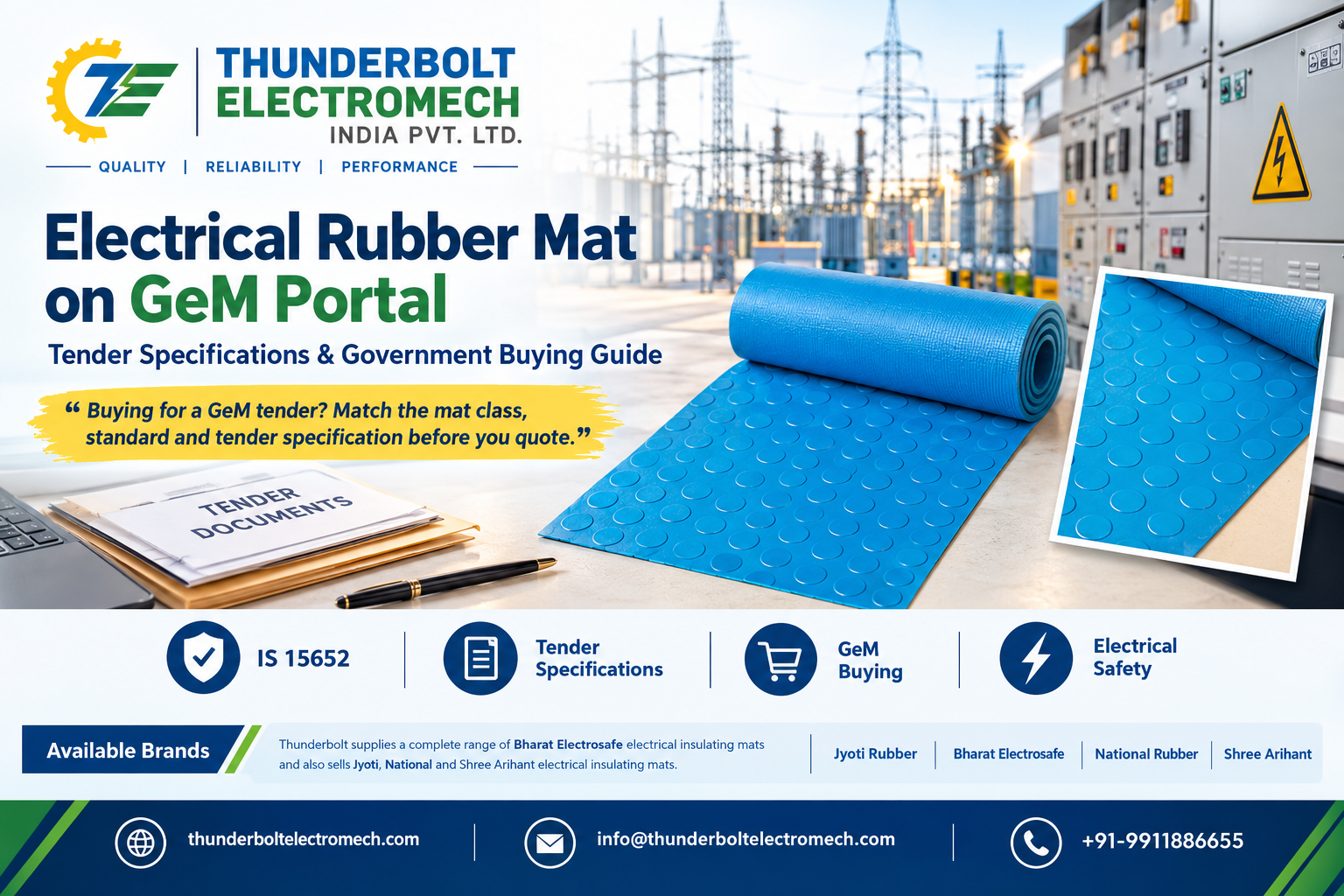
Quick Answer: On GeM, electrical rubber mats are listed under a specific category — “Electrical Safety Devices and Accessories (Insulating Mats for Electrical Purposes) as per IS 15652 (Q3)” — and PSU tenders from BHEL, NTPC, and PowerGrid confirm this in real bid documents. Class-I local content, MSE purchase preference, and reverse-auction rules all apply on top of the IS 15652 spec. An experienced Electrical Rubber Mat Supplier India buyers can trust needs to satisfy both layers, not just the rubber’s dielectric rating.
Introduction
Most articles on this subject repeat the same three facts — GeM exists, IS 15652 has three classes, and MSMEs get some kind of preference. None of that tells you what actually happens when a bid document lands in front of you.
So we pulled the real thing. Not a summary of GeM’s homepage — actual, downloaded GeM bidding documents issued by Bharat Heavy Electricals Limited, NTPC, and Power Grid Corporation for insulating mats, IS 15652, exactly the product this article is about. What we found changes the picture. GeM doesn’t just ask for a rubber mat that meets a standard. It runs the purchase through a specific product category code, a quality grading system called Q3, a reverse-auction mechanism most suppliers underestimate, and a local-content rule that can disqualify an otherwise perfect bid before price is even compared. This guide walks through all of it, using the real documents as evidence rather than generic procurement advice.
Electrical Rubber Mat Supplier India: What the GeM Category Actually Looks Like
Here’s something almost no supplier-facing content mentions by name: on GeM, electrical rubber mats aren’t listed as “rubber mats.” They sit under a formal category called “Electrical Safety Devices and Accessories (Insulating Mats for Electrical Purposes) as per IS 15652,” further split into quality sub-grades marked Q1, Q2, or Q3.
This isn’t a guess. A GeM bid floated by BHEL’s HPBP unit in Trichy for 140 units, and a separate BHEL bid from its Bangalore EPD office for 1,000 units, both list the item category exactly this way, tagged Q3. A third bid, raised by NLC India’s Darlipali Super Thermal Power Project for 250 units, uses the identical category string. Three different PSU buying offices, three different states, one unchanging category name.
Why does this matter to you as a buyer? Because if your internal purchase requisition doesn’t mirror this exact category language, GeM’s own search and catalogue-matching logic can push your requirement toward the wrong supplier pool entirely — one stocking a different Q-grade, or worse, a different IS standard’s mats altogether. If you’re a supplier, listing your product under anything other than this precise category string is why your catalogue entry sometimes never surfaces for a live bid at all.
Direct source: three separate GeM bid documents (BHEL Trichy, BHEL Bangalore, NLC Darlipali) all list this category verbatim — this is primary tender-document evidence, not a paraphrase.
What IS 15652 Requires — And Why “2.5mm” Alone Isn’t a Spec
Every one of those GeM categories still ultimately answers to Bureau of Indian Standards document IS 15652:2006, which replaced the older IS 5424:1969 mat standard following a Gazette notification dated 17 July 2007. The standard covers elastomeric floor-covering mats — natural rubber, synthetic rubber, or a blend — for protecting workers on AC installations up to 66 kV and DC installations up to 240 V.
| Class | Thickness | Working Voltage | Proof Voltage | Breakdown Voltage |
| Class A | 2.0 mm | 3.3 kV | 10 kV | 30 kV |
| Class B | 2.5 mm | 11 kV | 22 kV | 45 kV |
| Class C | 3.0 mm | 33 kV | — | — |
The number that should actually worry a buyer isn’t thickness — it’s minimum tensile strength (15 N/mm²) and minimum elongation at break (250%), both mandated for BIS certification. Two mats can share identical thickness and still fail differently under load, because dielectric performance depends on how evenly the elastomer cures, not how thick the sheet reads on a tape measure. A tender line that says “2.5mm rubber mat” without naming Class B and the working voltage is, strictly read, unenforceable — a supplier could legally deliver something within spec on paper and dangerously wrong for the site. We break the full class-to-voltage mapping down further in our complete IS 15652 buying guide.
The Local-Content Rule Most Rubber Mat Tenders Never Mention
This is the part of GeM procurement that catches even experienced suppliers off guard, because it has nothing to do with the mat itself.
Under the Public Procurement (Preference to Make in India) Order, 2017, every supplier bidding on GeM is classified by local content: a Class-I Local Supplier has at least 50% local content and gets the highest preference; a Class-II Local Supplier sits between 20% and 50% and is only considered if no Class-I bidder is available; anyone below 20% is a Non-Local Supplier, generally excluded outright unless the tender is opened globally. Where a Class-I bidder isn’t the lowest price, GeM still applies a 20% purchase-preference margin in their favour over Class-II or non-local bids.
Layer on top of that the Public Procurement Policy for Micro and Small Enterprises, 2012. Real GeM bid documents for this exact insulating-mat category show precisely how it plays out: if the lowest bidder (L1) isn’t an MSE, and an MSE has quoted within L1 plus 15%, that MSE gets a chance to match the L1 price — and if they do, the contract is split so the MSE receives a defined share of the total quantity, typically 25%, though buyers can set this as high as 100% in some notified bids. One NLC India tender for 250 mats explicitly marks “MSE Purchase Preference: Yes,” tying eligibility directly to a valid Udyam Registration verified online.
For a rubber mat supplier, this means price alone rarely wins outright. Being Udyam-registered and correctly self-certifying local content can shift a losing bid into a partial award, purely on policy mechanics that have nothing to do with rubber chemistry.
Direct source: PPP-MII Order 2017 definitions and the 20% margin figure are DPIIT policy text; the L1+15%/25%-quantity-split mechanic is quoted directly from real GeM bid documents for this insulating-mat category — both primary sources, cross-checked against each other.
How the Bidding Itself Runs: EMD, Reverse Auction, and What Actually Decides Price
Once technical bids clear, GeM often moves to a Reverse Auction (RA) among the top 50% of technically qualified bidders, ranked lowest to highest price — a rule stated explicitly in multiple insulating-mat bid documents from BHEL. In some cases, the RA excludes only the single highest bidder and opens to everyone else instead, depending on how the buying office configures the bid.
Earnest Money Deposit (EMD) requirements scale with order size — real bid documents for this category show EMD amounts ranging from roughly ₹17,000 to over ₹4.5 lakh depending on quantity and estimated value — but manufacturers with valid MSE status are exempt from EMD entirely, provided they submit supporting Udyam documentation with the bid. Traders, notably, are excluded from this exemption; only manufacturers and, for services, direct service providers qualify.
Practical read for a buyer: if your tender doesn’t explicitly state whether Reverse Auction is enabled, expect price negotiation to happen after technical qualification, not at the point of initial bid submission — and factor that into your evaluation timeline.
Practical read for a supplier: an EMD exemption claim without a valid, currently-active Udyam certificate uploaded at bid time gets rejected outright, no matter how compliant your mat is technically.
Bharat vs Jyoti vs National vs Vardhman vs Shree Arihant: Matching Brand to Bid Type
Thunderbolt Electromech supplies the full IS 15652 range across five established Indian brands, and each genuinely suits a different kind of GeM requirement rather than being interchangeable.
| Brand | Where It Fits | Typical Order Pattern |
| Bharat | Large PSU bulk tenders (100+ units) | Direct bid or RA-enabled e-bid |
| Jyoti | Tenders demanding detailed dielectric test paperwork | Q1/Q2 vendor-assessed categories |
| National | Mid-voltage (Class B) municipal and discom orders | L1 comparison, under ₹5 lakh |
| Vardhman | Cost-sensitive, high-volume L1 bids | Reverse-auction-heavy tenders |
| Shree Arihant | Non-standard roll lengths, smaller departments | Direct purchase, sub-₹25,000 |
No brand wins every category. A 1,000-unit BHEL bid and a district office’s 20-unit direct purchase are different animals entirely, which is exactly why sourcing from a supplier who stocks all five — rather than committing to one manufacturer’s fixed catalogue — lets you match brand to bid instead of forcing the bid to accept whatever’s on the shelf.
Electrical Rubber Mat Supplier India: Real Problems Buyers Run Into, and What Actually Fixes Them
Problem: “Our tender got zero qualified bids, even though rubber mat suppliers exist everywhere.”
Almost always a category-mismatch issue. If the requisition doesn’t reference the exact GeM category string — “Electrical Safety Devices and Accessories (Insulating Mats for Electrical Purposes) as per IS 15652” — with the correct Q-grade, listed suppliers under a slightly different category never see it. Fix: copy the category name verbatim from a prior successful bid rather than retyping it from memory.
Problem: “A Class-II supplier is undercutting our preferred Class-I vendor, and we’re not sure which one we’re required to pick.”
Fix: under PPP-MII, Class-II bidders are only considered when no Class-I bidder is available at all — and even then, Class-I gets a 20% price margin of preference. If a qualified Class-I bidder exists, the Class-II quote is legally set aside regardless of price.
Problem: “An MSE bidder wants to match our L1 price after the auction closed — is that allowed?”
Yes, and it’s built into the policy, not a loophole. If the MSE quoted within L1 plus 15% before the deadline, they retain the right to match L1 and receive their share of the quantity split — commonly 25% — even after the reverse auction concludes.
Problem: “We keep getting invoice rejections despite the mat being genuinely IS 15652 compliant.”
This is usually an HSN code mismatch (electrical rubber mats fall under HSN 40169100) rather than a product-quality issue — see our GST and HSN procurement note for the paperwork side of this specifically.
Problem: “We’re based in Delhi NCR and every reorder loses a week to freight from suppliers based elsewhere.”
Fix: work with a GeM registered rubber mat supplier Delhi departments can reach within a day’s transit, rather than absorbing repeated freight lag for routine reorders across the region — particularly relevant for smaller, recurring government tender rubber mat Delhi NCR purchases where speed decides vendor loyalty more than unit price does.
Real Use Cases, Drawn from Actual GeM Bids
BHEL, HPBP Trichy — 140 units. A thermal power boiler-plant unit requisitioning insulating mats under the Q3 category, with MSE exemption for years-of-experience explicitly marked “No” — meaning even MSE bidders had to prove standard experience criteria, not just Udyam status.
BHEL, EPD Bangalore — 1,000 units. A large electrical products division order marked as a Short Duration Bid, published under emergency procurement provisions for critical products — with MSE Exemption for Experience and Turnover marked “Yes,” a materially different eligibility bar from the Trichy bid despite both being BHEL offices.
NLC India, Darlipali Super Thermal Power Project — 250 units. A super-thermal power project order with Reverse Auction explicitly disabled (“No”), MSE Purchase Preference explicitly enabled (“Yes”), and no ePBG requirement — a lighter compliance load than the BHEL bids above it, illustrating how much bid structure varies even within the same product category.
The pattern across all three: identical product category, identical governing standard, three completely different procedural configurations. This is exactly why reading a GeM bid document’s fine print matters more than knowing IS 15652 alone.
Electrical Rubber Mat Supplier India: Why Government Buyers Keep Returning to Thunderbolt
GeM’s L1 and RA mechanisms already settle price. What decides repeat business is whether a supplier’s paperwork, brand range, and delivery timeline hold up when an auditor or a technical evaluator actually checks. Thunderbolt Electromech stocks Bharat, Jyoti, National, Vardhman, and Shree Arihant under one roof, covering Class A, B, and C in a single purchase order rather than forcing a department to split a tender across vendors. Operating from Delhi’s Chandni Chowk trading district — inside one of India’s longest-running electrical hardware supply networks — also means a Delhi NCR buyer can physically inspect a sample before technical bid opening, something a supplier three states away simply can’t offer on short notice.
Frequently Asked Questions
What GeM category do electrical rubber mats fall under?
“Electrical Safety Devices and Accessories (Insulating Mats for Electrical Purposes) as per IS 15652,” typically graded Q1, Q2, or Q3 depending on the vendor assessment level required.
Does Reverse Auction always apply to insulating mat tenders on GeM?
No. Real bid documents show it varies by buying office — some BHEL bids enable RA among the top 50% of technically qualified bidders, while an NLC India bid for the same product category disabled RA entirely.
Are MSE suppliers exempt from EMD on GeM?
Yes, but only manufacturers (not traders) with valid, currently active Udyam Registration uploaded at the time of bidding qualify for the exemption.
Can a Class-II local supplier win over a Class-I supplier if their price is lower?
Generally no. Class-I suppliers receive a 20% purchase-preference margin, and Class-II bidders are typically only considered when no Class-I bidder is available at all.
What’s the difference between IS 15652 Class A, B, and C mats?
Class A (2.0mm) covers up to 3.3 kV working voltage, Class B (2.5mm) covers up to 11 kV, and Class C (3.0mm) covers up to 33 kV — thickness alone doesn’t guarantee the class; tensile strength and dielectric test results do.
Trust Signals: Verify Before You Buy
- Company: Thunderbolt Electromech India Pvt. Ltd.
- Address: Shop No. 3538, Sitaram Bazar Rd, Bazar Sirkiwalan, Chawri Bazar, Chandni Chowk, Delhi – 110006
- Phone: +91-9911228857 / +91-6391217408
- Email: info@thunderboltelectromech.com
Explore More on Electrical Rubber Mat Procurement
Start with the full technical foundation in our pillar guide: Electrical Rubber Mat Supplier — The Complete Guide to IS 15652 Classes, Thickness & Buying in India (2026). Related reading in our Electrical Rubber Mat blog category covers GST and HSN codes, colour coding, and IS 15652 vs IEC 61111.
Conclusion
GeM procurement for electrical rubber mats runs on two layers stacked on top of each other, and this article covered both. The technical layer is IS 15652 itself — Class A, B, or C, tied to exact voltage and thickness, verified through tensile strength and dielectric test certificates rather than thickness alone. The procedural layer is GeM’s own machinery: a specific category name that PSU documents from BHEL, NTPC, and NLC all use identically; a Q-grade classification; local-content rules under the Make-in-India order that can override price outright; and MSE mechanics that let a smaller bidder claim a share of quantity even after losing on price. Real bid documents show these rules aren’t applied uniformly — three tenders for the same product came with three different RA and MSE-exemption configurations — which is exactly why a spec sheet alone never tells the full story. A Electrical Rubber Mat Supplier India government buyers can rely on repeatedly needs to get both layers right at once, across every brand a tender might specify. That’s the range Thunderbolt Electromech keeps in stock, out of Delhi, for exactly this reason.