
By Thunderbolt Electromech India Pvt. Ltd. — Delhi-based Electrical Rubber Mat Supplier of Bharat, Jyoti, National, Vardhman & Shree Arihant
📞 +91-9911886655 | ✉️ info@thunderboltelectromech.com | 🌐 thunderboltelectromech.com | 📍 Shop No. 3538, Sitaram Bazar Rd, Bazar Sirkiwalan, Chawri Bazar, Chandni Chowk, Delhi – 110006
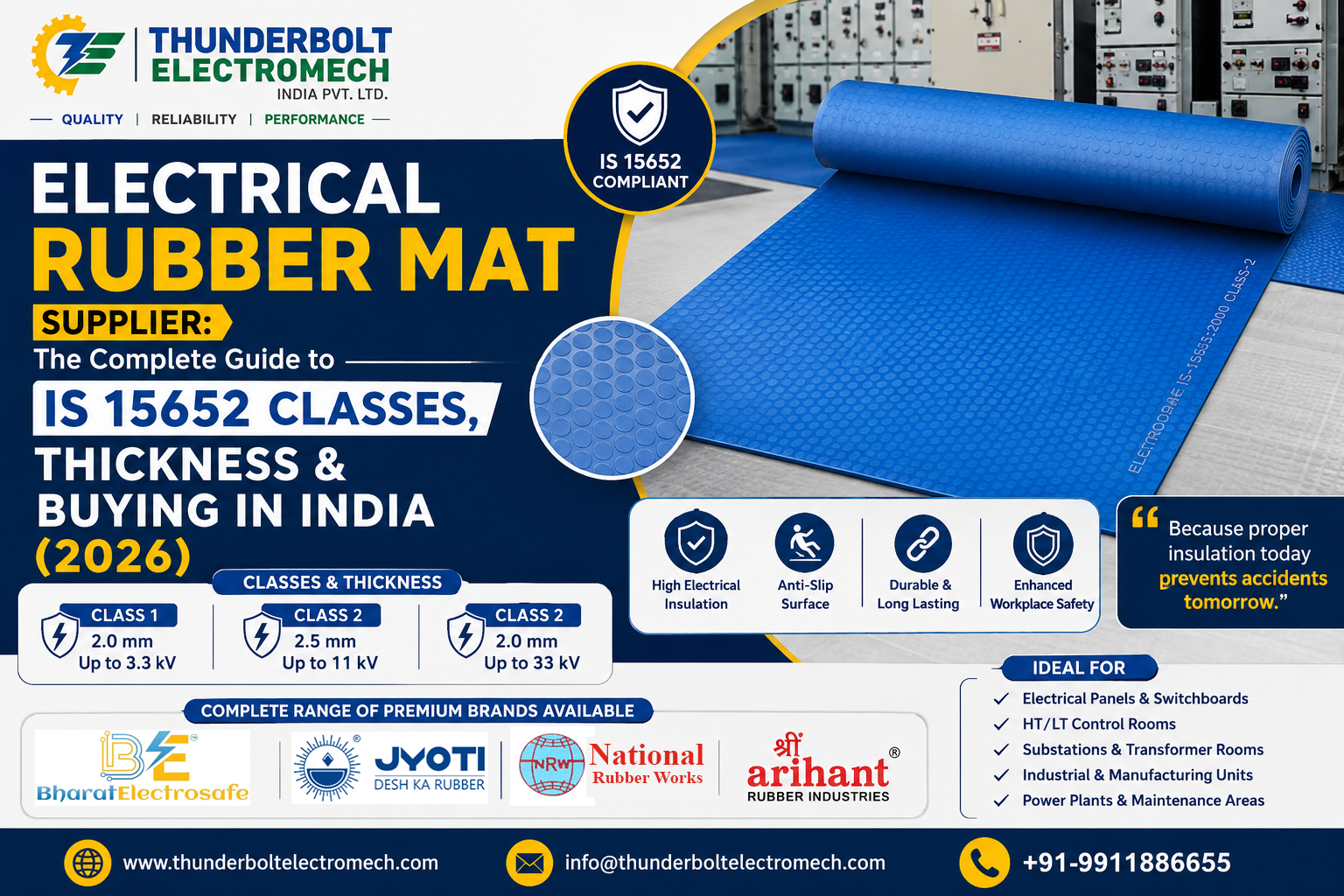
Quick Answer: An electrical rubber mat is a rubber floor covering placed in front of switchboards, panels, and switchgear to stop current from passing through a worker’s body into the earth. In India, the mat you buy should conform to IS 15652:2006, the standard that superseded the older IS 5424:1969, and it comes in three official classes — Class A (2.0mm, up to 3.3kV), Class B (2.5mm, 3.3kV–11kV), and Class C (3.0mm, 11kV–33kV, with the standard’s overall scope extending to 66kV AC and 240V DC for higher-voltage installations). Pick the class based on the actual system voltage at the panel, not the mat’s price or thickness alone, and always ask for the ISI mark and manufacturer test certificate before buying. Thunderbolt Electromech India Pvt. Ltd. stocks IS 15652-certified mats from Bharat, Jyoti, National, Vardhman, and Shree Arihant — five names that between them cover almost every voltage class an Indian industrial buyer will ever need.
Introduction
Somewhere in nearly every Indian factory, substation, and control room sits a rubber mat nobody thinks about until the day it matters. It’s cheap compared to the panel it sits in front of. It’s easy to overlook during a routine walkthrough. And it’s one of the only things standing between a technician’s body and a fault current that could stop their heart.
This guide is written for the person who’s never had to think hard about a rubber mat before — the purchase manager filling out a BOQ, the young engineer told to “get the panel room sorted,” the safety officer prepping for an audit next month. You don’t need to already know what “Class B” means to get value from this page. By the end, you will.
We’ll walk through what actually makes a mat safe, how India’s IS 15652 standard classifies mats by voltage, what thickness really buys you, how testing works, what a genuine mat costs versus a risky bargain, and how five major Indian brands — Bharat, Jyoti, National, Vardhman, and Shree Arihant — compare. Along the way, we’ll flag the mistakes that repeat across Indian sites, backed by research rather than guesswork, and labeled honestly where the data is thin.
What Is an Electrical Rubber Mat and Why IS 15652 Governs It
The Basic Physics, in Plain Words
Rubber, left in its natural or synthetic compound form, doesn’t conduct electricity well. That’s the entire idea behind an electrical rubber mat. Stand on one, and if you accidentally touch a live conductor, the mat interrupts the path current would otherwise take through your feet into the earth. No mat, no interruption — and depending on the fault, that difference can be the difference between a scare and a fatality.
But “rubber doesn’t conduct” isn’t a specification. A rubber doormat and a rubber insulating mat are both technically rubber, and only one of them will protect a worker standing in front of an 11kV panel. That gap between “made of rubber” and “certified to actually insulate at a stated voltage” is exactly what IS 15652 exists to close.
From IS 5424 to IS 15652 — What Changed
Before 2006, Indian electrical rubber mats were governed by IS 5424:1969, an older standard that had aged out of step with the materials and voltage classes actually in use across Indian industry. The Government of India formally superseded it through a Gazette Notification (S.O. 2086, dated 17 July 2007), replacing it with IS 15652:2006 (Source: Jyoti Rubber Udyog India Ltd, product documentation citing the Gazette Notification — Direct source found). The new standard was drafted broadly in line with the international IEC 61111 standard, though India’s version is, by most manufacturers’ own account, somewhat stricter on several test parameters (Source: Electromat.in, technical test methodology page — Direct source found).
If a mat you’re being sold still references only IS 5424, that’s a red flag worth asking about directly — it’s citing a standard that’s been formally superseded for nearly two decades.
How Rubber Becomes a Dielectric Barrier
The engineering detail most sales pitches skip: dielectric strength in a rubber mat isn’t a fixed property of “rubber” as a material category. It’s a function of the specific elastomer compound, the vulcanization process, and — critically — the absence of conductive fillers, carbon black in particular, that many other rubber products use for strength and abrasion resistance. An insulating-grade mat has to be compounded specifically to keep conductive additives out, which is part of why a genuine IS 15652 mat costs meaningfully more than a generic rubber floor mat that merely looks similar.
IS 15652 Electrical Rubber Mat Classes Explained: A, B and C
India’s standard defines three official voltage classes. Get this table into your procurement file — it’s the single most useful reference in this entire guide.
| Class | Thickness | System (Working) Voltage | Dielectric Breakdown Voltage |
| Class A | 2.0mm | Up to 3.3kV | 30kV |
| Class B | 2.5mm | 3.3kV – 11kV | 45kV |
| Class C | 3.0mm | 11kV – 33kV | 65kV |
(Source: IS 15652:2006 class specifications, cross-referenced across Duratuf Products, HIC Universal, and Bureau of Indian Standards documentation — Direct source found)
The standard’s overall scope statement covers protection for workers up to 66kV AC and 240V DC installations (Source: Scribd-hosted IS 15652:2006 summary; Jyoti Rubber Udyog product scope — Direct source found), and several manufacturers, including Jyoti, market a higher-voltage mat under this umbrella for HT substations, transformer rooms, and busbar panels running up to that ceiling. We flag this honestly: the widely available three-class table (above) is what’s consistently cited as the core IS 15652 classification, while the extended 66kV application range appears in the standard’s broader scope language and in manufacturer product descriptions rather than as a clearly separate “Class D” in every source we reviewed — no single, consistent fourth-class table was found across primary sources, so treat any “Class D” marketing claim with a request for the specific test certificate behind it.
The Safety Margin Math Nobody Explains
Here’s an engineering insight worth sitting with, because almost no supplier walks buyers through it: the safety margin between working voltage and breakdown voltage actually shrinks as you move up the classes.
- Class A: 3.3kV working vs 30kV breakdown → roughly a 9x margin
- Class B: 11kV working vs 45kV breakdown → roughly a 4x margin
- Class C: 33kV working vs 65kV breakdown → roughly a 2x margin
That’s not a flaw in the standard — it reflects how much harder it is to build proportionally larger safety buffers as absolute voltage climbs, and it’s consistent with how PPE standards generally scale. But it has a real practical consequence: the higher the voltage class, the less room for error a degraded mat has before it fails. A Class A mat that’s lost some dielectric strength to age still has a wide buffer. A Class C mat in the same condition has far less. This is exactly why periodic retesting — covered later in this guide — matters more, not less, as voltage class rises.
Electrical Rubber Mat Thickness Guide: Matching Millimetres to Kilovolts
Thickness and voltage class move together under IS 15652, but they’re not interchangeable specifications, and buyers frequently confuse the two.
2.0mm (Class A) suits LT panels, distribution boards, and general control room work up to 3.3kV — the majority of indoor panel-room installations in commercial and light-industrial settings.
2.5mm (Class B) covers the common industrial mid-range, 3.3kV to 11kV — the voltage band most factory substations and HT-side transformer feeds actually sit in.
3.0mm (Class C) handles 11kV to 33kV — utility switchyards, larger industrial substations, and any installation where a fault could genuinely be lethal in microseconds rather than merely dangerous.
The mistake we see repeated across sites: a buyer assumes a thicker mat is simply “safer,” and orders 3.0mm Class C mats for a 415V LT panel room that only ever needed Class A. That’s not extra safety — it’s wasted spend, since the panel’s actual working voltage never approaches what Class C is rated to withstand, and the thicker mat is also stiffer, heavier, and harder to lay flush against uneven flooring.
How Electrical Rubber Mats Are Tested: Proof Voltage, Breakdown Voltage & Leakage Current
The Three Numbers on a Genuine Test Certificate
A real IS 15652 test certificate isn’t a single pass/fail stamp. It reports several measured values, and understanding what each one means lets a buyer actually read the paperwork rather than just trusting the signature at the bottom.
Insulation Resistance (IR): Tested with a 5000V Megger, a genuine mat should show an IR reading around 100,000 megohms (MΩ) (Source: Electromat.in, dielectric measurement methodology — Direct source found). This is often checked after a 24-hour water-soak conditioning test, since moisture exposure is one of the fastest ways a compromised mat reveals itself.
Dielectric (Breakdown) Voltage: The maximum voltage the mat withstands before current passes through it — this is the 30kV / 45kV / 65kV figures shown in the class table above.
Tensile Strength and Elongation: IS 15652 mats are expected to show tensile strength around 15 MPa and elongation at break near 250% (Source: Duratuf Products, IS 15652 buyer checklist for EPC contractors — Direct source found). This matters more than it sounds — a mat that’s electrically excellent but mechanically brittle will crack underfoot within months in a busy panel room, and a cracked mat is a compromised mat regardless of what its original certificate said.
Why Test Voltage Is Always Higher Than Working Voltage
This is worth explaining plainly, because it’s a genuinely common buyer question: why does a 3.3kV-rated mat get tested at 30kV? The gap is the built-in safety margin, accounting for surge conditions, fault transients, and the real-world reality that “working voltage” is a steady-state number, while actual site conditions occasionally spike well above it (Source: insulatingmats.com, “Dielectric Strength in Electrical Mats” technical guide — Direct source found). A mat tested at exactly its working voltage, with zero margin, would offer no protection against the exact conditions it’s meant to guard against.
CPRI and ERDA Test Certificates
Beyond the manufacturer’s own in-house test report, credible Indian insulating mat suppliers can typically produce third-party type-test certification from accredited agencies such as CPRI (Central Power Research Institute) or ERDA (Electrical Research and Development Association). This independent verification matters because a manufacturer’s own certificate, however genuine, doesn’t confirm that the specific batch delivered matches the tested sample — third-party accreditation closes that gap. Ask for this documentation before a bulk order, not after a complaint.
ISI Marking — What’s Printed Every Metre
A genuine IS 15652 mat carries the ISI mark, the BIS licence number, and typically the class designation, printed or embossed at regular intervals along the roll — not just once on the packaging label. This per-metre marking exists precisely so a length cut from the middle of a roll, installed somewhere on-site, can still be traced back and verified. Mats without this repeated marking, sold loose or cut to length without any visible certification, are the single most common source of counterfeit or unverifiable stock in the Indian market.
Electrical Rubber Mat vs Electrical Insulating Mat vs PVC Matting
Buyers frequently ask whether “electrical rubber mat” and “electrical insulating mat” are different products. They aren’t — the terms are used interchangeably across the Indian market, including by the manufacturers themselves, and both refer to the same IS 15652-governed product. What genuinely differs is rubber matting versus ordinary PVC or anti-fatigue flooring.
| Attribute | IS 15652 Electrical Rubber Mat | Generic PVC Floor Mat | Anti-Fatigue Rubber Mat |
| Dielectric certification | Yes — ISI marked, class-rated | No | No |
| Tested breakdown voltage | 30kV–65kV+ depending on class | Not tested for this purpose | Not tested for this purpose |
| Intended use | Electrical shock protection at panels | General flooring, chemical resistance | Standing comfort, ergonomics |
| Compliance value in a safety audit | Meets IS 15652 requirement | Fails as electrical PPE | Fails as electrical PPE |
| Typical thickness | 2.0mm–3.0mm | Varies widely | 12mm–25mm |
| Risk if substituted at a panel | — | High — offers no verified insulation | High — offers no verified insulation |
The confusion between these categories isn’t harmless. A generic rubber-look mat placed in front of a panel because “it looks similar” provides no verified protection whatsoever, and would fail immediately if a safety auditor asked for its test certificate.
Shore Hardness and Surface Pattern: The Anti-Slip Specs Your Dielectric Rating Doesn’t Cover
Everything covered so far in this guide protects against one hazard: electric shock. It says nothing about a second, genuinely common hazard in the same panel room — a worker slipping on the mat itself, particularly where oil, condensation, or monsoon-tracked moisture collects near transformers and switchgear. IS 15652’s class table doesn’t address this at all, and it’s worth understanding as a separate specification, not an afterthought.
Shore A Hardness: Why 60-65 Has Become the Indian Market Standard
Shore A hardness measures a rubber compound’s resistance to indentation on a standardised durometer scale, and across dozens of independent Indian manufacturers and stockists — from Faridabad to Chennai to Alappuzha — electrical insulating mats consistently converge on a 60-65 Shore A hardness range as the market standard, with a firmer 70-75 Shore A variant offered by some manufacturers for higher-traffic or heavier-duty installations.
This range isn’t arbitrary. A mat too soft loses shape and wears through faster under repeated foot traffic and equipment movement in a panel room; a mat too hard grips the floor poorly, transmits more fatigue to a worker standing on it for extended periods, and can crack rather than flex when handled during installation or storage. The 60-65 Shore A band balances underfoot comfort against long-term durability for the compression and foot-traffic conditions a panel room actually produces.
Worth stating plainly: IS 15652 itself does not appear to mandate a specific Shore hardness value in its core class table. The 60-65 Shore A range is a consistent, market-wide manufacturing practice reflected across independent sellers nationally, not a fixed clause a buyer can cite chapter-and-verse from the standard. Treat it as a genuine quality benchmark worth asking for, not a certified legal requirement the way the dielectric class figures are.
Surface Pattern: Coin, Checkered, Dotted and Anti-Skid Designs
Surface texture is the second specification that has nothing to do with dielectric performance and everything to do with whether a worker stays upright. Indian manufacturers commonly offer several distinct surface patterns, each increasing the mat’s effective grip by breaking up an otherwise smooth contact surface:
- Coin (dot) pattern — small raised circular studs across the surface, one of the most common patterns on Indian-market mats, increasing grip while remaining comfortable for extended standing.
- Checkered (chequered) pattern — a grid-textured surface offering a similar anti-slip function, commonly seen on both standard and heavier-duty Shore-hardness variants.
- Anti-skid aberration pattern — a more pronounced texture marketed specifically for higher-slip-risk environments.
- Plain (smooth) surface — typically the lowest-cost option, offering measurably less friction underfoot than a textured surface, particularly once any moisture reaches the mat.
A plain, smooth-surface mat and a coin-patterned mat can carry the identical IS 15652 class, thickness, and dielectric rating — the pattern difference sits entirely outside the electrical specification, in the mechanical safety layer most buyers never think to ask about.
Two Independent Questions to Ask on Every Order
When specifying a mat, dielectric class and physical grip are two separate questions, and a supplier should be able to answer both without treating the second as an odd request:
- What voltage class does this panel actually need? (Answered by the class table earlier in this guide.)
- Given this installation’s actual moisture exposure and foot traffic, does a textured, higher-grip surface genuinely matter here, or is a standard pattern sufficient?
For outdoor switchyards, transformer rooms, and any panel room where spills or condensation are realistic, a textured pattern (coin, checkered, or anti-skid) is worth specifying explicitly rather than accepting whatever surface finish happens to be in stock. For dry, low-traffic indoor control rooms, the difference matters less, and a plain-surface mat at the correct dielectric class remains a perfectly reasonable, lower-cost choice.
Bharat, Jyoti, National, Vardhman & Shree Arihant: Brand Snapshot
Thunderbolt Electromech India Pvt. Ltd. stocks all five of these brands, and each has carved out a slightly different position in the Indian market.
Bharat Electrical Rubber Mat — a long-established name recognised across Indian industrial procurement circles, commonly specified where buyers want a familiar, widely-audited brand on their compliance paperwork.
Jyoti Electrical Rubber Mat — manufactured by Jyoti Rubber Udyog India Ltd under their “Electrasafe” product line, explicitly marketed for protection up to 66kV AC and 240V DC across HT switchgear, control panels, transformer rooms, battery rooms, and busbar panels (Source: Jyoti Rubber Udyog India Ltd, product page — Direct source found).
National Electrical Rubber Mat — a steady mid-market performer frequently specified in general industrial and commercial panel-room work across Class A and Class B ranges.
Vardhman Electrical Rubber Mat — one of the larger, more established Indian manufacturers, in operation since the mid-1990s, offering the full A/B/C class range along with additional international-standard variants including IEC 61111 and ASTM D178 compliance for export-linked buyers (Source: Vardhman product documentation — Direct source found).
Shree Arihant Electrical Rubber Mat — a recognised name in the trade, particularly noted for BIS-marked stock with CPRI/ERDA-backed test certification available on request.
None of these five is universally “the best” — the right choice depends on the voltage class needed, whether export or international-standard documentation matters for the project, and what a given site’s existing audit history already references. A supplier who stocks genuine documentation across all five, rather than pushing one brand regardless of fit, gives a buyer room to actually choose correctly.
Brand Quick Reference
| Brand | Class Range Typically Stocked | Notable Documentation | Best Fit |
| Bharat | A, B, C | ISI marking, standard test certificate | General industrial, widely audited installations |
| Jyoti (Electrasafe) | A, B, C, higher-range up to standard’s 66kV scope | IS 15652 certification, scope documentation to 240V DC | HT substations, transformer and battery rooms |
| National | A, B | Standard ISI marking | Mid-market industrial and commercial panel rooms |
| Vardhman | A, B, C | IS 15652 plus IEC 61111 and ASTM D178 variants | Export-linked projects needing international standard references |
| Shree Arihant | A, B, C | BIS marking with CPRI/ERDA-backed certification available | Sites where independent third-party verification is a priority |
This table is a starting reference, not a final decision — always confirm current stock and specific test documentation directly with the supplier for the class and voltage your project actually needs, since manufacturer product lines and certification depth can shift between batches.
Why Demand for Electrical Rubber Mat Suppliers Is Growing in India
This isn’t a static product category, and the numbers behind it are worth knowing before we get back to the technical detail.
The India Industrial Safety Equipment Market — the broader category electrical rubber mats sit inside — is projected to grow from roughly USD 14.8 billion in 2025 to USD 25.3 billion by 2031, at a compound annual growth rate near 8.9% (Source: Mobility Foresights, India Industrial Safety Equipment Market Size and Forecasts 2031 — Direct source found). That growth isn’t abstract — it’s driven directly by tighter enforcement of workplace safety compliance across manufacturing, construction, and utility sectors, along with expanding industrial and power infrastructure that needs panel rooms, substations, and switchyards built (and equipped) faster than ever.
Globally, the electrical safety PPE segment specifically — the category that includes insulating mats, gloves, and arc-rated protection — is estimated at over USD 22 billion in 2025, with the electrical application segment alone accounting for close to 55% of total market share, the single largest end-use category in the entire PPE space (Source: GMI Insights, Electrical Safety PPE Market industry analysis — Direct source found). Asia Pacific, India included, is flagged as the fastest-growing region for this category, driven by infrastructure expansion and progressively stricter worker-safety regulation (Source: GMI Insights — Direct source found).
What this means practically for a buyer: the days of treating an insulating mat as an afterthought line item are ending. Safety audits are getting more rigorous, not less, and suppliers who can’t produce genuine documentation are increasingly the ones losing bids — not just risking a compliance flag.
Electrical Rubber Mat Roll Size and Standard Dimensions
Most IS 15652 electrical rubber mat suppliers sell in standard roll format — typically 1 metre wide by 10 metres long, allowing a buyer to cut exactly the length needed for a given panel room rather than ordering pre-fixed sheet sizes. Some suppliers also offer pre-cut sheets, commonly 1m × 2m, for smaller installations or single-panel applications where a full roll would go largely unused.
A detail worth checking before ordering: the ISI Marked Electrical Rubber Mat designation should appear at regular intervals along the entire roll length — typically every metre — not just once at the start. This repeated marking is what lets a buyer cut a 3-metre length from the middle of a 10-metre roll and still have full traceability back to the certified batch. A roll that only carries marking at one end, with unmarked length in between, offers weaker documentation than it appears to at first glance.
Sizing for a panel room in practice: measure the total floor area directly in front of every panel, switchboard, and switchgear cabinet that operators will stand near during normal operation or maintenance — not just the panel’s own footprint. Add a margin of roughly 300-450mm beyond the panel’s front edge on each side, since a worker’s stance during switching operations often extends beyond the panel itself. Order slightly more than the exact calculated figure; offcuts from trimming to fit around doorframes, conduit runs, or uneven wall lines are normal, and running short mid-installation means a second order, a delivery wait, and an incomplete panel room in the meantime.
High Voltage Rubber Mat Applications: Substations, Switchyards and Transformer Rooms
A high voltage rubber mat — typically Class C, or a manufacturer’s higher-range product line extending toward the standard’s 66kV scope — serves a different installation profile than the Class A mats common in office-adjacent LT panel rooms.
Outdoor and semi-outdoor switchyards. A rubber mat for electrical panel work in an outdoor or semi-covered switchyard faces weather exposure that indoor Class A installations never see — direct sun, monsoon rain pooling at the panel base, and wider temperature swings across a single day. This accelerates the same ageing mechanisms — heat, moisture, ozone — covered in the retesting section below, which is exactly why outdoor HT installations should sit on a shorter practical inspection cycle than the standard 12-month baseline, even though the formal standard doesn’t mandate a shorter interval by location.
Transformer and battery rooms. These spaces combine high working voltage with additional hazards — oil contamination near transformers, acid exposure near battery banks — that plain dielectric rating alone doesn’t address. IS 15652-compliant mats are generally formulated with resistance to transformer oil, diesel, and common acids and alkalis built into the compound specification, which is worth confirming explicitly for these specific environments rather than assuming any certified mat automatically covers chemical exposure equally well.
Busbar panels and HT switchgear rooms. These installations typically call for the higher end of the standard’s voltage scope, and given the narrower safety margin at higher classes described earlier in this guide, they’re exactly where skipping the annual retest carries the most real risk.
Where to Buy: Delhi’s Electrical Rubber Mat Trading Hub
Anyone who’s actually sourced an electrical rubber mat in Delhi knows the trade is concentrated in a specific pocket of the old city — Chandni Chowk, Chawri Bazar, and Hauz Qazi, alongside neighbouring wholesale markets like Bhagirath Palace, form the traditional hub where most of Delhi’s rubber and electrical insulation dealers cluster. If you’re searching “electrical rubber mat Chandni Chowk,” “electrical rubber mat Chawri Bazar,” or “electrical rubber mat Hauz Qazi,” you’re searching in the right part of the city — this is where genuine stockists, not just resellers, actually hold inventory rather than drop-shipping from elsewhere.
Thunderbolt Electromech India Pvt. Ltd. is based directly in this belt — Sitaram Bazar Road, Bazar Sirkiwalan, in the Chawri Bazar–Chandni Chowk corridor — which means a buyer searching for an electrical rubber mat dealer Delhi can walk in, check the ISI marking on the roll in person, and walk out with stock the same day, rather than waiting on a courier from an out-of-state manufacturer.
For buyers outside the immediate area, sourcing from an electrical rubber mat manufacturer India relies on for consistent supply — rather than a one-off local vendor — matters more as order size grows. A national-level supplier relationship (covering the full range from small cut-piece orders to electrical rubber mat wholesale quantities for multi-site projects) generally holds pricing more consistently than sourcing piecemeal from whichever shop happens to have stock that week. Projects spanning multiple sites across Gurugram, Noida, Faridabad, and Ghaziabad often standardise on a single Electrical Rubber Mat Supplier Delhi NCR relationship for exactly this reason — consistent class documentation across every site, rather than a different vendor’s paperwork at each location.
How to Choose the Right Electrical Rubber Mat Supplier India for Your Site
A handful of direct questions separate a genuine Electrical Rubber Mat Supplier India buyers can rely on from a reseller moving unverified stock:
- Can they name the class you need before you tell them the price you want to pay? A supplier who asks for your panel’s working voltage first, rather than jumping straight to a quote, is thinking about the specification, not just the sale.
- Do they carry the ISI mark and BIS licence number visibly on their stock, not just in a catalogue PDF?
- Can they produce a CPRI or ERDA third-party test certificate on request, not only the manufacturer’s own paperwork?
- Do they stock more than one brand, so a genuinely unsuitable match doesn’t get pushed onto a buyer because it’s the only thing on the shelf?
- Do they understand the difference between Class A, B, and C well enough to explain it without checking a script?
Electrical Rubber Mat Price in India: What Drives the Cost
Electrical rubber mat price varies meaningfully by class, and buyers should expect that variation rather than treat it as suspicious. Market listings show Class A mats priced noticeably lower per metre than Class C, with figures commonly falling in a range from roughly ₹400 to ₹620 per metre depending on class, brand, and order volume (Source: IndiaMART trade listings for BIS-marked IS 15652 insulating mats — Direct source found). A buyer researching an electrical rubber mat size and price list before ordering — for example, sourcing an electrical rubber mat for 11kV panel work specifically — should expect Class B or C pricing rather than the lower Class A figures, since the higher classes carry a genuinely different manufacturing cost, not just a higher markup. Vardhman electrical rubber mat price, along with the other four brands stocked, tends to sit within this same market band once class and certification depth are matched like-for-like — brand alone rarely explains a large price gap once class is held constant. A few factors genuinely explain the spread:
Class and thickness. Higher classes use more raw compound per metre and require tighter manufacturing tolerances to hit their higher breakdown-voltage targets.
Certification depth. A mat backed by third-party CPRI/ERDA testing, not just an in-house certificate, typically costs more — and that premium buys verifiable documentation, not just a marketing claim.
Order volume. Roll purchases (typically 1m × 10m) generally offer better per-metre pricing than small cut-piece orders, since suppliers can plan production and logistics around bulk commitments.
Brand and warranty terms. Several manufacturers offer warranty periods — commonly around 12 months — covering material defects, which factors into list price (Source: Duratuf Products, warranty terms reference — Direct source found).
The genuine red flag isn’t a mat that costs more than expected — it’s one priced dramatically below the visible market range with no test certificate offered unprompted. That gap usually means either the compound isn’t genuinely insulation-grade, or the class marking doesn’t match what’s actually been tested.
Common Customer Problems Our Electrical Rubber Mat Supplier India Team Solves
Problem: “We bought a Class B mat, but our auditor flagged it as non-compliant.”
This usually traces back to missing documentation rather than a genuinely wrong mat — the buyer has the correct class but no ISI marking visible and no test certificate on file. Re-sourcing with proper paperwork attached, rather than assuming the mat itself needs replacing, often resolves the audit finding quickly.
Problem: “Our mat cracked within a year of installation.”
Cracking usually points to one of two causes: mechanical stress from being laid over an uneven or poorly prepared floor, or a mat that was mechanically weaker than its dielectric certificate suggested — since tensile strength and elongation are separate tests from breakdown voltage, and a supplier can, in theory, pass one while quietly cutting corners on the other. Requesting the full test report, not just the dielectric figure, catches this before purchase.
Problem: “We don’t know what class our existing panel room actually needs.”
This is one of the most common calls a genuine supplier fields. The fix is straightforward — confirm the panel’s actual working voltage from the single-line diagram or the panel nameplate, then match it directly against the class table in this guide, rather than guessing based on what a neighbouring plant uses.
Problem: “Our mat looks fine but we’re not sure if it still meets its original rating.”
Visual inspection alone can’t confirm dielectric performance — rubber degrades from heat, ozone, moisture, and chemical exposure in ways that aren’t always visible before failure. Scheduling periodic retesting, covered in the next section, is the only reliable answer.
Problem: “We’re being offered a mat at a price well below what we’ve seen elsewhere.”
As noted above, this is the clearest early warning sign of unverified stock. Asking directly for the ISI mark, class designation printed on the roll, and a third-party test certificate — before committing to the order — filters this out fast.
Common Buying Mistakes with Electrical Rubber Mats
Mistake 1 — Buying by thickness alone, without checking the class table.
Thickness correlates with class, but a buyer specifying “3mm mat” without confirming it’s genuinely Class C, tested and marked accordingly, can end up with an uncertified 3mm mat that happens to be that thick for unrelated reasons.
Mistake 2 — Assuming a higher class is automatically the safer buy.
As the safety-margin math above shows, over-specifying wastes money without adding usable protection for a panel that will never see anything close to that voltage.
Mistake 3 — Skipping the third-party test certificate.
A manufacturer’s own in-house certificate is a reasonable starting point, but for critical HT installations, independent CPRI/ERDA verification is worth insisting on.
Mistake 4 — Installing without checking floor condition first.
A mat laid over uneven concrete, sharp debris, or standing moisture degrades faster and can crack prematurely, regardless of how good the material itself is.
Mistake 5 — Treating the purchase as one-time, with no retesting plan.
Covered next — this is arguably the most consequential, least-followed practice across Indian industrial sites.
Mistake 6 — Buying loose, unmarked cut pieces from an unverified source.
Without the per-metre ISI marking intact, there’s no way to trace the material back to a specific tested batch after the fact.
What an Uncertified Mat Actually Costs You Later
It’s worth running the numbers on why the cheaper, undocumented mat is rarely the cheaper choice once the full picture is accounted for.
A genuine Class B mat, priced in the range discussed earlier in this guide, comes with a roughly 12-month warranty, a traceable test certificate, and ISI marking that satisfies any audit on the spot. An undocumented alternative, priced lower per metre, carries three hidden costs that rarely show up on the original purchase order: the cost of an audit non-conformance and the corrective-action paperwork that follows it, the cost of emergency replacement if the mat is pulled from service mid-project once the gap is discovered, and — in the worst case — the cost of an actual incident involving a mat that never had verified dielectric performance to begin with.
None of these costs are hypothetical. They’re the exact scenarios described in the customer problems section above, and every one of them traces back to the same root decision: buying on price alone, without asking for the paperwork that should have come standard.
There’s a simpler way to frame this for a purchase manager building next year’s budget: an electrical rubber mat, properly specified and retested annually, is one of the lowest-cost items in a panel room’s entire safety budget relative to what it protects against. Treating it as a negotiable line item, the way a generic consumable might be treated, misreads what the product is actually for.
Installation, Storage & Retesting: Keeping the Mat’s Rating Alive
Installation Basics That Actually Matter
Lay the mat on a clean, dry, debris-free floor, with edges trimmed cleanly rather than left ragged where they can catch and tear. Avoid folding a mat sharply for storage or transport — creasing at the same point repeatedly can create a localized weak spot in the rubber’s cross-section over time.
Storage Between Use
Store rolls flat or loosely coiled, away from direct sunlight and away from any source of ozone concentration — certain types of electrical equipment, including some motors and older-style fluorescent fixtures, generate low-level ozone that accelerates rubber ageing even in storage.
The Retesting Interval Most Sites Skip
This is the section worth reading twice. Rubber degrades invisibly. Heat, moisture, ozone, and chemical exposure all reduce a mat’s dielectric strength over time, often without any visible surface change (Source: insulatingmats.com, “Dielectric Strength in Electrical Mats” — Direct source found). A mat that looks perfectly intact on a walkthrough can fail a proof-voltage test the same day.
The internationally referenced practice, drawn from IEC 61111’s periodic testing guidance, is that insulating mats in active use should be re-tested within every 12 months, with a full visual inspection plus a dielectric proof test — not visual inspection alone — required for anything above the lowest voltage class (Source: IONIO, “Testing Insulating Mats — IEC 61111” technical guide — Direct source found). A closely related safety-guidelines reference states the same principle directly: no insulating matting, even material held in storage, should be used unless it has been inspected and electrically tested within the previous 12 months (Source: electricalrubbermat.com, Safety Guidelines — Direct source found).
Two situations override the routine annual schedule entirely: any visible mechanical damage (cuts, punctures, blistering) or any incident involving the mat should trigger immediate retesting or disposal, regardless of when the last scheduled test happened. A mat is a consumable safety item, not a permanent fixture — replacing one costs far less than the alternative.
Electrical Rubber Mat Supplier India vs Local Roadside Vendors: Why Documentation Matters
It’s worth being direct about a pattern that repeats across Indian industrial procurement: buying insulating mats from a general hardware vendor or roadside electrical shop, rather than a dedicated Electrical Rubber Mat Supplier India buyers can verify, is where most documentation gaps originate.
A general hardware vendor typically stocks whatever moves — PVC sheeting, generic rubber flooring, occasionally genuine insulating mat offcuts mixed in with non-certified stock — without necessarily distinguishing between them clearly at the point of sale. The mat might look identical. The price might even be attractive. What’s usually missing is the paper trail: no visible ISI marking repeated along the roll, no BIS licence number, no test certificate offered unless specifically asked for, and often no clear class designation at all.
This matters most at exactly the moment a buyer least expects to need it — during a statutory safety audit, a factory license renewal inspection, or after an incident, when an inspector or investigator asks for the mat’s certification and none exists. A dedicated supplier, by contrast, holds that documentation as standard practice, not as a special request.
Beyond the Mat: Danger Plates and the Rest of Your Panel Room Safety Kit
An electrical rubber mat rarely gets ordered alone. It’s one part of a panel room’s complete protective setup, and the same audit that flags a missing mat certificate frequently flags a second, unrelated gap in the same visit: faded or missing Danger Plate signage.
IS 2551 requires every medium and high-voltage installation to carry a permanent danger notice — the familiar skull-and-bones warning plate — sized and lettered to the standard, in Hindi, English, and the local language. A rubber mat protects a worker’s feet from current; a danger plate protects them earlier, before they even approach the panel, by making the hazard visible at a glance. Plants sourcing IS 15652 mats often restock IS 2551-compliant Danger Plates in the same order, and for good reason — both items surface together during almost every safety inspection, and both are cheap enough that “we’ll get to it later” rarely holds up once an auditor asks the question directly. For a deeper look at Danger Plate requirements and symbols, see our detailed guide, What Is a Danger Plate? Electrical Safety Signs, Symbols & Uses Explained.
Real Use Cases
Use case 1 — A Delhi NCR pharmaceutical plant’s panel room retrofit.
A pharmaceutical manufacturing unit renovating its LT panel room had been using generic anti-fatigue rubber matting for years, under the mistaken assumption it offered the same protection as a certified insulating mat. During a pre-audit walkthrough ahead of a client compliance visit, the mismatch surfaced immediately when the auditor asked for the mat’s ISI marking and found none. Switching to Class A, IS 15652-certified mat from Bharat, with the test certificate filed alongside the panel’s other compliance records, resolved the finding before the actual audit took place.
Use case 2 — An HT substation upgrade for a mid-sized manufacturing group.
A manufacturing group upgrading its 11kV substation infrastructure needed Class B and Class C matting across multiple panel rooms simultaneously, on a tight commissioning timeline. Rather than sourcing from a single brand that couldn’t cover the full quantity needed on schedule, the project combined Vardhman Class B stock with Shree Arihant Class C stock from the same supplier relationship — both backed by consistent ISI marking and test documentation — allowing commissioning to proceed on schedule without a mismatched or undocumented gap-filler product entering the site.
Use case 3 — A power distribution utility standardising its safety stock.
A regional power distribution utility running mixed-voltage infrastructure — LT distribution boards through to 33kV switchyard equipment — had historically sourced mats inconsistently across different depots, with some locations holding undocumented stock of unclear origin. Standardising procurement around Jyoti’s full-range offering, covering up to the standard’s higher voltage scope, alongside a fixed 12-month retesting schedule tracked centrally, gave the utility a single, auditable record across all depots instead of a patchwork of undocumented local purchases.
Use case 4 — A Delhi NCR panel-building workshop specifying mats by project.
A control panel fabrication workshop supplying finished panels to clients across multiple industries had, for years, quoted a generic “electrical rubber mat for panel” line item without specifying class, leaving the actual voltage-matching decision to whichever mat happened to be in stock at dispatch time. After a client rejected a delivered panel over mismatched mat documentation, the workshop restructured its BOQ template to require the panel’s working voltage and corresponding IS 15652 class to be specified at quotation stage, not at dispatch. Client rejections tied to mat documentation dropped to zero across the following two quarters.
Comparison Table: Electrical Rubber Mat Class Selection by Application
| Application | Typical Working Voltage | Recommended Class | Thickness |
| LT distribution boards, control panels | Up to 415V–3.3kV | Class A | 2.0mm |
| Factory substations, HT-side transformer feeds | 3.3kV – 11kV | Class B | 2.5mm |
| Industrial substations, utility switchyards | 11kV – 33kV | Class C | 3.0mm |
| HT substations, busbar and battery rooms (per manufacturer scope) | Up to 66kV AC / 240V DC | Higher-range product line (confirm class marking directly with supplier) | Manufacturer-specific |
Frequently Asked Questions
What voltage class of electrical rubber mat do I actually need?
Check the working voltage of the specific panel or switchgear the mat will sit in front of — not the plant’s overall supply voltage — and match it against the class table earlier in this guide. Class A covers up to 3.3kV, Class B covers 3.3kV to 11kV, and Class C covers 11kV to 33kV.
Is “electrical rubber mat” the same as “electrical insulating mat”?
Yes — these terms are used interchangeably across the Indian market and both refer to the same IS 15652-governed product. The distinction that actually matters is between a genuine certified mat and a generic PVC or rubber floor covering with no dielectric testing behind it.
How often should an electrical rubber mat be retested?
The widely referenced practice, drawn from IEC 61111 periodic testing guidance, is retesting every 12 months for mats in active use, with immediate retesting or disposal after any visible mechanical damage or incident involving the mat.
Can I use a thicker mat than my panel’s voltage actually requires?
Yes, mechanically it will work, but it doesn’t add usable protection beyond what the correct class already provides, and it costs more without a corresponding safety benefit for that specific installation.
How do I know if a mat I’ve been offered is genuinely certified?
Look for the ISI mark and BIS licence number printed repeatedly along the roll, not just once on outer packaging, and ask for the manufacturer’s test certificate — ideally backed by third-party CPRI or ERDA testing for critical HT applications.
Why is my mat’s test voltage so much higher than my panel’s working voltage?
That gap is the built-in safety margin, covering surge and fault conditions that can briefly push voltage well above the steady-state working level. A mat tested at exactly its working voltage would offer no real buffer against the exact conditions it exists to protect against.
What’s the actual difference between Bharat, Jyoti, National, Vardhman, and Shree Arihant electrical rubber mats?
All five manufacture IS 15652-certified product across the standard class range, but they differ in additional certifications offered (Vardhman, for instance, also markets IEC 61111 and ASTM D178-compliant variants for export-linked buyers), specific brand positioning, and which classes each holds in consistent stock at a given time — worth confirming directly with a supplier who carries multiple brands.
What roll size does an electrical rubber mat usually come in?
Most suppliers stock standard rolls of 1 metre width by 10 metres length, allowing buyers to cut the exact length needed for a given installation. Smaller pre-cut sheets, commonly 1m × 2m, are also available for single-panel applications where a full roll isn’t practical.
Is buying a certified electrical rubber mat actually worth the extra cost over a cheaper alternative?
Given that workplace safety enforcement and industrial safety spending in India are both on a clear upward trend, treating a mat’s certification as optional is increasingly a compliance risk as much as a safety one — audits are getting stricter, not more lenient, and an uncertified mat that passes unnoticed today is a documentation gap waiting to surface at the least convenient moment.
Why Thunderbolt Is Delhi’s Trusted Electrical Rubber Mat Supplier India
Thunderbolt Electromech India Pvt. Ltd. is a Delhi-based Electrical Rubber Mat Supplier India engineers, contractors, and purchase teams turn to for genuine, ISI-marked IS 15652 stock across Bharat, Jyoti, National, Vardhman, and Shree Arihant — with class documentation and test certificates available on request for every roll supplied. As an Electrical Rubber Mat Supplier Delhi teams can reach directly for urgent site requirements, Thunderbolt holds regular stock across Class A, B, and C, rather than sourcing per order, which keeps delivery timelines short when a panel-room retrofit or audit deadline can’t wait. Whether you’re searching electrical rubber mat Delhi for a walk-in purchase, electrical rubber mat near me from a nearby site office, or looking to buy electrical rubber mat online for a multi-city project, the same certified stock and documentation apply across every order channel.
Visit or contact Thunderbolt Electromech India Pvt. Ltd.: 📍 Shop no. 3538, Sitaram Bazar Rd, Bazar Sirkiwalan, Chawri Bazar, Chandni Chowk, Delhi, 110006 📞 +91-9911886655 ✉️ info@thunderboltelectromech.com
Conclusion
An electrical rubber mat looks simple, and that’s exactly why it gets under-specified so often — a rolled sheet of rubber doesn’t announce whether it’s genuinely IS 15652-certified or just rubber-shaped. This guide walked through what actually separates the two: the class table that maps thickness to working voltage, the safety-margin math that narrows as voltage climbs, the three real test parameters behind a genuine certificate, and the twelve-month retesting discipline that most sites skip until an audit forces the question. Price varies by class and certification depth for real reasons, and the cheapest quote with no test certificate offered is almost always the most expensive mistake in hindsight. Thunderbolt Electromech India Pvt. Ltd. stocks Bharat, Jyoti, National, Vardhman, and Shree Arihant electrical rubber mats — genuinely ISI-marked, class-documented, and matched to the voltage your panel actually runs at, not the thickest option on the shelf. Call +91-9911886655 or write to info@thunderboltelectromech.com to get the right class, with the paperwork to back it, before your next audit asks the question first.
[…] IS 15652’s actual voltage classes, thickness specs, and buying guidance, Thunderbolt’s pillar guide covers that ground in depth — this piece stays narrowly focused on the one question nobody else […]