
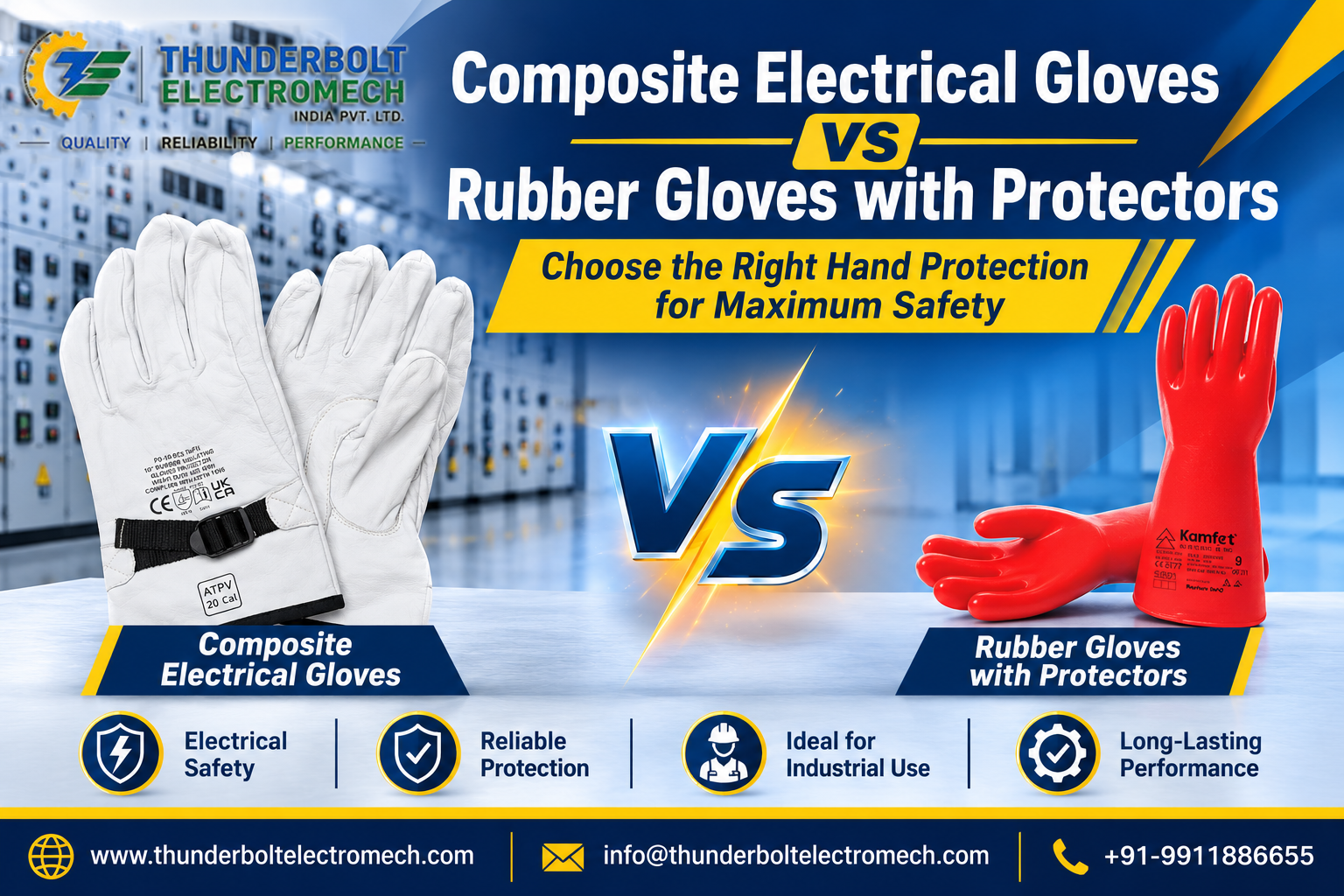
Quick Answer: Composite electrical gloves build mechanical protection into the glove, so they need no separate leather overglove. Standard thin rubber gloves still need protectors. Choose by the job’s cut and abrasion risk, not by voltage alone. If your technician keeps removing protectors to regain dexterity, test composite insulating gloves. Class 00 electrical gloves in composite form exist for low-voltage panel work. Always check the class and the hammer symbol on the label.
Introduction: The Protector That Ends Up in the Toolbox
Walk into any panel room and watch the hands. You will often see a technician in rubber gloves with the leather protectors pushed down, or missing altogether. Ask why and the answer is the same. “I can’t feel the screw.”
That shortcut costs more than it saves. A thin insulating glove has no defence against a sharp lug edge or a burr on a busbar cover. One small cut can become a pinhole, and a pinhole is a failed insulator.
As an Electrical Hand Gloves Supplier serving Delhi and the rest of India, Thunderbolt Electromech India Pvt. Ltd. hears this complaint every week. Buyers who search for an electrical hand gloves supplier Delhi trusts usually ask one question first: can we skip the protector? This blog answers it with engineering reasons, a class-by-class guide, and a clear way to choose.
We write for panel technicians, live-working crews and the engineers who buy their kit. You may not have used composite gloves yet. That is fine. We start from the basics of what each type does, then move to the decision.
What Each Glove Type Actually Does
Two glove systems compete here. They solve the same problem in different ways.
Rubber glove with leather protector. The rubber glove is the insulator. The leather overglove is armour. Each layer does one job. The rubber carries the dielectric rating. The leather takes the cuts, scrapes and punctures.
Composite glove. The maker builds the insulating layer and the mechanical layer into one structure. The glove carries both ratings. No second glove goes on top.
One maker, CATU, sells a Class 00 composite glove, the CGM-00. It is rated 500 V AC and 750 V DC under IEC 60903. The maker states it has higher mechanical properties and needs no leather overgloves. The same maker also sells a short 280 mm Class 00 rubber glove. That one gives no mechanical protection and requires silicone-leather overgloves.
Read that again. Same maker, same class, same voltage. The only difference is mechanical construction, and it changes the rules for use.
The hammer symbol
IEC 60903 labelling uses a hammer symbol for mechanically enhanced composite gloves. Look for it on the cuff or the label. No hammer, no assumption. Treat the glove as a plain rubber glove and fit the protector.
The Problem Behind the Question: Dexterity Versus Protection
Why do technicians strip the protector? Three engineering reasons explain it.
- Two layers, two sizes. The protector is cut larger than the rubber glove. The inner glove slides inside it. Fingers bunch at the tips, and the fingertip feel drops.
- Stiff leather at the joints. Leather resists bending at the knuckle. The worker has to push through that resistance on every grip.
- Poor fit between brands. A rubber glove from one maker and a protector from another rarely match. Gaps form at the fingers.
None of these makes the protector useless. Each makes it annoying. Annoying kit gets left behind.
The hazard rises quietly. A worker takes off the protector for one tight job. The job runs long. The gloves stay bare for the rest of the shift. Then a screw head catches the rubber.
What a small cut does to an insulating glove
Insulating rubber works because it is continuous. A nick of a few millimetres breaks that continuity. Moisture and dust enter the nick. The local dielectric strength falls. The glove may still look fine, and an air test may not catch a shallow cut.
This is why mechanical protection is part of electrical safety, not a separate topic. The glove’s job is to hold off voltage. Anything that damages the rubber attacks that job.
Comparison Table: Composite Gloves vs Rubber Gloves with Protectors
| Factor | Composite glove | Rubber glove + leather protector |
| Mechanical protection | Built in, shown by hammer symbol | Provided by the protector |
| Separate overglove | Not needed | Required |
| Dexterity | Usually better, single layer set | Lower, two layers |
| Fingertip feel | Better for small screws and terminals | Reduced by the extra layer |
| Cut and abrasion cover | Matched to the glove’s design | Often strong in leather, but only if worn |
| Risk of removing protection | Low | High, workers remove protectors |
| Class range | Commonly low classes, such as Class 00 | All classes 00 to 4 |
| Inspection | Whole glove, one item | Two items, rubber and leather |
| Repair and replacement | Replace the whole glove | Replace protector or rubber separately |
| Cost per pair | Often higher | Lower rubber glove, plus protector |
| Best for | Frequent, fine panel work | Heavy handling, rough surfaces, high classes |
No column wins everywhere. Composite helps most where the protector gets removed. Rubber with protector helps most where the job is rough and the class is high.
Electrical Hand Gloves Supplier India: Understanding All Glove Classes
You asked us to explain every class. Here it is. IEC 60903 defines six classes of insulating gloves. The class sets the maximum working voltage and the test voltage the maker applies.
| Class | Max working voltage (AC rms) | Max working voltage (DC) | Proof test voltage (AC) | Typical use |
| 00 | 500 V | 750 V | 2,500 V | Low-voltage control panels, DC battery work, light-duty maintenance |
| 0 | 1,000 V | 1,500 V | 5,000 V | LT panels, motor control centres, 415 V distribution |
| 1 | 7,500 V | 11,250 V | 10,000 V | Medium-voltage work to around 6.6 kV systems |
| 2 | 17,000 V | 25,500 V | 20,000 V | 11 kV and 15 kV class distribution |
| 3 | 26,500 V | 39,750 V | 30,000 V | 22 kV and 33 kV class lines |
| 4 | 36,000 V | 54,000 V | 40,000 V | Higher-voltage transmission-side work |
The maximum thickness also grows with class. The standard caps thickness at about 0.5 mm for Class 00, 1.0 mm for Class 0, 1.5 mm for Class 1, 2.3 mm for Class 2, 2.9 mm for Class 3 and 3.6 mm for Class 4. Thicker rubber means a stiffer glove. That is why dexterity falls as the class rises.
Class 00: the dexterity class
Class 00 is thin. That is its strength. It suits meter reading, terminal tightening and control wiring where feel matters. Class 00 electrical gloves in composite form fit this work well, because the mechanical layer comes in the same package. A Class 00 rubber glove without a protector is the most fragile setup in the table. Buyers searching for Class 00 gloves Delhi stockists often get this wrong.
Class 0: the everyday panel class
Class 0 covers 1,000 V AC. It is the workhorse for LT panel rooms in Indian factories. It is thin enough for fine work and strong enough for 415 V systems. Pair it with a protector, or choose a composite type if the maker offers one.
Class 1 to Class 4: the high-voltage classes
As the class rises, rubber gets thicker and stiffer. Leather protectors become essential for abrasion. At these classes, the glove protects a lineman at height, working near live conductors. Dexterity matters less than insulation margin. We rarely see composite gloves at the top classes. Check the datasheet before you assume.
What the class does not tell you
A class does not say how the glove handles a cut. It does not say how long the glove lasts in the field. It does not say if the glove is arc rated. Those come from the maker’s design, the glove’s category marking, and your inspection routine.
Engineering Insight: Match the Glove to the Cut and Abrasion Risk
Most buying advice stops at voltage. We think that is half the answer. Voltage fixes the class. The surface the worker touches fixes the glove type.
Here is the method our team uses on site visits. Score the job on three simple points.
- Edge exposure. Does the task touch sharp lugs, cut metal or fasteners with burrs?
- Contact time. How long do the hands stay in the panel? A ten-minute job and a four-hour shutdown job differ.
- Fine motor demand. Does the task need small screws, thin conductors or tight terminals?
Now read the result.
- High edge exposure, low fine motor demand: rubber glove with leather protector.
- Low edge exposure, high fine motor demand: composite glove, if the class fits.
- High on both: composite or a thin rubber glove with a close-fitting protector, plus a stricter inspection routine.
- Low on both: either works. Pick on cost and comfort.
A rule we give crews
If your team removes the protector more than once a week, the protector is not working for them. Do not scold the crew. Change the system. Trial a composite glove on the task where the protector comes off.
One limit to remember
Mechanical strength does not equal arc protection. A hammer symbol says the glove resists cuts and abrasion. It does not make the glove arc rated. Arc-flash protection needs its own rating, and your site’s risk assessment decides it.
Customer Problems and Solutions
These are the issues our sales desk hears most.
Problem 1: “My crew removes the protectors.”
Solution: find the task that triggers it. Usually it is fine work on small terminals. Trial a composite glove for that task, or fit a closer protector.
Problem 2: “The protector and the rubber glove do not fit together.”
Solution: buy both from a matched set. Size the rubber glove first. Then choose the protector for that size.
Problem 3: “We bought thin rubber gloves with no protector.”
Solution: pull them from live work until protectors arrive, or until you replace them with composite gloves. A Class 00 or Class 0 rubber glove alone is not a mechanical barrier.
Problem 4: “We cannot tell if a glove is composite.”
Solution: look for the hammer symbol and the maker’s data sheet. If neither is there, treat it as a standard rubber glove.
Problem 5: “The gloves pass the air test but cut easily.”
Solution: an air test checks for leaks, not for toughness. A glove can pass and still be thin at one spot. Replace on visible damage, not just on test results.
Problem 6: “Procurement wants the lowest price.”
Solution: compare cost per working month, not cost per pair. A cheap pair that is damaged early costs more. We cover this idea in our buying guide.
Real Use Cases
Numbers help. Real rooms help more.
Use case 1: LT panel maintenance in a plant
Crews work inside open cubicles at 415 V. Tasks include tightening lugs and swapping fuses. Edges are mild. Fine work dominates. A Class 0 glove with a close protector, or a composite option, fits best.
Use case 2: Battery bank and DC systems
DC voltages stay low, but fault current is high. Fine work on terminals is constant. Class 00 or Class 0 suits it. A composite Class 00 glove saves the fuss of a second layer in tight battery racks.
Use case 3: Substation switching at 11 kV
Operators rack breakers and operate isolators. Handles are rough. Dirt and moisture are common. Class 2 rubber gloves with leather protectors remain the practical choice.
Use case 4: Overhead line crews
Work at height, with rough pole hardware. High class, heavy abrasion. Thick rubber with sturdy protectors. Dexterity takes second place.
Use case 5: Contractor shutdown with mixed tasks
One day brings both light and rough work. A crew can carry both types and swap by task. Keep both in labelled bags so nobody mixes protectors across brands.
Case Study: A Panel Crew That Stopped Removing Protectors
This is an illustrative case based on typical site audits. It shows the method, not one client’s data.
The setting. A manufacturing unit near Delhi NCR. A six-person maintenance team looks after LT panels, MCCs and a DC battery room. Everyone wore Class 0 rubber gloves with leather protectors.
The observation. During a week of site walks, our team noted how often protectors came off. Three of six workers removed them during terminal work. Two kept them off for the full task. One glove showed a visible nick at the thumb base.
The diagnosis. Terminal work needed fingertip feel. The protectors were from a different maker and ran one size large. Fingers bunched inside.
The fix.
- Fit matched protectors, correctly sized, for the heavy tasks.
- Trial composite-type Class 00 and Class 0 gloves for terminal work where available.
- Add a two-minute visual check before each shift, covering thumb bases and fingertips.
- Retire the nicked glove at once.
The result. In the follow-up walk, protectors stayed on for rough work. Fine work used the glove type built for it. Nobody worked bare-handed over a protector. The lesson is simple. People follow rules that let them do the job.
Electrical Hand Gloves Supplier India: Raychem, Vidyut and Crystal Gloves
Thunderbolt Electromech India Pvt. Ltd. supplies Raychem electrical hand gloves across India. We also sell Vidyut and Crystal electrical hand gloves. You can see the range on our electrical hand gloves product page and the wider electrical hand gloves category.
Here is how we help you choose.
- Start with class. Tell us your working voltage. We match the class.
- Then ask about the task. Fine work or rough work? That decides whether you need a protector.
- Check the marking. We read the label with you, including the hammer symbol where it applies.
- Ask about composite. If you want a composite type, ask us for current availability in the class you need. We confirm it against the maker’s data sheet before we quote.
We do not promise a composite glove where none exists in a brand’s range. We would rather tell you that plainly.
For a deeper look at classes, testing and care, read our complete buying and safety guide.
How to Choose an Electrical Hand Gloves Supplier in Delhi and Across India
A good supplier does more than ship a box. These checks help you pick one.
- Class and test report. Ask for the class, the test voltage and a test record for the batch.
- Marking. The glove should show class, standard, size and manufacture date. A hammer symbol should appear on composite types.
- Size range. A wrong size ruins dexterity. Ask for the sizing chart.
- Protector match. Buy protectors made for the glove size.
- Storage advice. Rubber ages. Ask how to store it and how often to retest.
- Support after the sale. You may need advice on retesting or replacement.
A Delhi supplier brings one more advantage. You can walk in, hold the glove and try the fit. Many buyers from across NCR visit our Chawri Bazar shop for exactly that reason.
Pair gloves with the rest of panel-room safety
Gloves work alongside other controls. A clear danger plate on every panel door tells people what lies behind it. Buyers who search for a danger plate supplier Delhi often buy gloves in the same order. A panel danger plate with a proper warning symbol, an electrical danger sign board at the room entry, and a high voltage danger plate on live cubicles all support glove use. Ask us about danger plates when you place a glove order, and we can quote both together.
Care, Inspection and Retesting
The best glove fails when care is poor. Keep this short routine.
- Visual check before every use. Look for cuts, swelling, cracks, discolouration and embedded particles.
- Air test. Roll the cuff and trap air. Squeeze gently and listen for leaks. This checks for holes, as our other guides explain.
- Clean and dry. Wash with mild soap and water. Dry away from heat and sunlight.
- Store flat or loosely hung. No folding, no sharp tools alongside.
- Retest on schedule. Follow the maker’s interval and your site policy. Many sites retest at around six months in service.
- Retire on doubt. If you wonder whether a glove is safe, it is not.
Composite gloves need the same routine. The built-in mechanical layer does not remove the need to inspect.
Trust and Contact Details
Looking for an electrical gloves dealer Delhi NCR users can visit, or one that dispatches across India? We do both. We also help buyers who want Class 00 gloves Delhi stock for panel and battery work.
Thunderbolt Electromech India Pvt. Ltd. Shop No. 3538, Sitaram Bazar Rd, Bazar Sirkiwalan, Chawri Bazar, Chandni Chowk, Delhi, 110006 Phone: +91-9911886655 Email: info@thunderboltelectromech.com
Send your working voltage, task type and glove size. We will suggest a class, a glove type and a protector match.
Frequently Asked Questions
1. What are composite electrical gloves?
They are insulating gloves with mechanical protection built into the glove. They need no separate leather overglove. Look for the hammer symbol on the label.
2. Do rubber electrical gloves always need protectors?
Standard thin rubber gloves do. The rubber insulates. The protector guards against cuts, abrasion and punctures.
3. Which class of glove is composite?
Composite types appear most often in low classes, such as Class 00. One maker’s Class 00 composite glove is rated 500 V AC and 750 V DC. Check the data sheet for the class you need.
4. What does the hammer symbol mean?
IEC 60903 uses it to mark mechanically enhanced composite gloves. It tells you the glove has higher mechanical protection.
5. Do composite gloves give arc-flash protection?
Not by default. Mechanical strength and arc rating are separate. Check for a specific arc rating if the risk exists on your site.
6. Can I wear a Class 00 rubber glove without a protector?
No. A short Class 00 rubber glove gives no mechanical protection and needs silicone-leather overgloves.
7. Which glove class suits an LT panel?
Class 0 covers up to 1,000 V AC and suits 415 V panels. Class 00 covers up to 500 V AC and fits lower-voltage and DC work.
8. How often should I retest insulating gloves?
Follow the maker’s interval and your site policy. Many sites retest around every six months in service. Retire any glove with visible damage at once.
9. Does the air test replace electrical testing?
No. The air test finds leaks. It does not measure dielectric strength. Laboratory retesting does.
10. Where can I buy Raychem, Vidyut or Crystal gloves in India?
Thunderbolt Electromech India Pvt. Ltd. supplies them from Chawri Bazar, Delhi, and dispatches across India. Call +91-9911886655 or write to info@thunderboltelectromech.com.
Conclusion: Choose the Glove System That Workers Will Keep On
Here is the whole blog in short.
Composite electrical gloves build mechanical protection into the insulating glove, so they need no separate overglove. Standard thin rubber gloves still need leather protectors. The real danger is not either type. It is the protector that comes off because the worker cannot feel the screw.
We covered the six IEC 60903 classes, from Class 00 at 500 V AC to Class 4 at 36,000 V AC. Low classes favour dexterity, and composite gloves fit that space. High classes need thick rubber and sturdy protectors. We compared both systems in a table, scored jobs by edge exposure, contact time and fine motor demand, and worked through six customer problems, five use cases and one site case study. The decision rule is simple. Match the glove to the cut and abrasion risk, then confirm the class, the label and the hammer symbol.
Why choose Thunderbolt Electromech India Pvt. Ltd.? Because we work as a practical Electrical Hand Gloves Supplier, not a box shipper. We supply Raychem, Vidyut and Crystal electrical hand gloves. We read labels with you. We tell you plainly when a product does not exist in a brand’s range. We also supply danger plates and other panel safety items, so you can order in one place. You will find us in Chawri Bazar, Delhi, at +91-9911886655 and info@thunderboltelectromech.com.
Ready to choose? Browse the electrical hand gloves category, read the buying and safety guide, and send us your job details today.
