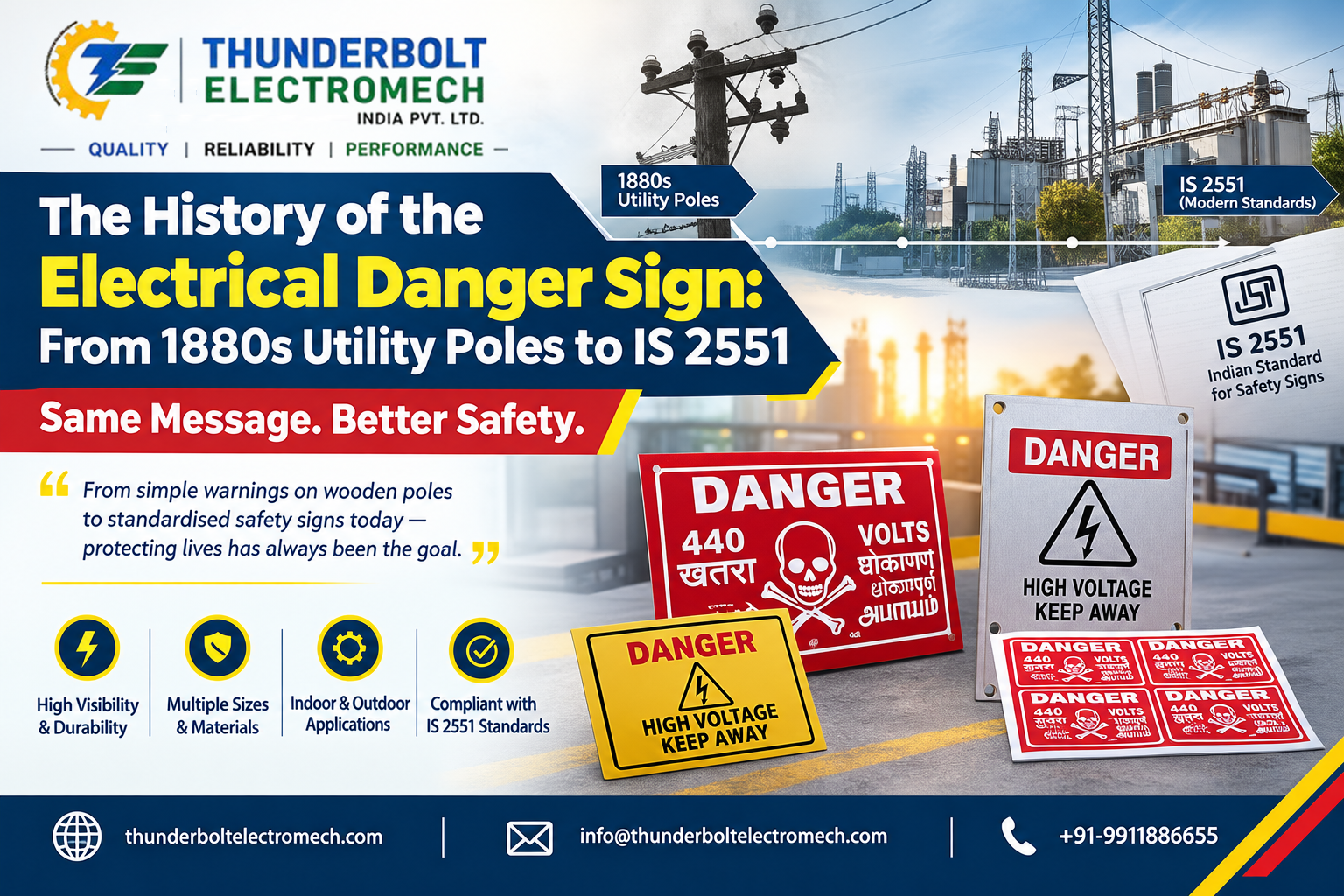
Quick Answer: The electrical danger sign traces back to the 1880s, when American and European utilities began marking newly electrified poles with skull-and-crossbones warnings borrowed from poison-bottle labelling. India formalised this practice under Indian Electricity Rule 35 and later IS 2551 (1963, revised 1982), which still governs plate size, colour and lettering today. If you’re sourcing a compliant board, working with an established Danger Plate Supplier who understands both the standard and the metallurgy behind it saves you from failed inspections and repeat purchases.
Most safety signage articles read like a checklist copied from a compliance PDF. This one doesn’t. We went back to the original Bureau of Indian Standards document, the Indian Electricity Rules of 1956, and 140 years of sign-making history to explain why the red rectangle with the skull sits on every transformer in the country — not just that it does.
Why This History Actually Matters to a Buyer Today
Here’s an engineering truth that most vendors won’t tell you: a danger plate is not decoration. It’s a legally mandated risk-communication device with a documented failure mode. When a plate fades, rusts through, or uses the wrong pictogram, the sign itself becomes the safety failure — not the wiring behind it. Understanding where the design came from tells you exactly which corners a cheap supplier is likely to cut.
Knowing this history also explains something buyers rarely question: why does an 1880s pictogram — a human skull — still appear on a 2026 substation door? The answer is recognition speed. A skull requires zero literacy and zero colour vision to register as “stop.” Every redesign attempt over the last century has failed to beat that one metric.
The 1880s: Electricity Arrives, and So Does the First Death Warning
Commercial electric power distribution began in earnest in the early 1880s, right around the time Edison’s Pearl Street Station started supplying New York in 1882. Within a handful of years, utilities were stringing bare conductors on wooden poles through public streets — and people were dying by touching them.
Safety became an increasing concern for electric utilities during the 1880s, and the “Danger of Death, Keep Off” sign emerged as part of that broader safety push. This wasn’t a single company’s marketing decision. It was a reaction to a genuine public-health crisis: exposed high-tension lines killing linemen and pedestrians in numbers that newspapers of the era openly reported. Organisations such as the National Safety Council and the American Society of Safety Engineers lobbied utilities for safer equipment and better worker education, and warning plates on poles were one of the earliest, cheapest interventions available.
Engineering insight: early utility signs weren’t standardised because there was no shared voltage classification system yet. A “danger” plate on a 1890s pole might warn against 2,000 volts or 20,000 volts — the sign said nothing about severity. This lack of graded warning is exactly the gap that Indian regulation would later close by tying plate size and wording to voltage class, a detail we’ll return to.
Where the Skull Came From: A Borrowed Symbol, Not an Invented One
The skull-and-crossbones on your danger plate wasn’t designed for electricity at all. It’s a recycled pictogram with a documented, centuries-long paper trail.
By the 1880s, the skull and crossbones had become the near-universal marker for poison, following an 1829 New York State law requiring poison containers to carry a clear warning label. Manufacturers gravitated toward the skull because it already carried centuries of association with mortality — used on plague plaques, military insignia, and burial markers long before it ever touched a bottle.
When electricity arrived as a new, invisible killer with no smell, sound, or colour to warn people away, sign-makers reached for the symbol vocabulary they already had. The skull didn’t need translation, didn’t need literacy, and already meant “this will kill you” in the public imagination. Electricity simply inherited it.
Labelled honestly: no single document records the exact year the skull first appeared specifically on an electrical sign rather than a poison bottle — the transfer likely happened gradually across the 1880s–1900s as utilities copied the format nearest to hand. This is an inferred continuity, not a directly documented handoff, and we’re flagging it as such rather than presenting it as settled fact.
History of the Danger Sign in India: From Colonial Rule to a National Standard
India’s regulatory history around danger signs is unusually well documented, because it runs through a chain of statutes you can still read today.
Electricity supply in India began under British administration in the late 19th century, governed loosely by the Indian Electricity Act of 1910. Safety provisions matured considerably under the Indian Electricity Rules, 1956, which remained the operative safety framework for nearly five decades. Rule 35 of these Rules required the owner of every medium, high, and extra-high voltage installation to permanently affix a danger notice in Hindi or English and the local language of the district, carrying the sign of skull and bones, in a design conforming to IS No. 2551.
That single sentence is the legal ancestor of every red danger plate bolted to an Indian transformer today.
How IS 2551 Was Born
The original IS 2551 standard was first prepared in 1963 to cover a Hindi-language version of the notice plates consistent with the rules then in force. Nearly two decades later, the Bureau of Indian Standards revisited it. IS 2551-1982 was adopted by the Indian Standards Institution on 7 October 1982, and it remains, remarkably, still the governing document — reaffirmed in 2005 and again in 2010 without a further technical revision.
The 1982 revision existed specifically to standardise notice-plate features in line with the amended Rule 35, and to lay down essential requirements and tests to ensure the plates actually function as intended in the field. That last clause is easy to skim past, but it’s the whole point: BIS wasn’t just regulating what the sign says. It was regulating whether the sign survives long enough to keep saying it — hence the weatherproofing and colour-retention tests baked into the standard.
This is a primary regulatory source — the actual BIS document text, archived and searchable — not a paraphrase from a secondary blog.
What IS 2551 Actually Specifies (Most Suppliers Skip This Part)
The standard recommends two plate sizes: 200 × 150 mm for display at medium-voltage installations, and 250 × 200 mm for high and extra-high voltage installations. All lettering must be centrally spaced, with letter and figure dimensions fixed by the standard’s own technical figures for each voltage class.
Two details most buyers never see in a spec sheet:
- Weather-proofness testing verifies colour retention of vitreous enamel coatings against a defined test method — the standard was written around enamel because that was the dominant rust-proof finish of the early 1980s. Powder coating, the material most suppliers use today, has to meet the same intent even though the base technology has moved on.
- The word “Danger” must appear in the universal languages of Hindi or English, with recommended equivalents provided for other regional languages — meaning a plate installed in Tamil Nadu or Punjab isn’t automatically compliant with a Delhi-standard Hindi/English board if the local inspector expects the regional-language equivalent too.
If you want the full buying checklist — voltage-to-size mapping, material selection, and installation placement rules — we’ve built that out separately on our Danger Plate Supplier in India: Complete Buying & Safety Standards Guide.
Rule 35 Is Gone — Here’s What Replaced It
Here’s something almost no supplier website mentions, and it matters if you’re doing compliance work in 2026. The Indian Electricity Rules of 1956 were formally replaced on 20 September 2010 by the Central Electricity Authority (Measures relating to Safety and Electric Supply) Regulations, 2010. Those 2010 regulations were themselves superseded again: the CEA notified the Measures relating to Safety and Electric Supply Regulations, 2023 on 8 June 2023, expressly suppressing the 2010 regulations.
The 2023 regulations set general safety requirements for the construction, installation, protection, operation, and maintenance of electric supply lines and apparatus, covering installations above and below 650 volts, overhead lines, underground cables, renewable generating stations, EV charging stations, and HVDC systems. The danger-notice obligation itself carries forward in substance — IS 2551 is still the referenced design standard — but the parent legal instrument citing it has changed twice since the plate on your factory wall was probably installed.
This is precisely the kind of detail a danger plate heritage supplier Delhi buyers have relied on for years should be tracking, because a plate that references “IE Rule 35” in its paperwork rather than the current CEA regulation number can raise unnecessary questions during a modern safety audit — even though the design specification itself hasn’t changed.
Material Evolution: Enamel, Mild Steel, Aluminium, and Vinyl
The 1982 standard was written for an enamel-coated era. Materials science has moved a long way since, and the choice genuinely changes plate lifespan — this isn’t marketing language, it’s basic corrosion chemistry.
Vitreous enamel (the original IS 2551 test material) is glass fused onto steel at high temperature. It’s extremely UV-stable and almost impossible to fade, but it’s brittle — a hard knock from a ladder or forklift can chip it down to bare metal, and that exposed edge becomes a rust-initiation point.
Powder-coated mild steel (1.6mm) replaced enamel as the dominant industrial choice because it resists impact far better while still giving a thick, baked-on pigment layer. The trade-off: if the powder coat is ever scratched through to bare steel — say, during transport or drilling mounting holes — corrosion can start at that exact point, especially in coastal or chemical-plant air. That’s why edge-sealing and pre-drilled, powder-coated hole edges matter more than most buyers realise.
Aluminium plates sidestep the rust question entirely, because aluminium forms a stable, self-limiting oxide layer rather than rusting through. That makes aluminium the better call for coastal substations, cement plants, or anywhere chemical fumes are present — at a moderate weight and cost premium over steel.
Vinyl danger stickers solve a completely different problem: curved surfaces, control-panel doors, and cable trays where a rigid plate can’t be mounted or where budget and quick replacement matter more than 15-year durability. They’re not a substitute for a load-bearing structural sign at a substation gate — they’re a complement for tighter, interior applications.
Comparison Table: Choosing the Right Danger Sign Material
| Parameter | Powder Coated MS Plate | Aluminium Plate | Vinyl Danger Sticker |
| Typical Sizes (Thunderbolt range) | 200×150 mm, 200×250 mm | 150×75 mm, 200×150 mm, 200×250 mm | 75×150 mm, 150×200 mm, 200×250 mm |
| Best Use Case | Substation gates, transformer yards, fences | Coastal, chemical, or humid installations | Panel doors, curved surfaces, cable trays |
| Corrosion Behaviour | Rust risk only if coating is breached | Self-passivating oxide layer, near-zero rust | Not applicable — no metal substrate |
| Structural Rigidity | High — resists bending and impact | Moderate — lighter, slightly more flexible | Low — needs a rigid backing surface |
| UV/Fade Resistance | Good with quality powder coat | Very good | Fair — depends on laminate grade |
| IS 2551 Compliance | Yes, when dimensions/lettering match | Yes, when dimensions/lettering match | Acceptable for interior use per site policy |
| Approx. Lifespan (outdoor) | 8–12 years | 12–15+ years | 3–5 years |
| Relative Cost | Moderate | Moderate–High | Low |
No single material is universally “best” — the right call depends on installation environment, voltage class, and mounting surface, which is exactly the kind of decision an experienced Danger Plate Supplier should walk you through rather than sell you a default SKU.
The Latest Trends: Where Danger Signage Is Heading in 2025–2026
Danger signage isn’t a frozen category. Three shifts are visible right now, and they matter for anyone specifying signage today rather than in 1982.
1. Retroreflective and photoluminescent hybrids are moving from niche to mainstream.
Industrial safety signage projects now specify heavy-duty retroreflective sheeting combined with photoluminescent materials so signs stay visible under forklift headlights, torchlight, or during power outages. This started in mines and tunnels, where visibility during blackout is a life-safety issue rather than a convenience, but it’s spreading into general industrial signage as the material costs fall.
2. Government-driven signage modernisation is accelerating replacement cycles.
Municipal bodies are actively swapping older signage for standardised retroreflective versions — one recent municipal project replaced older green signage with standardised blue retro-reflective boards across roughly 60 locations, in line with Indian Road Congress norms. While that specific example is road signage rather than electrical, it signals a broader public-sector appetite for visibility-upgraded signage that electrical safety boards are following.
3. The safety signage market itself is growing fast, and India is a meaningful part of that growth.
The global safety signs market is projected to grow from roughly USD 2.74 billion in 2025 to USD 2.96 billion in 2026, at close to an 8% compound annual growth rate, with reflective and highly visible materials, digital and LED signage, and multilingual symbol-based warning systems named as leading trends through the decade. For Indian buyers, that translates into more choice, but also more low-quality imports entering the market — which makes IS 2551 conformance an even more important filter, not less.
Labelled honestly: point 2’s specific example is municipal road signage, cited to illustrate the general modernisation trend, not a direct electrical-signage case study — we’re flagging that distinction rather than blurring it.
Customer Problems We See Every Week — And the Actual Fix
Talking to procurement teams and site engineers across India surfaces the same handful of problems on repeat. Here’s what they are, and what actually resolves them.
Problem: “Our plates faded to pink within two years.”
This is almost always a powder-coat quality issue, not a design flaw in IS 2551 itself. Cheap suppliers cut corners on the UV-stabiliser content of the pigment. Solution: ask your supplier for the pigment grade and UV test data before ordering in bulk — a compliant plate that fades within 24 months has failed its purpose regardless of what the standard says on paper.
Problem: “The electrical inspector rejected our plates during audit.”
Usually caused by non-standard lettering size or missing the local-language equivalent of “Danger.” Solution: buy from a supplier that manufactures strictly against the IS 2551 lettering-and-figure dimensions rather than a generic “danger sign” template scaled up or down freely.
Problem: “We need different sizes for different voltage zones and keep ordering the wrong one.”
Solution: map your voltage classes to plate size once, in writing, before your first order — 200×150 mm for medium voltage, 250×200 mm for high and extra-high voltage — and standardise procurement around that table rather than re-deciding for every purchase order.
Problem: “Our old signs reference ‘IE Rule 35’ and our new auditor flagged it as outdated.”
Solution: this is a paperwork issue, not a plate-quality issue. The physical design requirement under IS 2551 hasn’t changed, but your documentation should reference the current CEA 2023 Regulations rather than the superseded 1956 Rules.
Why a Heritage Supplier in Delhi Still Matters in a National Market
You can buy a danger plate from almost anywhere in India today — e-commerce has flattened geography for most industrial goods. So why does a danger plate heritage supplier Delhi buyer would recognise still hold an edge?
Delhi’s Chandni Chowk and Sadar Bazar trading belt has manufactured and distributed electrical hardware — cable accessories, safety plates, panel components — for generations, long before national e-commerce existed. That density of specialised manufacturing means shorter lead times on custom voltage markings, easier physical inspection before dispatch for Delhi-NCR buyers, and institutional familiarity with what electrical inspectors across northern India actually expect at audit.
Thunderbolt Electromech India Pvt. Ltd. operates from exactly that trading heritage, manufacturing:
- Powder Coated Danger Plates in 200 × 150 mm and 200 × 250 mm
- Aluminium Danger Plates in 150×75 mm, 200×150 mm, and 200×250 mm
- Danger Stickers in 150×200 mm, 200×250 mm, and 75×150 mm
— covering the full IS 2551 size range across three material types, so a single Danger Plate Supplier relationship can outfit an entire site rather than forcing separate vendor negotiations per material.
Trust Signals: Who You’re Actually Buying From
E-E-A-T isn’t a checkbox — it means a buyer should be able to verify who they’re dealing with before money changes hands. Here’s that information, plainly stated:
- Company: Thunderbolt Electromech India Pvt. Ltd.
- Address: Shop No. 3538, Sitaram Bazar Rd, Bazar Sirkiwalan, Chawri Bazar, Chandni Chowk, Delhi – 110006
- Phone: +91-9911228857 / +91-6391217408
- Email: info@thunderboltelectromech.com
We’d rather list a real shop address in a 150-year-old trading market than hide behind a generic contact form — that’s a deliberate choice, not an omission.
Explore More on Danger Plate Compliance
This article is part of our ongoing coverage of electrical danger signage in India. For the complete buying and standards framework, start with our pillar guide: Danger Plate Supplier in India: Complete Buying & Safety Standards Guide. You’ll find related deep dives — on sizing by voltage class, material selection, and installation placement — in our full Danger Plate blog category.
Frequently Asked Questions
Is IS 2551 still legally mandatory in 2026?
Yes. Even though the parent regulation has changed from the 1956 Rules to the 2023 CEA Regulations, IS 2551 remains the referenced design standard for danger notice plates on medium, high, and extra-high voltage installations.
Why does the danger sign still use a skull, not a lightning bolt?
The skull predates electrical use entirely — it was already the internationally recognised symbol for lethal hazard through poison labelling before electricity adopted it. No redesign since has matched its instant, literacy-independent recognition.
What’s the difference between the two IS 2551 plate sizes?
200×150 mm is specified for medium-voltage installations; 250×200 mm (commonly supplied as 200×250 mm) is specified for high and extra-high voltage installations.
How often should a danger plate be replaced?
Powder-coated mild steel typically holds up 8–12 years outdoors; aluminium can exceed 15 years; vinyl stickers used for interior panels usually need replacement every 3–5 years. Replace immediately, regardless of age, once lettering fades to the point of reduced legibility.
Conclusion
An electrical danger sign looks simple. It isn’t. Every element on that red-and-white plate — the skull, the exact letter height, the plate’s own weatherproofing test — carries a decision made somewhere between an 1880s American utility pole and a 1982 Bureau of Indian Standards committee room. None of it is arbitrary, and none of it has finished evolving; the CEA’s 2023 regulations and the industry’s shift toward retro reflective and photo luminescent finishes prove that. For a buyer, the practical takeaway is straightforward: match your plate size to your voltage class, verify the material against your site’s environment, and work with a Danger Plate Supplier who can speak to both the history behind the standard and the metallurgy that keeps it legible for the next decade — not just the next inspection.