By Thunderbolt Electromech India Pvt. Ltd. — Delhi-based Stockist & Distributor of Venus, Tycab, Bestrap & KSS Cable Ties
📞 +91-9911886655 | ✉️ info@thunderboltelectromech.com | 🌐 thunderboltelectromech.com | 📍 Shop No. 3538, Sitaram Bazar Rd, Bazar Sirkiwalan, Chawri Bazar, Chandni Chowk, Delhi – 110006
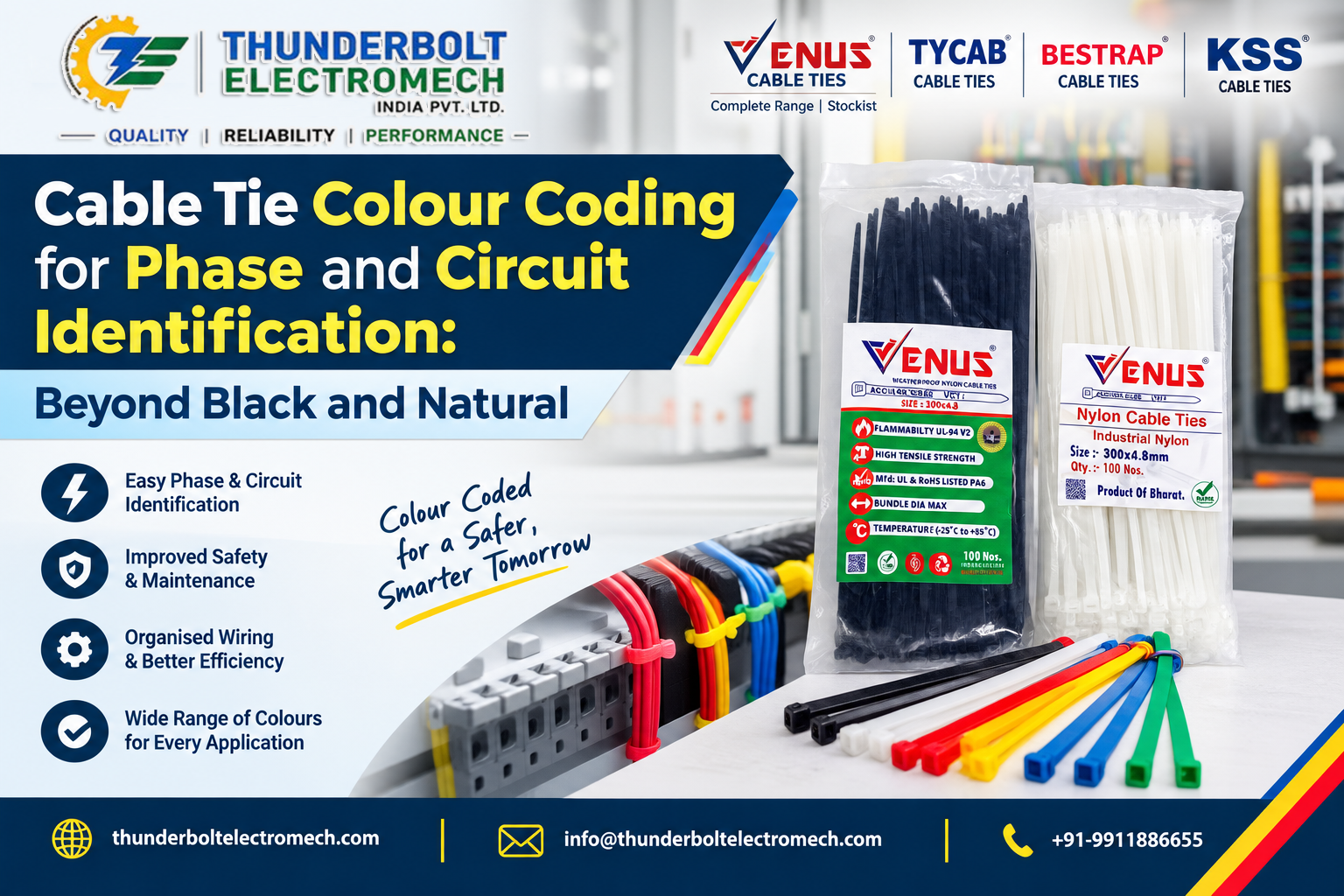
Quick Answer: Cable ties aren’t just black or natural. Coloured ties — red, yellow, blue, green, and printed marker variants — let panel builders mark phases (R-Y-B or Brown-Black-Grey), separate control wiring from power wiring, and flag DC polarity on solar and EV jobs, all without touching the conductor’s own insulation colour. There is no single mandatory Indian standard for tie colour itself, so most sites follow the same convention already used for wire insulation under IS 732:2019. A dependable cable ties supplier India partner stocks red, yellow, blue, black, green, and marker ties across Venus, Tycab, Bestrap, and KSS so one colour scheme can be applied consistently across an entire panel shop.
Introduction
Walk into most panel-fabrication units in Delhi-NCR and you’ll find two boxes of cable ties on the workbench: natural (white) and UV-black. That’s it. Everything else — every phase, every circuit, every DC-positive or DC-negative run — gets bundled with whatever colour happens to be in the bin that week. It works, mostly, until a technician six months later opens the panel for a fault and has no fast way to tell which bundle belongs to which phase without pulling out a multimeter and tracing wire by wire.
That gap is what this guide addresses. Wire insulation colour is already regulated territory in India — IS 732:2019 tells you what colour a phase conductor, neutral, or earth wire should be. But the cable tie holding that bundle together is a separate, unregulated choice, and almost nobody treats it as a design decision. It should be. A correctly colour-coded tie scheme turns a five-minute fault-finding job into a thirty-second visual check, and it costs nothing extra if you plan the SKU mix before ordering rather than after a breakdown.
We’ll walk through the actual standards that touch this topic (and the ones that don’t), two real categories of on-site problems this causes, a practical colour scheme you can copy directly, a brand-by-brand quick reference for Venus, Tycab, Bestrap, and KSS, and where cable lugs fit into the same colour-coding logic — because a bundle that’s perfectly colour-marked but terminated on an unmarked lug still leaves half the job undone. Throughout, we’ll flag which claims come from a named standard and which reflect field practice with no single documented source, so you’re not left guessing where the “rule” actually comes from.
1. Cable Ties Supplier India: Why Black and Natural Aren’t Enough Anymore
Ask most Indian electrical contractors why they use black cable ties outdoors and natural ones indoors, and the answer is simple: UV resistance and cost. Black PA66 with carbon-black loading survives sunlight; natural nylon is cheaper and fine indoors. That logic is sound as far as it goes. But it treats the cable tie purely as a fastener, when in a multi-phase panel it can also be a piece of information.
Consider a rooftop solar combiner box with eight DC string inputs, or a three-phase MCC panel feeding four separate motor starters. In both cases, every bundle looks identical once it’s tied off in the same natural or black tie. The only way to tell them apart later is a wire tag, a printed label, or memory — and memory is the least reliable of the three, especially six months after commissioning when the original technician has moved to a different site.
This is the real reason procurement teams are starting to specify coloured cable ties as a line item, not an afterthought. A cable ties supplier India buyer works with should be able to supply red, yellow, blue, green, and marker-flag ties in the same widths and tensile ratings as the standard black and natural range — not as a special-order novelty, but as regular stock. When that’s true, colour coding costs nothing beyond a small planning exercise on the purchase order. When it isn’t true, buyers either give up on the idea or end up sourcing one colour from one vendor and another from a second, which defeats the point of standardising in the first place.
2. Cable Tie Colour Coding Standards: What IS 732, IEC 62275 and IEC 60204-1 Actually Cover
Here’s where a lot of confusion starts, so it’s worth being precise about what each standard actually governs.
IS 732:2019 (Code of Practice for Electrical Wiring Installations) sets India’s conductor insulation colours: Red–Yellow–Blue for the three phases, Black for neutral, and Green or Green-Yellow for earth in the older, still widely used convention; newer installations increasingly follow the IEC-harmonised Brown–Black–Grey phase colours with Light Blue neutral. (Direct source: IS 732:2019, Bureau of Indian Standards.) This standard governs the wire’s own insulation — not the tie, tape, or label wrapped around it.
IEC 62275 (“Cable management systems — Cable ties for electrical installations,” now in its 4th edition, 2022, with UL 62275 and CSA C22.2 No. 62275 as its North American harmonised equivalents) governs the mechanical and material performance of the tie itself — tensile strength retention, temperature cycling, and the Type 1 versus Type 2 classification for how much strength a tie must retain after ageing. (Direct source: IEC 62275, 4th edition.) It does not specify tie colour at all.
IEC 60204-1 (Safety of machinery — Electrical equipment of machines) is closer to the mark: it recommends colour-based conductor identification inside machine control panels and is commonly cited by cable-tie and wire-marking manufacturers as the rationale for colour-coded accessories in industrial control cabinets. (Direct source: IEC 60204-1, referenced widely in industrial wiring colour-coding guidance.)
ANSI/TIA-606-C, the telecommunications infrastructure labelling standard, recommends specific colours for structured cabling categories (backbone, horizontal, equipment) — relevant to data-centre and server-room cable ties, less so to power panels. (Direct source: ANSI/TIA-606-C.)
Put together, this means: no dedicated Indian or international standard mandates a specific cable tie colour for phase identification. (No direct standard found specifying tie colour itself — this is inferred contractor practice built on top of the wire-colour standards above, not a documented tie-colour rule.) What sensible sites do instead — and what this guide recommends — is mirror the same Red-Yellow-Blue or Brown-Black-Grey convention already mandated for the wire insulation, so the tie colour and the wire colour tell the same story rather than two different ones.
3. The Real-World Problem: What Happens When Bundles Aren’t Colour-Marked
Two patterns show up repeatedly in panel-wiring and O&M work across the NCR industrial belt, and both are entirely preventable at the purchase-order stage.
Pattern one — the “which phase is this” delay.
A maintenance electrician opens an MCC panel to trace a tripped breaker. The wiring is correctly colour-coded at the conductor level, but every bundle is tied with the same natural tie, so multiple phases run through the same visual “block” of cable. Untangling which loop belongs to which phase means following each wire by hand along its full run — a five-to-fifteen-minute job that a single glance at colour-coded tie bundles would cut to under a minute. Multiply that delay across dozens of fault calls a year on a large industrial site and the cumulative labour cost is real, even though it never shows up as a single line item anywhere.
Pattern two — DC polarity confusion on solar and battery jobs.
Unlike AC phase wiring, DC installations (solar strings, battery banks, EV charging DC buses) don’t have a BIS-mandated colour code for positive and negative in the same way AC phases do. Two crews from two different contractors working the same rooftop, using two different informal conventions for which colour means positive, is a documented source of site confusion during commissioning and later maintenance handover — technicians have to re-verify polarity with a meter rather than trusting colour, defeating the purpose of colour-coding altogether. The fix isn’t a new standard; it’s a single documented convention, written into the site’s own wiring standard and applied consistently with coloured ties and marker flags at every termination point, so the “meaning” of red or blue doesn’t depend on which contractor tied that particular bundle.
Neither problem is expensive to prevent. Both require exactly the same fix: agree a colour scheme before wiring starts, write it down, and stock the ties needed to follow it — which is a sourcing decision as much as a design one.
4. A Practical Colour-Coding Scheme for Phase and Circuit Identification
Here is a scheme that mirrors the existing IS 732 wire-colour convention rather than inventing a new one — which matters, because a scheme that contradicts the wire colour underneath it is worse than no scheme at all.
| Bundle / Circuit Type | Recommended Tie Colour | Logic |
| Phase 1 (L1 / R) | Red | Matches R-Y-B wire convention |
| Phase 2 (L2 / Y) | Yellow | Matches R-Y-B wire convention |
| Phase 3 (L3 / B) | Blue | Matches R-Y-B wire convention |
| Neutral | Black or Natural | Matches Black-neutral convention; avoid confusing with earth |
| Earth / Protective Conductor | Green or Green-Yellow marker tie | Matches earth wire convention |
| Control wiring (24V/110V) | Grey or a dedicated fourth colour | Visually separates control loops from power bundles at a glance |
| DC Positive (solar / battery / EV) | Red (site-documented) | No mandated standard; must be fixed on site and never changed mid-project |
| DC Negative (solar / battery / EV) | Blue or Black (site-documented) | Same caveat — document it on the panel legend |
| Data / signal cabling | Blue or per ANSI/TIA-606-C scheme | Keeps power and data bundles visually distinct in mixed panels |
Two rules make this scheme work in practice rather than falling apart after the first re-wiring job. First, post the legend physically inside the panel door — a colour scheme that lives only in one engineer’s memory dies the day that engineer changes projects. Second, never reuse a colour for two different meanings within the same installation; if red means Phase 1 in the main panel, it cannot also mean DC-positive in the adjoining solar combiner box on the same roof, because a technician moving between the two will carry the wrong assumption with them.
5. Quick Reference: Colour-Coded Cable Tie Options by Brand
Thunderbolt Electromech stocks all four brands with overlapping — but not identical — colour, size, and material ranges. The charts below summarise typical stocked configurations for phase- and circuit-identification work; confirm exact SKU availability and current colour stock for your required width before placing a bulk order, since colour availability can shift faster than base natural/black stock.
Venus Cable Ties — Quick Reference
| Attribute | Typical Range |
| Material | PA66 (Nylon 6.6) |
| Colours stocked | Natural, UV-Black, Red, Yellow, Blue, Green |
| Width range | 2.5mm – 9mm |
| Marker/flag variant | Yes — for circuit ID and phase tagging |
| Best fit for colour coding | General panel wiring, phase-marked MCC bundling |
Tycab Cable Ties — Quick Reference
| Attribute | Typical Range |
| Material | PA66 (Nylon 6.6) |
| Colours stocked | Natural, UV-Black, with coloured variants available on request |
| Width range | Standard and heavy-duty range |
| Marker/flag variant | Limited — confirm availability per size |
| Best fit for colour coding | MRO stock replenishment where black/natural dominate and colour is a secondary, occasional need |
Bestrap Cable Ties — Quick Reference
| Attribute | Typical Range |
| Material | PA66 (Nylon 6.6); stainless steel band-and-buckle range also available |
| Colours stocked | Natural, UV-Black, Red, Yellow, Blue |
| Width range | Standard and heavy-duty |
| Marker/flag variant | Available in select widths |
| Best fit for colour coding | Panel fabrication and OEM machine-building where heavy-duty coloured ties are needed for outdoor-adjacent bundles |
KSS Cable Ties — Quick Reference
| Attribute | Typical Range |
| Material | Precision-moulded PA66 |
| Colours stocked | Natural, UV-Black, Red, Yellow, Blue, Green, plus dedicated marker/identification variants |
| Width range | Full standard range |
| Marker/flag variant | Yes — specifically positioned for circuit and phase identification by panel OEMs |
| Best fit for colour coding | Panel OEMs standardising an entire colour scheme across a large, repeatable panel design |
Buyers planning a full colour-coded rollout across a panel line typically mix two brands — one for the bulk natural/black volume, and a second stocked specifically for the marker and coloured range — rather than assuming a single brand covers every colour in every width. This is exactly the multi-brand stocking model a genuine cable ties supplier India partner should offer, so a single purchase order can specify colour by circuit type without a second vendor relationship.
6. Coloured Cable Ties for Identification in India: Sourcing Without Compromising Tensile Rating
A mistake worth naming directly: some buyers assume that adding colour to a cable tie means accepting a lower-grade resin, because coloured ties are less commonly stocked and therefore get bundled — figuratively and sometimes literally — with lower-cost, unbranded product lines. That assumption doesn’t hold for a properly manufactured coloured tie. Pigment added to virgin PA66 resin at the correct loading does not meaningfully change the base tensile or temperature performance of the strap; what changes is UV stability, and only for certain pigments — which is exactly why UV-rated outdoor ties are specifically compounded in carbon black rather than any other colour, and why a coloured tie destined for outdoor phase marking (on a rooftop solar combiner, for instance) needs to be checked for UV stabilisation separately from its base tensile rating, not assumed to inherit UV resistance from being “the same PA66” as a black tie.
The practical takeaway for anyone sourcing coloured cable ties for identification India-wide: ask for the same test documentation on a coloured tie that you’d ask for on a black or natural one — PA66 grade confirmation and, for any outdoor-facing coloured tie, UV test data specific to that pigment batch, not a general assurance that “it’s the same material.” A supplier unable or unwilling to separate these two questions is treating colour as decoration rather than as a specification.
7. Cable Ties Supplier India Checklist: Buying for a Colour-Coded Panel Standard
Before finalising a purchase order for a colour-coded rollout, work through this checklist:
- Document the scheme first, order second. Write the colour-to-circuit mapping into your panel wiring standard before placing any order — retrofitting a scheme onto stock already purchased in the wrong colour mix wastes both material and time.
- Confirm colour availability across your full size range, not just the most common width. A scheme that works in 4.8mm but has no coloured stock in 3.6mm forces a compromise mid-project.
- Separate UV requirement from colour requirement. State explicitly, per line item, whether a coloured tie needs UV stabilisation (outdoor/rooftop) or not (indoor panel).
- Ask for marker/flag variants where circuit numbers matter more than colour alone. Large panels with more than three or four circuit types often need printed marker ties in addition to, not instead of, colour.
- Standardise the same scheme across every panel your business builds. A colour scheme that changes from panel to panel defeats its own purpose — the whole value is that a technician can walk into any panel on site and read it the same way.
- Post the legend inside every panel door. A documented scheme that isn’t visible on site is a scheme that exists only in a procurement file nobody on the shop floor reads.
- Work with one cable ties supplier India vendor who can hold the full colour and size matrix in stock, rather than splitting the order across multiple vendors by colour — fragmentation here reintroduces the exact inconsistency the scheme is meant to eliminate.
8. Cable Ties Supplier India and Cable Lugs: Where Colour-Coding Logic Meets Termination
A colour-coded bundle of wires that terminates on an unmarked lug still leaves half the identification job undone, because the lug — not the tie — is what a technician actually touches when disconnecting or re-terminating a circuit. Cable lugs are the connector that crimps or bolts a stripped cable end onto a bus-bar, breaker terminal, or equipment lug, and in colour-disciplined panel shops, lug barrels or heat-shrink boots at the termination point increasingly carry the same colour logic as the tie holding the bundle behind them.
This isn’t a small or shrinking category. Global cable lug demand is being pulled upward by three simultaneous forces that show up directly in India’s panel-wiring and EPC market: renewable energy build-out, EV charging infrastructure, and grid modernisation. Industry market analysis puts India’s aluminium-copper (bimetallic) cable lug segment at roughly INR 2,800–3,200 crore in 2026, with bimetallic compression lugs — used specifically to prevent galvanic corrosion where aluminium conductors terminate onto copper bus-bars — accounting for over half of that value. (Direct source: IndexBox India Al Cu Cable Lug market analysis, 2026.) That bimetallic segment matters directly to phase-and-circuit identification because it’s exactly where colour-coded pre-insulated lug barrels are gaining traction: EPC projects are increasingly specifying colour-coded barrels on pre-insulated compression lugs to speed up field installation and cut error rates on large solar EPC jobs with thousands of repetitive terminations. (Direct source: IndexBox India Al Cu Cable Lug market analysis, 2026.)
Separately, global cable lug market forecasts put the segment on a trajectory toward roughly USD 6.6 billion by 2035, with renewable energy integration, EV charging build-out, and grid modernisation named as the three primary demand drivers, and Asia-Pacific — led by India’s own infrastructure spending — identified as the fastest-growing region. (Direct source: SNS Insider and GlobeNewswire cable lugs market reports, 2026.) Automotive and EV demand specifically is scaling fast: a single battery-electric powertrain can require 40 to 60 lug terminations, a volume driver that didn’t exist at scale a decade ago. (Direct source: Mordor Intelligence cable lugs market report.)
What this means for a panel fabricator or EPC contractor today is straightforward: the lug side of a panel-wiring bill of materials is growing in both volume and specification complexity at the same time the tie side is being asked to carry more identification information. A cable ties supplier India vendor who also stocks copper, aluminium, and bimetallic cable lugs — pin-type, ring-type, and tube-type — lets a panel builder apply one colour-coding discipline across both the bundling and termination stages of the same job, on a single purchase order, rather than coordinating colour conventions across two separate vendor relationships that may not even agree on which colour means which phase.
9. Coloured Cable Tie Supplier Delhi: Sourcing Locally for Faster Turnaround
For panel fabricators and EPC contractors working across the Delhi-NCR industrial belt — Wazirpur, Naraina, Okhla, Bawana, Narela, Faridabad, and Manesar — the practical case for working with a local coloured cable tie supplier Delhi teams already trust comes down to replenishment speed, not just price. A panel that’s 95% complete and waiting on the last carton of yellow phase-marking ties cannot ship on schedule if the nearest colour stock is three days away by road freight from an out-of-state distributor.
This is a particularly acute issue for coloured and marker variants specifically, because they typically move in smaller volumes than base black and natural stock, and smaller-volume SKUs are exactly the ones distant distributors are most likely to be out of when you need them. A Delhi-based cable ties supplier India vendor holding the full colour matrix locally — rather than ordering it in from a regional depot on demand — removes that bottleneck for time-sensitive site-commissioning deadlines.
The same logic applies directly to phase marking cable tie Delhi NCR projects on rooftop solar, telecom tower, and outdoor industrial installations across the region, where UV-stabilised coloured ties for phase and DC-polarity marking need to be available in the specific widths a given EPC contractor’s BOM calls for — not substituted with whatever colour happens to be in stock that week, which reintroduces exactly the inconsistency this entire colour-coding discipline is meant to solve.
10. Cable Ties Supplier India: How Thunderbolt Electromech Supports Colour-Coded Panel Wiring
Thunderbolt Electromech India Pvt. Ltd. is a Delhi-based authorised stockist and distributor of the complete Venus, Tycab, Bestrap, and KSS cable tie ranges — standard, heavy-duty, UV-black outdoor, releasable, marker/identification, and coloured variants across the width and tensile range covered in this guide — alongside copper, aluminium, and bimetallic cable lugs for the termination side of the same panel-wiring job.
For a buyer planning a colour-coded rollout, that combination matters in a concrete way: one purchase order can specify red, yellow, blue, green, black, and natural ties across the correct width range for phase, neutral, earth, control, and DC-polarity marking, plus the matching cable lugs for termination, from a single Delhi-based supplier — rather than piecing the scheme together from multiple vendors who may not stock the same colour in the same width, or who treat colour as a special-order exception rather than standard stock.
For the full sizing, material, and tensile-strength framework behind the base cable tie range referenced throughout this guide, see our pillar guide — Cable Ties Supplier India: Complete Guide to Sizes, Types, Materials, Strength & Industrial Buying — and browse the current stocked range, including coloured and marker variants, on our cable tie product page. For related deep dives on tensile ratings, UV resistance, and material selection, visit our Cable Tie category on the Thunderbolt Electromech blog.
11. Frequently Asked Questions
Q1. Is there a legal requirement for cable tie colour in India?
No. IS 732:2019 mandates conductor insulation colour, not cable tie colour. (No direct standard found mandating tie colour specifically.) Colour-coding the ties themselves is a site-level or company-level practice, not a statutory requirement — which is exactly why it needs to be documented in your own wiring standard rather than assumed to follow automatically from the wire colour underneath.
Q2. Can I just use the same colour tie as the wire it’s bundling?
Yes, and this is the most common and most defensible approach — matching red ties to red (Phase 1) wire bundles, for example — because it reinforces rather than contradicts the existing IS 732 wire colour convention, and it means a technician only needs to remember one colour scheme, not two.
Q3. What colour should I use for DC positive and negative on a solar installation?
There is no mandated Indian standard specifically for DC polarity colour on solar or battery installations, unlike AC phase colour. (No direct standard found.) The practical answer used across most rooftop EPC sites is red for positive and blue or black for negative, but the critical requirement is that whichever convention you choose gets documented on the site’s panel legend and applied identically across every combiner box on that project — inconsistency between contractors on the same roof is the actual failure mode, not the choice of colour itself.
Q4. Do coloured cable ties cost significantly more than black or natural ones?
Not meaningfully, for the pigment itself — the cost difference, where it exists, usually comes from lower order volumes for coloured SKUs rather than from the material cost of adding colour to PA66 resin. Ordering coloured ties in the same bulk-carton volumes as your standard black/natural stock, as part of a planned rollout rather than a reactive small order, largely closes this gap.
Q5. Are colour-blind technicians a real concern in colour-coded panel wiring?
Yes, and this is a genuinely under-discussed issue — it comes up repeatedly in electrician forums when comparing brown/orange/yellow-style colour schemes, which can be difficult for colour-blind individuals to reliably distinguish. Where this is a concern, printed marker/flag ties with text (L1, L2, L3, N) provide a redundant identification method that doesn’t rely on colour perception alone, and pairing colour with printed text is generally more robust than colour on its own for any panel likely to be serviced by more than one technician over its lifetime.
Q6. Is IS 14772 a valid certification to look for on a cable tie?
No — IS 14772:2020 covers boxes and enclosures for switches and wiring accessories, an entirely different product category, and citing it as a cable-tie certification is either a genuine mix-up or a misleading claim. The internationally recognised standard for cable tie mechanical performance is IEC 62275 (or its UL/CSA harmonised equivalents), which is what to ask a supplier about directly.
Q7. Should control wiring and power wiring use different tie colours?
This is common and sensible practice in panel shops handling mixed voltage systems, even though no single standard mandates a specific colour for the distinction — a dedicated colour (commonly grey or a colour not otherwise used elsewhere in that panel’s scheme) for control wiring at 24V or 110V makes it immediately visually distinct from power-carrying bundles, reducing the chance of a technician mistakenly treating a de-energised control loop as live, or vice versa.
Q8. Can I mix brands of coloured cable ties within the same colour scheme?
Yes, mechanically — a red Venus tie and a red KSS tie serve the same visual function. The consideration is consistency of shade and stock reliability rather than compatibility; buyers standardising a colour scheme across a large facility generally prefer sourcing each colour from a consistent brand and batch to avoid visible shade variation that could create doubt about whether “this red” and “that red” mean the same thing.
Q9. How do I introduce colour coding into an existing, unmarked panel without a full rewiring project?
Retrofitting is done incrementally: as a panel comes in for scheduled maintenance or fault-finding, re-tie the exposed bundles in the correct scheme colour rather than replacing the natural or black tie originally used, and update the panel-door legend at the same time. This spreads the cost across routine maintenance visits instead of requiring a dedicated shutdown solely for re-marking.
Q10. Where can I buy coloured and marker cable ties in bulk in Delhi?
Thunderbolt Electromech India Pvt. Ltd., a Delhi-based stockist of Venus, Tycab, Bestrap, and KSS, holds coloured and marker variants across the standard size range for bulk and rate-contract orders — contact details are listed at the top and bottom of this guide.
Get a Colour-Coding Quote
To plan a colour-coded cable tie rollout for your panels, share the following with our team, and we’ll put together a quotation covering the full scheme:
- Number of distinct circuit types to colour-code (phases, neutral, earth, control, DC polarity, data)
- Width and length range required per circuit type
- Indoor or outdoor/UV exposure for each colour
- Estimated monthly or annual quantity per colour
- Any accompanying cable lug requirement for the same termination points
Get in touch:
- Phone: +91-9911886655
- Email: info@thunderboltelectromech.com
- Website: thunderboltelectromech.com
- Address: Shop No. 3538, Sitaram Bazar Rd, Bazar Sirkiwalan, Chawri Bazar, Chandni Chowk, Delhi – 110006
Conclusion
Cable tie colour has been treated as an afterthought for long enough that most Indian panel shops still run on two colours — black and natural — for jobs that genuinely need six or seven to communicate what a fault-finding technician needs to know at a glance. None of the standards actually governing this space — IS 732, IEC 62275, IEC 60204-1 — mandate a tie colour scheme directly, which is precisely why so few sites have one: nobody is required to build it, so most don’t. But the absence of a mandate isn’t the absence of a benefit. A documented, consistently stocked colour scheme mirroring the existing IS 732 wire convention costs almost nothing to implement and measurably shortens fault-finding time, reduces DC-polarity confusion on solar and EV jobs, and gives every technician who ever opens that panel — not just the one who built it — a faster, more reliable way to read it.
Getting there depends less on picking the “right” colour and more on picking a supplier who can hold the full colour and size matrix in stock, batch after batch, so the scheme never has to bend to whatever happens to be available that week. Thunderbolt Electromech India Pvt. Ltd. stocks the complete Venus, Tycab, Bestrap, and KSS colour and marker range alongside copper, aluminium, and bimetallic cable lugs, giving Delhi-NCR and pan-India panel builders a single, well-documented cable ties supplier India partner for exactly this kind of standardisation project — from the first coloured tie on the workbench to the legend printed inside the panel door.