
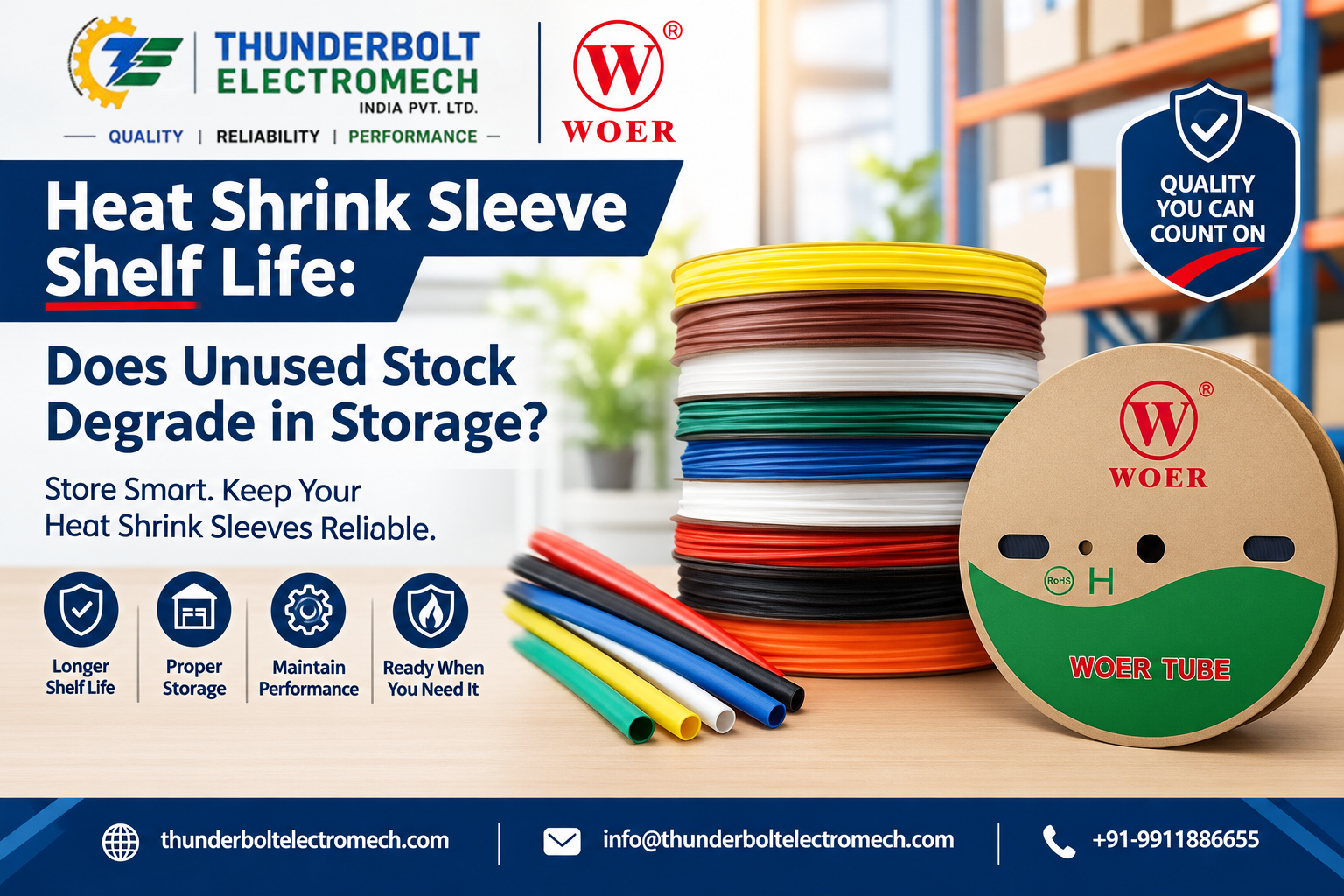
Quick Answer: Heat shrink sleeve rarely carries a hard expiry date, but unused stock does age. The real limit is dimensional life: how long a sleeve keeps its expanded size and still recovers fully. Published figures run from 3 to 12 years at 0–35 °C, and heat cuts them short. Test any stock older than 18 months, and buy from a heat shrink sleeve supplier who records manufacture dates.
Introduction
Most buyers treat heat shrink sleeve like cable. Buy it, shelve it, forget it. Then a shutdown arrives, someone opens a roll that has sat in the godown through two summers, and the sleeve will not slide over the lug barrel.
That failure has a cause, and most shelf-life articles miss it. Leading manufacturers publish dimensional life, not a date on which the plastic goes bad. TE Connectivity gives its Raychem products 36, 48, 60 or 144 months, then states that the figures are guidelines drawn from 30 years of experience and that it cannot provide test data to validate them. [Direct: E1] So what should a purchase manager do with numbers like that?
This article answers the heat shrink sleeve shelf life question with mechanism, published figures and a workbench test. We compare what manufacturers publish, estimate what Delhi heat does to those figures, and give a quick inspection routine for incoming WOER stock. For sizing questions, read our heat shrink sleeve size guide. For other stock and installation topics, browse the heat shrink sleeve category.
Heat Shrink Sleeve Supplier Truth: What Actually Degrades in Unused Stock
Three clocks, one label
Search “does heat shrink sleeve expire” and you will find confident dates. The engineering record is subtler. Three separate clocks run on a stored sleeve, and many sellers blur them.
Shelf life is the period a manufacturer stands behind, counted from the date of manufacture. [Direct: E2] Dimensional life is the minimum time the tubing holds its supplied dimensions inside defined limits. Service life is how long the installed sleeve insulates a joint. One tubing maker states plainly that shelf life and service life are different issues. [Direct: E13]
Dimensional life is the clock that matters in the godown. A test lab working to AS23053 explains that dimensional life is not an expiration date. A sleeve can be used beyond it while its measured dimensions stay inside the limits. [Direct: E4] The reverse also holds. A sleeve inside its labelled life can fail early after a summer in a hot store. [No direct source found; engineering inference from E1 and E3.]
The mechanism: expanded tubing stores strain, and stored strain leaks
Makers extrude the tube at its final small size, cross-link it, then heat it above the crystalline melting point and expand it. Fast cooling lets crystallites freeze the stretched chains in place, so the tube keeps the elastic energy it now holds. [Direct: E5] Peer-reviewed work on cross-linked polyethylene describes the same sequence: cooling in the stretched state freezes the stress, and heating above the crystalline melting point releases it. [Direct: E7]
That design carries a built-in weakness. The tube sits in a strained state and slowly tries to return to its original diameter. Lectromec reports that even in controlled storage, heat shrink tubing gradually shrinks back toward its original size over a period of years. [Direct: E4] Laboratory studies of cross-linked polyethylene find that blends with a higher degree of cross-linking lose stress more slowly. [Direct: E7] We found no published warehouse study for WOER sleeves. Storage is the same physics on a longer clock, but we are extrapolating. [No direct source found for warehouse-scale data on WOER sleeve.]
The practical point is simple. Fit fails first. The diameter you bought is the expanded diameter, and a sleeve that has crept back may no longer slip over a lug barrel.
Four ways stock loses value
Fit loss. The supplied inside diameter drifts below the size you specified. Crews notice it at the lug barrel.
Recovery shortfall. After heating, the sleeve misses its specified diameter or wall thickness. The AS23053 method checks exactly this. It measures the inside diameter as supplied, measures it again after unrestricted shrinkage, and measures wall thickness. [Direct: E4]
Adhesive ageing. Adhesive-lined sleeve carries its own limit. 3M gives its medium-wall polyolefin with hot-melt adhesive a 5-year shelf life from manufacture in humidity-controlled storage. Its multi-purpose tubing gets 10 years. [Direct: E2]
Heat damage in PVC. Grayline warns that heat shrinkable PVC is somewhat heat sensitive, must stay below 32 °C and out of direct sunlight, and can recover prematurely otherwise. Its polyolefin tubing tolerates high storage temperatures better. [Direct: E3]
One more variable is expansion ratio. TE bases its figures on standard-size products and tells buyers to consult it for over-expanded or special sizes. [Direct: E1] A larger expansion stores more strain, so we treat high-ratio sleeves as earlier candidates for testing. [No direct source found; engineering inference.]
Heat Shrink Sleeve Supplier Shelf Life Data: Published Numbers Compared
Here is what named manufacturers publish. Watch the units. Some quote shelf life from manufacture, some quote dimensional life, and the storage windows differ.
| Source | Product class | Published life | Storage window stated | What the number measures |
| TE Connectivity, Raychem (408-32191, Rev L) | Standard-size tubing | 36 to 144 months, by product | 0–35 °C (a few 0–30 °C), sealed original pack, no direct sun | Dimensional life; experience-based, no test data |
| 3M, Heat Shrink Tubing MFP | Multi-purpose | 10 years from manufacture | 10–27 °C, below 75% RH | Shelf life |
| 3M, MDT-A | Medium-wall polyolefin, hot-melt adhesive | 5 years from manufacture | 10–27 °C, below 75% RH | Shelf life |
| AS23053 tubing (via Grayline, Lectromec) | Aerospace-qualified | 1–5 years initial; extendable to 12 years maximum | 18–35 °C | Dimensional life |
| Zeus | PTFE and FEP to AS23053 | 4 years minimum | Specified storage temperatures | Dimensional life |
| Grayline | Heat shrinkable PVC | No number; keep below 32 °C, out of sun | Below 32 °C | Avoids premature recovery |
| WOER industrial grade | Sold by Thunderbolt | No published shelf-life figure found | Not stated | No direct source found |
Direct sources for rows 1–6: E1, E2, E3, E4, E5. The WOER row reflects our search of WOER’s public pages and the Thunderbolt product page (E9, E10).
What the spread tells you
The range is wide. AS23053 tubing starts at one year for some materials, and the standard caps extended life at 12 years. [Direct: E3] Raychem’s top class reaches 144 months, exactly 12 years. [Direct: E1]
The best numbers still rest on experience. TE says so in writing. Treat any published figure as a starting position, then verify with a physical test.
Storage windows top out at 27–35 °C. Delhi stock often leaves that window in summer, as the next section shows.
WOER publishes no shelf-life figure that we could find. Until WOER or your supplier gives you one in writing, plan on the shortest class in the table, 36 months. [No direct source found; this is a conservative planning assumption.]
What heat does to those numbers
Chemical ageing follows an Arrhenius pattern. Insulation practice uses a halving interval of about 10 °C: each 10 °C rise halves expected life, and the linear relationship fails close to transition points such as melting. [Direct: E8] IEC 60216-1 assumes an Arrhenius relationship and requires that no first-order transition occurs in the tested range. [Direct: E8] Heat shrink has such a transition. Crystalline melting drives the recovery. A godown sits far below it, so we use the rule as a screening tool, not a prediction. [No direct source found for applying the halving rule to dimensional life.]
We anchored the table at 35 °C, the top of TE’s stated window.
| Average storage temperature | Factor | 36-month class | 60-month class | 144-month class |
| 35 °C | 1.00 | 36 months | 60 months | 144 months |
| 40 °C | 0.71 | 25 months | 42 months | 102 months |
| 45 °C | 0.50 | 18 months | 30 months | 72 months |
| 50 °C | 0.35 | 13 months | 21 months | 51 months |
Months of dimensional life extrapolated above TE’s 35 °C ceiling. [No direct source found; engineering estimate from E8 inputs.]
Delhi’s outdoor maximum reaches about 45 °C in May and June. [Direct: E12] A closed godown under a metal roof can run hotter than the air outside. [No direct source found. Measure it.] A sleeve stored at a 45 °C average loses about half its margin on paper. That is why we recommend the 18-month test point: half of the shortest published class.
Heat Shrink Sleeve Supplier Storage Rules for Delhi NCR Godowns and Bulk Stock
Delhi NCR conditions that matter
Delhi’s summer runs hot with very low to moderate humidity, the monsoon brings high to very high humidity, and winter brings heavy fog and haze. [Direct: E12] Monthly August averages differ by dataset: one puts it near 62%, while another puts it near 77%. [Direct: E12] Set those against the guidance. TE’s window stops at 35 °C. 3M’s stops at 27 °C and 75% relative humidity. Delhi stock therefore leaves the window on temperature in May and June, and can brush the humidity ceiling in the monsoon. [Guidance direct: E1, E2; the comparison is ours.]
Storage rules that follow from the evidence
A heat shrink sleeve storage supplier in Delhi should be able to describe how it applies these rules. You can apply them to your own store today.
- Keep packs sealed. TE’s figures assume the original unopened packaging, out of direct sunlight. [Direct: E1]
- Get stock off the top shelf. Warm air collects under the roof. [No direct source found; physical reasoning.]
- Log the temperature. A USB data logger on the warmest shelf costs little and turns guesses into a maximum you can read.
- Rotate by manufacture date, not delivery date. Shelf life counts from manufacture. [Direct: E2]
- Keep sleeve away from heat sources. TE’s table carries the note “No Exposure to Exhaust Gases.” [Direct: E1]
- Control the trip. TE says product should not travel above its storage temperature, and that stock exposed to below 0 °C should return to room temperature before use to limit condensation. [Direct: E1] Avoid open trucks parked in May sun. [Engineering judgement.]
- Use adhesive-lined stock first. It has the shorter documented life in the 3M data. [Direct: E2] For opened cartons, a silica gel sachet is cheap insurance. [No direct source found.] Thunderbolt lists silica gel in its catalogue.
A quick incoming stock test for WOER sleeve
This routine adapts the AS23053 logic to a workshop. Take three samples per batch: one from the roll’s outer turns, one from near the core, and one from a different carton.
- Read the batch. Note the manufacture date and batch code. No date means unknown age, so test harder.
- Slide test. Push a 100 mm piece over the largest lug barrel or cable bundle you will use. It must pass without force. [Shop-floor adaptation of the inside-diameter check in E4.]
- Free-shrink test. Cut a 150 mm piece and heat it evenly to full recovery. WOER’s RSFR-H sheet lists a full-shrink temperature of 125 °C or above. [Direct: E9]
- Measure. Check recovered inside diameter and wall against the datasheet. The 6 mm product page lists radial shrinking of at least 50% and concentricity of at least 65%. [Direct: E10] If we read that as recovery to half the supplied diameter, a 6 mm sleeve should recover to 3 mm or less. [Our interpretation; confirm with the datasheet.]
- Inspect. Look for cracks, stickiness, stuck layers, chalking and uneven wall.
- Decide. Pass on both tests: use the batch. Fail the slide test only: quarantine it, or use it on smaller conductors. Fail the recovery test: stop, and call your supplier with the batch code.
Customer problems and solutions
| Problem | Likely cause | Fix |
| Sleeve will not slide over the lug barrel | Creep-back from long or hot storage has shrunk the supplied diameter | Run the slide test. Move up a size only after checking the recovered wall. Report the batch code. |
| Sleeve shrinks but the wall looks thin or lumpy | Aged stock, or overheating on site | Free-shrink a sample and compare it with a fresh roll. Check your heat gun setting. |
| Cut lengths stick together or flatten | Heat and pressure in packed cartons | Store flat, cool and unstacked. Discard deformed pieces. |
| Adhesive-lined sleeve leaks after shrink | Old or damp adhesive, or under-heating | Use adhesive-lined stock first. Keep it sealed. Confirm adhesive flow at the sleeve ends. |
| No date on the roll | Batch information never reached you | Ask for the invoice batch. Test before critical jobs. |
| You over-bought for a project that slipped | Stock cover exceeds half the shortest life class | Move it into routine work first. Retest at 18 months. |
The problem and cause columns reflect engineering judgement. [No direct source found, except the adhesive row, which draws on E2.]
Bulk heat shrink sleeve stock in Delhi NCR: buy in tranches
Bulk heat shrink sleeve stock in Delhi NCR saves per-metre cost and adds ageing risk. Balance them with one line of arithmetic: stock cover in months equals quantity held divided by monthly use. Keep cover at or below 18 months for stock of unknown life, and at or below half of any life you can document.
A plant using 200 m of 6 mm sleeve a month should therefore hold no more than 3,600 m, which is 36 of the 100 m rolls listed on the WOER 6 mm page. [Roll length direct: E10; the rest is our arithmetic.] Buying 600 m a quarter keeps cover near three months and the oldest roll well inside its safe window.
Heat Shrink Sleeve Supplier Checklist: Buying WOER Stock You Can Trust
What Thunderbolt lists
Thunderbolt Electromech is a distributor and supplier of WOER heat shrink sleeves in Delhi/NCR, with a complete WOER range. The catalogue shows industrial-grade sizes including 6 mm on a 100 m roll, plus 25 mm, 35 mm and 40 mm tubes. [Direct: E10] See the 25 mm, 35 mm and 40 mm pages, or the full heat shrink sleeve range.
The 6 mm page lists tensile strength of at least 10.4 MPa, elongation of at least 200%, dielectric strength of 15 kV/mm, and no cracking on heat shock or cold bend. [Direct: E10] WOER’s RSFR-H sheet carries the same tensile and elongation minimums and adds ageing limits: after 168 hours at 158 °C, tensile strength must stay at or above 7.3 MPa and elongation at or above 100%. [Direct: E9] That equals about 70% of the initial tensile minimum and 50% of the elongation minimum. [Our arithmetic.] If you send aged samples to a lab, that is a fair pass line. Confirm the datasheet for your exact product code first.
Seven questions to ask any heat shrink sleeve supplier
- What are the manufacture date and batch code on this roll?
- What storage temperature and humidity window does the maker specify?
- Is the quoted life shelf life or dimensional life, and does it count from manufacture?
- Is the size standard or over-expanded?
- Does the sleeve carry adhesive lining, and what is that life?
- Where and how was the stock stored before dispatch?
- What is the return route if a batch fails the slide or free-shrink test? Thunderbolt publishes a return and refund policy.
Items 3 to 5 draw on E1 and E2. The rest is buyer practice. [No direct source found.]
Heat Shrink Sleeve Supplier in Delhi/NCR: Contact Thunderbolt Electromech
Thunderbolt Electromech India Pvt. Ltd.
Address: Shop no 3538, Sitaram Bazar Rd, Bazar Sirkiwalan, Chawri Bazar, Chandni Chowk, Delhi 110006
Phone: +91-9911886655
Email: info@thunderboltelectromech.com
Hours: Monday to Saturday, 11:00–19:00 [Direct: E11]
Send the size, quantity, delivery location and, for existing stock, the batch code, through the contact page.
Conclusion: Treat Heat Shrink Sleeve Stock as a Dimensional Asset, Not a Forever Item
Does heat shrink sleeve expire? Not on a printed date, but it does age. The clock that counts is dimensional life, the time a sleeve keeps its expanded size and still recovers to specification. Manufacturers publish 3 to 12 years under cool storage, and the top guidance source admits those figures come from experience, not test data.
Heat shortens all of them. Our screening table shows a 60-month class product sliding to about 30 months at a 45 °C average. Delhi summers push stores toward that range, so plan on 18 months of cover for stock of unknown life. Rotate by manufacture date, log the temperature, and run the slide and free-shrink tests before any critical job. Buy bulk heat shrink sleeve stock in tranches, not in one large lot.
Ask every heat shrink sleeve supplier for the manufacture date and batch code before you accept a roll. For WOER stock in Delhi/NCR, call Thunderbolt Electromech on +91-9911886655 or write to info@thunderboltelectromech.com. Start with the WOER 6 mm sleeve, check diameters in our size guide, and browse the full heat shrink sleeve category.