
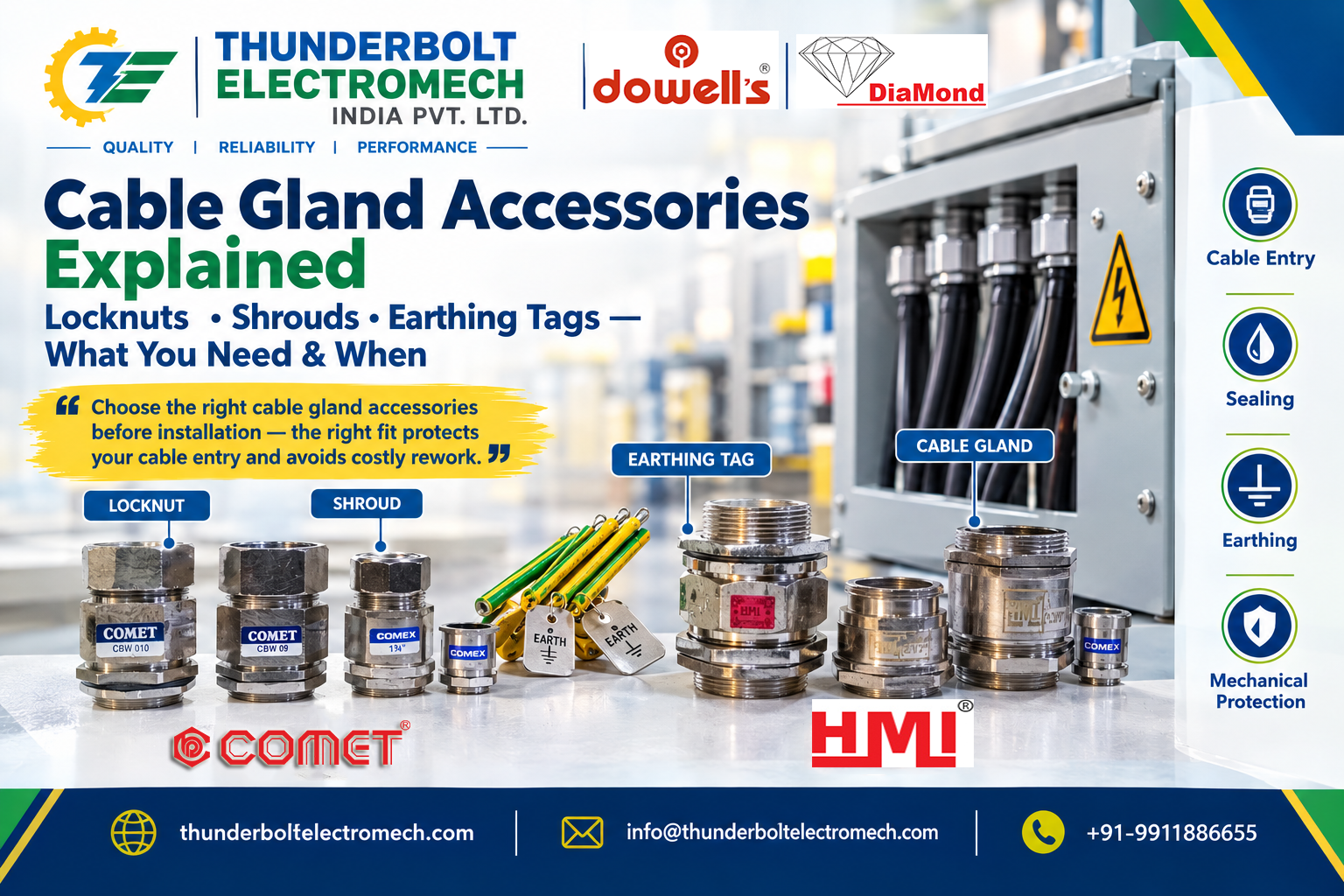
Quick Answer: Locknuts, shrouds, and earthing tags are the three accessories that turn a cable gland into a complete, code-compliant termination. The locknut secures the gland body to the enclosure and stops it backing out under vibration. The shroud is a PVC or TPE sleeve that shields the exposed gland threads from UV, dust and corrosion outdoors. The earthing tag maintains armour-to-enclosure earth continuity, and it becomes mandatory — not optional — the moment your enclosure is painted, powder-coated, or non-metallic. As a Cable Gland Supplier India, Thunderbolt Electromech supplies all three as genuine kit accessories rather than generic substitutes, because a mismatched accessory is one of the fastest ways to void a gland’s IP rating.
Introduction
Nobody writes a purchase order for a locknut. Buyers spec the cable gland, agree a price, place the order, and move on to the next line item. The locknut, the shroud, and the earthing tag get treated as the small bag of loose parts that come bundled in the box — until an inspector asks why the armour isn’t earthed, or a panel that passed commissioning starts showing corrosion streaks eighteen months later around the gland threads.
That gap between “small accessory” and “the thing that actually determines whether the termination passes inspection” is where most of the cost sits. A cable gland can be correctly sized, correctly rated, and still fail a site audit because the wrong locknut was substituted, the shroud was skipped to save two rupees per unit, or nobody realised the powder-coated gland plate had broken the earth path the moment it left the fabrication shop.
This guide is written for the people who actually specify and install these parts — panel builders, EPC site engineers, procurement teams working through a BOQ, and maintenance staff troubleshooting a gland that “looks fine but keeps failing IR tests.” It covers what each accessory does mechanically, when each one is genuinely required versus optional, and the specific field situations — painted enclosures, coastal sites, vibration-heavy plant, Delhi’s summer UV load — where skipping one quietly turns into a rework order.
As a Cable Gland Supplier India stocking Dowells, Comet, HMI, Diamond, and MIC glands, Thunderbolt Electromech is asked this question on nearly every call: “does this gland come with the locknut, shroud, and earth tag, or do I need to order them separately?” This article answers that question properly, with the engineering reasoning behind it.
If you haven’t yet worked through gland sizing and brand selection, our pillar guide — Cable Gland Supplier India: 15 Expert Tips to Choose the Right Cable Gland for Industrial Projects — covers that ground. This one picks up after the gland is chosen, at the point where the accessories decide whether the installation actually holds up.
Cable Gland Accessories — What Each Part Actually Does
A cable gland on its own does two jobs: it grips the cable and it seals the entry point. Everything else that makes the termination durable, earthed, and weather-resistant comes from the accessories fitted around it.
Locknut. A threaded ring, usually hexagonal, that clamps the gland body against the inside face of the enclosure wall or gland plate. Without it, the gland relies on thread friction alone to stay put — which fails under sustained vibration.
Shroud. A push-on or heat-formed sleeve, almost always PVC or TPE, that covers the exposed threaded section and locknut of the gland once it’s tightened. It has no sealing function of its own; it protects what’s already sealed underneath from the weather.
Earthing tag. A flat brass (occasionally stainless steel) washer with an integrated tab or stud, fitted between the gland body and the locknut or enclosure face, that gives armoured cable a dedicated, externally accessible point to bond to earth.
These three sit in a specific stacking order during installation — gland body, then serrated washer or earth tag where required, then locknut, then shroud fitted last over the completed joint. Getting that sequence wrong is one of the more common reasons a technically correct set of parts still fails to perform as a system.
Why “It Came in the Box” Isn’t the Same as “It’s Correct for This Job”
Most premium cable glands — Dowells, Comet, HMI — ship as a kit: gland body, sealing components, a standard locknut, sometimes a basic shroud. That default kit is engineered for a generic indoor application. The moment your installation deviates from that — outdoor, coastal, painted enclosure, high-vibration rotating equipment — the bundled accessory may no longer be the right one for the job, even though the gland itself is perfectly correct.
This is the distinction procurement teams and site engineers tend to miss: the gland size chart tells you which gland fits the cable. It does not tell you which locknut, shroud, or earth tag configuration fits the installation environment. Those are separate decisions, and they’re the subject of the rest of this guide.
Cable Gland Locknuts — Function, Types, and When a Standard One Isn’t Enough
What a Locknut Actually Does
The locknut’s job sounds trivial — hold the gland to the wall — but it’s doing real mechanical work. Once the gland is threaded through the gland plate or enclosure entry, the locknut is tightened from the inside, clamping the gland body against the panel wall and preventing it from rotating loose. On equipment subject to continuous vibration — motors, pumps, compressors, transformer yards — an untightened or under-torqued locknut is one of the more common causes of a gland working itself loose over months of operation, allowing the seal to shift and the cable to take up strain it was never meant to carry.
Standard cable gland locknuts are supplied in brass or nickel-plated brass to match the gland body, in metric threads (M16 through M75 covers most industrial gland sizes) matching whichever thread standard the gland itself uses — Metric, PG, BSP, or NPT. Mixing thread standards between the gland and locknut is a genuine field problem: an M25 gland threaded into a PG21 locknut will appear to engage for a turn or two before cross-threading, and a cross-threaded locknut rarely seats flush, which quietly compromises the clamping force even if it “looks” tightened.
Earthing Locknuts — A Different Part With the Same Shape
A standard locknut and an earthing locknut look almost identical from across a workbench, but they do different jobs. An earthing locknut has a serrated or toothed face on the side that contacts the enclosure — small machined teeth that bite through paint, oxide film, or powder coating to make direct metal-to-metal contact when torqued down. This is the part that restores equipotential bonding on a coated or painted panel, where a smooth-faced standard locknut would simply sit on top of the paint layer and never make electrical contact with the enclosure metal underneath. (Source: this serrated-face, equipotential-bonding function is the manufacturer-stated design purpose of earthing locknuts across multiple industrial gland ranges — direct source found.)
This is worth flagging because it’s an easy substitution mistake: a plain locknut and an earthing locknut cost roughly the same and are visually close enough that a storeman restocking a panel-builder’s shelf can hand over the wrong one without either party noticing until a continuity test fails.
Locknut Material Selection
- Brass / nickel-plated brass — the default for general industrial indoor and outdoor panels; good conductivity, adequate corrosion resistance for most Indian climate conditions.
- Stainless steel (304/316) — specified for coastal installations, chemical plants, and food-processing environments where brass would pit or discolour under chloride or acid exposure over time.
- Polyamide / nylon (non-metallic) — used only where the gland itself is a non-metallic type and no earth continuity is required through the gland assembly at all, such as some low-voltage data or signal cable entries.
Getting Torque Right on a Locknut
A locknut that’s hand-tight but not torqued to specification looks correctly installed on a visual inspection and fails the first vibration cycle it’s exposed to. Conversely, an over-torqued locknut on a thin gland plate can deform the plate around the entry hole, which distorts the gland body’s seating and can compromise the primary seal underneath — a failure mode that traces back to the locknut but shows up as a leaking gland. For the specific torque figures and the over-tightening failure mechanism in more detail, see Thunderbolt’s dedicated guide, Cable Gland Torque Specification: Why Over-Tightening Fails More Joints Than Under-Tightening.
For panel builders and electrical contractors sourcing brass and earthing locknuts as standalone stock rather than only as part of a gland kit, Thunderbolt Electromech operates as a cable gland locknut supplier Delhi teams can order from directly for bulk and repeat requirements, without being forced to buy a full gland kit every time a locknut alone needs replacing.
Cable Gland Shrouds — Weather Protection That Isn’t Optional Outdoors
What a Shroud Does — and What It Doesn’t
A shroud is a soft PVC or TPE sleeve that fits over the completed gland-and-locknut assembly, covering the exposed threads, the locknut, and the transition point where the cable enters the gland. It is not a sealing component. The IP rating of the termination is already established by the gland’s internal seals and compression rings before the shroud goes on. What the shroud adds is a second, external layer that keeps UV, dust, chemical spray, and moisture off the metal threads and the locknut face — parts that would otherwise sit exposed to the weather indefinitely.
Manufacturer literature across multiple gland brands is consistent on this point: shrouds are described as protection for the gland assembly, added “when additional environmental and corrosion protection is required,” rather than as a substitute for the gland’s own IP rating. (Direct source found — consistent across Prysmian, Hawke, and other manufacturer product documentation.)
Why Skip the Shroud and You’ll See It in the Threads First
The failure pattern with an unshrouded outdoor gland is predictable and slow. UV exposure doesn’t attack the brass gland body — it attacks the exposed rubber compression seal at the cable entry point and dries out any residual lubricant on the threads. Combined with dust and monsoon moisture sitting directly on the exposed brass, you get gradual thread corrosion and seal hardening at the exact point where future maintenance needs to reopen the gland to re-terminate or inspect the cable. A gland that’s been sitting shroud-less outdoors for two or three Delhi summers is noticeably harder to open for maintenance than an identical shrouded gland from the same installation date — the threads bind, and the compression nut resists turning even after the seal itself is loosened.
This matters specifically in North Indian conditions: Delhi and the NCR belt run through a long, high-UV summer followed by a monsoon with sustained humidity, and outdoor gland installations sit exposed to both extremes across a single year. A shroud rated for UV resistance is doing real, continuous work in that climate — it isn’t a cosmetic add-on.
When a Shroud Is Genuinely Optional vs When It Isn’t
| Installation condition | Shroud needed? | Reasoning |
| Indoor control panel, air-conditioned room | Optional | Minimal UV, dust, or moisture exposure |
| Outdoor MCC / distribution panel | Recommended | Direct sun and monsoon exposure on exposed threads |
| Coastal or high-humidity site | Strongly recommended | Salt-laden air accelerates thread corrosion significantly |
| Chemical plant, corrosive atmosphere | Recommended | Vapour exposure attacks unprotected brass over time |
| Marine platform / offshore box | Effectively mandatory | Continuous high-corrosivity environment |
| Solar plant outdoor junction box | Recommended | Multi-year unattended outdoor exposure with minimal maintenance access |
For projects in Delhi NCR sourcing shrouds separately for retrofits or maintenance stock — rather than only as part of a new gland order — Thunderbolt Electromech supplies as a cable gland shroud dealer Delhi NCR, with sizes matching the standard M16 through M63 gland range used across Dowells, Comet, HMI, Diamond, and MIC products.
Cable Gland Earthing Tags — The Part That’s Mandatory More Often Than Buyers Assume
What an Earthing Tag Does
An earthing tag — also called an earth tag, bonding tag, or earthing eyelet — is a flat brass stamping with two features: a central hole that the gland body passes through, and a projecting tab or stud that a separate earth conductor can be bolted to. It sits clamped between the gland body’s hexagonal shoulder and the locknut, so tightening the locknut during normal installation also clamps the earth tag firmly in place — no extra installation step beyond making sure it’s positioned correctly before the locknut goes on.
Its function is distinct from the gland’s own armour-clamping mechanism. On an armoured cable gland, the gland itself already clamps the cable armour and — in a metal enclosure with a bare, unpainted gland plate — that clamping typically provides a continuous earth path from armour to enclosure through direct metal contact. The earthing tag exists for the cases where that direct metal path isn’t reliable on its own.
The Case That Makes an Earth Tag Genuinely Mandatory: Painted and Powder-Coated Enclosures
This is the single most common reason an earth tag goes from “nice to have” to “required,” and it’s also the most commonly missed detail in gland specification. When a gland plate or enclosure is painted, powder-coated, or lacquered — which describes the overwhelming majority of modern industrial panels, for both aesthetics and corrosion protection — the locknut and gland body no longer make direct metal-to-metal contact with the enclosure. They’re contacting a layer of coating instead. Coating is an insulator. The earth continuity path that everyone assumes exists because the gland is bolted to a metal panel simply isn’t there unless something breaks through that coating layer. (Source: this is the manufacturer-documented rationale for earthing tags across multiple gland-accessory ranges, and matches the mechanical logic of serrated earthing locknuts described above — direct source found.)
An earthing tag with a stud or tab connection gives you a deliberate, externally verifiable bonding point that doesn’t depend on the coating being scraped through at the right spot by chance. It’s the difference between an earth path that exists because someone engineered it to exist, and one that exists only if the installer happened to over-torque the locknut enough to bite through paint at an unmarked location nobody can inspect afterward.
Indian Regulatory Context
India’s Central Electricity Authority (Measures Relating to Safety and Electric Supply) Regulations, 2010 require that the metallic covering of every cable be electrically and mechanically continuous throughout its length, and earthed where the installation requires it — the regulation is explicit that armour and metallic sheathing form part of the earthing system, not an incidental byproduct of clamping the cable in place. (Direct source found — CEA Regulations 2010, Regulation 106.) IS 3043, India’s code of practice for earthing, sets the resistance and continuity framework this sits within, though IS 3043 itself governs the earthing system broadly rather than specifying gland accessory hardware directly.
Internationally, the same logic appears under different regulation numbers — BS 7671 Regulation 543.3 in the UK requires supplementary earthing conductors in specific circuits, and NEC 250.102 in the US requires additional equipment grounding conductors in comparable scenarios. (Direct source found for both citations.) The consistency across three separate national codes on this exact point — that a coated or otherwise electrically interrupted enclosure surface needs a deliberate bonding accommodation — is a reasonable indicator that this isn’t a regional quirk of Indian practice; it’s a recognised gap in how coated enclosures behave electrically, addressed the same way everywhere.
When You Don’t Strictly Need One
- Unarmoured cables terminating into non-metallic (plastic) enclosures where there’s no metallic armour or enclosure body to bond in the first place.
- Bare, unpainted metal gland plates on some indoor control panels, where the gland-to-armour-to-enclosure path is genuinely continuous metal-to-metal without a coating layer in between — though many site engineers specify an earth tag here anyway as a low-cost redundancy rather than relying on assumed contact quality.
- Signal or instrumentation cable glands with no armour to bond — there’s nothing for the tag to connect.
If you’re working through when armoured versus unarmoured cable actually changes your gland and earthing decisions, Thunderbolt’s related guide, Armoured vs Unarmoured Cable Glands: Which One Do You Actually Need?, covers that distinction directly.
For engineers and consultants specifying earthing hardware for panel builds or retrofit projects across Delhi and the NCR belt, Thunderbolt Electromech supplies brass earthing tags across the full M16–M75 metric range as a dedicated cable gland earthing tag India stockist, alongside the matching earthing locknuts described in the previous section.
Customer Problems and Solutions
Procurement and site teams tend to run into the same handful of accessory-related problems on repeat. Here’s how they typically surface, and what actually fixes them.
Problem: The panel passed visual inspection, but the earth continuity test between armour and enclosure failed.
Solution: Check whether the gland plate is painted or powder-coated. If it is, the gland’s own clamping was never going to provide earth continuity on its own — fit a serrated earthing locknut or a proper earth tag with a bonded conductor to the enclosure earth bar, rather than assuming a standard locknut will eventually make contact.
Problem: A batch of outdoor glands installed eighteen months ago is now hard to reopen for cable re-termination, with visible green-brown corrosion on the threads.
Solution: This is the signature failure of unshrouded brass glands left exposed to sun and monsoon cycles. Fit shrouds on the remaining unshrouded units during the next maintenance window, and specify shrouded kits by default for any future outdoor order.
Problem: A locknut was substituted from a different brand’s stock during a rush order, and now the gland won’t seat flush.
Solution: Thread pitch varies subtly between manufacturers even at the same nominal size. Match locknuts to the gland brand and thread standard rather than treating locknuts as universal interchangeable hardware — keep brand-matched stock rather than a generic mixed bin.
Problem: A coastal-site customer reports brass locknuts pitting and discolouring within a year of installation.
Solution: Brass is not the right material choice for sustained salt-air exposure. Specify stainless steel (304 or 316) locknuts and earth tags for coastal and marine-adjacent sites at the procurement stage, rather than replacing brass hardware reactively once corrosion is already visible.
Problem: A maintenance team keeps finding earth tags installed but with no conductor actually bolted to the stud — the tag is present but doing nothing.
Solution: An earth tag only functions once a conductor is connected to it and bonded back to the enclosure or system earth bar. Installing the tag without completing the bonding connection is a common site shortcut that leaves the panel looking compliant on a parts list while the earth path is still broken — this needs to be checked at commissioning, not assumed from the presence of the hardware alone.
Comparison Table: Locknut vs Shroud vs Earthing Tag
| Feature | Locknut | Shroud | Earthing Tag |
| Primary function | Mechanically secures gland to enclosure | Weather and corrosion protection over exposed threads | Provides dedicated earth/bonding point |
| Affects IP rating | Indirectly (loosening compromises seal) | No — added after sealing is complete | No |
| Affects earth continuity | Only if earthing type (serrated) | No | Yes — this is its core function |
| Material options | Brass, stainless steel, nylon | PVC, TPE | Brass, stainless steel |
| Mandatory on painted enclosures | Yes (earthing type specifically) | Situational | Yes |
| Mandatory outdoors | Standard type, yes; always needed | Strongly recommended | Depends on enclosure and armour type |
| Typical failure if omitted or wrong type | Gland loosens under vibration; cable strain | Thread corrosion, hardened seals, difficult maintenance | Broken earth continuity, undetected until tested |
| Where Thunderbolt supplies as standalone stock | Cable gland locknut supplier Delhi | Cable gland shroud dealer Delhi NCR | Cable gland earthing tag India |
Procurement Checklist for Cable Gland Accessories
Before finalising a BOQ or placing a bulk order, confirm the following:
✔ Locknut thread standard matches the gland brand exactly (Metric, PG, BSP, or NPT).
✔ Earthing (serrated) locknuts specified wherever the enclosure or gland plate is painted, powder-coated, or non-metallic.
✔ Locknut and earth tag material upgraded to stainless steel for coastal, chemical, or high-corrosion sites.
✔ Shrouds included by default on every outdoor gland order, not added only after a corrosion complaint.
✔ Earth tags specified with a clear installation instruction to bond the stud to the enclosure or system earth bar — not left unconnected.
✔ Accessories sourced from the same brand as the gland body wherever possible, to avoid thread-pitch mismatches.
✔ Locknut torque specification confirmed and followed during installation, not just hand-tightened.
Cable Gland Accessories Frequently Asked Questions
Do I need an earthing tag with every single cable gland?
No. It’s required wherever the gland’s own clamping can’t be relied on to provide earth continuity on its own — chiefly painted or powder-coated enclosures, non-metallic gland plates, and installations where a supplementary earth conductor is specified by code. On a bare, unpainted metal gland plate with direct armour clamping, it’s often treated as good-practice redundancy rather than an absolute requirement.
What’s actually the difference between a shroud and a hood?
In cable gland terminology, “shroud” and “hood” are generally used interchangeably for the same PVC/TPE sleeve fitted over the gland after installation. Some manufacturers use “hood” specifically for a shorter cap-style cover and “shroud” for a longer sleeve that extends further down the cable — check the specific product description rather than assuming the terms are always distinct.
Can I use any brand’s locknut with any brand’s cable gland?
Not safely, even when the nominal thread size matches. Thread pitch and minor dimensional tolerances vary between manufacturers, and a mismatched locknut can seat poorly or cross-thread without an obvious visual sign. Match locknuts to the gland’s brand and thread standard.
My outdoor gland is leaking even though it has a shroud fitted — why?
A shroud provides no sealing function. If the gland is leaking, the fault is in the gland’s own compression seal or sizing — most commonly an incorrect cable OD match or an under-torqued compression nut — not the shroud. Check the seal and torque before assuming the shroud has failed.
Is a plain PVC shroud enough protection for Delhi’s summer heat and UV?
A shroud specifically rated for UV resistance is designed for this. A generic, non-UV-stabilised PVC sleeve can become brittle and crack within a couple of seasons under sustained high-UV exposure. Confirm UV resistance is stated for the specific shroud product, not assumed from the material name alone.
Do brass earthing tags corrode over time?
Yes, in the same conditions that affect any exposed brass component — coastal salt air, chemical vapour, sustained high humidity. Stainless steel earth tags are the standard substitution for these environments.
What locknut material should I use for a chemical plant or coastal site?
Stainless steel (304 or, for more aggressive chemical exposure, 316) rather than standard brass or nickel-plated brass. The material upgrade cost is minor compared to the cost of premature corrosion-driven replacement.
Can I buy locknuts, shrouds, and earth tags separately, or only as part of a full gland kit?
Most suppliers, Thunderbolt included, stock these as standalone spares for maintenance and retrofit orders — you don’t need to buy a complete new gland assembly just to replace a corroded shroud or a missing locknut.
How do I know if my specific enclosure needs an earth tag or not?
Check the enclosure surface finish first. If it’s painted, powder-coated, anodised, or otherwise coated at the gland entry point, treat an earth tag or earthing locknut as required rather than optional. If genuinely unsure, a continuity test between the cable armour and the enclosure earth bar after installation will confirm it directly — that’s the definitive check, not a visual assumption.
Is a serrated washer the same thing as an earthing tag?
They’re related but not identical. A serrated washer (or a locknut with a serrated face) bites through coating to make contact at the locknut-to-enclosure interface. An earthing tag is a separate component with its own stud or tab for bonding a dedicated conductor. Some installations use one, some use both, depending on the specification.
What’s the correct installation sequence for locknut, shroud, and earth tag together?
Gland body through the enclosure entry first, earth tag (if required) positioned against the gland body’s shoulder, locknut tightened over it from the inside to clamp everything in place, and the shroud fitted last, over the completed and tightened assembly from the outside. Fitting the shroud before the locknut is tightened is a common installation-order mistake that makes torque-checking the locknut afterward unnecessarily difficult.
Do cable gland accessories need separate IP or certification documentation from the gland itself?
For standard commercial and industrial installations, accessories are typically covered under the gland manufacturer’s overall kit rating rather than certified individually. For hazardous-area (Ex d, PESO-regulated) installations, however, mixing accessories from outside the certified kit can invalidate the gland’s hazardous-area approval — this is a stricter requirement than standard IP-rated installations. For the certification detail specific to hazardous areas, see Thunderbolt’s guide on Flameproof (Ex d) Cable Glands for Hazardous Areas.
Cable Gland Accessories Explained: Conclusion
Locknuts, shrouds, and earthing tags don’t show up on the headline spec sheet, but they’re what decide whether a correctly chosen cable gland actually performs the way its IP rating and earth continuity documentation say it will. A locknut that isn’t torqued correctly loosens under vibration. A shroud skipped to save a few rupees turns into a corroded, hard-to-service gland within a couple of monsoon cycles. An earthing tag left off a painted enclosure means the earth path everyone assumed was there was never actually connected — and that gap usually surfaces during an inspection or, worse, during a fault, not during commissioning.
None of these are complicated parts. They’re inexpensive, they’re simple to specify correctly once the reasoning is clear, and getting them right at the procurement stage costs almost nothing compared to the rework, failed inspections, or corrosion-driven replacements that follow from treating them as an afterthought. As a Cable Gland Supplier India, Thunderbolt Electromech stocks genuine, brand-matched locknuts, shrouds, and earthing tags alongside its full range of Dowells, Comet, HMI, Diamond, and MIC cable glands — as complete kits or as standalone spares for maintenance and retrofit orders across Delhi NCR and pan-India.
Browse the full range on the Cable Gland category page, or get in touch directly for accessory-specific stock and bulk pricing.
Contact Thunderbolt Electromech
- Phone: +91-9911886655
- Website: https://thunderboltelectromech.com
- Email: info@thunderboltelectromech.com
- Location: Shop no 3538, Sitaram Bazar Rd, Bazar Sirkiwalan, Chawri Bazar, Chandni Chowk, Delhi