
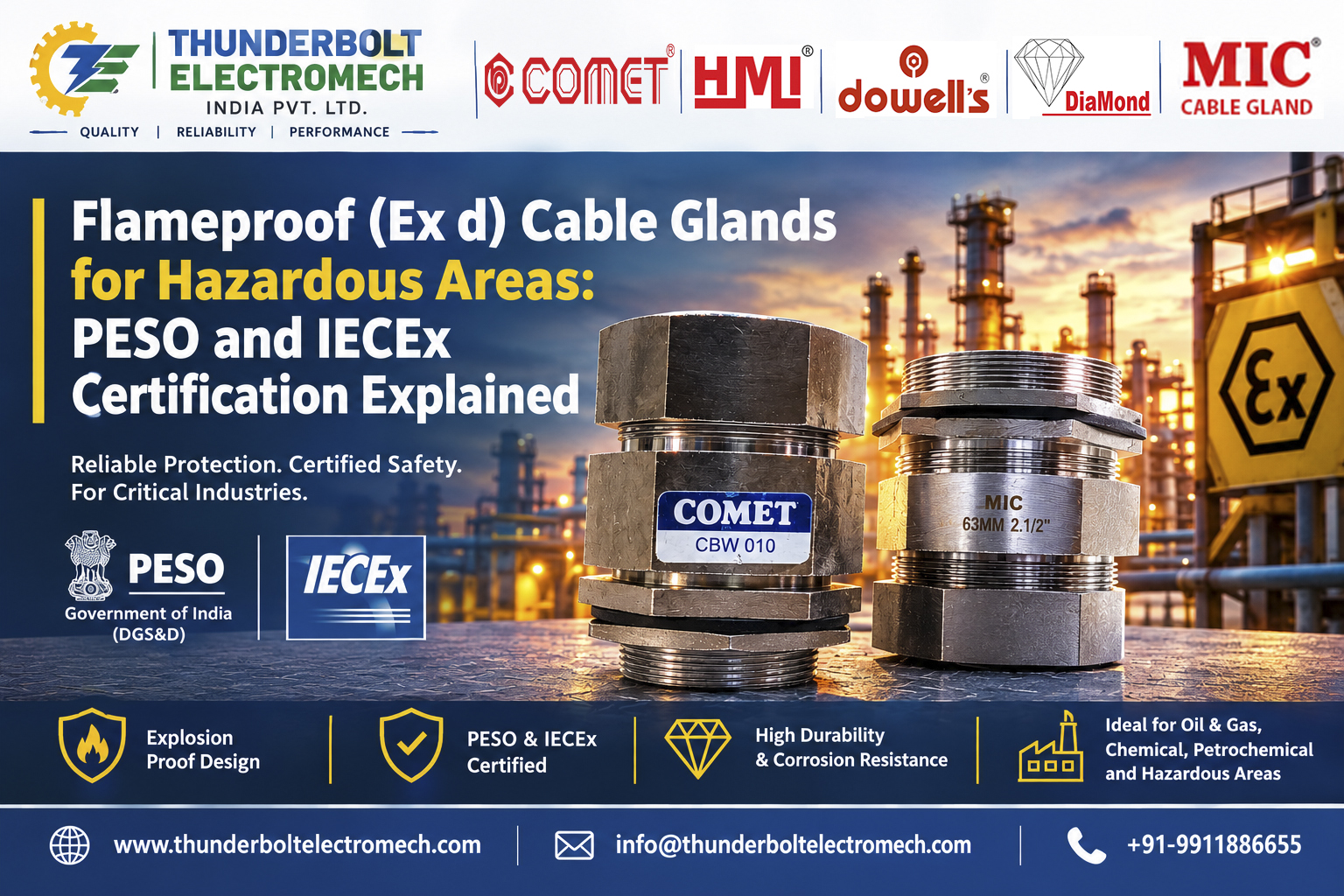
By Thunderbolt Electromech India Pvt. Ltd. — Delhi-based Distributor& supplier of Dowells, comet, HMI, Diamond and MIC cable glands
📞 +91-9911886655 | ✉️ info@thunderboltelectromech.com | 🌐 thunderboltelectromech.com | 📍 Shop No. 3538, Sitaram Bazar Rd, Bazar Sirkiwalan, Chawri Bazar, Chandni Chowk, Delhi – 110006
Quick Answer: An Ex d cable gland doesn’t stop an explosion — it contains one already happening inside a flameproof enclosure, cooling escaping gases below ignition temperature before they reach the outside atmosphere. In India, this equipment needs PESO approval under the Petroleum Rules, 2002, in addition to IECEx or ATEX certification — one without the other isn’t legally sufficient. Getting the gland wrong isn’t a minor mismatch: an incorrect gland can let gas migrate through a cable’s own internal gaps, bypassing the enclosure’s certification entirely. A genuine Cable Gland Supplier India should know this before quoting a size.
Introduction
Most cable gland decisions come down to diameter, thread size, and IP rating. In a hazardous area — a refinery, a chemical plant, an LPG bottling facility, anywhere flammable gas or vapour might be present — the decision carries a different weight entirely. Get it wrong here, and you’re not risking a leak. You’re risking the one thing standing between a contained internal fault and an explosion reaching an atmosphere that’s actively waiting to ignite.
This guide exists because most cable gland content treats “flameproof” as a checkbox — tick it, move on. It isn’t. Anyone searching flameproof cable gland India is usually trying to solve one of two problems at once: which gland actually fits the hazard, and which paperwork makes it legal to install. Ex d protection works on a specific engineering principle, PESO’s approval process in India works differently from what most buyers assume, and the gland itself can quietly defeat an otherwise perfectly certified enclosure if it’s the wrong type for the cable running through it. We’ll walk through all three, with the detail that actually matters to an engineer specifying this equipment — not just the definitions.
What “Flameproof” Actually Means: The Ex d Protection Concept
Here’s the detail that surprises people the first time they hear it: Ex d equipment is designed on the assumption that an internal explosion will happen, not that it won’t.
Unlike other protection concepts that try to prevent ignition entirely, a flameproof (Ex d) enclosure is built to withstand an internal explosion of flammable gas that has found its way inside, and to cool the resulting hot gases through tightly controlled flame paths — precision-machined joints between enclosure sections — before they escape to the surrounding atmosphere. By the time those gases reach the outside air, they’ve cooled below the ignition temperature of whatever gas is present outside, and the explosion never propagates beyond the enclosure (Source: ISEP, “Explosion-Proof Cable Glands Explained: Types, Standards, Applications and Selection Guide” — Direct source found).
Compare that to Ex e (increased safety) equipment, which works on the opposite assumption entirely: that normal operation will never produce a spark, arc, or excessive surface temperature capable of ignition in the first place. An Ex e cable gland achieves its protection through mechanical compression alone — clamping the cable’s outer sheath for sealing, with a second clamping element for strain relief. No compound filling. No internal seal around individual conductors. The entire design philosophy assumes internal ignition simply won’t occur, so stopping gas migration into the enclosure matters less than it does for Ex d (Source: metalmecheng.com, “Ex d vs Ex e Cable Gland – Key Differences, Standards & Selection Guide” — Direct source found).
This distinction is the reason a gland rated for one protection concept cannot simply substitute for the other, regardless of how similar they look on a shelf.
Why an Ordinary Cable Gland Can Defeat an Ex d Enclosure’s Entire Certification
This is the single most important engineering point in this guide, and it’s the one most buyers — and honestly, most general cable gland suppliers — never explain properly.
A multicore cable isn’t a solid piece of material. Between the individual insulated conductors inside its outer sheath, there are small air gaps — the interstices. A standard flameproof gland, even one correctly rated for Ex d, typically seals against the cable’s outer bedding using an elastomeric seal. That seal stops gas from getting in around the cable. It does nothing to stop gas travelling through the cable itself, along those internal interstitial gaps, straight into the enclosure it’s supposed to be protecting (Source: metalmecheng.com, “Barrier Cable Gland | Explosion-Proof Cable Entry for Hazardous Areas” — Direct source found).
Once that gas reaches the inside of an Ex d enclosure carrying live electrical equipment, the enclosure’s entire flameproof design — the precisely machined flame paths, the pressure-rated joints — becomes irrelevant to the specific hazard that just walked in through the cable rather than through the air gap the enclosure was designed to contain.
This is precisely why barrier cable glands exist. A barrier gland seals not just around the cable’s outer sheath, but around each individual core using a certified compound or resin, physically blocking the interstitial gas path a standard gland leaves wide open (Source: ISEP — Direct source found; CCG Cable Gland, “Barrier Glands” technical page — Direct source found). IEC 60079-14’s selection criteria specifically flag this as mandatory for cables lacking extruded bedding or compact circularity — unfilled multicore cables being the clearest example (Source: oil-gas.net, “Ex Cable Gland Selection & Installation: Avoiding Common Pitfalls” — Direct source found).
A genuinely contested detail worth flagging honestly here: historical guidance under IEC 60079-14 allowed an exemption from barrier gland requirements where the connected cable ran at least 3 metres external to the enclosure, based on Dekra and other testing showing that cable length alone can prevent flame transmission in certain cases (Source: IEC, “IEC 60079-14 cable glands requirements” technical background paper — Direct source found). At least one industry source states this 3-metre exemption was eliminated in a post-2024 update, making barrier glands compulsory for all Zone 1 Ex d installations regardless of cable length Given the safety stakes involved, the practical guidance is straightforward regardless of which version applies to your specific installation: confirm the current edition of IEC 60079-14 applicable to your project directly, and don’t rely on an older exemption without checking it’s still valid.
Barrier Glands vs Standard Ex d Glands: What’s Actually Different Inside
A standard Ex d gland with an elastomeric seal is built to retain explosive pressure within the enclosure and prevent hot gases passing through the cable entry point to the surrounding atmosphere — relying on that seal gripping the cable’s bedding (Source: CCG Cable Gland — Direct source found).
A barrier gland does everything a standard Ex d gland does, plus one additional, critical step: after the cable is inserted, an installer pours a certified compound or resin into a dedicated chamber within the gland body, which cures around each individual conductor core. This creates the conductor-level seal a standard gland cannot provide (Source: metalmecheng.com — Direct source found).
A genuinely important installation warning worth repeating plainly: incorrect compound filling is the most common cause of barrier gland installation failures, and it can void the equipment’s explosion protection certification entirely (Source: metalmecheng.com, “Barrier Cable Gland” — Direct source found). This isn’t a forgiving installation task for an untrained crew — IEC 60079-14 explicitly requires barrier gland installation to be carried out by a competent person familiar with its specific requirements.
Gas Groups, Temperature Classes and EPL: Decoding an “Ex d IIB T4 Gb” Marking
A flameproof cable gland’s certification marking looks cryptic until you know how to read it, and reading it correctly is the difference between specifying the right gland and specifying one that’s dangerously mismatched to your site.
Take a typical marking: Ex d IIB T4 Gb.
- Ex d — the protection concept, flameproof, as covered above
- IIB — the gas group, indicating which explosive atmospheres the equipment is certified against; Group IIC (covering gases like hydrogen and acetylene) is the most demanding, IIB (ethylene) sits in the middle, and IIA (propane) is the least demanding of the three industrial groups
- T4 — the temperature class, meaning the equipment’s maximum surface temperature won’t exceed 135°C, keeping it below the auto-ignition temperature of the gases it’s certified for
- Gb — the Equipment Protection Level, indicating a level of protection suited to Zone 1 (an area where an explosive atmosphere is likely to occur during normal operation)
The practical point this decoding exercise leads to: every element of that marking on the gland must match or exceed what the enclosure itself, and the specific zone it sits in, actually requires. A gland rated IIB cannot be substituted where the installation genuinely calls for IIC, even if every other dimension lines up perfectly
IECEx Certification: What It Actually Verifies
IECEx is an internationally recognised certification scheme confirming that hazardous-area equipment has been independently tested against the IEC 60079 series and manufactured under an audited quality system (Source: ISEP — Direct source found). It’s the closest thing the industry has to a globally portable “yes, this is genuinely tested” credential, and it’s widely accepted across markets outside Europe (which uses the separate but technically aligned ATEX scheme).
What IECEx does not do, and this matters enormously for Indian buyers specifically: it does not grant automatic market access in India.
PESO Approval in India: Why an IECEx Certificate Alone Isn’t Enough
This is the point where a lot of import and procurement decisions go wrong, often expensively.
PESO — the Petroleum and Explosives Safety Organisation, formerly the Chief Controller of Explosives (CCOE) — is India’s national regulator for equipment used in explosive and flammable atmospheres, operating under the Petroleum Rules, 2002 (specifically Rule 106), alongside related legislation including the Gas Cylinders Rules 2016 and the Static and Mobile Pressure Vessels (SMPV) Rules 2016 (Source: Flameproof Instrumentation, “Exploring PESO vs ATEX vs IECEx: Understanding Hazardous Area Certifications” — Direct source found). Any flameproof, increased-safety, or intrinsically safe equipment installed in a PESO-regulated premises — refineries, petroleum storage depots, CNG and LPG facilities, and comparable sites — legally requires PESO approval before installation or operation (Source: Euroswitch, “PESO-CCOE Ex d/db/tb” certification page — Direct source found).
Here’s the part manufacturers and buyers frequently get wrong: PESO does not retest equipment that already carries IECEx or ATEX certification. Instead, it verifies, evaluates, and formally endorses the equipment for compliance under Indian law, based on the documentation submitted This means an IECEx certificate is genuinely useful — it forms a core part of the PESO application dossier — but it is not, by itself, a substitute for the separate Indian approval.
PESO’s current SOP recognises three distinct approval routes, depending on where and how the equipment was manufactured and tested, and choosing the correct route matters — picking the wrong one can add weeks of delay to an approval that’s often already tied to a project deadline (Source: Green Permits — Direct source found). For equipment carrying a valid BIS licence for flameproof-type apparatus, or the relevant IECEx documentation under the applicable route, PESO’s SOP lists required supporting evidence including test reports, general assembly drawings, technical details of the manufacturing facility, and confirmation of trained personnel
A PESO approval, once granted, is valid only until the product’s design or standard changes — and critically, it typically requires renewal roughly every three years or per the specific rule’s stated validity period (Source: Flameproof Instrumentation — Direct source found). Buyers can and should verify a certificate’s genuine status directly through PESO’s own public portal (peso.gov.in) rather than taking a supplier’s documentation at face value — the same source notes non-compliance can lead to fines, shutdowns, and real liability exposure. Treat Ex d cable gland certification as a live document to be checked per project, not a one-time badge a manufacturer earned years ago and never revisits.
The Compliance Trap: Swapping a Cable Gland Can Void Your Enclosure’s Certification
This is a genuinely underappreciated risk, and it applies directly to cable gland procurement specifically.
A certified flameproof enclosure’s approval covers the complete assembly as tested — including the specific cable entry devices, glands, and plugs used at the time of certification. Change the gland to a different model, even one that’s independently Ex d rated, and you may have created a mismatch between the physically installed equipment and the approved design on file (Source: Diligence Certification, “PESO Approval For Flameproof Panels” — Direct source found). PESO’s own scrutiny process checks that model numbers, ratings, certificates, and drawings all match — a mismatch here is one of the most common and most avoidable causes of a rejected or invalidated approval.
Cable glands are frequently certified as “Ex Component” equipment (often marked with the symbol U) rather than as complete, standalone Ex equipment. This distinction matters: an Ex Component certificate confirms the gland itself has been tested to relevant clauses of the standard, but it explicitly requires further assessment by whoever integrates it into a specific enclosure, to confirm the combination as a whole meets the required protection level. Treating a component-certified gland as a drop-in universal replacement, without that integration assessment, is exactly the kind of gap that turns a technically-certified part into a non-compliant installation.
Cable Gland Supplier India — What to Verify Before Ordering for a Hazardous Area
A genuine Cable Gland Supplier India operating in the hazardous-area segment should be able to answer, without hesitation:
- Whether the gland is certified as standalone Ex equipment or as an Ex Component requiring further integration assessment
- The exact gas group, temperature class, and Equipment Protection Level the gland is certified for — not just “it’s flameproof rated”
- Whether a barrier (compound-filled) design is needed for your specific cable construction, or whether a standard Ex d gland with an elastomeric seal is genuinely sufficient
- Current PESO approval status for the specific model, verifiable against PESO’s public portal, not just a general company-level claim
- Whether the gland was part of the original tested assembly for your specific enclosure model, or requires a documented compatibility assessment if substituted
Installation Details That Get Overlooked: Thread Engagement and Cable Length
Thread engagement matters more precisely than most installers assume. Where a flameproof cable gland, adaptor, or blanking plug is fitted with a sealing washer, a minimum of five full threads must be engaged after the washer is fitted — not before (Source: metalmecheng.com, “ATEX Cable Glands” technical reference — Direct source found). Falling short of this engagement compromises the flame path the connection is meant to provide, regardless of how correctly rated the components themselves are.
Grease selection isn’t arbitrary either. Any grease used at a flameproof joint should be non-setting, non-metallic, and non-combustible — a detail easy to overlook when a maintenance team reaches for whatever lubricant is on hand during a routine service (Source: metalmecheng.com, “ATEX Cable Glands” — Direct source found).
Proper earthing continuity between the gland and the enclosure must be maintained as a standard part of installation, not an optional extra — a requirement that connects directly back to the broader earth-continuity principles covered in Thunderbolt’s guide on armoured vs unarmoured cable glands, since armoured cable terminations in hazardous areas carry both the flameproof requirement and the earth-continuity requirement simultaneously.
Comparison Table: Ex d vs Ex e vs Barrier Cable Glands
| Attribute | Ex d (Standard) | Ex e (Increased Safety) | Barrier (Ex d Compound-Filled) |
| Underlying assumption | Internal ignition may occur; contain it | Internal ignition should never occur | Same as Ex d, plus blocks internal gas migration |
| Sealing mechanism | Elastomeric seal around cable bedding | Mechanical compression only | Compound/resin sealed around individual cores |
| Gas migration through cable interstices | Not addressed | Generally not a design concern | Directly addressed — the gland’s core purpose |
| Typical cable type | Standard sheathed multicore | Standard sheathed multicore | Unfilled/non-compact multicore cables specifically |
| Installation complexity | Moderate | Low | High — requires competent-person compound filling |
| Best fit | Flameproof enclosures with compact/filled cable | Equipment with no internal ignition source by design | Flameproof enclosures with non-compact multicore cable |
Dowells, Comet, HMI, Diamond & MIC: Matching Range to Hazardous Area Requirements
Thunderbolt Electromech India Pvt. Ltd. stocks both premium and mid-range brands, and hazardous-area work specifically calls for the tighter manufacturing tolerances and documentation depth the high range provides.
Dowells, Comet, and HMI — Thunderbolt’s high-range brands — are the appropriate starting point for any flameproof or hazardous-area specification, since these applications depend on precise, verifiable certification and consistent manufacturing tolerance that general-purpose glands aren’t built or tested to provide.
Diamond and MIC, Thunderbolt’s medium range, remain correctly positioned for standard indoor, non-hazardous panel work — they are not a substitute for Ex-certified equipment on a classified hazardous site, regardless of price pressure on a project’s overall BOQ.
The critical point for any purchase manager building a mixed BOQ across hazardous and non-hazardous zones on the same project: segment the specification explicitly, sourcing genuinely PESO-approved, IECEx-documented glands for classified areas, and reserving the standard range for the non-hazardous portions of the same site.
Common Customer Problems and Solutions
Problem: “Our imported Ex d gland has an IECEx certificate, but our project inspector rejected it.”
This is almost always the IECEx-without-PESO gap covered above. An IECEx certificate is necessary supporting documentation for a PESO application — it is not, by itself, sufficient for legal installation in a PESO-regulated Indian facility. Initiating the PESO approval process using the existing IECEx documentation as a foundation resolves this.
Problem: “We replaced a failed gland on our Ex d panel with a different Ex d-rated gland, and now our compliance audit is flagging it.”
This is the substitution trap described above — even a correctly Ex d-rated replacement gland can create a mismatch against the enclosure’s originally approved and tested configuration. Document the substitution with a formal compatibility assessment, or source a gland matching the original certified assembly exactly.
Problem: “We’re not sure whether our multicore cable needs a barrier gland or a standard Ex d gland.”
This depends on the cable’s construction — compact, extruded-bedding cable may be adequately served by a standard Ex d gland under current guidance, while unfilled or non-compact multicore cable generally requires a barrier gland to block interstitial gas migration. Confirm against your cable’s actual construction data sheet, not an assumption based on cable diameter alone.
Problem: “Our supplier can’t tell us whether their gland is certified as Ex Component or full Ex Equipment.”
This is a legitimate red flag for hazardous-area work specifically. A supplier who can’t answer this distinction clearly is asking you to install equipment without knowing whether it needs further integration assessment before it’s compliant.
Common Mistakes in Hazardous Area Cable Gland Selection
Mistake 1 — Treating “flameproof” as a single generic spec rather than checking gas group, temperature class, and EPL against the actual zone requirement.
Mistake 2 — Assuming an IECEx or ATEX certificate alone satisfies Indian regulatory requirements. As covered at length, it doesn’t — PESO approval is a separate, mandatory step.
Mistake 3 — Substituting a gland on an already-certified enclosure without a documented compatibility assessment.Mistake 4 — Under-engaging threads at a sealing washer joint,
falling short of the five-full-thread minimum and quietly compromising the flame path.
Mistake 5 — Using a standard Ex d gland on non-compact multicore cable that genuinely needs barrier protection, leaving the interstitial gas migration path wide open despite an otherwise correctly rated gland.
Mistake 6 — Letting an untrained crew perform barrier compound filling. Incorrect compound filling is one of the most common causes of certification-voiding installation failures.
How to Choose the Right Cable Gland Supplier India for PESO-Compliant Projects
For hazardous-area procurement specifically, a capable Cable Gland Supplier India should demonstrate:
- Direct familiarity with PESO’s approval routes and current documentation requirements, not just a general awareness that “PESO exists”
- Ability to supply gas group, temperature class, and EPL documentation for every gland in the hazardous-area range
- Clear guidance on barrier versus standard Ex d gland selection based on actual cable construction
- Honesty about component-level versus full-equipment certification status for every product supplied
Why Thunderbolt for Hazardous Area Cable Glands
Thunderbolt Electromech India Pvt. Ltd. is a Delhi-based hazardous area cable gland supplier Delhi engineers and EPC contractors turn to for flameproof cable gland requirements across Dowells, Comet, and HMI ranges, with full certification documentation available for review before order. As a PESO certified cable gland Delhi NCR buyers can verify directly, Thunderbolt supports projects needing genuine, checkable compliance — not just a “flameproof” label on a datasheet. For the broader cable gland buying framework beyond hazardous-area applications specifically, see Thunderbolt’s pillar guide, Cable Gland Supplier India: 15 Expert Tips to Choose the Right Cable Gland for Industrial Projects, and the full stocked range on the Cable Gland category page.
Contact Thunderbolt Electromech India Pvt. Ltd.: 📍 Shop No. 3538, Sitaram Bazar Rd, Bazar Sirkiwalan, Chawri Bazar, Chandni Chowk, Delhi – 110006 📞 +91-9911886655 ✉️ info@thunderboltelectromech.com
Frequently Asked Questions
Does an IECEx certificate mean a cable gland can be legally used in India?
No. IECEx confirms independent testing to international standards, but India additionally requires PESO approval under the Petroleum Rules, 2002, before flameproof equipment can be legally installed in a regulated hazardous facility. This exact confusion shows up repeatedly in engineering forums, where installers assume an internationally recognised certificate is automatically sufficient for local compliance — it isn’t.
What’s the actual difference between an Ex d gland and a barrier gland if both are “flameproof rated”?
A standard Ex d gland seals around the cable’s outer bedding using an elastomeric seal, stopping gas from entering around the cable. A barrier gland adds a compound-filled seal around each individual conductor core, stopping gas from migrating through the internal gaps inside a multicore cable — a pathway a standard gland doesn’t address at all.
Can I install a barrier gland myself, or does it need a specialist?
IEC 60079-14 requires barrier gland installation to be carried out by a competent person specifically familiar with its compound-filling requirements. Incorrect filling is the most common cause of installation failures serious enough to void the equipment’s explosion protection certification.
If my cable run is longer than 3 metres, can I skip the barrier gland?
This depends on which edition of IEC 60079-14 governs your project — older guidance allowed this exemption based on cable-length testing, but at least one industry source reports this exemption was removed in a more recent update. Confirm the specific edition applicable to your installation directly rather than relying on an older rule of thumb.
Why did my compliance audit flag a gland I replaced, even though the new one is also Ex d certified?
A certified enclosure’s approval covers its complete tested assembly, including the specific gland originally used. Swapping to a different Ex d-rated gland, without a documented compatibility assessment, can create a mismatch against the approved design — exactly the kind of gap PESO’s own scrutiny process is built to catch.
How often does a PESO approval need renewal?
Typically around every three years, or per the specific validity period stated under the relevant rule, and only for as long as the product’s design and standard remain unchanged. Buyers can verify current status directly through PESO’s public portal.
Conclusion
A flameproof cable gland is not a bigger, tougher version of a standard one — it’s a component built around a specific engineering assumption that internal ignition can happen, and its entire job is making sure that ignition never reaches the atmosphere outside. This guide walked through why that job depends on details most buyers never see explained: the gas migration risk hiding inside a multicore cable’s own interstices, the real difference between a standard Ex d seal and a compound-filled barrier gland, how to actually decode a certification marking like Ex d IIB T4 Gb, and why an IECEx certificate — genuinely valuable as it is — still isn’t the finish line for legal use in India without a separate PESO approval behind it. The compliance trap that catches even experienced teams is subtler still: swapping one certified gland for another can quietly invalidate an enclosure’s entire approved configuration if nobody checks the assembly match first. Thunderbolt Electromech India Pvt. Ltd. supplies Dowells, Comet, and HMI cable glands for hazardous-area applications with the certification documentation this guide has walked through — not just a flameproof label on a box. Call +91-9911886655 to confirm gas group, temperature class, and PESO status before your next hazardous-area termination.
[…] Thunderbolt Electromech India Pvt. Ltd. is a Delhi-based Cable Lug Supplier India engineers, contractors, and purchase teams rely on as the distributor of Dowells cable lugs and the manufacturer and distributor of Ambica cable lugs, with pan-India delivery and consistent, correctly classified invoicing across every order. For the broader engineering buying framework across copper, aluminium, and bimetal cable lugs, see Thunderbolt’s pillar guide, Cable Lug Supplier India: Complete Industrial Buying Guide for Copper, Aluminium & Bimetal Cable Lugs (2026). For cable gland classification and selection guidance on the same purchase order, see the Cable Gland Supplier India pillar guide and, for hazardous-area procurement specifically, Flameproof (Ex d) Cable Glands for Hazardous Areas: PESO and IECEx Certification Explained. […]