By Thunderbolt Electromech India Pvt. Ltd. — Delhi-based Heat Shrink Sleeve Supplier of the Complete WOER Range
📞 +91-9911886655 | ✉️ info@thunderboltelectromech.com | 🌐 thunderboltelectromech.com | 📍 Shop No. 3538, Sitaram Bazar Rd, Bazar Sirkiwalan, Chawri Bazar, Chandni Chowk, Delhi – 110006
Quick Answer: Red, Yellow, and Blue mark the three phases under India’s traditional wiring convention — still the most common heat shrink sleeve colour coding on Indian sites. But India’s current standard, IS 11353:2023, aligns with IEC 60445:2021 and recommends Brown, Black, and Grey instead. Heat shrink sleeves matter here specifically because large power cables often ship with black outer sheaths only; the sleeve, not the cable, carries the phase colour at every termination.
Introduction
Ask an electrician which colour goes where on a three-phase panel, and you’ll get a confident answer in under two seconds: Red, Yellow, Blue. Ask them why, or whether that’s still the current standard, and the confidence usually drops. It should — because as of 2023, it technically isn’t the current standard anymore, even though it’s still what most Indian sites actually use.
This piece exists to clear up two things most electrical content gets wrong or skips entirely. First, what India’s actual, current colour identification standard says today, not what’s been repeated by habit for forty years — the search for RYB phase heat shrink sleeve India is still the most common query on this topic, and for good reason, since most sites still work this way. Second — and this is the part almost nobody explains properly — why a heat shrink sleeve, not the cable’s own insulation, is frequently the only thing doing the colour-coding job at all on power cabling, and what that means for how you should actually apply one. Thunderbolt Electromech India Pvt. Ltd., a Delhi/NCR distributor and supplier of the complete WOER Heat Shrink Sleeve range, gets this question often enough from panel builders and site engineers that it earns a dedicated answer.
Why Phase Colour Coding Exists in the First Place
Colour coding isn’t decoration. It’s a switching-error prevention system. A technician working inside a live panel, or checking phase sequence before commissioning a motor, relies on colour to confirm which conductor is which without tracing it back to source every single time. Get L1 and L2 crossed on a three-phase motor connection, and the motor runs backwards — a nuisance on a fan, potentially dangerous on a pump or conveyor. Get phases crossed on a paralleled generator set, and the consequence is considerably worse.
The colour itself carries no electrical property. It’s a communication system, and like any communication system, it only works if everyone reading it is using the same code.
R-Y-B vs the New IEC-Aligned Scheme: What IS 11353:2023 Actually Changed
Here’s the update most Indian electrical content hasn’t caught up with, and it’s worth knowing precisely rather than approximately.
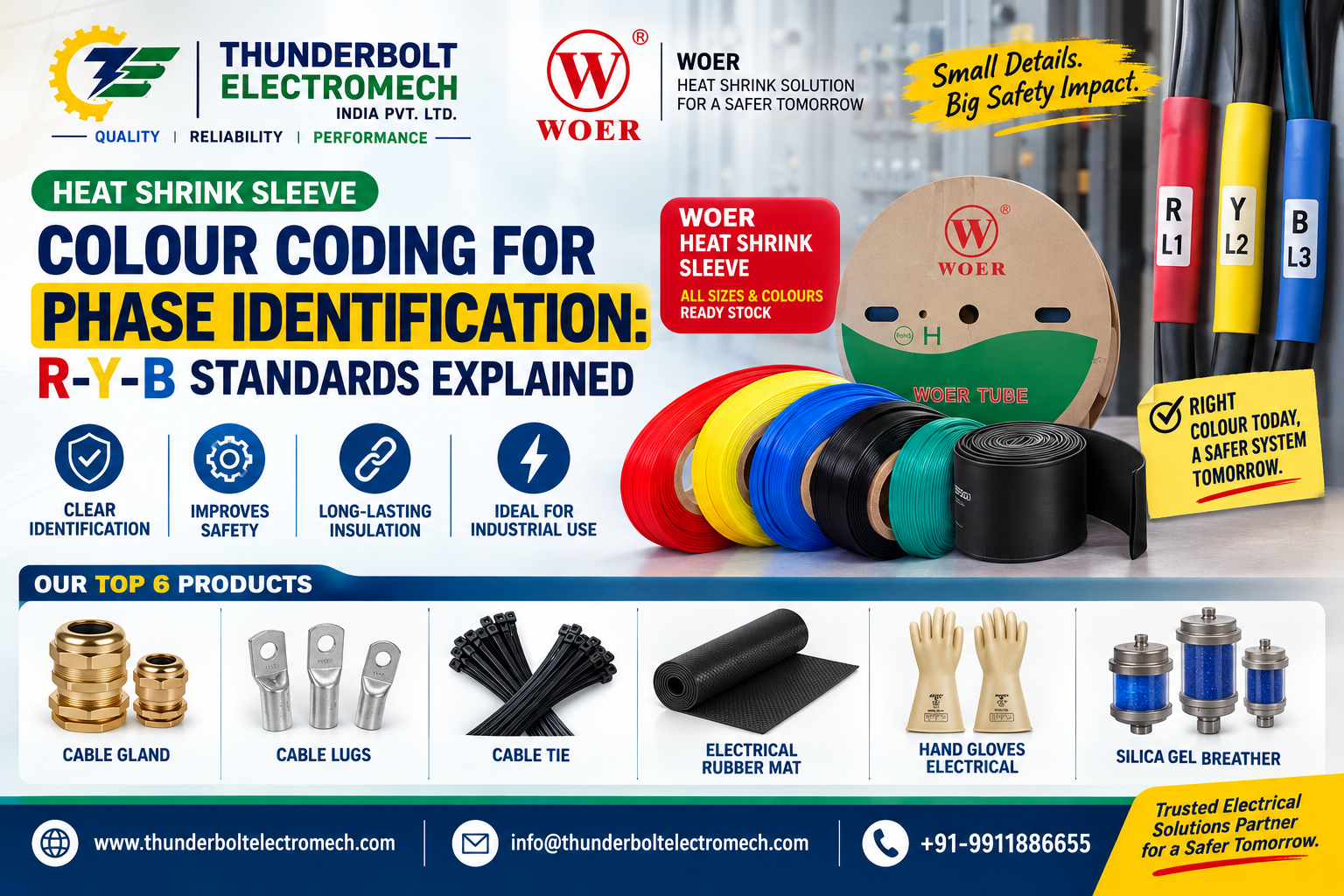
The legacy Indian scheme — the one still dominating Indian sites — uses Red, Yellow, and Blue for the three phases, Black for neutral, and Green or Green-Yellow for earth, as specified under IS 732:2019, the Code of Practice for Electrical Wiring Installations.
The current, revised standard is different. IS 11353:2023 — the Bureau of Indian Standards’ first revision of its conductor identification guide — is now identical under dual numbering with IEC 60445:2021
Why the gap between “current standard” and “what’s on site” matters practically. This scheme increasingly shows up on imported switchgear, IEC-certified equipment, and modern harmonised (HFFR) cable ranges sold in India (Source: cablepriceindia.com — Direct source found), while site-applied colour marking — the heat shrink sleeves and tape actually wrapped around terminations during installation — still defaults to R-Y-B out of habit and familiarity. That mismatch is not hypothetical. A panel commissioned last year with imported IEC-labelled MCCBs, wired by a crew applying legacy R-Y-B heat shrink at every gland entry, now carries two colour standards on the same equipment — one printed by the manufacturer, one applied on site. Anyone maintaining that panel five years from now, without knowing both standards existed, has a genuine misread risk sitting in front of them.
Why Core Insulation Colour Isn’t Enough for Power Cables
This is the point most colour-coding guides never address, because most of them are written about house wiring, where every core already comes pre-coloured from the cable manufacturer. Industrial power cabling doesn’t work that way.
Larger cross-section power cables — the XLPE and PVC-insulated armoured cables used for feeders, motor connections, and panel-to-panel runs — are frequently manufactured with a single-colour outer sheath, commonly black, regardless of how many cores run inside. The cable itself carries no phase information visible from outside. At every termination point — a gland entry, a lug connection, a joint — there is no coloured core to glance at and identify. The only way to mark phase identity at that visible point is to apply it externally, after the cable is already terminated.
This is precisely the job a colour-coded heat shrink sleeve does that the cable’s own construction cannot. Slide a Red, Yellow, or Blue (or Brown/Black/Grey, depending on which standard the site follows) WOER Heat Shrink Sleeve over each core at the termination, and the phase identity becomes visible exactly where a technician needs it — at the gland, at the lug, at the point where hands actually go during maintenance — regardless of what colour the cable’s outer sheath happens to be.
This distinction matters for procurement, not just installation technique. A site ordering heat shrink sleeve purely by size, with no thought given to colour range, is missing half of what the product needs to do on power cabling specifically. Colour isn’t a cosmetic option on this application — it’s the actual delivery mechanism for a safety requirement that the cable itself doesn’t fulfil.
Heat Shrink Sleeve Supplier — Full-Length Sleeves vs Ring Bands for Phase Marking
Two distinct application methods exist, and choosing between them depends on where along the cable run identification actually needs to be visible.
Full-length sleeving covers the entire exposed length of a core from the point it exits the cable’s outer sheath to the termination itself — the standard approach at a gland entry or panel termination, where the entire visible run of that conductor should read as one continuous colour.
Ring bands — short sections of coloured heat shrink sleeve, typically 15-25mm wide, applied at intervals along an otherwise unmarked run — suit longer cable trays or duct runs where full-length sleeving the entire visible length isn’t practical, but periodic identification at inspection points (every metre, or at each tray support) still needs to be maintained.
A genuine Heat Shrink Sleeve Supplier should stock colour ranges deep enough to support both approaches — full rolls for termination sleeving, and pre-cut or easily trimmed sections for ring-band marking — rather than offering only one width in one colour and leaving the rest to whatever a site can improvise with tape.
How to Apply Colour-Coded Heat Shrink Sleeves Correctly
Confirm the site’s actual standard before cutting a single piece.
As covered above, this is not a given — check whether the installation follows legacy R-Y-B or the current IEC-aligned Brown-Black-Grey scheme, and confirm which applies to this specific job, since mixing them within one panel creates exactly the confusion colour coding exists to prevent.
Maintain consistent phase sequence physically, not just by colour.
The broader engineering principle behind most busbar and switchgear phase arrangement conventions internationally — sequential phase order maintained front-to-back, top-to-bottom, or left-to-right as viewed from the front of the equipment — reduces misidentification risk even before a technician reads a single colour
Size the sleeve to the conductor, not the other way round.
A sleeve too loose won’t grip cleanly at the shrink point and can rotate out of correct viewing position over time; one too tight risks splitting during installation. Thunderbolt’s guide on heat shrink sleeve sizing covers the expanded-versus-recovered diameter calculation this depends on.
Heat from the centre outward, exactly as with any other heat shrink application.
Colour-coding sleeves are still heat shrink sleeves first — the correct heating technique detailed in Thunderbolt’s installation guide applies identically here, and a poorly shrunk colour sleeve that wrinkles or scorches is both a weak seal and an illegible marker.
Why Heat Shrink Outlasts Tape and Paint for Phase Marking
Coloured insulating tape and paint dabs are the two most common alternatives to heat shrink for site-applied phase marking, and both share the same underlying weakness: neither forms a permanent bond to the conductor.
Tape loosens and unwinds under vibration and thermal cycling — exactly the conditions present at any panel termination carrying real load, where thermal expansion and contraction happen daily. A loosened tape wrap doesn’t just look untidy; it can migrate along the conductor or fall away entirely, leaving the termination unmarked months after installation.
Paint fades and chips, particularly on conductors that see any handling during subsequent maintenance work — a paint dab brushed against during an unrelated repair is gone, with no easy way to confirm what colour it originally was.
A correctly shrunk heat shrink sleeve forms a continuous, mechanically gripped layer around the conductor that doesn’t rely on adhesive bonding to a potentially oily or dusty surface the way tape does. It shrinks into the conductor’s actual contours rather than sitting loosely wrapped around them, and because it’s doing double duty — insulation and mechanical protection alongside colour identification — a scorched or degraded sleeve is also visibly signalling a termination that may need re-inspection, which tape and paint never do. For the fuller comparison beyond phase marking specifically — dielectric performance, mechanical protection, and long-term cost — see Thunderbolt’s dedicated piece, Heat Shrink vs. Traditional Tape: Which Should You Use?
Bridging Legacy R-Y-B and IEC Brown-Black-Grey Without Recabling
This is a genuinely practical problem worth addressing directly, because most facilities aren’t going to re-cable an entire plant just because the national standard moved on paper.
You don’t need to replace existing R-Y-B marked cabling to bring a site into line with the current standard. Heat shrink sleeve remarking — stripping back the old colour identification at accessible termination points and applying new Brown-Black-Grey sleeves in its place — lets a facility transition its visible colour scheme without touching the cable itself. This is the practical bridge between “the standard changed” and “we have thousands of metres of correctly functioning R-Y-B marked cable already in service.”
A sensible transition approach, rather than an all-at-once changeover:
- New installations and any panel being newly commissioned should use the current IEC-aligned scheme from day one
- Existing panels undergoing any termination work for other reasons (a fault repair, a load addition) get their affected terminations remarked to the new scheme as part of that same work, rather than a separate dedicated project
- A clear, physically posted reference — inside the panel door, not just in a document nobody carries on site — showing which scheme that specific panel uses, since a mixed-standard facility genuinely needs this signage more than a single-standard one does
The heat shrink sleeve is the tool that makes this gradual transition possible at all. Without an external, colour-carrying layer that can be reapplied independently of the cable underneath, a standard transition would mean a wholesale re-cabling project. With it, the transition becomes a maintenance-cycle-by-maintenance-cycle process — exactly the kind of pragmatic approach a facilities team can actually execute without a dedicated capital project behind it.
Heat Shrink Sleeve Supplier — Matching Colour Range to Site Standards
A capable Heat Shrink Sleeve Supplier operating across a market where two active colour standards coexist should stock both palettes as standard, not as a special order:
- Red, Yellow, Blue for sites and contractors still working to the legacy scheme, which remains the practical majority across existing Indian installations
- Brown, Black, Grey for new installations, imported equipment terminations, and any project explicitly specifying IEC 60445:2021 alignment
- Black and Green/Yellow-Green for neutral and earth identification consistently, regardless of which phase scheme a given site uses
Buyers sourcing from a supplier who stocks only one palette are quietly limiting which standard they can correctly specify against — worth checking before committing to a bulk order for a multi-panel project. For the broader criteria worth checking before committing to any supplier relationship — not just colour range — see Thunderbolt’s guide, How to Choose the Best Heat Shrink Sleeve Supplier in India?
Comparison Table: R-Y-B vs Brown-Black-Grey vs DC Marking Conventions
| Convention | Phase / Conductor Colours | Where It Applies | Status in India |
| Legacy Indian (IS 732:2019) | Red (L1), Yellow (L2), Blue (L3), Black (Neutral), Green/Green-Yellow (Earth) | Traditional Indian fixed wiring and site practice | Still the most common in existing installations |
| IEC-aligned (IS 11353:2023 / IEC 60445:2021) | Brown (L1), Black (L2), Grey (L3), Light Blue (Neutral), Green-Yellow (Earth) | Current Indian standard; imported/IEC-certified equipment | Increasingly specified on new work, not yet dominant on site |
| DC systems (PV/battery) | Varies by project convention — commonly Red (positive), Black or Blue (negative) | Solar combiner boxes, battery banks | No single unified Indian mandate; project-specific marking essential |
Common Customer Problems and Solutions
Problem: “Our panel has a mix of Red/Yellow/Blue and Brown/Black/Grey markings, and nobody’s sure which applies where.”
This is exactly the mixed-standard scenario this guide addresses. The fix isn’t picking one scheme and remarking everything at once — it’s posting a clear reference inside the panel showing which scheme governs which section, and standardising new work going forward to the current IEC-aligned scheme.
Problem: “We ordered heat shrink sleeve for phase marking but only got black stock from our usual supplier.”
This points to a supplier stocking sleeve as a generic insulation product without maintaining a genuine colour range. A Heat Shrink Sleeve Supplier serving industrial phase-marking demand specifically needs Red, Yellow, Blue, Brown, and Grey available as standard stock, not black alone.
Problem: “Our tape-based phase marking keeps coming loose within months.”
Covered in detail above — tape doesn’t grip the conductor mechanically the way heat shrink does, and vibration or thermal cycling loosens it progressively. Switching to correctly sized, correctly shrunk colour sleeve at the same termination points resolves this permanently rather than requiring repeated re-taping.
Problem: “Our imported switchgear uses Brown/Black/Grey labelling, but our site cabling is still Red/Yellow/Blue — how do we reconcile this at the termination?”
Apply the switchgear’s labelled scheme (Brown-Black-Grey) via heat shrink sleeve at the point where the site cabling actually terminates into that equipment, clearly documenting the transition point so anyone tracing the circuit later understands exactly where the colour convention changes and why.
Common Colour-Coding Mistakes During Panel and Cable Work
Mistake 1 — Assuming Red-Yellow-Blue is still the “official” standard without checking.
As this guide has covered, IS 11353:2023 has moved the current Indian standard toward IEC alignment — a detail that genuinely surprises even experienced site electricians.
Mistake 2 — Mixing both schemes within a single panel with no documentation of where the transition happens.
Creates a real misidentification risk for whoever services that panel next without full context.
Mistake 3 — Relying on the cable’s outer sheath colour instead of marking each core individually.
As covered above, a black-sheathed power cable tells you nothing about which core is which phase — only sleeve or band marking at the termination does that.
Mistake 4 — Using tape as a “temporary” marking that becomes permanent.
A site intending to revisit and properly sleeve a termination “later” very often never does — heat shrink sleeve should be the first application, not the eventual upgrade.
Mistake 5 — Sourcing colour sleeve from a supplier with an incomplete palette.
Forces a site to substitute an available colour for the correct one, quietly reintroducing the exact confusion the colour system exists to prevent.
How a Heat Shrink Sleeve Supplier Delhi/NCR Contractors Trust Helps With Compliance
For contractors and panel builders working across a region where legacy and current colour standards coexist on active sites, a Heat Shrink Sleeve Supplier Delhi NCR teams can reach quickly should be able to, and any genuine phase identification sleeve Delhi NCR search should point buyers toward a supplier who can:
- Confirm current colour range availability across both R-Y-B and Brown-Black-Grey before a bulk order, not after — a heat shrink sleeve colours Delhi supplier relationship that only stocks black is not serving this specific need
- Explain the IS 11353:2023 transition clearly enough to advise a client making the switch, rather than simply fulfilling whatever colour is requested
- Supply matching sizes across the full colour range, so a project isn’t stuck substituting a different diameter in the one colour that happens to be in stock
- Support same-day or next-day dispatch across Delhi NCR for urgent termination work, since phase-marking gaps are often flagged during a live commissioning deadline, not weeks in advance
Why Choose Thunderbolt as Your Heat Shrink Sleeve Supplier for Phase Identification
Thunderbolt Electromech India Pvt. Ltd. is the Delhi-based distributor and supplier of the complete WOER Heat Shrink Sleeve range across Delhi/NCR, stocking the colour depth phase-identification work genuinely needs — not just the black industrial-grade stock most general suppliers default to. Whether a project follows the legacy Red-Yellow-Blue convention or the current IEC-aligned Brown-Black-Grey scheme under IS 11353:2023, Thunderbolt’s range supports both, backed by the same dielectric strength and shrink-ratio documentation covered in our broader Heat Shrink Sleeve Supplier pillar guide.
Contact Thunderbolt Electromech India Pvt. Ltd.: 📍 Shop No. 3538, Sitaram Bazar Rd, Bazar Sirkiwalan, Chawri Bazar, Chandni Chowk, Delhi – 110006 📞 +91-9911886655 ✉️ info@thunderboltelectromech.com
Frequently Asked Questions
Is Red-Yellow-Blue still correct for phase identification in India?
It remains the most widely used convention on existing Indian sites and is specified under IS 732:2019, but the current, revised Indian standard, IS 11353:2023, aligns with IEC 60445:2021 and points toward Brown-Black-Grey instead. Both are technically valid depending on which standard a specific project or piece of equipment follows — the key is knowing which applies where, not assuming one is universally current.
Why do I need coloured heat shrink sleeve if my cable already has coloured cores?
Smaller control and building-wiring cables typically do come with individually coloured cores, but larger power cables — armoured XLPE and PVC feeders in particular — are frequently manufactured with a single-colour black outer sheath regardless of internal phase count. Heat shrink sleeve is what actually carries visible phase identity at the termination for these cables.
Can I mix Red-Yellow-Blue and Brown-Black-Grey on the same site?
You can, during a transition period, but only with clear documentation showing exactly where and why the scheme changes — otherwise you’re recreating the exact identification risk colour coding exists to prevent.
What’s the difference between full-length sleeving and ring-band marking?
Full-length sleeving covers a core’s entire exposed length from sheath exit to termination, standard at gland entries and panel terminations. Ring bands are shorter sections applied at intervals along a longer, otherwise unmarked run — useful in cable trays or ducts where full coverage isn’t practical but periodic identification still matters.
Does heat shrink sleeve really last longer than tape for phase marking?
Yes — a correctly shrunk sleeve grips the conductor mechanically and doesn’t rely on adhesive bonding the way tape does, making it far more resistant to the vibration and thermal cycling that loosens tape over time.
Conclusion
Phase colour coding only works if the colour actually means the same thing to everyone reading it — and this guide has walked through why that’s currently more complicated in India than most site teams realise. IS 11353:2023 has quietly moved the country’s official standard toward IEC-aligned Brown-Black-Grey, even as Red-Yellow-Blue remains the practical majority on existing installations, and heat shrink sleeve is the one tool that lets a facility bridge that gap without a full re-cabling project. Beyond the standards question, the deeper engineering point stands regardless of which scheme a site follows: large power cables frequently carry no phase information in their own construction, and a colour-coded heat shrink sleeve applied correctly at every termination is what actually delivers that identification where a technician’s hands will be. Thunderbolt Electromech India Pvt. Ltd. supplies the full WOER Heat Shrink Sleeve colour range across Delhi/NCR, supporting both the legacy and current Indian standards, so your next termination carries the right colour, not just whatever happened to be in stock. Call +91-9911886655 or write to info@thunderboltelectromech.com to confirm colour availability for your next panel or cable termination job.