
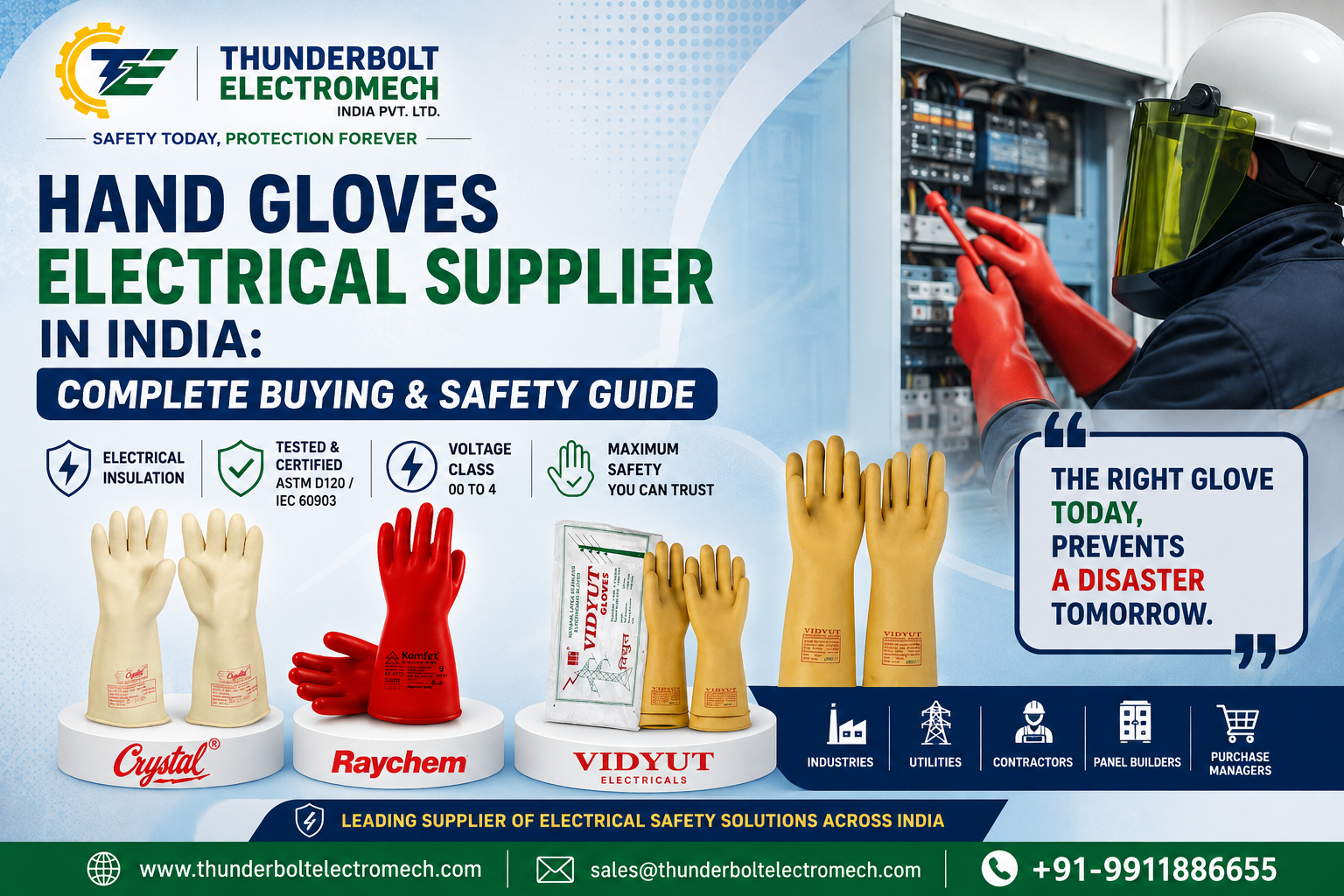
By Thunderbolt Electromech India Pvt. Ltd. — Delhi-based Distributor and Supplier of Raychem, Vidyut and Crystal Electrical Hand Gloves
📞 +91-9911886655 | ✉️ info@thunderboltelectromech.com | 🌐 thunderboltelectromech.com | 📍 Shop No. 3538, Sitaram Bazar Rd, Bazar Sirkiwalan, Chawri Bazar, Chandni Chowk, Delhi – 110006
Quick Answer: The right electrical hand gloves should be selected according to the electrical hazard, maximum working voltage, glove class, applicable standard, glove size, work method, mechanical hazards and required inspection/testing program. Do not choose a glove merely because it is made from rubber or because a supplier describes it as “high voltage.”
For electrical insulating gloves, standards such as IEC 60903 and ASTM D120 provide important technical frameworks. IEC 60903 applies to electrical insulating gloves and mitts used to protect workers against electric shock, while ASTM D120 covers rubber insulating gloves and recognizes Classes 00, 0, 1, 2, 3 and 4.
The most important procurement distinction is between maximum working voltage and test voltage. A proof-test voltage is not permission to use a glove at that voltage in normal work.
For industrial buyers, the safest purchasing sequence is:
Identify the hazard → establish voltage → select glove class → verify standard → confirm size → determine mechanical protection → check inspection/testing requirements → verify documentation → buy from a traceable supplier.
Thunderbolt Electromech India Pvt. Ltd. supplies Raychem electrical hand gloves across India and also offers Vidyut and Crystal electrical hand gloves for industrial and electrical safety requirements.
If you are comparing an Electrical Hand Gloves Supplier, compare the technical specification and documentation—not just the quoted price.
What Are Electrical Hand Gloves?
Electrical hand gloves are insulating gloves designed and tested for use where workers may face an electrical shock hazard.
They form part of a broader electrical safety system. They do not replace de-energization, isolation, lockout/tagout, verification, safe working distances, proper tools or trained personnel.
That distinction matters because many gloves sold for industrial hand protection are not electrical insulating gloves.
A cut-resistant glove can protect against a sharp edge.
A leather glove can provide mechanical protection.
A nitrile-coated glove can improve grip and handling.
None of those characteristics automatically establishes that the glove is suitable for electrical shock protection.
An electrical insulating glove must be evaluated as a specific product against its applicable technical requirements.
IEC 60903 states that the standard applies to electrical insulating gloves and mitts intended to protect workers against electric shock. It also covers composite gloves with integrated mechanical protection. ASTM D120 similarly covers the manufacturing and testing of rubber insulating gloves intended to protect workers from electrical shock. The standard identifies six electrical classes: 00, 0, 1, 2, 3 and 4.
Why the material alone is not enough
A common procurement mistake is:
“Rubber does not conduct electricity easily, so any thick rubber glove should be safe.”
That reasoning is incomplete.
Electrical safety depends on the finished product, its construction, electrical performance, condition, classification, testing and application.
A glove may look thick and robust while being unsuitable for the electrical exposure.
Conversely, an electrical insulating glove may be relatively thin because its design is optimized for insulation and dexterity.
This is why a competent Electrical Insulating Gloves Supplier should be able to discuss the product’s class, working voltage, applicable standard and documentation rather than simply quoting a material description.
Why Are Electrical Gloves Required?
Electricity does not need a large visible spark to cause serious injury.
A worker can be exposed through direct contact with energized conductors, accidental contact with equipment, damaged insulation, incorrect isolation, induced voltage or unexpected energization.
Electrical insulating gloves can provide an insulating barrier when the product is correctly selected, maintained and used within its specified limits.
But there is an important engineering rule:
PPE should not be used as a substitute for controlling the electrical hazard.
Where the work procedure permits, equipment should be de-energized, isolated and verified before work begins.
Electrical gloves have a specific job
Their purpose is to help protect the worker from electrical shock.
They are not automatically:
- Arc-flash suits
- Cut-resistant gloves
- Chemical-resistant gloves
- Heat-resistant gloves
- Welding gloves
- General-purpose work gloves
Some products can combine functions, but the buyer must verify the exact product specification.
IEC 60903, for example, recognizes composite gloves that incorporate additional mechanical protection.
Electrical shock protection versus arc-flash protection
This distinction deserves special attention.
A glove can have an electrical insulation rating without being the complete PPE solution for an arc-flash hazard.
Arc-flash risk assessment may require additional protection such as appropriate clothing, face and eye protection and other PPE.
Therefore, an engineer should ask two different questions:
1. What protection is required against electrical shock?
2. What protection is required against arc-flash energy and other hazards?
The answers may lead to different PPE requirements.
Electrical Hand Gloves Supplier: What Should Buyers Check?
When selecting an Electrical Hand Gloves Supplier, do not begin with price.
Begin with the specification.
A useful purchase enquiry should identify:
- Electrical system voltage
- AC or DC application
- Maximum working voltage
- Required glove class
- Applicable standard
- Glove size
- Glove length
- Application
- Quantity
- Required testing/documentation
- Protector glove requirement
- Delivery location
A quotation that only states:
“Electrical rubber gloves – ₹___ per pair”
does not provide enough technical information for a responsible industrial purchase.
Ask the supplier these questions
- What is the exact manufacturer?
- What is the exact model?
- What electrical class is the glove?
- What is its maximum working voltage?
- Which standard applies?
- Is the product tested?
- What identification or traceability is available?
- What sizes are available?
- Does the application require a protector glove?
- What inspection and retesting procedure applies?
A good supplier should be comfortable answering these questions.
Electrical Hand Gloves Supplier: Understanding Voltage Classes
The glove class is one of the most important technical selection criteria.
ASTM D120 identifies six classes of rubber insulating gloves:
- Class 00
- Class 0
- Class 1
- Class 2
- Class 3
- Class 4
The classes differ in electrical characteristics. ASTM D120 also addresses testing such as AC proof testing, AC breakdown testing, moisture absorption/proof testing, DC testing, ozone resistance, chemical tests, tensile strength, tear resistance and puncture resistance.
General ASTM D120 class framework
| Glove Class | Electrical category | Typical procurement question |
| Class 00 | Lowest class in the ASTM series | Is the application within the product’s specified working voltage? |
| Class 0 | Low-voltage category | Is the glove suitable for the actual system and work method? |
| Class 1 | Higher electrical class | What is the exact maximum working voltage of the selected product? |
| Class 2 | Higher-voltage category | Is the glove class matched to the exposure rather than simply nominal system voltage? |
| Class 3 | High-voltage category | Are additional PPE and work controls required? |
| Class 4 | Highest ASTM D120 class | Has the entire electrical safety system been evaluated? |
Important: The table above explains the class structure rather than providing a universal voltage-selection chart. The exact working-voltage values must come from the current manufacturer’s documentation and the applicable standard.
That distinction prevents a common procurement error: treating a class number as if it were a standalone voltage rating.
Working Voltage Is Not Proof-Test Voltage
This is one of the most important points in electrical glove procurement.
A glove can be tested at a voltage considerably higher than its permitted working voltage.
That does not mean the worker can operate at the test voltage.
Example of the procurement mistake
A buyer sees:
Proof test: 10,000 V
and concludes:
“This glove can be used on 10 kV.”
That conclusion may be wrong.
The buyer must distinguish:
- Maximum working voltage
- Proof-test voltage
- Breakdown voltage
- AC/DC test conditions
- Product class
The manufacturer’s technical documentation should be the controlling reference.
Why this matters
Electrical insulation is not a simple yes/no property.
Performance depends on:
- Material
- Thickness
- Manufacturing quality
- Moisture
- Surface contamination
- Damage
- Ageing
- Electrical stress
- Test conditions
- Product design
A serious purchase specification therefore asks for working voltage, not just a test number.
Electrical Hand Gloves Supplier: Types of Electrical Gloves
Electrical hand protection is not one single product category.
Different glove constructions address different combinations of electrical and mechanical requirements.
Rubber Insulating Gloves
Traditional rubber insulating gloves are designed to provide electrical insulation.
ASTM D120 covers rubber insulating gloves for protection against electrical shock and separates products into six electrical classes.
These are commonly considered when electrical workers require voltage-rated insulating protection.
Composite Gloves
Composite gloves combine electrical insulation with additional mechanical protection.
IEC 60903 specifically includes composite gloves within its scope.
The advantage is obvious in applications where workers need to reduce the need for separate protective layers.
However, the buyer should still check the exact manufacturer’s requirements and limitations.
Insulating Gloves with Protector Gloves
A traditional system uses:
Rubber insulating glove + mechanical protector glove
The insulating glove addresses the electrical hazard.
The protector glove helps protect the insulating glove from mechanical damage.
ASTM F3258 establishes requirements for protectors worn over rubber insulating gloves and emphasizes that the protector should fit over the insulating glove without causing mechanical damage or compromising its integrity.
This is not simply a matter of putting any leather glove on top.
Fit matters.
The protector must not damage or distort the insulating glove.
High Voltage Electrical Gloves
High Voltage Electrical Gloves should never be purchased merely because the product title includes the phrase “high voltage.”
Ask for the actual:
- Class
- Maximum working voltage
- Standard
- Test requirements
- Manufacturer
- Model
The term “high voltage” has to be converted into a measurable technical specification before procurement.
Electrical Gloves vs Regular Work Gloves
This is where many industrial buyers make mistakes.
| Feature | Electrical Insulating Gloves | Regular Work Gloves |
| Primary function | Electrical shock protection | General hand protection |
| Voltage classification | Applicable products have defined electrical classifications | Normally not voltage-rated |
| Dielectric performance | Designed/tested according to applicable requirements | Not normally established for electrical protection |
| Common materials | Electrical insulating rubber/elastomer | Leather, textile, nitrile, PU, PVC and others |
| Mechanical protection | May require protector glove | Often primary function |
| Electrical application | Product-specific | Do not assume suitability |
| Inspection | Important before use | Depends on product |
| Electrical retesting | Applicable to insulating PPE | Generally not applicable |
| Selection basis | Voltage, class, standard, application | Hazard/task and mechanical requirements |
The engineering question to ask
Do not ask:
“Is this glove rubber?”
Ask:
“Is this exact glove designed, tested and rated for electrical insulating protection at the voltage involved in this task?”
That question moves the purchase from a material-based decision to an engineering decision.
Electrical Insulating Properties: What Actually Matters?
Electrical insulation is influenced by the physical and electrical characteristics of the finished glove.
ASTM D120 demonstrates how broad the performance requirements are. It includes electrical tests as well as physical and environmental characteristics such as ozone resistance, tensile strength, tear resistance and puncture resistance.
That is an important insight for procurement teams.
A glove must survive the real workplace, not just pass one electrical number in a laboratory.
Four properties matter together
1. Electrical integrity
The glove must provide the required electrical insulation.
2. Mechanical integrity
Cuts, punctures, tears and severe abrasion can compromise the glove.
3. Environmental resistance
Heat, sunlight, ozone, chemicals and humidity can affect rubber products.
4. Traceability and testing
The organization needs confidence that the glove remains fit for service.
This is why electrical glove management should include both product selection and lifecycle control.
Electrical Hand Gloves Supplier: Standards and Certification
A supplier’s statement that a glove is “certified” should not end the buyer’s investigation.
Ask:
Certified to what?
Which standard?
Which exact model?
What documentation accompanies the product?
IEC 60903
IEC 60903:2014 is the international standard for electrical insulating gloves and mitts used to protect workers against electric shock.
The IEC states that the standard also covers composite gloves with integrated mechanical protection.
Evidence classification
Source type: Primary
Source: International Electrotechnical Commission.
Direct evidence found: Yes.
ASTM D120
ASTM D120 covers manufacturing and testing of rubber insulating gloves used to protect workers from electrical shock.
The ASTM specification recognizes six classes: 00, 0, 1, 2, 3 and 4.
Evidence classification
Source type: Primary
Direct evidence found: Yes.
ASTM F3258
ASTM F3258 addresses protectors worn over rubber insulating gloves and requires them to fit appropriately without compromising the insulating glove.
Evidence classification
Source type: Primary
Direct evidence found: Yes.
OSHA inspection and testing guidance
OSHA’s electrical safety guidance states that insulating gloves that fail inspection must be removed from service. It also describes regular electrical testing intervals and storage controls, including protection from excessive heat, sunlight, humidity, ozone and damaging chemicals.
OSHA’s interpretation further states that under its U.S. regulatory framework, rubber insulating gloves are tested before first issue and every six months thereafter, with additional testing in specified circumstances.
Evidence classification
Source type: Primary regulatory source
Direct evidence found: Yes.
Important India note: OSHA requirements are U.S. regulatory requirements. Indian organizations should not automatically treat OSHA’s interval as an Indian legal requirement. Use applicable Indian regulations, project specifications, manufacturer requirements and relevant standards for the actual workplace.
What About IS 4770 for Electrical Gloves in India?
Indian buyers may encounter IS 4770:1991 – Rubber Gloves – Electrical Purposes – Specification.
The BIS material available online identifies IS 4770:1991 and describes requirements, sampling and testing for rubber insulating gloves for electrical purposes.
However, buyers should verify the current status and applicability of any Indian Standard directly through BIS before placing it in a current tender or compliance statement.
Evidence classification
Source type: Primary BIS material.
Direct evidence found: Yes for the standard document.
Current-status caution: The available BIS pages should be checked at procurement time for current status, applicability and any replacement standard.
This matters because an old standard reference should not automatically be presented as a current mandatory requirement.
Electrical Hand Gloves Supplier: How to Select the Right Gloves
A practical selection process starts with the work—not the catalogue.
Step 1: Identify the electrical system
Write down:
- Nominal voltage
- Maximum voltage
- AC or DC
- Equipment type
- Exposure point
- Work location
Do not rely on memory.
Step 2: Identify the task
Is the worker:
- Maintaining an electrical panel?
- Testing switchgear?
- Working on a transformer?
- Maintaining a distribution board?
- Working in a substation?
- Performing installation?
- Commissioning equipment?
- Performing troubleshooting?
The same worker may need different PPE for different tasks.
Step 3: Establish whether the equipment can be de-energized
If it can be safely de-energized, isolation should be considered before PPE selection.
If energized work is permitted under the applicable procedure, the PPE requirements must match the hazard assessment.
Step 4: Determine the required glove class
Match the glove’s permitted working voltage to the actual exposure.
Never choose the class based only on the glove’s test voltage.
Step 5: Verify the standard
Ask the supplier to identify the applicable standard.
Step 6: Check size
Correct fit matters.
A glove that is too large can reduce dexterity.
A glove that is too small can restrict movement and create discomfort.
Step 7: Check protector requirements
Where mechanical protection is needed, use an appropriate protector designed to work with the insulating glove.
Step 8: Check documentation
Request:
- Datasheet
- Model number
- Class
- Voltage rating
- Standard
- Test information
- Identification/traceability information
- Manufacturer instructions
Step 9: Establish lifecycle control
Determine:
- Inspection frequency
- Electrical test frequency
- Storage method
- Cleaning method
- Replacement criteria
- Recordkeeping
Electrical Gloves for Different Industrial Applications
The phrase Electrical Gloves for Industrial Use covers a wide range of environments.
A factory electrician working on a low-voltage control panel has a different risk profile from a utility technician working around higher-voltage distribution equipment.
Manufacturing plants
Typical applications include:
- Electrical panels
- MCCs
- Control cabinets
- Distribution boards
- Motor control systems
- Industrial machinery
The glove class should be based on the actual electrical exposure.
Electrical contractors
Contractors often work across multiple sites.
The challenge is standardization.
Instead of purchasing a single glove class for every project, contractors can maintain a PPE matrix linked to the voltage and task at each site.
Transformer maintenance
Transformer work can involve significant electrical hazards.
The PPE selection should form part of a complete electrical work procedure rather than being treated as an isolated glove purchase.
Substations
Substation work may involve higher-voltage systems, switching operations and multiple simultaneous hazards.
High Voltage Electrical Gloves may form part of the PPE package where applicable, but the correct class must be established from the actual exposure and work procedure.
Utility and distribution work
Utility workers often require specialized electrical protective equipment, and glove selection should be integrated into the utility’s established live-working and electrical safety procedures.
Real Use Case 1: Industrial Panel Maintenance
Consider a factory maintenance team responsible for electrical panels.
The purchase department receives a request:
“Please purchase 30 pairs of electrical gloves.”
That request is too vague.
A technically stronger process is:
Panel voltage → task → electrical exposure → glove class → standard → size → protector requirement → documentation.
Suppose the facility has several voltage levels.
The team should not automatically issue the same glove to every worker.
Instead, the safety department and electrical engineering team should identify the required PPE for each task.
Procurement outcome
The purchase order can specify:
- Brand
- Model
- Class
- Maximum working voltage
- Standard
- Size
- Quantity
- Documentation
This creates traceability.
Real Use Case 2: Contractor Working at Multiple Sites
An electrical contractor may maintain:
- A commercial facility
- A manufacturing plant
- A distribution substation
- A transformer yard
The contractor’s procurement manager should avoid a “one glove fits every job” policy.
A better approach is a PPE schedule.
| Application | Voltage | Required Glove Class | Additional PPE | Documentation |
| Panel maintenance | Project-specific | Determine from exposure | Based on hazard assessment | Required |
| Industrial distribution | Project-specific | Determine from exposure | Based on task | Required |
| Transformer work | Project-specific | Determine from exposure | Based on hazard assessment | Required |
| Substation work | Project-specific | Determine from exposure | Full electrical PPE assessment | Required |
The exact class cannot be responsibly assigned from the application name alone.
That is the engineering point.
Real Use Case 3: Why Correct Sizing Matters
An electrician may reject a glove because it feels bulky.
The purchase team may then look for the thinnest possible alternative.
That is not necessarily the right answer.
A better solution is to evaluate:
- Correct glove class
- Correct size
- Appropriate glove length
- Suitable dexterity
- Correct protector
- Correct task
A properly fitted glove can improve handling without reducing the electrical protection required by the application.
Community discussions among electricians repeatedly mention fit and dexterity as practical concerns. These observations are useful for understanding user experience, but they should not replace manufacturer requirements or electrical safety standards.
Evidence classification
Source type: Peer/community research.
Direct technical authority: No.
Use: Practical user experience only.
Customer Problems and Solutions
Problem 1: “The supplier has not mentioned the glove class.”
Solution
Do not approve the purchase until the class and maximum working voltage are identified.
Problem 2: “The quotation only gives proof-test voltage.”
Solution
Ask specifically for maximum working voltage.
Proof-test voltage and working voltage are not interchangeable.
Problem 3: “Can we use leather gloves for electrical work?”
Solution
Do not treat leather work gloves as substitutes for voltage-rated electrical insulating gloves.
Where protector gloves are required, they should be used over the insulating glove as part of the specified protective system.
ASTM F3258 specifically addresses protectors intended for use over rubber insulating gloves.
Problem 4: “Why do we need inspection if the glove is new?”
Solution
A new product still needs to be handled according to the applicable inspection and testing program.
Once in service, the glove can also experience damage from storage, handling, tools, chemicals, heat or mechanical stress.
Problem 5: “The glove looks good, so it must be safe.”
Solution
Visual inspection and electrical testing answer different questions.
A glove can look acceptable while requiring testing under the applicable safety program.
OSHA guidance explicitly distinguishes inspection from periodic electrical testing.
Problem 6: “Can one glove class cover all our equipment?”
Solution
Only if the technical assessment confirms that the selected glove is suitable for every relevant exposure.
Do not standardize PPE simply for purchasing convenience.
Problem 7: “The competitor’s Electrical Gloves Price is lower.”
Solution
Compare:
- Same class?
- Same manufacturer?
- Same model?
- Same working voltage?
- Same standard?
- Same size?
- Same documentation?
- Same delivery?
- Same testing/traceability?
If the answer is no, it is not a like-for-like comparison.
Problem 8: “Our workers complain that gloves are difficult to handle.”
Solution
Check sizing and task suitability before changing the electrical protection level.
Community discussions frequently identify dexterity and fit as practical concerns for electrical workers.
Treat these as user-experience observations, not as substitutes for formal standards.
Electrical Glove Inspection: What Should Workers Check?
Inspection should be integrated into the site’s PPE procedure.
Before use, check the glove for obvious signs of deterioration.
Look for cuts
Examine the complete surface.
Look for punctures
Small punctures can be difficult to notice.
Check tears
Do not use damaged insulating gloves.
Check abrasion
Repeated rubbing against tools or equipment can damage the surface.
Look for contamination
Oil, chemicals, dirt and other contaminants may affect the glove material.
Look for signs of ageing
Changes in appearance, flexibility or surface condition deserve attention.
Check the cuff
The cuff is part of the glove and should be included in inspection.
Air inflation can help identify defects
Where the applicable inspection procedure permits, carefully expanding the glove can help reveal certain defects.
Workers should follow the manufacturer’s inspection method and workplace safety procedure rather than improvising a test.
OSHA’s electrical PPE guidance states that insulating equipment failing inspection must be removed from service.
Electrical Testing: Why It Matters
A visual inspection cannot establish the complete dielectric condition of an electrical insulating glove.
That is why electrical testing exists.
ASTM D120 includes electrical tests such as AC proof testing and AC breakdown testing along with physical and environmental tests.
ASTM F496 is also referenced by OSHA as a standard concerning in-service care of insulating gloves and sleeves.
OSHA testing example
Under OSHA’s U.S. requirements, rubber insulating gloves must be electrically tested before first issue and every six months thereafter, with additional testing in certain situations such as when insulating value is suspected, after repair, or after use without protectors.
Again, this is U.S. regulatory evidence, not a statement that every Indian workplace is legally governed by OSHA.
For an Indian industrial buyer, the correct approach is to verify:
- Applicable Indian requirements
- Project specifications
- Manufacturer instructions
- Relevant standards
- Internal electrical safety procedures
Storage and Maintenance of Electrical Gloves
A good Electrical Safety Gloves Supplier should provide storage and care instructions along with the product.
The glove’s service life is affected not only by electrical use but also by how the product is stored.
Avoid excessive heat
High temperatures can affect rubber and elastomeric materials.
Avoid direct sunlight
Long-term exposure can accelerate deterioration.
Control humidity
Store gloves in conditions specified by the manufacturer.
Avoid ozone exposure
Rubber can be affected by ozone.
Keep chemicals away
Certain chemicals can damage insulating materials.
Do not fold insulating gloves
OSHA’s electrical PPE guidance specifically advises that insulating gloves should not be folded during storage.
Keep gloves away from sharp objects
A glove can be damaged in storage before it ever reaches the worksite.
Maintain identification
Industrial organizations should be able to identify:
- Glove
- Class
- Size
- User/department
- Inspection status
- Test status
- Replacement status
Electrical Gloves vs. Mechanical Protector Gloves
A rubber insulating glove can provide electrical protection but may need mechanical protection.
That is where a protector glove comes in.
ASTM F3258 describes protectors designed to be worn over rubber insulating gloves and requires them to fit snugly without causing mechanical damage to the insulating glove.
The engineering logic is straightforward:
Insulating glove = electrical barrier
Protector glove = mechanical protection
A protector should not compromise the insulating glove.
Practical purchasing mistake
A company buys electrical insulating gloves and then purchases arbitrary leather gloves separately.
The safer procurement process is to specify a compatible protector system and check the fit.
How to Compare Electrical Hand Gloves Before Buying
Use this comparison framework.
| Buying Factor | What to Verify | Why It Matters |
| Brand | Exact manufacturer | Traceability |
| Model | Exact product/model | Prevents specification ambiguity |
| Class | 00/0/1/2/3/4 where applicable | Electrical classification |
| Working voltage | Manufacturer’s stated value | Determines suitability |
| Test voltage | Exact test value and condition | Must not be confused with working voltage |
| Standard | IEC/ASTM/other applicable requirement | Technical basis |
| Size | Correct worker size | Fit and dexterity |
| Length | Product-specific | Task suitability |
| Protector | Compatibility where required | Mechanical protection |
| Documentation | Datasheet/test documentation | Procurement verification |
| Storage | Manufacturer instructions | Serviceability |
| Inspection | Pre-use requirements | Defect control |
| Retesting | Applicable testing schedule | Lifecycle safety |
| Price | Like-for-like comparison | Commercial decision |
This is the table a purchase manager can actually use.
How Much Does Electrical Hand Gloves Price Depend On?
The Electrical Hand Gloves Price depends on more than the material.
Important cost variables include:
- Brand
- Glove class
- Maximum working voltage
- Product construction
- Standard
- Certification/testing requirements
- Size
- Length
- Quantity
- Packaging
- Availability
- Delivery location
- Protector glove requirement
Therefore, an online price comparison can be misleading.
A low-priced Class 00 product is not automatically a cheaper substitute for a higher-class product.
Likewise, two gloves with similar-looking photographs may have very different technical specifications.
What affects Electrical Hand Gloves Price?
When requesting a quotation, specify the product first.
For example:
“Please quote Raychem electrical insulating gloves, required class, size, quantity and applicable documentation.”
This produces a useful quotation.
Instead of:
“Send electrical glove price.”
Electrical Hand Gloves Supplier: How to Buy for Industrial Projects
For a project purchase, prepare a technical enquiry.
Recommended RFQ format
Product: Electrical insulating hand gloves
Brand preference: Raychem / Vidyut / Crystal
Application: Electrical maintenance
System voltage: Specify actual voltage
AC/DC: Specify
Required class: Based on technical assessment
Size: Specify
Quantity: Specify
Standard: Specify applicable requirement
Documentation: Datasheet, test documentation and traceability as required
Delivery location: Specify site
This allows the supplier to provide a technically meaningful quotation.
Electrical Hand Gloves Supplier: What Makes a Good Supplier?
An Electrical Hand Gloves Supplier should do more than send a catalogue.
A technically useful supplier should help the buyer establish:
- Product identity
- Brand
- Model
- Class
- Voltage rating
- Standard
- Size
- Availability
- Documentation
- Packaging
- Delivery
- Bulk quantity
- Product traceability
The supplier should also avoid making unsupported claims.
For example:
Weak claim: “This glove is 100% shockproof.”
Better technical statement: “This product is an electrical insulating glove with the manufacturer’s specified class, working-voltage rating and applicable standard.”
The second statement gives an engineer something to verify.
Electrical Gloves Supplier India: Why Local Procurement Support Matters
For organizations searching for an Electrical Gloves Supplier India, the supplier’s ability to handle technical enquiries and delivery requirements matters alongside product availability.
Indian customers may need:
- Small quantities
- Bulk project quantities
- Multiple sizes
- Different voltage classes
- Repeat orders
- Technical documentation
- Delivery to different states
- Contractor supply
- Industrial maintenance supply
A supplier serving these requirements should understand that the customer is often buying PPE for a process, not simply buying a pair of gloves.
Electrical Hand Gloves Supplier Delhi and Delhi NCR Procurement
For customers looking for an Electrical Hand Gloves Supplier Delhi, proximity can help with communication, quotation processing and dispatch.
The same applies to customers searching for an Electrical Gloves Supplier Delhi NCR.
However, location should not become the primary selection criterion.
The correct priority remains:
Technical suitability → authenticity/traceability → documentation → availability → delivery → commercial terms.
Thunderbolt Electromech India Pvt. Ltd. serves industrial and electrical customers across India and is based in Delhi.
Customers searching for an Electrical Gloves Dealer Delhi can contact Thunderbolt for Raychem, Vidyut and Crystal electrical hand glove requirements.
Thunderbolt Electromech Electrical Hand Gloves Range
Thunderbolt Electromech India Pvt. Ltd. supplies electrical hand gloves for industrial and electrical safety requirements across India.
The available brands include:
Raychem Electrical Hand Gloves
Thunderbolt supplies Raychem electrical hand gloves.
For every Raychem requirement, customers should specify the exact model/class and confirm current manufacturer documentation before purchase.
Vidyut Electrical Hand Gloves
Thunderbolt also supplies Vidyut electrical hand gloves for electrical safety requirements.
Crystal Electrical Hand Gloves
Crystal electrical hand gloves are also available through Thunderbolt’s electrical safety product range.
Why provide multiple brands?
Different customers have different procurement policies.
One project may specify a particular manufacturer.
Another may prioritize availability, technical specification or approved-vendor status.
A supplier with multiple product options can therefore help customers compare products against the actual requirement.
The comparison should still be technical.
Electrical Hand Gloves Supplier: Brand Is Not a Substitute for Specification
A common mistake is:
“Raychem is a good brand, so any Raychem glove will work.”
The same principle applies to every manufacturer.
A brand name does not replace:
- Product model
- Class
- Working voltage
- Standard
- Size
- Application
- Documentation
When placing an industrial order, write the technical specification into the purchase document.
That protects the buyer and supplier from ambiguity.
Electrical Gloves for Electricians: Practical Selection Factors
When selecting Electrical Gloves for Electricians, the worker’s actual task matters.
An electrician working on a panel may need good dexterity.
A technician performing higher-voltage maintenance may need a different glove class and additional PPE.
A utility worker may have different mechanical and environmental exposure.
Therefore, selection should consider:
Dexterity
Can the worker manipulate the required tools safely?
Fit
Does the glove fit the hand correctly?
Cuff length
Does it suit the task and other PPE?
Protector compatibility
Can a mechanical protector be used where required?
Environmental conditions
Will the glove encounter heat, sunlight, chemicals or moisture?
Inspection process
Can workers inspect the glove correctly before use?
Community discussions among electricians show recurring concerns about dexterity, glove thickness, sizing and protector compatibility. These discussions are valuable for understanding field experience, but they are not primary safety standards.
Evidence label: Peer research / community evidence.
Direct technical authority: No.
Customer Problem: “Our Workers Do Not Like Bulky Gloves”
This is a genuine operational problem.
A worker who struggles to handle small components may be tempted to modify the PPE system or remove protection.
The answer is not to select a lower electrical class without assessment.
Instead:
- Confirm the correct glove class.
- Confirm the size.
- Check the glove length.
- Consider a suitable protector.
- Review whether a composite product is appropriate.
- Review the work method.
- Train workers on correct use.
The objective is to maintain protection while improving usability.
Customer Problem: “We Need Gloves for Different Voltage Levels”
Create a glove inventory based on electrical class.
For example:
| Inventory Category | Application | Key Control |
| Lower-class insulating gloves | Lower-voltage work | Match to working voltage |
| Medium-class insulating gloves | Higher electrical exposure | Verify class and voltage |
| High-class insulating gloves | High-voltage applications | Detailed PPE assessment |
| Protector gloves | Mechanical protection | Compatible fit |
| Composite gloves | Combined protection | Verify exact standard |
The exact voltage limits should always come from the current product specification and applicable standard.
Customer Problem: “We Need 100 Pairs for a Project”
Bulk quantity does not reduce the importance of specification.
Before ordering 100 pairs, confirm:
- Number of workers
- Sizes
- Class
- Voltage
- Application
- Standard
- Testing
- Delivery schedule
- Storage
- Replacement stock
A bulk order with the wrong size is still the wrong order.
Electrical Hand Gloves Inspection and Maintenance Checklist
Use the following as a purchasing and safety-management checklist.
Before use
- Correct class
- Correct size
- Correct application
- No visible cuts
- No punctures
- No tears
- No severe abrasion
- No suspicious deterioration
- Clean and suitable condition
- Required protector fitted
- Test status current according to applicable procedure
During storage
- No direct sunlight
- No excessive heat
- No damaging chemicals
- No ozone exposure
- No sharp objects
- Not folded
- Protected from damaging environmental conditions
OSHA’s guidance specifically identifies excessive heat, sunlight, humidity, ozone and damaging substances as storage concerns for insulating gloves.
Research Note: What the Standards Say Versus What Workers Say
Technical content about electrical PPE should separate these two evidence types.
Primary research / authoritative evidence
IEC 60903
Direct evidence found. It defines the scope and technical framework for electrical insulating gloves and mitts used against electric shock.
ASTM D120
Direct evidence found. It covers manufacturing/testing of rubber insulating gloves and recognizes Classes 00–4.
ASTM F3258
Direct evidence found. It addresses protector gloves worn over rubber insulating gloves.
OSHA
Direct evidence found. OSHA provides U.S. regulatory guidance on inspection, testing, storage and protector gloves.
BIS
Direct evidence found for IS 4770 documentation. Current applicability/status should be checked directly with BIS before use in a current Indian specification.
Peer/community research
Reddit discussions among electricians commonly raise:
- Fit
- Dexterity
- Glove thickness
- Protector gloves
- Class 00 versus Class 0
- Practical handling
These discussions are useful as qualitative field observations.
Evidence label: Peer research.
Direct standards evidence: No.
Quora research
Direct Quora evidence found: No.
Quora’s pages were not directly accessible during this research session, so no technical claim in this article is attributed to Quora.
That is intentional.
For electrical safety, standards and regulatory/official technical documentation should carry more weight than forum answers.
Frequently Asked Questions About Electrical Hand Gloves
1. What are electrical hand gloves?
Electrical hand gloves are insulating gloves designed for electrical protective use. IEC 60903 covers electrical insulating gloves and mitts intended to protect workers against electric shock.
They must be selected, inspected and maintained according to their applicable product requirements.
2. Which electrical gloves are best for electricians?
There is no universal “best” electrical glove.
The correct product depends on the voltage, glove class, task, standard, size, mechanical hazards and work procedure.
For electricians, the best choice is the glove that meets the actual technical requirement rather than simply the most expensive or thickest option.
3. Can normal rubber gloves protect against electric shock?
Do not assume that ordinary rubber gloves are electrical PPE.
Electrical insulating gloves are purpose-designed and tested for electrical protection.
ASTM D120 specifically addresses rubber insulating gloves for protection against electrical shock.
4. What is a Class 00 electrical glove?
Class 00 is the lowest electrical class in the ASTM D120 sequence of Class 00, 0, 1, 2, 3 and 4.
The actual permissible working voltage should be verified from the applicable standard and manufacturer’s current product documentation.
5. What is a Class 0 electrical glove?
Class 0 is an electrical insulating glove class under ASTM D120.
Its suitability depends on the exact voltage rating and application.
Do not select Class 0 simply because a job is described as “low voltage.”
6. What is the difference between Class 0 and Class 1 gloves?
They are different electrical classifications under ASTM D120.
The higher class generally corresponds to higher electrical capability, but procurement should always use the manufacturer’s specified maximum working voltage and applicable standard rather than assuming a class number is sufficient by itself.
7. Do electrical gloves need leather protector gloves?
Mechanical protector gloves may be required over rubber insulating gloves depending on the work and applicable requirements.
ASTM F3258 specifically addresses protectors designed to be worn over rubber insulating gloves and emphasizes compatibility and protection of the insulating glove.
8. How often should electrical gloves be tested?
The answer depends on the applicable standard, regulation, manufacturer instructions and workplace safety program.
Under OSHA’s U.S. framework, rubber insulating gloves are tested before first issue and every six months thereafter, with additional testing in certain situations.
Indian workplaces should verify their own applicable requirements rather than automatically treating OSHA intervals as Indian law.
9. Do electrical gloves need to be inspected before use?
Yes.
Workers should inspect insulating gloves according to the applicable procedure and manufacturer guidance.
Look for cuts, punctures, tears, abrasion, contamination and deterioration.
OSHA states that insulating equipment that fails inspection must be removed from service.
10. How should electrical gloves be stored?
Store them according to the manufacturer’s instructions and protect them from excessive heat, sunlight, humidity, ozone, damaging chemicals and mechanical damage.
Do not fold insulating gloves.
OSHA’s electrical PPE guidance specifically addresses these storage conditions.
11. Can electrical gloves protect against arc flash?
Not automatically.
Electrical shock protection and arc-flash protection are separate considerations.
The complete PPE requirement should come from the electrical hazard assessment and applicable safety procedure.
12. Are nitrile gloves electrical gloves?
Not automatically.
Nitrile is a material description, not proof that a glove is voltage-rated electrical PPE.
Only use a product for electrical protection when its exact specification establishes suitability for the electrical hazard.
13. What standard applies to electrical insulating gloves?
IEC 60903 is an important international standard for electrical insulating gloves and mitts.
ASTM D120 is a key ASTM specification for rubber insulating gloves.
The correct standard depends on the product, application, contract and regulatory requirements.
14. Is IS 4770 relevant when buying electrical gloves in India?
IS 4770:1991 is an Indian Standard titled Rubber Gloves – Electrical Purposes – Specification. BIS material describes requirements and testing for rubber insulating gloves.
Before using it as a current procurement or compliance requirement, verify its present status and applicability through BIS.
15. What should I ask an Electrical Hand Gloves Supplier before buying?
Ask for:
- Brand
- Exact model
- Class
- Maximum working voltage
- AC/DC rating
- Applicable standard
- Test documentation
- Product traceability
- Size
- Length
- Protector requirements
- Storage instructions
- Inspection/testing requirements
A supplier who can answer these questions gives the purchase team a much stronger basis for comparison.
Why Choose Thunderbolt Electromech as Your Electrical Hand Gloves Supplier?
Thunderbolt Electromech India Pvt. Ltd. supplies electrical safety products to industrial customers, electrical contractors, maintenance teams, engineers and purchase departments across India.
For electrical hand glove requirements, Thunderbolt offers:
Raychem Electrical Hand Gloves
Vidyut Electrical Hand Gloves
Crystal Electrical Hand Gloves
The exact product, class, voltage rating, size and documentation should be confirmed according to the customer’s application.
What industrial buyers can discuss with Thunderbolt
- Product selection
- Brand requirements
- Electrical glove class
- Quantity
- Size
- Project supply
- Bulk orders
- Delivery requirements
- Technical documentation
- Electrical safety product requirements
For a project quotation, provide the electrical voltage, application, required class if already established, quantity and sizes.
That allows the supplier to respond accurately.
Contact Thunderbolt Electromech India Pvt. Ltd.
Thunderbolt Electromech India Pvt. Ltd.
Phone: +91-9911886655
Address:
Ground Floor, 3538, Sita Ram Bazar,
Chandni Chowk, North Delhi,
Delhi – 110006, India.
Website: Thunderbolt Electromech India Pvt. Ltd.
If you need an Electrical Gloves Supplier India for industrial maintenance, electrical contracting, project procurement or bulk supply, contact Thunderbolt Electromech with your technical requirement.
Final Electrical Hand Gloves Buying Checklist
Before approving an electrical glove purchase, check every point below.
Electrical requirement
- Actual system voltage identified
- AC/DC application identified
- Electrical exposure identified
- Work method identified
- Maximum working voltage established
Product requirement
- Correct glove class
- Correct manufacturer
- Exact model
- Correct size
- Correct length
- Applicable standard
- Protector requirement established
Documentation
- Datasheet
- Test documentation
- Product identification
- Traceability information
- Manufacturer instructions
Lifecycle management
- Pre-use inspection
- Electrical testing program
- Cleaning procedure
- Storage procedure
- Replacement procedure
- PPE records
Commercial requirement
- Quantity
- Delivery location
- Lead time
- Packaging
- Warranty/return conditions where applicable
- Like-for-like price comparison
Conclusion
Buying electrical hand gloves is not simply a matter of finding a rubber glove and checking the price.
For an engineer, contractor or purchase manager, the correct process starts with the electrical hazard.
What voltage is involved?
What is the work method?
Can the equipment be de-energized?
What electrical class is required?
What is the maximum working voltage?
Which standard applies?
Does the glove need mechanical protection?
How will workers inspect it?
How will the organization test, store and replace it?
Those questions create a defensible procurement decision.
The standards reinforce the same principle. IEC 60903 addresses electrical insulating gloves and mitts used against electric shock, while ASTM D120 establishes requirements for rubber insulating gloves and recognizes Classes 00 through 4. ASTM F3258 addresses protector gloves worn over rubber insulating gloves.
The practical lesson is equally important:
Never confuse working voltage with proof-test voltage.
A glove’s test value does not automatically become its permitted working voltage.
Similarly, never treat an ordinary leather, nitrile or rubber work glove as voltage-rated electrical PPE merely because the material appears insulating.
For industrial applications, glove selection should be tied to the task, voltage, product class, applicable standard, inspection procedure and lifecycle testing requirements.
Thunderbolt Electromech India Pvt. Ltd. supplies Raychem electrical hand gloves, along with Vidyut and Crystal electrical hand gloves, for customers across India.
Whether the requirement comes from an electrical contractor, factory maintenance department, engineering company, utility, project purchase team or industrial safety department, the best starting point is the technical specification.
Identify the hazard.
Match the glove class.
Verify the working voltage.
Check the standard.
Confirm the documentation.
Inspect and maintain the glove throughout its service life.
If you are looking for an Electrical Hand Gloves Supplier in India, Delhi or Delhi NCR, contact Thunderbolt Electromech India Pvt. Ltd. with your voltage, application, quantity and size requirements for a product-specific quotation.
Phone: +91-9911886655
Thunderbolt Electromech India Pvt. Ltd.
Ground Floor, 3538, Sita Ram Bazar, Chandni Chowk, North Delhi, Delhi – 110006, India.
[…] wider Electrical Hand Gloves range, and buyers comparing classes side by side can start from the complete buying and safety guide, which walks through sizing, storage, and reordering cycles in more depth than a single standard […]
[…] For deeper reading, see our complete buying and safety guide to electrical hand gloves. […]