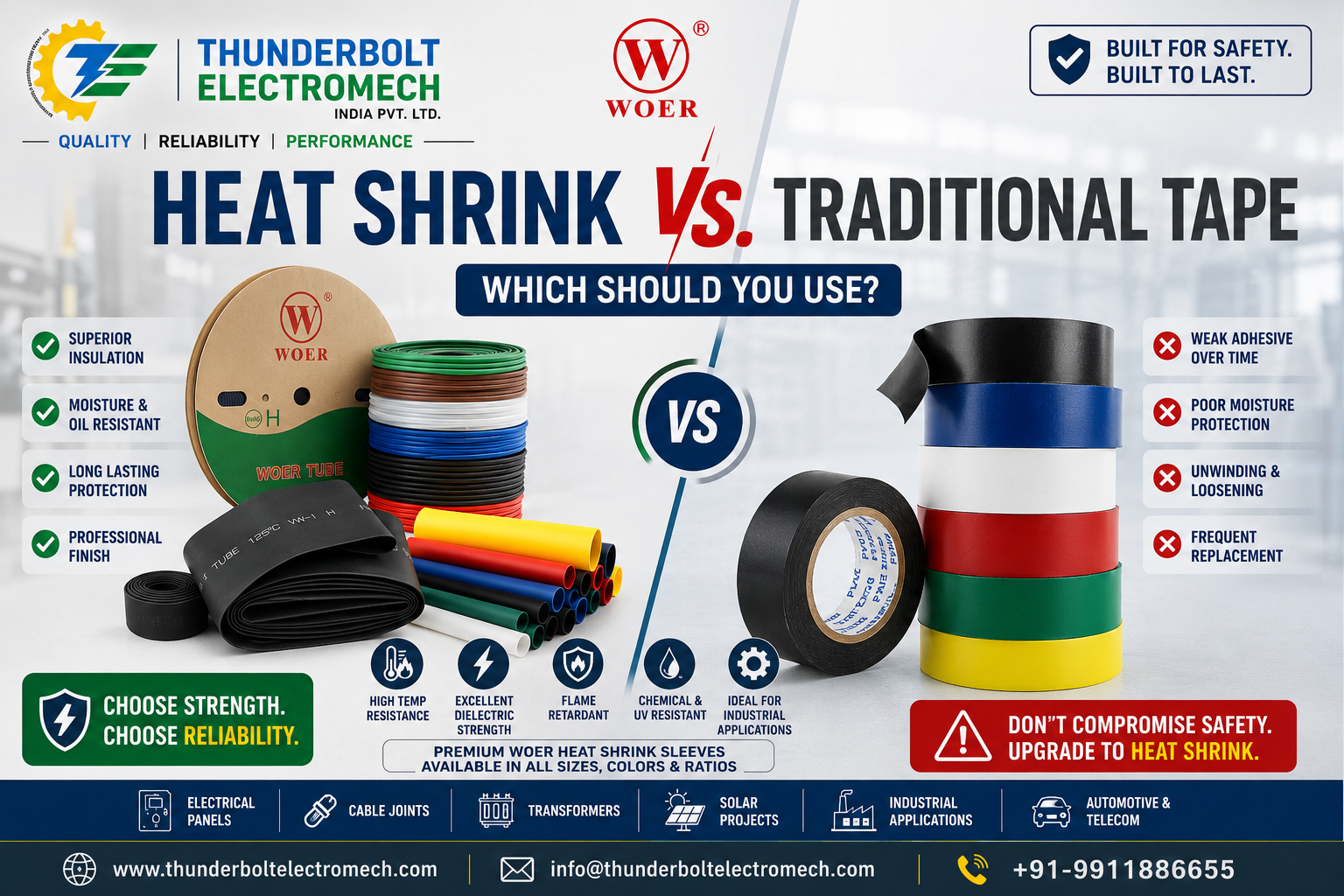
Quick Answer: Heat shrink sleeves outperform traditional electrical tape in most industrial and commercial electrical applications. A quality heat shrink sleeve provides permanent insulation, superior moisture protection, higher mechanical strength, chemical resistance, and a professional finish. Traditional insulation tape is still useful for temporary repairs, cable identification, and low-risk maintenance work, but it can loosen over time due to heat, dust, oil, and vibration.
For engineers, contractors, panel builders, OEMs, and purchase managers, the best practice is straightforward:
- Use WOER Heat Shrink Sleeves for cable joints, terminal insulation, busbars, control panels, transformers, solar installations, and industrial wiring.
- Use electrical insulation tape only where quick temporary insulation is required or during maintenance work.
If you are searching for a reliable Heat Shrink Sleeve Supplier, Thunderbolt Electromech supplies a complete range of WOER Heat Shrink Sleeves across Delhi NCR and throughout India for industrial electrical applications.
Introduction
Electrical insulation is often treated as a minor component of an installation. In reality, it determines how safely an electrical system performs over the next five, ten, or even twenty years.
Every cable termination, every crimped lug, and every busbar connection creates a point where electrical reliability depends on proper insulation. A poor insulation method allows moisture, dust, oil, chemicals, and mechanical stress to enter the connection. Over time, this increases resistance, creates heat, accelerates corrosion, and eventually leads to equipment failure.
For decades, electrical tape has been the most common insulation material because it is inexpensive and readily available. However, modern industries are increasingly replacing tape with heat shrink sleeves because they offer better electrical performance, longer service life, and significantly lower maintenance costs.
Today’s industries operate under demanding conditions:
- High temperatures
- Outdoor exposure
- Oil contamination
- Chemical environments
- Continuous vibration
- High humidity
- Heavy electrical loading
In such environments, ordinary electrical tape gradually loses its adhesive strength. The edges begin lifting, dust accumulates, moisture enters, and insulation performance declines.
Heat shrink sleeves solve these problems by forming a tight protective layer around the cable after heating. Instead of depending on adhesive, the sleeve permanently shrinks around the conductor, creating a durable insulation barrier.
That is why engineers working in power plants, substations, electrical panel manufacturing, railways, telecom projects, renewable energy installations, process industries, and commercial infrastructure increasingly specify heat shrink sleeves instead of conventional insulation tape.
Thunderbolt Electromech is a trusted Heat Shrink Sleeve Supplier offering a complete range of WOER Heat Shrink Sleeves suitable for industrial, commercial, and electrical infrastructure projects across Delhi NCR and India.
Heat Shrink Sleeve Supplier – Why Industries Are Replacing Traditional Electrical Tape
The debate between heat shrink sleeves and insulation tape is no longer about price alone. It is about lifecycle cost, reliability, safety, and maintenance.
Although electrical tape appears inexpensive initially, repeated maintenance and replacement increase its actual cost over the life of an electrical installation.
Heat shrink sleeves provide long-term protection immediately after installation.
Traditional Electrical Tape
Electrical tape consists of PVC or vinyl material coated with pressure-sensitive adhesive.
Advantages include:
- Low initial cost
- Easy to install
- No heating equipment required
- Suitable for temporary repairs
- Good flexibility
However, electrical tape has several practical limitations.
Common Problems with Electrical Tape
- Adhesive weakens over time
- Tape unwraps due to vibration
- Dust sticks to exposed adhesive
- Moisture enters beneath overlapping layers
- Poor UV resistance
- Reduced life outdoors
- Oil causes adhesive failure
- Uneven insulation thickness
These issues become serious in industrial environments where equipment operates continuously.
Why Heat Shrink Sleeves Perform Better
Heat shrink sleeves are manufactured from cross-linked polyolefin material.
When heated uniformly, they shrink tightly around cables, lugs, terminals, and joints.
The result is a seamless insulation layer that offers:
- Electrical insulation
- Mechanical protection
- Moisture sealing
- Abrasion resistance
- Chemical resistance
- Long service life
Because the sleeve physically grips the cable instead of relying on adhesive, it remains secure even under continuous vibration.
This is one of the primary reasons why experienced engineers increasingly prefer purchasing from a trusted Heat Shrink Sleeve Supplier Delhi rather than depending solely on conventional insulation tapes.
Where Heat Shrink Sleeves Are Used
Modern industries use heat shrink sleeves in:
- Electrical control panels
- Transformer terminals
- Busbar insulation
- Solar power systems
- Cable joints
- Switchgear
- Industrial machinery
- Railway electrical systems
- Telecom installations
- Automotive wiring
- Battery cable protection
- Wind energy projects
These applications demand reliable insulation that continues performing for years without frequent maintenance.
WOER Heat Shrink Sleeves Offered by Thunderbolt Electromech
Thunderbolt Electromech supplies premium WOER Heat Shrink Sleeves suitable for:
- Low-voltage cables
- Medium-voltage insulation
- Cable terminations
- Busbar insulation
- Cable identification
- Wire harness protection
- Industrial cable management
The sleeves are engineered for consistent shrink ratios, excellent dielectric strength, and reliable long-term insulation.
As a dependable Heat Shrink Tube Supplier, Thunderbolt supports industries requiring quality products for critical electrical installations.
Heat Shrink Sleeve vs Traditional Tape
| Feature | Heat Shrink Sleeve | Traditional Tape |
| Installation | Heat gun required | Manual |
| Insulation Quality | Excellent | Moderate |
| Moisture Protection | Excellent | Fair |
| UV Resistance | High | Moderate |
| Chemical Resistance | High | Low |
| Mechanical Strength | Excellent | Moderate |
| Appearance | Professional | Uneven |
| Service Life | Long | Shorter |
| Maintenance | Very Low | Frequent |
| Reliability | Excellent | Moderate |
Although heat shrink sleeves require heating equipment during installation, the long-term performance easily outweighs the initial effort.
Heat Shrink Sleeve Supplier – How to Select the Right Heat Shrink Sleeve
Selecting the correct sleeve involves much more than matching cable diameter.
Professional engineers evaluate several technical parameters before purchasing.
1. Shrink Ratio
Heat shrink sleeves are available in different shrink ratios.
Common options include:
- 2:1
- 3:1
- 4:1
Higher shrink ratios accommodate greater differences between the original sleeve diameter and the cable size.
2. Operating Temperature
Industrial electrical installations often experience elevated temperatures.
Always verify:
- Minimum shrink temperature
- Continuous operating temperature
- Maximum short-term temperature
Quality polyolefin sleeves generally perform well across a wide temperature range.
3. Voltage Level
Different projects require different insulation ratings.
Examples include:
- Control wiring
- LT panels
- Distribution boards
- Transformer connections
- Busbars
Selecting the appropriate sleeve ensures safe insulation performance.
4. Environmental Conditions
Outdoor installations require resistance against:
- UV radiation
- Rain
- Dust
- Oil
- Chemicals
- Salt atmosphere
These conditions influence product selection significantly.
Companies searching for a dependable Heat Shrink Sleeve Delhi NCR supplier often prioritize environmental durability because local industries include power distribution, manufacturing, telecom, and infrastructure projects.
5. Cable Diameter
Improper sizing leads to installation problems.
A sleeve that is too large may not shrink adequately.
A sleeve that is too small cannot fit over connectors or terminals.
Proper measurement before ordering reduces installation errors.
6. Application Type
Different applications require different sleeve types.
Examples include:
- Cable joint protection
- Lug insulation
- Wire harnesses
- Busbars
- Battery cables
- Instrumentation wiring
A specialized Heat Shrink Sleeve for Cable Joint provides superior sealing compared with ordinary insulation tape.
Why Polyolefin Heat Shrink Sleeves Are Preferred
Most industrial projects specify cross-linked polyolefin because it offers an excellent balance between:
- Flexibility
- Mechanical strength
- Flame resistance
- Electrical insulation
- Durability
That is why many engineers specifically request a Polyolefin Heat Shrink Sleeve Supplier when preparing project procurement lists.
Customer Problems & Solutions
| Customer Problem | Practical Solution |
| Tape starts peeling after a few months | Use WOER Heat Shrink Sleeves for permanent insulation. |
| Cable joints absorb moisture | Install heat shrink sleeves with proper shrinking technique. |
| Wiring looks unprofessional | Heat shrink sleeves provide a neat factory finish. |
| Outdoor cables fail frequently | Choose UV-resistant heat shrink sleeves. |
| Cable identification becomes difficult | Use colour-coded heat shrink sleeves. |
| Busbars require better insulation | Use busbar-specific heat shrink sleeves. |
| Maintenance costs remain high | Replace tape-based insulation with heat shrink technology. |
| Industrial vibration loosens insulation | Heat shrink sleeves stay securely in place. |
Engineering Comparison Table
| Engineering Parameter | Heat Shrink Sleeve | Electrical Tape |
| Dielectric Strength | Excellent | Moderate |
| Tracking Resistance | High | Medium |
| Mechanical Protection | Excellent | Fair |
| Moisture Barrier | Excellent | Limited |
| Abrasion Resistance | High | Low |
| Oil Resistance | Excellent | Moderate |
| Chemical Resistance | High | Low |
| UV Stability | Excellent | Moderate |
| Service Life | 10–20 years (application-dependent) | Typically shorter in harsh conditions |
| Professional Finish | Excellent | Fair |
Research-Backed Technical Insights
Field experience across electrical utilities, industrial plants, and OEM manufacturing consistently shows that insulation failures are more common at joints, terminations, and exposed cable ends than along the cable itself.
These locations experience combined electrical, thermal, and mechanical stress. As current flows through a conductor, even a slight increase in contact resistance generates localized heat. If insulation is compromised by moisture or contamination, degradation accelerates.
Heat shrink sleeves address these failure mechanisms by creating a tight, continuous insulating layer that minimizes exposure to environmental contaminants while adding mechanical reinforcement around the connection. Cross-linked polyolefin materials also maintain stable dielectric properties over a broad operating temperature range and resist cracking better than adhesive-based wrapping methods under vibration.
For high-reliability applications such as electrical panels, transformers, renewable energy systems, and industrial automation, engineers increasingly specify heat shrink as the preferred insulation method because it reduces maintenance intervals and improves long-term system reliability.
Heat Shrink Sleeve Supplier – How to Install Heat Shrink Sleeves Correctly for Maximum Protection
Choosing a premium heat shrink sleeve is only half the job. Proper installation determines whether the insulation will perform reliably for years or begin failing within months.
Many insulation failures are not caused by poor-quality sleeves. They happen because the sleeve size was incorrect, the cable surface was contaminated, or the heat was applied unevenly. Even a high-quality product cannot compensate for an improper installation process.
As a trusted Heat Shrink Sleeve Supplier, Thunderbolt Electromech recommends following a standardized installation procedure to achieve the best electrical and mechanical performance.
Step 1: Clean the Cable Surface
Before installation:
- Remove dust and dirt.
- Wipe away grease or oil.
- Ensure the conductor and insulation are completely dry.
- Remove any sharp edges or burrs.
A clean surface allows the sleeve to shrink evenly around the cable.
Step 2: Select the Correct Sleeve Size
Choose a sleeve that:
- Slides comfortably over connectors and cable lugs.
- Shrinks tightly around the insulated cable.
- Covers the complete joint with additional overlap on both ends.
Using an oversized sleeve may leave air gaps, while an undersized sleeve may split during heating.
Step 3: Position the Sleeve Properly
Place the sleeve before making the final cable connection whenever possible.
Ensure equal overlap on both sides of:
- Cable joints
- Lugs
- Ferrules
- Connectors
This provides balanced insulation and better strain relief.
Step 4: Apply Uniform Heat
Always use:
- Heat gun
- Controlled hot-air blower
Avoid using an open flame because it can:
- Burn the sleeve
- Cause uneven shrinkage
- Damage cable insulation
Move the heat gun continuously from the centre toward both ends.
Step 5: Inspect the Finished Installation
A correctly installed sleeve should:
- Fit tightly
- Show no wrinkles
- Have no trapped air
- Cover the entire joint
- Maintain a smooth finish
Proper installation significantly improves insulation reliability.
Why WOER Heat Shrink Sleeves Stand Out
Thunderbolt Electromech supplies WOER Heat Shrink Sleeves, which are trusted across industries for:
- Consistent shrink ratio
- Flame-retardant material
- Excellent dielectric strength
- UV resistance
- Long service life
- Uniform wall thickness
- Reliable performance in industrial environments
Organizations searching for a dependable Heat Shrink Sleeve Supplier Delhi often choose WOER because of its proven quality and availability across multiple sizes.
Heat Shrink Sleeve Supplier – Choosing the Right Supplier Matters More Than You Think
Many buyers compare only prices while purchasing heat shrink sleeves. However, experienced engineers know that product consistency and technical support are equally important.
An unreliable sleeve can create expensive downtime that far exceeds the initial purchase cost.
Selecting the right Heat Shrink Sleeve Supplier ensures:
- Genuine products
- Consistent dimensions
- Technical guidance
- Ready stock
- Faster delivery
- Long-term supply support
Questions to Ask Before Purchasing
Ask your supplier:
- Is the sleeve polyolefin?
- What is the shrink ratio?
- What voltage applications are supported?
- Is it flame retardant?
- What operating temperature is recommended?
- Are multiple colours available?
- Is technical support available?
Professional suppliers answer these questions confidently.
Why Delhi NCR Industries Prefer Local Stock Availability
Electrical contractors frequently work with strict project deadlines.
Waiting several days for insulation material may delay:
- Panel manufacturing
- Site commissioning
- Transformer installation
- Solar commissioning
- Cable termination work
Therefore, buyers often prefer a Heat Shrink Sleeve Dealer Delhi with ready inventory and quick dispatch.
Thunderbolt Electromech maintains stock for industrial customers across Delhi NCR and supplies projects throughout India.
Applications Across Industries
WOER Heat Shrink Sleeves are widely used in:
Electrical Panel Manufacturing
Protecting cable lugs and busbar joints.
Power Distribution
Insulating transformer cable terminations.
Renewable Energy
Protecting solar DC cable joints.
Railway Projects
Cable harness insulation.
Telecom Infrastructure
Weather-resistant cable identification.
Industrial Automation
Wire harness management.
Heavy Manufacturing
Protection against oil, vibration, and chemicals.
Customers searching for a dependable Heat Shrink Sleeve Delhi NCR supplier often require multiple sleeve sizes for these varied applications.
Additional Engineering Comparison Table
| Parameter | Heat Shrink Sleeve | PVC Electrical Tape |
| Moisture Sealing | Excellent | Fair |
| Chemical Exposure | Excellent | Limited |
| UV Stability | High | Medium |
| Abrasion Resistance | High | Low |
| Mechanical Strength | Excellent | Moderate |
| Installation Appearance | Professional | Variable |
| Long-Term Maintenance | Minimal | Frequent |
| Cable Identification | Easy with colour options | Limited |
| Outdoor Suitability | Excellent | Moderate |
| Industrial Reliability | Very High | Medium |
Engineering Comparison Table – Selecting the Right Heat Shrink Sleeve
| Application | Recommended Sleeve |
| Cable Lugs | Polyolefin Heat Shrink |
| Busbars | Busbar Heat Shrink Sleeve |
| Cable Joints | Heat Shrink Sleeve for Cable Joint |
| Battery Cables | Heavy Wall Sleeve |
| Control Panels | Flame Retardant Sleeve |
| Outdoor Cables | UV Resistant Sleeve |
| Transformer Connections | Industrial Heat Shrink Sleeve |
| Solar Installations | Polyolefin Heat Shrink Sleeve |
Real Use Case #1
A panel manufacturing company in Delhi NCR supplied LT distribution panels for a commercial complex. During quality inspections, engineers found that manually wrapped insulation tape around cable lugs had started lifting at the edges after storage in a warm warehouse. Dust adhered to the exposed adhesive, and several joints required rework before dispatch.
The company replaced tape with WOER Heat Shrink Sleeves sourced through an Industrial Heat Shrink Sleeve Supplier. Each lug was insulated using the correct sleeve size and a controlled heat gun application. The finished panels had cleaner cable routing, uniform insulation, and improved resistance to handling during transportation and installation.
The change reduced rework, improved appearance, and gave customers greater confidence in the quality of the finished electrical panels. Throughout the project, procurement teams also benefited from predictable Heat Shrink Sleeve Price and consistent product availability from a reliable supplier, making future maintenance planning easier.
Real-World Use Case #2
An EPC contractor executing a solar power project initially used insulation tape for DC cable terminations. Within one monsoon season, moisture penetrated several taped joints, leading to insulation degradation and repeated maintenance visits.
During the next phase of the project, the contractor switched to WOER Heat Shrink Sleeves supplied by Thunderbolt Electromech. The sleeves formed a tight seal around each termination, providing better resistance to rain, dust, and UV exposure. Maintenance requirements dropped noticeably, and commissioning inspections were completed without insulation-related observations.
Real-World Use Case #3
A transformer maintenance company servicing industrial facilities in Delhi replaced aging insulation tape on transformer cable terminations with heat shrink sleeves during preventive maintenance.
The upgraded insulation improved the appearance of the installations and reduced the likelihood of moisture ingress. Engineers also reported faster inspections because the sleeves remained intact without the peeling and adhesive residue commonly associated with old tape.
Trust Thunderbolt Electromech
Thunderbolt Electromech supplies premium WOER Heat Shrink Sleeves for:
- Electrical Panel Manufacturers
- OEMs
- Transformer Manufacturers
- Solar EPC Companies
- Industrial Plants
- Infrastructure Projects
- Railways
- Contractors
- Electrical Consultants
Our Product Range
- WOER Heat Shrink Sleeves
- Heat Shrink Tubes
- Cable Glands
- Cable Lugs
- Cable Ties
- Electrical Rubber Mats
- Danger Plates
- Silica Gel Breathers
- Lockout Boxes
- Industrial Electrical Safety Products
Contact Thunderbolt Electromech
Thunderbolt Electromech (India) Pvt. Ltd.
📍 Delhi NCR, India
📞 +91-9911886655
🌐 www.thunderboltelectromech.com
📧 info@thunderboltelectromech.com
Frequently Asked Questions
1. Is a heat shrink sleeve better than electrical tape?
Yes. Heat shrink sleeves provide superior insulation, moisture protection, mechanical strength, and durability. They are the preferred choice for permanent electrical installations, whereas electrical tape is better suited for temporary repairs.
2. Where should heat shrink sleeves be used?
They are ideal for cable joints, lugs, terminals, busbars, wire harnesses, battery cables, electrical panels, transformers, switchgear, solar systems, telecom equipment, and industrial machinery.
3. Can heat shrink sleeves be used outdoors?
Yes. Polyolefin heat shrink sleeves offer excellent resistance to UV rays, moisture, dust, and varying weather conditions, making them suitable for outdoor installations.
4. Do heat shrink sleeves prevent electrical shock?
They help reduce the risk of accidental contact by providing an additional insulating layer around conductors. However, they should always be used as part of a properly designed and compliant electrical system.
5. What is the difference between heat shrink tubes and heat shrink sleeves?
The terms are often used interchangeably. Both refer to tubing that shrinks when heated to provide insulation and protection. Product specifications may vary depending on the application.
6. What shrink ratio should I choose?
A 2:1 ratio is suitable for many standard cable applications. Larger connectors or irregular shapes may require 3:1 or 4:1 sleeves. Select the ratio based on cable size and installation requirements.
7. Are WOER Heat Shrink Sleeves flame retardant?
WOER offers flame-retardant heat shrink sleeves designed for industrial electrical applications. Always verify the product specifications for the exact grade you intend to use.
8. Can heat shrink sleeves protect cable joints from moisture?
Yes. Properly installed sleeves form a tight protective barrier that helps reduce moisture ingress and improves the long-term reliability of cable joints.
9. How long do heat shrink sleeves last?
When correctly selected and installed, quality heat shrink sleeves can deliver reliable performance for many years. Actual service life depends on environmental conditions, operating temperatures, and maintenance practices.
10. How do I select the right size?
Measure the cable and the largest connector it must pass over. Choose a sleeve that fits over the connector before shrinking and contracts tightly around the cable after heating.
11. Are heat shrink sleeves reusable?
No. Once a sleeve has been shrunk, it is intended for permanent installation. It should be cut away and replaced if the connection requires rework.
12. Can heat shrink sleeves replace electrical tape completely?
In most permanent industrial applications, yes. However, electrical tape still has value for temporary insulation, quick repairs, and cable marking during maintenance.
13. Why is polyolefin preferred for industrial use?
Cross-linked polyolefin combines excellent electrical insulation, flexibility, chemical resistance, and mechanical durability, making it suitable for demanding industrial environments.
14. What factors influence heat shrink sleeve price?
The Heat Shrink Sleeve Price depends on the material type, shrink ratio, wall thickness, diameter, length, flame-retardant properties, and order quantity. Purchasing from an established supplier also ensures consistent quality and reliable technical support.
15. Why choose Thunderbolt Electromech as your Heat Shrink Sleeve Supplier?
Thunderbolt Electromech supplies a complete range of genuine WOER Heat Shrink Sleeves with multiple sizes, dependable stock availability, technical assistance, and prompt delivery across Delhi NCR and India. This makes it a trusted partner for engineers, contractors, industries, OEMs, and purchase managers.
Conclusion
Heat Shrink vs. Traditional Tape: Which Should You Use?
The answer depends on the application—but for most modern industrial electrical systems, heat shrink sleeves are the clear choice.
Traditional electrical tape remains useful for temporary repairs and basic maintenance, but it cannot match the long-term performance of a professionally installed heat shrink sleeve. Heat shrink technology provides stronger electrical insulation, improved mechanical protection, superior resistance to moisture, dust, oils, chemicals, UV exposure, and vibration, while delivering a cleaner and more reliable finish.
For critical installations such as electrical panels, transformers, switchgear, solar projects, cable terminations, busbars, and industrial machinery, investing in high-quality WOER Heat Shrink Sleeves helps reduce maintenance costs, improve safety, and extend equipment life.
If your organization is looking for a trusted Heat Shrink Sleeve Supplier, Thunderbolt Electromech offers a complete range of WOER Heat Shrink Sleeves along with expert guidance to help you select the right product for every application.
Contact Thunderbolt Electromech Today
Whether you are an engineer designing a new panel, a contractor working against tight project timelines, an industry upgrading electrical infrastructure, or a purchase manager sourcing reliable insulation materials, Thunderbolt Electromech is ready to support your requirements.
Our Advantages:
- Complete range of WOER Heat Shrink Sleeves
- Competitive pricing for bulk and project orders
- Fast delivery across Delhi NCR and PAN India
- Technical support for product selection
- Reliable stock availability for industrial projects
Call: +91-9911886655
Email: info@thunderboltelectromech.com
Website: www.thunderboltelectromech.com
Choose Thunderbolt Electromech for dependable insulation solutions that improve electrical safety, reduce maintenance, and keep your projects running efficiently.