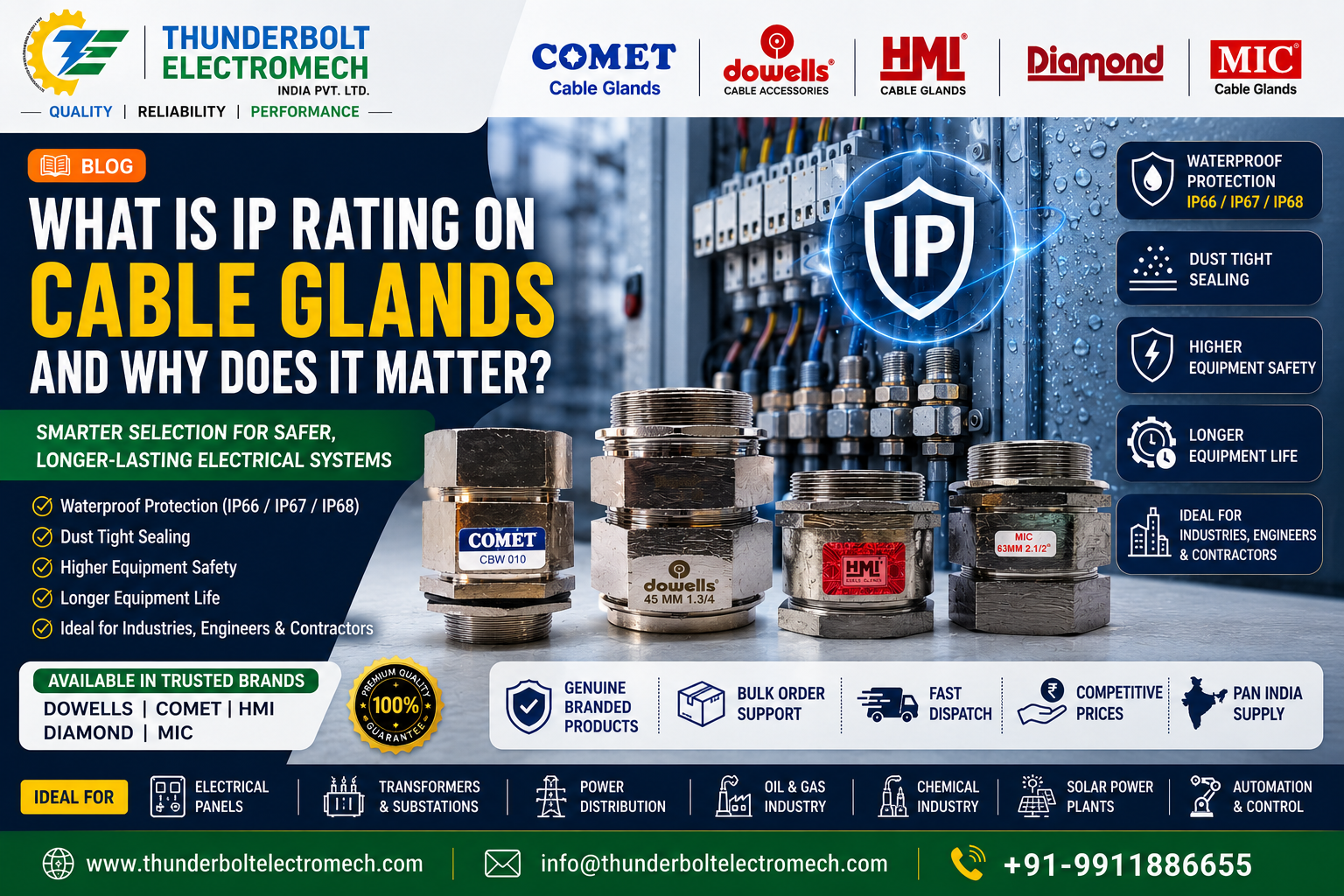
Quick Answer: The IP (Ingress Protection) rating on a cable gland indicates how effectively the gland prevents dust and water from entering an electrical enclosure through the cable entry point. Choosing the correct IP-rated cable gland is essential because it protects electrical equipment from moisture, dust, corrosion, insulation failure, and unexpected downtime. For most industrial applications, IP66, IP67, and IP68 cable glands are the preferred choices due to their superior environmental protection.
If you are selecting cable glands for electrical panels, transformers, substations, solar plants, process industries, or hazardous areas, always match the cable size, cable outer diameter (OD), gland type, thread size, and IP rating together. At Thunderbolt Electromech, a trusted Cable Gland Supplier India, we supply premium Dowells, Comet, HMI, MIC, and Diamond cable glands for every industrial application.
Introduction
A cable gland is often viewed as a small accessory compared to switchgear, transformers, motors, and control panels. In reality, it performs one of the most critical jobs in an electrical installation—it seals the cable entry point while providing mechanical retention, environmental protection, and electrical safety.
Even a high-quality cable or premium electrical panel can fail prematurely if the wrong cable gland is installed. Dust entering the enclosure can contaminate electrical contacts, while water ingress can damage insulation, corrode terminals, and create dangerous short circuits. These failures result in costly downtime, frequent maintenance, and safety hazards.
This is where the IP rating becomes essential.
Whether you are an engineer designing an industrial control panel, a contractor installing outdoor electrical equipment, a purchase manager sourcing materials, or a maintenance professional responsible for plant reliability, understanding IP ratings helps you choose the right cable gland for every environment.
At Thunderbolt Electromech, a Delhi-based Cable Gland Supplier India, we offer a comprehensive range of cable glands from globally recognized brands including Dowells, Comet, HMI, MIC, and Diamond. Our portfolio includes:
-
- Brass Cable Glands
-
- Nickel Plated Brass Cable Glands
-
- Single Compression Cable Glands
-
- Double Compression Cable Glands
-
- Weatherproof Cable Glands
-
- Flameproof Cable Glands
-
- Industrial Cable Glands
-
- Armoured Cable Glands
-
- Cable Glands for Hazardous Areas
This guide explains everything engineers need to know about IP ratings, cable gland sizing, cable diameter selection, and industrial applications while helping buyers make technically correct purchasing decisions.
Cable Gland Supplier India – What Is an IP Rating and Why Does It Matter?
An IP Rating (Ingress Protection Rating) is an internationally recognized classification system defined under IEC 60529. It indicates how well an electrical enclosure or cable gland protects against the entry of solid particles and liquids.
Every cable gland is tested under controlled laboratory conditions to verify its sealing capability. The result is expressed using two digits following the letters IP.
For example:
-
- IP54
-
- IP65
-
- IP66
-
- IP67
-
- IP68
Each rating indicates increasing levels of protection.
A cable gland does far more than hold a cable in place. It creates a complete seal between the cable and the enclosure while maintaining the equipment’s IP rating.
Without a properly selected gland:
-
- Dust enters the panel.
-
- Rainwater reaches electrical terminals.
-
- Moisture causes corrosion.
-
- Cable movement loosens electrical connections.
-
- Cable insulation deteriorates.
-
- Equipment reliability decreases.
These failures often originate from one incorrectly selected cable gland.
What Does IP Stand For?
IP stands for Ingress Protection.
Ingress means anything entering an enclosure from outside.
This includes:
-
- Dust
-
- Water
-
- Moisture
-
- Chemicals
-
- Dirt
-
- Oil mist
-
- Metal particles
-
- Fine powder
-
- Industrial contaminants
The better the sealing performance, the higher the IP rating.
For a detailed comparison of these protection levels, see our IP66, IP67, IP68 or IP69 Cable Gland Protection Rating Guide.
IP Code Explanation (Ingress Protection)
The IP Code consists of two numbers.
Example: IP66
-
- First Digit = Protection against solids
-
- Second Digit = Protection against liquids
First Digit – Solid Protection
| First Digit | Protection Level |
| 0 | No protection |
| 1 | Objects over 50 mm |
| 2 | Objects over 12.5 mm |
| 3 | Objects over 2.5 mm |
| 4 | Objects over 1 mm |
| 5 | Dust protected |
| 6 | Dust tight |
Industrial cable glands are generally rated IP6X, meaning complete protection against dust ingress.
Second Digit – Water Protection
| Second Digit | Protection Against |
| 0 | No protection |
| 1 | Vertical water drops |
| 2 | Dripping water |
| 3 | Water spray |
| 4 | Water splashes |
| 5 | Water jets |
| 6 | Powerful water jets |
| 7 | Temporary immersion |
| 8 | Continuous immersion |
The combination of both digits determines the suitability of a cable gland for specific industrial environments.
Why Is IP Rating Important for Cable Connectors?
Many buyers compare prices before specifications. However, selecting a lower-IP cable gland simply because it costs less can result in significant maintenance expenses later.
A properly rated cable gland helps:
-
- Prevent water ingress.
-
- Stop dust contamination.
-
- Protect copper cable lugs from corrosion.
-
- Improve insulation resistance.
-
- Increase equipment lifespan.
-
- Maintain enclosure protection.
-
- Reduce maintenance frequency.
-
- Improve operator safety.
For outdoor switchboards, transformer yards, solar plants, chemical industries, pharmaceutical facilities, and process plants, IP66 or higher is generally recommended.
Common IP Ratings Used in Industry
| IP Rating | Dust Protection | Water Protection | Typical Applications |
| IP54 | Limited | Splash Resistant | Indoor electrical panels |
| IP55 | Dust Protected | Low-pressure water jets | Commercial installations |
| IP65 | Dust Tight | Water Jets | Factories and workshops |
| IP66 | Dust Tight | Heavy Water Jets | Outdoor panels |
| IP67 | Dust Tight | Temporary Immersion | Industrial equipment |
| IP68 | Dust Tight | Continuous Immersion | Underground and marine applications |
Cable Gland Supplier India – Choosing the Right Cable Gland Size and IP Rating
Selecting the correct cable gland involves more than matching thread sizes. Engineers must evaluate multiple parameters to ensure a safe and reliable installation.
The five key factors are:
-
- Cable size (sq.mm)
-
- Cable outer diameter (OD)
-
- Cable construction (armoured or unarmoured)
-
- Thread type and enclosure entry
-
- Required IP rating
Ignoring any of these factors can lead to poor sealing, cable damage, or premature equipment failure.
Understanding Cable Size (sq.mm) vs Cable Outer Diameter (OD)
A common mistake is assuming that cable size and cable outer diameter are the same. They are not.
Cable Size (sq.mm)
Cable size refers to the cross-sectional area of the conductor. It determines the current-carrying capacity of the cable.
Examples include:
-
- 1.5 sq.mm
-
- 2.5 sq.mm
-
- 4 sq.mm
-
- 10 sq.mm
-
- 16 sq.mm
-
- 25 sq.mm
-
- 35 sq.mm
-
- 50 sq.mm
-
- 95 sq.mm
- 185 sq.mm
Cable Outer Diameter (OD)
Outer diameter measures the total outside diameter of the complete cable, including insulation, bedding, armouring, and outer sheath.
Cable glands are selected primarily according to Outer Diameter (OD) rather than conductor size.
For example:
| Cable Size | Approximate OD |
| 2.5 sq.mm | 8–10 mm |
| 4 sq.mm | 10–12 mm |
| 10 sq.mm | 13–18 mm |
| 16 sq.mm | 17–22 mm |
| 25 sq.mm | 22–27 mm |
| 35 sq.mm | 27–33 mm |
| 50 sq.mm | 32–39 mm |
| 70 sq.mm | 38–46 mm |
| 95 sq.mm | 45–55 mm |
Note: The exact OD varies by manufacturer and cable construction. Always verify the cable datasheet before selecting a gland.
Cable Gland Size Selection Chart
| Cable OD | Approximate Gland Size | Typical Application |
| 8–12 mm | 20S | Control Panels |
| 10–14 mm | 20 | Lighting Circuits |
| 13–18 mm | 25 | Motors |
| 18–22 mm | 32 | Industrial Panels |
| 22–27 mm | 40 | Power Feeders |
| 27–34 mm | 50 | Transformers |
| 38–46 mm | 63 | HT Panels |
| 46–60 mm | 75 | Large Industrial Cables |
Customer Problems and Solutions
Selecting the wrong cable gland often leads to recurring issues in industrial installations. The table below highlights common problems and practical solutions.
| Customer Problem | Root Cause | Recommended Solution |
| Water entering electrical panels | Low IP-rated gland used outdoors | Use IP66 or IP67 cable glands |
| Cable slipping from gland | Incorrect gland size | Select gland based on actual cable OD |
| Corrosion around cable entry | Poor environmental sealing | Choose nickel-plated brass glands with proper sealing washers |
| Frequent insulation failures | Moisture ingress | Upgrade to double compression cable glands for outdoor and hazardous applications |
| Panel overheating near cable terminals | Loose mechanical grip causing movement | Ensure correct gland tightening torque and secure cable retention |
| Dust accumulation inside enclosure | Inadequate IP protection | Use dust-tight IP6X-rated cable glands |
Engineering Comparison Table
| Parameter | Single Compression Gland | Double Compression Gland |
| Sealing Points | One | Two |
| Suitable for Armoured Cable | Limited | Excellent |
| Mechanical Cable Grip | Moderate | High |
| Vibration Resistance | Good | Excellent |
| Outdoor Performance | Good | Excellent |
| Recommended IP Rating | Up to IP66 | IP66–IP68 |
| Hazardous Area Suitability | Limited | Preferred |
Research-Backed Technical Insights
Modern industrial environments place greater demands on cable entry systems than ever before. Equipment is exposed to vibration, washdown procedures, UV radiation, oil mist, chemical vapours, and temperature fluctuations. In such conditions, the cable gland becomes a critical part of the enclosure’s protection strategy rather than just a mounting accessory.
One often-overlooked benefit of selecting the correct IP-rated gland is its impact on cable lugs. Moisture entering through an improperly sealed gland can travel along the cable sheath, eventually reaching copper or aluminium lugs. This can accelerate corrosion, increase contact resistance, and create hot spots at electrical terminations. By maintaining an effective seal, an appropriately rated cable gland helps preserve the integrity of both the cable and its termination, reducing maintenance costs and improving long-term reliability.
Real Use Case #1
A manufacturing plant in the Delhi NCR region experienced repeated tripping in outdoor motor control panels during the monsoon season. Initial inspections focused on breakers and contactors, but the root cause was moisture entering through undersized, low-IP cable glands.
The maintenance team replaced the existing glands with correctly sized, IP66-rated double compression brass cable glands, selected according to the actual cable outer diameter. The upgraded installation also included proper sealing washers and correct tightening torque.
The result was a significant reduction in moisture ingress, improved insulation resistance, fewer unplanned shutdowns, and increased confidence in the reliability of the electrical distribution system.
Throughout such projects, working with a reliable Cable Gland Supplier India that provides technical guidance, accurate sizing, and trusted brands such as Dowells, Comet, HMI, MIC, and Diamond ensures that engineers and purchase managers receive products suited to the application rather than simply choosing by price alone.
Cable Gland Supplier India: Brand-Wise IP Ratings, Size Charts & How to Choose the Right Cable Gland
Selecting the correct IP-rated cable gland is just as important as selecting the correct cable size. Even premium cables can fail prematurely if the gland allows dust, moisture, oil, or chemicals to enter the enclosure.
As a leading Cable Gland Supplier India, Thunderbolt Electromech supplies premium Dowells, Comet, HMI, MIC and Diamond cable glands for industries requiring dependable sealing under harsh operating conditions.
Different industries require different protection levels.
-
- Indoor electrical panels
-
- Outdoor lighting poles
-
- Solar power plants
-
- Wind turbines
-
- Oil & Gas plants
-
- Chemical industries
-
- Railways
-
- Metro projects
-
- Power Distribution
-
- Transformer manufacturing
Choosing the wrong IP rating often results in:
-
- Water ingress
-
- Corrosion
-
- Electrical leakage
-
- Cable insulation failure
-
- Equipment downtime
-
- Increased maintenance costs
This is why experienced engineers always evaluate both the enclosure and the gland before installation.
Understanding IP Ratings for Various Industrial Applications
Different industries demand different ingress protection.
| Industry | Recommended IP Rating |
| Indoor Distribution Boards | IP54–IP55 |
| Outdoor Junction Boxes | IP66 |
| Transformer Marshalling Boxes | IP66/IP67 |
| Solar Combiner Boxes | IP67 |
| Chemical Plants | IP68 |
| Food Processing Industry | IP69 (where applicable) |
| Oil & Gas Hazardous Areas | IP66/IP67 with Flameproof Glands |
| Marine Applications | IP68 |
IP65 vs IP66 vs IP67 vs IP68
Many buyers ask whether IP65 is enough.
The answer depends entirely on the installation environment.
| IP Rating | Dust Protection | Water Protection | Recommended Application |
| IP65 | Complete | Low pressure water jets | Indoor panels |
| IP66 | Complete | Heavy water jets | Outdoor installations |
| IP67 | Complete | Temporary immersion | Flood-prone areas |
| IP68 | Complete | Continuous immersion | Underground & marine use |
Most industrial engineers prefer IP66 or IP67 because they provide excellent protection without significantly increasing project cost.
Which IP Rating Should You Buy?
Indoor Electrical Panels
Recommended:
-
- IP54
-
- IP55
- IP65
Outdoor Electrical Panels
Recommended:
- IP66
Solar Power Projects
Recommended:
-
- IP67
Because solar installations remain exposed to:
-
- UV radiation
-
- Rain
-
- Dust storms
- High temperatures
Transformer Industry
Recommended:
-
- IP66
-
- IP67
Transformer marshalling boxes often experience condensation, making higher IP ratings essential.
Oil & Gas Plants
Recommended:
-
- Flameproof Double Compression Cable Glands
Combined with:
-
- IP66
- IP67
Underground Cable Systems
Recommended:
IP68
Cable Gland Supplier India: Brand-Wise Selection Guide for Industrial Buyers
Thunderbolt Electromech offers multiple trusted brands, each suited to different budgets and project specifications.
Dowells Cable Glands
Dowells is widely recognized for premium-quality brass cable glands used in critical infrastructure.
Ideal for:
-
- Power plants
-
- Refineries
-
- Government projects
-
- EPC contractors
-
- Metro rail
-
- Transmission utilities
Typical features include:
-
- Nickel-plated brass
-
- Excellent corrosion resistance
-
- High IP ratings
-
- Precision threading
- Long service life
Comet Cable Glands
Comet cable glands are trusted across India for their excellent quality-to-price ratio.
Available in:
-
- Single Compression
-
- Double Compression
-
- Weatherproof
-
- Flameproof
According to the uploaded Comet price list, the Weatherproof CBW series and Flameproof CBF series cover cable ODs from approximately 8.0 mm to 104.0 mm, with thread sizes ranging from 3/4″ to 4½”.
Comet Weatherproof (CBW) Reference Chart
| Cable OD (mm) | Thread | Code |
| 8–12.5 | 3/4″ | CBW01SS |
| 12.6–16.5 | 3/4″ | CBW01S |
| 16.6–18 | 3/4″ | CBW01 |
| 18.1–20 | 1″ | CBW02 |
| 20.1–23 | 1″ | CBW03 |
| 23.1–26 | 1″ | CBW04 |
| 26.1–30 | 1¼” | CBW05 |
| 30.1–33 | 1½” | CBW06 |
| 33.1–37 | 1½” | CBW07 |
| 37.1–41 | 2″ | CBW08 |
| 41.1–46 | 2″ | CBW09 |
| 46.1–52 | 2″ | CBW010 |
| 52.1–56 | 2½” | CBW011S |
| 56.1–60 | 2½” | CBW011 |
| 60.1–66 | 3″ | CBW012 |
| 66.1–72 | 3″ | CBW013A |
| 72.1–78 | 3¼” | CBW013 |
| 78.1–84 | 3½” | CBW014 |
| 84.1–94 | 4″ | CBW015 |
| 94.1–104 | 4½” | CBW016 |
The Flameproof CBF series follows the same OD and thread progression with corresponding CBF codes.
HMI Cable Glands
HMI cable glands are popular among:
-
- OEM panel builders
-
- Machine manufacturers
-
- Automation companies
Advantages include:
-
- Accurate machining
-
- Reliable sealing
-
- Competitive pricing
- Consistent quality
MIC Cable Glands
MIC provides an economical solution for medium-budget industrial projects.
Suitable for:
-
- Commercial buildings
-
- Electrical contractors
-
- Residential projects
- Utility panels
Diamond Cable Glands
Diamond cable glands offer a strong balance between affordability and industrial performance.
Frequently used in:
-
- Infrastructure projects
-
- Builder electrical systems
-
- Industrial control panels
- Manufacturing units
Approximate Cable Size vs Cable Gland Selection
| Cable Size | Approx Cable OD | Common Gland |
| 2.5 sq.mm | 7–9 mm | M16 |
| 4 sq.mm | 8–10 mm | M16 |
| 6 sq.mm | 10–12 mm | M20 |
| 10 sq.mm | 12–14 mm | M20 |
| 16 sq.mm | 14–17 mm | M25 |
| 25 sq.mm | 18–22 mm | M32 |
| 35 sq.mm | 22–27 mm | M40 |
| 50 sq.mm | 27–32 mm | M50 |
| 70 sq.mm | 32–38 mm | M63 |
| 95 sq.mm | 38–45 mm | M75 |
Always verify the actual cable outer diameter (OD) from the cable manufacturer’s datasheet before selecting a gland.
Single Compression vs Double Compression Cable Glands
| Feature | Single Compression | Double Compression |
| Sealing Point | One | Two |
| Outdoor Protection | Good | Excellent |
| Moisture Resistance | Moderate | High |
| Heavy Vibration | Moderate | Excellent |
| Hazardous Areas | Limited | Recommended |
| Armoured Cable Support | Standard | Superior |
| Cost | Lower | Higher |
For critical installations such as refineries, substations, and heavy industries, double compression glands are generally preferred for enhanced sealing and mechanical retention.
NEMA vs IP Ratings
International projects sometimes specify NEMA instead of IP.
| IP Rating | Approximate NEMA Equivalent |
| IP54 | NEMA 3 |
| IP55 | NEMA 3R |
| IP65 | NEMA 4 |
| IP66 | NEMA 4X |
| IP67 | NEMA 6 |
| IP68 | NEMA 6P |
IP ratings focus on dust and water ingress, while NEMA classifications also account for factors such as corrosion resistance and environmental durability.
Cable Lug Research: Why Cable Glands Alone Are Not Enough
A high-quality cable gland cannot compensate for a poorly terminated cable lug. Reliable electrical systems depend on both secure cable entry and proper conductor termination.
For long-term reliability:
-
- Match lug size exactly to conductor size.
-
- Use the recommended crimping die.
-
- Avoid mixing aluminium and copper lugs without appropriate bimetallic connectors.
-
- Inspect terminations periodically in high-vibration environments.
-
- Replace corroded lugs during preventive maintenance to reduce heat buildup and voltage drop.
This integrated approach improves system reliability and minimizes unscheduled downtime.
Additional Engineering Comparison
| Parameter | Premium Brand | Medium Brand |
| Precision Machining | Excellent | Good |
| Nickel Plating | Premium | Standard |
| Corrosion Resistance | High | Moderate |
| IP Performance | Excellent | Good |
| Service Life | Longer | Standard |
| Suitable for Critical Projects | Yes | Moderate |
Real Use Case #2: Solar Power Plant
A 20 MW solar installation experienced repeated moisture ingress in combiner boxes during the monsoon season. The issue was traced to undersized cable glands that failed to compress the cable jacket properly. Replacing them with correctly sized IP67 double compression glands eliminated water ingress and reduced maintenance visits over the following year.
Real Use Case #3: Chemical Manufacturing Unit
A chemical processing plant upgraded its outdoor motor control centers with nickel-plated brass flameproof cable glands. The improved sealing prevented corrosive vapors and washdown water from entering the enclosures, increasing equipment reliability and reducing unplanned shutdowns.
Trust Thunderbolt Electromech
Thunderbolt Electromech supplies a comprehensive range of cable glands from leading brands, including:
-
- Dowells
-
- Comet
-
- HMI
-
- MIC
-
- Diamond
Why choose Thunderbolt Electromech?
-
- Genuine branded products
-
- Technical assistance for size selection
-
- Bulk order support
-
- PAN India supply
-
- Fast dispatch
-
- Competitive pricing
Contact Details
Thunderbolt Electromech
-
- Phone: +91-9911886655
-
- Website: www.thunderboltelectromech.com
- Location: Delhi, India
Frequently Asked Questions (FAQs)
1. What is the purpose of an IP rating for cable glands?
It indicates the level of protection a cable gland provides against dust and water ingress, helping ensure safe and reliable operation in different environments.
2. Is IP68 always better than IP67?
Not necessarily. IP68 is intended for continuous immersion, while IP67 is sufficient for most industrial outdoor applications. Select the rating based on actual site conditions.
3. Which cable gland is best for outdoor electrical panels?
IP66 or IP67 rated brass cable glands are commonly recommended because they provide excellent protection against rain, dust, and washdown conditions.
4. Can I use a single compression gland for armoured cable?
Single compression glands can be used in suitable applications, but double compression glands are generally preferred for armoured cables in heavy-duty or outdoor installations due to better sealing and cable retention.
5. How do I determine the correct cable gland size?
Measure the cable’s outer diameter (OD) from the manufacturer’s datasheet and match it with the gland’s specified cable acceptance range.
6. Why does the cable outer diameter matter more than conductor size?
Cable glands seal around the cable jacket, not the conductor. The OD determines whether the gland can achieve the required compression and IP rating.
7. Are brass cable glands better than plastic cable glands?
Brass cable glands offer higher mechanical strength, better corrosion resistance, and are preferred for industrial, hazardous, and outdoor environments.
8. What is the difference between weatherproof and flameproof cable glands?
Weatherproof glands protect against dust and water, while flameproof glands are designed for hazardous areas to help contain ignition sources and maintain enclosure integrity.
9. Which industries commonly use double compression cable glands?
Oil & gas, petrochemical, power generation, mining, marine, and heavy manufacturing industries frequently specify double compression glands.
10. What is the difference between IP66 and IP67?
IP66 protects against powerful water jets, whereas IP67 also provides protection during temporary immersion in water.
11. Can one cable gland fit multiple cable sizes?
Only within its specified cable OD range. Using a cable outside that range can compromise sealing performance.
12. Do cable glands require maintenance?
Periodic inspection is recommended to check for loose connections, damaged seals, corrosion, or mechanical wear, especially in outdoor or corrosive environments.
13. Which cable gland brands does Thunderbolt Electromech supply?
Thunderbolt Electromech supplies Dowells, Comet, HMI, MIC, and Diamond cable glands to suit a variety of industrial applications and budgets.
14. Can cable glands improve equipment lifespan?
Yes. Properly selected cable glands reduce the risk of moisture ingress, contamination, and cable movement, helping extend equipment life.
15. How can I get help selecting the right cable gland?
Provide the cable type, conductor size, outer diameter, application, and installation environment. The technical team at Thunderbolt Electromech can recommend the appropriate brand, size, and compression type.
Conclusion: Choose the Right Cable Gland for Long-Term Protection and Performance
Selecting a cable gland is about far more than matching a thread size. Engineers and procurement teams must evaluate cable outer diameter, installation environment, required IP rating, compression type, and brand reliability to ensure long-term safety and dependable performance.
Whether your project involves indoor distribution boards, outdoor substations, solar power plants, chemical facilities, or hazardous industrial environments, the right cable gland significantly improves equipment reliability, minimizes maintenance, and protects critical electrical assets.
Thunderbolt Electromech offers a complete portfolio of trusted cable gland solutions from Dowells, Comet, HMI, MIC, and Diamond, supported by technical expertise to help you choose the correct gland for every application.
Need Expert Assistance?
If you’re an engineer, contractor, panel builder, industrial buyer, or purchase manager looking for the right cable gland, contact Thunderbolt Electromech for:
-
- Technical selection support
-
- Brand-wise sizing guidance
-
- Bulk order pricing
-
- Fast PAN India delivery
-
- Genuine branded products for industrial projects
With the right cable gland selection, you invest in safer installations, lower maintenance costs, and longer-lasting electrical systems.