By Thunderbolt Electromech India Pvt. Ltd. — Delhi-based Distributor& Supplier of Dowells, comet, HMI, Diamond and MIC Cable Glands
📞 +91-9911886655 | ✉️ info@thunderboltelectromech.com | 🌐 thunderboltelectromech.com | 📍 Shop No. 3538, Sitaram Bazar Rd, Bazar Sirkiwalan, Chawri Bazar, Chandni Chowk, Delhi – 110006
Quick Answer: Choose IP66 for cable glands facing outdoor rain, wash-down spray, or dusty industrial floors where water arrives as jets rather than standing depth. Choose IP67 where the gland might briefly sit under water — a flooded cable trench or a monsoon-waterlogged pit — up to 1 metre for 30 minutes. Choose IP68 where the gland stays submerged for extended periods, such as underground junction boxes or pump-house cabling, and always ask the supplier for the manufacturer-declared depth and duration, because IEC 60529 leaves IP68’s exact limits open to the manufacturer rather than fixing them. Choose IP69 (or IP69K) only where the gland faces close-range, high-pressure, high-temperature washdown — dairy plants, pharmaceutical cleanrooms, or food-processing lines — since a rating built for that test doesn’t automatically cover deep submersion, and a submersion-rated gland doesn’t automatically survive a steam jet. Rating is only half the decision; the gland’s construction — single or double compression, brass or polyamide, correctly matched to your cable’s outer diameter — determines whether it actually holds that rating in the field.
Introduction
Ask five site engineers what “IP68 cable gland” means, and you’ll likely get five slightly different answers — some confident, some hedging, most assuming higher always beats lower. That confusion costs money. A plant that over-specifies IP68 for an indoor panel pays for sealing performance it will never use. A plant that under-specifies IP66 for a cable pit that floods every monsoon pays for it differently — with corroded terminations, tripped earth faults, and a maintenance call at 2 AM.
This guide breaks the IP66/67/68/69 decision down the way a procurement engineer actually needs it: what each number is tested against, where the ratings genuinely overlap and where they don’t, and how gland construction — not just the number stamped on the box — decides whether the rating holds up after installation. It draws on IEC 60529, IEC 62444 (the standard specific to cable glands, not general enclosures), and the day-to-day questions Thunderbolt Electromech India Pvt. Ltd. fields as a Cable Gland Supplier India buyers turn to across Dowells, Comet, HMI, Diamond, and MIC ranges.
If you are new to IP ratings, start with our guide What is IP Rating on Cable Glands and Why Does It Matter?
What IP66, IP67, IP68 and IP69 Actually Mean for Cable Glands
Every IP rating is a two-digit code defined under IEC 60529, adopted in India as IS/IEC 60529 — which superseded the earlier IS 12063:1987 standard and carries the same test requirements as the international version, word for word (Source: Bureau of Indian Standards, IS/IEC 60529:2001 — Direct source found). The first digit rates solid-particle protection on a 0-6 scale; the second rates liquid ingress on a 0-9 scale, or 9K for the automotive/hygiene variant.
IP66 — dust-tight, powerful water jets. The gland is fully sealed against dust ingress and tested against water projected in powerful jets from any direction, using a 12.5mm nozzle at roughly 100 litres per minute from 3 metres. This simulates monsoon downpours, high-pressure hose-down, and driving rain on outdoor switchgear — not submersion.
IP67 — dust-tight, temporary immersion. The test places the gland (mounted as it would be in service) under 1 metre of still water for 30 minutes, with the top surface at least 15cm below the waterline. This is the rating for a cable pit that occasionally floods, or a gland mounted low on outdoor equipment where standing water can briefly reach it.
IP68 — dust-tight, continuous immersion at manufacturer-specified depth and duration. Here’s the detail most buyers miss: IEC 60529 does not fix a single depth or time for IP68. It requires the manufacturer to state both, and to test to that stated condition — which means “IP68” from one manufacturer might mean 1.5 metres for 24 hours, while another manufacturer’s IP68 gland is tested to 5 metres for 7 days (Source: IEC 60529 IP Code, cross-referenced via Tameson.com and Turck technical guidance — Direct source found). Two products can carry the identical IP68 label and perform very differently underground.
IP69 / IP69K — high-pressure, high-temperature jet washdown. This test sprays water at 80-100°C, at pressures around 8,000-10,000 kPa, from a fan nozzle held 100-150mm from the surface, at four angles, while the product rotates on a turntable — replicating the aggressive steam-cleaning routines used in dairy, food-processing, and pharmaceutical plants (Source: DIN 40050-9 / ISO 20653 test parameters, cited via Turck technical guide — Direct source found). IP69K is defined under ISO 20653, not IEC 60529 itself, though IEC 60529’s newer editions include an equivalent IPX9 water test.
The overlap trap. IP67 and IP68 do not automatically include IP66. Immersion tests and jet tests are separate physical tests under IEC 60529, and passing one does not certify the other — a gland tested only for 1-metre immersion could still fail a direct high-pressure jet test, because the two hazards stress the seal differently (Source: Castle Compliance, IEC 60529 Ingress Protection Testing — Direct source found). If your site faces both risks — a gland that must survive occasional pit flooding and daily pressure-washing — insist on a dual rating, such as IP66/IP68, rather than assuming the higher number covers everything below it.
Why Cable Gland IP Rating Is Not the Same as Enclosure IP Rating
This is where most procurement teams get tripped up, and it’s rarely explained clearly on a datasheet: a cable gland’s IP rating is a system rating, not a component rating. Unlike a sealed enclosure tested as a fixed, closed unit, a cable gland is only as good as the cable passing through it.
The sealing range is the real spec, not the IP number. Every cable gland has a stated cable-diameter sealing range — for example, 7mm to 13mm for a common M20 double-compression gland. The elastomer seal (usually nitrile or EPDM) inside the gland must compress evenly around the cable’s outer sheath to achieve the rated IP number. Fit a cable at the extreme low end of that range, and the seal doesn’t compress enough to close the gap; fit one at the extreme high end, and the seal can’t close around an already-tight cable without over-stressing the elastomer. Either way, the printed IP68 rating on the gland’s body means nothing if the cable sitting inside it falls outside the tested diameter range.
Torque is a hidden variable most installers never check. IEC 62444 specifies mechanical performance requirements alongside IP compliance, including retention and sealing under specified torque (Source: IEC 62444:2010, Cable glands for electrical installations — Direct source found). In practice, an under-torqued compression nut — common when installers use hand tightness “to avoid over-tightening” — leaves the seal partially compressed, which quietly downgrades an IP68-rated gland to something closer to IP54 in real-world performance, even though nothing about the gland itself has changed.
Single compression vs double compression changes what’s achievable. A single-compression gland seals only the outer cable jacket. A double-compression gland adds a second, inner seal that grips the cable’s inner bedding or armour, which is what most manufacturers rely on to sustain IP67/IP68 ratings under mechanical stress and thermal cycling — not just the outer seal alone. Specifying “IP68” without also specifying double compression construction is, in practice, an incomplete specification for any outdoor or buried application.
Material matters more over time than on day one. A brass cable gland with an EPDM or nitrile seal holds its rated compression through repeated thermal cycling — a real factor across Delhi’s summer-to-winter swing, where outdoor panel surface temperatures can move from near 0°C in January to well above 45°C in June. Polyamide (nylon) glands are lighter and cost less upfront, but under sustained UV exposure and heat, the plastic body can lose dimensional stability faster than brass, gradually reducing the seal compression that the original IP rating depended on. This is an engineering trade-off worth pricing into the decision, not just the sticker price of the gland itself.
IP66 vs IP67 vs IP68 vs IP69: Side-by-Side Comparison
| Rating | Water Test | Typical Test Duration | Best Fit Application | Not Suited For |
| IP66 | Powerful jets, any direction | Continuous spray, 3 min per direction | Outdoor panels, wash-down areas, rain exposure | Submerged or buried cabling |
| IP67 | Immersion to 1m depth | 30 minutes | Cable pits with occasional flooding, low-mounted outdoor glands | Continuous submersion, high-pressure steam |
| IP68 | Immersion beyond 1m | Manufacturer-specified (varies widely) | Underground junction boxes, pump-house cabling, borewell connections | High-pressure/high-temp washdown |
| IP69 / IP69K | High-pressure, high-temp jet (80–100°C, ~8,000–10,000 kPa) | 30 sec per angle, 4 angles | Dairy, food-processing, pharma cleanroom washdown lines | Deep or prolonged submersion |
Note the diagonal gaps in the table — an IP68 gland is not automatically IP69K-capable, and an IP69K gland is not automatically rated for 3-metre submersion. Where a single installation faces two of these hazards at once, the only correct answer is a dual-rated product, confirmed against both individual test standards rather than assumed from the higher digit.
How to Match IP Rating to Your Installation Environment
Rather than defaulting to “the highest rating available,” work backward from the actual hazard at the installation point:
Indoor control panels, dry plant rooms. IP54 or IP66 is usually sufficient — dust ingress and occasional condensation are the real risks here, not water jets or submersion. Paying for IP68 indoors adds cost without adding protection against anything the gland will actually face.
Outdoor junction boxes, rooftop equipment, exposed switchgear. IP66 covers monsoon rain and wash-down spray. Step up to IP67 only if the mounting point itself sits low enough to be briefly submerged during heavy flooding.
Underground cable pits, borewell and submersible pump connections. IP68 is the starting point, but the depth and duration matter — a pit that floods to 2 metres for a few hours during monsoon needs a gland tested to at least that depth, not one whose IP68 rating was only verified at 1.2 metres.
Food, pharma, dairy, and other washdown-heavy environments. IP69K, and ideally a dual IP68/IP69K rating if the same equipment also faces standing water on the plant floor between cleaning cycles.
Hazardous area installations (flameproof, increased safety enclosures). IP66 or IP67 is typical here, but the gland must additionally meet IEC 60079 series requirements for the specific protection type (Ex d, Ex e) — IP rating alone does not certify a gland for use in a classified hazardous zone.
Dowells, Comet, HMI and Diamond Cable Glands: Matching the Range to the Job
Thunderbolt Electromech India Pvt. Ltd. stocks two clear tiers, and the IP-rating conversation looks different depending on which tier a project sits in.
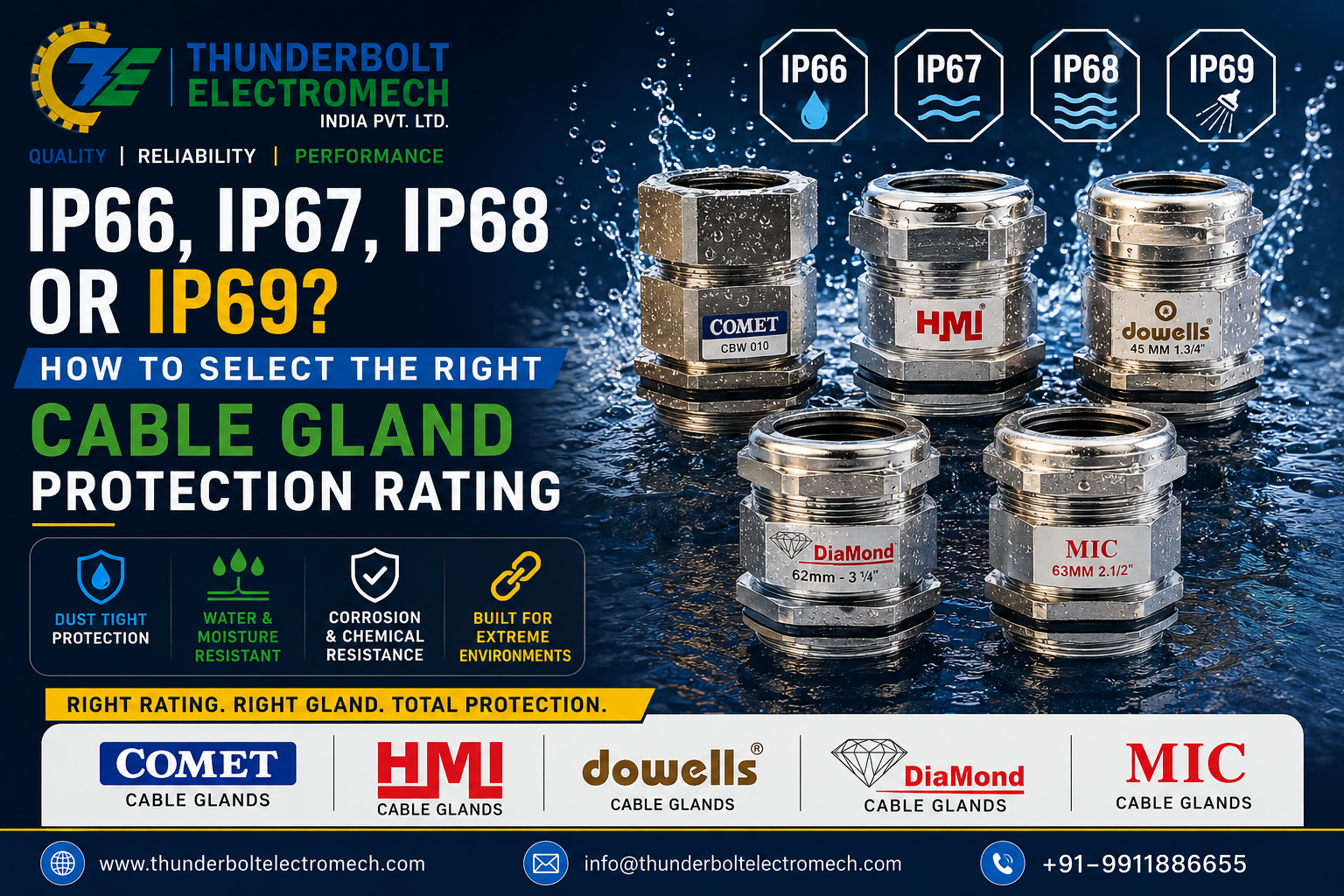
High range — Dowells Cable Glands, Comet Cable Glands, HMI Cable Glands. These three brands anchor the premium end of the stock — double-compression construction as standard on most models, brass bodies with nickel or chrome plating, and consistent IP66/IP67 performance across the range, with select double-compression models extending to IP68 depending on cable diameter and torque. Dowells Cable Glands are a frequent specification on utility and heavy-industrial contracts where documented IP compliance is checked at commissioning. Comet Cable Glands see heavy use across panel-building workshops in Delhi NCR, largely because the range covers a wide diameter spread without needing custom orders. HMI Cable Glands are commonly specified where budget-conscious buyers still need double-compression, brass-bodied construction rather than stepping down to polyamide.
Medium range — Diamond Cable Glands and MIC Cable Glands. Diamond Cable Glands and MIC glands serve projects where IP66 is the functional requirement — indoor panels, standard outdoor enclosures not facing submersion risk, and general LT wiring — at a price point that makes sense for high-volume orders. These are not lesser-quality products; they’re correctly positioned for applications that don’t need IP68’s submersion performance, and specifying the high-range brands here would simply add cost without adding usable protection.
The practical guidance for a purchase manager: match the tier to the actual hazard, not to brand reputation alone. A dry indoor panel doesn’t need Dowells’ IP68-capable construction any more than a buried cable joint should be trusted to a gland rated only for IP66 spray protection.
Common Customer Problems Our Cable Gland Supplier India Team Solves
Problem: “We bought IP68 glands, but water still got into the junction box.”
In nearly every case this traces back to one of two things: the cable’s outer diameter fell outside the gland’s sealing range, or the compression nut was hand-tightened rather than torqued to the manufacturer’s specification. Re-checking both against the datasheet — not assuming “IP68 on the box” is enough — resolves this almost every time.
Problem: “Our supplier can’t tell us the actual depth and duration behind their IP68 claim.”
This is a legitimate red flag, not a minor gap. Since IEC 60529 leaves IP68’s exact test parameters to the manufacturer, a supplier who can’t produce the specific depth-and-duration figure is likely reselling a generic “IP68” label without the underlying test report. A genuine cable gland supplier India engineers can trust should hand over that number on request, not shrug and repeat the rating.
Problem: “We’re paying for IP68 glands on an indoor panel that will never see water.”
This is over-specification, and it happens often when a single BOQ standardises on one gland type across an entire project regardless of where each gland actually sits. Segmenting the order — Diamond or MIC range for dry indoor points, Dowells or Comet where real water exposure exists — cuts unnecessary spend without lowering protection anywhere it matters.
Problem: “The gland fits the cable, but the rubber seal already looks compressed unevenly after installation.”
Uneven compression usually means the cable sits near the edge of the gland’s rated diameter range, or the gland was tightened at an angle rather than square to the entry point. Moving to the next size gland, matched properly to the cable’s measured outer diameter, fixes the root cause rather than just re-tightening the same mismatched fit.
Problem: “We need IP66 outdoors and IP69K washdown resistance on the same line.”
Single-rating products won’t cover both hazards reliably. This calls for a dual-rated gland, verified against both the IEC 60529 jet/immersion tests and the ISO 20653 high-temperature washdown test — not a single-number spec sheet.
Common IP Rating Selection Mistakes
Mistake 1 — Assuming a higher IP number is always better.
As covered above, IP68 doesn’t cover IP66’s jet-spray test, and IP69K doesn’t cover IP68’s submersion depth. Match the rating to the actual hazard, not to the biggest number on the page. Once the required IP protection level is established, the next step is selecting the correct gland based on cable diameter, construction and application. Our Cable Gland Supplier India guide covers the complete selection process.
Mistake 2 — Ignoring the cable’s outer diameter tolerance.
Cables from different manufacturers, even at the “same” nominal size, can vary in outer diameter by a millimetre or more. Measuring the actual cable, not trusting the datasheet nominal figure, avoids a gland that technically fits but never seals correctly.
Mistake 3 — Treating single and double compression as interchangeable.
Single-compression glands are lighter, cheaper, and adequate for many indoor IP66 applications. They are not a substitute for double compression wherever mechanical strain relief and long-term IP67/IP68 performance actually matter — buried joints, vibrating equipment, or frequently flexed cable runs.
Mistake 4 — Skipping the manufacturer’s torque specification.
A correctly rated gland, under-torqued at installation, performs like a lower-rated one. This single step — checking and applying the specified torque, not “tight enough by feel” — is free and routinely skipped.
Mistake 5 — Buying unbranded stock without a test report.
IP66, 67, 68, and 69 claims printed on unbranded packaging, with no accompanying IEC 60529 or IEC 62444 test documentation, are effectively unverifiable. A documented brand — Dowells, Comet, HMI, or Diamond — with a traceable test report removes that risk from the specification.
Case Study 1: A Delhi NCR Cold-Storage Facility
A cold-storage plant running underground power cabling to its compressor room had standardised on a generic “IP68” gland sourced from a local wholesale market, with no accompanying datasheet. During the first heavy monsoon after commissioning, two of the underground junction boxes showed moisture ingress, despite sitting well within what the plant assumed was safe submersion depth. On inspection, the glands had no documented depth-and-duration test behind the IP68 claim — the label existed, but nothing behind it. Switching to Dowells double-compression glands, verified against a stated 3-metre/24-hour IP68 test condition matching the pit’s actual flood depth, resolved the recurring ingress across the following monsoon season.
Case Study 2: A Panel-Building Workshop in Delhi
A control panel fabrication workshop supplying LT panels across NCR had been using a single gland type — mid-range, IP66-rated — across every panel regardless of the end installation. Panels destined for outdoor rooftop AC units, exposed to direct rain and occasional standing water at the base, began showing early corrosion at cable entries within a year. The fix wasn’t a wholesale upgrade to IP68 across every panel; it was segmenting the specification — IP66 mid-range glands retained for indoor and sheltered panels, IP67-rated Comet glands specified for the rooftop and outdoor-exposed units. Field corrosion complaints from that product line dropped across the following commissioning batches.
Case Study 3: An Industrial Contractor Handling Pump-House Wiring
A contracting firm installing submersible pump connections across multiple sites had been treating “IP68” as a single fixed spec across projects with very different pit depths — some pits flooding to under a metre, others regularly reaching 4-5 metres during peak monsoon runoff. Standardising on one IP68 gland type meant the deeper sites were under-protected, since that particular gland’s tested depth topped out well below what those pits actually experienced. Requesting manufacturer-specific depth-and-duration figures for each site, and matching HMI double-compression glands rated to the deeper condition specifically for high-flood sites, cut return-visit callouts for water-related faults across the contractor’s site log.
How to Choose the Right Cable Gland Supplier in India
A few direct questions separate a genuine Cable Gland Supplier India engineers can rely on from a reseller moving unverified stock:
- Can they state the exact depth and duration behind an IP68 claim, not just repeat the number?
- Do they stock both single and double compression construction, and can they explain when each applies?
- Is the cable diameter sealing range published for every size, so buyers can match against actual measured cable OD rather than nominal size?
- Do they carry documented brands — Dowells, Comet, HMI, Diamond — alongside a mid-range option, so the specification can be matched to the actual application instead of over- or under-buying?
- Can they supply IEC 62444 or IS/IEC 60529 test documentation on request, for audit and commissioning records?
Why Engineers and Purchase Managers Choose Thunderbolt as Their Cable Gland Supplier India
Thunderbolt Electromech India Pvt. Ltd. is a Delhi-based Cable Gland Supplier India industries, contractors, and purchase teams turn to when the specification needs to be right the first time — not re-ordered after a monsoon failure. The stock spans both tiers covered in this guide:
- High range: Dowells Cable Glands, Comet Cable Glands, and HMI Cable Glands — double-compression, brass-bodied construction suited to outdoor, buried, and IP67/IP68 applications
- Medium range: Diamond Cable Glands and MIC Cable Glands — reliable IP66 performance for indoor panels and standard outdoor enclosures, at a price point suited to high-volume orders
Every order comes with the technical clarity this guide has pushed for throughout: published sealing-range diameters, documented IP test conditions, and torque specifications — not a bare part number and a price.
Visit or contact Thunderbolt Electromech India Pvt. Ltd.: 📍 Shop no. 3538, Sitaram Bazar Rd, Bazar Sirkiwalan, Chawri Bazar, Chandni Chowk, Delhi, 110006 📞 +91-9911886655 ✉️ info@thunderboltelectromech.com
Frequently Asked Questions
Is IP68 always better than IP66 for outdoor cable glands?
No. IP68 tests submersion; IP66 tests high-pressure jets. A site facing driving rain and hose-down spray, but never standing water, is better served by a properly torqued IP66 double-compression gland than by an IP68 gland that was never tested against direct jet pressure. This exact confusion shows up regularly in online engineering forums, where users ask why their “higher-rated” IP68 gland still let water in during pressure washing — the answer is almost always that IP68 doesn’t cover the jet test IP66 does.
Can I reuse a cable gland after removing it from a cable?
Manufacturers generally don’t recommend it for critical IP67/IP68 applications. The elastomer seal takes a compression set around the original cable’s exact diameter and contour; reinstalling on a different cable, or even the same cable at a different point, rarely restores the original sealing performance. For non-critical indoor IP54/IP66 runs, some reuse is common in practice, but it comes with a real, if usually minor, derating risk.
Does an IP68 cable gland need extra sealant or silicone at the entry point?
If the gland is correctly sized to the cable and torqued to specification, no — added sealant isn’t part of the tested configuration and can, in some cases, interfere with the elastomer seal’s intended compression. Sites that feel the need to add silicone “just in case” are usually compensating for a diameter mismatch that should be fixed by selecting the correct gland size instead.
How do I know if a cable gland is genuinely IP68, or just marketed as one?
Ask for the manufacturer’s test report showing the specific depth and duration used, referenced against IEC 60529 or IS/IEC 60529. A supplier who can produce that document, rather than a generic spec sheet with “IP68” printed with no supporting data, is the one worth ordering from for any submersion-critical application.
What’s the practical difference between single and double compression cable glands?
Single compression seals only the outer cable jacket with one gland ring. Double compression adds a second inner seal gripping the cable’s inner layer or armour, giving significantly better strain relief and more consistent IP67/IP68 performance under vibration, thermal cycling, and mechanical pull — the conditions that most commonly cause a single-compression gland to lose its rating over time in the field.
Why does my cable gland’s IP rating not match my enclosure’s IP rating?
Because they’re tested and rated separately. An enclosure rated IP66 doesn’t automatically make every cable entry point IP66 — each gland must independently meet or exceed the enclosure’s rating, correctly matched to its specific cable, or the entire assembly’s real-world protection drops to the weakest link in the chain, not the enclosure’s printed rating.
Conclusion
Cable gland IP ratings are not a simple ladder where higher always wins — IP66, IP67, IP68, and IP69 each test a different hazard, and the right choice depends on matching the test to the actual water exposure at the installation point, not the biggest number on the datasheet. Equally important, and far less discussed, is that the rating printed on a gland’s body only holds if the cable diameter, compression type, and installation torque all match what the manufacturer actually tested. Thunderbolt Electromech India Pvt. Ltd. supplies both tiers needed to get this right — Dowells, Comet, and HMI Cable Glands for IP67/IP68 submersion and heavy-duty applications, and Diamond and MIC Cable Glands for standard IP66 indoor and outdoor use — with documented specifications behind every size. Call +91-9911886655 or write to info@thunderboltelectromech.com to get the right gland matched to your actual site conditions, not just the highest number on the shelf.