
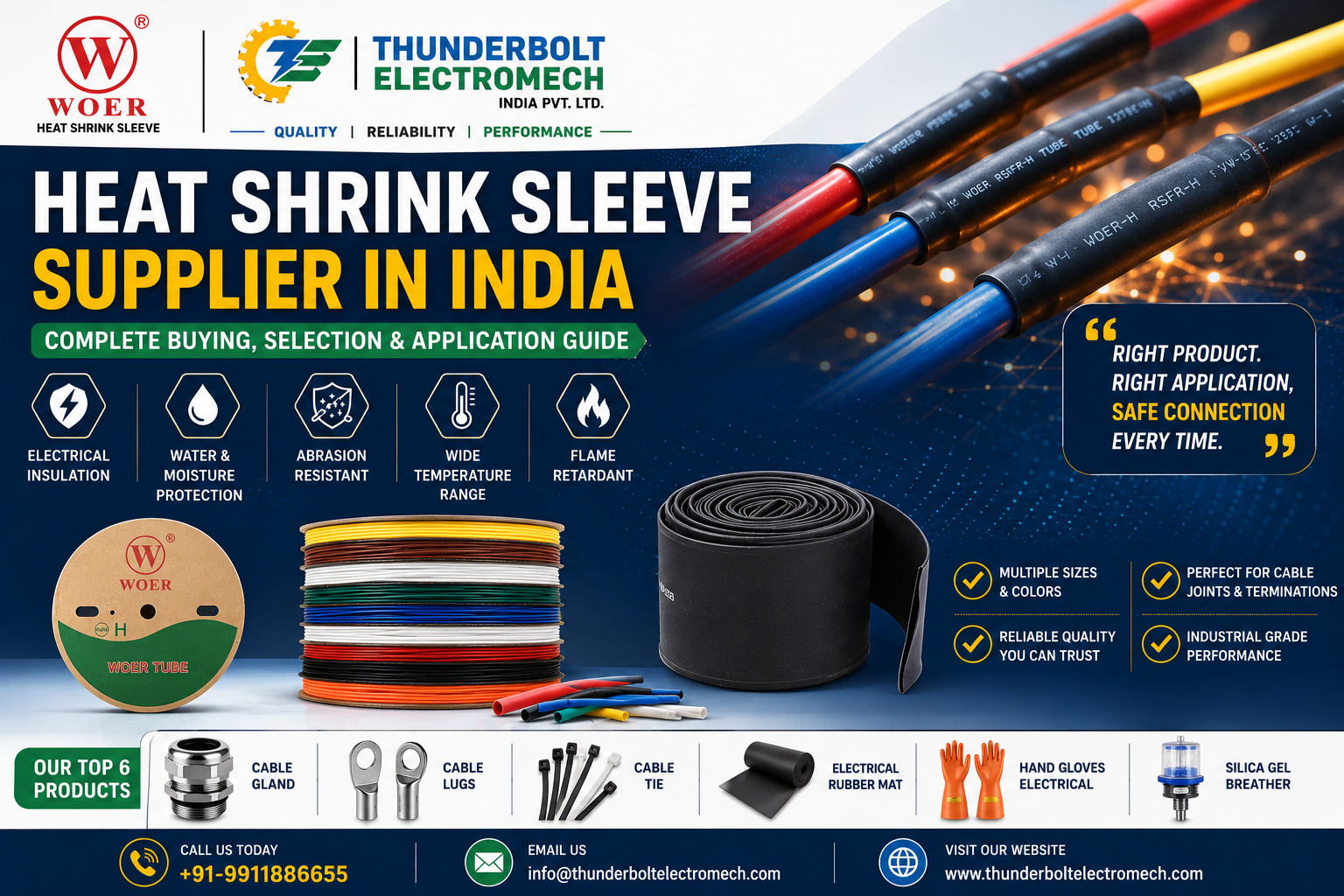
By Thunderbolt Electromech India Pvt. Ltd. — Delhi-based Heat Shrink Sleeve Supplier of the Complete WOER Range
📞 +91-9911886655 | ✉️ info@thunderboltelectromech.com | 🌐 thunderboltelectromech.com | 📍 Shop No. 3538, Sitaram Bazar Rd, Bazar Sirkiwalan, Chawri Bazar, Chandni Chowk, Delhi – 110006
Suggested Tags: Heat Shrink Sleeve Supplier, Heat Shrink Tubing, WOER, Electrical Heat Shrink Sleeve, Delhi Electrical Supplier, Cable Jointing
Quick Answer: A heat shrink sleeve is a polymer tube — most commonly polyolefin — that contracts radially when heated, gripping tightly around a cable, joint, or connector to insulate it electrically, seal out moisture, and protect it mechanically. The two numbers that actually determine whether a sleeve fits your job are its expanded diameter (the size before shrinking, which must slide over the largest section of whatever you’re covering) and its recovered diameter (the size after shrinking, which must be smaller than the object for a tight grip). The relationship between the two is the shrink ratio — a 2:1 sleeve shrinks to half its expanded size, a 3:1 sleeve shrinks to a third, and so on.
Choosing correctly means matching wall thickness to mechanical exposure (thin-wall for general wire insulation, heavy-wall for cable joints and terminations exposed to abrasion), matching shrink ratio to how irregular the object underneath is (higher ratios for connectors and joints with big diameter jumps, standard 2:1 for uniform cable runs), and confirming the sleeve’s temperature rating matches your operating environment. For most Indian industrial and electrical panel work, WOER-brand polyolefin sleeves in the 6mm–40mm range, rated 55°C to 125°C operating temperature, cover the large majority of use cases — Thunderbolt Electromech stocks this range as a Delhi-based heat shrink sleeve supplier with same-batch consistency for bulk orders.
Introduction
Heat shrink sleeve looks like the simplest item on an electrical BOM — a length of tube, heated with a gun, that shrinks and grips. It’s also one of the easiest items to under-specify, because the two numbers printed on the packaging (something like “20/10mm”) mean almost nothing to a buyer who hasn’t been told what an expanded diameter and a recovered diameter actually are, or why the sleeve that fits perfectly over a straight cable run can be completely wrong for a cable joint with a lug barrel twice the cable’s own diameter.
This guide is built around that gap. It covers the engineering principle behind why heat shrink sleeve works at all, the practical differences between thin-wall, medium-wall, and heavy-wall sleeve, how to actually read a shrink ratio instead of guessing at it, and how to buy from a heat shrink sleeve supplier in India without ending up with a box of sleeve that’s the wrong size for the job it was bought for.
What Is a Heat Shrink Sleeve and How Does It Work?
A heat shrink sleeve is a tube of cross-linked polymer — polyolefin is by far the most common base material for electrical applications — manufactured in an expanded state and engineered to contract back toward its original, smaller extrusion diameter when heated past a defined temperature threshold. Understanding why it does this, rather than just accepting that it does, actually helps with sizing decisions later in this guide.
The engineering principle, not the marketing version. During manufacturing, the polymer tube is extruded at its final, small diameter, then irradiated (typically with an electron beam) to cross-link the polymer molecules into a semi-rigid three-dimensional network. This cross-linking is what gives the material “memory.” The tube is then heated above its crystalline melting point and mechanically expanded — often with internal air pressure — to a larger diameter, then rapidly cooled while still held in that expanded state. The cooling locks the expanded shape in place, but the cross-linked molecular network underneath is still, in effect, straining to return to its original, smaller form. When you apply heat again during installation, you’re not creating a new shrinking action — you’re releasing the stored elastic energy from that original cross-linked structure, letting the polymer relax back toward the diameter it was extruded at in the first place. This is why a heat shrink sleeve can only shrink once: after installation, the stored energy has been released, and there’s no further “shrink” left in the material.
This also explains the difference between expanded diameter and recovered diameter in engineering terms, not just definitional ones. The expanded diameter is the artificially enlarged, energy-storing state the sleeve ships in. The recovered diameter is the material’s actual relaxed, unstressed state — the diameter it was originally extruded at before the manufacturing process forced it wider. When a supplier lists a sleeve as “20/10mm,” they’re telling you the artificially expanded size (20mm) and the natural, relaxed size the polymer wants to return to (10mm) — everything in between is the working range you can install it over.
What this structure gives you, functionally:
- Insulation — a continuous polymer barrier over exposed conductor, replacing or supplementing tape-based insulation with a more consistent, seamless layer.
- Mechanical protection — the shrunk sleeve wraps and grips, resisting abrasion, flexing, and impact at joints and terminations that would otherwise be the weakest mechanical point in a cable run.
- Moisture protection — a properly shrunk sleeve, particularly adhesive-lined variants, creates a genuine seal against moisture ingress, which matters enormously at outdoor joints and terminations.
- Strain relief — at a cable-to-connector transition, the sleeve reduces the sharp flex point that would otherwise concentrate mechanical stress exactly where the conductor is most vulnerable.
- Cable identification — colour-coded sleeve doubles as a permanent, weather-resistant marking system for phase identification or circuit tracing, more durable than adhesive labels in harsh environments.
On the standards side: IEC 60684-2:2025 specifically covers test methods for flexible insulating sleeving, including heat-shrinkable sleeving intended primarily for electrical conductors and electrical apparatus connections — this is the international reference point for how sleeve performance (dimensional recovery, dielectric strength, thermal ageing) is actually verified, rather than simply claimed on a datasheet.
Types of Heat Shrink Sleeves Used in Electrical Applications
Not every sleeve is interchangeable, and picking by diameter alone while ignoring wall thickness and formulation is one of the most common buying mistakes in this category.
Thin-Wall Heat Shrink Tubing
The general-purpose workhorse — typically under 0.5mm wall thickness after shrinking, used for wire bundling, general conductor insulation, and light identification marking. Buyer note: thin-wall is the most economical option per metre, but it’s not the right choice anywhere mechanical abrasion or repeated flexing is expected, since its thinner wall has less material to absorb physical wear.
Medium-Wall Heat Shrink Sleeves
A step up in wall thickness, often used where some mechanical protection is needed but a full heavy-wall, adhesive-lined solution would be overkill — connector bodies, moderate-exposure terminations, general panel wiring where the sleeve does more than pure insulation.
Heavy-Wall Heat Shrink Sleeves
Built for cable joints, terminations, and splices — the applications where the sleeve is genuinely doing structural and environmental sealing work, not just cosmetic insulation. Heavy-wall sleeve is frequently adhesive-lined as standard, since the applications it’s used for (outdoor joints, underground cable terminations) are exactly where moisture sealing matters most. Buyer note: this is the category to specify for any HT cable joint or outdoor termination — using thin-wall sleeve here to save cost is a false economy that shows up as a moisture-related fault months later.
Adhesive-Lined Heat Shrink Sleeves
Sleeve with an internal hot-melt adhesive layer that flows and fills gaps as the outer polymer shrinks, creating an actual environmental seal rather than just a tight mechanical wrap. Buyer note: essential for any outdoor, underground, or moisture-exposed joint; unnecessary added cost for dry, indoor panel wiring where sealing isn’t the primary requirement.
Flame-Retardant Heat Shrink Tubing
Formulated to self-extinguish rather than propagate flame, typically verified against a flammability classification (WOER’s own industrial-grade range, for instance, is rated to the ASTM D2671 C-VW-1 flammability class). Buyer note: this matters most inside enclosed panels and control cabinets, where a fault-driven ignition source has limited ventilation and any flame-propagating material inside the enclosure makes a bad situation worse.
Flexible Heat Shrink Tubing
Formulated to stay pliable after shrinking rather than becoming rigid, useful where the finished cable run needs to flex repeatedly in service — moving machinery, cable chains, robotic arms — rather than sit static once installed.
Identification and Colour-Coded Sleeves
Sleeve supplied in a defined colour range specifically for phase marking, circuit identification, or general cable-management colour coding. Buyer note: for multi-phase panel work, standardising a colour convention (and buying enough of each colour, not just black) up front avoids a mixed-colour patch job later when one colour runs out mid-installation.
Heat Shrink Sleeve Size, Diameter and Shrink Ratio Explained
This is the section that actually prevents wasted orders, so it’s worth reading slowly if you’re the person specifying quantities.
Before-shrink (expanded) diameter is the size the sleeve ships in — the size it needs to be to physically slide over whatever you’re covering. After-shrink (recovered) diameter is the size it settles to once fully heated — the size that determines whether it actually grips tightly enough to do its job. Wall thickness is measured in the recovered state, and it’s what determines mechanical durability, not the expanded-state wall thickness, which is thinner and stretched.
Shrink ratio expresses the relationship between these two diameters, written as X:1. A 2:1 ratio — the most common and generally most economical for uniform, cost-sensitive applications — means the expanded diameter is twice the recovered diameter; a sleeve that ships at 20mm will settle to roughly 10mm once fully shrunk. A 3:1 ratio shrinks to a third of its expanded size, giving more flexibility to cover components with a bigger jump between the widest point (a connector body or lug barrel) and the narrowest point (the cable itself) it needs to seal against. Higher-ratio products — 4:1, and specialist products up to 6:1 — exist specifically for highly irregular profiles: multiple cable joints, branch-off points, or connectors with a dramatic step-down to the cable diameter, where even a 3:1 ratio wouldn’t close the gap.
The formula that actually matters: Recovered diameter = Expanded diameter ÷ Shrink ratio. A 3:1 sleeve with a 12mm expanded diameter recovers to 4mm. If your cable measures 5mm, that sleeve is now too tight to have shrunk over it correctly — you needed either a larger expanded diameter or a lower shrink ratio for that specific cable.
Working example. If a sleeve is marked 20/10mm, the buyer should understand that the first number represents the expanded internal diameter and the second represents the nominal recovered internal diameter, subject to the manufacturer’s specification — meaning this specific sleeve ships at 20mm ID (large enough to slide over an object up to roughly 20mm, with a small installation clearance factored in) and will settle toward 10mm ID once fully heated, giving it an effective shrink ratio of 2:1.
The practical mistake this section exists to prevent: do not select purely by cable diameter. Measure the largest section that the sleeve must pass over — not the cable itself, but the connector, lug barrel, or joint body sitting at one end of the run, since the sleeve has to physically slide past that widest point before it ever reaches the section it’s meant to seal. This is a practical engineering distinction many generic buying guides miss entirely: they tell you to “measure your cable,” when the real constraint is almost always the widest obstruction along the sleeve’s installation path, not the cable’s own diameter. Add a 10–20% clearance margin on top of that widest-point measurement so the sleeve slides on freely without forcing, then confirm the shrink ratio brings the recovered diameter down tight enough against the narrowest section — typically the bare cable — to form a proper seal.
Heat Shrink Sleeve Supplier: How to Select Materials, Standards & Certification
Material selection and standards compliance are where a genuine heat shrink sleeve supplier earns the relationship, rather than just moving stock.
Polyolefin is the dominant base material for general electrical applications — good dielectric strength, reasonable temperature range, cost-effective at volume. WOER’s own industrial-grade polyolefin range, for reference, carries a documented operating temperature range of 55°C to 125°C, dielectric strength of 15kV/mm (tested per ASTM D149), minimum ultimate tensile strength and elongation figures tested per ASTM D2671, and a flammability rating of ASTM D2671 C-VW-1 — this is the kind of documented, testable specification sheet worth requesting from any supplier, rather than accepting “heat shrink sleeve, industrial grade” as a sufficient description on its own.
PVC sleeve exists as a lower-cost alternative for less demanding applications but generally offers a narrower temperature range and different flame-performance characteristics than polyolefin — worth a direct comparison against your specific application’s requirements rather than assuming interchangeability.
What a genuine test certificate should show, drawing on the ASTM D2671 and IEC 60684-2 framework referenced above: dielectric strength (typically reported in kV/mm), tensile strength and elongation at break in the recovered state, a stated flammability classification, cold-bend performance (does the material crack when flexed at low temperature), and shrink temperature range. A datasheet that only states “meets industry standards” without naming which standard, and without the actual numeric test results, is a marketing claim, not a specification.
Heat Shrink Sleeve for Cable Joint and Termination Work
A heat shrink sleeve for cable joint applications sits at the demanding end of the product category, because a joint is inherently the weakest mechanical and electrical point in any cable run — it’s where two conductor ends meet, where insulation has been stripped back and reapplied, and where moisture ingress does the most damage if it gets in. For this reason, cable jointing work almost always calls for heavy-wall, adhesive-lined sleeve rather than the thin-wall product suited to general wire dressing — the adhesive lining is what actually seals around the irregular profile a joint creates, where the cable’s insulation steps down to bare conductor and back up again through the joint body.
This is also where heat shrink sleeve for electrical insulation performance matters most in practice: a joint carries the same current as the cable either side of it, and any weakness in the sleeve’s dielectric performance at that specific point becomes the failure point for the entire run, not a generalised risk spread evenly across the cable’s length.
Heat Shrink Sleeve for Electrical Panels and Insulation Applications
Inside a control panel or MCC, heat shrink sleeve does different work than it does at an outdoor joint — less about environmental sealing, more about insulation consistency, flame performance inside an enclosed space, and identification. An electrical heat shrink sleeve used for panel-internal wiring should prioritise a documented flame-retardant rating (as covered above) given the enclosed, lower-ventilation environment, alongside a colour range sufficient for whatever phase or circuit identification convention the panel builder standardises on. Thin- to medium-wall sleeve generally suits this application, since panel wiring isn’t typically exposed to the abrasion or moisture that heavier-wall product is engineered against.
LT vs HT Applications: Where Sleeve Selection Actually Changes
Low-tension panel and general wiring work tolerates a wider range of acceptable sleeve choices — thin-to-medium wall, standard 2:1 ratio, without adhesive lining in most indoor cases. High-tension cable jointing and termination work narrows that range considerably: heavy-wall, frequently adhesive-lined, often higher shrink ratio to accommodate the larger, more irregular joint and termination bodies typical of HT cable work, and a documented dielectric strength figure that’s been actually verified against the installation’s working voltage rather than assumed adequate. For any HT substation or transformer-yard cable termination work, this sleeve selection should also be paired with the correct 11kV danger plate or 33kV danger plate marking on the equipment itself — heat shrink sleeve protects the joint electrically, but the site still carries the same statutory signage requirement under IS 2551 and CEA Regulation 20 covered in our separate Danger Plate Supplier guide, since a well-sealed cable joint doesn’t reduce a substation’s obligation to warn anyone approaching it of the live voltage present.
Indoor vs Outdoor Applications
Indoor sleeve selection can generally prioritise cost and flame performance over environmental sealing, since the installation isn’t exposed to rain, UV, or temperature swings beyond a controlled panel-room range. Outdoor applications — cable joints in trenches, overhead line terminations, rooftop solar cable runs — need adhesive-lined sleeve as a near-default, plus confirmation that the specific product’s temperature rating covers the actual outdoor swing your site experiences, not just a generic “industrial grade” assumption. UV resistance also becomes relevant for any sleeve with prolonged direct sun exposure, similar in principle to the UV-stabilisation consideration covered in our cable ties guide — a sleeve that isn’t UV-stabilised can embrittle over an outdoor installation’s service life well before its mechanical or dielectric properties would otherwise have degraded.
Heat Shrink Sleeve Supplier India: Price Factors & Bulk Buying
Heat shrink sleeve price and heat shrink tube price in India are driven primarily by four factors: diameter and wall thickness (larger diameter and heavier wall means more raw material per metre), formulation (adhesive-lined and flame-retardant grades cost more than basic thin-wall polyolefin), roll length and order volume (bulk roll pricing improves meaningfully over small cut-length purchases), and brand/documentation depth (a supplier who can produce genuine ASTM/IEC-referenced test data typically prices at a modest premium over undocumented stock, which is generally worthwhile for panel builders facing safety audits).
As a concrete reference point from current stock: WOER 6mm industrial-grade sleeve is priced at ₹10.60 per metre-equivalent (100-metre roll format) against a ₹12.60 list price, while the larger 25mm and 40mm formats price at ₹48.80 and ₹88.80 respectively — giving a genuine sense of how price scales with diameter across this specific product line. As a heat shrink sleeve supplier India buyers can rely on for consistent bulk pricing, Thunderbolt Electromech quotes against actual order volume and diameter mix rather than a flat per-metre rate applied uniformly across every size.
Heat Shrink Sleeve Supplier Delhi: Why Location & Fast Delivery Matter
For panel fabricators in Wazirpur and Naraina, EPC contractors working HT terminations in Faridabad and Manesar, or facilities teams anywhere across the NCR industrial belt, sourcing from a heat shrink sleeve supplier Delhi buyers can reach directly shortens replenishment time for urgent jointing work — cable faults and emergency terminations rarely happen on a convenient schedule, and a local heat shrink sleeve dealer Delhi can typically turn around an urgent size or colour requirement faster than a distant distributor shipping interstate. Consolidating heat shrink sleeve with cable ties, cable lugs, cable glands, and danger plates from one Delhi-based supplier also reduces the number of vendor relationships a busy procurement team has to manage across a single panel-wiring or cable-jointing project.
Comparison Table: Sleeve Type by Application
| Sleeve Type | Wall Thickness | Adhesive Lined | Best Application | Shrink Ratio Typical |
| Thin-Wall | Light | No | General wire bundling, light insulation | 2:1 |
| Medium-Wall | Moderate | Sometimes | Connector bodies, general panel wiring | 2:1–3:1 |
| Heavy-Wall | Thick | Usually yes | Cable joints, terminations, outdoor splices | 3:1–4:1 |
| Flame-Retardant | Varies | Sometimes | Enclosed panels, control cabinets | 2:1–3:1 |
| Flexible-Grade | Moderate | Rarely | Moving machinery, cable chains | 2:1–3:1 |
| Colour-Coded/ID | Light–Moderate | Rarely | Phase marking, circuit identification | 2:1 |
How to Actually Install Heat Shrink Sleeve Correctly
Buying the right size solves half the problem — installation technique determines whether that correctly sized sleeve actually performs the way its datasheet promises.
Start heating from the centre, not the end. Applying heat from one end first can trap air inside the sleeve, creating a bubble that prevents full contact with the underlying surface at exactly the point where a tight seal matters most. Working from the middle outward pushes trapped air toward the open ends, where it can escape freely.
Keep the heat source moving. A heat gun held stationary on one spot risks scorching or degrading the polymer before the rest of the sleeve has recovered evenly, leaving an inconsistent finish with weak points at the overheated section. Continuous, even movement across the sleeve’s length produces uniform shrinkage.
Watch for the adhesive flow, not just the polymer shrinkage, on lined sleeve. With adhesive-lined heavy-wall sleeve, full recovery isn’t just about the outer polymer tightening — the internal adhesive needs to reach flow temperature and visibly emerge at the sleeve’s open ends. A sleeve that looks fully shrunk on the outside but shows no adhesive flow at the ends likely hasn’t reached full internal temperature, and the environmental seal it’s meant to provide may be incomplete.
Don’t rush the cooling. A freshly shrunk sleeve is still soft and can deform if handled, flexed, or knocked before it cools back to ambient temperature. Giving it even a minute of undisturbed cooling time before moving the cable or joint avoids introducing a permanent deformation into what should be a uniform, symmetrical seal.
Pre-fit before you cut cable length. This sounds obvious but causes real rework when skipped: slide the sleeve onto the cable before making a final termination, not after. A technician who terminates a lug first and only then realises the sleeve can’t reach past the finished connection has to redo the termination — a completely avoidable delay caught by sequencing the work correctly from the start.
Shelf Life, Storage & Batch Consistency
Heat shrink sleeve has a genuine shelf life, and it’s a detail bulk buyers frequently overlook. The cross-linked polymer’s stored elastic energy — the same property that makes it shrink on demand — can degrade slowly over years of storage, particularly if the stock is kept in fluctuating temperatures, direct sunlight, or high humidity. A roll that’s been sitting in a poorly controlled warehouse for several years may not recover to its full rated diameter or may shrink unevenly compared to fresh stock, even though it looks physically identical on the shelf.
For a facility buying in bulk against an annual rate contract, this is worth building into a stock rotation practice — oldest stock used first, storage kept in a stable, moderate-temperature area away from direct sun, and a periodic spot-check on older rolls (a simple test-shrink on a scrap length) before committing an aged batch to a critical joint or termination. This is the same storage-discipline principle covered in our electrical insulating mat guide, and it applies just as directly here: a correctly specified product that’s been poorly stored can underperform its own datasheet, through no fault of the original manufacturing.
Choosing the Right Heat Shrink Sleeve Supplier: WOER Range at Thunderbolt Electromech
Thunderbolt Electromech India Pvt. Ltd. supplies the complete WOER heat shrink sleeve and heat shrink tubing range — from 6mm through 40mm diameter, in black and colour-coded options, industrial-grade polyolefin rated 55°C to 125°C operating temperature — as a Delhi-based supplier for panel OEMs, EPC contractors, and industrial MRO buyers. As a heat shrink tube supplier and broader heat shrink tubing supplier India partner, we supply this range alongside the cable ties, cable lugs, cable glands, danger plates, and electrical insulating mats covered across our other buying guides, giving panel-wiring and cable-jointing buyers a single consolidated source for the consumables that appear together on almost every job.
Common Customer Problems and Solutions
Problem: “The sleeve wouldn’t slide over our cable lug.”
This is almost always a sizing error where the buyer measured the cable, not the lug barrel — the widest point along the installation path. Solution: always measure the largest section the sleeve must pass over, as covered in the sizing section above, not just the cable diameter.
Problem: “The joint failed after monsoon exposure despite using heat shrink sleeve.”
Frequently traced to using non-adhesive-lined sleeve on an outdoor joint that needed a genuine environmental seal. Solution: specify adhesive-lined, heavy-wall sleeve for any outdoor or underground joint, not general-purpose thin-wall stock.
Problem: “We keep running out of one colour mid-installation.”
A common issue when colour-coded stock is ordered reactively rather than against a planned phase-identification convention. Solution: calculate colour-split quantities against your actual panel or installation plan before ordering, not after the first colour runs low.
Problem: “Our panel failed a flame-retardancy audit point.”
Traced to using general-purpose sleeve inside an enclosed panel without checking its flammability classification. Solution: confirm ASTM D2671 (or equivalent) flame-retardant classification specifically for any panel-internal application, and keep the datasheet on file for audit purposes.
Real Use Cases
A panel OEM standardising sleeve sizes across its production line (Naraina, Delhi).
A control panel fabricator had been buying heat shrink sleeve reactively, picking up whatever diameter a local vendor had in stock, resulting in a mixed-size, mixed-brand inventory that made consistent panel-to-panel quality difficult to guarantee. Auditing actual lug and cable diameters across their panel range — similar to the size-standardisation approach covered in our cable ties guide — showed that three core diameters covered the large majority of their work. Standardising on those three sizes from one supplier, ordered against monthly production volume, both improved consistency and reduced per-metre cost through predictable bulk ordering.
An EPC contractor terminating an outdoor 11kV cable joint after a fault (Faridabad).
A contractor repairing a faulted underground 11kV cable initially specified standard thin-wall sleeve for the repair, prioritising speed over the joint’s actual environmental exposure. The repair failed again within a single monsoon season, traced to moisture ingress at the joint — the thin-wall sleeve had insulated the joint electrically but never sealed it against water ingress the way adhesive-lined heavy-wall sleeve would have. The subsequent repair used correctly specified heavy-wall, adhesive-lined sleeve rated for the joint’s actual outdoor exposure, alongside confirming the site’s danger notice signage was current for the 11kV rating.
A facilities team colour-coding a multi-phase panel retrofit (South Delhi commercial complex).
A facilities team retrofitting an ageing panel needed consistent phase identification across dozens of circuits, previously marked with degraded adhesive labels that had become illegible after years of service. Switching to colour-coded heat shrink sleeve at each termination point gave a permanent, weather- and wear-resistant identification system that won’t degrade the way an adhesive label does over the same service life.
FAQs on Heat Shrink Sleeves and Suppliers
Q1. What’s the difference between expanded and recovered diameter?
Expanded diameter is the sleeve’s size as supplied, before shrinking — large enough to slide over your cable, connector, or joint. Recovered diameter is the size it settles to once fully heated, and this is what determines the actual grip and seal.
Q2. How do I calculate what recovered diameter I’ll get?
Recovered diameter = expanded diameter ÷ shrink ratio. A 3:1 sleeve with a 15mm expanded diameter recovers to roughly 5mm.
Q3. Should I size heat shrink sleeve based on my cable diameter?
Not purely — size based on the largest section the sleeve must physically pass over during installation, which is often a connector or lug barrel rather than the cable itself, then confirm the recovered diameter grips tightly enough at the narrower cable section.
Q4. What shrink ratio should I use for a cable joint?
Cable joints typically have a significant diameter step between the joint body and the cable either side of it, so a 3:1 or higher ratio generally accommodates this better than a standard 2:1 ratio designed for more uniform profiles.
Q5. Is adhesive-lined sleeve necessary for indoor panel wiring?
Generally not — adhesive lining exists primarily for environmental sealing against moisture, which matters most for outdoor and underground joints. Indoor panel wiring in a controlled environment typically doesn’t need this added cost.
Q6. What temperature rating do I need?
Confirm the sleeve’s rated operating temperature range covers both your installation environment and any thermal load from the equipment it’s near — WOER’s industrial-grade range, for reference, is rated 55°C to 125°C, suitable for most general industrial and panel applications.
Q7. Does heat shrink sleeve carry a flame-retardancy standard?
Genuine industrial-grade sleeve should carry a documented flammability classification — WOER’s range, for instance, is rated to ASTM D2671 C-VW-1 — worth confirming explicitly for any panel-internal application.
Q8. What’s the difference between thin-wall and heavy-wall sleeve?
Thin-wall suits general wire bundling and light insulation where mechanical exposure is minimal; heavy-wall is built for cable joints, terminations, and splices where abrasion resistance and, often, environmental sealing matter more.
Q9. Can I use the same heat shrink sleeve for LT and HT applications?
Not generally by default — HT cable joints and terminations typically need heavier wall thickness, adhesive lining, and verified dielectric performance suited to the higher working voltage, rather than the lighter general-purpose sleeve adequate for most LT panel wiring.
Q10. What determines heat shrink sleeve price?
Diameter and wall thickness, formulation (adhesive-lined and flame-retardant grades cost more), roll length and order volume, and the depth of test documentation a supplier can provide.
Q11. Why does an HT cable joint need heat shrink sleeve if the equipment already has a danger plate?
These solve different problems — the danger plate is a statutory warning notice required by law, while heat shrink sleeve is the physical insulation and environmental seal protecting the joint itself. A properly sleeved joint and a properly displayed danger notice are both required, not interchangeable safety measures.
Q12. How do I know if my heat shrink sleeve has fully recovered during installation?
A fully recovered sleeve should show no visible wrinkling, should conform tightly to the underlying shape without gaps, and — where the product has a colour-change or clear-window indicator — any adhesive should be visible flowing at the sleeve’s open ends confirming the adhesive layer has activated.
Conclusion
Heat shrink sleeve earns its reputation as a simple product right up until the moment a wrong size, wrong wall thickness, or wrong shrink ratio turns a five-minute installation task into a repeat callout. The engineering behind it isn’t complicated once explained — a cross-linked polymer relaxing back toward its original extruded diameter when heated — but the sizing decision it demands is genuinely easy to get wrong if a buyer measures the cable instead of the widest obstruction along the installation path, or reaches for general-purpose thin-wall stock on a joint that actually needed a heavy-wall, adhesive-lined seal.
Match wall thickness to mechanical and environmental exposure, match shrink ratio to how irregular the underlying profile is, and confirm the temperature and flammability rating suit where the sleeve is actually being installed — indoors in a controlled panel, or outdoors on a joint that has to survive a full monsoon cycle. Get those three decisions right, and heat shrink sleeve does exactly the job it’s engineered for.
Thunderbolt Electromech India Pvt. Ltd. supplies the complete WOER heat shrink sleeve range — 6mm through 40mm, industrial-grade polyolefin, 55°C to 125°C rated — as a Delhi-based heat shrink sleeve supplier serving panel OEMs, EPC contractors, and industrial buyers across the NCR region and pan-India, alongside the cable ties, cable lugs, cable glands, danger plates, and insulating mats covered across our other buying guides.
[…] panel builders, maintenance departments and purchase teams, choosing a technically suitable Heat Shrink Sleeve Supplier India is therefore as important as choosing the sleeve […]