By Thunderbolt Electromech India Pvt. Ltd. — Delhi-based Danger Plate Supplier of Powder Coated, Aluminium & Sticker Danger Plates
📞 +91-9911886655 | ✉️ info@thunderboltelectromech.com | 🌐 thunderboltelectromech.com | 📍 Shop No. 3538, Sitaram Bazar Rd, Bazar Sirkiwalan, Chawri Bazar, Chandni Chowk, Delhi – 110006
Quick Answer: A danger plate is a permanently mounted warning sign used to identify electrical equipment or installations where contact or approach can expose people to electrical hazards. In India, the Central Electricity Authority (CEA) Measures Relating to Safety and Electric Supply Regulations, 2023 require installations with voltage exceeding 250 V to have a danger notice permanently fixed in a conspicuous position, using a skull-and-bones sign according to relevant standards. The regulation specifically covers equipment such as motors, generators, transformers and other electrical plant and equipment. For Indian procurement, IS 2551:1982, Danger Notice Plates, remains an important reference. The BIS product manual identifies 200 × 150 mm as a nominal size for medium-voltage installations and 250 × 200 mm for high- and extra-high-voltage installations. It also identifies visual examination, dimensional checks, marking and weather-proofness among the relevant controls.
The important point is this: a danger plate is not simply a red-and-white board with a warning symbol. Its voltage information, wording, symbol, visibility, mounting position, material, dimensions and environmental durability all affect whether the warning remains useful throughout the life of the installation.
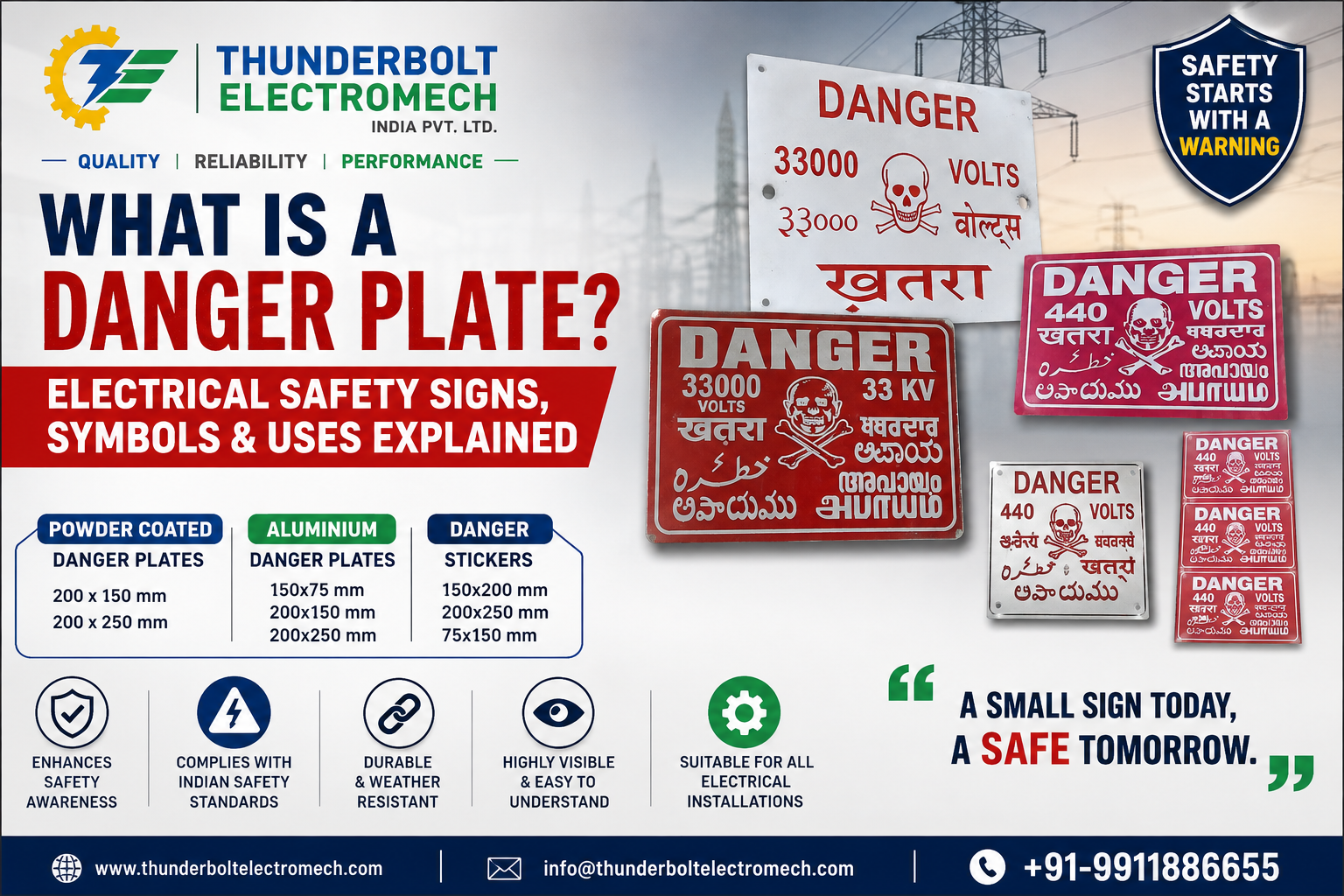
Thunderbolt Electromech supplies electrical danger plates in several formats, including Powder Coated Danger Plates in 200 × 150 mm and 200 × 250 mm, Aluminium Danger Plates in 150 × 75 mm, 200 × 150 mm and 200 × 250 mm, and danger stickers in 150 × 200 mm, 200 × 250 mm and 75 × 150 mm.
Introduction
Walk into an electrical room and the first thing an experienced technician looks for is not the brand name on the panel.
It is the warning.
A clear danger notice immediately changes how a person approaches the equipment. It tells an electrician, contractor, maintenance worker, security employee or visitor that the enclosure is not ordinary machinery and that electrical precautions apply.
That is the practical role of an Electrical Danger Plate.
However, purchasing teams often reduce the decision to three questions:
- What is the size?
- What material is available?
- What is the price?
Those questions matter, but they do not cover the engineering problem.
The better question is:
Will the selected warning plate remain clearly visible, correctly identified and physically intact for the environment in which it is installed?
That distinction becomes important in substations, transformer yards, electrical panels, distribution boards, industrial plants and power-generation facilities.
India’s current CEA safety regulations make danger notices part of the electrical installation safety framework. Regulation 20 applies to installations exceeding 250 V and specifies permanent danger notices in conspicuous positions. The regulation also identifies motors, generators, transformers and other electrical plant and equipment, along with certain overhead-line supports and specified high-frequency installations.
So, when a buyer searches for a Danger Plate Supplier, the requirement is not merely for a printed sign.
The buyer needs the right warning product for the application.
This guide explains how to evaluate one.
Danger Plate Supplier: What Is a Danger Plate?
A danger plate is a physical safety identifier fixed close to electrical equipment or an electrical installation to communicate the presence of an electrical hazard.
It normally combines several pieces of information:
- A danger signal or warning word.
- An electrical hazard symbol.
- Voltage information where required.
- Language appropriate to the installation.
- A contrasting design that can be noticed quickly.
- A mounting arrangement suitable for the equipment.
- Material and finish appropriate to the environment.
The CEA Regulations 2023 are particularly important because Regulation 20 does not treat the notice as optional decoration. It requires the owner of every installation above 250 V to affix a danger notice permanently in a conspicuous position, in Hindi or English and the local language of the district, with a skull-and-bones sign of a design according to relevant standards.
What makes a danger plate different from an ordinary sign?
An ordinary identification label might say:
Panel No. 4
A warning plate communicates something much more important:
There is an electrical hazard here.
That difference changes the design priorities.
An equipment identification label can be small because the person reading it already expects to inspect the equipment.
A warning plate needs to attract attention before the person interacts with the equipment.
This is why electrical hazard warning signs use strong visual contrast, recognizable symbols and short wording.
Direct evidence
Primary source: CEA Regulations 2023.
The regulation explicitly requires a danger notice for installations exceeding 250 V and identifies electrical equipment including transformers, generators and motors.
Supporting standard: BIS’s current product manual for IS 2551:1982 identifies danger notice plates as a standardized product category and specifies nominal sizes for medium, high and extra-high voltage applications.
No direct finding: There is no basis to claim that every commercially available plate, sticker or custom sign automatically complies with IS 2551. Compliance must be established from the manufacturer’s product documentation, testing and applicable certification where required.
Danger Plate Supplier: Why Are Electrical Danger Plates Important?
An electrical hazard sign has one job before anything else:
Make the hazard difficult to overlook.
Electrical installations create a special communication problem. The danger may not be visible.
There may be:
- no flame,
- no smoke,
- no moving mechanism,
- no obvious sound,
- no physical barrier indicating the exact hazard.
A closed electrical panel can look completely harmless.
The danger plate provides the missing visual information.
The warning works before the worker touches the equipment
Consider a distribution panel in an industrial facility.
An experienced electrician may know the panel is live.
A contractor entering the room for another task may not.
A danger notice provides a first-level warning before the person opens a door, removes a cover or approaches exposed electrical equipment.
The CEA regulations also require permanent indications that help distinguish different circuits and installations. Regulation 26 requires permanent indication so different circuits or apparatus in generating stations, substations, junction boxes and pillar boxes can be readily distinguished. Regulation 27 similarly requires permanent indication for installations with more than one feed.
This reveals an important engineering principle:
Electrical safety communication is not only about warning people that electricity exists. It is also about reducing ambiguity.
Customer Problem → Solution
| Customer problem | What can go wrong | Better solution |
| Plate is too small | Worker may overlook it | Select a suitable danger plate size |
| Voltage is missing | Worker cannot immediately identify system level | Include correct voltage information |
| Poor contrast | Warning becomes difficult to notice | Use strong visual contrast |
| Plate fades outdoors | Hazard information becomes unreadable | Choose weather-resistant construction |
| Sticker peels | Warning disappears from equipment | Match adhesive/product type to surface |
| Incorrect language | Message may not be understood | Follow applicable language requirements |
| Plate mounted in hidden location | Warning appears only after approach | Install at a conspicuous position |
| Wrong voltage marking | Creates misleading information | Verify actual equipment voltage before ordering |
| Generic sign on different equipment | Identification becomes ambiguous | Match plate to equipment/application |
A danger plate does not replace electrical isolation
This point deserves emphasis.
A warning plate does not make equipment electrically safe.
It does not replace:
- isolation,
- lockout/tagout procedures,
- earthing,
- guarding,
- interlocking,
- protective devices,
- safe working procedures,
- competent electrical personnel.
The plate communicates the hazard.
The electrical safety system controls the hazard.
Danger Plate Supplier: What Does the Skull-and-Crossbones Symbol Mean?
The familiar skull and crossbones electrical sign is one of the strongest visual elements used on electrical warning plates.
Its advantage is speed.
A worker does not need to read a paragraph to understand that the equipment presents a serious hazard.
The CEA 2023 regulation specifically refers to a skull-and-bones sign for danger notices. The older IS 2551 documentation also identifies the skull-and-crossbones symbol as part of the danger notice plate design.
Why use a symbol instead of words alone?
Language creates a delay.
A Hindi-speaking worker, English-speaking engineer and visiting contractor may not have the same preferred language.
A symbol can communicate across those language differences.
That does not mean words are unnecessary.
The CEA regulation specifically provides for the notice in Hindi or English and the local language of the district.
So the stronger approach is:
symbol + concise warning + relevant voltage information + appropriate language.
Danger symbol versus equipment identification
Do not confuse these two.
A plate saying:
11 kV VCB PANEL – INCOMER 1
identifies the equipment.
A danger plate tells people:
this equipment presents an electrical hazard.
Both can be useful, but they serve different purposes.
Electrical Safety Sign Board design principle
A good Electrical Safety Sign Board should be:
- immediately recognizable,
- readable from an appropriate approach distance,
- securely mounted,
- resistant to the expected environment,
- correctly marked,
- positioned where it is not hidden by doors, cables or other equipment.
International safety-sign systems also emphasize standardized safety colours, shapes and graphical symbols. ISO 7010 covers registered safety signs and works with ISO 3864 principles for safety colours and graphical-symbol design.
Evidence classification: Primary international standards source for the ISO framework; Indian application should still follow applicable Indian regulations and standards.
Danger Plate Supplier: Where Are Danger Notice Plates Installed?
The location of a danger plate should follow the hazard, not simply the convenience of the installer.
The CEA regulation provides direct evidence for several applications.
It covers:
- motors,
- generators,
- transformers,
- electrical plant and equipment,
- equipment used for controlling or regulating electrical apparatus,
- certain overhead-line supports,
- specified high-frequency installations.
Electrical Panels
An electrical panel is one of the most common locations for an electrical warning.
A plate may be placed on the panel door or enclosure where a person can see it before interacting with the panel.
For indoor panels, the plate must remain visible even when the surrounding room is busy with cables, instruments and other equipment.
A small label hidden behind a cable tray has little safety value.
Transformers
A transformer presents a particularly important warning application.
A danger plate for transformer should be positioned so that the warning is visible before a person approaches the transformer enclosure, tank or associated equipment.
For larger installations, more than one warning location may be appropriate depending on access points.
The CEA regulation specifically names transformers among the equipment covered by its danger-notice requirement.
Substations
A danger plate for substation serves a wider communication purpose because a substation may contain several pieces of electrical equipment.
Warning communication may be required at:
- entrances,
- equipment enclosures,
- transformer locations,
- switchgear,
- specific electrical apparatus,
- restricted-access areas.
The CEA regulations define enclosed substations around equipment at or above 650 V and contain specific requirements for substations and switching stations.
Poles
Danger notices can also apply to certain overhead-line supports.
The 2023 CEA regulation covers supports of overhead lines above 650 V where they can be easily climbed without ladders or special appliances.
Switchgear Rooms
Switchgear rooms require clear hazard identification because workers may interact with breakers, isolators, busbars and control equipment.
The warning should be visible before the person enters or approaches the equipment.
Distribution Equipment
A danger plate for distribution board should clearly communicate the electrical hazard at the point where workers may open, operate or maintain the equipment.
This becomes especially important where several distribution boards exist in the same service room.
Power Plants
A danger plate for power plant equipment may be used around generators, transformers, switchgear and other electrical plant.
The warning system should work as part of the overall site safety communication system.
Types of Electrical Danger Signs
Not every warning application requires the same physical product.
A buyer may encounter:
- metal danger plates,
- powder-coated plates,
- aluminium plates,
- stickers,
- plastic or polymer-based signs,
- custom warning boards,
- equipment-specific labels.
The correct choice depends on the installation.
Metal plates
Metal plates are useful where permanent mechanical mounting is preferred.
They can be screwed, bolted or otherwise mechanically fixed.
Aluminium plates
An aluminium danger plate can be attractive where low weight and corrosion resistance are important.
Thunderbolt supplies aluminium danger plates in:
- 150 × 75 mm
- 200 × 150 mm
- 200 × 250 mm
These sizes are company-supplied product options and should not automatically be interpreted as equivalent to the nominal sizes specified under IS 2551.
That distinction matters.
Powder-coated danger plates
Thunderbolt supplies powder-coated danger plates in:
- 200 × 150 mm
- 200 × 250 mm
Powder coating can provide a practical finish for many industrial applications, particularly where the plate needs a durable coated surface.
But the coating itself should not be treated as proof of compliance with a particular standard.
Danger stickers
Thunderbolt also supplies danger stickers in:
- 150 × 200 mm
- 200 × 250 mm
- 75 × 150 mm
Stickers can be useful where drilling or mechanical fastening is undesirable.
However, the surface condition matters.
Oil, dust, moisture, rough paint, corrosion and poor surface preparation can reduce adhesion.
FRP Danger Plate
FRP-based signs may be considered for certain industrial environments because fibre-reinforced polymer materials can provide useful mechanical and environmental characteristics.
However, FRP Danger Plate should not be assumed to be an IS 2551-compliant danger notice merely because the sign contains the correct wording or symbol.
For procurement, separate these questions:
- What material is it?
- What standard applies?
- Has conformity been demonstrated?
- Is the product suitable for the installation?
- Is the sign required to be permanent?
That is a much better buying method.
LT vs HT Danger Plates
The terms LT Danger Plate and HT Danger Plate are widely used in electrical procurement.
They are useful commercial search terms, but the buyer should not rely only on the label.
The actual installation voltage must determine the warning information.
440V Danger Plate
A 440V Danger Plate is commonly searched for in relation to three-phase low-voltage/LT electrical systems.
Before ordering, confirm the actual system voltage and the wording required by the project specification.
Do not copy “440 V” from an old plate simply because the new panel looks identical.
11KV Danger Plate
An 11KV Danger Plate is relevant to medium-voltage distribution equipment and substations.
This is a particularly common procurement requirement in utility, industrial and infrastructure projects.
The important detail is the actual nominal system voltage.
HT Danger Plate
The term HT Danger Plate generally refers to warning plates used with high-voltage electrical installations.
But “HT” alone is not sufficient information for manufacturing a voltage-specific plate.
The supplier should know the actual voltage marking required.
LT Danger Plate
Likewise, LT Danger Plate is a broad category.
A buyer should confirm:
- equipment voltage,
- location,
- plate dimensions,
- language,
- symbol,
- material,
- mounting method.
Comparison: Voltage and application
| Search term | Typical buyer intent | What buyer should verify |
| 440V Danger Plate | LT electrical equipment | Actual system voltage and panel application |
| LT Danger Plate | Low-voltage panels/distribution | Required voltage marking |
| 11KV Danger Plate | MV switchgear/substation | Actual nominal voltage |
| HT Danger Plate | High-voltage installations | Voltage level and site specification |
| High voltage danger plate | General HV warning | Exact voltage and installation |
| Voltage warning plate | Equipment-specific warning | Correct voltage text |
Engineering insight: A voltage marking is not merely descriptive. It helps the person approaching the equipment understand the electrical context before opening, touching or working near it.
What Information Should an Electrical Danger Plate Display?
The exact content depends on the application and applicable standard, but a practical electrical warning plate may contain:
- danger wording,
- skull-and-crossbones symbol,
- voltage,
- language,
- equipment-specific warning,
- manufacturer identification where applicable.
IS 2551’s design documentation provides specific arrangements for lettering and voltage information, including the concept that the actual system voltage should be inserted rather than treating one voltage value as universal.
Why voltage accuracy matters
Suppose an old plate says:
DANGER 11,000 VOLTS
The transformer is replaced.
The new installation is different.
The old plate remains.
The sign is still visually impressive, but the information may now be wrong.
That is a safety communication failure.
The correct process is to verify the equipment documentation before ordering replacement signage.
Languages
The CEA 2023 regulation is clear about language requirements for danger notices: Hindi or English and the local language of the district.
This is particularly relevant for installations where contractors and maintenance personnel may come from different linguistic backgrounds.
Materials Used for Danger Plates
Material selection should follow the environment.
Material comparison
| Material / format | Typical advantage | Limitation to consider | Suitable thought process |
| Mild steel | Strong permanent construction | Can corrode if finish fails | Permanent industrial mounting |
| Powder-coated metal | Durable coated finish | Coating damage can expose substrate | Panels and industrial areas |
| Aluminium | Lightweight and corrosion-resistant | Lower stiffness than thicker steel | Indoor/outdoor signage depending on specification |
| Sticker | Easy application | Adhesive and surface condition matter | Flat clean surfaces |
| FRP | Non-metallic construction | Must verify specification and conformity | Special industrial environments |
| Vitreous enamelled steel | Traditional IS 2551 construction | More specialized manufacturing | Standard-specific applications |
There is an important distinction here.
The BIS product manual for IS 2551:1982 identifies mild steel sheet as the raw material for the standard product and gives the relevant nominal sizes.
The original IS 2551 text specifies a mild-steel plate of at least 1.6 mm thickness with vitreous enamel finish and signal-red lettering, figures and skull-and-crossbones on the front.
Therefore:
“Aluminium danger plate” and “IS 2551 danger notice plate” are not automatically interchangeable descriptions.
The procurement specification has to decide which requirement governs.
How to Choose the Right Electrical Danger Sign
A good purchasing decision can be reduced to a practical checklist.
Step 1: Identify the equipment
Is it:
- electrical panel,
- transformer,
- switchgear,
- distribution board,
- substation equipment,
- generator,
- motor,
- power plant equipment,
- pole-mounted equipment?
Step 2: Confirm the voltage
Do not guess.
Check:
- equipment nameplate,
- electrical single-line diagram,
- project specification,
- approved equipment drawing,
- site documentation.
Step 3: Determine the required plate size
The danger plate size should provide enough space for the warning, symbol and voltage information while remaining appropriate for the equipment.
For IS 2551, BIS identifies:
- 200 × 150 mm for medium-voltage installations;
- 250 × 200 mm for high- and extra-high-voltage installations.
Step 4: Select the material
Ask where the plate will live.
Indoor control room?
Outdoor transformer yard?
Dusty factory?
Moist location?
Exposed to sunlight?
The environment should influence the material and finish.
Step 5: Select mounting
A permanent installation may favour:
- screws,
- bolts,
- rivets,
- mechanical fasteners.
A suitable sticker may work where mechanical fixing is not practical.
Step 6: Check readability
Stand at the normal approach point.
Can the warning be understood quickly?
If not, moving or enlarging the sign may be more useful than simply buying a more expensive material.
When Should a Danger Plate Be Replaced?
There is no useful rule saying every danger plate must automatically be replaced after a fixed number of years.
Instead, inspect the condition and information.
Replace a plate when:
- wording becomes unreadable,
- voltage information becomes incorrect,
- the symbol is damaged,
- the plate becomes badly corroded,
- the coating has deteriorated significantly,
- the plate is loose,
- the sticker peels,
- the sign is hidden,
- equipment has changed,
- the electrical installation has been modified,
- the plate no longer meets the project specification.
The BIS product manual identifies visual examination and dimensional checks as part of the inspection framework and also includes weather-proofness testing for the standardized product.
That gives buyers an important lesson:
A safety sign should be inspected as a physical product, not treated as permanent simply because it was installed once.
Customer Problems and Practical Solutions
Problem 1: “We need a danger plate but don’t know which size.”
Solution: Start with the installation voltage and applicable project specification. Do not select a size only because another panel uses it.
Problem 2: “The outdoor plate has faded.”
Solution: Select a product and finish suitable for the environmental exposure. For standardized products, check the applicable weather-proofness requirements.
Problem 3: “We need 11 kV warning plates for a substation.”
Solution: Confirm the actual equipment voltage, required dimensions and applicable standard before ordering.
Problem 4: “We cannot drill the panel.”
Solution: Consider an appropriate adhesive warning product where the surface and environmental conditions allow it.
Problem 5: “We need different sizes for one project.”
Solution: Prepare a schedule listing equipment, voltage, location, plate size, material and quantity before placing the order.
Problem 6: “We need Delhi delivery quickly.”
Solution: A local Danger Plate Supplier Delhi NCR can be useful when project schedules require faster coordination, especially for urgent panel, substation or industrial maintenance requirements.
Real Use Cases
Case 1: Industrial LT Panel
Situation: An industrial plant has several LT distribution panels installed in one electrical room.
Problem: Identification labels exist, but the danger warning is inconsistent.
Engineering response: Standardize the warning format across the room. Use the correct LT voltage information, visible warning symbol and consistent mounting position.
Buyer requirement: LT Danger Plate suitable for the panel surface.
Lesson: Consistency reduces hesitation and makes the electrical hazard easier to recognize.
Case 2: 11 kV Substation
Situation: An industrial facility operates an 11 kV receiving substation.
Problem: The equipment has old warning plates, some of which have deteriorated.
Engineering response: Verify the actual voltage, equipment locations and required plate dimensions. Replace damaged signs rather than simply adding new stickers over old information.
Buyer requirement: 11KV Danger Plate for relevant equipment.
Lesson: A warning system should be reviewed when the installation changes or the physical sign deteriorates.
Case 3: Outdoor Transformer
Situation: A transformer is located outdoors in a dusty industrial area.
Problem: The existing warning plate has become difficult to read.
Engineering response: Select a durable plate construction and mount it where the warning remains visible from the normal approach.
The CEA regulations specifically identify transformers within the scope of the danger-notice requirement.
Lesson: Location and environmental exposure are as important as the printed message.
Case 4: Distribution Board Replacement
Situation: A contractor replaces an old distribution board.
Problem: The new enclosure is smaller, so the previous warning plate no longer fits properly.
Engineering response: Select the warning plate after confirming the new enclosure dimensions and required information.
Lesson: Never assume that the replacement panel can use the old plate without checking.
Case 5: Multi-Voltage Electrical Room
Situation: An electrical room contains equipment operating at different voltage levels.
Problem: Similar-looking panels create identification confusion.
Engineering response: Use permanent identification and appropriate danger warnings for the individual installations.
This approach aligns with the CEA requirement for permanent indication so different circuits and installations can be readily distinguished.
Lesson: Warning signage should reduce ambiguity, not create it.
Comparison Table: Which Danger Plate Should You Buy?
| Requirement | Powder-coated plate | Aluminium plate | Danger sticker | Standard-specific plate |
| Permanent industrial use | Excellent option | Good option | Application dependent | Strong choice where applicable |
| Lightweight | Moderate | Excellent | Excellent | Depends on construction |
| Mechanical fixing | Yes | Yes | No drilling usually needed | Usually mechanical |
| Outdoor exposure | Depends on coating | Often suitable | Adhesive dependent | Depends on specified construction |
| Panel application | Yes | Yes | Yes | Yes |
| Custom information | Possible | Possible | Possible | Limited by standard design |
| Standard compliance | Must be separately verified | Must be separately verified | Must be separately verified | Designed around applicable standard |
| Best buying question | Is coating/environment suitable? | Is aluminium suitable? | Will adhesive survive? | Does the product meet the specified standard? |
This comparison is more useful than simply asking which material is “best.”
There is no universal best material.
There is only a better match for a particular installation.
Buying from a Danger Plate Supplier
When a purchasing team searches for a Danger Plate Supplier India, the first screening should not be based only on price.
Ask the supplier for:
- Available sizes.
- Material options.
- Voltage options.
- Product photographs.
- Applicable standards.
- Certification information where applicable.
- Mounting options.
- Outdoor suitability.
- Quantity availability.
- Delivery location.
- Product-specific documentation.
- Customization capability.
Why supplier capability matters
A supplier handling electrical safety products should understand the difference between:
- a warning sticker,
- an aluminium sign,
- a powder-coated plate,
- a standard-specific danger notice plate.
The words may look similar in a catalogue.
The applications are not identical.
Danger Plate Manufacturer India vs Supplier
The search term Danger Plate Manufacturer India can indicate a buyer looking for direct manufacturing capability.
But a project buyer may also benefit from an established distributor or stockist that can supply multiple formats and sizes.
For a commercial project, availability can matter as much as manufacturing origin.
Why Buy from a Danger Plate Supplier in Delhi?
Thunderbolt Electromech is based in Delhi and serves customers across India.
For customers specifically searching for a Danger Plate Supplier Delhi, local proximity can simplify:
- urgent procurement,
- sample coordination,
- quantity discussions,
- project-specific requirements,
- replacement orders,
- dispatch planning.
Thunderbolt also serves the wider NCR market, making Danger Plate Supplier Delhi NCR a relevant commercial search category.
For customers looking specifically for an Electrical Danger Plate Supplier Delhi, the important point is not simply location. It is the combination of product availability, correct specification and dispatch capability.
Thunderbolt product range
Thunderbolt Electromech supplies:
Powder Coated Danger Plates
- 200 × 150 mm
- 200 × 250 mm
Aluminium Danger Plates
- 150 × 75 mm
- 200 × 150 mm
- 200 × 250 mm
Danger Stickers
- 150 × 200 mm
- 200 × 250 mm
- 75 × 150 mm
These are Thunderbolt’s currently stated product offerings for this article. They should be selected against the project’s voltage, standard and installation requirements rather than assuming that every listed size is interchangeable with an IS 2551 specification.
Danger Plate Price: What Actually Changes the Cost?
A buyer searching for danger plate pricing should avoid comparing products by dimensions alone.
Price can change with:
- material,
- thickness,
- coating,
- printing method,
- finish,
- size,
- quantity,
- mounting arrangement,
- customization,
- packaging,
- certification requirements,
- delivery location.
A small aluminium plate and a standard-specific heavy permanent plate may have completely different manufacturing requirements.
Therefore, a low Danger Plate Price does not necessarily mean better procurement value.
The correct comparison is:
Price + durability + specification + readability + application suitability.
Research Behind Electrical Danger Plates
This subject has stronger technical evidence than many generic safety-sign articles suggest.
Primary source 1: CEA Regulations 2023
The Central Electricity Authority’s 2023 regulations are the most important current Indian regulatory reference used in this article.
Regulation 20 requires danger notices for installations exceeding 250 V and specifies permanent placement, language and skull-and-bones signage.
Evidence classification: Primary regulatory source.
Primary source 2: BIS Product Manual for IS 2551
The BIS product manual identifies IS 2551:1982 as Danger Notice Plates (First Revision) and specifies nominal sizes of 200 × 150 mm for medium-voltage installations and 250 × 200 mm for high- and extra-high-voltage installations.
It also identifies visual examination, dimensional checking, marking and weather-proofness within its inspection/testing framework.
Evidence classification: Primary standards/conformity-assessment source.
Primary/standard source 3: IS 2551
The IS 2551 text specifies the historical standardized construction, including mild steel, minimum thickness, vitreous enamel finish, signal-red markings and the skull-and-crossbones symbol. It also discusses weather-proofness testing.
Evidence classification: Indian Standard text; use current BIS documentation for procurement decisions.
International reference: ISO 7010
ISO 7010 establishes a framework for registered safety signs and connects safety-sign design with ISO 3864 principles.
Evidence classification: Primary international standards organization.
International reference: OSHA
OSHA’s sign rules provide useful international context: danger signs are associated with immediate danger, while sign wording should be concise, readable and factually accurate.
Evidence classification: Primary U.S. regulatory source; not an Indian compliance requirement.
Evidence Map: What Is Directly Supported?
| Claim | Evidence status | Source |
| Danger notices are required for installations exceeding 250 V under CEA 2023 | Direct | CEA Regulation 20 |
| Skull-and-bones sign is specified | Direct | CEA Regulation 20 |
| Transformers and generators are covered | Direct | CEA Regulation 20 |
| 200 × 150 mm is a nominal IS 2551 medium-voltage size | Direct | BIS product manual |
| 250 × 200 mm is a nominal IS 2551 HV/EHV size | Direct | BIS product manual |
| IS 2551 identifies mild steel construction | Direct | BIS product manual |
| Weather-proofness is part of the IS 2551 testing framework | Direct | BIS product manual / IS 2551 |
| Aluminium is suitable for every IS 2551 application | No direct evidence found | Do not make this blanket claim |
| Every danger sticker is equivalent to a danger notice plate | No direct evidence found | Treat stickers separately |
| Every commercially available plate is BIS compliant | No direct evidence found | Verify product documentation |
| Thunderbolt supplies the listed sizes | Company-provided product information | Thunderbolt Electromech |
| Thunderbolt is Delhi based and serves pan India | Company-provided business information | Thunderbolt Electromech |
This distinction is important for an authoritative commercial page. It prevents the article from turning marketing statements into unsupported technical claims.
Frequently Asked Questions
1. What is a danger plate?
A danger plate is a warning sign permanently or securely installed near electrical equipment to communicate an electrical hazard.
2. Why is a danger plate required?
It provides visible hazard identification. In India, CEA Regulation 20 requires danger notices for installations exceeding 250 V, subject to the regulation’s requirements.
3. What symbol is used on an electrical danger plate?
The CEA regulation specifies a skull-and-bones sign for the danger notice.
4. What is an 11KV Danger Plate?
It is a danger notice intended for an installation where the applicable equipment/system voltage is 11 kV, subject to the project’s specification and applicable standards.
5. What is a 440V Danger Plate?
It is a voltage-specific electrical warning plate commonly associated with LT systems around the 440 V class. The actual equipment voltage should always be confirmed before ordering.
6. What is the standard size of a danger plate in India?
The BIS product manual for IS 2551 identifies 200 × 150 mm for medium-voltage installations and 250 × 200 mm for high- and extra-high-voltage installations.
7. Can I use an aluminium danger plate?
Yes, aluminium plates are available commercially and can be useful for suitable applications. However, do not assume that an aluminium plate automatically meets a particular standard. Verify the project requirement.
8. Can danger stickers replace metal plates?
A sticker can be useful for certain applications, but it should not automatically be treated as equivalent to a standard-specific permanent danger notice plate.
9. Where should a danger plate be installed?
It should be installed in a conspicuous position close to the relevant electrical hazard. CEA Regulation 20 specifically identifies equipment such as transformers, generators and motors.
10. What is the difference between LT and HT danger plates?
The primary difference is the electrical installation/application and the voltage information that must be communicated. Always verify the actual system voltage rather than selecting only on the terms LT or HT.
11. What should I check before buying a danger plate?
Check voltage, size, material, wording, symbol, language, mounting method, environmental conditions and applicable standards.
12. Is a danger plate the same as an electrical safety board?
Not always. An electrical safety board can contain broader safety instructions, whereas a danger plate generally provides immediate hazard identification.
13. Can I get danger plates in Delhi?
Yes. Thunderbolt Electromech is a Delhi-based supplier serving customers in Delhi NCR and across India.
14. What sizes does Thunderbolt supply?
Thunderbolt supplies powder-coated plates in 200 × 150 mm and 200 × 250 mm, aluminium plates in 150 × 75 mm, 200 × 150 mm and 200 × 250 mm, and danger stickers in 150 × 200 mm, 200 × 250 mm and 75 × 150 mm.
15. Should I buy a danger plate based only on price?
No. Compare specification, material, durability, readability, voltage marking and application suitability along with price.
Why Choose Thunderbolt Electromech India Pvt. Ltd.?
For project enquiries, bulk requirements and electrical safety signage procurement:
Thunderbolt Electromech India Pvt. Ltd.
Address: Shop No. 3538, Sitaram Bazar Rd, Bazar Sirkewalan, Chawri Bazar, Chandni Chowk, Delhi – 110006
Phone: +91-9911886655
Email: info@thunderboltelectromech.com
Website: thunderboltelectromech.com
Thunderbolt Electromech operates from Delhi and supplies electrical products to customers across India. For danger plates, buyers can discuss voltage, size, material, quantity and project requirements before ordering.
Conclusion
A danger plate is a small component with a large safety responsibility.
The strongest procurement decision starts with the electrical installation, not the catalogue photograph.
First identify the equipment. Then verify the voltage. After that, select the required plate size, material, wording, symbol, language and mounting method. Finally, check whether the product actually meets the standard or project specification being requested.
For Indian electrical installations, the CEA Regulations 2023 provide direct regulatory evidence for danger notices on installations exceeding 250 V, including specified electrical equipment such as transformers, generators and motors. BIS documentation for IS 2551 provides further technical reference for danger notice plates, including nominal sizes and inspection requirements.
That is why choosing a Danger Plate Supplier should not be reduced to finding the cheapest printed board.
The supplier should be able to help you match the warning product to the installation.
Thunderbolt Electromech offers powder-coated danger plates, aluminium danger plates and danger stickers in multiple sizes, with supply from Delhi to customers across India.
For an electrical panel, transformer, distribution board, switchgear room or substation, the right warning should be visible before someone reaches the hazard.
That is the real purpose of electrical safety signage.