
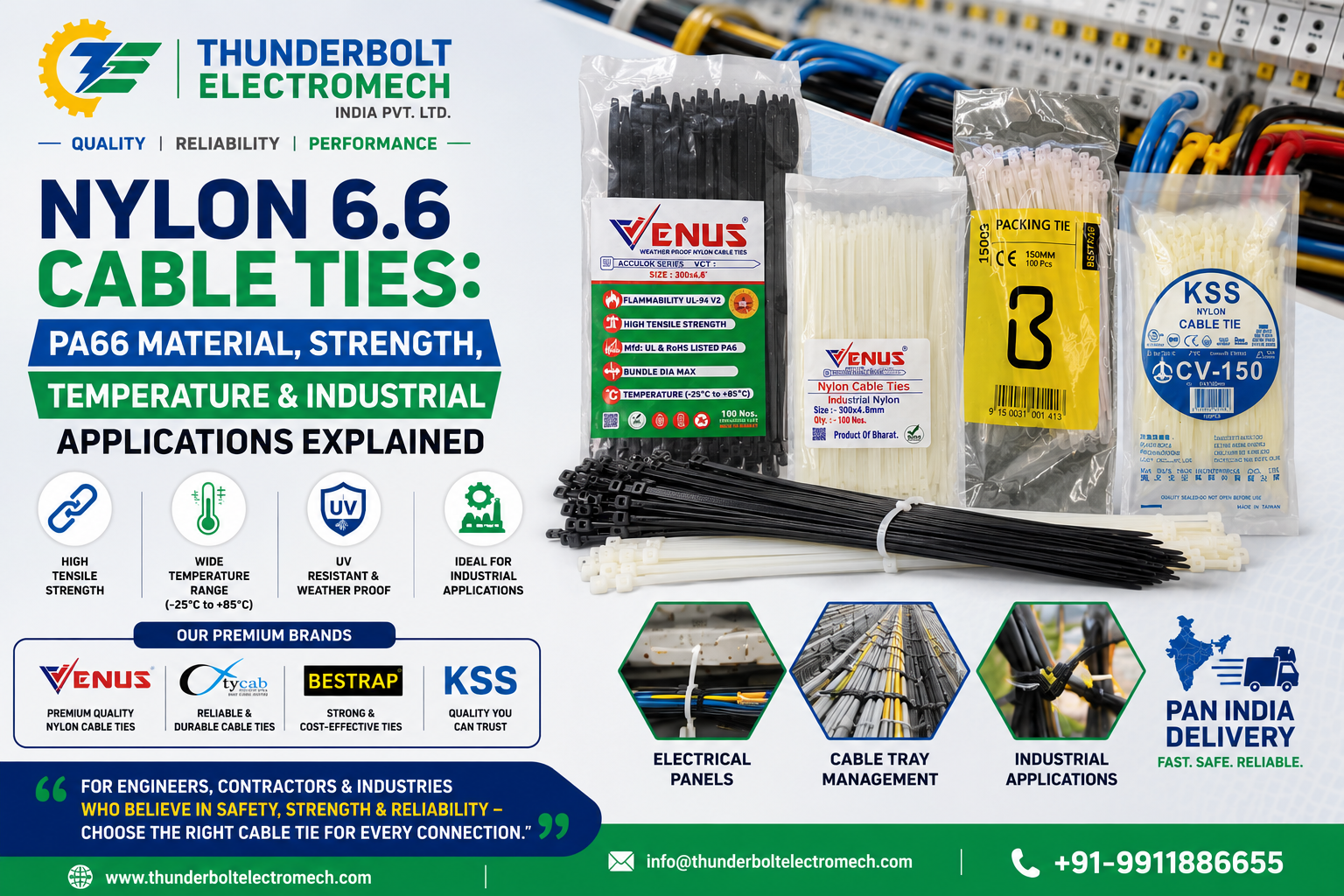
By Thunderbolt Electromech India Pvt. Ltd. — Delhi-based Distributor and Supplier of Venus, Tycab, Bestrap and KSS Cable Tie
📞 +91-9911886655 | ✉️ info@thunderboltelectromech.com | 🌐 thunderboltelectromech.com | 📍 Shop No. 3538, Sitaram Bazar Rd, Bazar Sirkiwalan, Chawri Bazar, Chandni Chowk, Delhi – 110006
Quick Answer: Nylon 6.6 (PA66) cable ties — sometimes searched simply as PA66 Cable Ties — are made from a semi-crystalline engineering thermoplastic that outperforms cheaper Nylon 6 (PA6) ties on nearly every spec that matters for industrial use — melting point (around 255-260°C versus roughly 220°C), tensile strength retention over time, and resistance to creep under sustained tension. Standard black, UV Resistant Nylon Cable Ties typically hold rated tensile strength from 8kg on small sizes up to well over 100kg on Heavy Duty Nylon Cable Ties, operate reliably across -40°C to +85°C, and are tested against UL 62275 or the older UL 62275/IEC 62275 standard where genuine compliance exists. Natural (white) ties suit indoor panels away from sunlight; black ties are carbon-black stabilized for outdoor and UV-exposed runs. If your installation involves heat, vibration, sustained load, or outdoor exposure, PA66 is the only Nylon Cable Tie Material worth specifying — Nylon 6 looks identical on the shelf but degrades faster under every one of those conditions.
Introduction
A cable tie is the cheapest component in most electrical installations and, quietly, one of the most consequential. It holds a wiring harness away from a hot busbar. It keeps control cables from chafing against a panel’s sharp edge for the next fifteen years. It bundles conductors inside a rooftop junction box that will bake at 60°C every summer afternoon in Delhi and then contract every winter night. When a tie fails, it rarely fails alone — a sagging harness touches a live terminal, a loose bundle abrades through insulation, and what should have cost a few rupees in ties turns into a shutdown.
Most buyers never ask what nylon grade they’re actually purchasing. They see “cable tie,” check the length, and order. This guide exists because the difference between Nylon 6 and Nylon 6.6 (PA66) — two materials that look and feel identical out of the packet — decides whether that tie is still holding its rated strength in year five or has quietly relaxed into a loose loop by year two. We’ll walk through PA66’s material chemistry, real tensile and temperature numbers, where black and natural ties genuinely differ, and how the four brands Thunderbolt Electromech India Pvt. Ltd. stocks — Venus, Tycab, Bestrap, and KSS — compare against each other for engineers, contractors, and purchase managers sourcing as a Cable Ties Supplier India relationship, not a one-time order. For buyers based in the capital specifically, this guide also covers what to look for from any Cable Tie Supplier Delhi teams shortlist, and why proximity to a genuine Nylon Cable Tie Supplier Delhi projects can reach same-day matters more than most procurement checklists admit.
Nylon 6.6 Cable Ties: What Is PA66 Material?
Understanding Nylon Cable Tie Material at the chemistry level is what separates a genuine engineering specification from a guess made off a packaging label.
The Polymer Behind the Product
PA66, chemically polyamide 6,6, is a semi-crystalline engineering thermoplastic produced from hexamethylenediamine and adipic acid — the “6,6” refers to the six carbon atoms each monomer contributes to the polymer chain. That symmetric, tightly-packed molecular structure is what gives PA66 its defining trait: a genuine, sharp melting point around 255-260°C, roughly 35-40°C higher than PA6’s melting point of about 220°C (Source: Manufyn, Nylon PA66 Material Guide — Direct source found).
Why the Molecular Structure Matters for a Cable Tie Specifically
A cable tie isn’t just holding a static shape — its locking head relies on the material staying dimensionally stiff under continuous tension for years. PA66’s tighter crystalline packing resists creep — the slow, permanent stretching of a polymer under sustained load — far better than PA6’s looser structure. Tycab’s own technical material puts this plainly: over years of service, Nylon 6 loses tensile strength progressively as its polymer chains relax, and moisture accelerates that relaxation, while Nylon 66’s tighter crystalline structure holds its day-one tensile strength close to what it delivers at year five (Source: Tycab, “Nylon 66 vs Nylon 6 Cable Ties” — Direct source found).
Moisture: PA66’s One Real Trade-Off
PA66 is hygroscopic — it absorbs atmospheric moisture, which acts almost like a built-in plasticiser. In continuous humidity above roughly 85% RH, PA66 can absorb close to 10% moisture by weight, and that absorption measurably reduces tensile strength — published industry data puts the reduction as high as 40% under sustained high-humidity exposure (Source: cxnyloncabletie.com, “How to Choose Durable Nylon Cable Ties for Industrial Wiring” — Direct source found). This matters directly for buyers in coastal India or humid industrial zones, and it’s a genuine engineering trade-off worth knowing rather than a marketing footnote — PA66 still outperforms PA6 under the same conditions, but “PA66 is always best regardless of humidity” isn’t quite accurate either.
How Strong Are Nylon 6.6 Cable Ties?
Getting Nylon Cable Tie Tensile Strength right on a purchase order is the single line item most likely to be under-specified without anyone noticing until a bundle fails.
Reading a Tensile Rating Correctly
The number printed on a cable tie’s packaging — say, 18kg, 40kg, or 120kg — is the minimum loop tensile strength measured under standardized laboratory conditions, typically at room temperature immediately after installation. Field performance runs lower. Real-world tests on nylon cable ties under vibration and elevated temperature — the conditions of an actual engine bay or plant floor rather than a lab bench — show holding power can run 30-40% below the packaging figure (Source: Zhejiang Tolerance Electrical Co., “How Nylon Cable Ties Achieve Tensile Strength” — Direct source found). This is precisely why specifying a tie rated comfortably above your actual bundle weight — not just barely sufficient — is standard engineering practice, not overcaution.
PA66 vs PA6, By the Numbers
Comparative material data puts PA66’s tensile strength around 150 MPa, against roughly 80 MPa for standard PA6 — nearly double (Source: Zhejiang Tolerance Electrical Co. — Direct source found). That gap explains why every serious specification — UL listings, IEC 62275, most OEM automotive and panel-building standards — is written around Nylon 66, not Nylon 6, whenever the tie is doing structural work rather than temporary bundling.
What Actually Determines the Rating on a Specific Tie
Tensile strength on a given cable tie size isn’t just “PA66 = strong.” It’s a function of:
- Cross-sectional width and thickness at the locking head, where failure actually initiates
- Tooth engagement design inside the locking mechanism — a sharper, deeper tooth resists back-slip under load better than a shallow one
- Barrel material consistency — batch-to-batch variation in unbranded stock often shows up as inconsistent tensile results across the same nominal size, which is a genuine, if underreported, quality-control problem in the lower end of the Indian market
Nylon Cable Tie Temperature Rating: What Engineers Should Know
The Two Numbers That Actually Matter
A cable tie’s temperature rating isn’t one figure — it’s a range, and the two ends behave completely differently:
Low-temperature limit (typically -40°C for genuine PA66): Below this point, PA66 becomes progressively more brittle, and installation itself — the act of pulling the tie tight — becomes the highest-risk moment, since a cold, brittle tie is far more likely to crack at the head during tensioning than during years of subsequent service.
High-temperature continuous service limit (typically 85°C for standard grades, up to 105-120°C for heat-stabilized formulations): Continuous exposure above the rated limit accelerates thermal oxidation of the polymer, gradually reducing tensile strength and flexibility even without any visible discoloration. Standard PA66’s continuous service ceiling sits around 120°C, with heat-stabilized grades pushing toward 150°C for specialized applications (Source: Manufyn, Nylon PA66 Material Guide — Direct source found).
Why This Matters More in India Than the Datasheet Suggests
Most cable tie datasheets quote a temperature range as if it’s a single steady-state condition. Indian industrial environments rarely offer that. A rooftop junction box in Delhi swings from near-freezing pre-dawn winter temperatures to surface temperatures well above 60°C under direct summer sun — a daily thermal cycle, not a fixed exposure. Repeated cycling stresses the polymer differently than constant heat does, through repeated expansion and contraction at the locking head. Buyers specifying ties for outdoor or rooftop panel work should treat the published temperature range as a boundary condition to stay well inside, not a target to design against.
PA66 vs Other Cable Tie Materials
PA66 vs PA6 (Nylon 6)
Covered above in detail — PA66 wins on tensile strength, thermal ceiling, moisture stability, and long-term creep resistance. PA6 wins on flexibility, impact resistance in cold conditions, and upfront cost.
PA66 vs PA12
PA12 resists moisture absorption far better than PA66 and holds up well in damp or intermittently wet conditions, making it a genuine alternative for coastal or high-humidity sites — but it typically costs more and isn’t the default choice for standard indoor/outdoor industrial panels where PA66’s cost-performance balance wins.
PA66 vs PA46
PA46 handles repeated thermal cycling with less fatigue cracking than PA66, which sounds attractive for the thermal-cycling scenario described above — but PA46 needs added UV stabilizers for outdoor use and remains a niche, higher-cost specification rather than a mainstream industrial cable tie material in the Indian market.
The Practical Takeaway
For the overwhelming majority of Indian industrial, electrical panel, and general wiring applications, PA66 remains the correct default — not because alternatives don’t exist, but because PA66 is the material every major standard (UL, IEC 62275) is written around, meaning compliant, well-documented stock is far easier to source and verify than niche alternatives.
Black vs Natural Nylon 6.6 Cable Ties
What “Black” Actually Means Chemically
Black cable ties aren’t PA66 with a different colourant sprayed on top. The black pigment is almost always carbon black, compounded directly into the resin before extrusion, and carbon black is one of the most effective UV stabilizers available for polymers — it physically absorbs and dissipates UV radiation before it can break the polymer’s molecular chains.
What Natural (White/Milky) Ties Are Actually For
Natural PA66 ties contain no UV stabilizer package. They’re intended for indoor use — inside control panels, junction boxes, and enclosures where sunlight never reaches them. Used outdoors, natural ties degrade visibly within months: UV radiation breaks down the polymer chains at the surface, and the tie becomes brittle and chalky before eventually cracking under normal tension.
The Mistake That Costs Plants Money Every Year
Sourcing teams frequently order natural ties for outdoor installations simply because they were cheaper per bundle at the time of purchase, without registering that the price difference reflects a missing UV-stabilizer package, not a lower-quality tie. The correct standard, worth stating plainly: any tie exposed to direct or indirect sunlight, even briefly during installation and commissioning, should be black, UV-resistant PA66 — never natural.
UV Resistance: When Should You Use Black Nylon Cable Ties?
Beyond the Obvious Outdoor Case
The obvious answer is “outdoors, always.” The less obvious cases where black, UV resistant nylon cable ties matter:
- Semi-outdoor enclosures — rooftop AC units, outdoor DBs with ventilation slats, and canopy-covered switchgear that still receives significant indirect UV through gaps and openings
- Indoor installations near large glazed windows or skylights — factory floors with extensive natural lighting can expose ties to meaningful UV dosage over years, even though the location is technically “indoor”
- Ties used during transport or staging — bundles of cable staged outdoors before installation, even for a few weeks, can begin UV degradation before the tie ever reaches its final indoor location
The Real Numbers Behind “UV Resistant”
Published comparative testing shows PA66 retaining roughly 92% of its original tensile strength after 1,000 hours of accelerated UV exposure, against PA6 degrading to around 78% under the same test (Source: Zhejiang Tolerance Electrical Co. — Direct source found). This is exactly the kind of number a purchase manager should ask a supplier to substantiate — a generic “UV resistant” label on unbranded packaging, without a stated test duration and retained-strength figure, is a claim without evidence behind it.
Nylon 6.6 Cable Ties for Electrical Wiring
Bundling Versus Structural Load-Bearing
Electrical Cable Ties do two distinct jobs, and specifying the same tie for both is a common, avoidable mistake:
Bundling — grouping multiple conductors together for organisation and identification, where tensile demand is low and appearance/cable management matters more.
Structural support — securing a cable to a fixed point, supporting cable weight along a vertical run, or anchoring a harness against vibration, where the tie is genuinely load-bearing and undersizing it creates real risk.
Fire and Flammability Considerations
Electrical panel work often calls for cable ties rated UL 94 V-2 or better on flammability — a self-extinguishing characteristic that matters directly inside enclosed panels where an electrical fault could otherwise ignite bundled insulation and any flammable material nearby, including the ties themselves. This is a specification worth confirming explicitly with any cable ties supplier India buyers work with, rather than assuming every PA66 tie automatically carries it.
Cable Ties for Electrical Wiring in Panel Rooms
Inside LT and HT panel rooms specifically, cable ties for electrical wiring should be sized generously against the bundle’s actual diameter — not the tightest fit available — because panel-room bundles are frequently added to or modified during commissioning and later maintenance, and an undersized tie leaves no working margin for that inevitable rework.
Nylon 6.6 Cable Ties for Industrial Applications
Industrial Cable Ties face a very different duty cycle than a residential or office cabling job, and the specification should reflect that difference rather than default to whatever’s cheapest per bag.
Heavy Machinery and Vibration Environments
Industrial cable ties securing wiring on or near moving machinery face continuous, cyclical mechanical stress that static panel installations never see. Heavy duty nylon cable ties, rated at 40kg tensile strength and above, with a wider cross-section at the locking head, resist the back-slip that lighter ties suffer under sustained vibration.
Outdoor Substations and Switchyards
Nylon cable tie temperature rating and UV resistance both matter simultaneously here — a substation tie faces full-sun exposure, wide seasonal temperature swings, and often direct rain, all at once. This is where black, heavy-duty PA66 ties with a genuine UL 62275 or IEC 62275 pedigree earn their premium over unbranded stock.
Cable Management in Server Rooms and Control Rooms
A different demand profile entirely — low mechanical load, but high cycle count, since server room and control panel cabling gets modified frequently. Here, releasable (reusable) PA66 ties often outperform standard one-time ties on total cost of ownership, even at a higher unit price, because they avoid the cut-and-replace cycle that standard ties require every time a rack gets reconfigured.
Standard vs Heavy-Duty Nylon Cable Ties
| Attribute | Standard Duty | Heavy Duty |
| Typical Tensile Strength | 8kg – 22kg | 40kg – 120kg+ |
| Typical Width | 2.5mm – 4.8mm | 7.2mm – 9mm |
| Best Application | Panel wiring, indoor bundling, control cabinets | Outdoor cable runs, machinery harnesses, structural anchoring |
| Locking Head Design | Standard single-tooth engagement | Reinforced, wider tooth engagement |
| Typical Material Grade | PA66, standard stabilization | PA66, often heat- and UV-stabilized |
How Cable Tie Length and Width Affect Performance
Length Is Not Just About Fitting Around the Bundle
A tie sized exactly to the bundle’s diameter, with minimal spare length past the locking head, offers less margin for future additions to that bundle — and re-tensioning an already-cut tie isn’t possible. Sizing with 15-20% additional length beyond the minimum needed keeps rework practical without needing a full re-tie.
Width Correlates Directly With Tensile Rating, Not Just Appearance
A wider tie isn’t simply a heavier-duty aesthetic choice — width directly increases the cross-sectional area resisting tension at the locking head, which is why heavy-duty ties are both wider and thicker, not just longer. Substituting a narrow tie doubled up in place of a single correctly-rated wide tie is a common field workaround that does not deliver equivalent tensile performance, since the failure point remains the locking head geometry, not the raw material volume.
Common Nylon 6.6 Cable Tie Selection Mistakes
Mistake 1 — Assuming all “nylon” cable ties are PA66.
Unbranded and budget stock frequently uses PA6 or blended regrind material without disclosing it, since “nylon cable tie” isn’t a protected or verified claim on generic packaging.
Mistake 2 — Using natural ties outdoors to save cost.
Covered in detail above — this is the single most common, most expensive-in-hindsight mistake in outdoor installations.
Mistake 3 — Ignoring the temperature swing, not just the peak.
A tie rated for 85°C continuous service can still underperform in an environment cycling repeatedly between temperature extremes, even if it never exceeds the rated ceiling.
Mistake 4 — Sizing for a tight fit with zero spare length.
Leaves no margin for bundle modifications and forces premature cut-and-replace during routine maintenance.
Mistake 5 — Buying on price per hundred pieces without checking tensile documentation.
The cheapest tie per unit is frequently the most expensive tie over a project’s life, once field failures, callbacks, and replacement labour are counted.
Mistake 6 — Overlooking UL 94 flammability rating inside enclosed panels.
A detail rarely checked at order time and occasionally flagged only during a safety audit, well after installation.
Venus vs Tycab vs Bestrap vs KSS Cable Ties
Venus Cable Ties — Quick Reference Chart
| Spec | Detail |
| Material | PA66, natural and black (UV-stabilized) |
| Tensile Range | Standard through heavy-duty sizes |
| Typical Use | General industrial, panel wiring, bundling |
| Positioning | Thunderbolt’s core stocked range and primary stockist line |
Tycab Cable Ties — Quick Reference Chart
| Spec | Detail |
| Material | PA66, UL-listed formulations available |
| Certification | UL Type 21/21S rated ranges, IEC 62275 aligned |
| Typical Use | Applications requiring documented compliance — OEM, export-linked, audited installations |
| Positioning | Specification-driven buyers who need traceable certification on file |
Bestrap Cable Ties — Quick Reference Chart
| Spec | Detail |
| Material | PA66, standard and heavy-duty ranges |
| Typical Use | Industrial bundling, general electrical wiring |
| Positioning | Reliable mid-market option for volume industrial orders |
KSS Cable Ties — Quick Reference Chart
| Spec | Detail |
| Material | PA66, wide size range including releasable/reusable ties |
| Typical Use | Panel building, server/control room cable management, general electrical |
| Positioning | Broad SKU range suited to mixed-application purchase orders |
Choosing Between Them
None of these four brands is objectively “best” across every job — the right call depends on whether the project needs documented UL/IEC certification on file (Tycab), broad everyday stock availability (Venus), volume-friendly pricing for standard industrial runs (Bestrap), or a wide SKU spread including releasable ties for control-room work (KSS). A Cable Ties Supplier India buyers can lean on for genuine guidance should be able to make that recommendation project-by-project, not push one brand regardless of the application.
Common Customer Problems and Solutions
Problem: “Our outdoor cable ties turned brittle and started snapping within a year.”
Almost always traces to natural (non-UV-stabilized) ties used outdoors, or budget black ties with an inadequate UV package. Switching to genuinely UV-stabilized black PA66 — verified against actual retained-strength data, not just the word “UV resistant” on the bag — resolves this.
Problem: “We keep buying ‘nylon cable ties’ but batches feel inconsistent — some snap much easier than others.”
This points to unverified material sourcing, likely mixed PA6/PA66 or regrind content varying batch to batch. Standardising on a documented brand — Venus, Tycab, Bestrap, or KSS — with consistent material sourcing removes this variability.
Problem: “Ties are loosening over time on our machinery harnesses, even though nothing looks broken.”
This is creep and vibration-induced back-slip, not visible failure. Moving to heavy-duty PA66 ties with reinforced tooth engagement, sized correctly for the bundle, addresses the mechanism rather than just replacing like-for-like.
Problem: “Our panel-room ties failed a flammability check during a safety audit.”
Standard commodity ties without a stated UL 94 rating are the usual cause. Specifying UL 94 V-2 rated ties specifically for enclosed panel applications going forward closes this compliance gap.
Comparison Table: Nylon 6.6 vs Nylon 6 Cable Ties
| Property | Nylon 6.6 (PA66) | Nylon 6 (PA6) |
| Melting Point | ~255-260°C | ~220°C |
| Approx. Tensile Strength | ~150 MPa | ~80 MPa |
| Moisture Absorption | ~1.5-2.8% (up to ~10% in extreme humidity) | ~2.5-3.5% |
| UV Retained Strength (1,000 hrs) | ~92% | ~78% |
| Long-Term Creep Resistance | Strong — holds rated strength over years | Weaker — degrades progressively |
| Typical Standard Compliance | UL 62275, IEC 62275 | Rarely specification-compliant |
| Best Fit | Structural, outdoor, long-term, compliance-driven installations | Short-term bundling, low-stress applications |
Real Use Cases
Use case 1 — A Delhi rooftop solar installation contractor.
A solar EPC contractor had standardised on the cheapest available black cable ties for module wiring runs, without verifying UV-stabilizer content. Within eighteen months, field inspections found ties across multiple rooftop sites had turned brittle and several had snapped, leaving DC cable runs unsecured against panel frames. Switching to genuinely UV-stabilized PA66 ties — verified against a supplier-provided retained-strength test result rather than packaging claims alone — eliminated recurring field snap reports across subsequent installations.
Use case 2 — An industrial panel-building workshop supplying export orders.
A panel builder supplying control panels to an export client needed documented UL compliance on every wiring component, including cable ties, for the client’s own audit trail. Switching the panel-wiring line from unbranded stock to Tycab’s UL Type 21/21S rated ties gave the workshop traceable certification to hand over with each shipment, resolving a compliance gap that had previously required manual justification during client audits.
How a Cable Ties Supplier India Helps With Industrial Selection
Sourcing cable ties as a genuine engineering decision — not a commodity purchase — is where a real Cable Ties Supplier India relationship pays for itself. The right supplier should be able to:
- Confirm actual PA66 material content and point to test documentation, not just the word “nylon” on the bag
- Recommend black vs natural correctly based on the installation’s actual UV exposure, not default to whichever is cheaper
- Match tensile rating to the bundle’s real weight and vibration exposure, not just its diameter
- Explain which brand in the range — Venus, Tycab, Bestrap, or KSS — fits a specific compliance or budget requirement
- Support local delivery across Delhi NCR fast enough that a site doesn’t substitute the wrong tie just because it’s what’s on hand
Cable Lugs: A Related Purchase Worth Planning For
Cable ties rarely travel alone on a purchase order — they’re almost always bought alongside cable lugs, since both sit at the termination and bundling stage of the same wiring job. Cable lugs in India are governed primarily by IS 8309 for aluminium tubular terminal ends and complementary standards for copper tubular lugs, covering crimping geometry, conductivity, and inspection-hole design for XLPE cable terminations (Source: IS 8309:1993, Bureau of Indian Standards — Direct source found). A growing share of the Indian market has also moved toward bimetallic lugs — friction-welded copper-to-aluminium construction — specifically to prevent galvanic corrosion at aluminium-to-copper busbar connections, a failure mode that shows up years after commissioning if the wrong lug type gets used at a mixed-metal joint.
For buyers planning ahead: as industrial cabling shifts toward higher-current XLPE and aluminium conductor runs across new commercial and infrastructure projects, demand for correctly-specified, IS 8309-compliant tubular lugs — paired with properly rated cable ties for the same harness — is a purchasing pattern worth locking into a single supplier relationship now, rather than sourcing lugs and ties from separate vendors who don’t cross-check compatibility.
FAQs
What is the difference between Nylon 6 and Nylon 6.6 cable ties?
Nylon 6.6 (PA66) has a higher melting point, roughly double the tensile strength, better long-term creep resistance, and better UV retention than Nylon 6 (PA6). PA6 costs less and offers slightly more flexibility, but it’s not the material specified in serious UL or IEC standards for structural cable tie applications.
Are black cable ties always UV resistant?
Not automatically. Black colour usually indicates carbon-black UV stabilization, but unbranded stock can be black-pigmented without a genuine UV-stabilizer package. This exact question shows up often in online electrical forums, where users report ties that were “black but still failed outdoors within a year” — the answer is almost always an inadequate or absent UV additive despite the colour.
Can I use natural (white) cable ties outdoors if I only need them for a short time?
It depends on the exposure duration and intensity, but the safer default is no — even short-term outdoor staging can begin UV degradation, and the cost difference between natural and black UV-stabilized ties is small enough that it rarely justifies the risk.
What temperature can nylon cable ties actually handle?
Standard PA66 cable ties typically operate from -40°C to +85°C continuously, with heat-stabilized grades extending toward 105-120°C for specialized high-heat applications like engine bays or near-transformer installations.
Do heavy-duty cable ties really make a difference, or is it just marketing?
The difference is measurable and real — heavy-duty ties have wider, thicker cross-sections at the locking head specifically, which directly increases the tensile load the tie can hold before the head fails, not just before the strap material itself breaks.
Why did my cable tie snap even though it wasn’t overloaded?
The most common causes, in order of frequency: UV degradation on a natural or poorly-stabilized tie used outdoors, a sharp edge on the mounting surface cutting into the strap over time, or genuine material inconsistency from unbranded stock — a question that surfaces regularly on electrical contractor forums and Q&A communities, usually traced back to one of these three causes rather than a manufacturing defect in a properly specified tie.
Is a more expensive cable tie always better?
Not necessarily — price differences often reflect genuine material and certification differences (documented PA66, UL/IEC compliance, verified UV stabilization), but they can also reflect brand premium alone. The way to tell the difference is asking for actual test documentation, not assuming price equals quality by default.
Why Choose Thunderbolt Electromech India Pvt. Ltd. is relevant
Thunderbolt Electromech India Pvt. Ltd. is a Delhi-based Cable Ties Supplier India engineers and purchase managers turn to for genuine PA66 stock across Venus, Tycab, Bestrap, and KSS ranges — with material and tensile documentation available on request for every brand and size, and same-day availability across Delhi NCR for urgent site requirements.
Visit or contact Thunderbolt Electromech India Pvt. Ltd.: 📍 Shop no. 3538, Sitaram Bazar Rd, Bazar Sirkiwalan, Chawri Bazar, Chandni Chowk, Delhi, 110006 📞 +91-9911886655 ✉️ info@thunderboltelectromech.com
Conclusion
Nylon 6.6 earns its place as the industrial default not because it’s the only nylon that exists, but because its molecular structure — tighter, more crystalline, more heat-resistant than PA6 — delivers the specific combination of tensile strength, creep resistance, and long-term stability that cable ties actually need in real installations. The material choice, the black-versus-natural decision, and the correct tensile and width specification for the actual load aren’t separate small decisions; they’re one engineering decision made properly or made carelessly. Thunderbolt Electromech India Pvt. Ltd. stocks genuine PA66 cable ties across Venus, Tycab, Bestrap, and KSS — matched to project requirements rather than sold as one-size-fits-all commodity stock — alongside IS 8309-compliant cable lugs for the same termination work. Call +91-9911886655 or write to info@thunderboltelectromech.com to get the right tie, in the right material, for the environment it actually has to survive.
[…] Guide to Sizes, Types, Materials, Strength & Industrial Buying, and the related deep dives on Nylon 6.6 (PA66) material properties and Cable Tie Tensile […]