By Thunderbolt Electromech India Pvt. Ltd. — Delhi-based Distributor and Supplier of Raychem, Vidyut and Crystal Electrical Hand Gloves
📞 +91-9911886655 | ✉️ info@thunderboltelectromech.com | 🌐 thunderboltelectromech.com | 📍 Shop No. 3538, Sitaram Bazar Rd, Bazar Sirkiwalan, Chawri Bazar, Chandni Chowk, Delhi – 110006
Quick Answer: Electrical safety gloves are insulating hand protection designed for work where electric shock is a risk. The correct glove is selected by the applicable standard, glove class, maximum working voltage, testing requirements, physical condition, fit and application. In India, IS 13774:2021 is identical to IEC 60903:2014, while ASTM D120 is a separate specification for rubber insulating gloves.
Introduction
A glove can look perfectly suitable for electrical work and still be the wrong glove for the job.
The problem is that buyers frequently start with the wrong question: “Which electrical glove should I buy?” The better question is: “What electrical hazard am I dealing with, which standard applies, and what class and rating does the task require?”
That distinction matters for electricians, maintenance teams, electrical contractors, utility personnel, plant engineers and purchase managers.
In India, IS 13774:2021 — Live Working Gloves of Insulating Material is the current Indian Standard identified by BIS. BIS states that the 2021 edition is identical to IEC 60903:2014, which covers electrical insulating gloves and mitts used to protect workers against electric shock. The BIS product manual also identifies insulating and composite glove types and Classes 00, 0, 1, 2, 3 and 4.
This guide therefore starts with the Indian/IEC framework and then explains where ASTM D120 fits.
The aim is simple: help you understand the classification, voltage terminology, testing and selection process before you purchase electrical hand gloves.
What Are Electrical Safety Gloves?
Electrical safety gloves are insulating gloves intended to provide electrical protection against electric shock. They are different from ordinary industrial hand gloves, cut-resistant gloves or general-purpose rubber gloves.
IEC 60903 specifically covers electrical insulating gloves and mitts. It also covers composite gloves, which incorporate additional mechanical protection.
That distinction is easy to miss.
A general rubber glove is not automatically an electrical insulating glove simply because rubber is an electrically resistant material. The glove must be designed, manufactured and tested for its intended electrical protection.
For an electrical worker, the selection therefore starts with the application rather than the appearance of the glove.
A proper electrical hand glove selection should consider:
- applicable standard
- glove class
- maximum working voltage
- AC/DC application where relevant
- required testing
- physical condition
- glove size
- length
- environmental properties
- mechanical protection requirements
BIS’s product manual for IS 13774:2021/IEC 60903:2014 identifies glove classes from 00 through 4, sizes from 7 through 12, and standard lengths including 280, 360, 410, 460 and 800 mm long configurations within its certification scope.
[INTERNAL LINK: Electrical Hand Gloves category]
Why Do Electrical Safety Gloves Have Different Classes?
The class tells you where the glove sits within the electrical protection system.
ASTM D120 explicitly defines six classes — 00, 0, 1, 2, 3 and 4 — with different electrical characteristics.
The Indian/IEC framework also identifies Classes 00, 0, 1, 2, 3 and 4 in the BIS certification scope for IS 13774:2021/IEC 60903:2014.
That does not mean that a buyer should simply pick the highest class available.
The glove needs to match the electrical task and the applicable requirements.
For example, a worker dealing with a low-voltage application does not select a glove simply because Class 4 sounds safer. The correct choice follows the electrical exposure, standard, work procedure and required protection.
This is also why online product descriptions need to be read carefully. Some supplier pages mix terms such as working voltage, proof-test voltage, withstand voltage and breakdown voltage without clearly defining which standard they are using.
Thunderbolt’s article should not make that mistake.
Electrical Safety Gloves: Classes and Voltage Ratings
The six commonly referenced classes are:
| Glove class | Maximum AC working voltage commonly specified | Maximum DC working voltage commonly specified |
| Class 00 | 500 V | 750 V |
| Class 0 | 1,000 V | 1,500 V |
| Class 1 | 7,500 V | 11,250 V |
| Class 2 | 17,000 V | 25,500 V |
| Class 3 | 26,500 V | 39,750 V |
| Class 4 | 36,000 V | 54,000 V |
These maximum-use figures are published in technical documentation for IEC 60903-type insulating gloves and are also reproduced by Indian electrical-safety suppliers.
Important: these figures should not be confused with the voltage used during a dielectric proof test. A proof-test voltage is deliberately higher than the glove’s maximum working voltage.
That is why a Class 0 glove, for example, should not be described simply as a “5,000 V glove” because a 5 kV figure can refer to a test value rather than the maximum working voltage.
For purchasing, always check the manufacturer’s technical documentation and the applicable standard.
Class 00 Electrical Gloves
Class 00 sits at the lower end of the six-class system.
Technical references for IEC 60903-type gloves identify Class 00 with a maximum working voltage of 500 V AC and 750 V DC.
That makes Class 00 relevant to lower-voltage electrical applications where the task and work procedure require insulating gloves.
Do not select Class 00 merely because the installation is labelled “low voltage.” The actual work exposure and applicable safety procedure still need to be established.
Class 0 Electrical Gloves
Class 0 is commonly specified up to 1,000 V AC and 1,500 V DC in IEC 60903-type technical documentation.
This class appears frequently in Indian electrical glove listings because it covers a range of low-voltage electrical maintenance applications.
For a buyer, the useful question is not:
“Is Class 0 popular?”
It is:
“Does the Class 0 glove’s certified rating match my actual application?”
Class 1 Electrical Gloves
Class 1 moves into a higher voltage category, with commonly published maximum working values of 7,500 V AC and 11,250 V DC.
This class is therefore not simply an upgraded version of a low-voltage glove. It is intended for a substantially different electrical exposure.
Where the work involves higher electrical energy, selection should be tied to the work method and risk assessment rather than voltage alone.
Class 2 Electrical Gloves
Class 2 is commonly specified up to 17,000 V AC and 25,500 V DC.
Class 2 products are widely associated with medium-voltage electrical work, substations and utility applications.
But the phrase “17 kV glove” can be misleading if it is used without context. The 17,000 V figure represents a maximum working-voltage value in the relevant classification. It does not mean the glove should be selected for every installation below 17 kV without considering the work procedure and applicable standard.
Class 3 Electrical Gloves
Class 3 is commonly specified up to 26,500 V AC and 39,750 V DC.
At this level, purchasing should be treated as a technical PPE decision rather than a simple product comparison.
The buyer should verify the standard, class, testing documentation, size, length, condition and application before placing an order.
Class 4 Electrical Gloves
Class 4 is the highest class in the six-class system and is commonly specified up to 36,000 V AC and 54,000 V DC.
A higher class does not automatically make a glove appropriate for every electrical task.
The glove still has to meet the requirements applicable to the job.
Electrical Safety Gloves: Indian BIS and IEC Standards
For Thunderbolt’s Indian audience, IS 13774:2021 / IEC 60903:2014 should be the main standards framework in this article.
BIS identifies IS 13774:2021 as “Live Working Gloves of Insulating Material (Second Revision).” BIS’s preview states that the Indian standard is identical to IEC 60903:2014 and was adopted to align with that IEC edition.
IEC describes IEC 60903:2014 as the standard for electrical insulating gloves used to protect workers against electric shock. It also covers composite gloves that include integrated mechanical protection.
This is the framework Indian buyers should understand first.
What does the BIS product manual cover?
The BIS product manual identifies the certification scope by:
- Type: insulating or composite
- Class: 00, 0, 1, 2, 3 or 4
- Size
- Standard length
- Lined or unlined construction
- Special categories/properties
The listed sizes include 7, 7.5, 8, 8.5, 9, 9.5, 10, 10.5, 11, 11.5 and 12, with other sizes possible by agreement between manufacturer and client.
That is useful for purchase departments because “Class 2” alone is not a complete specification.
Electrical Safety Gloves: How Does ASTM D120 Fit In?
ASTM D120 is important, but it should not replace the Indian/BIS framework in an India-focused article.
ASTM D120-22 is the Standard Specification for Rubber Insulating Gloves. It covers manufacturing and testing of rubber insulating gloves used to protect workers from electrical shock. It defines Type I and Type II gloves and six classes: 00, 0, 1, 2, 3 and 4.
ASTM D120 also specifies a range of tests, including AC proof, AC breakdown, moisture absorption/proof, DC proof, DC breakdown, ozone resistance, chemical tests, tensile strength, tear resistance and puncture resistance.
The important buyer lesson
Do not combine ASTM and IEC/BIS figures into one unlabeled table.
The class names are shared, but the standards are separate specifications.
For an Indian buyer, establish which standard the product is certified/tested against. Then compare the glove using that standard’s requirements.
That single habit prevents a lot of confusing product comparisons.
Electrical Safety Gloves: How Are They Tested?
Testing is where an electrical glove stops being merely a rubber product and becomes safety PPE with defined performance requirements.
BIS’s product manual for IS 13774:2021/IEC 60903:2014 provides a scheme of inspection and testing and identifies the testing equipment and sampling framework used for certification.
The relevant technical checks include electrical and physical characteristics.
Depending on the applicable standard and test requirement, these can include:
- visual examination
- dimensional checks
- thickness
- tensile strength
- elongation
- puncture resistance
- tension set
- dielectric testing
- ageing-related tests
- environmental or special-property tests
Older IEC technical material also identifies tensile strength, elongation, tension set and electrical proof/withstand testing among the requirements for insulating gloves.
ASTM D120 separately specifies electrical and mechanical tests including AC/DC proof and breakdown tests, ozone resistance, chemical testing, tensile strength, tear resistance and puncture resistance.
The takeaway is simple:
Electrical glove testing is not one single test.
Proof-Test Voltage Is Not the Same as Working Voltage
This is one of the most important points for buyers.
Suppose a product description says:
Proof test: 5,000 V
That does not mean:
Maximum working voltage: 5,000 V.
For IEC 60903-type classification, Class 0 is commonly listed with a 1,000 V AC maximum working voltage, while 5,000 V appears as a proof-test value in technical glove documentation.
The two numbers have different purposes.
Maximum working voltage
This tells you the maximum electrical operating level associated with the glove class under the applicable specification.
Proof-test voltage
This is the voltage applied during a specified electrical test to verify insulation performance.
Breakdown voltage
This refers to the voltage level associated with electrical failure during a breakdown test. It should not be treated as the recommended working voltage.
A good purchasing specification should therefore state the class and applicable working rating, not simply advertise the largest voltage number appearing on a product sheet.
What Is the Difference Between Insulating and Composite Gloves?
IEC 60903 distinguishes between electrical insulating gloves and composite gloves.
An insulating glove provides electrical protection. A composite glove incorporates additional mechanical protection.
This matters because electrical work can involve hazards beyond electric shock.
A glove may need to deal with:
- abrasion
- puncture
- cuts
- chemicals
- ozone
- temperature
- mechanical contact
The exact requirements depend on the product category and applicable standard.
BIS’s IS 13774 product manual also identifies special categories and composite/insulating types within its certification scope.
For conventional insulating gloves that do not provide the required mechanical protection, a suitable protector glove may be required according to the applicable work practice and risk assessment. IEC-related documentation specifically describes insulating gloves that are normally used with leather protector gloves for mechanical protection.
How Should You Choose the Right Electrical Safety Gloves?
The selection process should follow a fixed sequence.
1. Identify the electrical application
Start with the actual work.
Is the worker performing electrical maintenance, panel work, testing, utility work, line work or another task?
Don’t begin with the catalogue.
2. Establish the electrical exposure
Determine the relevant system voltage and the work exposure.
A nominal equipment voltage alone does not replace the site’s electrical safety procedure.
3. Identify the applicable standard
For an Indian application, check whether the glove is specified/certified to IS 13774:2021 / IEC 60903:2014 or another standard required by the purchaser or application.
4. Select the class
Once the applicable framework and electrical exposure are known, select the appropriate glove class.
5. Check testing information
Ask for the relevant manufacturer’s documentation, certification and test information where required.
6. Check physical condition
A correctly classified glove is not acceptable simply because its label is correct.
Inspect the actual glove.
7. Check size and length
BIS’s product manual identifies multiple glove sizes and standard lengths under the IS 13774 certification scope.
Fit affects practical use. A glove that is technically correct but poorly sized is not a good purchasing decision.
8. Check additional hazards
If the work includes mechanical, chemical, ozone or temperature hazards, check whether the glove’s category or construction addresses them.
9. Check the product documentation
Don’t buy from a listing that only says:
“Shockproof.”
Ask for the technical specification.
Electrical Safety Gloves: Common Customer Problems and Solutions
| Customer problem | Better approach |
| Buyer selects a glove only by price | Compare standard, class, rating and documentation first |
| Product says “5 kV glove” without explaining the figure | Ask whether 5 kV is working, proof-test or breakdown voltage |
| Buyer confuses rubber gloves with insulating gloves | Verify the applicable electrical standard |
| Class is missing from the quotation | Request the exact class |
| Buyer chooses only by equipment voltage | Review the complete electrical work procedure |
| Glove size is ignored | Confirm hand size and available glove sizes |
| Mechanical hazards are ignored | Check whether a composite glove or protector is required |
| No test/certification information is available | Request relevant technical documentation |
| ASTM and IEC figures are mixed | Keep each standard’s data separately labelled |
This is where a knowledgeable Electrical Safety Gloves Supplier should add value. A supplier should help the buyer understand the specification rather than simply quote a price.
Electrical Safety Gloves: Comparison of the Main Selection Factors
| Selection factor | Why it matters | What buyer should ask |
| Standard | Defines applicable requirements | Which standard applies? |
| Class | Defines electrical classification | What class is required? |
| Working voltage | Determines electrical application | What is the maximum applicable working voltage? |
| Test voltage | Verifies insulation during testing | What test requirement applies? |
| Glove material | Affects insulation and physical properties | What material is specified? |
| Size | Affects fit and usability | Which sizes are available? |
| Length | Determines coverage | What length is supplied? |
| Mechanical protection | Addresses non-electrical hazards | Is a protector or composite construction required? |
| Special properties | Addresses environmental exposure | Is resistance to oil, acid, ozone or cold required? |
| Documentation | Supports purchasing verification | Is test/certification information available? |
Real Use Cases: How the Selection Logic Works
Use Case 1: Low-voltage electrical maintenance
A maintenance team working on a low-voltage installation should not select gloves simply because the product title contains “electrical.”
The team should establish the work voltage, applicable standard, required class and site procedure.
For example, Class 00 and Class 0 occupy the lower end of the six-class system, with commonly published maximum AC working values of 500 V and 1,000 V respectively.
The exact product still needs to be checked against its documentation.
Use Case 2: 11 kV electrical work
An 11 kV application requires much more careful selection than simply searching:
“11 kV electrical gloves.”
The buyer should determine the applicable class and standard.
Class 1 is commonly specified up to 7.5 kV AC, while Class 2 is commonly specified up to 17 kV AC.
That comparison illustrates why the class must be checked against the actual electrical exposure.
Use Case 3: Substation maintenance
Substation work can involve electrical, mechanical and environmental hazards.
The purchasing decision therefore needs more than a voltage number.
The buyer should evaluate:
electrical class + standard + testing + mechanical protection + environmental requirements + work procedure.
IEC 60903 specifically recognizes composite gloves where electrical and mechanical protection are combined.
What Should a Buyer Ask an Electrical Gloves Supplier?
Before placing an order, ask the supplier for the exact specification.
A useful enquiry should include:
Glove type: Electrical insulating/composite
Class: Required class
Standard: Applicable standard
Maximum working voltage: Required value
AC/DC: As applicable
Size: Required size
Length: Required length
Special properties: If applicable
Testing/certification: Required documentation
This is much better than sending:
“Please quote electrical gloves.”
A precise enquiry also makes supplier comparison easier.
Electrical Safety Gloves Supplier India: What Should You Check?
When comparing an Electrical Safety Gloves Supplier India, don’t judge the supplier only by catalogue size or advertised price.
Look at whether the supplier can provide the information needed to make a technically correct purchase.
A useful supplier should be able to identify:
- available classes
- relevant standards
- product specifications
- sizes
- lengths
- applicable testing information
- brand/manufacturer
- delivery availability
- product documentation
For a national buyer, delivery capability matters too. But delivery should come after specification.
The cheapest glove is not automatically the lowest-cost solution if the wrong class or specification results in a rejected purchase.
Electrical Hand Gloves Supplier India: How Thunderbolt Fits the Buying Process
Thunderbolt Electromech India Pvt. Ltd. is a Delhi-based supplier of electrical safety equipment and electrical hand gloves.
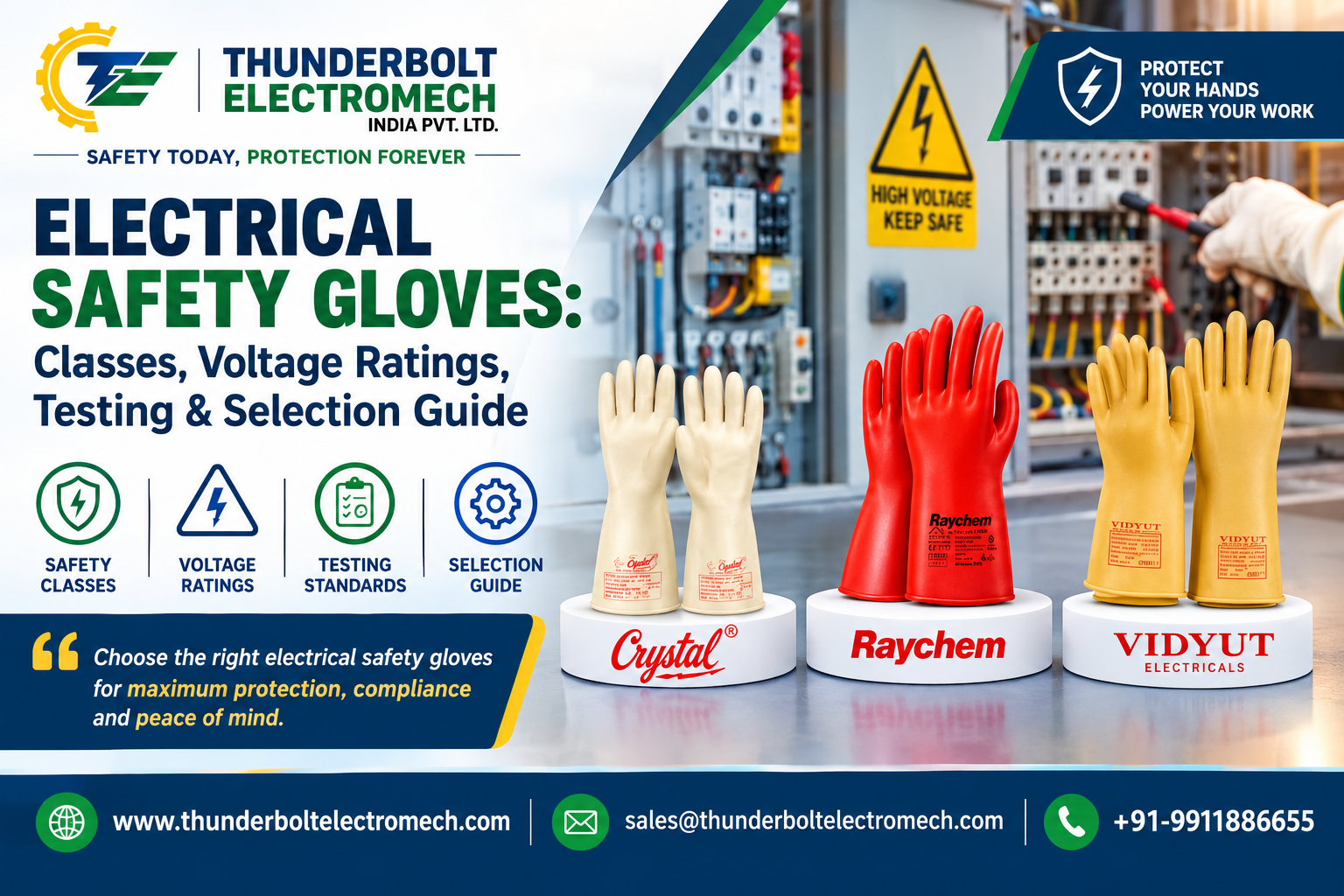
Thunderbolt’s electrical hand-glove range includes Raychem, Vidyut and Crystal electrical hand gloves, according to the product information provided for this content cluster.
For a purchase enquiry, the buyer should specify the required class, voltage application, size and applicable standard rather than asking only for “electrical gloves.”
The commercial purpose of this cluster article is not to replace the pillar page. Its job is to educate the buyer first.
Once the reader understands the technical selection process, the pillar can handle the broader supplier and buying journey.
Electrical Hand Gloves Supplier Delhi: What Local Buyers Should Ask
For Delhi buyers, proximity can make communication and dispatch easier, but local availability should not replace technical verification.
If you are searching for an Electrical Hand Gloves Supplier Delhi, ask the same questions you would ask a national supplier:
- Which class is available?
- Which standard applies?
- What is the maximum working voltage?
- What sizes are available?
- What glove length is available?
- What testing information is supplied?
- Is the required quantity available?
- Can the supplier support repeat industrial orders?
This makes Electrical Hand Gloves Supplier Delhi a commercial search term, while the technical content remains useful to the reader regardless of location.
Electrical Hand Gloves Supplier Delhi NCR: What Industrial Buyers Should Check
A Delhi NCR purchase may involve factories, contractors, infrastructure companies, utilities, panel builders or maintenance departments.
Those buyers should not assume that one glove specification fits every job.
A contractor working on a low-voltage panel and a team working around higher-voltage equipment can have completely different PPE requirements.
Therefore, an Electrical Hand Gloves Supplier Delhi NCR should be evaluated on specification support as well as availability.
Electrical Safety Hand Gloves: Buying Checklist
Before approving the purchase order, check:
- Class
- Applicable standard
- Maximum working voltage
- AC/DC requirement
- Size
- Length
- Material
- Special category/properties
- Testing information
- Manufacturer/brand
- Quantity
- Packaging
- Documentation
A purchase order that contains these details is much stronger than one that simply says:
“Electrical safety gloves — 20 pairs.”
Frequently Asked Questions
1. Are electrical safety gloves the same as ordinary rubber gloves?
No. Electrical insulating gloves are specifically covered by standards such as IEC 60903 and IS 13774 for electrical protection. A general-purpose rubber glove should not automatically be treated as electrical PPE.
2. What are Class 00, 0, 1, 2, 3 and 4 gloves?
They are six electrical glove classes identified in the IEC/BIS certification framework and ASTM D120. Each class has different electrical characteristics and maximum-use values.
3. What is the maximum AC working voltage for Class 0?
IEC 60903-type technical references commonly identify Class 0 with a maximum working voltage of 1,000 V AC.
4. What is the maximum AC working voltage for Class 2?
Class 2 is commonly specified at 17,000 V AC maximum working voltage in IEC 60903-type technical documentation.
5. Is proof-test voltage the same as working voltage?
No. A proof-test voltage is a test value and should not be treated as the glove’s permitted working voltage.
6. What standard should Indian buyers look for?
For the Indian framework, IS 13774:2021 / IEC 60903:2014 is the key standard for live-working gloves of insulating material. BIS states that IS 13774:2021 is identical to IEC 60903:2014.
7. What is ASTM D120?
ASTM D120 is a specification for rubber insulating gloves. It defines six classes — 00, 0, 1, 2, 3 and 4 — and includes electrical and physical testing requirements.
8. Do electrical gloves require testing?
Electrical insulating gloves are subject to specified testing under the applicable standard. BIS’s product manual for IS 13774:2021/IEC 60903:2014 provides inspection and testing requirements for certification.
9. Should I select an electrical glove only by voltage?
No. Voltage is one major selection factor, but the buyer should also consider the applicable standard, glove class, testing, physical condition, size, length, environmental properties and mechanical protection requirements.
10. Do electrical gloves provide mechanical protection?
Not every insulating glove does. IEC 60903 distinguishes ordinary insulating gloves from composite gloves that include integrated mechanical protection.
11. Where can I buy electrical hand gloves in India?
Buy from a supplier that can clearly provide the glove class, applicable standard, working-voltage information, size, product documentation and required quantity. For Thunderbolt’s commercial supplier information, see the Electrical Hand Gloves Supplier pillar page.
Conclusion
Choosing electrical safety gloves should start with the standard and application, not the product photograph or price.
For Indian buyers, IS 13774:2021 / IEC 60903:2014 should be the primary technical framework. ASTM D120 is useful when the product or purchasing specification is based on the ASTM system. Keep the two standards clearly separated when comparing classes, tests and voltage values.
Then follow the selection chain:
Application → applicable standard → glove class → working voltage → testing → physical condition → size/length → additional protection.
That sequence gives purchase teams, contractors and electrical professionals a much better basis for selecting electrical hand gloves.
If you are buying for an industrial project, don’t send only the words “Electrical Hand Gloves Supplier in India” Specify the class, standard, voltage application, size, quantity and documentation required. That small change makes the quotation process more precise and reduces the chance of receiving a product that does not match the job.