By Thunderbolt Electromech India Pvt. Ltd. — Delhi-based Danger Plate Supplier & Danger Plate of Powder Coated, Aluminium & Sticker Danger Plates
📞 +91-9911886655 | ✉️ info@thunderboltelectromech.com | 🌐 thunderboltelectromech.com | 📍 Shop No. 3538, Sitaram Bazar Rd, Bazar Sirkiwalan, Chawri Bazar, Chandni Chowk, Delhi – 110006
Quick Answer: IS 2551 is India’s governing standard for danger notice plates, but it’s worth knowing this plainly: it’s a “First Revision” dated 1982, and it hasn’t been formally updated since. It specifies material (1.6mm mild steel, vitreous enamelled), the skull-and-crossbones symbol, red lettering, and text in Hindi or English plus a named regional language. What most buyers never learn is that the standard’s own text only ever formalized requirements for rigid plates — sticker-format notices were flagged as “under consideration” in 1982 and were never separately standardized. A genuine Danger Plate Supplier should know this history, not just the dimensions.
Introduction
Most articles about IS 2551 read like a spec sheet — dimensions, symbol, colour, done. That’s useful, but it skips the more interesting question: where did this standard actually come from, has it kept pace with how signage has evolved everywhere else, and does every product sold as a “danger plate” today actually sit inside what the standard formally covers?
This guide goes into that history and those gaps directly, because they matter for a genuinely informed buying decision. Thunderbolt’s pillar guide already walks through sizing, material comparison, and a step-by-step buying checklist in detail — worth reading first if you haven’t. This piece goes narrower: the standard’s regulatory lineage, what it does and doesn’t formally cover, and what’s changed in signage practice globally that IS 2551’s text has not.
The Standard’s Actual History: Older Than Most Buyers Assume
IS 2551 traces back to 1963, when it was originally prepared to standardise the Hindi-language version of danger notices under the rules then in force. The version still governing Indian installations today is officially titled “Danger Notice Plates (First Revision),” issued to align with Indian Electricity Rule 35 as it stood at the time — dated 1982 (Source: Bureau of Indian Standards, IS 2551-1982, full text via archive.org — Direct source found).
That’s the detail worth sitting with: the core standard behind every danger plate installed in India today is over four decades old, and it has not undergone a further formal revision since. Compare that to how safety signage standards have evolved elsewhere — the international ISO 3864 series and the American ANSI Z535 series have both seen multiple revisions in the same period, incorporating updated research on sign visibility, colour psychology, and material durability. IS 2551 has not followed the same revision cadence.
This isn’t necessarily a defect — a lot of the underlying physics of a warning symbol hasn’t changed since 1982. But it does mean buyers relying on the standard for guidance on anything beyond its original 1982 scope — newer reflective materials, photoluminescent options, digital or QR-linked signage — are relying on a document that was never written with those options in mind.
What IS 2551 Formally Requires
Material and construction. The standard specifies 1.6mm thick mild steel, vitreous enamelled, with the danger symbol and lettering rendered in red (Source: Sun-Signs, danger signage technical reference, cross-checked against IS 2551 primary text scope — Direct source found).
The skull-and-crossbones symbol, positioned and proportioned per the standard’s own layout diagrams — the one element designed to communicate the hazard regardless of a reader’s literacy or language.
Text content: the word “danger” rendered in Hindi or English, centred and uniformly lettered, alongside a recommended regional-language equivalent.
Marking for traceability: manufacturer identification and the standards mark, positioned so as not to interfere with the primary warning message.
The Regional Languages IS 2551 Actually Names
Most content covering this standard says vaguely “local language required” without ever stating which ones. The standard’s own Appendix B recommends specific equivalents to the word “Danger” across seven regional languages: Punjabi, Urdu, Marathi, Tamil, Malayalam, Bengali, and Oriya (Source: IS 2551-1982, Appendix B, full text via archive.org — Direct source found). The standard’s own drafting note adds that equivalents in other regional languages were, at the time, still under consideration for future inclusion.
Why this matters practically for a multi-state buyer: if your installation sits in a state whose language isn’t among these seven — Kannada, Telugu, Gujarati, or several others — the standard itself doesn’t hand you an official equivalent term. In practice, suppliers and installers source a locally verified translation and apply it consistently, since the underlying regulatory intent (a hazard warning understood by the people actually present at the site) clearly extends beyond the seven languages the 1982 text happened to list.
The Regulatory Gap Almost Nobody Talks About: Plates vs. Stickers
This is the single most important, least-discussed finding in IS 2551’s own text, and it directly affects any buyer considering a sticker-format danger notice.
The standard’s own scope clause states plainly: “This standard for the time being includes the requirements of danger notice in the form of plates only.” It goes on to acknowledge that sticker-format danger notices were already “in vogue” in some states at the time of the 1982 revision, and that “requirements of such danger notices in a form other than plates are under consideration for standardization” (Source: IS 2551-1982, Clause 0.5, full text via archive.org — Direct source found).
That consideration, as far as the standard’s own published text shows, was never formally completed. IS 2551 — the actual document Indian electrical safety compliance points back to — has never carried a separate, formally standardized specification for sticker-format danger notices, even though stickers have been sold, installed, and generally accepted in practice across the country for decades.
What this means practically, stated carefully: danger stickers remain widely used, widely accepted by inspectors in day-to-day practice, and a legitimate secondary or supplementary marking tool — Thunderbolt sells them for exactly that reason. But a buyer treating a sticker as formally interchangeable with a rigid plate for the primary, standalone statutory notice on a high-voltage installation is relying on decades of accepted practice, not on an explicit clause inside IS 2551 itself. Where the primary, standalone statutory notice is in question — particularly on HT installations most likely to draw an Electrical Inspector’s direct scrutiny — a rigid plate remains the form the standard’s own text unambiguously covers.
Has Global Signage Practice Moved Past What IS 2551 Specifies?
Genuinely, in some respects, yes — and it’s worth knowing what’s changed elsewhere even if Indian regulation hasn’t formally adopted it.
Photoluminescent and reflective materials have become standard in many international safety signage frameworks for low-light and emergency visibility, letting a warning remain legible during a power outage or in poorly lit plant areas — a scenario IS 2551’s vitreous-enamel specification, written in 1982, doesn’t address at all, since it predates the material’s widespread industrial signage use.
International standards bodies have iterated repeatedly on sign design research — how colour, symbol proportion, and viewing distance interact — through multiple revisions of frameworks like ANSI Z535 and ISO 3864 since the early 1990s. IS 2551 has not undergone a parallel formal update process in that time.
None of this means IS 2551 is unsafe or non-functional — the skull-and-crossbones symbol still communicates instantly, and mild steel vitreous enamel remains a genuinely durable material choice, as Thunderbolt’s own guide on how long danger plates actually last covers in detail. It does mean that buyers with genuinely demanding visibility requirements — low-light substations, emergency-egress-adjacent installations — should treat IS 2551 compliance as the regulatory floor, and consider supplementary reflective or photoluminescent signage as an enhancement where the installation’s actual risk profile calls for it, rather than assuming the 1982 baseline represents current best practice in every respect.
From IE Rule 35 to CEA Regulation 20: The Legal Requirement Behind the Standard
IS 2551 is a technical specification — it describes what a compliant plate looks like. The legal obligation to actually install one comes from a separate source: originally the Indian Electricity Rules, 1956 (specifically Rule 35), and today carried forward under Regulation 20 of the Central Electricity Authority’s (Measures Relating to Safety and Electric Supply) Regulations, 2023, which requires a permanent danger notice on any installation exceeding 250V.
The relationship between the two is worth understanding clearly: the regulation creates the legal duty to display a notice; IS 2551 defines what that notice must physically look like to satisfy the duty. A plate that satisfies IS 2551’s dimensional and symbol requirements but is installed somewhere the regulation doesn’t actually require one adds nothing legally, and a site that skips the plate entirely is in breach of the regulation regardless of how good the specification document looks on paper.
Comparison Table: What IS 2551 Explicitly Covers vs. What It Doesn’t
| Element | Covered by IS 2551’s Own Text | Status |
| Rigid plate dimensions and material | Yes | Explicitly specified (1.6mm MS, vitreous enamel) |
| Skull-and-crossbones symbol layout | Yes | Explicitly specified with layout diagrams |
| Hindi/English + 7 named regional languages | Yes | Explicitly named in Appendix B |
| Sticker-format notices | No | Acknowledged as “in vogue,” formal requirements never completed |
| Photoluminescent/reflective materials | No | Not addressed — postdates the 1982 text |
| Digital or QR-linked signage | No | Not addressed — postdates the 1982 text |
| Legal obligation to display a notice at all | No | Governed separately, currently under CEA Regulation 20 (2023) |
Why Manufacturer Marking Matters More Than It Looks
IS 2551 requires manufacturer identification and the standards mark to appear on every compliant plate, positioned so it doesn’t interfere with the primary danger message. This isn’t a branding courtesy — it’s a traceability mechanism. If a plate degrades prematurely, cracks, or is later found not to match its claimed specification, the marking is what allows an inspector, or the buyer themselves, to trace it back to a specific manufacturer and batch. A plate with no visible marking at all offers no such trail, which is exactly the gap that shows up when a buyer tries to raise a quality complaint months after installation and has no way to prove which supplier actually produced the plate in question.
Common Design and Compliance Mistakes
Mistake 1 — Assuming a sticker satisfies the same statutory role as a rigid plate.
As covered at length above, this is a genuine grey area in the standard’s own text, not a settled equivalence.
Mistake 2 — Defaulting to Hindi/English only, without checking the local regional requirement.
Even where the specific state’s language isn’t among IS 2551’s seven named examples, a verified local translation should still be applied.
Mistake 3 — Treating a faded or missing manufacturer mark as a cosmetic issue.
It’s a traceability failure that becomes a real problem the moment a quality or compliance question is raised after installation.
Mistake 4 — Assuming the 1982 baseline is automatically “best practice” rather than a compliance floor.
For higher-risk or low-visibility installations, supplementary reflective or photoluminescent signage is worth genuine consideration even though the base standard doesn’t require it.
Mistake 5 — Confusing the technical specification (IS 2551) with the legal obligation to install a notice at all (currently CEA Regulation 20).
Both matter, but they answer different questions — one tells you what to install, the other tells you that you must.
Real Use Case: A Delhi NCR EPC Contractor’s Sticker-vs-Plate Discovery
An EPC contractor commissioning a series of 11kV substations across Delhi NCR had, for several projects, used adhesive danger stickers as the primary and only warning notice on each HT switchgear enclosure, treating them as functionally identical to a rigid plate since both carried the same skull-and-crossbones symbol and voltage marking. During a pre-energisation inspection on one site, the Electrical Inspector raised a direct question about whether the sticker satisfied the intent of the statutory notice requirement, given its adhesive, non-rigid construction.
Rather than contest the point, the contractor reviewed IS 2551’s own scope language directly and found the standard had never formally extended its specification to sticker-format notices. Switching the primary notice on every HT enclosure across the project to a rigid, IS 2551-specified plate — while retaining stickers as supplementary labelling inside panel compartments — resolved the inspector’s concern immediately and avoided a repeat query at the remaining sites still awaiting inspection. The contractor updated its internal specification template so that future HT commissioning work defaults to rigid plates for the primary notice as standard practice, rather than leaving the choice to whichever stock happened to be on hand.
Comparison Table: Rigid Plate vs Sticker for the Primary Statutory Notice
| Consideration | Rigid Plate (IS 2551 Specified) | Adhesive Sticker |
| Explicitly covered by IS 2551’s text | Yes | No — acknowledged but never formally standardized |
| Suitable as primary statutory notice on HT equipment | Yes, unambiguously | Widely accepted in practice, but not explicitly codified |
| Durability under repeated handling/weather | High — rigid construction, vitreous enamel or powder coat | Lower — adhesive edges degrade under UV and moisture over time |
| Best role | Primary, standalone statutory notice | Supplementary labelling, secondary or internal marking |
| Cost | Higher per unit | Lower per unit |
Common Customer Problems and Solutions
Problem: “We were told our danger stickers aren’t ‘IS 2551 compliant’ during an audit — is that accurate?”
Technically, this is a fair challenge to raise, since IS 2551’s own text never completed formal standardization for sticker-format notices. For a primary statutory notice — particularly on HT equipment — switching the main notice to a rigid, IS 2551-specified plate resolves the ambiguity outright, while stickers remain useful as supplementary or secondary-location marking.
Problem: “Our plant sits in a state whose language isn’t one of the seven named in IS 2551 — what should our plate say?”
Source a verified local-language translation of “danger” for that region and apply it consistently across your signage, since the regulatory intent — a warning understood by the people present — clearly extends beyond the specific seven languages the 1982 appendix happened to list.
Problem: “We want better visibility for our substation in low-light conditions — does IS 2551 cover reflective signage?”
No — this postdates the standard’s scope entirely. Treat IS 2551’s plate as your compliance baseline, and add photoluminescent or reflective supplementary signage as a genuine safety enhancement where low-light visibility is a real operational concern.
Problem: “Is our danger plate’s design outdated just because the standard is from 1982?”
Not necessarily — the core symbol and material choice remain functional and widely accepted. The more useful question is whether your specific installation’s risk profile (visibility conditions, inspection frequency, audience literacy) calls for anything beyond the 1982 baseline, not whether the baseline itself has expired.
Danger Plate Supplier — What This History Means for Your Next Order
A genuine Danger Plate Supplier should be able to speak to this history directly, not just recite dimensions. Practically, that means being able to explain why a rigid plate remains the safer default for a primary statutory notice, confirming which of the seven named regional languages (or a verified local equivalent) applies to your specific site, and being upfront that reflective or photoluminescent options sit outside IS 2551’s original scope rather than presenting them as if the standard already covers everything sold under its name.
A short procurement checklist worth applying to any order citing danger plate design as per IS 2551: confirm the product is a rigid plate, not a sticker, for any primary HT or LT statutory notice; confirm material thickness (1.6mm) and finish (vitreous enamel or equivalent powder coat) are stated explicitly, not just implied; confirm the regional language is either one of the standard’s seven named examples or a separately verified local translation; and confirm manufacturer marking is visibly present on the specific batch being supplied, not just shown in a catalogue image. Buyers researching danger notice plate compliance India as a general search term are usually trying to answer exactly these four questions, whether or not they’re phrased this precisely at the point of search.
Why Thunderbolt for IS 2551-Compliant Danger Plates
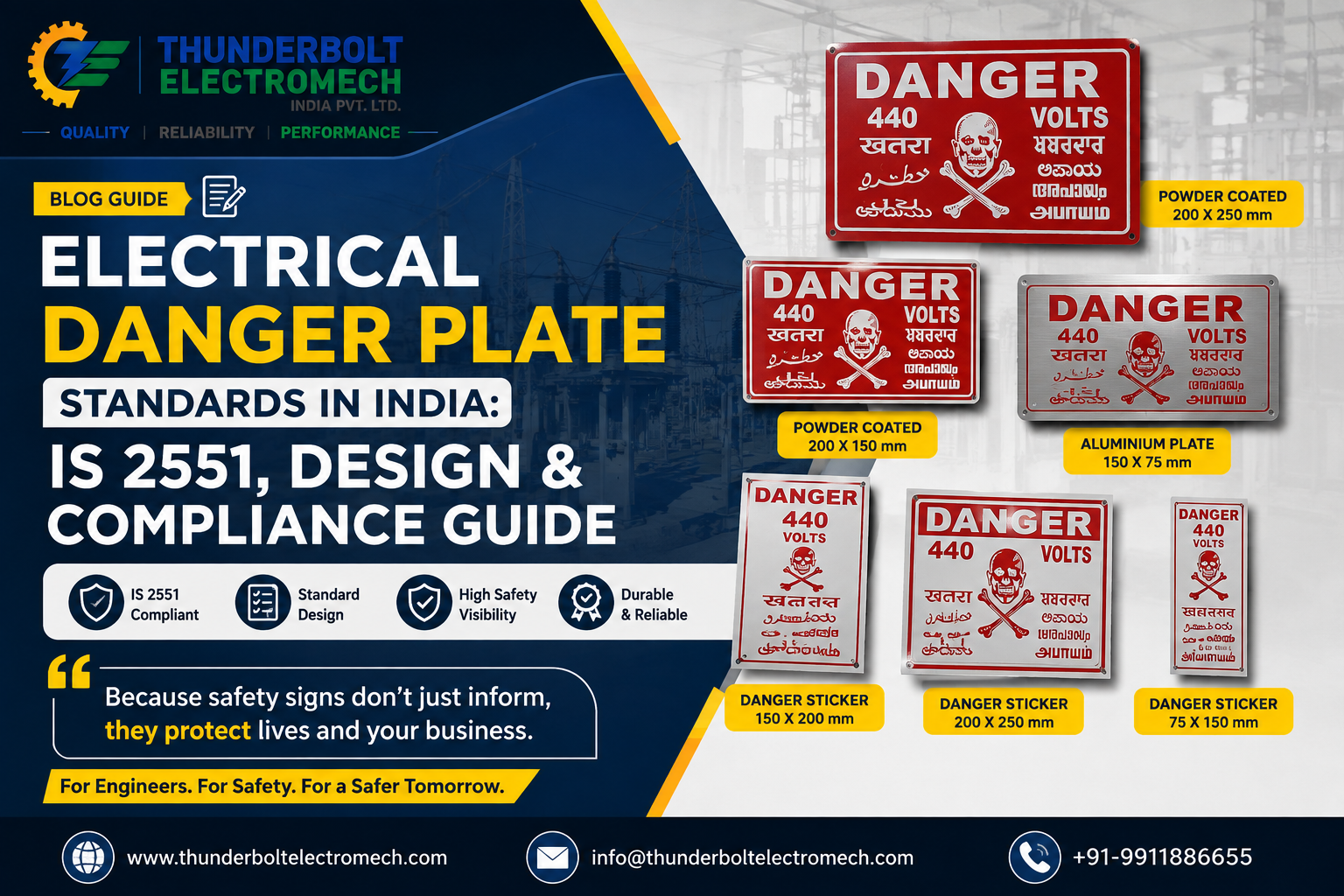
Thunderbolt Electromech India Pvt. Ltd. is a Delhi-based Danger Plate Supplier stocking Powder Coated Danger Plates in 200×150mm and 200×250mm, Aluminium Danger Plates in 150×75mm, 200×150mm, and 200×250mm, and Danger Stickers in 150×200mm, 200×250mm, and 75×150mm — with the honest guidance in this guide applied to every order: rigid plates for the primary statutory notice, stickers positioned correctly as supplementary marking. For buyers researching the IS 2551 danger plate standard or the underlying electrical safety sign standard India follows more broadly, or looking for a Danger Plate Supplier Delhi teams can reach directly, or an IS 2551 danger plate supplier Delhi NCR contractors already trust for HT commissioning work, Thunderbolt’s Chandni Chowk base supports same-day collection alongside pan-India dispatch. Buyers specifically comparing danger plate specification IS 2551 language against a danger notice plate dealer Delhi’s actual stock should expect the same rigid-plate-first guidance this piece has laid out, not a generic catalogue pitch. For panel-specific placement and sizing guidance, see Danger Plate for Electrical Panel: Types, Placement, Size & Safety Guide, and for the full symbol and colour explanation, see What Is a Danger Plate? Electrical Safety Signs, Symbols & Uses Explained.
Contact Thunderbolt Electromech India Pvt. Ltd.: 📍 Shop No. 3538, Sitaram Bazar Rd, Bazar Sirkiwalan, Chawri Bazar, Chandni Chowk, Delhi – 110006 📞 +91-9911886655 ✉️ info@thunderboltelectromech.com
Frequently Asked Questions
When was IS 2551 last officially revised?
It is officially titled “Danger Notice Plates (First Revision)” and is dated 1982. Based on the standard’s own published text, it has not undergone a further formal revision since — making it, as of today, a document over four decades old.
Are danger stickers actually compliant under IS 2551?
This is genuinely nuanced. IS 2551’s own scope clause states it covers plate-format notices; sticker-format notices were acknowledged as commonly used but were never separately, formally standardized within the document. Stickers remain widely accepted in practice and useful as supplementary signage, but a rigid plate is the form the standard’s text unambiguously covers for a primary statutory notice.
Which languages does IS 2551 officially require alongside Hindi or English?
Its Appendix B names seven regional languages: Punjabi, Urdu, Marathi, Tamil, Malayalam, Bengali, and Oriya. For states outside these seven, a verified local-language equivalent is used in practice, consistent with the regulation’s underlying intent.
Does IS 2551 require reflective or photoluminescent danger plates?
No — the standard predates the widespread industrial use of these materials and doesn’t address them. They’re worth considering as a supplementary enhancement for low-light installations, not a compliance requirement.
What’s the actual legal requirement behind IS 2551, and where does it come from?
The legal duty to display a danger notice at all currently sits under Regulation 20 of the CEA (Measures Relating to Safety and Electric Supply) Regulations, 2023, tracing back to the original Indian Electricity Rules, 1956, Rule 35. IS 2551 defines what the notice must look like to satisfy that separate legal duty.
Is a 40-year-old standard still safe to rely on?
The core symbol and material specification remain functional — the skull-and-crossbones warning communicates as effectively today as it did in 1982. The more useful question for a specific installation is whether its risk profile calls for enhancements beyond the standard’s original scope, not whether the baseline itself needs replacing.
Conclusion
IS 2551 is the right document to point to when someone asks what a compliant Indian danger plate looks like — but treating it as a fully current, exhaustively complete specification misses the more useful picture. It’s a 1982 revision that has stood without further formal update, it names seven specific regional languages rather than everyone actually spoken across Indian industrial sites, and its own text openly admits it never finished standardizing the sticker format so many buyers assume it already covers. None of this makes the standard unsafe — it makes it worth understanding as what it actually is: a durable, functional baseline from four decades ago, not a living document tracking every material and visibility advance that’s happened since. Thunderbolt Electromech India Pvt. Ltd. supplies rigid plates, aluminium variants, and stickers with this distinction made clear at the point of purchase, not discovered later during an audit. Call +91-9911886655 or write to info@thunderboltelectromech.com to specify the right format for your actual compliance need.