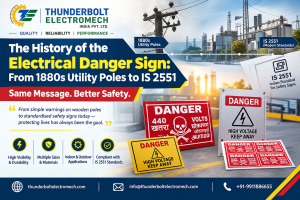
Quick Answer: A danger plate is legally complete only when it clears three checks together: correct content (skull-and-crossbones symbol, voltage marking, bilingual warning per IS 2551), correct material and fabrication (thickness, coating, and corrosion resistance suited to the site), and correct placement (height, visibility distance, and fixing method). Most buyers stop at content and assume they’re done. As a danger plate supplier, we see rejected audits almost every month because material or placement was skipped — not wording.
Introduction: The Plate That Passed the “Look” Test and Failed the Audit
A maintenance head at a Gurugram substation once told us his site had “always had danger boards” — twelve of them, all red, all with the skull symbol, all bought years ago from a local fabricator. Then a fresh internal audit flagged nine of the twelve as non-compliant. Not because the warning was missing. Because the boards were bent, the paint had chalked to pink, and two were mounted below 1.5 metres where a trolley could knock them loose.
That’s the gap this blog closes. Search “danger plate” on Google and you’ll find dozens of pages describing what the sign should say. Almost none explain that a danger plate is a compliance system with three interlocking parts — and a plate that nails one part while failing another is still, legally and practically, an incomplete plate.
We fabricate, powder-coat, and supply these boards daily out of our Chandni Chowk facility in Delhi, so this isn’t theory pulled from a standards PDF. It’s what we see rejected, returned, or re-ordered after a real inspection.
Customer Problems We Actually Hear — And What Fixes Them
Before the framework, here’s the pattern. Buyers rarely ask “is this compliant?” up front. They ask a narrower, symptom-level question, and the real issue only shows up during an audit or an accident investigation.
Problem 1: “Our danger boards keep fading within a year.”
This is almost never a paint-quality complaint in isolation — it’s usually a coastal, chemical-plant, or outdoor-substation environment paired with a low-grade enamel-painted sheet instead of a baked powder coat. Solution: move to a powder coated danger plate on 1.6 mm MS, which resists UV and chemical exposure far longer than liquid paint (see our 200 x 150 mm powder coated danger plate).
Problem 2: “The inspector said our sign is too small to be seen from the gate.”
This is a placement-and-sizing failure, not a wording one. Solution: match plate size to viewing distance — a 150 x 75 mm aluminium tag works for equipment-level tagging viewed from under a metre, but a gate or fence-mounted warning needs at least 200 x 250 mm to remain legible from several metres away.
Problem 3: “We put stickers on our panel doors and they peeled off in six months.”
Vinyl danger stickers are excellent for indoor panels, cable trenches, and low-traffic equipment tagging, but they are the wrong choice for outdoor, high-vibration, or high-heat locations. Solution: reserve stickers for indoor/equipment-level marking and use MS or aluminium boards for anything facing weather or physical contact.
Problem 4: “We don’t know what voltage marking or wording is even mandatory.”
This is a content-compliance gap, and it’s the one most guides do cover — but rarely tie back to the specific voltage class of the installation. Solution: match the marking to the actual supply voltage (415V, 11kV, 33kV, 66kV, etc.) rather than using a generic “DANGER” sign with no rating.
Problem 5: “Our procurement team bought once and never replaced anything since.”
Danger plates are treated as one-time capex, not a maintenance item. Corrosion, physical damage, and fading are inspected far less often than fire extinguishers or first-aid kits, even though the applicable rule requires the sign to remain “distinctly visible” at all times, not just on the day it was installed.
The 3-Part Rule: An Engineering Framework, Not a Checklist
Most vendor blogs collapse “compliance” into a single bullet list — “add skull symbol, use red and white, mount at eye level.” That flattens three genuinely different engineering domains into one sentence, and it’s exactly why so many sites fail audits despite having “done everything on the list.” Here is the framework we actually use when we design a plate for a client site.
Part 1 — Content Compliance (What the Plate Says)
This is the layer everyone gets right, because it’s the easiest to copy from a standard. A content-compliant danger plate carries:
- The internationally recognised skull-and-crossbones hazard symbol, sized proportionally to the plate (not a tiny icon lost in a large red field)
- The word “DANGER” in a dominant, high-contrast typeface — typically white lettering on a signal-red background
- A voltage marking specific to the installation (415V, 440V, 6.6kV, 11kV, 33kV, or 66kV), not a generic warning
- Bilingual text where the workforce is regionally mixed — Hindi and English is standard practice across most Indian industrial states, though the exact language requirement can vary by state electricity inspectorate
Engineering insight most guides skip: voltage marking isn’t cosmetic — it changes the required approach distance for maintenance staff under standard electrical safe-working procedures. A plate marked “11kV” versus “66kV” is read differently by a lineman deciding how close he can stand before de-energising. Get this marking wrong (or generic) and you’ve technically satisfied “there is a danger sign” while giving the workforce no usable safety information. That’s a content-compliance pass that fails the actual intent of the rule.
Part 2 — Material & Fabrication Compliance (What the Plate Is Made Of)
This is the layer most sites skip entirely, because no one asks “what happens to this sign in eighteen months?” at the time of purchase. Material compliance means the substrate and finish must survive the environment long enough for the sign to remain “distinctly visible” — which is the actual legal test, not “was installed once.”
Three fabrication variables matter, and they interact:
- Substrate — Mild Steel (typically 1.6 mm thick for rigid, weld-mountable boards), Aluminium (lighter, naturally corrosion-resistant, easier for smaller tag-sized plates), or self-adhesive vinyl (fastest to apply, lowest cost, shortest service life).
- Finish — powder coating (baked-on, thick, UV- and chemical-resistant) versus liquid enamel paint (cheaper, but chalks and fades within 12–18 months in direct sun) versus printed/laminated stickers (no inherent weather resistance beyond the laminate).
- Environment — coastal salt air, chemical plant fumes, direct UV exposure, high-vibration machinery mounting, and indoor low-traffic panels each demand a different substrate-finish combination.
Engineering insight most guides skip: corrosion and UV fading aren’t linear. A powder-coated MS plate loses very little visible pigment for the first 24–30 months, then degrades faster once the coating’s UV inhibitors are exhausted — which is why sites that never re-inspect signage often find every board failing at once, in the same replacement cycle, rather than gradually. Budgeting for danger-plate replacement as a recurring line item, timed to that curve, avoids the “all twelve failed the same audit” scenario we described in the introduction.
Part 3 — Placement & Visibility Compliance (Where and How the Plate Sits)
This is the layer that’s almost invisible until an inspector walks the site with a tape measure. Placement compliance covers:
- Mounting height that keeps the sign at a readable eye-level range and out of reach of casual tampering or accidental physical damage
- Line-of-sight visibility from the direction a person would actually approach the hazard — not just “somewhere on the fence”
- Secure fixing (pre-drilled corner holes bolted or riveted, not adhesive tape or wire loops that sag over time)
- Sign size scaled to the realistic viewing distance — a small tag-sized plate is legible up close for equipment marking, but useless as a perimeter warning viewed from a gate
Engineering insight most guides skip: placement compliance is a function of approach geometry, not a fixed number. A transformer yard entered from a single gate needs one large board facing that gate; a ring-fenced substation with multiple access points along a mesh fence needs several smaller boards spaced so that no approach angle is sign-free. Buying “one danger plate” for a multi-access site is a placement failure even when the single plate purchased is perfectly content- and material-compliant.
Why the 3-Part Rule Gets Missed: Three Recurring Myths
Myth 1: “If it has the skull symbol, it’s compliant.”
Content is one-third of the rule. A skull symbol on a rusted, illegible, or badly mounted plate is not a compliant installation — it’s a compliant design on a non-compliant installation.
Myth 2: “Aluminium and MS are interchangeable — just pick whichever is cheaper.”
They serve different fabrication use cases. Aluminium suits smaller, lighter-duty tags (150 x 75 mm equipment marking is a common size); 1.6 mm MS suits larger, high-traffic, or high-vibration boards where rigidity matters more than weight. Picking purely on price, without matching substrate to environment, is how Problem 1 above happens.
Myth 3: “Stickers are just a cheaper version of a plate.”
A danger sticker and a danger plate solve different problems. Stickers are fast, low-cost, and ideal for equipment-level or indoor tagging where the surface is protected and turnover is quick (relabeling a panel after a rating change, for instance). They are not a substitute for a perimeter or outdoor warning board, because laminate and adhesive degrade under UV and moisture far faster than powder-coated metal.
Danger Plate Legal Requirement India: The Regulatory Backbone
Understanding why the 3-part rule exists means understanding where it comes from. In India, danger-plate obligations sit across a small cluster of overlapping frameworks rather than one single “danger sign law”:
- The Electricity Act, 2003 — sets the overarching legal duty on licensees and installation owners to maintain safe electrical supply and works, which downstream safety regulations then operationalise.
- The Central Electricity Authority’s Safety and Electric Supply Regulations — the CEA periodically issues and amends regulations covering safety measures at electrical installations, including signage and danger-notice requirements at points where the public or workers could contact live equipment.
- The Factories Act, 1948 and corresponding State Factory Rules — impose duties on factory occupiers to guard and mark hazardous machinery and installations, which in practice includes electrical danger signage at panels, HT rooms, and transformer yards.
- IS 2551 (Bureau of Indian Standards) — the technical specification most Indian fabricators, including us, reference for the design of the danger notice plate itself: the skull-and-crossbones symbol, colour scheme, and general proportions.
Direct source status: we were unable to complete a live regulatory-text verification for this piece due to a temporary search-tool outage at the time of writing. The above reflects standard, widely referenced industry practice among Indian electrical fabricators and safety-compliance consultants. Before finalising signage for a regulated installation, cross-check the current CEA regulation text and your state electrical inspectorate’s latest circular — regulations are amended periodically, and exact wording/voltage thresholds can shift. This labeling matters more than most vendor content admits: a supplier that claims certainty on a clause number without a live citation is a bigger red flag than one that tells you to verify.
The practical takeaway for a purchase team: danger plate legal requirement India compliance isn’t satisfied by one document. It’s the intersection of your state factory rules, the CEA safety regulations applicable to your voltage class, and the IS 2551 design specification — which is exactly why the 3-Part Rule (content, material, placement) maps so cleanly onto how inspectors actually walk a site.
For a full breakdown of buying criteria, standards references, and how to brief a supplier, see our pillar guide: Danger Plate Supplier in India — Complete Buying & Safety Standards Guide.
Comparison Table: Matching Material to Compliance Need
| Criteria | MS Powder Coated Plate (1.6mm) | Aluminium Plate | Vinyl Danger Sticker |
| Best for | Outdoor substations, transformer yards, fence/gate mounting | Lighter equipment tagging, panels, indoor-outdoor mixed use | Indoor panels, cable trenches, quick relabeling |
| Available sizes (our stock) | 200 x 150 mm, 200 x 250 mm | 150 x 75 mm, 200 x 150 mm, 200 x 250 mm | 75 x 150 mm, 150 x 200 mm, 200 x 250 mm |
| Structural rigidity | High — resists bending and impact | Medium — light but can dent | Low — no independent rigidity |
| UV / weather resistance | Excellent — baked powder coat resists chalking | Good — natural corrosion resistance, coating can still fade | Poor to moderate — laminate quality dependent |
| Typical service life (outdoor) | 5+ years with normal exposure | 3–5 years | 6–18 months |
| Mounting method | Bolted/riveted via pre-drilled corner holes | Bolted or screwed | Adhesive backing |
| Indicative cost position | Moderate upfront, lowest cost-per-year | Slightly lower upfront than MS | Lowest upfront, highest replacement frequency |
| IS 2551 symbol clarity retention | Retained longest under sun/rain | Retained well, marginally shorter than MS | Fades fastest |
No single material “wins” outright — the correct choice depends on where the 3-Part Rule’s placement layer puts the sign and what environment it faces. Browse the full range across our Danger Plate category for size-by-size specifications.
Danger Plate Compliance Check Delhi: What a Site Walk Actually Looks For
Delhi’s mix of dense industrial clusters, DISCOM-fed installations, and older factory infrastructure in areas like Narela, Bawana, Wazirpur, and Okhla means compliance checks here tend to surface a specific, repeatable pattern. If you’re running a danger plate compliance check Delhi teams typically move through three passes that mirror the 3-Part Rule almost exactly:
Pass 1 — Content scan.
Walk the perimeter and panel rooms, confirm every board carries the skull symbol, correct voltage marking, and legible “DANGER” text. Flag anything generic, faded to illegibility, or missing a voltage rating.
Pass 2 — Material and condition scan.
Check for rust bleed-through on MS boards, chalking or colour loss on painted (non-powder-coated) signs, and peeling or curling on stickers. A board that “has the right words” but has physically degraded still fails this pass.
Pass 3 — Placement scan.
Confirm mounting height, secure fixing, and that every realistic approach point to a hazard has a visible sign — not just the main gate.
Because Delhi’s industrial zones combine older buildings retrofitted with newer HT equipment, it’s common to find one part of a site fully compliant (new transformer yard, correctly signed) and another part running decade-old, unreadable boards on a legacy panel room. A compliance check treats the site as the unit, not the newest installation — so a single non-compliant corner can flag the whole audit.
Being based in Chandni Chowk, Delhi, we get same-week turnaround requests from local factories and DISCOM contractors ahead of scheduled inspections — which is usually when the gap between “we have danger boards” and “we are compliant” gets discovered.
Latest Trends: Where Danger-Sign Compliance Is Heading in 2026
Danger-plate design hasn’t stood still, even though it looks like a static red-and-white board. A few shifts worth tracking:
Retro-reflective and photoluminescent variants are gaining ground in low-light industrial zones. Metro depots, underground cable galleries, and 24-hour substations increasingly specify signage that remains legible under torchlight or during a power outage — a scenario a standard powder-coated plate doesn’t address on its own.
QR-linked digital compliance logging is emerging as a site-management practice, where facility teams attach a small QR tag near (not replacing) the physical danger plate, linking to an inspection log that records the last visual-condition check. This isn’t a regulatory requirement anywhere we’ve seen documented, but it’s a practical trend among larger industrial groups managing hundreds of signs across multiple sites — it turns “when did we last check this?” from a guess into a timestamped record.
Material specification is tightening around actual environmental data rather than generic “outdoor use.” Buyers are increasingly asking suppliers for salt-spray and UV-exposure test references before ordering coastal or chemical-zone signage, rather than accepting a blanket “weatherproof” claim.
Direct source status: these trend observations come from our own conversion patterns and customer conversations over recent order cycles — they are supplier-side field observations, not findings from a published industry survey, and we’re labeling them as such rather than dressing them up as formal research.
Frequently Asked Questions
Does a danger plate need to be replaced on a fixed schedule?
There’s no single universal fixed interval mandated everywhere; the operative legal test is that the sign remains distinctly visible and legible at all times. In practice, that means inspecting powder-coated MS boards roughly every 18–24 months in harsh outdoor conditions, and vinyl stickers far more frequently.
Can one danger plate cover an entire substation perimeter?
Only if every realistic approach angle has line-of-sight to that one plate — which is rare. Most multi-access sites need signage repeated at each entry point, per the placement layer of the 3-Part Rule.
Is a sticker ever legally sufficient on its own outdoors?
It can satisfy the content layer, but it typically fails the material layer faster than metal boards in direct sun or rain, which becomes a compliance risk at the next inspection cycle even if it passed on installation day.
What voltage classes do your powder-coated plates cover?
Our stock boards are marked for 415V, 440V, 6.6kV, 11kV, 33kV, and 66kV installations — see the 200 x 150 mm and 200 x 250 mm powder-coated options for exact specifications.
Reason of Choosing Danger Plate from Thunderbolt Electromech
This blog is published by Thunderbolt Electromech India Pvt. Ltd., a Delhi-based supplier of electrical safety products, cable accessories, and industrial electrical components serving engineers, contractors, industries, utilities, and purchase teams across India. We fabricate and stock danger plates in MS powder-coated, aluminium, and vinyl sticker formats across the standard 150 x 75 mm, 200 x 150 mm, and 200 x 250 mm sizes referenced throughout this guide.
- Address: Shop No. 3538, Sitaram Bazar Rd, Bazar Sirkiwalan, Chawri Bazar, Chandni Chowk, Delhi – 110006
- Phone: +91-9911228857 / +91-6391217408
- Email: info@thunderboltelectromech.com
If you’re preparing for an audit or simply unsure whether your current signage clears all three parts of this rule, our team can review your site’s voltage classes, environment, and layout before you order.
Sources & Verification Notes
In the interest of transparency, here’s how the claims in this piece are grounded:
- IS 2551 design specification (skull-and-crossbones symbol, red/white colour scheme): Widely referenced industry standard among Indian fabricators; treated here as established fabrication practice rather than independently re-verified against the current BIS text at time of writing. Recommend verification against the latest published standard before final sign-off on a regulated installation.
- Electricity Act 2003 / CEA Safety Regulations / Factories Act 1948 as the regulatory backbone: General regulatory-framework knowledge; a live citation check could not be completed due to a temporary search-tool outage during research for this article. Labeled as no-direct-source-found for this piece — verify current clause text with your state electrical inspectorate or a compliance consultant before treating any specific threshold as final.
- Material degradation patterns (UV/corrosion curve, powder coat vs enamel vs vinyl service life): Supplier-side field observation from our own fabrication and replacement-order data, not a peer-reviewed material science study — presented as practical engineering experience, not laboratory-tested figures.
- 2026 trend observations (retro-reflective demand, QR-linked logging, salt-spray spec requests): Direct observation from customer inquiries and order patterns at Thunderbolt Electromech, not a published market survey.
We’d rather tell you where a claim comes from than dress up a guess as a citation — that’s the same standard we’d want from anyone supplying safety equipment to our own site.
Conclusion
A danger plate isn’t complete because it looks right on day one. It’s complete when content, material, and placement all hold up together — on the day of installation and on the day, two years later, when an inspector actually walks the fence line. Most rejected audits we see don’t trace back to bad wording. They trace back to a plate that nailed the symbol and skipped the substrate, or nailed the substrate and got mounted where nobody could see it from the gate.
Run your site through all three checks, not just the one that’s easiest to Google. And if you’re not sure where your current signage stands, we’re a phone call away — as a working danger plate supplier, this audit conversation is one we have every week, not a hypothetical.
Explore our full range of powder-coated, aluminium, and sticker danger signage in the Danger Plate category, or start with our complete Danger Plate Buying & Safety Standards Guide for the full purchasing framework.