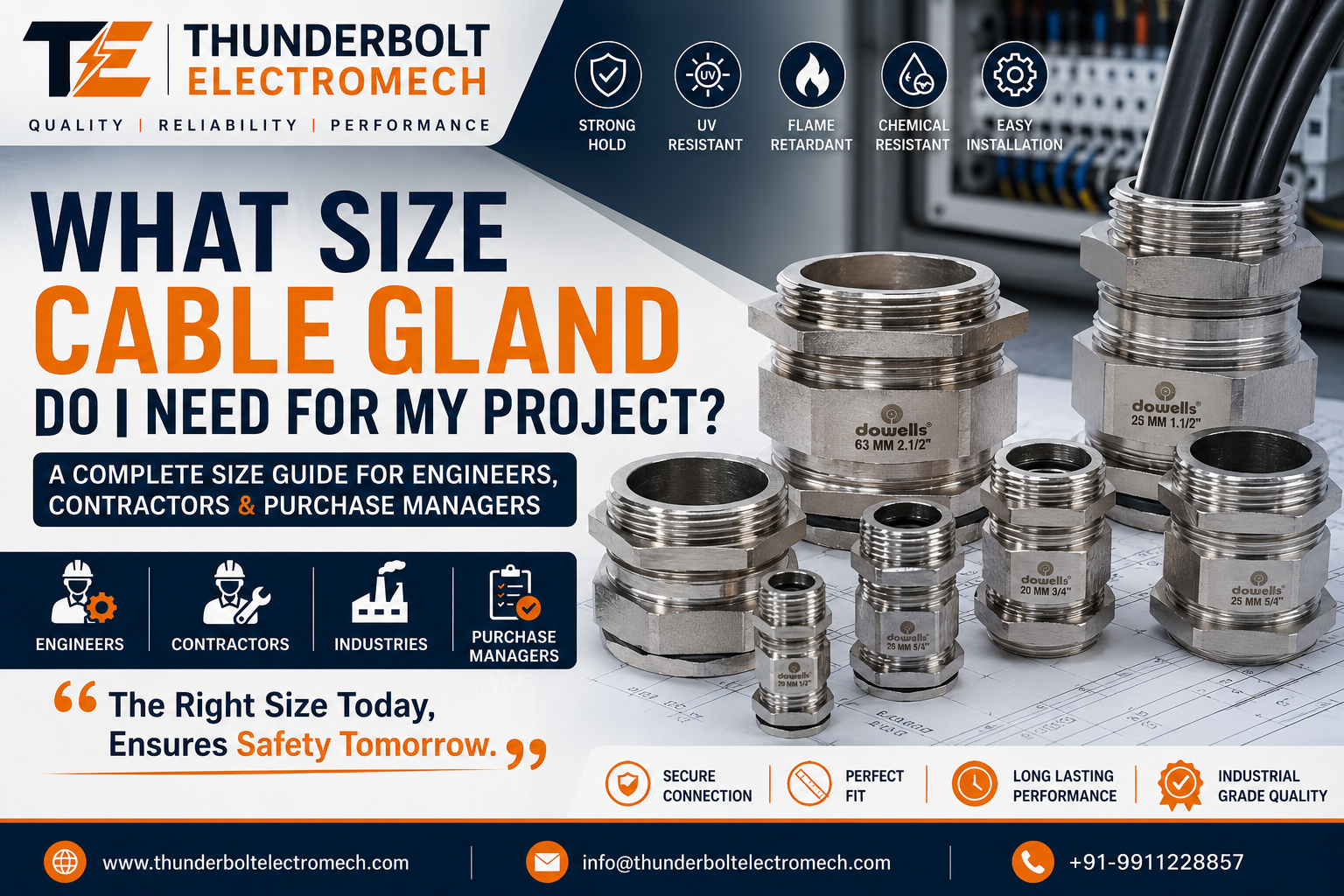
Quick Answer: The correct cable gland size depends primarily on the cable’s outer diameter (OD) rather than only the cable conductor size (sq.mm). Measure the cable’s outside diameter using a vernier caliper or refers to the manufacturer’s cable datasheet. Once you know the OD, match it with the recommended gland size using a Cable Gland Size Chart. Also consider:
- Single or Double Compression Cable Gland
- Armoured or Unarmoured Cable
- Indoor or Outdoor Installation
- Hazardous Area Requirement
- Brass or Nickel-Plated Brass Construction
- Thread Type (Metric, ET, PG or NPT)
Choosing the correct gland size improves sealing performance, prevents cable damage, maintains the IP rating, and extends cable life.
Introduction
Selecting the correct cable gland size is one of the most important steps in any electrical installation. Whether you are working on an electrical panel, transformer, solar plant, manufacturing unit, oil and gas facility, railway project, or industrial automation system, the right Cable Gland ensures safe cable entry, proper sealing, mechanical retention, and long-term protection. Many installation failures occur because the cable gland is selected only by cable conductor size (sq.mm) instead of the cable’s actual outer diameter (OD). Even a high-quality cable gland cannot deliver reliable performance if the size is incorrect.
One of the most common mistakes engineers, contractors, and purchase managers make is assuming that two cables with the same conductor size require the same cable gland. In reality, insulation thickness, armour type, and cable construction vary between manufacturers, resulting in different outer diameters for the same conductor size. Installing an undersized gland can damage the cable sheath, while an oversized gland fails to compress the sealing ring properly, allowing dust, moisture, and contaminants to enter the enclosure.
This is why experienced professionals always measure the Cable Outer Diameter (OD) before selecting a cable gland. International installation practices and cable manufacturers recommend choosing the gland according to the cable’s overall diameter rather than conductor size alone.
As a trusted Cable Gland Supplier India, Thunderbolt Electromech supplies premium industrial cable glands from Dowells, Comet, and HMI for high-performance applications, along with Diamond Cable Glands for economical industrial projects. Our team helps engineers, EPC contractors, OEMs, panel builders, industries, and purchase managers select the correct gland size based on technical requirements, ensuring reliable cable management, superior IP protection, and long service life. This guide explains everything you need to know to choose the right cable gland size for your project with confidence.
Cable Gland Supplier India: Understanding Cable Gland Size Selection for Every Project
Choosing the correct cable gland is not simply about purchasing a brass fitting that matches the cable entry hole. It is a technical process that involves understanding cable construction, cable outer diameter, environmental conditions, thread standards, and the application’s mechanical requirements. A properly selected cable gland protects electrical equipment from dust, water, vibration, strain, and environmental damage while maintaining the enclosure’s IP rating.
For engineers and purchase managers, selecting the correct cable gland reduces installation failures, lowers maintenance costs, and increases equipment reliability. Whether you are installing cables in control panels, substations, solar plants, industrial machinery, or hazardous environments, proper gland sizing directly impacts system performance.
Why Cable Gland Size Matters
Cable gland size determines how effectively the gland seals around the cable. The compression seal is designed to grip a specific cable diameter range. If the gland is too small, excessive compression may damage the insulation, armour, or outer sheath, reducing cable life and increasing the risk of electrical faults.
Conversely, if the gland is too large, the sealing ring cannot compress adequately around the cable, allowing water, dust, oil, and moisture to enter the enclosure. This compromises the equipment’s IP rating and may lead to corrosion, insulation failure, or short circuits.
Selecting the correct cable gland size offers several advantages:
- Maintains IP65, IP66, IP67, or IP68 protection.
- Prevents cable movement due to vibration.
- Protects cable insulation from mechanical stress.
- Improves equipment reliability.
- Extends cable service life.
- Reduces maintenance costs.
- Ensures compliance with industrial installation standards.
For critical industries such as power distribution, solar energy, oil and gas, railways, and manufacturing, proper gland sizing is essential for long-term operational safety.
What is Cable Outer Diameter (OD)?
The Cable Outer Diameter (OD) is the overall outside diameter of a completed cable, including insulation, bedding, armour (if applicable), and the outer protective sheath. It is measured in millimetres (mm) and is the primary dimension used to select the correct cable gland.
Many professionals mistakenly rely only on conductor size, such as 16 sq.mm or 35 sq.mm, but cables with identical conductor sizes can have significantly different outer diameters depending on:
- Number of cores
- Armour type
- Insulation thickness
- Sheath material
- Voltage rating
- Manufacturer specifications
For example, two 25 sq.mm cables from different manufacturers may have outer diameters of 21 mm and 24 mm respectively. Although both have the same conductor size, they require different gland sizes to achieve proper sealing.
The most accurate way to determine Cable OD is by referring to the cable manufacturer’s datasheet or measuring the cable using a vernier caliper before selecting the gland.
Why Cable Sq.mm Alone Cannot Select a Cable Gland
Cable conductor size (sq.mm) indicates the cross-sectional area of the conductor and its current-carrying capacity. It does not determine the cable’s physical dimensions or sealing requirements.
The same conductor size can have different outer diameters because of variations in:
- PVC insulation
- XLPE insulation
- Armouring
- Additional bedding layers
- Fire-resistant construction
- Low-smoke halogen-free (LSZH) sheathing
For example:
| Cable Specification | Conductor Size | Approx. Outer Diameter |
| PVC Cable | 16 sq.mm | 16–18 mm |
| XLPE Armoured Cable | 16 sq.mm | 20–23 mm |
| Fire Resistant Cable | 16 sq.mm | 22–24 mm |
If gland selection is based only on conductor size, the seal may fail, reducing safety and reliability. Therefore, always use the cable’s Outer Diameter (OD) to choose the appropriate gland.
How Engineers Measure Cable Diameter
Professional cable installers and engineers follow a systematic process to determine the correct cable gland size:
- Obtain the cable manufacturer’s technical datasheet.
- Locate the cable’s overall outer diameter (OD).
- If the datasheet is unavailable, measure the cable using a calibrated vernier caliper.
- Compare the measured OD with the gland manufacturer’s sealing range.
- Select the gland that fully covers the measured cable diameter.
- Verify the thread size matches the equipment entry hole.
- Confirm whether a single or double compression gland is required.
Following this method ensures accurate gland selection and minimizes installation issues.
Understanding Thread Sizes
Thread size determines how the cable gland fits into the equipment enclosure. Selecting the correct thread type is just as important as choosing the correct sealing range.
Metric Threads
Metric threads are the most widely used standard in modern industrial equipment. Sizes such as M20, M25, M32, M40, M50, and M63 are commonly found in electrical panels, automation systems, and switchgear.
Best suited for: Industrial automation, control panels, OEM equipment, and IEC-compliant installations.
ET (Electrical Thread)
ET threads are widely used in India for traditional industrial installations. Many electrical contractors and panel builders continue to use ET-thread cable glands due to compatibility with existing infrastructure.
Best suited for: Indian electrical panels, substations, and industrial applications.
PG Threads
PG (Panzer-Gewinde) threads originated in Germany and are commonly found in imported machinery and older European equipment.
Best suited for: Imported machines, instrumentation systems, and legacy industrial equipment.
NPT Threads
NPT (National Pipe Thread) is a tapered thread standard extensively used in North America and international oil & gas industries.
Best suited for: Process plants, petrochemical facilities, hazardous locations, and heavy industrial installations.
Selecting the wrong thread standard can result in poor mechanical fit, compromised sealing, and increased installation time.
Types of Cable Glands
Different industrial applications require different cable gland designs. Thunderbolt Electromech supplies a comprehensive range of cable glands to meet these requirements.
Brass Cable Gland
Brass cable glands are manufactured from high-quality brass and are often nickel-plated to improve corrosion resistance. They provide excellent mechanical strength, durability, and long service life.
Applications:
- Electrical panels
- Industrial machinery
- Transformers
- Power distribution systems
- Solar projects
Industrial Cable Gland
Industrial cable glands are engineered for demanding environments where reliability and environmental protection are essential. These glands offer excellent sealing, strain relief, and resistance to vibration.
Applications:
- Manufacturing plants
- Process industries
- Infrastructure projects
- Industrial automation
Armoured Cable Gland
Armoured cable glands are specifically designed for steel wire armoured (SWA) and other armoured cables. They provide secure mechanical anchoring while ensuring effective earth continuity and cable protection.
Applications:
- Power plants
- Heavy industries
- Underground cable installations
- Transformer yards
Weatherproof Cable Gland
Weatherproof cable glands protect electrical systems from rain, dust, humidity, and outdoor environmental conditions while maintaining the required IP rating.
Applications:
- Outdoor control panels
- Solar power plants
- Street lighting
- Telecommunications
Flameproof Cable Gland
Flameproof cable glands are used in hazardous areas where explosive gases or combustible dust may be present. These glands help prevent ignition by maintaining explosion-proof integrity.
Applications:
- Oil & gas facilities
- Chemical plants
- Refineries
- Pharmaceutical manufacturing
- Hazardous industrial zones
Research: Why Global Manufacturers Recommend Selecting Cable Glands Using Cable Outer Diameter (OD)
Leading cable gland manufacturers and industrial installation practices consistently recommend selecting cable glands based on the Cable Outer Diameter (OD) rather than conductor size because the gland’s sealing mechanism compresses around the cable’s external sheath—not the conductor inside.
International IEC installation practices emphasize maintaining enclosure protection by ensuring the sealing element matches the cable’s overall diameter. Industrial installation methods followed by EPC contractors and panel manufacturers also specify verifying the cable OD before installation to maintain ingress protection, prevent cable movement, and avoid premature equipment failure.
Major cable manufacturers publish detailed technical datasheets that include the cable’s overall outer diameter specifically to help engineers choose the correct cable gland. Since insulation thickness, armouring, and sheath materials vary between cables designs, relying solely on conductor size can result in incorrect gland selection.
For engineers, contractors, and purchase managers, the most reliable approach is simple: measure the cable’s outer diameter, match it with the manufacturer’s gland sealing range, confirm the thread type, and then select the appropriate single or double compression cable gland. This method improves installation quality, enhances equipment safety, and ensures long-term performance across industrial applications.
Cable Gland Size Guide
Selecting the correct cable gland is essential for maintaining the safety, reliability, and performance of any electrical installation. Whether you are installing cables in electrical panels, transformers, solar plants, substations, industrial machinery, or hazardous locations, choosing the right gland size prevents cable damage, ensures proper sealing, and protects equipment from dust, water, vibration, and corrosion.
Many engineers and purchase managers mistakenly select cable glands based only on the cable conductor size (sq.mm). However, professional cable gland selection is based primarily on the Cable Outer Diameter (OD) because the gland seals around the cable’s outer sheath, not the conductor inside. Understanding cable size, outer diameter, threads type, sealing range, cable entry, and IP rating is therefore essential.
Cable Size (sq.mm)
Cable size refers to the cross-sectional area of the conductor, measured in square millimetres (sq.mm). It determines the cable’s current-carrying capacity but does not determine the cable gland size.
For example:
- 1.5 sq.mm – Lighting circuits
- 2.5 sq.mm – Power sockets
- 6 sq.mm – Distribution wiring
- 16 sq.mm – Industrial panels
- 35 sq.mm – Transformers
- 70 sq.mm – Power distribution
- 120 sq.mm – Heavy industrial installations
Two cables with the same conductor size may have different insulation thicknesses and armour constructions, resulting in different outer diameters. Therefore, cable size alone should never be used to select a cable gland.
Cable Outer Diameter (OD)
Cable Outer Diameter (OD) is the total outside diameter of the completed cable, including insulation, bedding, armour, and outer sheath. It is the most important parameter when selecting a cable gland because the sealing ring compresses around the cable’s external surface.
Engineers typically determine the cable OD by:
- Referring to the cable manufacturer’s datasheet.
- Measuring the cable using a vernier caliper.
- Checking technical specifications provided by the cable supplier.
Selecting a gland based on the correct cable OD ensures proper sealing, maintains the enclosure’s IP rating, and prevents cable movement.
Thread Size
The cable gland thread secures the gland to the enclosure. Selecting the correct thread ensures proper installation and mechanical strength.
Common thread standards include:
- Metric (M20, M25, M32, M40, M50, M63) – Most common in modern industrial installations.
- ET (Electrical Thread) – Widely used in Indian electrical panels.
- PG Thread – Found on imported machinery and older European equipment.
- NPT Thread – Used in oil & gas, petrochemical, and international industrial applications.
Always verify the enclosure’s thread specification before purchasing a cable gland.
Cable Entry
Cable entry refers to the point where the cable enters an electrical enclosure such as a control panel, switchgear, junction box, transformer, or motor terminal box.
A properly selected cable gland provides:
- Secure cable anchoring
- Mechanical strain relief
- Protection against cable pull-out
- Dust and water sealing
- Vibration resistance
- Long-term reliability
Poor cable entry selection can lead to moisture ingress, cable damage, and equipment failure.
Sealing Range
Every cable gland is designed to accommodate a specific cable diameter range known as the Sealing Range.
For example:
- Gland Size 20S: 8–10 mm
- Gland Size 20: 10–15 mm
- Gland Size 25: 15–21 mm
Selecting a cable outside the gland’s sealing range can result in:
- Water leakage
- Dust ingress
- Loose cable support
- Damaged cable insulation
- Reduced IP protection
Always ensure the cable OD falls within the manufacturer’s recommended sealing range.
IP Rating
The IP (Ingress Protection) rating indicates the gland’s ability to protect electrical equipment against dust and water.
Common ratings include:
| IP Rating | Protection Level |
| IP65 | Dust-tight and protected against water jets |
| IP66 | Dust-tight and resistant to powerful water jets |
| IP67 | Temporary immersion protection |
| IP68 | Continuous immersion protection (manufacturer-dependent) |
The required IP rating depends on the installation environment. Outdoor, marine, industrial, and hazardous applications generally require higher protection levels.
Cable Gland Size Chart
The following chart provides a general reference for matching cable conductor size, approximate cable outer diameter, and the suggested cable gland size. Always verify the actual cable OD with the cable manufacturer’s datasheet before making a final selection.
| Cable Size | Approx. Cable OD | Suggested Gland Size |
| 1.5 sq.mm | 8–10 mm | 20S |
| 2.5 sq.mm | 9–11 mm | 20S |
| 4 sq.mm | 10–12 mm | 20 |
| 6 sq.mm | 12–15 mm | 20 |
| 10 sq.mm | 15–18 mm | 25 |
| 16 sq.mm | 18–21 mm | 25 |
| 25 sq.mm | 21–26 mm | 32 |
| 35 sq.mm | 25–30 mm | 32 |
| 50 sq.mm | 29–35 mm | 40 |
| 70 sq.mm | 34–41 mm | 50 |
| 95 sq.mm | 40–48 mm | 63 |
| 120 sq.mm | 48–55 mm | 75 |
Important: These values are approximate. Actual cable outer diameters vary between manufacturers, insulation types, and armour constructions. Always select the gland based on the measured Cable OD.
Cable Gland Supplier India
Cable Gland Size Calculator
Selecting the correct cable gland can be simplified by following a logical calculation process. Instead of relying solely on conductor size, engineers use the cable’s outer diameter, construction type, and installation environment to determine the appropriate gland.
Step 1: Find the Cable Outer Diameter (OD)
Locate the cable’s overall outside diameter from the manufacturer’s datasheet or measure it with a vernier caliper.
↓
Step 2: Identify the Cable Type
Determine whether the cable is:
- PVC Insulated
- XLPE Insulated
- Multi-core
- Single-core
- Flexible Cable
- Control Cable
- Instrumentation Cable
↓
Step 3: Determine Whether the Cable is Armoured or Non-Armoured
This decision affects the type of cable gland required.
- Armoured Cable → Double Compression Cable Gland
- Non-Armoured Cable → Single Compression Cable Gland
↓
Step 4: Choose Single Compression or Double Compression
Single Compression Cable Gland
Best for:
- Indoor electrical panels
- Control panels
- Junction boxes
- Light industrial installations
Double Compression Cable Gland
Best for:
- Outdoor applications
- Armoured cables
- Hazardous areas
- Heavy industrial environments
- Oil & Gas
- Solar Projects
↓
Step 5: Match Cable OD with the Manufacturer’s Size Chart
Compare the measured cable OD with the gland manufacturer’s sealing range.
Example:
Cable OD = 20 mm
Recommended gland sealing range = 18–21 mm
Suggested gland = Size 25
↓
Step 6: Confirm Thread Size
Verify the enclosure entry thread:
- Metric
- ET
- PG
- NPT
↓
Final Gland Selection
After confirming:
- Cable OD
- Cable Type
- Armour Type
- Compression Type
- Thread Standard
- Sealing Range
You can confidently select the correct cable gland for reliable, long-lasting performance.
Brand Selection Guide
Dowells Cable Gland
Dowells is a trusted name in the Indian electrical industry, known for manufacturing premium-quality brass cable glands that meet the requirements of demanding industrial applications.
Advantages
- High-quality brass construction
- Excellent corrosion resistance
- Reliable sealing performance
- Suitable for harsh industrial environments
- Precision-engineered threads
- Long service life
Applications
- Power plants
- Solar projects
- Electrical panels
- Transformers
- Switchgear
- Industrial automation
- Infrastructure projects
Available Sizes
Dowells cable glands are available in a wide range of sizes to suit different cable outer diameters, from small control cables to large industrial power cables.
When to Use
Dowells cable glands are ideal for EPC contractors, OEMs, heavy industries, utilities, and projects requiring premium reliability and long-term performance.
Comet Cable Gland
Comet cable glands are widely used across industrial installations due to their robust construction and dependable sealing capabilities.
Applications
- Power distribution
- Industrial control panels
- Manufacturing plants
- Infrastructure
- Automation systems
- Commercial buildings
Industrial Benefits
- High mechanical strength
- Reliable cable retention
- Excellent weather resistance
- Suitable for indoor and outdoor use
- Long operational life
Selection Tips
Choose Comet cable glands when durability, weather protection, and dependable industrial performance are essential.
HMI Cable Gland
HMI cable glands are engineered for high-performance industrial environments where reliability and protection are critical.
Best for High-Performance Projects
- Oil & Gas
- Refineries
- Petrochemical plants
- Heavy engineering
- Mining
- Infrastructure
Heavy Industries
Designed to withstand vibration, dust, moisture, and mechanical stress in demanding industrial applications.
Outdoor Installations
Suitable for:
- Solar power plants
- Outdoor electrical panels
- Telecommunications
- Utility projects
- Weather-exposed installations
Diamond Cable Gland
Diamond cable glands provide a practical and economical solution for standard industrial and commercial electrical installations.
Medium-Range Applications
- Commercial buildings
- Light industries
- Distribution boards
- Control panels
- General electrical contracting
Cost-Effective Projects
Diamond cable glands offer dependable performance while helping contractors manage project costs effectively.
Commercial Installations
Suitable for offices, shopping complexes, residential developments, educational institutions, and general industrial projects where reliable cable management is required.
Brand Comparison Table
| Brand | Quality | Industrial Use | Weatherproof | Flameproof | Best For |
| Dowells | Premium | Excellent | Yes | Yes | EPC Projects, Power Distribution, Heavy Industries |
| Comet | Premium | Excellent | Yes | Yes | Power Plants, Industrial Panels, Infrastructure |
| HMI | Premium | Excellent | Yes | Yes | Heavy Industries, Oil & Gas, Outdoor Installations |
| Diamond | Medium | Good | Yes | Limited | Budget Projects, Commercial Installations, General Industry |
Cable Gland Supplier India
Single Compression vs Double Compression Cable Gland Size
Selecting the correct cable gland type is just as important as selecting the correct cable gland size. Many engineers focus only on the cable diameter but overlook whether the application requires a Single Compression Cable Gland or a Double Compression Cable Gland. This mistake can reduce the cable’s service life, compromise the enclosure’s IP rating, and increase maintenance costs.
The choice depends on several factors, including the cable construction, installation environment, mechanical stress, and the level of protection required. Single compression cable glands are commonly used for indoor and light-duty industrial applications, whereas double compression cable glands are preferred for armoured cables, outdoor installations, heavy industries, and hazardous locations.
As a trusted Cable Gland Supplier India, Thunderbolt Electromech supplies premium cable glands from Dowells, Comet, HMI, and Diamond, helping engineers, contractors, and purchase managers select the right gland for every project.
Single Compression Cable Gland
A Single Compression Cable Gland compresses only the outer sheath of the cable. It provides mechanical retention and environmental sealing through a single sealing ring positioned around the cable jacket. These glands are widely used where cables are not subjected to excessive vibration, tension, or harsh environmental conditions.
Because of their simple construction, single compression glands are easy to install, cost-effective, and suitable for most indoor industrial applications.
How Single Compression Cable Glands Work
When the gland nut is tightened, the sealing ring compresses around the cable’s outer sheath, creating a secure seal. The compression prevents dust, moisture, and contaminants from entering the enclosure while also providing strain relief to the cable.
The armour, if present, is not compressed separately as it is in double compression glands.
Advantages of Single Compression Cable Glands
Cost-Effective Solution
Single compression cable glands are economical while still providing reliable sealing for standard industrial applications.
Quick Installation
Their simple design allows electricians and panel builders to install them quickly, reducing installation time.
Easy Maintenance
Removing and reinstalling cables is relatively straightforward, making them suitable for electrical panels that require periodic maintenance.
Good Environmental Protection
When correctly selected according to Cable Outer Diameter (OD), these glands provide effective sealing against dust and water.
Lightweight Construction
Their compact design makes them suitable for control panels, instrumentation systems, and commercial electrical installations.
Applications of Single Compression Cable Glands
Single compression cable glands are widely used in:
- Electrical Panels
- Distribution Boards
- PLC Panels
- Control Panels
- Indoor Switchgear
- Commercial Buildings
- Manufacturing Units
- Instrumentation Panels
- HVAC Systems
- Machine Control Panels
These applications generally involve lower vibration levels and controlled environmental conditions.
When Should You Choose a Single Compression Cable Gland?
Choose a single compression gland when:
- The cable is non-armoured or lightly armoured.
- Installation is indoors.
- Exposure to moisture is limited.
- Mechanical stress is low.
- Maintenance accessibility is important.
- Cost optimisation is required.
Single Compression Cable Gland Size Guide
Always select the gland according to the cable’s Outer Diameter (OD).
General selection example:
| Cable OD | Typical Gland Size |
| 8–10 mm | 20S |
| 10–15 mm | 20 |
| 15–21 mm | 25 |
| 21–26 mm | 32 |
| 29–35 mm | 40 |
| 34–41 mm | 50 |
Always confirm the sealing range using the manufacturer’s technical catalogue before finalising the selection.
Double Compression Cable Gland
A Double Compression Cable Gland provides sealing at two separate locations:
- Around the cable’s outer sheath.
- Around the cable armour or inner bedding.
This dual sealing mechanism offers superior mechanical retention, higher ingress protection, and enhanced resistance to vibration, making it the preferred choice for heavy industrial environments.
Double compression glands are widely used for armoured cables where reliable sealing and mechanical support are critical.
How Double Compression Cable Glands Work
Unlike single compression glands, double compression glands grip both the cable armour and the outer sheath independently.
This provides:
- Better cable anchoring
- Improved vibration resistance
- Higher pull-out strength
- Better water sealing
- Superior IP protection
- Enhanced mechanical stability
Advantages of Double Compression Cable Glands
Superior Water Protection
Double sealing significantly reduces the risk of water or moisture entering the enclosure.
Better Mechanical Strength
The cable remains firmly secured even under continuous vibration or movement.
Ideal for Armoured Cables
These glands are specifically designed to terminate Steel Wire Armoured (SWA) and similar industrial cables.
Higher IP Rating Performance
Double compression glands help maintain IP66, IP67, and IP68 ratings in demanding environments.
Longer Service Life
Reduced cable movement minimises insulation wear and mechanical damage.
Suitable for Harsh Environments
Excellent performance in:
- Dust
- Rain
- Heat
- Chemicals
- Corrosive environments
- Outdoor installations
Applications of Double Compression Cable Glands
Double compression glands are commonly installed in:
- Power Plants
- Solar Projects
- Oil & Gas Facilities
- Petrochemical Plants
- Steel Plants
- Cement Plants
- Railway Infrastructure
- Metro Projects
- Wind Energy Projects
- Mining
- Outdoor Electrical Panels
- Heavy Industrial Equipment
- Transformer Installations
When Should You Choose a Double Compression Cable Gland?
Choose a double compression gland when:
- The cable is armoured.
- Installation is outdoors.
- Continuous vibration is present.
- Equipment is exposed to dust or water.
- Hazardous areas require higher protection.
- High mechanical strength is necessary.
Double Compression Cable Gland Size Guide
Selection is based on:
- Cable Outer Diameter (OD)
- Armour Diameter
- Bedding Diameter
- Thread Size
- Manufacturer’s sealing range
Typical selection:
| Cable OD | Typical Gland Size |
| 15–18 mm | 25 |
| 18–24 mm | 32 |
| 24–30 mm | 40 |
| 30–40 mm | 50 |
| 40–50 mm | 63 |
| 50–60 mm | 75 |
Always verify the manufacturer’s catalogue (Dowells, Comet, HMI, or Diamond) because sealing ranges may vary slightly by brand.
Comparison Table
| Feature | Single Compression | Double Compression |
| Number of Seals | One | Two |
| Outdoor Use | Good | Excellent |
| Heavy-Duty Applications | Medium | Excellent |
| Armoured Cable Support | Limited | Best |
| Hazardous Area Suitability | Limited | Excellent |
| Mechanical Strength | Good | Excellent |
| Water Protection | Good | Excellent |
| Vibration Resistance | Moderate | High |
| Pull-Out Resistance | Moderate | Excellent |
| Installation Cost | Lower | Higher |
| Best Application | Indoor Panels | Heavy Industries & Outdoor Projects |
Customer Problems & Solutions
Problem 1: Cable Gland Leaks Water
Problem
After installation, water enters the electrical enclosure during rain or equipment wash-down. Moisture causes corrosion, insulation breakdown, and electrical failures.
Cause
The cable gland was selected using conductor size instead of the cable’s actual Outer Diameter (OD). As a result, the sealing ring could not compress correctly.
Solution
Always measure the Cable OD and match it with the manufacturer’s sealing range. For outdoor or exposed installations, use a correctly sized Double Compression Cable Gland to achieve better ingress protection.
Problem 2: Cable Slips from the Gland
Problem
The cable moves inside the gland due to vibration, cable weight, or pulling force.
Cause
The compression range does not match the cable diameter, resulting in inadequate gripping force.
Solution
Select a gland whose sealing range fully covers the cable’s outer diameter. In high-vibration environments, use a double compression gland for enhanced mechanical retention.
Problem 3: IP Rating Fails
Problem
Dust and moisture enter the enclosure despite using an IP-rated cable gland.
Cause
Incorrect gland size, improper tightening, damaged seals, or incompatible thread standards.
Solution
Use the correct gland size, inspect sealing components before installation, and ensure the thread type (Metric, ET, PG, or NPT) matches the enclosure.
Problem 4: Cable Insulation Gets Damaged
Problem
The cable sheath shows cuts, deformation, or compression marks after installation.
Cause
An undersized cable gland was over-tightened, applying excessive pressure to the cable.
Solution
Measure the cable accurately, select the appropriate gland size, and tighten only to the manufacturer’s recommended torque.
Problem 5: Wrong Thread Selected
Problem
The gland cannot be securely fitted into the equipment entry, leading to leaks or mechanical instability.
Cause
The installer selected the wrong thread type or size.
Solution
Verify the enclosure specification before purchasing. Confirm whether the equipment requires Metric, ET, PG, or NPT threads and choose the corresponding cable gland.
Real Industrial Use Cases
Solar Plant
A solar EPC contractor required cable glands capable of withstanding UV exposure, heavy rain, and temperature fluctuations. Double compression brass cable glands were selected for armoured DC cables, providing reliable sealing, vibration resistance, and long-term outdoor performance.
Power Distribution Panel
An electrical panel manufacturer installed single compression cable glands for indoor low-voltage distribution boards. The glands offered secure cable entry, simplified installation, and effective sealing in a controlled environment while reducing project costs.
Transformer Manufacturing
A transformer manufacturer used heavy-duty brass double compression cable glands for incoming armoured feeder cables. The dual compression design ensured excellent strain relief, earth continuity, and protection against vibration during operation.
Metro Rail Infrastructure
Metro rail projects involve continuous vibration, dust, and demanding operating conditions. Double compression cable glands were selected for signalling, communication, and power cables to maintain reliable cable retention and enclosure protection throughout the infrastructure’s service life.
Chemical Plant
A chemical processing facility required corrosion-resistant cable termination for hazardous environments. Nickel-plated brass double compression cable glands were installed to resist corrosive chemicals, maintain ingress protection, and support safe operation in challenging industrial conditions.
Key Takeaway
Whether you choose a Single Compression or Double Compression Cable Gland, the most important factor is selecting the correct size based on the Cable Outer Diameter (OD), installation environment, and cable construction. For indoor control panels, single compression glands are often sufficient. For armoured cables, outdoor installations, heavy industries, and hazardous locations, double compression cable glands provide superior sealing, mechanical strength, and long-term reliability. As a trusted Cable Gland Supplier India, Thunderbolt Electromech offers expert guidance and genuine products from Dowells, Comet, HMI, and Diamond to help customers make the right choice for every project.
Cable Gland Supplier India: Buying Guide for Engineers and Purchase Managers
Selecting the correct cable gland is a technical decision that directly affects the safety, reliability, and longevity of an electrical installation. Engineers, EPC contractors, panel builders, OEMs, industrial maintenance teams, and purchase managers often focus on price or brand while overlooking critical technical parameters such as Cable Outer Diameter (OD), cable construction, thread standard, IP rating, operating environment, and compression type. These factors determine whether a cable gland will perform effectively over the long term.
As a trusted Cable Gland Supplier India, Thunderbolt Electromech supplies premium cable glands from Dowells, Comet, HMI, and Diamond. We assist customers across India in selecting the right cable gland for applications ranging from industrial control panels to power plants, solar farms, oil & gas facilities, and infrastructure projects.
This buying guide provides a practical checklist to help engineers and purchase managers make informed decisions and avoid costly installation errors.
Complete Buying Checklist for Engineers and Purchase Managers
Before placing an order, verify the following points:
✓ Measure the Cable Outer Diameter (OD)
Always measure the cable’s outer diameter using a vernier caliper or refer to the cable manufacturer’s datasheet. The cable gland seals around the outer sheath, making Cable OD the most important selection parameter.
✓ Identify the Cable Type
Determine whether the cable is:
- Armoured
- Non-armoured
- XLPE
- PVC
- Flexible
- Control cable
- Instrumentation cable
- Power cable
Different cable constructions require different gland types.
✓ Assess the Installation Environment
Consider where the cable will be installed:
- Indoor control panels
- Outdoor solar plants
- Chemical factories
- Marine applications
- Power plants
- Hazardous areas
The environment influences the required IP rating, material, and compression type.
✓ Confirm the Required IP Rating
Select a gland that meets the protection level needed for the project.
Common ratings include:
- IP65
- IP66
- IP67
- IP68
Outdoor installations generally require IP66 or higher.
✓ Evaluate Operating Temperature
High temperatures can affect sealing materials and cable insulation. Verify that the gland material and seals are suitable for the expected operating temperature.
✓ Check for Hazardous Area Requirements
If the installation is in oil & gas, petrochemical, or explosive environments, choose flameproof or hazardous-area-approved cable glands that comply with relevant standards.
✓ Verify the Thread Standard
Ensure compatibility between the cable gland and enclosure.
Common thread types include:
- Metric
- ET
- PG
- NPT
Incorrect thread selection may result in poor sealing or installation failure.
✓ Check Brass Quality
Industrial cable glands should be manufactured from high-grade brass to provide excellent mechanical strength, electrical continuity, and corrosion resistance.
✓ Consider Nickel Plating
Nickel-plated brass cable glands offer additional protection against corrosion, chemicals, and harsh outdoor conditions, making them suitable for demanding industrial applications.
✓ Choose a Reputable Brand
Thunderbolt Electromech supplies trusted brands including:
- Dowells
- Comet
- HMI
- Diamond
Each brand is selected for its reliability, consistent quality, and suitability for industrial applications.
✓ Review Warranty and Quality Assurance
Ensure the supplier provides genuine products backed by quality assurance and technical support.
✓ Evaluate Supplier Support
A reliable supplier should offer:
- Technical product selection assistance
- Bulk order capability
- Prompt delivery
- GST billing
- After-sales support
- Product documentation
Choosing a knowledgeable supplier helps prevent costly mistakes and ensures the right product is selected for every project.
Brass Cable Gland Supplier Delhi
Thunderbolt Electromech is a trusted Brass Cable Gland Supplier Delhi, serving electrical contractors, panel builders, OEMs, EPC companies, system integrators, and industrial maintenance teams with high-quality cable gland solutions. We supply genuine brass cable glands from leading brands including Dowells, Comet, HMI, and Diamond, ensuring reliable performance across a wide range of industrial and commercial applications.
Our extensive product range includes single compression and double compression cable glands, armoured cable glands, weatherproof cable glands, and industrial brass cable glands designed to meet the requirements of electrical panels, transformers, switchgear, substations, manufacturing plants, solar projects, and infrastructure developments.
What sets Thunderbolt Electromech apart is our technical approach to product selection. Rather than recommending cable glands based only on conductor size, our team assists customers in selecting the correct gland according to Cable Outer Diameter (OD), cable type, installation environment, thread standard, sealing range, and IP rating. This reduces installation errors and improves long-term reliability.
With ready stock, competitive pricing, and bulk supply capabilities, we support projects of all sizes—from small commercial installations to large industrial developments. Whether you require premium Dowells cable glands for EPC projects, Comet cable glands for power distribution, HMI cable glands for heavy industries, or Diamond cable glands for cost-effective commercial applications, Thunderbolt Electromech delivers dependable solutions backed by technical expertise and responsive customer service.
Cable Gland Supplier Delhi NCR
Thunderbolt Electromech is a reliable Cable Gland Supplier Delhi NCR, offering fast delivery and technical support to customers throughout the National Capital Region. We regularly serve industrial clients, electrical contractors, OEMs, and panel manufacturers in Noida, Greater Noida, Ghaziabad, Gurugram, Faridabad, Sonipat, Bahadurgarh, and surrounding industrial areas.
Our logistics network enables prompt dispatch for urgent project requirements, while our experienced sales team provides guidance in selecting the appropriate cable gland based on cable construction, Cable Outer Diameter (OD), compression type, thread standard, and environmental conditions. This ensures customers receive products that match their technical specifications and project needs.
Thunderbolt Electromech also supports bulk procurement for infrastructure projects, manufacturing facilities, solar EPC companies, utilities, and commercial developments. Every order is supplied with proper GST billing, ensuring smooth procurement processes for corporate and government projects.
In addition to supplying premium cable glands from Dowells, Comet, HMI, and Diamond, we also provide related industrial electrical products, enabling customers to source multiple components from a single trusted supplier. Our commitment to product quality, technical assistance, and timely delivery has made us a preferred partner for projects across Delhi NCR and throughout India.
Frequently Asked Questions (FAQs)
1. What size cable gland do I need?
The correct cable gland size is determined primarily by the Cable Outer Diameter (OD) rather than the conductor size. Measure the cable’s outer sheath and match it with the manufacturer’s recommended sealing range.
2. How do I measure cable outer diameter?
Use a vernier caliper to measure the overall diameter of the cable, including insulation and outer sheath. Alternatively, refer to the cable manufacturer’s technical datasheet.
3. Why is Cable OD more important than sq.mm?
The gland seals around the cable’s outer sheath, not the conductor. Two cables with the same conductor size may have different outer diameters due to varying insulation and armour thickness.
4. Can I use one cable gland for different cable sizes?
Only if the cables fall within the gland’s specified sealing range. Using a gland outside its sealing range can compromise the IP rating and cable retention.
5. Which cable gland is best for armoured cable?
Double compression brass cable glands are generally recommended for armoured cables because they provide separate sealing for the armour and outer sheath, ensuring superior mechanical strength and environmental protection.
6. What is the difference between ET and Metric threads?
Metric threads follow international metric standards, while ET threads are commonly used in Indian electrical installations. Always match the gland thread to the enclosure’s threaded entry.
7. Which cable gland is best for outdoor use?
Nickel-plated brass double compression cable glands with IP66 or higher ratings are ideal for outdoor installations exposed to moisture, dust, and temperature variations.
8. Which brand is better: Dowells, Comet, HMI, or Diamond?
Dowells, Comet, and HMI are widely recognised for premium industrial performance and are suitable for demanding applications such as power plants, EPC projects, and heavy industries. Diamond offers reliable performance for commercial and budget-focused projects.
9. Can I reuse a cable gland?
Reusing a cable gland is generally not recommended if the sealing components, threads, or compression rings show signs of wear or damage. For critical installations, new glands should always be used.
10. Where can I buy genuine cable glands in India?
Thunderbolt Electromech supplies genuine cable glands from Dowells, Comet, HMI, and Diamond across India, offering technical guidance, bulk order support, and prompt dispatch for industrial projects.
Trust Signals
Choosing a trusted supplier is as important as choosing the right product. Thunderbolt Electromech is committed to providing genuine industrial electrical products backed by technical expertise and dependable customer service.
Why Choose Thunderbolt Electromech?
- Genuine cable glands from Dowells, Comet, HMI, and Diamond
- Technical guidance for correct product selection
- Bulk order support for industrial and infrastructure projects
- Competitive pricing
- GST billing
- PAN India delivery
- Support for engineers, contractors, OEMs, EPC companies, and purchase managers
- Wide range of industrial electrical products including cable glands, cable lugs, cable ties, heat shrink sleeves, and electrical safety products
Company: Thunderbolt Electromech
Website: https://thunderboltelectromech.com/
Phone: +91-9911228857
Email: info@thunderboltelectromech.com
Location: Delhi, India
Conclusion
Choosing the right cable gland is not simply a matter of matching the conductor size. The correct selection depends on Cable Outer Diameter (OD), cable construction, compression type, thread standard, IP rating, and the installation environment. A properly selected cable gland improves sealing performance, protects against dust and moisture, enhances mechanical retention, and extends the service life of the electrical installation.
Whether your project involves electrical panels, power distribution, solar installations, manufacturing plants, oil & gas facilities, or infrastructure developments, selecting genuine products from trusted brands such as Dowells, Comet, HMI, and Diamond ensures long-term reliability and safety.
If you need assistance in selecting the correct cable gland size or choosing between single compression and double compression cable glands, the technical team at Thunderbolt Electromech is ready to help.
Need Expert Help Choosing the Right Cable Gland?
Thunderbolt Electromech supplies a comprehensive range of premium cable glands for industrial, commercial, and infrastructure projects across India.
Why Buy from Thunderbolt Electromech?
✔ Genuine Dowells, Comet, HMI, and Diamond cable glands
✔ Expert guidance based on Cable OD and application
✔ Bulk order support for EPCs, OEMs, and contractors
✔ Competitive pricing and GST billing
✔ Fast dispatch across Delhi NCR and PAN India
✔ Dedicated technical assistance for engineers and purchase managers
Contact Us Today
- Website: https://thunderboltelectromech.com/
- Phone: +91-9911228857
- Email: info@thunderboltelectromech.com