By Thunderbolt Electromech India Pvt. Ltd. — Delhi-based Distributor and Supplier of Venus, Tycab, Bestrap and KSS Cable Tie
📞 +91-9911886655 | ✉️ info@thunderboltelectromech.com | 🌐 thunderboltelectromech.com | 📍 Shop No. 3538, Sitaram Bazar Rd, Bazar Sirkiwalan, Chawri Bazar, Chandni Chowk, Delhi – 110006
Quick Answer: Choosing a cable tie by length alone is a common purchasing mistake. The correct selection depends on three dimensions—length, strap width and usable bundle diameter—plus tensile strength, material, temperature, UV exposure and installation method.
For example, a 200 × 4.8 mm cable tie means approximately 200 mm overall length × 4.8 mm strap width. It does not mean that it can automatically secure a 200 mm diameter bundle.
For a practical starting point:
- 100 mm: small control wires, sensors and compact panel wiring.
- 150 mm: small-to-medium electrical bundles.
- 200 mm: general electrical panel and equipment wiring.
- 250–300 mm: larger industrial bundles and cable routing.
- 400–500 mm: large harnesses and bigger cable groups.
- 600 mm and above: large industrial bundles where the manufacturer’s specified bundle diameter and tensile rating justify the selection.
The important point is this: never select a tie simply because the cable tie is longer. Select it because its specified bundle diameter, tensile strength and material match the installation.
Introduction: Why Cable Tie Size Matters More Than It Looks
A cable tie is inexpensive compared with a switchboard, control panel, solar installation or industrial cable harness. That low price sometimes causes engineers and procurement teams to treat cable ties as a commodity where any size will work.
It will not.
A cable tie that is too short will not close correctly. One that is too narrow may lack the required loop tensile strength. One that is unnecessarily wide or strong can increase cost and make installation awkward. More importantly, an incorrectly tightened tie can damage cable insulation.
The international standard IEC 62275:2022 covers metallic, non-metallic and composite cable ties and their associated fixing devices used for managing or securing wiring systems in electrical installations. The standard also recognizes that cable ties can be used to support wiring systems, subject to additional requirements.
That distinction matters for industrial buyers.
A cable tie used simply to organize control wires is not necessarily being asked to do the same mechanical job as one holding a large harness in an automotive, solar, telecom or industrial environment.
This guide explains how to read cable-tie dimensions, calculate bundle diameter, compare the Venus, Tycab, Bestrap and KSS ranges, and avoid the sizing mistakes that cause premature failure.
Research label: Direct standard source = IEC. Manufacturer data are identified separately. Third-party commercial listings are not treated as primary technical evidence.
Cable Ties Supplier India: What Should an Engineer Check Before Ordering?
A good purchase specification should contain more information than:
“Need 10,000 cable ties.”
A better RFQ states:
Brand + length × width + colour + material + tensile requirement + environmental requirement + quantity.
For example:
KSS / Tycab / Venus / Bestrap, 250 × 4.8 mm, black, UV-resistant where required, specified minimum loop tensile strength, 100 pcs/pack.
This reduces the possibility of receiving a visually similar but technically different product.
Five parameters that actually matter
1. Length
Length determines how much circumference the tie can wrap around.
It is not the same as maximum bundle diameter.
2. Width
The strap width generally increases the available mechanical strength, but width alone should never be treated as a substitute for the manufacturer’s tensile-strength specification.
3. Maximum bundle diameter
This is the most useful figure when selecting a cable tie for a known bundle.
Manufacturer tables may give a maximum bundle diameter that differs considerably from a simple mathematical estimate because the tie head, locking mechanism and usable strap length consume part of the overall length.
For example, a KSS CV-240LB is listed by KSS at 240 mm length, 7.6 mm width, 534 N minimum loop tensile strength and 61 mm maximum bundle diameter.
That is why an engineer should use the manufacturer’s bundle-diameter figure whenever it is available.
4. Material
Common cable-tie materials include:
- Nylon 6.6 / PA66
- Nylon 6
- UV-stabilized nylon
- Heat-stabilized nylon
- Flame-retardant grades
- Polypropylene
- Stainless steel
- Special engineering polymers
Material choice becomes critical when the installation is exposed to sunlight, elevated temperature, chemicals, vibration or fire-performance requirements.
5. Environment
A natural-colour indoor tie and a black UV-stabilized outdoor tie may look similar on a purchase order. They are not necessarily equivalent.
For example, HellermannTyton identifies its standard PA66 cable ties as not UV stabilized, while its black PA66W range is UV stabilized and specifically intended for outdoor use.
Engineering insight: The correct question is not “Which cable tie is strongest?” It is “Which cable tie provides enough mechanical capacity for this bundle while surviving the installation environment without damaging the cables?”
Cable Ties Supplier India: Quick Reference Chart for Venus Cable Ties
Evidence label: Direct product-market source, not manufacturer primary source. A publicly available commercial listing identifies Venus cable ties in a broad size range, so the figures below should be confirmed against the current Venus product catalogue or datasheet before being written into a project specification.
| Venus Cable Tie Parameter | Published Reference |
| Brand | Venus |
| Material reported | Nylon / Nylon 66 |
| Length range reported | 100–1220 mm |
| Width range reported | 2.5–9.0 mm |
| Reported bundle diameter | 2–300 mm |
| Reported tensile range | 8–50 kg |
| Flammability reference | UL94 V-2 |
| Typical use | Cable fitting / locking / bundling |
| Supply format reported | 100 pcs and bulk options |
How an Indian project buyer should interpret this
The large range makes Venus useful when a project has several cable-bundle dimensions and wants to consolidate procurement around one product family.
But do not specify:
“Venus 300 mm = suitable for X mm bundle”
unless the current manufacturer’s or supplier’s technical sheet confirms that exact combination.
No direct manufacturer datasheet found during this research for the exact Venus size matrix.
That distinction is important for engineers preparing tender documents.
Cable Ties Supplier India: Quick Reference Chart for Tycab Cable Ties
Evidence label: Direct manufacturer source.
Tycab states that its standard cable ties are manufactured from Nylon 66, with the standard range extending from 75 mm to 1200 mm and tensile-strength options up to 120 kgf. Its published examples include 75 × 2.5, 100 × 2.5, 150 × 2.5 and 200 × 2.5 mm ties.
| Tycab Cable Tie Parameter | Manufacturer Reference |
| Material | Nylon 66 |
| Length range | 75–1200 mm |
| Maximum tensile option | Up to 120 kgf |
| Example size | 75 × 2.5 mm |
| Example size | 100 × 2.5 mm |
| Example size | 150 × 2.5 mm |
| Example size | 200 × 2.5 mm |
| Standard application | Panels, switchgear, solar, telecom, OEM harnessing |
| Permanent/releasable | Standard range described as non-releasable |
Tycab also states that its black cable ties are UV stabilized for outdoor conditions in its catalogue.
For procurement, this makes Tycab particularly interesting when the project requires repeatable sizes, documented product characteristics and a known manufacturer range.
Cable Ties Supplier India: Quick Reference Chart for Bestrap Cable Ties
Evidence label: Direct manufacturer/brand-family source for material and operating range; exact size matrix not directly found.
Bestrap appears within the Tycab/Blackburn product family. The published product information identifies Bestrap as Nylon 6, with an operating range of approximately −10°C to +85°C, and positions it for routine wiring, packing, warehouse and general assembly applications.
| Bestrap Parameter | Verified Reference |
| Brand | Bestrap |
| Material | Nylon 6 |
| Operating temperature | −10°C to +85°C |
| Typical application | Routine wiring |
| Other applications | Packing, warehouse, general assembly |
| Product family | Cable ties |
| Exact full length/width matrix | No direct complete matrix found |
This is a useful procurement distinction.
Bestrap should not automatically be treated as interchangeable with Tycab Nylon 66 merely because both are plastic cable ties. Material differences can affect application suitability, particularly when temperature, UV exposure or long-term mechanical loading matters.
Cable Ties Supplier India: Quick Reference Chart for KSS Cable Ties
Evidence label: Direct manufacturer source.
KSS provides one of the most technically detailed public cable-tie ranges found during this research. Its standard family includes standard, UV-resistant, cold-weather, heat-resistant, solar, flame-retardant, releasable, mounting and stainless-steel cable ties.
A representative KSS Nylon 66 product, CV-240LB, is specified as follows:
| KSS CV-240LB Parameter | Manufacturer Data |
| Length | 240 mm |
| Width | 7.6 mm |
| Maximum bundle diameter | 61 mm |
| Minimum loop tensile strength | 534 N |
| Approx. kgf equivalent | 54.5 kgf |
| Material | Nylon 66 |
| Flame rating | UL94 V-2 |
| Maximum operating temperature stated | 85°C |
| Colour shown | Black |
| Certifications listed | UL, CSA, DNV, CE, UKCA, VDE, LR, ABS, RoHS |
KSS also publishes dedicated UV, cold-weather and heat-resistant ranges rather than expecting one standard tie to handle every environment.
That is the right way to think about industrial cable-tie selection.
Cable Tie Size: What Do 200×4.8 mm Numbers Mean?
When a cable tie is marked 200 × 4.8 mm, the first number normally indicates the nominal overall length, while the second indicates the strap width.
So:
200 × 4.8 mm = approximately 200 mm length × 4.8 mm width.
It does not mean:
- 200 mm bundle diameter
- 200 mm usable circumference
- 200 mm maximum cable size
The actual maximum bundle diameter depends on the cable tie’s design and manufacturer specification.
This is why two 200 mm cable ties from different manufacturers can have different maximum bundle capacities.
Cable Tie Length vs Width: What’s the Difference?
Think of length as the reach and width as part of the mechanical capacity.
A long tie may wrap a large bundle, but if its strap is narrow and its tensile rating is low, it may not be appropriate for a mechanically demanding application.
A shorter, wider tie can have higher tensile strength but still fail the application because it physically cannot wrap around the bundle.
The selection hierarchy
For industrial procurement, use this order:
- Required bundle diameter
- Manufacturer’s maximum bundle diameter
- Required tensile strength
- Material/environment
- Length
- Width
- Colour and packaging
Do not reverse this order simply because the warehouse has one size in stock.
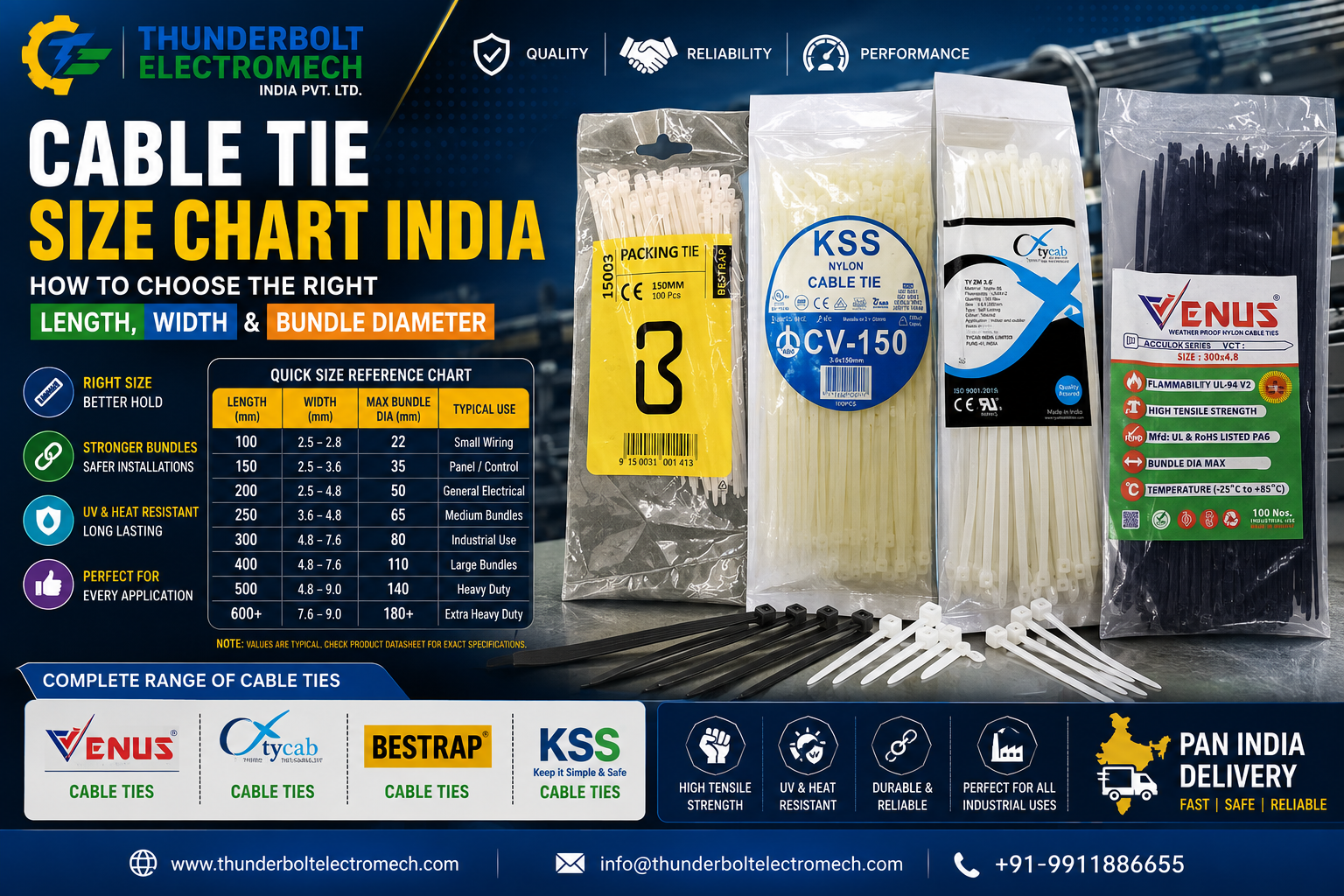
Cable Tie Size Chart by Length and Width
The following is a procurement-oriented reference chart, not a universal manufacturer’s specification. Actual bundle capacities vary by brand and design.
| Nominal Length | Common Width Category | Typical Application |
| 75–100 mm | 2.2–2.5 mm | Small wires, sensors, compact harnesses |
| 150 mm | 2.5–3.6 mm | Control wiring, small bundles |
| 200 mm | 2.5–4.8 mm | Panels, equipment wiring |
| 250 mm | 3.6–4.8 mm | Medium industrial bundles |
| 300 mm | 4.6–7.6 mm | Larger harnesses and industrial wiring |
| 400 mm | 4.8–7.6 mm | Large cable groups |
| 500 mm | 4.8–9.0 mm | Heavy industrial bundling |
| 600 mm+ | 7.6–9.0 mm+ | Large bundles, subject to manufacturer specification |
This is deliberately a selection framework rather than a fabricated universal bundle-diameter table.
For example, one KSS 240 × 7.6 mm model has a maximum bundle diameter of 61 mm, while HellermannTyton’s 390 mm × 4.6 mm T50I is specified for up to 85 mm.
Length alone clearly does not tell the whole story.
How to Calculate Required Bundle Diameter
For a roughly circular cable bundle, you can estimate diameter from circumference:
D ≈ C ÷ π
Where:
- D = bundle diameter
- C = measured bundle circumference
Example
Suppose the circumference around a cable group is approximately 157 mm.
Then:
D ≈ 157 ÷ 3.1416 ≈ 50 mm
The engineer should then select a cable tie whose manufacturer-specified maximum bundle diameter exceeds 50 mm, while also checking tensile strength and environmental requirements.
Do not simply calculate:
50 mm × π = 157 mm
and order a 157 mm cable tie.
The tie head and locking mechanism consume usable length, so the manufacturer’s maximum bundle diameter is the final reference.
Which Cable Tie Size Is Best for Electrical Wiring?
There is no universal “best size.”
For small panel wiring, a 100–150 mm tie can be sufficient. For larger control-panel groups, 200–300 mm sizes may be more practical.
The correct selection depends on:
- cable count
- individual cable diameter
- required bend radius
- bundle diameter
- weight
- vibration
- installation environment
- required tensile strength
- future maintenance access
A useful engineering rule is:
Do not compress the bundle simply to make a smaller cable tie fit.
The tie should organize the cables rather than deform them.
100 mm vs 150 mm vs 200 mm Cable Ties
| Size | Best suited for | Main advantage | Main limitation |
| 100 mm | Small wire bundles | Compact and economical | Limited reach |
| 150 mm | Small/medium bundles | Versatile panel size | Not suitable for large bundles |
| 200 mm | Medium bundles | Wider application range | Can be excessive for tiny harnesses |
Case Study 1 — Control Panel Wiring
Engineering scenario — illustrative, not a claimed Thunderbolt customer case.
A control-panel contractor has several groups of 8–12 small control wires. The technician uses a 300 mm tie because it is available in the toolbox.
The bundle stays together, but the long tail creates unnecessary protrusion and the oversized tie head makes routing less neat.
Solution: move to a correctly sized 100–150 mm tie after measuring the actual bundle.
Lesson: Bigger is not automatically better.
300 mm vs 400 mm vs 500 mm Cable Ties
Longer ties become useful when cable bundles become physically larger.
However, industrial buyers should not automatically increase length when the bundle grows. They should also check strap width and tensile strength.
A 500 mm tie with inadequate tensile performance may be less appropriate than a shorter heavy-duty tie with a better mechanical rating.
KSS, for example, separates its product families according to different environmental and performance requirements, while Tycab offers multiple tensile-strength options across its long-length range.
How Much Extra Length Should You Leave?
There is no universal percentage that applies to every cable-tie model.
The practical requirement is simpler:
There must be enough usable strap to pass around the entire bundle and engage the locking head according to the manufacturer’s instructions.
Do not specify an arbitrary “20% extra” or “50 mm extra” rule as an engineering standard.
Better procurement method
Measure the bundle.
Then check:
- Manufacturer maximum bundle diameter.
- Minimum bundle diameter.
- Strap width.
- Minimum loop tensile strength.
- Locking mechanism.
- Environmental rating.
If the bundle is close to the maximum allowable diameter, move to the next suitable size rather than trying to force the tie closed.
How to Select Cable Tie Size for Industrial Cable Bundles
Industrial cable bundles are where procurement shortcuts become expensive.
Step 1 — Measure the actual bundle
Do not estimate from cable count alone.
Ten 6 mm cables and ten 10 mm cables create very different bundles.
Step 2 — Identify the environment
Ask:
- Indoor or outdoor?
- Direct sunlight?
- High temperature?
- Chemical exposure?
- Vibration?
- Fire-performance requirement?
- Marine environment?
- Solar installation?
KSS, for example, publishes dedicated UV-resistant, cold-weather, heat-resistant, solar and flame-retardant families.
Step 3 — Select the tensile rating
For simple wire organization, the required mechanical load may be modest.
For heavy harnesses or applications with vibration, support and movement, tensile strength becomes much more important.
Step 4 — Check cable compatibility
A cable tie should hold the bundle without crushing or cutting into insulation.
Field discussions among electricians also repeatedly highlight the risk of overtightening. One recent electrician discussion specifically described the possibility of a tie tool cutting into cable insulation when excessive tension is applied.
That is community evidence, not a formal engineering standard, but it reflects a real installation risk.
Case Study 2 — Outdoor Solar Cable Routing
Engineering scenario — illustrative.
A solar contractor uses standard natural nylon ties on outdoor cable routes because they cost less.
The installation initially looks fine. The problem appears later: the selected material was not appropriate for prolonged UV exposure.
Solution: specify a manufacturer-designated UV-stabilized cable tie rather than choosing solely by length and price.
HellermannTyton explicitly distinguishes UV-stabilized PA66W ties from standard PA66 ties and identifies UV-stabilized products for outdoor use.
Engineering lesson: environmental specification can be more important than adding 50 mm to the tie length.
Common Cable Tie Size Selection Mistakes
Mistake 1: Buying by length only
A 300 mm tie is not automatically stronger or better than a 200 mm tie.
Mistake 2: Ignoring maximum bundle diameter
The manufacturer’s maximum bundle diameter should take precedence over a rough mathematical estimate.
Mistake 3: Treating width as tensile strength
Width is important, but the datasheet’s minimum loop tensile strength is the better comparison.
Mistake 4: Using standard nylon outdoors
Outdoor applications should use an appropriate UV-stabilized product where specified by the manufacturer.
Mistake 5: Over-tightening
Tight is not the same as correct.
The objective is stable cable retention without damaging insulation.
Mistake 6: Selecting a tie that is too short
Technicians sometimes stretch the tie to make it close. That is not a valid engineering solution.
Mistake 7: Selecting the cheapest tie for every application
Price per piece ignores replacement labour, downtime and premature failure.
Mistake 8: Mixing undocumented brands on critical projects
A project can become difficult to maintain when different unmarked or poorly documented cable ties are installed throughout the same facility.
Real-World Engineering Case Study 3 — Industrial Control Cabinet
Illustrative engineering case, not a claimed Thunderbolt customer installation.
A cabinet contains power, control and instrumentation wires. The installer bundles everything together using one large tie.
The result looks neat, but the arrangement creates three problems:
- Maintenance technicians cannot easily isolate individual circuits.
- Different cable types experience different bending forces.
- A single tie removal requires cutting across a large mixed bundle.
Better solution
Create separate functional bundles:
- power
- control
- instrumentation
- communication
Then select tie size according to each bundle.
This approach costs slightly more in ties but reduces maintenance complexity.
A cable tie is not only a fastening component. It is part of the maintainability design of the electrical system.
Cable Tie Size Selection and Cable Lugs: The Connection Engineers Often Miss
Cable ties and cable lugs do different jobs, but they meet at the same installation boundary.
The tie manages the cable.
The lug terminates the conductor.
If the cable bundle is poorly organized, the cable can reach the lug with excessive bending, pulling or twisting. That can make termination work harder and may affect installation quality.
For power-cable connections, IEC 61238-1-1:2018 covers compression and mechanical connectors for copper and aluminium conductors up to 1 kV and includes mechanical, electrical and short-circuit test requirements.
For installations above 1 kV up to 30 kV, IEC 61238-1-3 addresses compression and mechanical connectors for non-insulated conductors.
This creates a useful procurement chain:
Cable → Cable Tie → Cable Routing → Cable Lug → Terminal → Equipment
When purchasing cable accessories, engineers should therefore consider cable ties and lugs as part of the same termination workflow, even though they are separate products.
For example, TE Connectivity’s compression-lug documentation identifies conductor material, conductor cross-section, lug hole size and crimp technology as selection characteristics.
Why this matters for future procurement
A project purchasing team that standardizes cable accessories can reduce errors by keeping records of:
- cable size
- cable type
- lug type
- lug material
- stud size
- crimping method
- cable-tie size
- tie material
- environmental rating
That information becomes extremely useful during expansion and maintenance.
Customer Problems and Practical Solutions
| Customer Problem | Likely Cause | Better Solution |
| Tie does not close around bundle | Insufficient length | Measure bundle and select higher specified diameter |
| Tie breaks during installation | Wrong tensile class or damaged material | Check minimum loop tensile strength and storage condition |
| Cable insulation gets marked | Excessive tension | Use controlled installation tension |
| Outdoor ties become brittle | Incorrect material/UV protection | Select UV-stabilized product |
| Procurement keeps receiving different sizes | Poor RFQ specification | Specify length × width + material + tensile requirement |
| Large bundle looks secure but moves | Insufficient mechanical capacity | Review tensile strength and fixing arrangement |
| Maintenance takes too long | Oversized mixed bundles | Separate functional cable groups |
| Cable lug termination is awkward | Poor cable routing | Organize bundle before termination and maintain bend requirements |
What Does a Cable Tie Size Chart India Need to Show?
A useful technical chart should include more than length.
At minimum, procurement should request:
Length | Width | Thickness | Material | Minimum Loop Tensile Strength | Maximum Bundle Diameter | Temperature | UV Rating | Colour | Certification
For industrial applications, add:
Installation temperature | Chemical resistance | Flame rating | Mounting type | Tool requirement
That is much more useful than a catalogue containing only “200 mm, 300 mm, 400 mm.”
How a Cable Ties Supplier India Can Help With Project Procurement
Thunderbolt Electromech India Pvt. Ltd. supplies cable ties for industrial and electrical applications and stocks/supplies Venus Cable Ties, while also offering Tycab, Bestrap and KSS Cable Ties.
For a project buyer, the useful part is not simply having four brands available.
The value is being able to compare:
- size
- width
- material
- tensile requirement
- application
- quantity
- delivery requirement
- project standard
A procurement enquiry should therefore include the bundle diameter or cable size, rather than asking only for “cable ties.”
Suggested RFQ format
Required: Nylon cable ties
Application: Industrial electrical panel
Bundle diameter: ___ mm
Required length: To be selected
Minimum tensile strength: ___ N/kgf
Colour: Black/Natural
UV exposure: Yes/No
Quantity: ___ pieces
Preferred brands: Venus / Tycab / Bestrap / KSS
That gives the supplier enough information to recommend the appropriate product rather than guessing.
Evidence and Research Notes
Primary / direct research sources
IEC: IEC 62275:2022 directly defines requirements for cable ties and associated fixing devices used in electrical installations.
KSS: The manufacturer’s current product pages provide material, dimensions, tensile strength, temperature and certification information for its cable-tie families.
Tycab: The manufacturer’s current website provides Nylon 66 material information, size range, tensile options and application information.
IEC 61238: Direct IEC information supports the cable-lug section concerning compression and mechanical connectors.
Secondary / commercial evidence
Venus dimensions and ranges cited above were located through commercial Indian supplier listings rather than a direct Venus manufacturer catalogue.
Community research
Reddit discussions were reviewed for practical installer concerns, particularly overtightening and cable-insulation damage. These are field opinions and experiences, not standards evidence, and have been treated accordingly.
No-direct-found labels
- Venus: No direct manufacturer technical datasheet for the complete current size matrix was found in this research.
- Bestrap: Direct brand-family information was found, but not a complete current size-by-size technical table.
- Universal bundle-diameter chart: No single universal chart should be treated as valid across all manufacturers because maximum bundle diameter depends on the tie design.
FAQs
1. What does 200 × 4.8 mm mean on a cable tie?
It normally indicates approximately 200 mm overall length and 4.8 mm strap width. It does not indicate a 200 mm bundle diameter.
2. How do I calculate cable tie bundle diameter?
Measure the circumference around the complete bundle and divide it by π:
Bundle diameter ≈ circumference ÷ 3.1416
Then compare the result with the manufacturer’s specified maximum bundle diameter.
3. Is a longer cable tie always better?
No. Longer length only provides greater wrapping reach. You still need suitable tensile strength, material, width and environmental performance.
4. Which is better: 200 mm or 300 mm cable ties?
Neither is universally better. Choose according to actual bundle diameter and the manufacturer’s maximum specified bundle capacity.
5. Can I use natural nylon cable ties outside?
Do not assume that standard natural nylon is suitable for prolonged outdoor UV exposure. Use a product specifically identified by its manufacturer as UV stabilized when the application requires it.
6. What is the difference between Nylon 6 and Nylon 66 cable ties?
They are different polymer materials with different engineering characteristics. Tycab identifies its standard cable ties as Nylon 66, while Bestrap is identified as Nylon 6.
For critical applications, compare the actual manufacturer’s temperature, tensile, environmental and certification data instead of choosing solely from the polymer name.
7. Can cable ties damage electrical wires?
Yes, improper installation can create a problem. Excessive tension can concentrate pressure on the cable jacket or insulation. Field electricians also report this concern when using high-tension tools.
8. What is minimum loop tensile strength?
It is a mechanical performance value used to describe the load capacity of the closed cable tie loop under the applicable test method. KSS, for example, specifies 534 N for its CV-240LB product.
9. Are black cable ties better than white cable ties?
Not simply because of colour. Black ties are often manufactured with UV-stabilizing additives, but the buyer should confirm the actual product specification. Tycab’s published information, for example, identifies its black cable ties as UV stabilized for outdoor conditions.
10. Which cable tie is suitable for solar projects?
The selection should consider UV exposure, temperature, cable bundle diameter, tensile requirement and the project’s installation specification. KSS and Tycab both publish product options intended for solar/outdoor applications.
11. Should cable ties be tightened as much as possible?
No. The objective is secure retention without damaging the cable. Where tools are used, use the manufacturer’s recommended installation procedure and tension setting.
12. How do I choose a cable tie for a large industrial cable bundle?
Measure the bundle, determine the maximum diameter, identify the environmental conditions and select a product whose manufacturer-specified bundle diameter and tensile strength meet the application.
13. Are KSS cable ties suitable for industrial use?
KSS offers standard and specialized cable-tie families for industrial applications, including UV-resistant, heat-resistant, cold-weather, flame-retardant and other variants. The exact model should be selected according to the application.
14. Are Tycab cable ties suitable for electrical panels?
Tycab describes its Nylon 66 cable ties for applications including electrical panels, switchgear, solar, telecom and industrial wiring.
15. What information should I give a Cable Ties Supplier India?
Provide:
- cable/bundle diameter
- application
- indoor/outdoor condition
- temperature
- UV exposure
- required colour
- approximate quantity
- preferred brand
- tensile requirement, if specified
- project or client standard
That information allows the supplier to recommend a technically appropriate size instead of simply quoting the cheapest available tie.
16. Can cable ties be used near cable lugs?
Yes, they can be part of cable management around a termination, but they should not be used to impose unacceptable mechanical force on the cable termination. The cable routing should respect the cable manufacturer’s bending and installation requirements.
17. Why should I buy cable ties and cable lugs from the same electrical supplier?
The products perform different functions, but coordinated procurement can make cable-accessory selection easier. The supplier can help align cable size, lug selection, cable routing and cable-tie requirements, particularly on larger electrical projects.
Trust Signal: Thunderbolt Electromech India Pvt. Ltd.
Thunderbolt Electromech India Pvt. Ltd. is a Delhi-based electrical products supplier serving industrial, electrical, contractor and project procurement requirements.
The company supplies Venus Cable Ties, Tycab Cable Ties, Bestrap Cable Ties and KSS Cable Ties, along with other electrical cable-management products and cable accessories.
Phone: +91-9911886655
Registered address: Ground Floor, 3538, Sita Ram Bazar, Delhi, Delhi 110006, India. Public company-registry information lists this address for Thunderbolt Electromech India Private Limited.
For project enquiries, buyers should share the cable diameter, required quantity, application environment and preferred brand so the appropriate cable tie can be selected.
Conclusion: Choose Cable Ties by Engineering Requirement, Not Just Length
A cable tie size chart is useful only when you understand what its numbers actually represent.
200 × 4.8 mm tells you length and width. It does not tell you the maximum bundle diameter, tensile capacity or environmental suitability.
For industrial procurement, the better method is to start with the bundle, not the tie.
Measure the cable group. Calculate or verify the bundle diameter. Check the manufacturer’s maximum bundle diameter. Then compare tensile strength, material, temperature, UV resistance, flame rating and installation method.
For Venus Cable Ties, Tycab Cable Ties, Bestrap Cable Ties and KSS Cable Ties, the available technical information shows why brand-to-brand substitution should not be based on dimensions alone. Tycab specifies Nylon 66 and a broad 75–1200 mm range; Bestrap uses Nylon 6 in its published family information; KSS provides detailed performance-based product families; and Venus is available across a broad Indian-market size range, although a complete direct manufacturer matrix was not found in this research.
The same engineering discipline should continue into cable termination. Cable ties organize the cable, while cable lugs establish the electrical connection. Standards such as IEC 61238 demonstrate that conductor size, connector design, mechanical performance and electrical testing all matter in power connections.
For contractors, engineers and purchase managers, the simplest procurement rule is therefore:
Specify the bundle diameter. Specify the environment. Specify the required performance. Then select the cable tie.
That approach produces a better installation than choosing a cable tie merely because it is longer, cheaper or already available in the warehouse.
For cable tie sizing, brand comparison and bulk project requirements, Thunderbolt Electromech India Pvt. Ltd. can be contacted at +91-9911886655.