By Thunderbolt Electromech India Pvt. Ltd. — Delhi-based Manufacturer of Ambica Lugs and Supplier of Dowells lugs
📞 +91-9911886655 | ✉️ info@thunderboltelectromech.com | 🌐 thunderboltelectromech.com | 📍 Shop No. 3538, Sitaram Bazar Rd, Bazar Sirkiwalan, Chawri Bazar, Chandni Chowk, Delhi – 110006
Quick Answer: Cable glands usually do not fail because the gland body suddenly becomes defective. Water ingress is more often created by a mismatch between the cable, gland, enclosure entry, sealing interface and installation method.
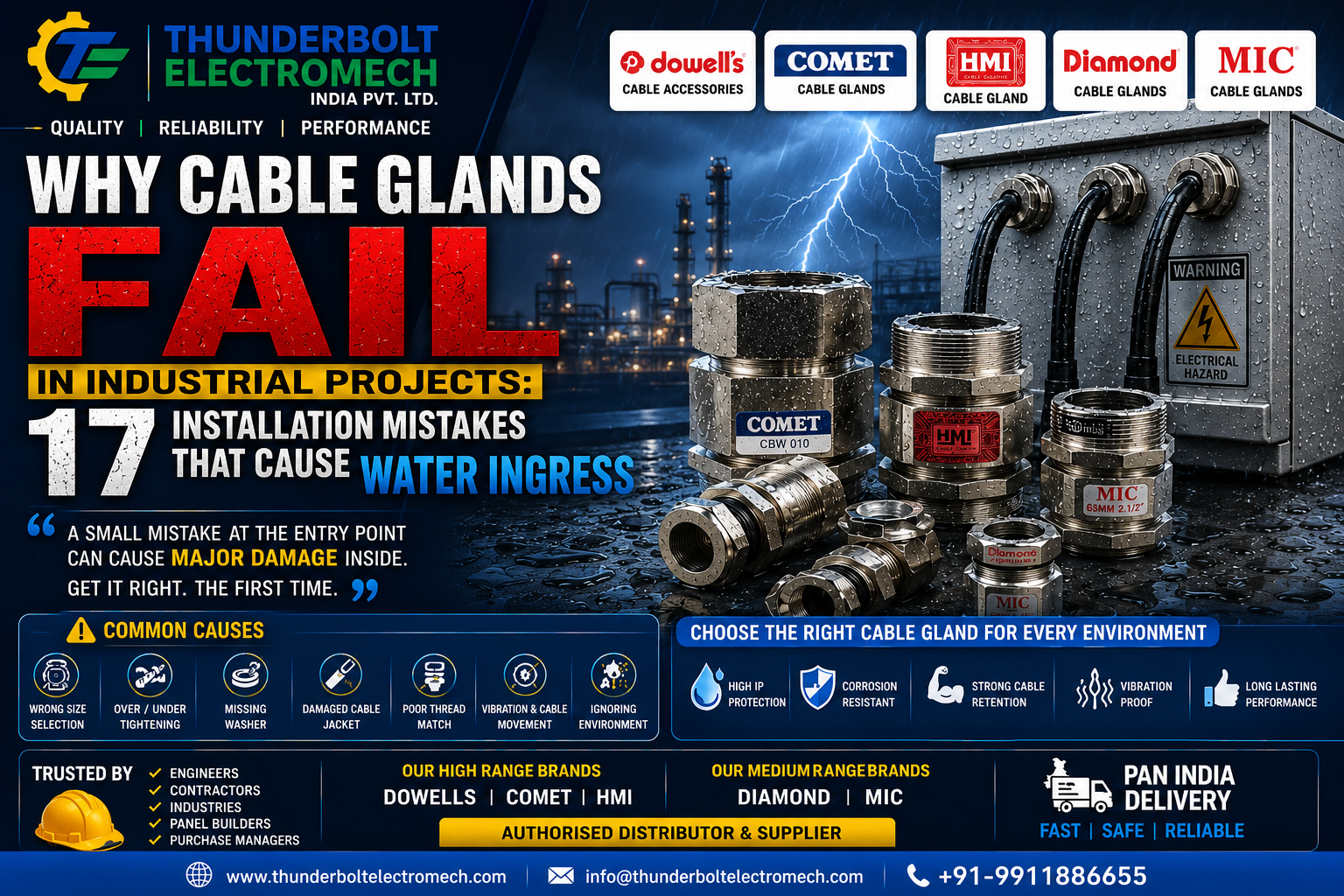
The highest-risk mistakes are using the wrong cable diameter range, mixing thread standards, omitting the entry seal, damaging the rubber seal, over-tightening or under-tightening the compression nut, making a poor enclosure hole, leaving unused entries open, selecting an unsuitable gland for the cable construction, allowing vibration to loosen the assembly, and assuming that an IP rating on the gland automatically guarantees the same IP rating for the complete enclosure.
IEC 62444 treats cable glands as complete components subject to construction and performance requirements, while manufacturer installation guidance specifically identifies sealing, cable dimensions, thread interfaces and armour termination as critical parts of installation integrity.
The practical answer: specify the gland from the actual cable OD, cable construction, entry thread, enclosure thickness, environmental exposure and required IP performance, then install and inspect it as a complete sealing system.
Cable Gland Supplier India: Why Installation Details Decide Water Ingress
An industrial cable gland has a deceptively small job description. It must secure the cable, maintain the enclosure’s environmental protection, provide strain relief and, where applicable, maintain armour bonding or earth continuity.
The problem starts when engineers treat it simply as a threaded fitting.
IEC 62444:2010 defines requirements and tests for the construction and performance of cable glands for electrical installations. The standard covers complete cable glands as supplied by the manufacturer or supplier and addresses areas including mechanical and electrical properties, external influences, marking and testing.
That distinction matters on an industrial project.
A gland may have a high advertised IP rating and still leak after installation because the system around the gland is wrong.
The sealing system has several interfaces
Think about a typical cable entry as four separate sealing zones:
- Cable-to-seal interface — the compression element must suit the actual cable OD.
- Gland-to-enclosure interface — the entry thread, washer or O-ring must create the intended seal.
- Thread-to-thread interface — the male and female thread forms must actually match.
- Cable construction/armour interface — armoured cable glands must correctly accommodate the armour and sealing arrangement.
CMP’s installation guidance makes this especially clear. For parallel threaded entries, the manufacturer specifies the use of an entry-thread sealing washer for higher IP levels, while clearance holes also require an appropriate sealing washer. Tapered threads behave differently and should be installed according to the manufacturer’s instructions.
So the common site argument — “The gland is IP68, therefore water cannot enter” — is incomplete.
The correct question is:
Was the installed cable-entry assembly configured in the way that allows the claimed protection to be maintained?
IP rating is not a magic number
The IP code describes protection against ingress under defined test conditions. It does not mean that every installation containing an IP-rated gland automatically achieves the same enclosure rating.
This becomes particularly important when an enclosure has multiple cable entries.
For example, suppose a panel has 20 cable entries. Nineteen may be perfectly installed. One unused hole is left open or one gland has a damaged sealing washer. The enclosure’s practical environmental integrity can then be compromised through that single weak point.
Engineering insight: in a multi-entry panel, the sealing performance is effectively constrained by the weakest entry.
That is why purchase specifications should not stop at:
“Supply IP68 cable glands.”
A stronger RFQ states:
- Cable OD range
- Cable type
- Armoured/unarmoured construction
- Entry thread
- Enclosure wall thickness
- Required IP performance
- Material
- Environmental exposure
- Required accessories
- Quantity
- Applicable certification, where relevant
Thunderbolt Electromech’s existing cable-gland range includes Dowells, Comet and HMI in its higher-range offering and Diamond and MIC for its medium-range requirement, according to the company’s supplied product range for this cluster.
Cable Gland Supplier India: 17 Installation Mistakes That Cause Water Ingress
The following list is deliberately practical. These are the points an engineer should inspect when a panel, junction box or outdoor enclosure starts showing moisture around cable entries.
1. Choosing the gland from nominal cable size instead of actual cable OD
This is one of the most important mistakes.
A cable described as a particular conductor size does not automatically tell you the exact finished outer diameter. Different cable constructions can have different sheath dimensions.
Comet’s published selection guidance specifically instructs users to select the appropriate gland using actual cable dimensions or the specified cable data.
Solution: Measure the finished cable OD at the termination point and compare it with the manufacturer’s gland sealing range.
Evidence status: Direct manufacturer evidence found.
2. Selecting a gland whose compression range barely covers the cable
A gland may technically accept a cable while providing little useful compression margin.
If the cable is near the extreme edge of a sealing range, installation tolerances, jacket variation and long-term movement can become more significant.
Solution: Do not choose by nominal size alone. Check the actual minimum and maximum sealing range in the product datasheet.
Engineering insight: A good gland selection is not simply “Will the cable enter?” It is “Will the sealing element produce stable compression around the complete cable circumference?”
Evidence status: Direct engineering/manufacturer guidance found for actual cable dimensions; no universal compression-margin value found that applies to every gland design.
3. Mixing Metric, PG, BSP, NPT or other thread forms
Thread mismatch can create a deceptively convincing assembly.
The gland may screw into the enclosure several turns, yet the interface may not be correctly matched.
Comet’s published information identifies multiple thread forms, including BSC/ET, NPT, PG, PF, BSP and metric variants.
Solution: Record the enclosure entry thread before ordering. Never assume that similar-looking threads are interchangeable.
Evidence status: Direct manufacturer evidence found.
4. Forgetting the enclosure-side sealing washer
The compression seal around the cable is not the same thing as the seal between the gland and enclosure.
For parallel-threaded entries, CMP states that sealing washers are required for maintaining higher IP levels; its guidance similarly identifies washers for clearance-hole applications.
Solution: Check whether the selected gland requires an O-ring, nylon washer or another specified interface seal.
Evidence status: Direct manufacturer installation evidence found.
5. Using a damaged, cut or distorted sealing insert
A sealing insert can be damaged during assembly or storage.
A small cut might not leak immediately during a visual inspection. Under rain, spray, vibration or thermal cycling, however, the defect can become a leakage path.
Solution: Inspect the seal before installation. Reject components with cuts, deformation, contamination or obvious deterioration.
Evidence status: Direct primary product-test principle; no universal field failure percentage found.
6. Over-tightening the gland
“More tight” is not equivalent to “more waterproof.”
Excessive compression can deform the sealing element, damage the cable jacket or distort plastic components.
Manufacturers therefore specify installation procedures rather than simply asking installers to tighten as hard as possible.
Solution: Follow the exact manufacturer’s assembly instructions and torque requirements where specified.
Evidence status: Direct manufacturer installation guidance found.
7. Under-tightening the compression nut
The opposite problem is just as serious.
If the compression element does not develop sufficient contact pressure, the gland may provide cable retention without producing the expected environmental seal.
Solution: Use the manufacturer’s tightening procedure. Where a torque specification exists, use a calibrated torque tool rather than relying only on hand feel.
Evidence status: Direct installation guidance found; exact torque is product-specific.
8. Cutting or damaging the cable sheath at the gland
The cable jacket is part of the sealing surface.
A screwdriver slip, knife cut or excessive stripping can create a defect exactly where the gland is expected to seal.
Solution: Strip only what the gland’s installation instructions require. Keep the sealing area smooth and undamaged.
Evidence status: Engineering inference from the sealing mechanism; no single universal failure statistic found.
9. Installing the gland on a rough or badly finished enclosure hole
A poorly punched hole can leave burrs, sharp edges or an uneven sealing surface.
That can damage an O-ring or prevent the gland shoulder from seating correctly.
Solution: Deburr the hole, verify the hole diameter and inspect the seating surface before installing the gland.
Evidence status: Direct installation guidance from industry sources; no universal permissible roughness value found across gland types.
10. Ignoring enclosure wall thickness
An enclosure can be physically compatible with the gland thread while still being unsuitable for the gland’s intended installation arrangement.
Wall thickness affects thread engagement, gland projection and the ability of sealing accessories to seat correctly.
Solution: Include enclosure material and wall thickness in the gland-selection sheet.
Evidence status: Direct engineering guidance found; exact minimum engagement is product-specific and should not be generalized.
11. Leaving unused cable entries open
This mistake is surprisingly easy to make during project modifications.
A panel may have spare holes for future cables. If those entries remain open, the enclosure’s environmental protection is compromised.
Purpose-designed stopping plugs exist specifically to close unused entries while maintaining specified ingress protection.
Solution: Use compatible blanking/stopping plugs rated for the required application.
Evidence status: Direct product evidence found.
12. Routing the cable upward into the gland without controlling water paths
Even a sealed entry can be exposed to water that collects around the cable.
Cable routing influences whether rainwater runs directly toward the entry point.
Solution: Where installation geometry permits, route cables so that water does not naturally drain toward the enclosure entry. Use suitable drip loops or cable support where required by the installation design.
Evidence status: Engineering design guidance; no direct universal test result found for every installation geometry.
13. Allowing the cable to pull sideways on the gland
A cable should not use the gland as its only structural support for a large unsupported cable length.
Vibration and side loading can transfer mechanical forces to the sealing interface.
Community engineering discussions also identify vibration and gland rotation as concerns in demanding installations.
Solution: Support heavy cables separately and keep the gland primarily responsible for entry sealing and appropriate cable retention.
Evidence status: Peer engineering evidence + mechanical engineering reasoning; no universal fatigue-life figure found.
14. Failing to account for vibration
Pumps, motors, compressors and industrial machinery generate vibration.
A connection that remains tight during commissioning can gradually change under repeated mechanical loading if the gland and mounting arrangement are poorly selected.
CMP highlights the importance of avoiding self-loosening in cable-gland armour clamping and maintaining reliable cable security.
Solution: For vibration-prone equipment, specify suitable gland construction, support the cable correctly and include gland condition in preventive maintenance inspections.
Evidence status: Direct manufacturer evidence + peer engineering discussion.
15. Using the wrong gland construction for armoured cable
Armoured cables require more than a simple cable-jacket seal.
The armour must be properly terminated where the gland design requires it, and the assembly may also need appropriate sealing accessories.
CMP specifically discusses armour clamping and the relationship between proper termination and reliable earth continuity.
Solution: Select the gland against the actual armour type, cable construction and applicable installation requirements. A gland must match the actual cable outer diameter. For the calculation and selection method, see Cable Gland Size Selection Explained.
Evidence status: Direct manufacturer evidence found.
16. Assuming IP68 automatically means protection against every water exposure
This is an important specification mistake.
IP ratings are test classifications, not universal promises against every combination of pressure, jet direction, immersion, chemicals and mechanical damage.
Even IPX5/IPX6 and IPX7/IPX8 address different water exposure conditions; one rating should not casually be treated as a substitute for every other test condition.
Solution: Match the required IP performance to the actual environment — rain, washdown, water jets, immersion or other exposure — and confirm the complete installed arrangement.
Evidence status: Primary standard framework + engineering interpretation.
17. Buying on price before defining the application
A low-cost gland can appear attractive in a quotation comparison.
But the purchasing comparison changes dramatically when the project requires:
- Specific cable OD
- Armoured cable termination
- Outdoor exposure
- High ingress protection
- Vibration resistance
- Correct thread standard
- Suitable material
- Required accessories
- Certification
Solution: Ask suppliers to quote against a technical schedule rather than a product name alone.
This is where a technically capable Cable Gland Supplier India can add value beyond simply supplying boxes.
Evidence status: Commercial/engineering recommendation; no direct universal cost-of-failure dataset found.
Cable Gland Supplier India: Selection Comparison for Industrial Projects
A purchase manager should avoid comparing cable glands only by price per piece.
| Selection factor | Basic purchasing approach | Engineering approach |
| Cable size | Nominal conductor size | Actual finished cable OD |
| Thread | “Same size” assumed | Metric/PG/NPT/BSP/etc. verified |
| Water protection | IP number only | Complete installed assembly evaluated |
| Enclosure | Hole diameter only | Hole + wall thickness + sealing surface |
| Cable type | Power/control | Armoured/unarmoured + construction |
| Environment | Indoor/outdoor | Water, dust, chemicals, UV, vibration, temperature |
| Accessories | Optional | Washer, locknut, shroud, earth tag, stopping plug as required |
| Installation | Tighten manually | Manufacturer procedure + specified torque |
| Testing | Visual inspection | Inspection + appropriate enclosure/IP validation |
| Supplier selection | Lowest price | Technical fit + genuine product + availability |
How Thunderbolt’s range fits the buyer’s decision
Thunderbolt Electromech is a Delhi-based electrical-products supplier serving industrial and commercial requirements.
For this cluster, the company states that it supplies:
- Dowells Cable Glands — higher-range requirement
- Comet Cable Glands — higher-range requirement
- HMI Cable Glands — higher-range requirement
- Diamond Cable Glands — medium-range requirement
- MIC Cable Glands — medium-range requirement
The Thunderbolt website also publicly identifies cable glands as one of its product categories and lists Dowell’s, HMI and Comet among its cable-gland brands. (Thunderbolt Electromech)
Important: The exact gland model should still be selected from the actual cable specification and the current manufacturer’s datasheet. No direct public product-level datasheet was found in this research pass that verifies every model in Thunderbolt’s stated range against a single IP/torque specification.
Customer Problem 1: “Water is entering around the gland.”
Likely causes:
- Incorrect cable diameter range
- Missing washer
- Damaged seal
- Incorrect thread
- Poor hole finish
- Loose compression nut
- Gland not seated correctly
Recommended troubleshooting sequence:
- Photograph the external gland and enclosure interface.
- Measure cable OD.
- Check gland model and size.
- Check thread type.
- Remove and inspect sealing components.
- Inspect the enclosure hole.
- Check whether the gland requires a washer or O-ring.
- Reassemble according to manufacturer instructions.
- Test the enclosure as appropriate for the project specification.
Do not immediately replace the gland with another random size.
Customer Problem 2: “The gland looks tight but water still enters.”
This is a classic diagnostic trap.
Tightness of the nut does not prove sealing at the enclosure-to-gland interface.
CMP’s guidance explicitly distinguishes the cable seal from the entry interface and specifies sealing arrangements according to thread and IP requirements.
Solution: Inspect both sealing planes independently.
Customer Problem 3: “The panel worked during commissioning but failed after monsoon.”
These points toward an environmental or mechanical installation issue rather than necessarily a manufacturing defect.
Check:
- Cable routing
- Gland orientation
- Water pooling
- Washer/O-ring condition
- Panel roof/drip arrangement
- Cable support
- Vibration
- Unused entries
- Seal compression
Engineering insight: A commissioning test performed in dry weather does not replicate months of rain, temperature cycling and vibration.
Cable Gland Supplier India: Real Use Cases and Failure Diagnosis
Case Study 1 — Outdoor control panel after monsoon
Observed problem: Moisture appears inside an outdoor control panel after heavy rainfall.
Initial assumption: “The cable gland has failed.”
Investigation path:
The technician checks the cable OD and discovers that the installed cable sits close to the edge of the gland’s usable sealing range. The panel entry also lacks the specified sealing interface.
Root cause: The problem is not simply the gland body. The installation configuration is incomplete.
Corrective action: Replace the incorrect sealing arrangement, verify the gland against the actual cable OD and inspect all other entries.
Research status: Engineering case model based on documented failure mechanisms; not presented as a Thunderbolt customer incident.
Case Study 2 — Motor junction box with vibration
Observed problem: A gland gradually rotates and the enclosure develops an environmental leak.
A similar concern appears in an AskEngineers discussion where the question focused on glands loosening or rotating under vibration. The community response emphasized appropriate gland construction, installation sequence and sealing locknut arrangements rather than simply adding adhesive.
Engineering lesson: Do not use thread-locking chemicals as an automatic substitute for correct mechanical design. Compatibility with gland materials also matters.
Corrective action:
- Verify gland construction.
- Verify locknut/interface arrangement.
- Support the cable.
- Inspect vibration sources.
- Follow manufacturer installation requirements.
Research status: Peer/community evidence found; not a controlled laboratory study.
Case Study 3 — Water entering through the cable itself
This is the failure mode many troubleshooting teams overlook.
A cable can have a compromised jacket or construction that allows water to travel along internal pathways. In an AskEngineers discussion involving underwater cable leakage, participants described water traveling along the cable after the cable jacket was compromised.
Engineering lesson: If replacing the gland does not eliminate the problem, inspect the cable itself.
The gland cannot repair a damaged cable construction.
Research status: Peer engineering evidence found. No direct universal failure-rate data found.
Thunderbolt’s Product Cluster: Where Cable Glands Fit
For internal linking and commercial topical authority, the cable-gland pillar should not exist as an isolated page.
Thunderbolt’s broader electrical-product cluster includes:
Cable Entry & Cable Management
- Cable Glands
- PVC PG Glands
- PVC Hoods
- Shrink Sleeves
- PVC Flexible Pipe
- Cable Ties
Cable Termination
- Copper Cable Lugs
- Aluminium Cable Lugs
- Aluminium In-Line Connectors
- Copper Reducer Terminals
- Bi-Metallic Terminals
- Tube Terminals
- Pin Terminals
- Fork Terminals
Electrical Safety
- Electrical Rubber Mats
- Electrical Hand Gloves
- Danger Plates
- Lockout Boxes
- Rescue Hooks
- Discharge Rods
- First Aid Boxes
- Shock Treatment Charts
Transformer & Electrical Maintenance
- Silica Gel Breathers
- Silica Gel
- Electrical tapes and insulation products
Thunderbolt’s website publicly lists cable glands, shrink sleeves, PVC hoods, cable ties, electrical rubber mats, silica gel breathers and multiple cable-lug/termination categories. (Thunderbolt Electromech)
Recommended internal-link architecture:
- Cable Gland Supplier India → Cable Lug Supplier
- Cable Gland Supplier India → Heat Shrink Sleeve Supplier
- Cable Gland Supplier India → Cable Tie Supplier
- Cable Gland Supplier India → Electrical Rubber Mat Supplier
- Cable Gland Supplier India → Electrical Hand Gloves Supplier
- Cable Gland Supplier India → Danger Plate Supplier
- Cable Gland Supplier India → Silica Gel Breather Supplier
- Cable Gland Supplier India → Lockout Box Supplier
This creates a logical cluster rather than stuffing unrelated keywords into the article.
FAQ: Cable Gland Installation Questions Engineers and Buyers Ask
1. Why is water entering my electrical panel through a cable gland?
Usually inspect the cable-to-seal interface, gland-to-panel interface, thread compatibility, washer/O-ring, cable diameter, gland tightening and enclosure hole first. A gland’s nominal IP rating does not compensate for an incorrect installation.
2. How do I choose the correct cable gland size?
Measure the actual outside diameter of the finished cable and compare it with the gland manufacturer’s specified sealing range. Do not select solely from conductor cross-section. Comet’s published guidance specifically emphasizes actual cable dimensions.
3. Is IP68 always better than IP66?
Not automatically.
The correct rating depends on the exposure the equipment must withstand. IP classifications correspond to defined test conditions, so the required rating should match the actual environmental requirement rather than simply choosing the largest number.
4. Can I use silicone around a cable gland to stop leakage?
Do not treat silicone as a substitute for selecting and installing the correct gland system. First identify the actual leak path. Adding sealant can hide a poor mechanical interface and complicate future maintenance. For the complete cable gland selection and purchasing framework, see our Cable Gland Supplier India guide.
No direct evidence found for a universal rule that silicone should or should not be used with every cable gland. Follow the gland and enclosure manufacturer’s instructions.
5. Should a cable gland have a sealing washer?
It depends on the gland/thread/enclosure arrangement. CMP specifically recommends appropriate sealing washers for several parallel-thread and clearance-hole configurations where higher ingress protection is required.
6. Can a cable gland become loose because of vibration?
Yes, mechanical loosening is a legitimate design concern in vibration-prone installations. Community engineering discussions specifically raise gland rotation and self-loosening concerns, while manufacturer guidance emphasizes secure cable and armour termination. (Reddit)
7. Why does my gland leak even though it is tightly tightened?
Because the cable seal is only one part of the system. The enclosure interface, thread, washer/O-ring, hole geometry and cable size can still create a leak path.
8. Can I use the same cable gland for different cable diameters?
Only if all those cable diameters fall within the manufacturer’s specified sealing range and the cable construction is compatible with the gland.
9. What happens if the cable gland is too large?
The sealing element may not compress sufficiently around the cable, potentially compromising environmental protection and cable retention.
10. What happens if the gland is too small?
The seal can be excessively compressed and the cable jacket may be damaged. Select according to the manufacturer’s permitted cable range rather than forcing the cable through.
11. Why should unused panel holes be closed?
An unused entry is an open path into the enclosure. Purpose-designed stopping plugs are available to close unused entries while preserving specified ingress protection.
12. Can I use a cable gland without a sealing washer?
That depends on the thread and required IP performance. For several high-IP parallel-thread and clearance-hole applications, manufacturer guidance calls for an appropriate sealing washer. (CMP Products)
13. Does the cable gland maintain earth continuity for armoured cables?
An appropriate armoured gland is designed to terminate the armour and provide the required electrical/mechanical continuity. The exact method depends on gland construction and cable type. CMP identifies effective armour clamping as important to reliable earth continuity.
14. What should I tell a Cable Gland Supplier India before requesting a quotation?
Send:
- Cable manufacturer/type
- Actual cable OD
- Armoured or unarmoured construction
- Number of cores
- Cable size
- Entry thread
- Enclosure wall thickness
- Material requirement
- Indoor/outdoor application
- IP requirement
- Quantity
- Required accessories
- Certification requirement, if applicable
This allows the supplier to recommend an actual product rather than guessing from a catalogue picture.
15. Are Comet Cable Glands suitable for industrial applications?
Comet’s published information covers heavy-duty, weatherproof, flameproof and nylon cable-gland ranges, with selection based on actual cable dimensions and application requirements. (M.J. Traders)
The exact model should be selected according to the cable, environment and required certification.
16. How should I compare Dowells Cable Glands with other brands?
Compare the specific model, not just the brand name. Review cable range, gland construction, thread, sealing system, material, IP performance, cable type, accessories and certification against your project specification.
17. Where can I buy Comet Cable Glands, Diamond Cable Glands, Dowells Cable Glands and HMI Cable Glands in India?
Thunderbolt Electromech India Pvt. Ltd. supplies the stated range for industrial and commercial requirements, with higher-range options including Dowells, Comet and HMI and medium-range options including Diamond and MIC.
For a quotation, send the cable OD, gland type, thread, quantity and application details.
Quora research note: Quora was searched as part of the requested community-source review, but direct Quora pages were not accessible to the research system in this pass. Therefore, no direct Quora claim has been presented as evidence. The FAQ instead uses recurring technical questions plus accessible Reddit/engineering discussions.
Research & Evidence Map
For this pillar page, the evidence has been separated into three levels.
Primary research / standards
IEC 62444:2010 — Cable glands for electrical installations
Evidence: Direct primary standard source. It establishes requirements and tests covering cable-gland construction and performance.
Primary manufacturer engineering guidance
CMP’s installation guidance provides direct technical information on:
- Entry sealing
- Parallel versus tapered threads
- Sealing washers
- IP protection
- Armour clamping
- Earth continuity
- Cable dimensions and installation integrity
Secondary / peer evidence
Reddit/AskEngineers discussions were used only to identify real-world troubleshooting themes such as:
- Water travelling through damaged cable construction
- Vibration and gland rotation
- Practical cable-gland selection concerns
Important: These are peer observations, not controlled engineering studies.
No direct evidence found
The following claims should not be presented as universal numerical facts unless Thunderbolt or the relevant manufacturer supplies supporting documentation:
- A universal percentage of cable-gland failures caused by each mistake
- One universal cable-gland tightening torque
- One universal minimum thread engagement for all gland models
- A universal service life for every cable gland
- A universal IP68 water-depth/time condition applicable to every product
- A universal claim that one brand is technically superior to another
That distinction is important for an engineering-facing commercial page.
Buyer Checklist: Before Ordering Cable Glands
A purchase manager can send this checklist to the supplier with the RFQ:
Cable information
- Cable OD: ______ mm
- Cable type: ______
- Armoured/unarmoured: ______
- Cable size: ______
- Number of cores: ______
Enclosure information
- Entry thread: ______
- Hole size: ______
- Enclosure thickness: ______ mm
- Material: ______
Environment
- Indoor/outdoor
- Rain exposure
- Washdown
- Dust
- Chemical exposure
- Vibration
- Temperature
Gland requirements
- Brand/model: ______
- Material: ______
- IP requirement: ______
- Certification: ______
- Accessories: washer / locknut / shroud / earth tag / stopping plug
- Quantity: ______
This simple RFQ structure eliminates many of the errors that later appear to be “gland failures.”
Thunderbolt Electromech India Pvt. Ltd.
Delhi-based electrical product supplier serving industrial, contractor and project procurement requirements.
Cable Gland Range: Dowells, Comet, HMI, Diamond and MIC
Phone: +91-9911886655
Email: info@thunderboltelectromech.com
Registered Address: Ground Floor, 3538, Sita Ram Bazar, Delhi, Chandni Chowk, North Delhi, Delhi – 110006. The registered-company address is independently listed in public corporate records.
For quotation: Share the cable OD, cable type, thread, application, IP requirement and quantity. This allows Thunderbolt’s team to identify the appropriate gland rather than quoting from cable size alone.
Conclusion: Why Cable Glands Fail in Industrial Projects
Most cable-gland water-ingress problems are not mysterious. They occur at interfaces.
The wrong cable diameter creates poor compression.
The wrong thread compromises the enclosure interface.
The missing washer creates another leak path.
The damaged sheath defeats the sealing surface.
The unsupported cable transfers mechanical load into the gland.
The open spare hole defeats the enclosure’s protection.
And the wrong IP assumption can leave an engineer confident about a specification that the installed assembly does not actually satisfy.
That is why selecting a Cable Gland Supplier India should not be reduced to comparing price per piece.
For an industrial project, the supplier should be able to work from the actual cable OD, cable construction, thread, enclosure, environment, IP requirement and accessories. Thunderbolt Electromech’s range covering Dowells Cable Glands, Comet Cable Glands, HMI Cable Glands, Diamond Cable Glands and MIC Cable Glands gives purchase teams multiple options across the stated higher- and medium-range requirements.
The better buying question is not:
“Which cable gland is cheapest?”
It is:
“Which complete cable-entry system will remain mechanically secure and environmentally sealed under the conditions in which this equipment will actually operate?”
That question leads to better specifications, fewer installation mistakes and much easier troubleshooting when the plant is finally exposed to rain, washdown, dust and vibration.
Need help selecting the right cable gland?
Contact Thunderbolt Electromech India Pvt. Ltd. at +91-9911886655 or info@thunderboltelectromech.com with the cable OD, cable type, thread, IP requirement and quantity.