

By Thunderbolt Electromech India Pvt. Ltd. — Delhi-based Manufacturer of Ambica Lugs and Supplier of Dowells lugs
📞 +91-9911886655 | ✉️ info@thunderboltelectromech.com | 🌐 thunderboltelectromech.com | 📍 Shop No. 3538, Sitaram Bazar Rd, Bazar Sirkiwalan, Chawri Bazar, Chandni Chowk, Delhi – 110006
Quick Answer: If you are selecting an aluminium cable lug, do not choose it only by cable size or price. Match the lug to the conductor material, conductor construction, cross-sectional area, termination equipment, connection material, installation environment and applicable testing requirements.
For an aluminium conductor terminating into an aluminium-compatible equipment connection, an aluminium compression lug can be appropriate. For copper conductors, use a correctly sized copper lug. When an aluminium conductor must terminate onto copper equipment, a bimetallic lug is usually the more appropriate engineering solution because the interface has to address the aluminium-to-copper material transition.
This distinction matters because the lug is not simply a piece of metal with a hole at one end. It is the electrical and mechanical transition between the conductor and the equipment terminal. A poor fit can create resistance, localized heating, mechanical weakness and premature failure.
For Indian buyers, the supplier should therefore be evaluated on material, dimensions, conductor compatibility, manufacturing consistency, crimping requirements, documentation, availability and application support—not merely Cable Lug Price India.
BIS’s current material on IS 8309 is particularly useful for aluminium tubular terminal ends: the standard covers compression-type tubular terminal ends for aluminium conductors of insulated cables up to and including 11 kV, with requirements covering material, dimensions and tests such as visual/dimensional examination, flattening and electrical conductivity.
Introduction
Cable termination looks simple until a high-current circuit begins to behave differently from the design expectation.
A cable may have the correct cross-sectional area. The breaker may be correctly rated. The panel may be properly fabricated. Yet a termination can still become the weak point if the lug does not match the conductor, the crimp is poorly executed, the contact surface is unsuitable, or the interface between dissimilar metals has not been considered.
That is why the choice of a Cable Lug Supplier India should begin with engineering requirements rather than catalogue browsing.
The market contains copper, aluminium and bimetallic lugs; standard and long-barrel constructions; tubular and specialised designs; ring terminals and other cable termination products. Thunderbolt Electromech’s current product range includes aluminium tubular terminals, long-barrel terminals, XLPE lugs, inline lugs, copper and aluminium termination products, and bi-metallic terminals. (Thunderbolt Electromech)
The company also supplies related electrical connection products such as cable glands, cable ties, heat-shrink sleeves and electrical safety products, allowing procurement teams to consolidate several cable-accessory requirements. (Thunderbolt Electromech)
The more important question, however, is:
Which lug should you actually specify?
The answer depends on the conductor and the termination—not on the word “aluminium” appearing in the product title.
What Is an Aluminium Cable Lug?
An aluminium cable lug is a termination component designed to connect an aluminium conductor to another electrical or mechanical connection point.
Its basic geometry normally contains two functional regions:
- Cable-entry/barrel section – receives the stripped conductor.
- Palm/terminal section – provides the hole or interface through which the lug is secured to a busbar, stud, terminal or equipment connection.
The barrel must accommodate the conductor correctly. The palm must provide a suitable mechanical and electrical interface.
This is why a lug is a system component, not an isolated accessory.
The Indian standard documentation for IS 8309 describes tubular terminal ends, also commonly called lugs, as components used to make electrical connections to other circuit components. It specifically emphasizes appropriate material and dimensions for good electrical connection and durability. (Bureau of Indian Standards)
Why aluminium needs careful termination
Aluminium has different physical and electrochemical characteristics from copper. Its electrical conductivity is lower than copper, and its oxide layer is electrically problematic at a poorly prepared interface.
That does not make aluminium unsuitable.
It means the termination has to be engineered correctly.
The lug should provide the required conductor accommodation, mechanical compression and stable contact arrangement. Where aluminium connects to copper equipment, the material transition also deserves attention.
Cable Lug Supplier India: How Should Engineers Choose Between Aluminium, Copper and Bimetal Lugs?
The first selection question should be:
What conductor material are you terminating?
That question immediately narrows the field.
1. Aluminium lugs
Aluminium Lugs are intended for aluminium conductors and are widely relevant to aluminium power cables and distribution applications.
For a project specifying aluminium conductors, an aluminium tubular compression terminal can be a logical starting point, provided the lug’s dimensions and tested application match the cable construction.
BIS’s IS 8309 documentation specifies aluminium compression-type tubular terminal ends for insulated aluminium conductors and addresses rated voltages up to and including 11 kV. It also identifies requirements around material, dimensions, workmanship and testing.
2. Copper lugs
Copper Lugs are generally selected for copper conductors.
A copper conductor and copper termination can avoid the material transition that becomes relevant when copper and aluminium are joined directly.
But “copper” by itself is not enough information.
The engineer still needs to check:
- conductor cross-sectional area;
- stranded or compacted construction;
- barrel dimensions;
- palm dimensions;
- mounting-hole diameter;
- number and geometry of crimps;
- equipment terminal arrangement;
- current duty;
- environmental exposure;
- applicable standard or project specification.
3. Bimetal cable lugs
A Bimetal Cable Lug Supplier becomes relevant when the conductor and equipment connection involve different metals—for example, aluminium cable to copper busbar or copper equipment terminal.
A bimetallic termination is designed to manage that transition through a purpose-designed interface rather than asking an installer to improvise a copper-to-aluminium connection.
This is an important distinction.
Do not treat a bimetal lug as a premium version of an aluminium lug. It solves a different interface problem.
Aluminium vs Copper vs Bimetal Cable Lugs
| Selection factor | Aluminium lug | Copper lug | Bimetal lug |
| Typical conductor | Aluminium | Copper | Usually aluminium conductor to copper equipment |
| Main advantage | Compatible aluminium termination | Compatible copper termination | Purpose-designed dissimilar-metal transition |
| Typical use | Aluminium power cables | Copper power/control cables | Aluminium cable to copper busbar/equipment |
| Material transition | Low when aluminium-to-aluminium | Low when copper-to-copper | Specifically engineered for transition |
| Main selection concern | Correct aluminium conductor fit | Correct copper conductor fit | Correct conductor + interface combination |
| Installation | Correct crimping is essential | Correct crimping is essential | Correct crimping and interface installation are essential |
| Price | Application dependent | Application dependent | Usually higher due to construction |
| Best selection basis | Cable + terminal compatibility | Cable + terminal compatibility | Cable + cable/equipment metal compatibility |
Engineering insight: the “best” lug is not the one with the highest conductivity on a catalogue sheet. It is the lug that produces a reliable electrical and mechanical transition for the complete termination system.
Cable Lug Supplier India: What Makes Compression Cable Lugs Reliable?
Compression Cable Lugs deserve special attention because installation quality becomes part of the electrical connection.
The lug is mechanically deformed around the conductor using the specified crimping system. The result is intended to create a stable electrical and mechanical connection.
IEC 61238-1-1:2018 establishes test methods and requirements for compression and mechanical connectors for power cables up to 1 kV, covering copper and aluminium conductors over specified cross-sectional ranges.
An earlier IEC 61238-1 publication also established testing requirements for compression and mechanical connectors for power cables up to 30 kV and recognized different application classes, including connectors intended for distribution or industrial networks where high short-circuit stresses can occur.
These standards are valuable because they illustrate a critical point:
Electrical connection performance cannot be judged only from visual appearance.
The Crimp Is Part of the Product
Consider two identical lugs.
One is installed with the correct conductor preparation, approved tooling and correct die sequence.
The other is installed using an unsuitable die or an improvised tool.
They may look similar after installation.
Electrically, mechanically and thermally, they may not behave the same.
This is why a serious Cable Lug Manufacturer India or supplier should be able to explain:
- which conductor sizes the lug covers;
- which cable construction it supports;
- which crimping method applies;
- whether a particular die profile is required;
- how many crimps are required;
- where the crimp locations should be positioned;
- whether the lug is intended for indoor or outdoor use;
- what documentation accompanies the product.
The barrel is not just a tube
An engineer should look at the barrel length and internal geometry as functional parameters.
A longer barrel can provide more crimping area, but that does not automatically mean it is superior. The barrel must correspond to the intended conductor and crimping procedure.
Likewise, forcing a large conductor into a smaller barrel is not an acceptable “tight fit.” It changes the termination geometry and may compromise installation.
IS 8309: A Particularly Important Reference for Aluminium Terminations
For buyers specifying aluminium tubular terminal ends, IS 8309 is one of the most relevant Indian references.
BIS’s material states that IS 8309 covers compression-type tubular terminal ends for aluminium conductors of insulated cables up to and including 11 kV. The documentation also refers to aluminium material Grade 19501 of IS 5082 and standard dimensions for different conductor sizes.
The testing framework includes:
- visual examination and dimensional checks;
- flattening test;
- electrical conductivity test.
The flattening test is an especially useful engineering detail. It relates to whether the terminal end can withstand installation-related deformation without cracking. That is more meaningful than simply saying a lug is “strong.”
Important distinction
Do not write:
“All cable lugs must comply with IS 8309.”
That would be too broad.
The standard specifically concerns compression-type tubular terminal ends for aluminium conductors of insulated cables within its stated scope.
For a procurement team, this distinction matters because the correct standard depends on the product and application.
IS 5082 and Aluminium Electrical Material
BIS’s material for IS 5082:1998 addresses wrought aluminium and aluminium alloys for electrical applications, including chemical composition, mechanical properties and electrical resistivity/conductivity.
BIS also lists IS 5082:1998 within its Scheme-I product certification framework.
This creates an important procurement checkpoint:
Do not ask only “Is the lug aluminium?” Ask what aluminium material specification and manufacturing evidence support the product.
Cable Lug Supplier India: How Do You Select the Correct Size?
Cable size is the starting point.
It is not the complete specification.
An engineer specifying a cable lug should ideally provide the supplier with a termination schedule containing at least:
- conductor material;
- cable size in mm²;
- conductor construction;
- cable type;
- voltage class;
- insulation type;
- equipment terminal material;
- stud/bolt size;
- palm orientation;
- required lug type;
- environmental conditions;
- required standard;
- Crimping system or tool specification.
Example
Suppose a project calls for an aluminium power cable.
A weak procurement description would say:
Aluminium lug – 240 sq mm.
A better specification would identify:
Aluminium conductor, 240 mm², conductor construction, intended termination equipment, required lug geometry, hole diameter, applicable standard, crimping system and project requirements.
That additional information reduces the chance of a technically unsuitable substitution.
Why Cable Size Alone Can Mislead
Two conductors can have the same nominal cross-sectional area while having different construction characteristics.
For example, a compacted stranded conductor and another construction may not present the same effective geometry to the lug barrel.
The lug therefore has to accommodate the actual conductor—not simply the number printed on the cable drum.
BIS’s IS 8309 grouping guidance distinguishes aluminium terminal-end varieties according to conductor configurations, including conventional stranded and compacted XLPE cable applications.
That is a useful lesson for procurement:
The conductor construction belongs in the lug specification.
The Mounting Hole Matters
The cable side gets most of the attention, but the equipment side can create another problem.
The palm hole must suit the equipment stud or bolt.
If the hole is oversized, the connection geometry may not match the equipment manufacturer’s intended arrangement. If it is undersized, the lug simply cannot be installed.
The palm dimensions also matter where clearances, phase spacing, busbar geometry or enclosure dimensions are constrained.
For control panels and compact equipment, these seemingly minor dimensions can become decisive.
Long Barrel vs Standard Barrel
A long-barrel lug can provide additional crimping length, depending on its design.
But do not select it solely because “longer is stronger.”
The correct selection depends on:
- cable construction;
- conductor size;
- available termination space;
- crimping equipment;
- manufacturer instructions;
- electrical/mechanical duty.
Thunderbolt’s current product catalogue includes both aluminium tubular and long-barrel termination options. (Thunderbolt Electromech)
XLPE Cable Applications
XLPE cable installations often require careful matching between conductor construction and lug design.
The supplier should know whether the cable is:
- compacted;
- stranded;
- sector-shaped;
- round;
- aluminium;
- copper;
- single-core;
- multicore.
A lug designed for one conductor geometry should not automatically be assumed suitable for another.
Copper Cable Lug Supplier: When Should You Choose Copper Lugs?
A Copper Cable Lug Supplier should be able to distinguish between conductor compatibility and equipment compatibility.
Copper lugs make sense when the conductor itself is copper and the termination system is designed accordingly.
The selection still requires attention to conductor size and construction.
Copper lugs are particularly relevant for:
- industrial control panels;
- switchboards;
- distribution systems;
- motor connections;
- earthing and bonding arrangements where specified;
- battery and DC systems;
- equipment requiring copper conductors.
However, the engineer should not assume that every copper lug has the same performance.
The lug’s material, plating, dimensions, barrel geometry and manufacturing quality all matter.
When Does a Bimetal Lug Make More Sense?
Imagine an aluminium cable terminating onto a copper busbar.
You now have three materials or interfaces to think about:
- aluminium conductor;
- lug;
- copper equipment connection.
A plain aluminium lug can leave the equipment-side interface as the critical transition.
A copper lug is inappropriate for an aluminium conductor unless the system specifically permits a different connection method.
A bimetal cable lug is designed specifically to address this transition.
That is why a Bimetal Cable Lug Supplier should be part of the procurement conversation for aluminium-to-copper terminations.
Engineering insight
The bimetallic connection should not be evaluated only by its price premium.
Evaluate the cost of the entire interface:
lug + preparation + installation + inspection + thermal reliability + maintenance exposure + failure consequence.
A slightly more expensive correct termination can be less expensive than repeated troubleshooting of an incorrectly specified connection.
Cable Lugs Delhi: What Should Local Buyers Check?
For buyers searching for Cable Lugs Delhi, availability is useful, but local proximity should not replace technical verification.
A Delhi-based supplier can offer an advantage when:
- project deadlines are short;
- replacement parts are needed quickly;
- multiple cable-accessory products must be sourced;
- engineers need help matching lugs to cables;
- procurement requires smaller quantities;
- urgent maintenance requirements arise.
However, the buyer should still request the technical details.
A nearby warehouse cannot compensate for the wrong lug.
Cable Lug Supplier Delhi NCR: How Should Procurement Teams Evaluate Suppliers?
A Cable Lug Supplier Delhi NCR should be assessed against a practical checklist.
Supplier checklist
1. Product identification
Ask for the exact part number or product description.
2. Material
Confirm copper, aluminium or bimetallic construction.
3. Conductor compatibility
Confirm cable material, cross-section and construction.
4. Dimensions
Check barrel length, palm dimensions, mounting-hole size and other critical dimensions.
5. Standard
Ask which standard or manufacturer specification governs the product.
6. Testing/documentation
Request available test certificates, inspection documents or conformity documentation where relevant.
7. Crimping instructions
Confirm required tool, die and crimp sequence.
8. Quantity and availability
Check whether the requested size is actually in stock.
9. Packaging
Cable lugs can be damaged, contaminated or mixed during poor storage and handling.
10. Technical support
A good supplier should be able to ask you questions rather than simply accept “send 100 pieces.”
Electrical Cable Lugs: What Failure Modes Should Engineers Watch?
A cable lug failure does not always begin with a dramatic event.
Often the process is gradual.
A connection develops higher resistance. The resistance produces heat. Heating changes the interface. The cycle repeats.
The result can be thermal damage, insulation deterioration, equipment downtime or, in severe cases, fire.
Common failure pathways
Incorrect lug size
The barrel does not match the conductor.
Solution: verify conductor size and construction against the lug manufacturer’s specified range.
Incorrect crimping
The wrong die or crimping method is used.
Solution: standardize approved tooling and installation instructions.
Poor conductor preparation
The conductor is damaged, contaminated or inadequately prepared.
Solution: establish a controlled termination procedure.
Wrong material combination
An aluminium conductor is terminated into an incompatible copper interface.
Solution: evaluate a bimetallic solution where appropriate.
Loose equipment connection
The lug may be correct but the bolted interface is not properly assembled.
Solution: follow the equipment manufacturer’s connection procedure and specified torque requirements.
Mechanical stress
The cable pulls on the lug.
Solution: provide appropriate cable support so the lug is not being used as a cable restraint.
Electrical Cable Connectors vs Cable Lugs
People often use Electrical Cable Connectors and cable lugs as interchangeable search terms.
They are related, but the application can differ.
A lug typically provides a termination from a cable conductor to equipment, a stud, busbar or terminal.
A connector can also refer to components designed to join conductors or cables together.
For example, Thunderbolt’s current range includes Aluminium In Line Connectors and copper tube in-line connectors in addition to terminal products. (Thunderbolt Electromech)
This distinction is useful in procurement because an engineer requiring a cable-to-cable joint should not automatically order a cable-to-busbar lug.
Cable Terminal Lugs: What Should Be on the Purchase Order?
A technically useful purchase description might look like:
Cable Terminal Lug – Aluminium – for specified conductor size and construction – compression type – specified palm hole – required standard/application – quantity.
For copper:
Cable Terminal Lug – Copper – for specified copper conductor size and construction – compression type – specified palm hole – required standard/application – quantity.
For an aluminium-to-copper interface:
Bimetallic cable terminal lug – aluminium conductor entry with copper equipment interface – specified conductor size – specified mounting-hole dimensions – required application/standard – quantity.
The objective is simple:
Make substitution difficult unless the replacement is technically equivalent.
Cable Lug Price India: What Actually Determines the Cost?
A buyer searching for Cable Lug Price India will find a wide range of prices.
That variation is normal.
Price depends on several variables:
- material;
- conductor size;
- barrel length;
- palm geometry;
- mounting-hole size;
- surface treatment;
- manufacturing process;
- bimetallic construction;
- certification/testing;
- packaging;
- order quantity;
- brand;
- logistics;
- project-specific requirements.
A large aluminium lug requires substantially more material than a small control-circuit terminal. A bimetallic component adds manufacturing complexity compared with a simple single-metal lug.
Thunderbolt’s website currently lists a range of cable-lug and termination products with different prices and variants, illustrating why a single “lug price” is not technically meaningful without specifying the exact product. (Thunderbolt Electromech)
Do not compare price per piece alone
A procurement team should compare:
Unit price + correct fit + installation requirements + documentation + availability + expected service performance.
A cheap lug that requires rework is not cheap.
Customer Problems and Practical Solutions
| Customer problem | Likely cause | Practical solution |
| Lug does not fit cable | Wrong conductor size/construction | Verify cable OD/conductor details and lug range |
| Lug fits but crimp is poor | Incorrect die/tool | Use specified crimping system |
| Aluminium cable terminates on copper busbar | Dissimilar metals | Evaluate bimetallic lug |
| Lug hole does not fit stud | Wrong palm geometry | Confirm hole diameter before purchase |
| Cable overheats at termination | High contact resistance/poor connection | Inspect crimp and bolted interface |
| Supplier offers only a generic “240 sq mm lug” | Incomplete specification | Give conductor, material, construction and interface details |
| Price varies between suppliers | Material/design/brand differences | Compare technical specification, not only price |
| Replacement lug is unavailable during breakdown | Poor inventory planning | Maintain critical termination sizes |
| Multiple accessories come from different vendors | Fragmented procurement | Consolidate cable accessories where technically suitable |
Case Study 1: Aluminium Cable to Aluminium Equipment
Situation
An industrial distribution system uses an aluminium power cable and an aluminium-compatible equipment termination.
Procurement mistake
The team orders a lug solely on the basis of “aluminium, same sq mm.”
Better engineering approach
The team confirms:
- conductor size;
- conductor construction;
- lug barrel;
- palm dimensions;
- hole size;
- crimping method;
- applicable specification.
Result
The termination is selected based on the complete interface rather than a single size number.
Evidence status: Direct standard evidence. BIS directly describes aluminium compression terminal-end requirements and relevant tests under IS 8309.
Case Study 2: Aluminium Cable to Copper Busbar
Situation
An aluminium cable must terminate on copper equipment.
Initial proposal
Use a conventional aluminium lug and bolt it to the copper busbar.
Engineering concern
The cable conductor and equipment interface involve dissimilar metals.
Better approach
Specify a suitable bimetallic termination designed for the aluminium conductor and copper equipment interface.
Lesson
The lug material should be selected according to both ends of the connection.
Evidence status: Engineering inference supported by standards framework. IEC has dedicated requirements concerning connection of aluminium conductors and copper conductors in aluminium-bodied clamping arrangements, demonstrating that dissimilar-metal connections require specific consideration rather than being treated as ordinary same-metal connections.
Case Study 3: Same Cable Size, Different Conductor Construction
Situation
A project has an aluminium cable specified by nominal cross-sectional area.
Procurement shortcut
The purchasing department orders a generic lug with the same nominal mm² number.
Problem
The cable construction does not match the assumed conductor geometry.
Better approach
The engineer provides the conductor construction to the supplier and selects the appropriate terminal variety.
BIS’s IS 8309 implementation material specifically distinguishes terminal-end groupings for different aluminium conductor configurations, including compacted XLPE cable applications.
Lesson
Cross-sectional area is necessary information, but it is not always sufficient information.
Case Study 4: Large Project Procurement
Situation
A contractor needs thousands of cable terminations for a project.
Problem
The purchasing team evaluates suppliers only on unit price.
Better procurement model
The contractor creates a termination schedule with:
- cable size;
- conductor material;
- cable construction;
- lug type;
- palm hole;
- quantity;
- standard;
- crimping method;
- required documentation.
Then suppliers quote against the same specification.
Result
The comparison becomes meaningful.
This is particularly valuable when comparing a Cable Lug Manufacturer India, distributor, dealer and local stockist.
Cable Lug Supplier India: Why the Supplier’s Technical Questions Matter
A supplier that asks questions before quoting is not necessarily making the buying process difficult.
The questions can prevent an incorrect supply.
A technically responsible supplier may ask:
Is the conductor copper or aluminium?
What is the cable size?
Is it compacted?
Is it XLPE?
What is the equipment-side material?
What hole size is required?
Is the termination indoor or outdoor?
What standard is specified in the project?
These questions reveal whether the supplier understands the application.
For a high-value industrial purchase, that conversation is useful.
Thunderbolt Electromech as a Cable Accessory Source
Thunderbolt Electromech India Pvt. Ltd. operates from Delhi and supplies cable accessories and industrial electrical products.
Its current online catalogue shows aluminium cable termination categories including Tubular Type, Long Barrel, XLPE Lug and Inline Lug, along with copper and bimetallic termination products. (Thunderbolt Electromech)
The same product ecosystem includes:
- Cable Glands
- Cable Lugs
- Cable Ties
- Heat Shrink Sleeves
- Electrical Rubber Mats
- Electrical Hand Gloves
- Danger Plates
- Rescue Hooks
- Discharge Rods
- First Aid Boxes
- Fire Buckets
- Silica Gel Breathers
The company’s website also lists cable-gland brands and electrical hand-glove categories, alongside the cable termination range. (Thunderbolt Electromech)
This wider product cluster matters to industrial procurement teams because a cable termination project rarely involves a lug alone.
A complete installation can require:
Cable → Cable Gland → Cable Lug → Heat Shrink Sleeve → Cable Tie → Panel/Equipment → Safety Products
That is a procurement chain, not just a product.
Related Thunderbolt Product Cluster
Cable Glands
Cable glands provide cable entry, mechanical retention and, depending on design, environmental sealing and other functions.
Cable Lugs
Cable lugs establish the conductor-to-equipment termination.
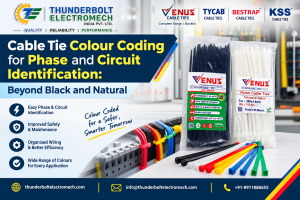
Cable Ties
Cable ties assist cable management and bundling. They should not substitute for proper mechanical cable support where significant cable loads exist.
Heat Shrink Sleeves
Heat-shrink products can provide insulation, identification, protection and other application-specific functions depending on their construction.
Electrical Rubber Mats
Electrical insulating mats provide an insulating surface around designated electrical work areas where appropriate to the installation and safety procedure.
Electrical Hand Gloves
Electrical gloves are part of the personal protective equipment system and must be selected according to the voltage class, applicable requirements and work procedure.
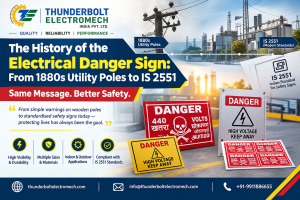
Danger Plates
Danger plates communicate electrical hazards and voltage-related warnings around electrical equipment.
Rescue Hooks
Rescue hooks can support emergency response procedures where specified and should be located and maintained according to the site’s safety plan.
Discharge Rods
Discharge rods are relevant to controlled electrical discharge/earthing procedures in appropriate high-voltage work environments.
First Aid Boxes
First aid equipment supports workplace emergency response.
Fire Buckets
Fire buckets are site fire-safety equipment and should be deployed according to the site’s fire-risk assessment.
Silica Gel Breathers
Silica gel breathers are used with suitable transformer applications to manage moisture in the breathing air path.
The point is not to combine unrelated products into one purchase blindly.
It is to recognize that cable termination reliability sits inside a wider electrical installation system.
How to Inspect Cable Lugs Before Installation
Before installation, the technician or stores team should check:
1. Correct part
Compare the delivered part against the purchase order.
2. Material
Confirm aluminium, copper or bimetal construction.
3. Dimensions
Check barrel and palm dimensions against the approved drawing or catalogue.
4. Surface
Look for cracks, deep scratches, corrosion, contamination or manufacturing defects.
5. Barrel
Check that the entry is clean and suitable for the conductor.
6. Palm
Check mounting-hole size and flatness.
7. Marking
Where applicable, verify manufacturer/product identification and relevant markings.
8. Packaging
Check whether parts are mixed between different sizes.
This sounds basic.
On a large project, it prevents surprisingly expensive mistakes.
Installation: The Crimping Process Deserves Control
A good cable lug can still fail if installation is poor.
A controlled termination procedure should establish:
- correct cable identification;
- correct lug identification;
- correct stripping length;
- conductor preparation;
- correct insertion depth;
- approved crimping tool;
- approved die;
- correct crimp position;
- correct number/order of crimps;
- inspection;
- equipment-side installation;
- required torque or connection procedure;
- final inspection/documentation.
The precise method must follow the lug manufacturer’s instructions and project requirements.
Never improvise the crimp
A common field mistake is selecting a die because it is “close enough.”
It is not.
Crimping tools and dies are part of the termination system.
IEC 61238-1-1’s scope itself reinforces that compression connector performance is evaluated through defined test methods and requirements rather than visual inspection alone.
What Research Says About Aluminium Termination Selection
The most useful research for this subject is not a random blog claiming that one metal is always better.
It is the combination of primary standards, test requirements and application engineering.
Primary source: BIS
BIS’s IS 8309 documentation directly addresses aluminium compression tubular terminal ends and specifies material, dimensions and tests including conductivity and flattening.
Primary source: IEC
IEC 61238-1-1 specifies testing and requirements for compression and mechanical connectors for copper and aluminium power cables up to 1 kV within its stated scope.
IEC’s earlier 61238-1 framework addressed compression and mechanical connectors for power cables up to 30 kV and identified application classes, including high-short-circuit-duty distribution and industrial networks.
Primary source: CEA
The Central Electricity Authority maintains India’s regulatory framework for electrical safety and construction/operation requirements. Its current site lists the 2023 Measures Relating to Safety and Electric Supply Regulations and also records amendments in 2026.
Evidence label: Direct found. These are direct primary regulatory/standards sources.
Evidence limitation: These documents establish requirements and testing frameworks; they do not mean every commercially sold lug automatically complies with every listed standard. Product-specific conformity must be verified from the supplier/manufacturer.
Direct Evidence vs Engineering Interpretation
| Statement | Evidence status |
| IS 8309 covers aluminium compression tubular terminal ends up to and including 11 kV | Direct found – BIS (Bureau of Indian Standards) |
| IS 8309 includes visual/dimensional, flattening and electrical conductivity testing | Direct found – BIS (Bureau of Indian Standards) |
| IS 5082 addresses aluminium material for electrical applications | Direct found – BIS (Bureau of Indian Standards) |
| IEC 61238-1-1 covers compression/mechanical connectors for copper and aluminium conductors within its scope | Direct found – IEC (IEC Webstore) |
| Connector selection must account for conductor material and equipment interface | Engineering interpretation supported by standards (IEC Webstore) |
| Bimetallic terminations can be relevant to aluminium-to-copper interfaces | Engineering interpretation; application-dependent (IEC Webstore) |
| A low-priced lug is not necessarily the lowest-cost termination | Engineering/economic inference; no direct single-source evidence found |
| Correct crimp tooling influences termination quality | Directly supported by compression-connector testing framework; exact tool requirements remain product-specific (IEC Webstore) |
This distinction is important for an authoritative technical article.
Do not turn an engineering inference into a fake standard requirement.
A Practical Buyer Specification Sheet
Before requesting a quotation from a Cable Lug Supplier Delhi NCR, prepare the following:
| Parameter | Example requirement |
| Conductor material | Aluminium |
| Cable size | 240 mm² |
| Conductor construction | Specify actual construction |
| Cable insulation | XLPE, if applicable |
| Lug type | Tubular compression |
| Barrel | Standard/long barrel as required |
| Equipment connection | Copper/aluminium/bimetal-compatible |
| Palm hole | Specify actual stud/bolt size |
| Voltage | Specify project voltage |
| Standard | Project/BIS/IEC requirement |
| Quantity | Required number |
| Crimping system | Specify if fixed by project |
| Documentation | Test/conformity documents as required |
| Delivery | Site/project requirement |
This format reduces vague purchasing.
What Should Engineers Ask an Aluminium Cable Lug Supplier?
Before approving a supplier, ask:
“Which cable constructions does this lug cover?”
Not just “Which sq mm?”
“What material specification applies?”
Especially for large industrial orders.
“What testing has been performed?”
Ask for evidence rather than accepting an unqualified “tested” statement.
“What crimping method should we use?”
A supplier should be able to identify the applicable installation procedure.
“Is this intended for aluminium-to-copper equipment?”
If yes, confirm whether the product is actually intended for that interface.
“Can you supply consistent quantities?”
A project with mixed or substituted lug designs creates installation and maintenance problems.
Cable Lug Price India: How to Compare Quotations Properly
Suppose Supplier A quotes ₹X.
Supplier B quotes ₹X + 15%.
Supplier A looks cheaper.
But now compare:
- material;
- exact dimensions;
- standard;
- manufacturing quality;
- testing;
- crimping requirements;
- packaging;
- availability;
- lead time;
- Replacement support.
The price difference may have a legitimate engineering reason.
The correct procurement method is therefore:
Compare like-for-like technical specifications first. Compare price second.
For repetitive project purchases, a supplier should ideally quote against the same approved specification so that the procurement team can compare actual equivalents.
When Should You Choose an Aluminium Cable Lug?
Choose an aluminium termination when:
- the conductor is aluminium;
- the lug is designed for the actual conductor construction;
- the equipment interface is compatible;
- the application falls within the lug’s rated/design scope;
- the installation method is available;
- the supplier can provide the required documentation.
Do not choose aluminium merely because aluminium is cheaper.
When Should You Choose Copper?
Choose copper when:
- the conductor is copper;
- the lug’s dimensions match the conductor;
- the equipment interface is suitable;
- the product meets the project specification;
- the installation procedure is defined.
Copper can be an excellent choice, but the word “copper” does not eliminate the need for correct sizing and installation.
When Should You Choose Bimetal?
A bimetallic lug deserves consideration when:
- the conductor is aluminium;
- the equipment terminal/busbar is copper;
- the project calls for a purpose-designed transition;
- the termination design and manufacturer documentation support the application.
This is often where the biggest procurement error occurs.
The engineer thinks about the cable.
The termination thinks about both sides.
Final Selection Matrix
| Application | Recommended starting point |
| Aluminium cable → aluminium-compatible equipment | Aluminium lug |
| Copper cable → copper equipment | Copper lug |
| Aluminium cable → copper busbar | Bimetallic lug, subject to application/design |
| Copper cable → aluminium-bodied connection | Evaluate compatible connector/interface design |
| Cable-to-cable joining | Inline connector/jointing solution rather than ordinary terminal lug |
| XLPE aluminium cable | Lug specifically suitable for conductor construction |
| Compact high-current panel | Check palm geometry, clearance and termination space |
| Outdoor installation | Verify environmental and installation requirements |
| Large industrial project | Use approved termination schedule and documented supplier qualification |
Why Thunderbolt Electromech Can Be Considered for Cable Termination Procurement
For businesses searching for a Cable Lug Manufacturer India, Aluminium Cable Lug Supplier, Copper Cable Lug Supplier, or Cable Lug Supplier India, the important consideration is not simply whether a supplier lists the product.
It is whether the supplier can help match the product to the application.
Thunderbolt Electromech’s cable and electrical product range currently includes aluminium tubular terminals, long-barrel terminals, XLPE lugs, inline lugs, copper termination products and bi-metallic terminals. (Thunderbolt Electromech)
The broader catalogue also includes cable glands, electrical hand gloves, electrical rubber mats, discharge rods, rescue hooks, fire buckets, first-aid boxes, silica gel breathers, heat-shrink sleeves and cable ties. (Thunderbolt Electromech)
For industrial procurement, that broader range can be useful when a project requires multiple cable-accessory and electrical-safety items from one Delhi-based source.
Thunderbolt Electromech Contact Details
Company: Thunderbolt Electromech India Pvt. Ltd.
Address: Shop No. 3538, Sitaram Bazar Road, Bazar Sirkiwalan, Chawri Bazar, Chandni Chowk, Delhi – 110006. (Thunderbolt Electromech)
Phone: +91-9911886655
Email: info@thunderboltelectromech.com
Website: thunderboltelectromech.com
The contact page also lists additional phone numbers and email addresses, so procurement teams should verify the preferred contact route when placing orders. (Thunderbolt Electromech)
Frequently Asked Questions
1. What is the best aluminium cable lug for a power cable?
There is no universal “best” aluminium lug. Select one according to conductor size, conductor construction, lug dimensions, equipment interface, installation method and applicable standard.
2. Is an aluminium lug better than a copper lug?
Neither is universally better. The conductor material and equipment connection determine the appropriate choice.
3. When should I use a bimetal cable lug?
Consider a bimetallic lug when an aluminium conductor must terminate onto a copper equipment interface, subject to the manufacturer’s application and project requirements.
4. What is IS 8309?
IS 8309 is an Indian Standard for compression-type tubular terminal ends for aluminium conductors of insulated cables, within its stated voltage and product scope. BIS material states that it covers applications up to and including 11 kV.
5. Does IS 8309 apply to every cable lug?
No. Its scope should be checked before applying it to a particular product. It specifically addresses compression-type tubular terminal ends for aluminium conductors of insulated cables.
6. What information should I give a Cable Lug Supplier India?
Give conductor material, cable size, conductor construction, cable type, equipment connection, mounting-hole requirement, lug type, quantity and applicable project/standard requirements.
7. Why does conductor construction matter?
Because two conductors with the same nominal cross-sectional area can have different geometries. The terminal barrel must accommodate the actual conductor construction.
8. Are Compression Cable Lugs suitable for aluminium cables?
They can be, provided the specific lug is designed and tested for the relevant aluminium conductor and installation method.
9. How does Cable Lug Price India vary?
Price depends on material, size, construction, barrel design, palm dimensions, bimetallic construction, brand, testing/documentation, quantity and logistics.
10. How do I find a reliable Cable Lug Supplier Delhi NCR?
Compare suppliers using technical specifications, product documentation, availability, installation support, consistency and price. Do not select purely by quotation value.
11. What are Electrical Cable Lugs used for?
They terminate conductors onto equipment terminals, busbars, studs and other electrical connection points.
12. Are Electrical Cable Connectors and lugs the same?
Not always. A lug is typically a termination component, while “connector” can include products intended to join conductors or cables. The exact product application should be confirmed.
13. What are Cable Terminal Lugs?
Cable terminal lugs are termination components that connect a cable conductor to equipment or another designated terminal point.
14. What should I check before crimping?
Confirm the correct lug, conductor size and construction, stripping length, insertion depth, approved tool, die, crimp sequence and installation instructions.
15. Can I use any crimping die for an aluminium lug?
No. Use the tool/die arrangement specified for the particular lug and installation system.
16. Why are bimetal lugs more expensive?
They involve a more complex material/interface arrangement designed for applications involving dissimilar metals. The exact cost depends on size, construction and manufacturer.
17. Are Copper Lugs suitable for aluminium cables?
Do not assume so. A lug should be selected for the conductor and complete connection system. Aluminium conductors generally require an appropriate aluminium or purpose-designed bimetallic termination depending on the equipment interface.
18. What should an Aluminium Cable Lug Supplier provide?
At minimum, the supplier should be able to clearly identify product type, conductor compatibility, size range, material, dimensions and installation requirements. Project-specific testing or conformity documents should be supplied where required.
19. Is a long-barrel lug always better?
No. Barrel length should match the conductor, crimping system, available space and application requirements.
20. Why should engineers specify the equipment-side material?
Because the correct termination depends on the interface. An aluminium conductor terminating onto copper equipment presents a different engineering problem from aluminium-to-aluminium termination.
Conclusion: How to Choose the Right Cable Lug Supplier India
Choosing an aluminium cable lug is not a matter of selecting the cheapest component with the same cable-size number printed on the packet.
The correct process is more disciplined.
Start with the conductor material.
Then identify the conductor construction and cross-sectional area.
Next, identify the equipment-side material and terminal geometry.
Then select the correct aluminium, copper or bimetallic lug.
After that, verify the dimensions, applicable standard, testing/documentation and installation procedure.
Finally, evaluate the supplier on technical support, consistency, availability, delivery and total procurement cost.
For aluminium compression terminal ends, BIS’s IS 8309 documentation provides a particularly useful reference because it connects material, dimensions, workmanship and tests such as electrical conductivity and flattening rather than treating the lug as a simple commodity.
IEC’s connector standards provide another important engineering lesson: compression and mechanical connectors should be evaluated through defined requirements and test methods, particularly where power-cable applications and high electrical/mechanical stresses are involved.
And that leads to the simplest procurement rule:
Do not buy the lug that merely fits the cable. Buy the termination that fits the complete electrical connection.
For buyers looking for Cable Lugs Delhi, a Cable Lug Supplier Delhi NCR, Aluminium Cable Lug Supplier, Copper Cable Lug Supplier, or a broader Cable Lug Manufacturer India source, Thunderbolt Electromech provides aluminium, copper and bimetallic termination categories alongside cable glands, heat-shrink sleeves, cable ties and electrical safety products. (Thunderbolt Electromech)For technical enquiries and bulk requirements:
Thunderbolt Electromech India Pvt. Ltd.
Shop No. 3538, Sitaram Bazar Road, Bazar Sirkiwalan, Chawri Bazar, Chandni Chowk, Delhi – 110006
Phone: +91-9911886655
Email:info@thunderboltelectromech.com
[…] tubular, long barrel, XLPE, or inline — since Thunderbolt’s guide on that exact question, Aluminium Cable Lug Supplier India: Which Type Should You Choose?, already walks through that decision in detail. It doesn’t re-explain bimetal lugs or […]