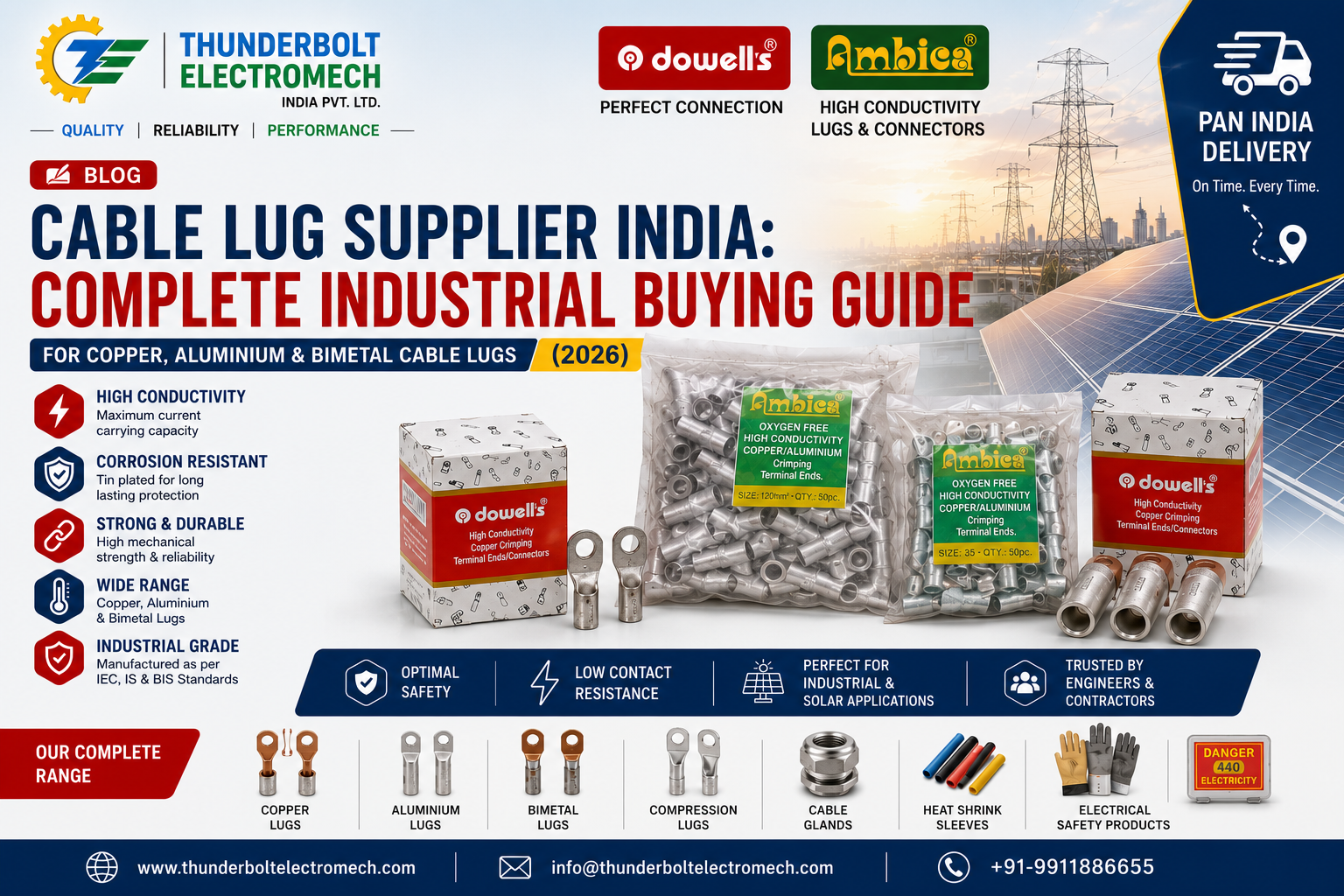
Quick Answer: If you’re looking for a reliable Cable Lug Supplier India, don’t choose based only on price. The right cable lug depends on the conductor material (copper or aluminium), cable size, current rating, termination type, environmental conditions, and compliance with standards such as IEC 61238-1, IS 8309, and relevant BIS specifications. Selecting the wrong lug can increase contact resistance, cause overheating, damage switchgear, reduce equipment life, and even lead to electrical fires.
For most industrial applications:
- Copper Cable Lugs are best for copper conductors because they offer excellent conductivity, mechanical strength, and corrosion resistance.
- Aluminium Cable Lugs are ideal for aluminium conductors used in utility and power distribution systems.
- Bimetal Cable Lugs should always be used when terminating aluminium conductors onto copper busbars or equipment to prevent galvanic corrosion.
- Compression Cable Lugs are the preferred choice for industrial, EPC, utility, renewable energy, and heavy-duty applications because they create a gas-tight, low-resistance connection.
A trusted Cable Lug Supplier Delhi NCR should not only supply products but also provide technical guidance, size selection support, fast delivery, and a complete range of related products such as cable glands, heat shrink sleeves, and electrical safety equipment.
Introduction
Every electrical system, whether it’s a manufacturing plant, transformer yard, metro project, solar farm, data centre, or commercial building, relies on hundreds or sometimes thousands of electrical terminations. While transformers, switchgear, and cables often receive the most attention, experienced engineers know that the reliability of the entire system frequently depends on one small but critical component—the cable lug.
A cable lug is far more than a simple connector. It is the engineered interface that transfers electrical current safely from a conductor to equipment. A poor-quality or incorrectly selected lug can create high resistance, excessive heat, loose connections, vibration failures, and insulation damage. These issues may not appear immediately, but over time they can lead to costly shutdowns, equipment failures, or serious safety hazards.
As industries across India expand and infrastructure projects become more demanding, buyers are searching for more than just a Cable Lug Manufacturer India. They want a supplier who understands industrial applications, supports technical selection, and can deliver complete electrical connectivity solutions. Whether you are sourcing Copper Cable Lugs, Aluminium Lugs, Bimetal Cable Lugs, or Electrical Cable Connectors, choosing the right supplier has a direct impact on project quality, maintenance costs, and long-term reliability.
This pillar guide has been written for engineers, EPC contractors, utilities, panel builders, OEMs, industries, and procurement managers. It answers the most common commercial and technical questions buyers ask before purchasing cable lugs and provides practical engineering insights that go beyond generic product descriptions.
Cable Lug Supplier India: What Are Cable Lugs?
A cable lug, also known as a Cable Terminal Lug or Electrical Cable Lug, is a metallic connector designed to terminate the end of an electrical conductor and provide a secure, low-resistance connection to electrical equipment such as busbars, circuit breakers, transformers, motors, generators, switchgear, and control panels.
Unlike twisting a conductor around a terminal bolt, a properly installed cable lug ensures consistent electrical contact, high mechanical strength, and reliable current transfer over many years of service.
A cable lug consists of three primary parts:
1. Barrel
The barrel receives the stripped conductor and is compressed using a hydraulic or mechanical crimping tool. The quality of the barrel design determines how well the conductor strands are compacted, which directly affects electrical resistance and mechanical pull-out strength.
2. Palm
The palm is the flat section with the mounting hole. It connects to equipment using bolts, nuts, and washers. The palm must provide sufficient contact area to dissipate heat and maintain a stable electrical connection.
3. Inspection Window (where applicable)
Many compression cable lugs include an inspection window that allows installers to verify the conductor has been inserted fully before crimping.
Why Cable Lugs Are Critical in Industrial Electrical Systems
Industrial electrical systems carry high currents under demanding conditions. Even a small increase in contact resistance at one termination point can generate significant heat over time.
For example, in a manufacturing facility operating continuously, a poorly crimped cable lug on a motor feeder may cause localized heating. Thermal cycling can gradually loosen the connection, increasing resistance further. Eventually, this can lead to insulation failure, nuisance tripping, equipment damage, or even fire.
Properly selected and installed cable lugs provide several critical benefits:
- Low-resistance current transfer
- High mechanical strength
- Reduced voltage drop
- Improved heat dissipation
- Resistance to vibration
- Long service life
- Enhanced safety
- Easier maintenance and inspection
For industries where downtime is expensive, investing in high-quality Electrical Cable Lugs is a cost-effective way to improve overall system reliability.
Types of Cable Lugs
Different applications require different cable lug designs. Understanding the available types helps engineers select the most suitable option.
Copper Cable Lugs
Copper lugs are manufactured from high-conductivity electrolytic copper and are often tin-plated to improve corrosion resistance.
Advantages:
- Excellent electrical conductivity
- High mechanical strength
- Low contact resistance
- Long service life
- Suitable for indoor and outdoor installations
Common Applications:
- Switchgear
- MCC and PCC panels
- Transformers
- Industrial motors
- UPS systems
- Renewable energy projects
- Data centres
Aluminium Cable Lugs
Aluminium lugs are designed specifically for aluminium conductors. They offer a lighter and more economical solution for utility and power distribution applications.
Advantages:
- Lower weight
- Cost-effective
- Suitable for large conductor sizes
- Good conductivity for aluminium systems
Applications:
- Utility feeders
- Distribution networks
- Overhead transmission
- Industrial feeders
Bimetal Cable Lugs
Bimetal lugs consist of an aluminium barrel friction-welded to a copper palm. This design prevents galvanic corrosion when aluminium conductors are connected to copper equipment.
Advantages:
- Prevents electrochemical corrosion
- Maintains low contact resistance
- Suitable for mixed-metal connections
- Improves long-term reliability
Applications:
- Transformers
- Solar power plants
- Wind farms
- Distribution substations
- Utility installations
Compression Cable Lugs
Compression lugs are permanently attached to the conductor using hydraulic crimping tools. They are the preferred choice for industrial applications because they create a gas-tight connection that minimizes oxidation and maintains low electrical resistance.
Mechanical Cable Lugs
Mechanical lugs use bolts or shear-head screws to secure the conductor without crimping. They are commonly used for maintenance, temporary installations, or locations where hydraulic tools are not available.
Copper vs Aluminium vs Bimetal Cable Lugs
Selecting the correct lug material is essential for electrical performance and long-term durability.
| Feature | Copper Lugs | Aluminium Lugs | Bimetal Cable Lugs |
| Conductivity | Excellent | Good | Excellent at transition point |
| Corrosion Resistance | Very High (Tin-Plated) | Moderate | Very High |
| Mechanical Strength | High | Medium | High |
| Weight | Higher | Lower | Moderate |
| Suitable for Copper Cable | Yes | No | No |
| Suitable for Aluminium Cable | No | Yes | Yes |
| Copper Busbar Connection | Yes | No | Yes |
| Outdoor Applications | Excellent | Good | Excellent |
| Service Life | Very Long | Long | Very Long |
Engineering Insight
One of the most common mistakes made during industrial installations is terminating an aluminium conductor directly onto a copper busbar using a standard aluminium lug. This creates galvanic corrosion because aluminium and copper have different electrochemical potentials. Over time, oxidation increases contact resistance, resulting in heat generation and premature failure.
A properly selected Bimetal Cable Lug Supplier can help eliminate this issue by recommending friction-welded bimetal lugs specifically designed for mixed-metal connections.
Customer Pain Points & Solutions
Industrial buyers often face recurring challenges when selecting cable lugs. Understanding these issues helps reduce installation errors and improve system reliability.
| Customer Problem | Practical Solution |
| Wrong lug size ordered | Match conductor cross-section, strand type, and stud size before purchasing |
| Overheating at terminations | Use the correct compression lug and recommended crimping dies |
| Corrosion in outdoor installations | Select tin-plated copper or bimetal lugs |
| Loose electrical connections | Follow specified torque values and inspect regularly |
| Aluminium cable connected to copper equipment | Use bimetal cable lugs |
| Frequent maintenance issues | Choose high-quality compression lugs with proper installation practices |
| Difficulty sourcing multiple electrical accessories | Work with a supplier offering cable lugs, cable glands, heat shrink sleeves, and safety products together |
Engineering Research
Field investigations across industrial facilities consistently show that cable termination quality has a major influence on electrical reliability. Many connection failures are not caused by the conductor itself but by incorrect lug selection, improper crimping, contamination, or inadequate maintenance.
Several engineering principles explain why:
Contact Resistance
Electrical current flows through the microscopic contact points between the conductor strands and the lug barrel. Incomplete compression leaves air gaps, increasing resistance and heat generation.
Thermal Cycling
As electrical equipment heats up during operation and cools during shutdown, conductors and terminals expand and contract. Well-designed compression lugs maintain stable contact pressure throughout these cycles.
Vibration Resistance
Industrial motors, pumps, compressors, and generators produce continuous vibration. Long-barrel compression lugs provide better mechanical retention than short-barrel designs, reducing the likelihood of loosening over time.
Corrosion Control
Tin plating protects copper from oxidation, while bimetal construction prevents galvanic corrosion between aluminium conductors and copper terminals. Proper material selection significantly extends service life in humid, coastal, or chemically aggressive environments.
Comparison Table: Choosing the Right Cable Lug
| Application | Recommended Cable Lug | Reason |
| Industrial Control Panels | Copper Compression Lug | High conductivity and reliable termination |
| Distribution Transformers | Bimetal Lug | Safe aluminium-to-copper connection |
| Solar Power Plants | Tin-Plated Copper Lug | Outdoor corrosion resistance |
| Wind Energy Projects | Long-Barrel Compression Lug | Better vibration performance |
| Utility Feeders | Aluminium Lug | Compatible with aluminium conductors |
| Motor Feeders | Copper Compression Lug | High current capacity and mechanical strength |
| Chemical Plants | Tin-Plated Copper or Bimetal Lug | Improved corrosion resistance |
| Data Centres | Copper Lug | Stable, low-resistance connections for critical loads |
Real Industrial Use Case #1
Eliminating Overheating in a Medium-Voltage Distribution Panel
An EPC contractor responsible for commissioning a new manufacturing facility reported abnormal temperature rises at several medium-voltage panel terminations during thermal imaging inspections. Although the cable sizes were correct, infrared scans revealed hotspots significantly above adjacent connections.
A technical review found that the aluminium conductors had been terminated onto copper busbars using standard aluminium lugs. Within a short period, oxidation had begun to develop at the interface, increasing contact resistance.
The maintenance team replaced the terminations with friction-welded Bimetal Cable Lugs, cleaned the contact surfaces, applied the recommended joint compound, and reassembled the connections using the specified torque values. Follow-up thermal inspections after commissioning showed uniform temperature distribution across all phases.
Engineering Lesson: Cable failures often originate at the termination point rather than within the cable itself. Selecting the correct lug material for the conductor and equipment interface is one of the simplest and most effective ways to improve long-term electrical reliability.
Cable Lug Supplier India: Compression vs Mechanical Cable Lugs: Which One Should You Choose?
One of the most important decisions engineers, EPC contractors, and purchase managers make is selecting between Compression Cable Lugs and Mechanical Cable Lugs. Both connect conductors to electrical equipment, but they differ significantly in installation method, long-term reliability, maintenance requirements, and suitable applications.
If you ask an experienced commissioning engineer which connection performs better over a 20-year plant life, the answer is almost always compression cable lugs—provided they are crimped with the correct die using a calibrated hydraulic tool.
Mechanical cable lugs still have an important role, especially in maintenance, temporary installations, and retrofit projects where hydraulic crimping is impractical. Understanding the strengths and limitations of each type helps avoid costly mistakes.
What are Compression Cable Lugs?
Compression cable lugs are designed to create a permanent, gas-tight electrical connection between the conductor and the lug barrel. The stripped conductor is inserted into the barrel and compressed using a hydraulic crimping tool fitted with the manufacturer’s recommended die.
During crimping, the barrel deforms around the conductor strands, eliminating air gaps and creating intimate metal-to-metal contact. This reduces electrical resistance and limits oxidation over time.
A properly executed compression joint can maintain low resistance for decades, even in environments exposed to vibration, thermal cycling, or heavy electrical loading.
Advantages of Compression Cable Lugs
- Extremely low contact resistance
- High mechanical pull-out strength
- Excellent vibration resistance
- Long service life
- Suitable for high-current applications
- Preferred by utilities, OEMs, and EPC contractors
- Low maintenance after installation
Typical Applications
- Power plants
- Electrical substations
- Renewable energy projects
- Transformer connections
- Switchgear
- MCC and PCC panels
- Industrial motors
- Generator terminals
- Data centres
What are Mechanical Cable Lugs?
Mechanical cable lugs secure the conductor using set screws or shear-head bolts instead of hydraulic crimping. Installation requires basic hand tools rather than specialized crimping equipment.
These lugs are commonly used for field repairs, temporary installations, or locations where access is limited.
Advantages
- Easy installation
- No hydraulic crimper required
- Faster maintenance work
- Reusable in some applications
- Ideal for emergency repairs
Limitations
- Higher contact resistance than compression lugs
- Periodic torque checks required
- Less suitable for heavy vibration
- Lower long-term reliability under high currents
Compression vs Mechanical Cable Lugs
| Parameter | Compression Cable Lug | Mechanical Cable Lug |
| Installation | Hydraulic Crimp | Bolted |
| Electrical Resistance | Very Low | Low |
| Vibration Performance | Excellent | Moderate |
| Installation Speed | Moderate | Fast |
| Maintenance | Minimal | Periodic Torque Check |
| Service Life | 20–30+ Years | Depends on Maintenance |
| Current Carrying Capacity | Excellent | Good |
| Industrial Preference | Very High | Moderate |
| Renewable Energy | Recommended | Limited |
| Utility Projects | Preferred | Limited |
Engineering Insight
One reason compression lugs outperform mechanical lugs is cold welding. During hydraulic crimping, extremely high pressure plastically deforms both the conductor strands and the lug barrel. This creates a near gas-tight interface that significantly reduces oxidation and maintains stable electrical performance.
Mechanical lugs depend on bolt pressure. Over years of thermal expansion, vibration, and conductor creep, this pressure can reduce if torque is not periodically verified.
Cable Lug Supplier India: Cable Lug Size Selection Guide
Selecting the correct cable lug size is far more important than many buyers realize. Oversized lugs reduce contact pressure, while undersized lugs prevent full conductor insertion and may damage conductor strands.
Every cable lug should match four parameters:
- Conductor cross-sectional area (sq.mm)
- Conductor material (Copper or Aluminium)
- Stud hole diameter
- Current carrying requirement
Many procurement teams focus only on cable size and ignore the stud size, resulting in installation delays when the lug cannot fit the equipment terminal.
Step 1: Identify Cable Cross-Section
Examples:
- 16 sq.mm
- 25 sq.mm
- 35 sq.mm
- 50 sq.mm
- 70 sq.mm
- 95 sq.mm
- 120 sq.mm
- 150 sq.mm
- 185 sq.mm
- 240 sq.mm
- 300 sq.mm
- 400 sq.mm
- 500 sq.mm
- 630 sq.mm
Step 2: Determine Conductor Material
Choose:
- Copper Cable Lug Supplier products for copper conductors
- Aluminium Cable Lug Supplier products for aluminium conductors
- Bimetal Cable Lug Supplier products for aluminium-to-copper transitions
Step 3: Select Correct Stud Size
Typical stud sizes include:
- M6
- M8
- M10
- M12
- M14
- M16
- M20
The palm hole of the cable lug must match the equipment terminal bolt.
Step 4: Consider Installation Environment
Questions to ask:
- Indoor or outdoor?
- Coastal environment?
- Chemical exposure?
- High vibration?
- High humidity?
- Underground installation?
- Solar plant?
- Wind farm?
Environmental conditions influence material selection and corrosion protection.
Cable Lug Size Chart
| Cable Size (sq.mm) | Typical Stud Sizes | Common Application |
| 10 | M6 | Control Panels |
| 16 | M6/M8 | Distribution Boards |
| 25 | M8 | Industrial Panels |
| 35 | M8 | Motors |
| 50 | M10 | MCC Panels |
| 70 | M10 | Power Feeders |
| 95 | M10/M12 | Transformers |
| 120 | M12 | Industrial Feeders |
| 150 | M12 | Generator Connections |
| 185 | M16 | Switchgear |
| 240 | M16 | Main Distribution |
| 300 | M20 | Utility Feeders |
| 400 | M20 | High Current Systems |
| 500 | M20 | Substations |
| 630 | M20+ | Transmission Equipment |
Engineering Note: Always verify the lug dimensions with the manufacturer’s technical datasheet, as barrel length and palm dimensions may vary between manufacturers.
IEC / BIS / IS Standards for Cable Lugs
Compliance with recognized standards ensures safety, performance, and compatibility.
IEC 61238-1
International standard covering mechanical and electrical testing of compression and mechanical connectors for power cables.
Tests include:
- Temperature rise
- Mechanical pull-out
- Short-circuit performance
- Current cycling
- Electrical resistance
IS 8309
Indian Standard specifying dimensions and performance requirements for compression cable lugs and terminals.
BIS Compliance
Bureau of Indian Standards certification indicates adherence to Indian quality and safety requirements where applicable.
Additional Good Practices
Industrial buyers should also verify:
- Tin plating quality
- Material purity
- Dimensional accuracy
- Traceability
- Batch identification
Professional Crimping Guide
Buying the best cable lug is only half the job. Installation quality determines whether the connection performs reliably over its service life.
Step 1: Strip the Cable
Use the correct stripping tool to avoid nicking conductor strands.
Step 2: Clean the Conductor
Remove oxidation, dirt, and moisture. For aluminium conductors, apply a suitable oxide-inhibiting joint compound before insertion.
Step 3: Insert Fully
Ensure the conductor reaches the end of the barrel. If the lug has an inspection window, confirm that the conductor is visible.
Step 4: Select the Correct Die
Always use the die size specified by the lug manufacturer. Incorrect dies can lead to insufficient compression or barrel damage.
Step 5: Hydraulic Crimping
Make the required number of crimps in the sequence recommended by the manufacturer, typically starting from the palm side toward the cable entry.
Step 6: Inspect the Joint
Check for:
- Uniform crimp impressions
- No cracks or deformation
- Secure conductor retention
- Correct alignment
Step 7: Install and Torque
Mount the lug to the equipment terminal and tighten bolts to the specified torque. Under-tightening can lead to overheating, while over-tightening may damage the palm or hardware.
Common Installation Mistakes
Even premium cable lugs can fail if installed incorrectly.
| Mistake | Consequence | Recommended Practice |
| Wrong lug size | Poor contact | Match lug to cable size |
| Wrong crimp die | High resistance | Use manufacturer-approved die |
| Incomplete conductor insertion | Reduced contact area | Verify full insertion before crimping |
| Mixing copper and aluminium without bimetal lug | Galvanic corrosion | Use bimetal lugs for transitions |
| Loose bolts | Hotspots | Apply specified torque |
| Reusing compression lugs | Weak connection | Use new lugs for every installation |
| Ignoring corrosion | Increased resistance | Use tin-plated or bimetal lugs where required |
Industry-wise Applications
Different industries have different operating environments and therefore require different cable lug solutions.
| Industry | Recommended Cable Lug |
| Manufacturing Plants | Copper Compression Lugs |
| Steel Plants | Long-Barrel Copper Lugs |
| Cement Industry | Tin-Plated Copper Lugs |
| Chemical Plants | Corrosion-Resistant Copper or Bimetal Lugs |
| Solar Power | Tin-Plated Copper Compression Lugs |
| Wind Energy | Long-Barrel Compression Lugs |
| Oil & Gas | Heavy-Duty Compression Lugs |
| Railways | Vibration-Resistant Copper Lugs |
| Utilities | Aluminium and Bimetal Lugs |
| Data Centres | High-Conductivity Copper Lugs |
Real Industrial Use Case #2
Improving Reliability in a Solar Power Plant
A utility-scale solar project experienced recurring hotspot alarms during infrared inspections of DC combiner panels after the first monsoon season. Investigation showed that several terminations had been assembled using lugs that were not optimized for the conductor type and environmental conditions. Minor installation inconsistencies also contributed to increased contact resistance.
During the maintenance shutdown, the engineering team replaced the affected terminations with tin-plated copper compression cable lugs, re-crimped the conductors using calibrated hydraulic tools and manufacturer-approved dies, and sealed the joints with suitable heat shrink sleeves to improve moisture protection.
Subsequent thermographic inspections during peak summer generation showed balanced temperatures across all phases, reduced maintenance interventions, and improved confidence in long-term system reliability.
Engineering Lesson: In outdoor installations such as solar plants, the quality of the termination is as important as the cable itself. Correct material selection, precise crimping, and proper environmental protection significantly improve electrical performance and reduce lifecycle maintenance costs.
Advanced Engineering Tables
Current Capacity Reference (Indicative)
| Cable Size (sq.mm) | Typical Continuous Current Range* |
| 16 | 70–85 A |
| 25 | 90–115 A |
| 35 | 115–140 A |
| 50 | 145–175 A |
| 70 | 180–220 A |
| 95 | 220–270 A |
| 120 | 260–320 A |
| 150 | 310–380 A |
| 185 | 355–430 A |
| 240 | 430–520 A |
*Actual current-carrying capacity depends on conductor material, insulation type, installation method, ambient temperature, grouping, and applicable standards.
Recommended Lug Selection by Project Type
| Project Type | Preferred Lug Type | Reason |
| Industrial Control Panels | Copper Compression Lug | Reliable low-resistance connections |
| Transformer Installations | Bimetal Lug | Safe copper-to-aluminium transition |
| Solar PV Plants | Tin-Plated Copper Lug | Excellent corrosion resistance |
| Wind Farms | Long-Barrel Compression Lug | Better vibration performance |
| Utility Distribution | Aluminium or Bimetal Lug | Compatible with aluminium conductors |
| Data Centres | Copper Compression Lug | Stable electrical performance for critical loads |
Cable Lug Supplier India: Complete Industrial Buying Guide
Choosing the right Cable Lug Supplier India is one of the most important procurement decisions for any industrial electrical project. A cable lug may account for only a small percentage of the total project cost, but it has a significant impact on system reliability, electrical safety, maintenance costs, and equipment lifespan.
Many procurement teams focus only on unit price. Experienced engineers, however, evaluate the complete lifecycle cost, product quality, technical support, compliance with standards, delivery capability, and after-sales service.
Whether you are sourcing Copper Cable Lugs, Aluminium Lugs, Bimetal Cable Lugs, or Compression Cable Lugs, this buying guide will help you make informed decisions that reduce failures and improve long-term performance.
Step 1: Identify the Conductor Material
The first step is identifying the conductor material because the wrong lug material can create high-resistance joints and corrosion.
Copper Conductors
Always use high-quality Copper Cable Lugs manufactured from electrolytic copper with tin plating.
Ideal for:
- Industrial Panels
- Motors
- Switchgear
- UPS Systems
- Generators
- Data Centres
Aluminium Conductors
Use Aluminium Cable Lugs specifically designed for aluminium conductors.
Applications include:
- Power Distribution
- Utility Feeders
- Industrial Feeders
- Overhead Systems
Mixed Copper & Aluminium Systems
Whenever aluminium conductors terminate on copper busbars or transformer terminals, always use Bimetal Cable Lugs.
This prevents:
- Galvanic corrosion
- Increased resistance
- Overheating
- Loose joints
- Premature failure
Step 2: Verify Cable Size
Never estimate cable size.
Always verify:
- Cross-sectional area (sq.mm)
- Conductor class
- Number of strands
- Outside diameter
- Current carrying requirement
Incorrect cable size selection remains one of the leading causes of termination failures.
Step 3: Select the Correct Barrel Length
Compression cable lugs are generally available in:
- Standard Barrel
- Long Barrel
- Heavy Duty Long Barrel
Long barrel lugs provide:
- Larger crimping area
- Better mechanical retention
- Lower resistance
- Improved vibration resistance
Long-barrel designs are preferred for:
- Wind Turbines
- Steel Plants
- Heavy Motors
- Mining
- Railways
Step 4: Check Environmental Conditions
Environmental conditions directly affect cable lug life.
Consider:
- Indoor installation
- Outdoor exposure
- Coastal areas
- Chemical plants
- High humidity
- High temperature
- Dust
- Oil contamination
- UV exposure
For harsh environments, choose tin-plated or corrosion-resistant cable lugs.
Step 5: Verify Applicable Standards
Always confirm compliance with applicable standards before purchasing.
Look for products manufactured in accordance with:
- IEC 61238-1
- IS 8309
- Relevant BIS specifications
- Manufacturer quality assurance procedures
Step 6: Evaluate the Supplier
A professional Cable Lug Supplier Delhi NCR should provide:
- Technical datasheets
- Size selection assistance
- Fast delivery
- Product traceability
- Consistent stock availability
- Engineering support
- Complete electrical accessory range
Cable Lug Supplier India: Manufacturer vs Supplier
One of the most common questions procurement teams ask is:
Should we buy directly from a manufacturer or through an industrial supplier?
The answer depends on project requirements.
Buying Directly from a Manufacturer
Manufacturers produce cable lugs in their own facilities.
Advantages include:
- Factory pricing for high volumes
- Product development capability
- Custom production
- Large batch orders
Disadvantages:
- High minimum order quantities
- Longer lead times
- Limited mixed-product availability
- Less flexibility for urgent requirements
Buying from an Industrial Supplier
A professional supplier sources products from leading manufacturers and maintains inventory to support industrial customers.
Advantages include:
- Immediate availability
- Technical support
- Mixed product orders
- Multiple brands
- Faster delivery
- Lower minimum quantities
- Better project support
Why Many EPC Contractors Prefer Suppliers
Most EPC contractors purchase:
- Cable Lugs
- Cable Glands
- Heat Shrink Sleeves
- Rubber Mats
- Hand Gloves
- Danger Plates
- Cable Ties
- Silica Gel Breathers
Buying all products from one supplier simplifies procurement and reduces logistics complexity.
Manufacturer vs Supplier Comparison
| Parameter | Manufacturer | Industrial Supplier |
| Product Variety | Limited to own range | Multiple brands |
| Delivery Speed | Moderate | Fast |
| Small Orders | Limited | Yes |
| Technical Guidance | Product-specific | Application-focused |
| Emergency Supply | Limited | Excellent |
| Mixed Product Orders | Difficult | Easy |
| Stock Availability | Production-based | Ready Inventory |
| EPC Project Support | Moderate | Excellent |
Cable Lug Price Factors
Many buyers ask:
“Why do two cable lugs with the same size have different prices?”
The answer lies in engineering and manufacturing quality.
1. Raw Material Purity
High-conductivity electrolytic copper costs more than recycled copper but offers:
- Lower resistance
- Better conductivity
- Longer service life
2. Tin Plating Quality
Premium tin plating improves:
- Corrosion resistance
- Surface durability
- Shelf life
- Outdoor performance
3. Barrel Thickness
A thicker barrel provides:
- Better crimp quality
- Higher pull-out strength
- Improved thermal performance
4. Manufacturing Precision
Precision manufacturing ensures:
- Accurate dimensions
- Uniform wall thickness
- Proper inspection windows
- Reliable fitment
5. Testing
Premium cable lugs undergo:
- Pull-out testing
- Resistance testing
- Current cycling
- Short-circuit testing
- Dimensional inspection
Typical Cost Drivers
| Factor | Effect on Price |
| Copper Purity | High |
| Tin Plating | Medium |
| Barrel Length | Medium |
| Material Thickness | High |
| Testing & Certification | Medium |
| Packaging | Low |
| Brand Reputation | Medium |
| Order Quantity | Reduces unit cost at scale |
Procurement Checklist
Before approving any purchase order, procurement and engineering teams should verify the following:
Product Checklist
✓ Correct cable size
✓ Correct stud hole
✓ Copper, Aluminium or Bimetal
✓ Compression or Mechanical
✓ Tin-plated finish
✓ Required quantity
✓ Manufacturer markings
✓ Batch identification
✓ Technical datasheet
✓ Installation instructions
Supplier Checklist
✓ Product availability
✓ Delivery commitment
✓ Technical support
✓ Replacement policy
✓ GST invoice
✓ Warranty (where applicable)
✓ Consistent supply capability
✓ Experience with industrial projects
Copper Lug vs Aluminium Lug Lifecycle Cost Analysis
Many buyers compare only the initial purchase price, but the total lifecycle cost provides a more accurate measure of value.
| Parameter | Copper Lug | Aluminium Lug |
| Initial Cost | Higher | Lower |
| Conductivity | Excellent | Good |
| Corrosion Resistance | Excellent | Moderate |
| Maintenance | Low | Moderate |
| Service Life | Very Long | Long |
| Voltage Drop | Lower | Slightly Higher |
| Long-Term Reliability | Excellent | Good |
| Lifecycle Cost | Lower over time | Higher if maintenance increases |
Engineering Perspective
Although copper lugs typically have a higher upfront cost, they often reduce maintenance, energy losses, and replacement frequency, making them the more economical choice for many industrial installations over the equipment’s operational life.
Advanced Engineering Insights
Contact Resistance Matters More Than Many Engineers Realize
A cable termination carrying hundreds of amperes may have only a few micro-ohms of resistance when installed correctly. Even a slight increase caused by poor crimping, oxidation, or inadequate contact pressure can generate significant heat under continuous load.
Vibration Causes Hidden Failures
Industries with rotating machinery—including mining, steel, cement, railways, and heavy manufacturing—experience continuous vibration.
Long-barrel compression cable lugs distribute mechanical stress more effectively than short-barrel designs, helping maintain reliable contact over time.
Thermal Expansion Must Be Considered
Copper and aluminium expand differently with temperature changes. In mixed-metal systems, using a standard aluminium lug on a copper busbar can accelerate joint degradation. Properly engineered Bimetal Cable Lugs are designed to accommodate these differences and improve long-term stability.
Electrical Cable Connectors
Cable lugs are part of a broader family of Electrical Cable Connectors that ensure safe and efficient power transmission.
Common connector types include:
Compression Cable Lugs
Preferred for permanent industrial terminations.
Mechanical Cable Lugs
Ideal for maintenance, temporary installations, and retrofit work.
Pin Terminals
Used in control panels and terminal blocks.
Fork Terminals
Allow easier removal during maintenance without fully removing terminal hardware.
Ring Terminals
Provide secure bolted connections in electrical equipment.
Inline Connectors
Join two conductors while maintaining electrical continuity.
Selecting the appropriate connector depends on conductor type, current rating, environmental conditions, and maintenance requirements.
Real Industrial Use Case #3
Improving Reliability in a Large Manufacturing Plant
A large manufacturing facility experienced repeated overheating alarms on motor feeder connections supplying heavy production equipment. Infrared inspections identified several cable terminations operating at significantly higher temperatures than similar circuits under comparable loads.
A detailed engineering audit revealed multiple issues:
- Inconsistent crimping practices across installation teams
- Mixed use of standard and long-barrel cable lugs
- Incorrect hydraulic die selection on several terminations
- Lack of documented torque verification during commissioning
During a planned shutdown, the maintenance team standardized the installation process. All affected terminations were replaced with correctly sized long-barrel compression cable lugs, installed using calibrated hydraulic crimping tools and manufacturer-recommended dies. Final bolt tightening was performed using calibrated torque wrenches, and thermal imaging was included in the preventive maintenance program.
After the upgrade, follow-up inspections during full-load operation showed uniform temperature profiles across the motor feeders, and the facility reported fewer unplanned maintenance interventions related to cable terminations.
Engineering Lesson: Reliable electrical performance depends on the complete termination process—not just the cable lug itself. Correct product selection, proper crimping, accurate torque application, and routine condition monitoring work together to maximize system reliability.
Advanced Comparison Tables
Recommended Cable Lug by Application
| Application | Recommended Lug Type | Reason |
| Industrial Control Panels | Copper Compression Lug | Low resistance and high reliability |
| Power Transformers | Bimetal Compression Lug | Copper-to-aluminium compatibility |
| Solar Power Plants | Tin-Plated Copper Lug | Excellent outdoor corrosion resistance |
| Wind Turbines | Long-Barrel Copper Lug | Superior vibration resistance |
| Utility Distribution | Aluminium or Bimetal Lug | Optimized for aluminium conductors |
| Data Centres | Copper Compression Lug | Stable electrical performance |
| Chemical Plants | Tin-Plated Copper/Bimetal Lug | Improved corrosion resistance |
| Heavy Manufacturing | Long-Barrel Compression Lug | Better mechanical retention |
Buyer Decision Matrix
| Requirement | Best Choice |
| Lowest electrical resistance | Copper Compression Lug |
| Aluminium conductor termination | Aluminium Lug |
| Aluminium to copper transition | Bimetal Lug |
| High-vibration environment | Long-Barrel Compression Lug |
| Emergency field repair | Mechanical Lug |
| Long service life | Tin-Plated Copper Compression Lug |
| Large EPC project | Compression Lugs from a trusted industrial supplier |
Why Choose Thunderbolt Electromech?
Selecting the right Cable Lug Supplier India is about more than comparing prices. Engineers, EPC contractors, OEMs, electrical consultants, and procurement managers require a supplier who understands industrial applications, maintains consistent inventory, provides technical guidance, and delivers products on schedule. A poor-quality cable lug or delayed delivery can stop commissioning, increase maintenance costs, and compromise electrical safety.
Thunderbolt Electromech has established itself as a trusted supplier of industrial electrical products by focusing on quality, technical support, and customer satisfaction. The company serves industries across India with a complete range of electrical connection and safety products designed for power distribution, control panels, transformers, renewable energy, manufacturing plants, utilities, railways, and infrastructure projects.
Whether your project requires Copper Cable Lugs, Aluminium Cable Lugs, Bimetal Cable Lugs, Compression Cable Lugs, or a complete package of electrical accessories, Thunderbolt Electromech offers solutions tailored to industrial requirements.
Complete Technical Support
Industrial projects often involve complex electrical systems where selecting the wrong cable lug can lead to overheating, loose connections, or premature equipment failure. Thunderbolt Electromech supports customers by helping them choose the right product based on:
- Cable conductor material
- Cable cross-sectional area
- Current carrying capacity
- Stud hole size
- Indoor or outdoor installation
- Chemical or coastal environment
- Vibration levels
- Applicable standards
This technical approach reduces installation errors and improves long-term reliability.
One Supplier for Complete Electrical Solutions
Instead of coordinating with multiple vendors, customers can source a complete range of industrial electrical products from Thunderbolt Electromech. This simplifies procurement, reduces lead times, and ensures compatibility across the installation.
Fast Delivery Across India
Project schedules are often tight, and delays in receiving electrical accessories can postpone commissioning. Thunderbolt maintains inventory for frequently used products and supports urgent supply requirements for:
- EPC Contractors
- Panel Builders
- OEMs
- Industries
- Utilities
- Infrastructure Projects
- Solar EPC Companies
- Wind Energy Projects
- Government Departments
Focus on Quality
Every cable termination is a critical point in an electrical system. High-quality products help reduce contact resistance, improve current flow, and extend equipment life.
Thunderbolt emphasizes:
- Consistent product quality
- Reliable sourcing
- Technical documentation
- Industrial-grade solutions
- Responsive customer support
Thunderbolt Electromech Complete Cable Lug Product Cluster
One of Thunderbolt Electromech’s strengths is its ability to provide not only cable lugs but also a complete ecosystem of electrical connection and safety products. This integrated approach helps engineers and procurement teams source compatible products from a single trusted supplier.
1. Copper Cable Lugs
Manufactured from high-conductivity electrolytic copper and typically tin-plated for corrosion resistance.
Applications:
- MCC & PCC Panels
- Industrial Switchgear
- Motors
- Transformers
- DG Sets
- UPS Systems
- Data Centres
- Renewable Energy Projects
Key Benefits:
- Excellent conductivity
- High mechanical strength
- Low contact resistance
- Long service life
2. Aluminium Cable Lugs
Designed specifically for aluminium conductors used in utility and industrial power distribution systems.
Applications:
- Distribution Feeders
- Power Utilities
- Transmission Systems
- Industrial Feeders
Benefits:
- Lightweight
- Cost-effective
- Suitable for large conductor sizes
3. Bimetal Cable Lugs
Bimetal cable lugs combine an aluminium barrel with a copper palm, providing a reliable transition between aluminium conductors and copper equipment.
Applications:
- Transformers
- Solar Power Plants
- Wind Farms
- Substations
- Distribution Panels
Benefits:
- Prevent galvanic corrosion
- Low contact resistance
- Long-term reliability
4. Compression Cable Lugs
Compression lugs create permanent, gas-tight connections using hydraulic crimping tools.
Recommended for:
- Utilities
- EPC Projects
- Heavy Industries
- Oil & Gas
- Renewable Energy
- High-current applications
5. Cable Glands
Thunderbolt supplies a comprehensive range of cable glands from leading brands, suitable for industrial panels, hazardous areas, and outdoor installations.
Applications include:
- LT Panels
- HT Panels
- Junction Boxes
- Switchgear
- Cable Trays
- Instrumentation Systems
6. Heat Shrink Sleeves
Thunderbolt offers a complete range of WOER Heat Shrink Sleeves for cable insulation, joint protection, moisture sealing, and mechanical protection.
Available options include:
- Thin Wall Heat Shrink Sleeves
- Dual Wall Heat Shrink Sleeves
- Flame Retardant Heat Shrink Sleeves
- Busbar Heat Shrink Tubes
- Heavy Duty Heat Shrink Products
7. Electrical Rubber Mats
Used for electrical insulation around switchboards, substations, and control panels to protect personnel from step and touch potential.
8. Electrical Hand Gloves
Thunderbolt supplies Raychem, Crystal, and Vidyut electrical insulating gloves for safe live-line maintenance and electrical operations across multiple voltage classes.
9. Danger Plates
Industrial warning plates for transformers, switchyards, substations, electrical panels, and high-voltage installations.
10. Rescue Hooks
Designed for emergency rescue of personnel exposed to electrical hazards without direct contact.
11. Discharge Rods
Used to safely discharge stored electrical energy before maintenance activities on high-voltage equipment.
12. Fire Buckets
Essential fire safety equipment for industrial facilities, electrical rooms, warehouses, and construction sites.
13. First Aid Boxes
Complete industrial first aid kits to support workplace safety and emergency preparedness.
14. Silica Gel Breathers
Help maintain transformer insulation performance by reducing moisture ingress into transformer oil during breathing cycles.
Why Buy the Complete Product Cluster?
Purchasing all related products from a single supplier offers several advantages:
- Simplified procurement
- Better product compatibility
- Reduced logistics costs
- Faster delivery
- Single point of contact
- Consistent technical support
- Improved inventory planning
Thunderbolt Electromech: Trust Signals
Industrial buyers prefer suppliers who demonstrate reliability, technical capability, and long-term support.
Products Supplied
- Copper Cable Lugs
- Aluminium Cable Lugs
- Bimetal Cable Lugs
- Compression Cable Lugs
- Cable Glands
- Heat Shrink Sleeves
- Electrical Rubber Mats
- Electrical Hand Gloves
- Danger Plates
- Rescue Hooks
- Discharge Rods
- Fire Buckets
- First Aid Boxes
- Silica Gel Breathers
- Cable Ties
- Industrial Electrical Safety Products
Industries Served
- Manufacturing
- Power Generation
- EPC Projects
- Utilities
- Oil & Gas
- Steel Plants
- Cement Plants
- Renewable Energy
- Railways
- Infrastructure
- Commercial Buildings
- OEM Manufacturers
Contact Information
Phone: +91-9911886655
Email: info@thunderboltelectromech.com
Website: https://thunderboltelectromech.com
Location: Delhi NCR, India
Delhi NCR Supply Network
Thunderbolt Electromech supplies industrial electrical products across Delhi NCR while serving customers throughout India.
Primary Service Locations
- Delhi
- Noida
- Greater Noida
- Ghaziabad
- Gurugram
- Faridabad
- Sonipat
- Bahadurgarh
- Manesar
- Bhiwadi
Pan-India Supply
Products are regularly supplied to:
- Uttar Pradesh
- Haryana
- Punjab
- Rajasthan
- Gujarat
- Maharashtra
- Karnataka
- Tamil Nadu
- Telangana
- Andhra Pradesh
- Madhya Pradesh
- Chhattisgarh
- Odisha
- West Bengal
- Bihar
- Jharkhand
- Assam
- Kerala
- Uttarakhand
Frequently Asked Questions
1. Which is the best Cable Lug Supplier India?
Choose a supplier that offers technically compliant products, multiple lug types, application support, fast delivery, and a complete range of electrical accessories rather than focusing only on the lowest price.
2. Which cable lug material is best?
Copper is preferred for copper conductors, aluminium for aluminium conductors, and bimetal lugs for aluminium-to-copper terminations.
3. What is the difference between copper and bimetal cable lugs?
Copper lugs connect copper conductors, while bimetal lugs combine an aluminium barrel with a copper palm to safely connect aluminium conductors to copper equipment.
4. Can aluminium cable be terminated using a copper lug?
No. Aluminium conductors should use aluminium or bimetal lugs to avoid compatibility issues and reduce the risk of corrosion.
5. What causes cable lug overheating?
Common causes include incorrect lug size, poor crimping, loose bolts, oxidation, contamination, and improper material selection.
6. Which is better: compression or mechanical cable lugs?
Compression cable lugs are generally preferred for permanent industrial installations due to their low electrical resistance and high mechanical strength. Mechanical lugs are useful for maintenance and retrofit applications.
7. How do I select the correct cable lug size?
Match the conductor cross-sectional area, conductor material, stud hole size, and current requirement. Always verify dimensions against the manufacturer’s technical datasheet.
8. Why are long-barrel cable lugs recommended?
They provide a larger crimping area, better mechanical retention, and improved performance in high-vibration environments.
9. What standards should cable lugs comply with?
Look for products designed in accordance with standards such as IEC 61238-1 and IS 8309, along with applicable BIS requirements where relevant.
10. Are tin-plated cable lugs better than bare copper?
Tin plating improves corrosion resistance, making cable lugs more suitable for humid, coastal, or chemically aggressive environments.
11. Can cable lugs be reused?
Compression cable lugs should not be reused after crimping. Mechanical lugs may be reusable if permitted by the manufacturer and inspected before reuse.
12. What crimping tool should I use?
Always use a calibrated hydraulic crimping tool with the die specified by the cable lug manufacturer.
13. Why is thermal imaging useful for cable terminations?
Infrared inspections help identify developing hotspots caused by high contact resistance before they result in failures.
14. How often should cable terminations be inspected?
Inspection frequency depends on the installation, but critical systems should include periodic visual inspections, torque verification, and thermal imaging as part of preventive maintenance.
15. Are cable lugs suitable for solar power plants?
Yes. Tin-plated copper compression lugs are commonly used because they provide good corrosion resistance and reliable performance in outdoor conditions.
16. What is galvanic corrosion?
It is an electrochemical reaction that occurs when dissimilar metals, such as aluminium and copper, are connected in the presence of moisture. Bimetal lugs help prevent this issue.
17. Do cable lugs affect energy efficiency?
Yes. Properly selected and installed cable lugs reduce contact resistance, minimizing energy losses and heat generation.
18. What other products are required with cable lugs?
Cable glands, heat shrink sleeves, cable ties, insulating materials, and appropriate safety equipment are commonly used alongside cable lugs.
19. Why buy from a supplier instead of multiple vendors?
A single supplier simplifies procurement, ensures product compatibility, and reduces coordination, shipping, and inventory costs.
20. Which industries use cable lugs?
Power generation, utilities, manufacturing, renewable energy, oil & gas, railways, infrastructure, data centres, commercial buildings, and heavy engineering all rely on cable lugs.
21. What factors influence Cable Lug Price India?
Material purity, plating quality, barrel design, manufacturing precision, testing, certifications, and order quantity all affect pricing.
22. How can I extend the service life of cable lugs?
Use the correct lug type, follow proper crimping procedures, apply recommended torque, protect terminations from corrosion, and include periodic inspections in the maintenance program.
Conclusion
Cable lugs are among the smallest components in an electrical system, yet they have one of the greatest influences on safety, reliability, and operational continuity. Choosing the correct cable lug involves far more than matching the cable size. Engineers and procurement professionals must consider conductor material, current rating, environmental conditions, installation method, standards compliance, and long-term maintenance requirements.
Throughout this guide, we explored the fundamentals of cable lugs, compared copper, aluminium, and bimetal options, explained compression versus mechanical connections, reviewed size selection, standards, crimping practices, lifecycle costs, and procurement strategies, and highlighted the importance of integrating cable lugs with complementary products such as cable glands, heat shrink sleeves, and electrical safety equipment.
For industrial buyers, selecting an experienced Cable Lug Supplier India provides access not only to quality products but also to technical expertise that helps improve installation quality, reduce downtime, and enhance long-term electrical performance.
Whether you are working on a manufacturing plant, utility network, renewable energy project, commercial facility, or infrastructure development, Thunderbolt Electromech is equipped to support your electrical connectivity requirements with dependable products and responsive service.
Contact Thunderbolt Electromech
If you are looking for Copper Cable Lugs, Aluminium Cable Lugs, Bimetal Cable Lugs, Compression Cable Lugs, or a complete range of industrial electrical products, Thunderbolt Electromech can help you select the right solution for your application.
Phone: +91-9911886655
Email: info@thunderboltelectromech.com
Website: https://thunderboltelectromech.com
Serving: Engineers, EPC Contractors, Utilities, OEMs, Industries, Panel Builders, Renewable Energy Developers, and Purchase Managers across Delhi NCR and all of India.
Request a technical consultation or quotation today and let Thunderbolt Electromech help you build safer, more reliable, and longer-lasting electrical systems with industrial-grade cable lugs and complete electrical connectivity solutions.