
By Thunderbolt Electromech India Pvt. Ltd. — Delhi-based Manufacturer of Ambica Lugs & Supplier of Dowells Lugs
📞 +91-9911886655 | ✉️ info@thunderboltelectromech.com | 🌐 thunderboltelectromech.com | 📍 Shop No. 3538, Sitaram Bazar Rd, Bazar Sirkiwalan, Chawri Bazar, Chandni Chowk, Delhi – 110006
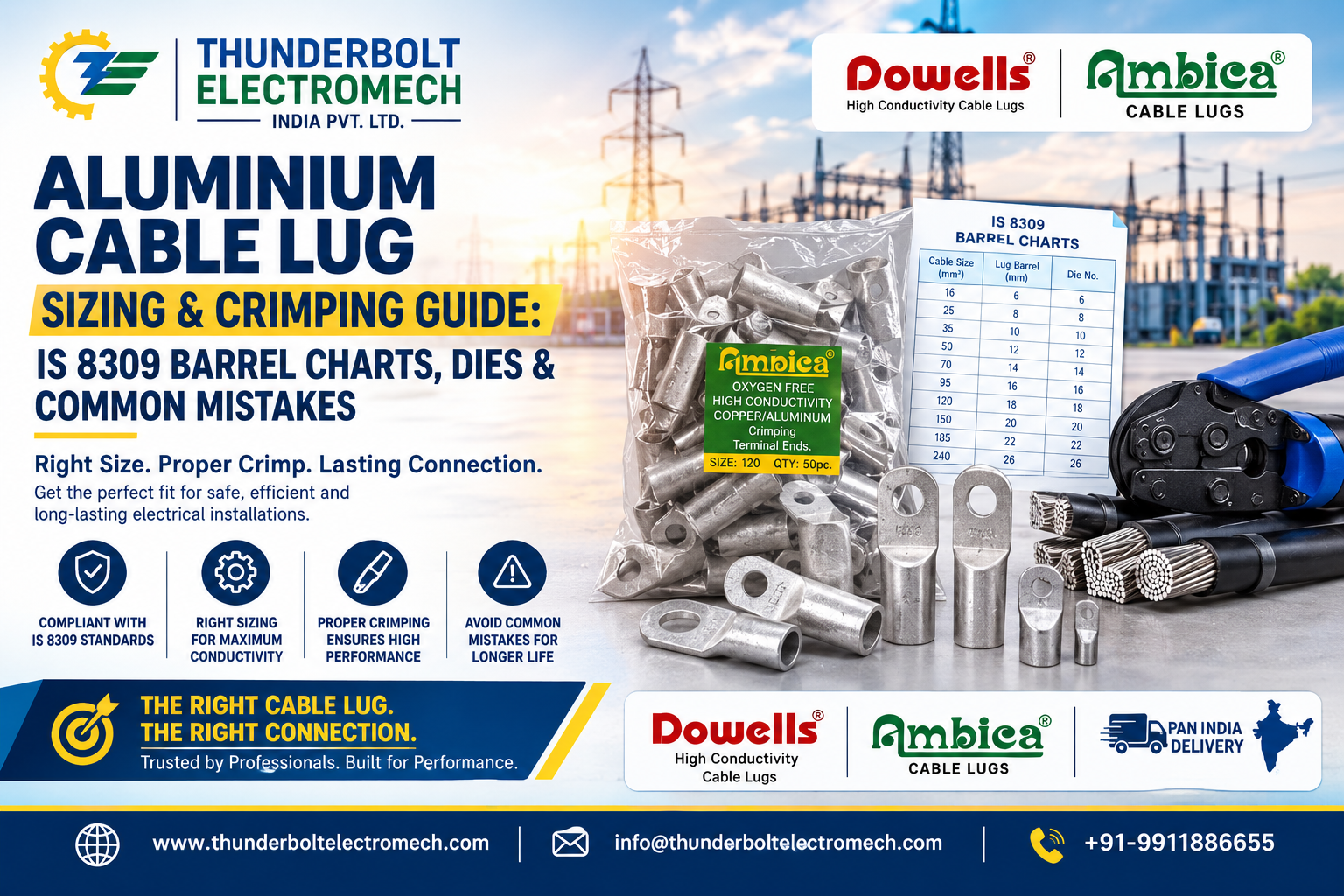
Quick Answer: Sizing an aluminium cable lug correctly means matching the barrel to the conductor’s actual construction, not just its printed cross-section — round stranded, compacted, and flexible conductors of the identical mm² rating can need different barrel diameters. Under IS 8309:1993, cross-sections up to 185mm² typically need a single crimp; 240mm² and above need two crimps along the barrel. The crimping die must match the lug’s specified die number, not just physically fit. Get any of these three wrong and the lug can look correctly installed while carrying a fraction of its rated joint strength. Thunderbolt Electromech India Pvt. Ltd., a Cable Lug Supplier India distributing Dowells and manufacturing and distributing Ambica cable lugs, supplies sizing guidance alongside every batch.
Introduction
Most aluminium cable lug failures never happen because someone chose the wrong lug type. They happen because someone chose the right lug and then sized or crimped it wrong — a barrel one size off from the conductor’s actual diameter, a single crimp on a cross-section that needed two, a die that fit but wasn’t the one specified for that lug. None of these mistakes are visible after the sleeve or heat shrink goes over the joint. They surface months later as a hot spot, a loose connection, or a failed pull test during an audit nobody was expecting to fail.
This guide is deliberately narrow. It doesn’t re-cover which lug type to choose — tubular, long barrel, XLPE, or inline — since Thunderbolt’s guide on that exact question, Aluminium Cable Lug Supplier India: Which Type Should You Choose?, already walks through that decision in detail. It doesn’t re-explain bimetal lugs or copper-to-aluminium galvanic corrosion either — see Bimetal Cable Lug Supplier India: Prevent Galvanic Corrosion for that. What this guide covers is the part almost nothing online explains clearly: once you’ve picked the right lug, how do you size and crimp it so it actually performs the way IS 8309 intends?
IS 8309: The Standard Behind Every Aluminium Lug’s Dimensions
IS 8309:1993, issued by the Bureau of Indian Standards under the Power Cables sectional committee (ETD 9), specifies compression-type tubular terminal ends for aluminium conductors of insulated cables — and critically, it specifies dimensions separately for different conductor constructions at the same nominal cross-section, not a single universal barrel size per mm² rating (Source: Bureau of Indian Standards, IS 8309:1993, archive.org — Direct source found).
The standard’s own dimensional tables list distinct specifications for terminal ends crimped onto round stranded conductors versus compacted conductors, because compaction changes a conductor’s actual outer diameter even though its cross-sectional area — and therefore its current rating — stays identical (Source: IS 8309:1993, Table 2, full text via archive.org — Direct source found). A lug barrel sized correctly for a round stranded 95mm² conductor will not necessarily grip a compacted 95mm² conductor with the same compression quality, because the compacted conductor arrives at that cross-section through a smaller, denser outer diameter.
Material matters as much as geometry. IS 8309 requires the aluminium used in the terminal end to conform to IS 5082, the Indian Standard for aluminium and aluminium alloy wire rod for electrical purposes (Source: Electro Crimp Contacts (I) Pvt. Ltd., IS 8309:1993 technical datasheet — Direct source found). A barrel with correct dimensions but non-compliant material can pass a visual and dimensional check while still under-delivering on conductivity — which is exactly why the standard includes its own conductivity test procedure rather than relying on a material certificate alone.
Why Barrel Sizing Isn’t a Single Number: Round Stranded, Compacted & Flexible Conductors
This is the detail that trips up more procurement teams than any other part of aluminium lug sizing, because most cross-section charts present cable size as if it maps to one fixed barrel diameter.
Flexible conductors need a bigger barrel than the cross-section chart suggests.
A flexible conductor of a given cross-section has a larger outer diameter than a solid or standard stranded conductor of the identical cross-section, because its finer individual strands pack less densely inside the same nominal area (Source: bewl.in, technical catalogue FAQ — Direct source found). Order a lug sized purely off the mm² figure printed on the cable drum, and a flexible conductor frequently won’t seat to full depth in a barrel that would comfortably fit a standard stranded conductor of the same rating.
Compacted conductors run the opposite direction.
Compaction reduces a conductor’s outer diameter relative to an equivalent round stranded conductor at the same cross-section, which is exactly why IS 8309 tabulates the two separately rather than treating them as interchangeable.
The practical fix is measuring, not assuming.
Before ordering in bulk, measure the actual conductor outer diameter with vernier calipers against the specific cable reel being terminated, and cross-check that figure against the lug manufacturer’s barrel diameter — not just the cross-section rating both numbers are supposed to correspond to.
The Crimp Count Threshold Nobody Puts on the Box: Single vs Double Crimping
Here’s an engineering detail that rarely appears on a commercial lug’s packaging or a distributor’s price list, despite deciding whether a termination actually meets its rated joint strength.
For fine-stranded conductors specifically, standard crimping practice calls for a single crimp on cross-sections up to 185mm², but conductors from 240mm² upward need to be crimped twice along the barrel’s length to achieve adequate compression across the full contact area (Source: Klauke, “Connection Technology and Crimp Profiles,” technical reference — Direct source found). A single crimp applied to a 240mm²-plus conductor — even with the exactly correct die — under-compresses the portion of the barrel furthest from the crimp point, leaving a section of the joint with contact resistance far higher than the crimped portion suggests on inspection.
This matters because a single visual check after crimping won’t reveal it. The crimp that was actually applied looks identical whether it was the only crimp needed or the first of two required — the barrel still shows a clean, compressed hexagonal profile at that point. The difference only shows up in a pull test, a contact resistance measurement, or, worst case, thermal imaging on an energised joint months later.
A rule worth pinning to a workshop wall: if the cross-section is 240mm² or larger, confirm the lug manufacturer’s specified crimp count before crimping — don’t assume one crimp per lug is universal just because it’s been the default on every smaller job.
Matching the Die to the Lug — Not Just the Cable
A crimping die’s job is to apply the correct, calibrated compression profile to a specific lug’s barrel geometry — and “the die that physically fits” is not the same specification as “the die stamped on the lug.”
Every compliant compression lug carries a die number specific to its tubular section, and using a mismatched die — even one that seats onto the barrel without obvious resistance — produces either under-compression (leaving voids inside the crimp that raise resistance and reduce pull-out strength) or over-compression (which can crack the barrel wall or extrude aluminium material out past the intended crimp zone) (Source: ergom.com, “How to properly crimp aluminium tubular cable lugs?” — Direct source found).
The practical consequence for a site running multiple lug brands or sourcing dies separately from lugs: never assume die interchangeability between brands, even at identical nominal barrel sizes. A die sized for one manufacturer’s barrel wall thickness can apply meaningfully different compression to another manufacturer’s lug at the same catalogue size, because wall thickness and alloy hardness both factor into the die’s designed compression force.
Crimping Tools: Hydraulic, Mechanical & Battery — What Actually Changes
Mechanical (hand) crimping tools suit smaller cross-sections and lower-volume work, applying compression through hand-operated leverage. They’re portable and need no power source, but the operator’s consistency directly affects crimp quality — fatigue over a long run of terminations can produce a gradually weaker crimp toward the end of a shift.
Hydraulic crimping tools — hand-pumped or battery-hydraulic — deliver higher, more consistent compression force, and are the standard choice for larger cross-sections where mechanical tools can’t generate sufficient pressure. Consistency across a large batch of terminations is the real advantage here, not just raw force.
Battery-powered hydraulic tools add repeatable, pre-set compression cycles, removing operator-to-operator variation almost entirely — a genuine advantage on utility and EPC contracts where dozens or hundreds of identical terminations need documented, consistent crimp quality across an entire crew, not just a single skilled technician’s work.
Regardless of tool type, the crimp is only as good as the die fitted to it — a battery-hydraulic tool with the wrong die still produces a wrong crimp, just more consistently.
How to Read an Aluminium Lug’s Markings Before You Crimp
A compliant compression lug is permanently stamped with specific information for exactly this reason — so an installer can verify correct tooling before crimping, not discover a mismatch afterward. The standard marking set includes the manufacturer’s name or logo, the die number required, a graphical indication of how many crimps and where they should sit along the barrel, the material, the cable cross-section and profile the lug is designed for, and — on ring-type lugs — the bolt hole size (Source: ergom.com — Direct source found).
Reading this correctly before crimping is a five-second check that prevents the two most common sizing errors this guide covers: confirming the printed cross-section actually matches the conductor in hand, and confirming the crimp-count graphic before assuming a single crimp is sufficient. A lug with no visible marking at all offers no way to make either check — which is itself a reason to be cautious of unmarked or poorly marked stock regardless of price.
The Conductivity Detail Most Datasheets Skip
A stated purity figure on an aluminium lug’s material certificate doesn’t fully describe its electrical performance, and the same principle that applies to copper applies here. A “99% copper content” figure doesn’t guarantee 99% IACS conductivity, because conductivity is affected specifically by what makes up the remaining impurity fraction — as little as 0.5% arsenic content in that balance can reduce conductivity by roughly 50-60% (Source: bewl.in, technical catalogue FAQ — Direct source found). The equivalent principle holds for aluminium under IS 5082: a purity percentage alone, without knowing the specific impurity composition, isn’t a complete conductivity guarantee. This is exactly why IS 8309 specifies its own conductivity test procedure using a calibrated instrument, separate from — not a substitute for — material composition certification (Source: IS 8309:1993, full text — Direct source found).
Cable Lug Supplier India — Getting Sizing Right Before You Order
A genuine Cable Lug Supplier India should function as a sizing resource before the order ships, not just a catalogue lookup. Practically, that means being able to:
- Ask whether the conductor is round stranded, compacted, or flexible — not assume standard stranded by default
- Confirm crimp count against the specific cross-section, flagging the 185mm²/240mm² threshold unprompted rather than waiting to be asked
- Supply the correct die number alongside the lug, or confirm compatibility with a crew’s existing tooling before dispatch
- Provide IS 5082 material certification and conductivity test data on request, not only a dimensional datasheet
Common Sizing and Crimping Mistakes
Mistake 1 — Sizing purely from a cross-section chart without checking conductor construction.
Round stranded, compacted, and flexible conductors all need different barrel tolerances at an identical nominal cross-section, as covered above.
Mistake 2 — Single-crimping a cross-section that requires double-crimping.
Genuinely common on larger feeder terminations, and invisible without specifically checking the manufacturer’s crimp-count specification for that size.
Mistake 3 — Using a die because it physically fits, not because it’s specified for that lug.
A die that seats onto the barrel without resistance isn’t confirmation it’s the correct die — cross-check the stamped die number.
Mistake 4 — Assuming crimp quality is tool-independent.
A hand-operated mechanical crimper run by a fatigued operator late in a long shift can produce a materially weaker crimp than the same tool used earlier in the day, even with the correct die.
Mistake 5 — Ignoring the inspection hole where one exists.
Lugs manufactured with an inspection hole in the barrel let an installer visually confirm the conductor has reached full insertion depth before crimping — skipping this check is how a conductor that’s stopped short of full depth gets crimped anyway, leaving reduced contact area inside the barrel.
Mistake 6 — Buying unmarked stock to save cost.
Without the manufacturer’s die number and crimp-count marking on the lug itself, there’s no way to verify after installation whether the correct tooling and crimp count were actually used — a genuine problem the day a joint needs troubleshooting.
Comparison Table: Crimp Count and Sizing Reference by Cross-Section
| Conductor Cross-Section | Typical Crimp Count | Key Sizing Check |
| Up to 185mm² | Single crimp | Confirm conductor construction (round stranded / compacted / flexible) against barrel diameter |
| 240mm² and above | Double crimp along barrel length | Confirm crimp-count marking on lug before crimping; verify die matches barrel wall thickness |
| Flexible conductors, any cross-section | Per manufacturer spec, often needs next barrel size up | Measure actual outer diameter — don’t rely on cross-section chart alone |
| Compacted conductors, any cross-section | Per manufacturer spec, typically smaller barrel than round stranded equivalent | Confirm IS 8309 compacted-conductor dimensional table, not the round stranded table |
Beyond Sizing: Where to Read About Lug Types, Bimetal & Copper
This guide focuses specifically on sizing and crimping, so a few closely related questions are covered in more depth elsewhere on Thunderbolt’s site rather than repeated here:
- For choosing between tubular, long barrel, XLPE, and inline aluminium lug types, see Aluminium Cable Lug Supplier India: Which Type Should You Choose?
- For connecting aluminium conductors to copper busbars and avoiding galvanic corrosion, see Bimetal Cable Lug Supplier India: Prevent Galvanic Corrosion
- For Copper Lugs and copper-specific terminations, sourced from a dedicated Copper Cable Lug Supplier, see Cable Lug Supplier India | Copper Cable Lugs for Industrial Electrical Applications
- For solar-specific Electrical Cable Lugs and DC-side termination guidance, see Best Cable Lugs for Solar Power Systems: Engineering & Sourcing Guide
- For the full buying framework across Compression Cable Lugs, Aluminium Lugs, and Bimetal Cable Lug Supplier options together, see the pillar guide, Cable Lug Supplier India: Complete Industrial Buying Guide for Copper, Aluminium & Bimetal Cable Lugs (2026)
Whichever lug type or material you land on through those guides, the sizing and crimping principles in this piece apply once you’re ready to actually terminate the conductor.
Aluminium Cable Lug Price in India: Why Sizing Errors Cost More Than the Lug
A correctly sized, correctly crimped aluminium lug costs very little relative to the cable and equipment it terminates — which is exactly why sizing and crimping mistakes are so disproportionately expensive when they happen. A Cable Lug Price India comparison that only looks at per-piece cost misses the real economics: an under-crimped 240mm² joint that runs hot for months before detection can mean a shutdown, a re-termination under time pressure, and in the worst case, damage to the equipment the joint feeds. None of that shows up on the original purchase order line for the lug itself.
The genuine cost driver worth paying attention to isn’t brand premium — it’s whether the supplier hands over crimp-count and die guidance alongside the lug, or leaves that entirely to the installer to already know. A slightly higher price that comes with correct sizing support up front is, in almost every case, the cheaper outcome over the joint’s service life.
Common Customer Problems Our Cable Lug Supplier India Team Solves
Problem: “Our crimp looks fine, but the joint failed a pull test.”
This is the single most common symptom of a crimp-count mismatch on larger cross-sections — a visually clean single crimp on a 240mm²-plus conductor that actually needed two. Re-crimping with the correct double-crimp technique, confirmed against the lug’s own marking, resolves it.
Problem: “The lug barrel doesn’t fully seat our flexible cable, even though the cross-section matches.”
Covered in detail above — flexible conductors have a larger outer diameter than standard stranded conductors at the identical cross-section. Ordering the next barrel size up, matched to the conductor’s actual measured diameter, fixes this.
Problem: “We used what we thought was the right die, but the crimp doesn’t look consistent with our other terminations.”
This usually means the die was sized for a different manufacturer’s barrel wall thickness at the same nominal size. Cross-checking the die number stamped on the lug itself, rather than assuming size compatibility across brands, catches this before it becomes a batch-wide issue.
Problem: “We can’t tell after the fact whether our crew used the correct crimp count on completed joints.”
This is a documentation gap more than a technical one. Standardising on lugs with clear, legible crimp-count marking, and logging die number and crimp count per termination during installation — not just relying on memory — closes this gap for future audits.
Real Use Cases
Use case 1 — A Delhi NCR panel-building workshop tracing intermittent pull-test failures.
A panel fabrication workshop supplying industrial control panels had been passing routine visual inspection on its aluminium feeder terminations but began seeing occasional pull-test failures during a client’s incoming quality audit — specifically on larger cross-section joints. Investigation found the crew had been applying a single crimp across all cross-sections, including several 240mm² and 300mm² terminations that required two. Retraining around the crimp-count threshold, and adding a crimp-count check to the workshop’s internal sign-off sheet, eliminated the pull-test failures in the following audit cycle.
Use case 2 — A utility contractor standardising die selection across multiple lug brands.
A contractor terminating aluminium feeders across several substations had been sourcing lugs from more than one supplier over time, assuming dies were interchangeable at matching nominal sizes. A batch of terminations crimped with a die from one manufacturer, applied to another manufacturer’s lug at the same catalogue size, produced visibly inconsistent crimp profiles during a routine inspection. Standardising die sourcing to match each lug batch specifically — rather than treating dies as a generic, brand-agnostic tool — resolved the inconsistency across subsequent terminations.
Use case 3 — An industrial maintenance team building a crimp documentation record.
A manufacturing plant running periodic aluminium feeder maintenance had no record of which die or crimp count had been used on existing terminations installed years earlier, making troubleshooting a hot joint a guessing exercise. Going forward, the plant began logging die number, crimp count, and lug batch against each new termination at the point of installation, using the lug’s own stamped marking as the source record — turning what had been undocumented work into a traceable maintenance history.
Thunderbolt’s Complete Electrical Accessories Product Cluster
Cable lugs are one part of a broader termination and panel-safety kit, and Thunderbolt Electromech India Pvt. Ltd. — a Cable Lug Manufacturer India relies on directly for the Ambica range — supplies the surrounding range from the same Delhi base with pan-India delivery:
- Aluminium Lugs and Copper Lugs — Dowells and Ambica ranges, sized and marked to IS 8309 and standard copper terminal specifications, covering the full family of Cable Terminal Lugs and Electrical Cable Connectors a panel or feeder termination needs
- Bimetal Cable Lugs — friction-welded aluminium-to-copper transitions
- Cable Glands — Dowells, Comet, and HMI (high range) and Diamond and MIC (medium range), armoured and unarmoured
- WOER Heat Shrink Sleeve — for insulating and sealing the crimped lug-to-cable transition
- Nylon 6.6 Cable Ties — Venus, Tycab, Bestrap, and KSS ranges
- Electrical Rubber Mats — Bharat, Jyoti, National, Vardhman, and Shree Arihant, IS 15652-certified
- Electrical Hand Gloves — Raychem, Vidyut, and Crystal ranges
- Danger Plates, First Aid Boxes, Fire Buckets, and Silica Gel Breathers — the rest of a complete panel-room and substation kit
How to Choose the Right Cable Lug Supplier India for Pan-India Delivery
Beyond correct sizing guidance, logistics matter on any commissioning timeline. A capable Cable Lug Supplier India should offer:
- Genuine pan-India delivery, not just Delhi/NCR coverage with ad-hoc arrangements elsewhere
- Stock depth across common cross-sections, so a large termination job doesn’t stall on a single out-of-stock size
- Die compatibility guidance included with the order, not left for the installer to work out independently
- Batch-level material and conductivity documentation available on request, including for repeat orders months later
Why Thunderbolt Is Your Trusted Cable Lug Supplier India
Thunderbolt Electromech India Pvt. Ltd. is a Delhi-based Cable Lug Supplier India engineers, contractors, and purchase teams rely on as the distributor of Dowells cable lugs and the manufacturer and distributor of Ambica cable lugs, with pan-India delivery on every order. Because Ambica is manufactured within Thunderbolt’s own supply chain, sizing and crimp-specification questions — die number, crimp count for a given cross-section, conductor construction guidance — get answered from direct production knowledge, not relayed through several distribution layers. For buyers searching Cable Lugs Delhi for same-day collection, or a Cable Lug Supplier Delhi NCR contractors can reach without waiting on inter-state shipping, Thunderbolt’s Chandni Chowk location covers both walk-in purchase and pan-India dispatch from the same stock.
Contact Thunderbolt Electromech India Pvt. Ltd.: 📍 Shop No. 3538, Sitaram Bazar Rd, Bazar Sirkiwalan, Chawri Bazar, Chandni Chowk, Delhi – 110006 📞 +91-9911886655 ✉️ info@thunderboltelectromech.com
Frequently Asked Questions
Do I need to size an aluminium lug differently for stranded versus solid conductor?
Yes — IS 8309 tabulates round stranded and compacted conductor dimensions separately, since compaction changes a conductor’s outer diameter without changing its cross-sectional area. A barrel sized correctly for one construction won’t necessarily crimp correctly on the other at the same nominal mm² rating.
How do I know if my cross-section needs a single crimp or a double crimp?
Standard practice on fine-stranded conductors calls for a single crimp up to 185mm², and two crimps along the barrel from 240mm² upward. Confirm against the crimp-count marking stamped on the specific lug you’re using, since this is the detail most likely to be assumed rather than checked.
Can I use any die that fits the lug’s barrel diameter?
No — a die that physically fits isn’t confirmation it’s the correct die. Different manufacturers’ lugs can have different barrel wall thickness at the same nominal size, and using a mismatched die risks under- or over-compression even when it seats without obvious resistance. Always match the die number stamped on the lug.
Why won’t my flexible cable seat fully into a lug sized for its cross-section?
Flexible conductors have a larger outer diameter than solid or standard stranded conductors at the identical cross-section, because their finer strands pack less densely. The next barrel size up, matched to the conductor’s actual measured diameter, typically resolves this.
Does a higher-purity aluminium lug guarantee better conductivity?
Not entirely — conductivity depends on the specific impurity composition, not purity percentage alone. This is why IS 8309 specifies its own conductivity test procedure rather than relying solely on a material purity certificate.
What’s the fastest way to catch a sizing or crimping mistake before it becomes a field failure?
Check the lug’s stamped marking — die number and crimp-count graphic — against what was actually used before energising the joint, and where the budget allows, run a pull test or contact resistance check on a sample of terminations rather than relying on visual inspection alone.
Conclusion
Aluminium lug failures rarely start with the wrong lug type — they start with the right lug sized or crimped incorrectly, in ways that look fine at installation and only reveal themselves later as heat, resistance, or a failed pull test. This guide walked through the three checks that actually determine whether a compression joint performs to its rated strength: matching barrel geometry to the conductor’s real construction (round stranded, compacted, or flexible), applying the correct crimp count once cross-section crosses 240mm², and matching the die to the specific lug rather than to whatever fits. None of these checks cost anything beyond a few seconds of attention to the lug’s own stamped marking, and all three are invisible in a standard visual inspection once the job is done. Thunderbolt Electromech India Pvt. Ltd. supplies Dowells and Ambica aluminium cable lugs with sizing and crimp guidance included, not left for the installer to work out alone, and delivers pan-India. Call +91-9911886655 or write to info@thunderboltelectromech.com before your next large-cross-section termination, and get the crimp count confirmed before the tool closes.

[…] needs two crimps along the barrel to achieve full compression. Thunderbolt’s dedicated guide, Aluminium Cable Lug Sizing & Crimping Guide: IS 8309 Barrel Charts, Dies & Common Mistakes, covers this in full — worth reading alongside this guide if your next order includes both ties […]
[…] above typically requiring two crimps along the barrel rather than one. Thunderbolt’s guide, Aluminium Cable Lug Sizing & Crimping Guide: IS 8309 Barrel Charts, Dies & Common Mistakes, covers this in full — worth a read for any project where cable ties and cable lugs are being […]