
Every industrial electrical system depends on one simple but extremely important component—the electrical connection. Whether electricity powers a manufacturing plant, an electrical panel, a transformer, a solar power system, or a large industrial machine, every connection must safely carry current without generating excessive heat or causing power loss.
One of the most critical components that ensures safe and reliable electrical connections is the Cable Lug.
A cable lug forms the interface between an electrical conductor and equipment such as transformers, MCC panels, PCC panels, switchgear, busbars, circuit breakers, motors, and distribution boards. A properly selected and professionally installed cable lug minimizes electrical resistance, reduces heat generation, improves conductivity, and significantly enhances system reliability.
Poor cable termination remains one of the leading causes of electrical failures in industries. Loose cable connections create high contact resistance, resulting in overheating, voltage drops, insulation damage, equipment failure, production downtime, and in severe cases, electrical fires.
This is why selecting a reliable Cable Lug Supplier India is just as important as selecting the right cable itself.
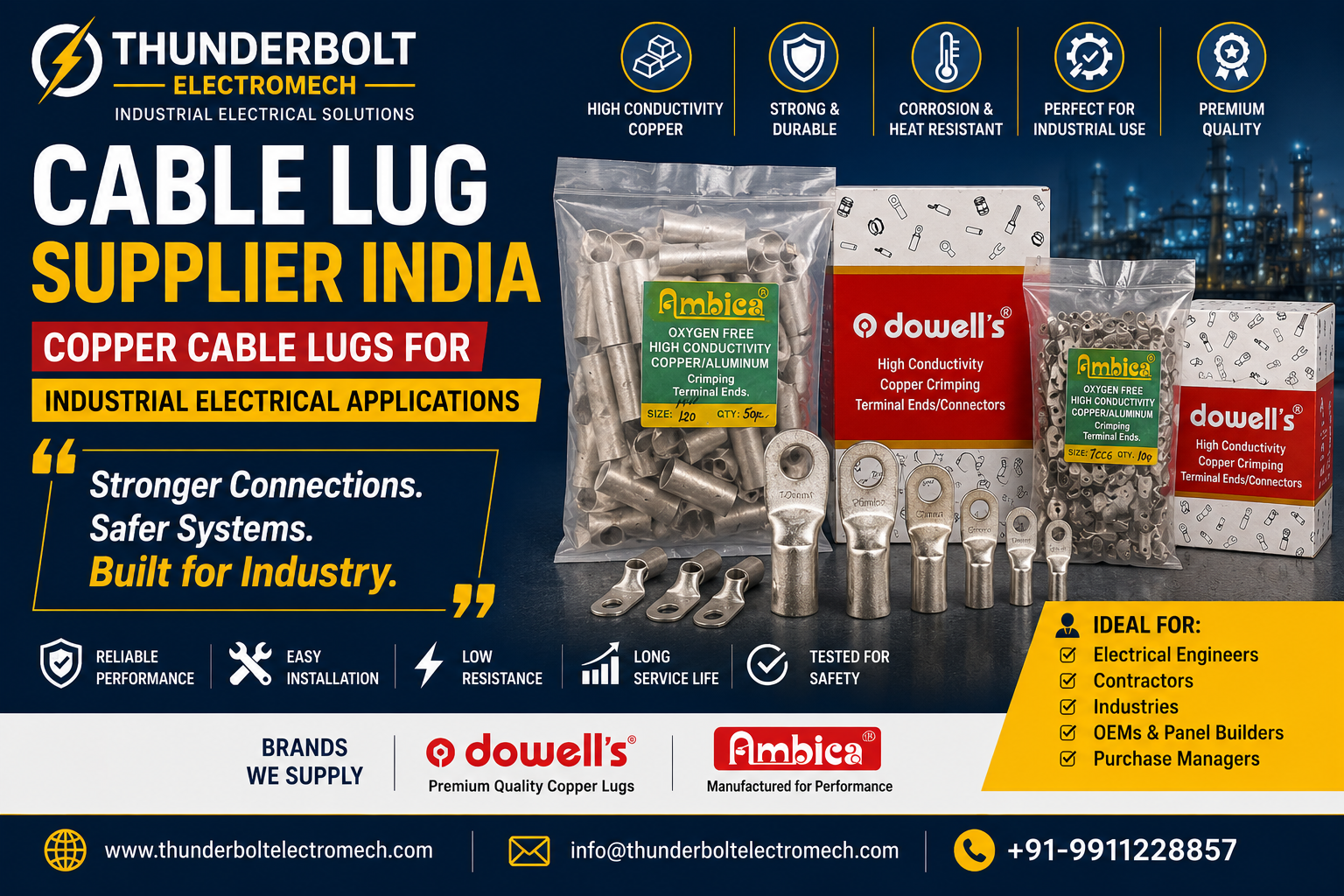
At Thunderbolt Electromech, we supply high-quality Dowells Copper Cable Lugs across India while also manufacturing Ambica Copper Cable Lugs for industrial applications. Our products serve electrical contractors, OEM manufacturers, EPC companies, panel builders, power utilities, solar developers, infrastructure companies, and heavy industries looking for reliable cable termination solutions.
Throughout this guide, you will learn how cable lugs work, why copper cable lugs dominate industrial applications, how to select the correct cable lug size, common installation mistakes, industrial use cases, and how to choose the right supplier for long-term electrical reliability.
Market Research: Growth of Cable Lug Demand in India
India is currently experiencing one of the fastest industrial infrastructure expansions in the world. According to government infrastructure initiatives and industry reports, investments in manufacturing, renewable energy, smart cities, metro rail, industrial corridors, EV charging infrastructure, and data centres continue to increase every year.
As electrical infrastructure expands, the demand for reliable cable termination products also rises.
Several factors are driving the demand for quality cable lugs across India:
Manufacturing Expansion
India’s manufacturing sector continues to grow through initiatives like Make in India, industrial corridors, and increasing domestic production. Every manufacturing unit requires reliable electrical distribution systems where copper cable lugs ensure safe power transmission.
Renewable Energy Projects
India continues to install large-scale solar parks and rooftop solar systems. Every inverter, combiner box, transformer, and distribution panel depends on high-quality cable termination accessories.
Copper cable lugs provide:
- Excellent conductivity
- Long service life
- Low maintenance
- Corrosion resistance
Growth of Data Centres
Cloud computing, AI infrastructure, fintech companies, and telecom expansion have accelerated the construction of modern data centres.
These facilities require:
- Zero downtime
- Reliable electrical connections
- Low contact resistance
- High current carrying capability
This increases demand for premium copper cable lugs.
Electric Vehicle Infrastructure
Thousands of EV charging stations are being installed throughout India.
These charging systems require:
- High current connections
- Reliable cable termination
- Low heat generation
- Long operational life
Cable lugs play an essential role in ensuring charging efficiency.
Power Generation & Transmission
Thermal plants, hydroelectric stations, substations, and transmission projects continue to invest in modern electrical accessories capable of carrying heavy electrical loads safely.
Why This Matters
India’s increasing electrification, industrial automation, renewable energy expansion, and infrastructure development are creating unprecedented demand for high-quality electrical termination products.
As industries invest in modern electrical systems, choosing the right Cable Lug Supplier India becomes essential for ensuring safety, efficiency, and long-term operational reliability.
What is a Cable Lug?
A cable lug is an electrical connector designed to terminate the end of an electrical conductor and create a secure connection with electrical equipment.
Instead of inserting bare wire directly into electrical equipment, engineers crimp a cable lug onto the conductor to create a mechanically strong and electrically efficient termination.
Cable lugs connect cables to:
- Busbars
- Circuit Breakers
- Motors
- Transformers
- MCC Panels
- PCC Panels
- Distribution Boards
- Switchgear
- Control Panels
- Generator Connections
Why Proper Cable Termination Matters
A properly installed cable lug offers:
✔ Low contact resistance
✔ Maximum electrical conductivity
✔ High mechanical strength
✔ Safe current transfer
✔ Longer equipment life
✔ Reduced maintenance
Without proper cable termination:
- Connections loosen over time
- Heat generation increases
- Voltage drops occur
- Equipment efficiency decreases
- Fire risk increases
Why Copper Cable Lugs Are Preferred in Industries
Industrial electrical engineers overwhelmingly prefer copper cable lugs because copper possesses outstanding electrical and mechanical properties.
High Electrical Conductivity
Copper is one of the most conductive engineering metals available.
High conductivity means:
- Lower electrical losses
- Better power transmission
- Reduced voltage drop
- Improved system efficiency
Industries operating heavy machinery require stable electrical supply, making copper the preferred choice.
Low Contact Resistance
Every electrical connection creates some resistance.
Poor-quality lugs increase resistance, resulting in:
- Heat generation
- Energy loss
- Loose connections
- Equipment damage
Copper cable lugs significantly reduce contact resistance, ensuring efficient current flow.
Excellent Corrosion Resistance
Industrial environments expose electrical equipment to:
- Humidity
- Chemicals
- Dust
- Outdoor weather
- Industrial pollution
Copper cable lugs resist corrosion effectively, ensuring long service life.
Superior Mechanical Strength
Industrial cable connections experience:
- Vibration
- Mechanical stress
- Thermal expansion
- Heavy current loads
Copper cable lugs maintain strong crimping performance and prevent conductor pull-out.
Types of Cable Lugs
Selecting the correct type of cable lug is as important as selecting the correct cable size. Different industrial applications require different lug designs based on current rating, equipment configuration, installation method, and maintenance requirements.
Copper Cable Lugs
Copper cable lugs remain the most widely used cable termination accessory in industrial electrical systems.
Construction
- Electrolytic copper
- High conductivity
- Seamless barrel
- Precision punching
- High-strength crimp area
Applications
- Industrial panels
- Transformers
- Motors
- Distribution boards
- Switchgear
- Busbars
- Generator panels
Advantages
- High conductivity
- Excellent current carrying capacity
- Low resistance
- Long service life
- Strong mechanical grip
Ring Type Cable Lugs
Ring-type cable lugs feature a circular hole that securely bolts onto electrical terminals.
Applications
- Battery systems
- MCC Panels
- Distribution Boards
- Busbars
- Industrial Motors
Benefits
- Secure connection
- Vibration resistance
- Reliable long-term performance
- Easy inspection
Fork Type Cable Lugs
Fork-type cable lugs simplify maintenance because they can be installed or removed without completely removing the terminal bolt.
Applications
- Control Panels
- Instrumentation Panels
- Industrial Automation
- PLC Panels
Benefits
- Faster maintenance
- Reduced downtime
- Convenient installation
Pin Type Cable Lugs
Pin-type cable lugs terminate conductors that connect to terminal blocks and compact electrical equipment.
Common Uses
- PLC Systems
- Automation Panels
- Relay Connections
- Terminal Blocks
Aluminium Cable Lugs
Although copper dominates industrial electrical systems, aluminium cable lugs remain suitable for specific applications where lightweight conductors and lower costs are priorities.
Advantages
- Lightweight
- Cost-effective
- Suitable for aluminium conductors
- Used in overhead transmission systems
Limitations
- Lower conductivity than copper
- Requires proper anti-oxidation treatment
- Not suitable for every industrial application
Copper Cable Lug Supplier India for Industrial Electrical Connections
Choosing the right Copper Cable Lug Supplier India ensures reliable cable termination, reduced electrical failures, and long-lasting system performance. Thunderbolt Electromech supplies premium Dowells Copper Cable Lugs and manufactures Ambica Copper Cable Lugs, serving industries across India with consistent quality, bulk availability, and technical support.
Product Section – Dowells Copper Cable Lugs
Dowells is one of India’s most trusted brands for copper crimping lugs, widely used in electrical infrastructure, panel manufacturing, power distribution, automation, and industrial installations.
Technical Specifications
| Specification | Details |
| Material | Electrolytic Copper |
| Finish | Electro Tin Plated |
| Conductivity | Excellent |
| Operating Temperature | Suitable for Industrial Applications |
| Manufacturing Standard | Precision Engineered |
| Installation | Hydraulic Crimping |
Applications
- MCC Panels
- PCC Panels
- Motors
- Transformers
- Solar Plants
- Electrical Contractors
- OEM Manufacturing
- Industrial Machinery
Benefits
- Excellent conductivity
- Corrosion-resistant finish
- Strong crimping performance
- Long service life
- Reliable electrical contact
- Wide range of sizes
Buyer Guidance
Dowells cable lugs are ideal for industries seeking branded, tested, and reliable cable termination solutions. Engineers working on critical infrastructure projects often prefer Dowells because of their consistent manufacturing quality and nationwide availability.
Product Section – Ambica Copper Cable Lugs
Thunderbolt Electromech also manufactures and supplies Ambica Copper Cable Lugs, designed for dependable industrial electrical connections and bulk project requirements across India.
Technical Specifications
| Specification | Details |
| Material | High-Grade Electrolytic Copper |
| Finish | Tin-Plated for Corrosion Resistance |
| Design | Heavy-Duty Crimp Type |
| Compatibility | Copper Conductors |
| Current Capacity | Suitable for Low to High Current Applications |
Applications
- Electrical Panels
- Industrial Machinery
- Power Distribution
- Renewable Energy Systems
- Infrastructure Projects
- Commercial Buildings
Benefits
- High electrical conductivity
- Excellent mechanical strength
- Reliable crimping performance
- Cost-effective for bulk orders
- Manufactured with strict quality control
Buyer Guidance
Ambica Copper Cable Lugs are an excellent choice for contractors, OEMs, and industries seeking dependable quality with competitive pricing for large-scale installations.
Manufacturing Process of Copper Cable Lugs
The manufacturing quality of a copper cable lug directly determines its electrical conductivity, mechanical strength, resistance to corrosion, and service life. Even if two cable lugs appear identical externally, differences in raw material quality, manufacturing precision, and quality control can significantly affect their performance in industrial applications. This is why engineers and purchase managers often prefer reputed brands such as Dowells and reliable manufacturers like Ambica, supplied by Thunderbolt Electromech, where quality consistency is maintained across every batch.
Step 1: Selection of Raw Material
The manufacturing process begins with the selection of high-conductivity electrolytic copper. Electrolytic copper is widely preferred because of its excellent electrical conductivity, low impurity levels, and high ductility.
A high-quality raw material ensures:
- Excellent electrical conductivity
- Low contact resistance
- Higher current carrying capacity
- Better crimping performance
- Longer operational life
Poor-quality copper containing impurities may increase resistance, generate excessive heat, and reduce equipment reliability.
Step 2: Copper Tube Cutting
Manufacturers use seamless copper tubes of different diameters according to the required cable size.
The tube is cut into accurate lengths using precision cutting machines.
Accuracy is extremely important because:
- The barrel length affects crimping quality.
- Longer barrels provide better conductor grip.
- Uniform cutting ensures consistent product quality.
Step 3: Barrel Forming
The copper tube passes through hydraulic presses where the barrel and palm are formed.
During this stage:
- The palm becomes flat.
- The barrel remains cylindrical.
- Material thickness is maintained.
- Mechanical strength is preserved.
The forming process determines how much mechanical load the lug can withstand after installation.
Step 4: Hole Punching
A precision punching machine creates the stud hole.
Common hole sizes include:
| Stud Size | Common Application |
| M4 | Control Panels |
| M5 | Instrument Panels |
| M6 | Small MCC Panels |
| M8 | Distribution Boards |
| M10 | Transformers |
| M12 | Heavy Electrical Equipment |
| M16 | High Current Busbars |
Accurate hole dimensions ensure proper bolt tightening and reliable electrical contact.
Step 5: Annealing Process
Annealing is a controlled heat treatment process.
Purpose:
- Removes internal stress
- Improves ductility
- Prevents cracking
- Makes crimping easier
- Improves mechanical flexibility
Without proper annealing, cable lugs may crack during hydraulic crimping.
Step 6: Surface Finishing
Premium cable lugs are generally electro-tin plated.
Benefits:
- Better corrosion resistance
- Reduced oxidation
- Improved shelf life
- Lower contact resistance
- Better appearance
Tin plating is particularly useful in humid and coastal environments.
Step 7: Inspection and Quality Control
Every batch undergoes inspection for:
- Copper purity
- Dimensions
- Barrel diameter
- Hole diameter
- Thickness
- Mechanical strength
- Surface finish
Manufacturers also conduct:
- Conductivity testing
- Pull-out testing
- Crimp testing
- Visual inspection
Consistent quality control ensures dependable electrical performance.
Cable Lug Size Selection Guide
Selecting the correct cable lug is one of the most critical decisions in any electrical installation. An undersized lug can overheat and fail, while an oversized lug may not crimp securely, resulting in loose connections.
Engineers should always match the cable lug to the conductor cross-sectional area, not merely the outer insulation diameter.
Common Cable Sizes and Recommended Lug Sizes
| Cable Size | Typical Application | Recommended Lug |
| 1.5 sq mm | Control Wiring | 1.5 sq mm Lug |
| 2.5 sq mm | Lighting Circuits | 2.5 sq mm Lug |
| 4 sq mm | Small Motors | 4 sq mm Lug |
| 6 sq mm | Distribution Panels | 6 sq mm Lug |
| 10 sq mm | Industrial Machines | 10 sq mm Lug |
| 16 sq mm | MCC Panels | 16 sq mm Lug |
| 25 sq mm | Power Distribution | 25 sq mm Lug |
| 35 sq mm | Motors | 35 sq mm Lug |
| 50 sq mm | Transformers | 50 sq mm Lug |
| 70 sq mm | Generator Panels | 70 sq mm Lug |
| 95 sq mm | Heavy Load Panels | 95 sq mm Lug |
| 120 sq mm | High Current Equipment | 120 sq mm Lug |
Importance of Matching Barrel Size
The barrel must fully accommodate the conductor.
Correct barrel size provides:
- Better crimping
- Low resistance
- Strong mechanical grip
- Longer service life
Incorrect barrel selection can lead to overheating and conductor pull-out.
Current Rating and Stud Hole Selection
Cable lug selection should consider both electrical current and terminal hardware.
Approximate Current Guide
| Cable Size | Approximate Current Capacity* |
| 1.5 sq mm | 15–20 A |
| 2.5 sq mm | 20–30 A |
| 4 sq mm | 30–40 A |
| 6 sq mm | 40–50 A |
| 10 sq mm | 60–70 A |
| 16 sq mm | 80–100 A |
| 25 sq mm | 110–125 A |
| 35 sq mm | 140–160 A |
| 50 sq mm | 170–200 A |
| 70 sq mm | 220–260 A |
| 95 sq mm | 270–320 A |
| 120 sq mm | 320–380 A |
*Actual current capacity depends on conductor material, insulation, installation method, ambient temperature, and applicable standards.
Stud Hole Selection Guide
| Stud Size | Typical Equipment |
| M4 | Terminal Blocks |
| M5 | Instrument Panels |
| M6 | Control Panels |
| M8 | MCC Panels |
| M10 | Distribution Boards |
| M12 | Transformers |
| M16 | Heavy Busbars |
Always verify the equipment terminal before ordering cable lugs.
Complete Cable Lug Installation Guide
Proper installation is just as important as selecting the correct cable lug.
Step 1: Select the Correct Cable Lug
Confirm:
- Cable cross-section
- Conductor material
- Current rating
- Stud hole size
- Number of fixing holes (if applicable)
Step 2: Strip the Cable
Use a proper cable stripper.
Avoid:
- Cutting conductor strands
- Damaging insulation
- Leaving excessive exposed conductor
Step 3: Insert the Conductor
Insert the conductor fully into the barrel until it reaches the end.
Do not leave air gaps inside the barrel.
Step 4: Hydraulic Crimping
Use the correct die set.
Apply uniform pressure.
Never use:
- Hammer
- Pliers
- Improvised tools
A hydraulic crimping tool provides the required compression for a secure electrical and mechanical connection.
Step 5: Inspect the Crimp
Check for:
- Proper compression
- No cracks
- Full conductor insertion
- Secure grip
- Clean finish
Step 6: Tighten the Terminal
Mount the lug using the recommended bolt torque.
Loose bolts increase resistance and cause overheating.
Common Installation Mistakes
| Mistake | Consequence |
| Wrong cable lug size | Loose connection |
| Wrong crimping die | Poor compression |
| Damaged conductor strands | Reduced current capacity |
| Loose terminal bolts | Heat generation |
| Incorrect stud hole | Improper mounting |
| Mixing copper lug with aluminium conductor without suitable transition | Galvanic corrosion risk |
Customer Problems & Solutions
Problem 1: Cable Lug Becomes Hot During Operation
Cause: Loose bolts, incorrect lug size, poor crimping, or low-quality material.
Solution: Use the correct-sized electrolytic copper cable lug, crimp with a calibrated hydraulic tool, and tighten terminals to the specified torque.
Problem 2: Frequent Electrical Breakdowns
Cause: High contact resistance from poor cable termination.
Solution: Choose quality cable lugs from trusted suppliers such as Thunderbolt Electromech and follow correct installation practices.
Problem 3: Cable Pulls Out After Installation
Cause: Oversized barrel or insufficient crimping.
Solution: Match the lug barrel exactly to the cable size and verify pull-out strength after crimping.
Problem 4: Corrosion in Outdoor Installations
Cause: Exposure to moisture, salt, or chemicals.
Solution: Use electro-tin plated copper cable lugs and protect connections with heat shrink sleeves where appropriate.
Problem 5: Delays Due to Material Shortages
Cause: Supplier cannot provide consistent stock or pan-India delivery.
Solution: Work with a supplier that offers a broad product range, reliable inventory, and nationwide logistics support.
Real Industrial Applications
Manufacturing Plants
Manufacturing facilities rely on cable lugs for:
- Motor terminals
- CNC machines
- Production lines
- Conveyor systems
- MCC and PCC panels
Reliable cable terminations reduce unplanned downtime and maintenance costs.
Solar Power Projects
Solar installations use cable lugs in:
- DC combiner boxes
- Inverters
- AC distribution panels
- Transformer connections
- Earthing systems
Tin-plated copper lugs help withstand outdoor environmental conditions.
Power Plants
Thermal, hydro, and renewable power stations require cable lugs for:
- Generator terminals
- Switchyards
- Control systems
- Auxiliary power panels
- Transformer connections
These applications demand high conductivity and dependable mechanical strength.
MCC & PCC Panel Manufacturing
Panel builders use cable lugs for:
- Busbar connections
- Incoming feeders
- Outgoing feeders
- Circuit breakers
- Control wiring
Accurate lug selection improves safety, simplifies maintenance, and ensures compliance with project specifications.
Comparison Tables
Copper vs Aluminium Cable Lugs
| Feature | Copper Cable Lug | Aluminium Cable Lug |
| Electrical Conductivity | Excellent | Moderate |
| Contact Resistance | Very Low | Higher |
| Mechanical Strength | High | Moderate |
| Corrosion Resistance | Excellent (Tin-Plated) | Lower without protection |
| Current Carrying Capacity | Higher | Lower for equivalent size |
| Industrial Preference | Widely Preferred | Specific Applications |
| Initial Cost | Higher | Lower |
Dowells vs Ambica Cable Lugs
| Feature | Dowells | Ambica |
| Brand Position | Established Industrial Brand | Manufacturer & Value-Oriented Solution |
| Material | Electrolytic Copper | High-Grade Electrolytic Copper |
| Finish | Electro Tin Plated | Tin Plated |
| Product Range | Extensive Standard Sizes | Standard & Project-Based Options |
| Industrial Applications | Power, Panels, Infrastructure | OEMs, Contractors, Panels, Industrial Projects |
| Bulk Availability | Yes | Yes |
| Pan-India Supply Through Thunderbolt | Yes | Yes |
Buyer Selection Guide: Choosing the Best Cable Lug Supplier India
Selecting the right supplier affects not only product quality but also project timelines, safety, and lifecycle costs. Before placing an order, evaluate the supplier on the following criteria:
- Material quality: Ensure the lugs are manufactured from high-conductivity electrolytic copper with consistent dimensions.
- Product range: Availability of copper, aluminium, ring, pin, fork, heavy-duty, and specialized cable lugs in multiple sizes.
- Standards and quality control: Ask about manufacturing processes, testing, and quality assurance.
- Technical support: A knowledgeable supplier should help you select the correct lug size, stud hole, and application-specific solution.
- Bulk supply capability: Verify stock availability for large industrial and infrastructure projects.
- Pan-India delivery: Timely logistics are critical to avoid project delays.
- Complementary products: Working with a supplier who also offers cable glands, cable ties, heat shrink sleeves, and electrical safety products simplifies procurement.
Thunderbolt Electromech supports engineers, contractors, OEMs, EPC companies, panel builders, and industries by supplying Dowells Cable Lugs across India and manufacturing Ambica Cable Lugs, backed by technical assistance and dependable nationwide delivery. This integrated approach helps customers source multiple industrial electrical products from a single, reliable partner.
[…] For Copper Lugs and copper-specific terminations, sourced from a dedicated Copper Cable Lug Supplier, see Cable Lug Supplier India | Copper Cable Lugs for Industrial Electrical Applications […]