
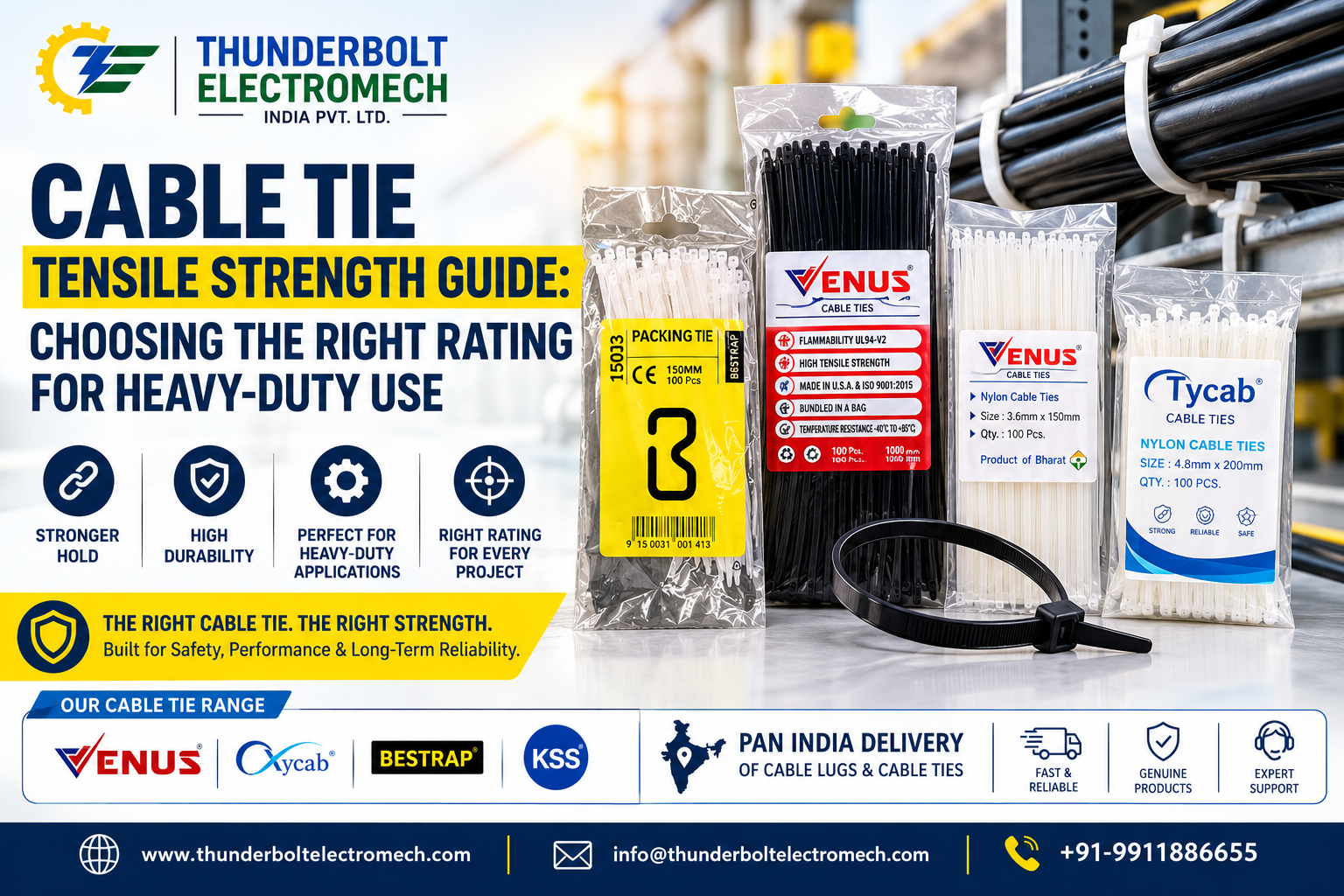
By Thunderbolt Electromech India Pvt. Ltd. — Delhi-based Distributor and Supplier of Venus, Tycab, Bestrap & KSS Cable Ties
📞 +91-9911886655 | ✉️ info@thunderboltelectromech.com | 🌐 thunderboltelectromech.com | 📍 Shop No. 3538, Sitaram Bazar Rd, Bazar Sirkiwalan, Chawri Bazar, Chandni Chowk, Delhi – 110006
Quick Answer: Tensile strength on a cable tie almost always refers to loop tensile strength — the force the closed loop withstands before the locking head fails, tested under IEC 62275 / UL 62275. Choose a rating well above your bundle’s actual weight, not just above it: apply roughly 2x for static indoor bundles, 3x for outdoor runs, and 4-5x where vibration is involved. Check whether the tie is Type 1 (retains only 50% of its rated strength after heat, UV, and temperature cycling) or Type 2 (retains 100%) before assuming the printed kg figure holds up in the field. Thunderbolt Electromech India Pvt. Ltd. stocks Venus, Tycab, Bestrap, and KSS ranges as a Cable Ties Supplier India engineers can verify ratings against directly.
Introduction
“How strong does this cable tie need to be?” sounds like a simple question, and most buyers answer it the simple way — they look at the bundle, guess a number, and buy whichever tie’s packaging shows a bigger kg figure than that guess. It works, most of the time, right up until it doesn’t: a harness sags six months into a rooftop installation, a machinery loom loosens under vibration nobody accounted for, or a tie that tested fine on day one turns brittle and lets go in year two.
This guide exists to answer the strength question properly — not “what’s the difference between standard and heavy-duty ties” (Thunderbolt’s earlier guide already covers that comparison well), but specifically: how is Nylon Cable Tie Tensile Strength actually tested, what do the two classification types mean for real-world performance, and how do you calculate the Cable Tie Load Rating your application genuinely needs rather than picking a number that feels safe. We’ll work through the standard behind the rating, the calculation itself, and where Venus, Tycab, Bestrap, and KSS Heavy Duty Cable Ties sit on that scale — as stocked and distributed by Thunderbolt Electromech India Pvt. Ltd., a Cable Ties Supplier India contractors and purchase managers turn to when the rating actually needs to be right, not just printed on the bag.
What “Tensile Strength” Actually Means on a Cable Tie
Two different numbers get called “tensile strength” in casual conversation, and confusing them is the first mistake this guide exists to prevent.
Loop tensile strength is the figure that matters for almost every real cable tie application — it’s the force required to break the tie’s locking head or strap while the tie is formed into its closed, working loop shape, exactly as it sits around a bundle in service. This is what IEC 62275 and its regional adoptions (UL 62275 in the US, CSA C22.2 No. 62275 in Canada) actually test and classify (Source: TestResources, “IEC 62275 for Cable Tie Testing” — Direct source found).
Straight material tensile strength — the strength of the nylon material itself, pulled flat rather than looped — is a separate figure, and it’s not what determines whether a tie holds a bundle in place. A material with excellent straight tensile strength can still have a mediocre loop tensile rating if the locking head design is weak, because the head, not the strap material, is usually where a loaded cable tie actually fails first.
This distinction matters directly for how you read a spec sheet: if a supplier quotes only “material tensile strength” without a loop tensile figure specifically, you don’t yet have the number that predicts real-world bundle-holding performance.
IEC 62275 and UL 62275: The Standard Behind Every Genuine Strength Rating
IEC 62275, “Cable ties for electrical installations,” is the international standard governing cable tie performance classification, adopted regionally as UL 62275 in the US and CSA C22.2 No. 62275 in Canada, both built on the same underlying IEC text with regional additions (Source: UL Solutions, “Cable Ties for Cable Management” — Direct source found). It classifies ties by material, loop tensile strength, temperature rating, fire contribution, and environmental resistance — not tensile strength alone (Source: EN IEC 62275:2019/2022 standard documentation, iteh.ai — Direct source found).
How the test actually works. Loop tensile testing uses a mandrel — a rod matching the tie’s intended bundle diameter — with the tie formed into its working loop around it, then pulled under controlled jaw separation until failure, with the load at failure recorded as the declared strength (Source: IEC 62275 Edition 4.0, commented version, cdn.standards.iteh.ai — Direct source found). The 2022 edition of the standard specifically added the option to test using dead weights rather than only a mechanical tensile tester, broadening how manufacturers can generate compliant test data (Source: EN IEC 62275:2026 standard summary — Direct source found).
A commonly referenced classification threshold under the harmonised North American standards requires ties meeting a specific tier to maintain 220 Newtons (roughly 23kg / 50 lb-f) for an additional five minutes beyond the initial load point (Source: NEMA, “Cable Tie Type Classifications, UL 62275” — Direct source found) — a useful benchmark figure worth knowing when comparing a “heavy-duty” claim against an actual tested standard rather than a marketing label alone.
Type 1 vs Type 2: The Classification Most Buyers Have Never Heard Of
This is the single most consequential piece of information in this entire guide, and it almost never appears in commercial cable tie listings.
Under UL 62275 and its harmonised international equivalent, cable ties fall into two performance types based on how much of their declared strength survives real-world environmental exposure — heat aging, temperature cycling, and UV light where applicable:
Type 1 ties maintain 100% of their declared loop tensile strength only in their original, as-received condition. After heat aging and temperature cycling, they need only retain 50% of that original declared strength to still pass classification (Source: NEMA, “UL 62275, Cable Ties for Electrical Installations” simplified guide — Direct source found).
Type 2 ties must retain 100% of their declared strength even after heat aging, temperature cycling, and UV exposure where relevant — with all-metallic construction ties facing additional vibration conditioning requirements on top (Source: NEMA, UL 62275 simplified guide — Direct source found).
What this means in practice, stated plainly: a Type 1 tie printed with an 18kg rating may, after a year of thermal cycling in an outdoor or hot panel-room environment, only reliably hold something closer to 9kg — while still being entirely compliant with its own classification. This isn’t a defect. It’s how the standard is written. The problem is that almost no retail or wholesale listing tells a buyer which type they’re actually purchasing, and the printed kg figure alone doesn’t reveal it.
The practical takeaway: for any application where the tie’s failure would have real consequences — securing cabling near moving machinery, overhead runs where a dropped bundle is a safety hazard, or anything outdoors and UV-exposed — ask specifically whether the tie is Type 1 or Type 2, not just what it’s as-received rating says.
The Calculation: How to Choose the Right Rating for Your Load
Step 1 — Estimate the Actual Bundle Weight
Weigh or calculate the total weight of everything the tie will support, per tie — not the whole run’s weight divided evenly if ties are spaced unevenly, and not just the cable weight if the bundle includes armour, conduit sections, or accessories hanging from it.
Step 2 — Apply the Correct Safety Factor
Multiply the estimated load by a safety factor matched to the actual installation conditions, not a single blanket number applied everywhere:
- 2x for static, indoor, low-risk bundling — cable management inside a dry panel or server rack
- 3x for outdoor installations, where thermal cycling and occasional mechanical disturbance are realistic
- 4-5x for anything exposed to vibration — machinery looms, vehicle harnesses, rooftop equipment subject to wind load
(Source: DIFVAN, “How Much Weight Can a Zip Tie Hold? Tensile Strength Guide” — Direct source found)
Step 3 — Match to a Rated Tie, Not the Closest One
Choose a tie whose declared loop tensile strength — not straight material strength — meets or exceeds the calculated figure from Step 2. Round up to the next available rating rather than down, and where the installation is outdoor, high-vibration, or otherwise environmentally demanding, confirm Type 2 classification specifically rather than assuming the as-received figure will hold.
Why a “50kg Tie” Might Not Actually Hold 50kg After Installation
Beyond the Type 1/Type 2 distinction, several real-world factors quietly reduce a tie’s effective holding strength below its printed rating, and none of them show up on the packaging:
Manufacturing variability. Breaking strength genuinely varies between production batches, even at the same nominal rating, due to differences in moulding consistency and material batch purity (Source: Cable Ties Unlimited, “How to Calculate the Breaking Strength of Cable Ties” — Direct source found).
Dynamic and repetitive loading. A tie rated for a static load can fail well below that rating under sudden or repetitive force — vibration, wind gusting on an outdoor bundle, or a harness that flexes with equipment movement (Source: Cable Ties Unlimited — Direct source found).
Installation tension. A tie tightened past its intended tension during installation can pre-stress the locking head, reducing the additional load it can absorb before failing compared to a correctly tensioned tie of the identical rating.
Environmental exposure compounding over time. UV, chemical exposure, and temperature extremes degrade strength progressively — which loops back directly to the Type 1/Type 2 distinction covered above, since that classification exists specifically to describe how much of this degradation a given tie is designed to resist.
Width, Thickness and Cross-Section: How They Drive the Rating
Loop tensile rating isn’t a marketing decision — it’s a direct function of the tie’s physical cross-section at the locking head, the point where failure actually initiates under load.
Width increases the contact area resisting shear at the tooth engagement point inside the locking head, which is why simply doubling up two narrow ties rarely matches the performance of a single correctly-rated wider tie — the failure point remains the same narrow geometry, just duplicated, rather than genuinely reinforced.
Thickness affects both tensile and flexural performance — a thicker strap resists the bending stress that develops as a loaded bundle shifts or vibrates, not just the straight pull-apart force a loop tensile test measures directly.
Locking head tooth design matters as much as raw dimensions. A deeper, sharper tooth engagement resists back-slip under sustained load better than a shallow tooth profile at the identical strap width — which is part of why two ties with matching width and thickness specs can still show meaningfully different loop tensile ratings once tested.
Quick Reference: Venus Cable Tie Tensile Strength
Venus’s range covers the full spread from light bundling ties through High Tensile Cable Ties for demanding outdoor and machinery work.
| Size Range | Typical Loop Tensile Strength | Best Fit |
| Small (2.5-3.6mm width) | 8-18 kg | Light bundling, control panel wiring |
| Medium (4.8mm width) | 22-40 kg | General industrial bundling |
| Heavy (7.2-9mm width) | 45-80 kg+ | Machinery harnesses, outdoor runs |
Quick Reference: Tycab Cable Tie Tensile Strength
| Size Range | Typical Loop Tensile Strength | Best Fit |
| Small (2.5-3.6mm width) | 8-18 kg | Light bundling, indoor panels |
| Medium (4.8mm width) | 22-40 kg | General industrial, UL Type-documented runs |
| Heavy (7.2-9mm width) | 45-80 kg+ | Compliance-driven, OEM and export-linked projects |
Quick Reference: Bestrap Cable Tie Tensile Strength
| Size Range | Typical Loop Tensile Strength | Best Fit |
| Small (2.5-3.6mm width) | 8-18 kg | Volume indoor bundling |
| Medium (4.8mm width) | 22-40 kg | General industrial wiring |
| Heavy (7.2-9mm width) | 45-80 kg+ | Volume outdoor and industrial runs |
Quick Reference: KSS Cable Tie Tensile Strength
| Size Range | Typical Loop Tensile Strength | Best Fit |
| Small (2.5-3.6mm width) | 8-18 kg | Server/control room cable management |
| Medium (4.8mm width) | 22-40 kg | Panel building, mixed application orders |
| Heavy (7.2-9mm width) | 45-80 kg+ | Industrial bundling requiring releasable options |
Figures above reflect typical industry ranges for each width class across standard PA66 construction; always confirm the exact declared loop tensile rating and Type 1/Type 2 classification on the specific product datasheet before specifying for a critical application.
Common Selection Mistakes
Working from a proper Cable Tie Strength Chart rather than a rough guess is where most Industrial Cable Ties selection actually goes wrong or right — and the mistakes below account for nearly every field failure this guide’s case studies describe.
Mistake 1 — Choosing a rating based on straight material strength, not loop tensile strength.
Covered at length above — these are different figures, and only loop tensile predicts real bundle-holding performance.
Mistake 2 — Never checking Type 1 vs Type 2 classification.
The single biggest hidden gap between a printed rating and real-world performance after environmental exposure.
Mistake 3 — Applying the same safety factor regardless of environment.
A 2x indoor safety factor applied to an outdoor, vibration-exposed installation leaves far less real margin than the number suggests.
Mistake 4 — Doubling up narrow ties instead of specifying a single correctly-rated wide tie.
Doesn’t meaningfully change the failure point at the locking head.
Mistake 5 — Over-tightening during installation.
Pre-stresses the locking head and reduces the tie’s remaining capacity to absorb additional load.
Mistake 6 — Buying on printed kg figure alone, with no batch consistency or type documentation from the supplier.
Manufacturing variability between batches is real, and a supplier who can’t speak to consistency testing is asking you to trust a number with no backing.
Comparison Table: Safety Factor by Installation Environment
| Environment | Recommended Safety Factor | Why |
| Static indoor bundling (panels, racks) | 2x estimated load | Low mechanical disturbance, stable temperature |
| Outdoor, non-vibrating installations | 3x estimated load | Thermal cycling, occasional wind/mechanical disturbance |
| Vibration-exposed (machinery, vehicles) | 4-5x estimated load | Repetitive dynamic loading well below static failure threshold |
| Safety-critical overhead runs | 4-5x estimated load + Type 2 confirmed | Consequence of failure justifies maximum margin |
Common Customer Problems and Solutions
Problem: “Our outdoor cable ties are failing well before their rated weight.”
This is almost always a Type 1/Type 2 mismatch — a tie whose declared strength was never designed to hold after real UV and thermal exposure. Switching to confirmed Type 2 ties for outdoor work resolves the gap between the printed figure and actual field performance.
Problem: “We calculated the load correctly but the tie still failed under vibration.”
Static load calculations don’t capture dynamic, repetitive stress. Re-specifying with a 4-5x safety factor rather than the 2-3x appropriate for static installations, and confirming the tie’s rated performance under vibration conditioning specifically, addresses this.
Problem: “We’re getting inconsistent results across different batches of the same nominal rating.”
This points to manufacturing variability from an unverified source. Standardising on a documented brand — Venus, Tycab, Bestrap, or KSS — with consistent material sourcing and available batch documentation removes this inconsistency.
Problem: “We don’t know whether our current stock is Type 1 or Type 2.”
This is worth resolving before the next outdoor or safety-critical order, not after a failure — ask your supplier directly, and if they can’t answer, that’s itself useful information about how closely they track what they’re selling.
The genuine red flag isn’t a Tycab Cable Tie Price that runs slightly above a generic alternative — it’s a price with no batch consistency or type documentation offered unprompted, since that gap usually means the classification testing behind the number was never actually done.
Case Study 1: A Delhi NCR Rooftop Solar Installer’s Repeat Failures
A rooftop solar EPC contractor had standardised on the cheapest available heavy-duty black cable ties for securing DC cable runs across module rows, choosing a rating that comfortably exceeded the calculated static bundle weight using a straightforward 2x safety factor. Within a year, multiple installations showed ties that had visibly loosened or snapped, despite the original calculation appearing conservative on paper.
Investigation found two compounding issues: the safety factor used was appropriate for static indoor bundling, not outdoor rooftop installations exposed to wind load and daily thermal cycling, and the ties themselves were unverified for Type 1 versus Type 2 classification — meaning their real strength after a year of UV and heat exposure had likely dropped well below the as-received figure the original calculation was based on. Switching to Type 2, UV-stabilized heavy-duty ties from Tycab’s documented range, and revising the safety factor to 3x for the outdoor application specifically, eliminated the recurring failures across subsequent installations.
Case Study 2: An Industrial Plant’s Vibration-Related Harness Failures
A manufacturing facility running cable harnesses along a line of vibrating process equipment kept experiencing loosened bundles requiring monthly re-tightening, despite using ties rated well above the harness’s static weight. The maintenance team had calculated load using only the bundle’s weight at rest, applying a standard indoor safety factor without accounting for the continuous vibration the equipment generated.
Re-specifying with a 4-5x safety factor appropriate for vibration exposure, and moving to wider, Venus Heavy Duty Cable Tie stock with reinforced tooth engagement rather than simply increasing quantity of the existing narrow ties, resolved the recurring loosening. The plant’s maintenance log showed zero tie-related re-tightening callouts across the following two quarters, down from a near-monthly recurring task.
Cable Lugs: Getting the Termination Right Alongside the Bundle
A correctly rated cable tie holds a bundle together — but the same harness almost always terminates at a lug, and an under-specified termination undermines everything the tie was protecting. This is worth planning for now, not as an afterthought, because Indian industrial cabling is shifting toward higher-current aluminium and XLPE conductor runs across new commercial, solar, and infrastructure projects — exactly the applications where heavy-duty cable ties and correctly rated cable lugs get ordered together on the same purchase order.
Two details worth knowing before that order goes out: cross-section sizing isn’t a single number — round stranded, compacted, and flexible conductors need different lug barrel diameters at an identical nominal mm² rating, and larger conductors need more than one crimp — standard practice calls for a single crimp up to 185mm², but 240mm² and above needs two crimps along the barrel to achieve full compression. Thunderbolt’s dedicated guide, Aluminium Cable Lug Sizing & Crimping Guide: IS 8309 Barrel Charts, Dies & Common Mistakes, covers this in full — worth reading alongside this guide if your next order includes both ties and terminations, since getting the tie rating right and then under-speccing the lug at the end of the same harness defeats the purpose of getting either one correct.
How a Cable Ties Supplier India Relationship Helps You Get the Rating Right
The calculation in this guide only works if the supplier behind it can actually confirm what you’re buying. A genuine Cable Ties Supplier India relationship should be able to:
- Confirm declared loop tensile strength specifically, not just quote a generic “nylon strength” figure
- Tell you directly whether a given product line is Type 1 or Type 2 classified
- Recommend the correct safety factor band based on your actual installation environment, not sell you the highest-margin size regardless of fit
- Stand behind batch consistency across repeat orders, since manufacturing variability is real and worth asking about directly
For the full picture on cable tie material, sizing, and brand selection beyond strength specifically, see Thunderbolt’s pillar guide, Cable Ties Supplier India: Complete Guide to Sizes, Types, Materials, Strength & Industrial Buying, and the related deep dives on Nylon 6.6 (PA66) material properties and the Cable Tie Size Chart for length, width, and bundle diameter.
Frequently Asked Questions
What does “loop tensile strength” mean on a cable tie’s packaging?
It’s the force the tie’s closed, working loop withstands before the locking head or strap fails, tested under IEC 62275 / UL 62275 — the figure that actually predicts real bundle-holding performance, as opposed to the material’s straight, unlooped tensile strength.
What’s the difference between Type 1 and Type 2 cable ties?
Type 1 ties only need to retain 50% of their declared strength after heat aging and temperature cycling; Type 2 ties must retain 100%, even after UV exposure where applicable. A Type 1 tie’s printed rating can significantly overstate its real strength after a year or two of outdoor or hot-environment service.
How much safety margin should I add above my calculated bundle weight?
A commonly used framework is 2x for static indoor bundles, 3x for outdoor installations, and 4-5x wherever vibration is involved — always rounding up to the next available rated tie rather than down.
Does a wider cable tie always mean a higher tensile rating?
Generally yes, since width directly increases the contact area resisting failure at the locking head — but tooth engagement design and material consistency also affect the final rating, so two ties at the same width can still test differently.
Can I just use two narrow ties instead of one heavy-duty tie to save cost?
Not reliably — doubling up narrow ties duplicates the same weak failure point rather than reinforcing it, since the locking head geometry, not the overall material volume, is usually where failure initiates first.
How do I know if my current cable tie supplier’s stock is genuinely tested to IEC 62275?
Ask for the declared loop tensile strength figure specifically, along with Type 1/Type 2 classification — a supplier who can produce both without hesitation is testing against the real standard; one who can only quote a generic kg figure likely isn’t.
Why Choose the Thunderbolt Electromech India Pvt. Ltd. for Cable Tie
Thunderbolt Electromech India Pvt. Ltd. is a Delhi-based Cable Ties Supplier India engineers and purchase managers rely on for genuine, correctly documented Venus, Tycab, Bestrap, and KSS ranges — with loop tensile strength and type classification available on request for every size and brand. For buyers searching Cable Tie Supplier Delhi or a Heavy Duty Cable Tie Supplier Delhi teams can reach the same day, and for contractors across Cable Ties Supplier Delhi NCR and further afield, Thunderbolt’s Chandni Chowk base — right in the Cable Tie Supplier Chandni Chowk and Cable Tie Dealer Chawri Bazar trading belt — covers both walk-in purchase and wider dispatch from the same stock. Nylon Cable Tie Supplier Delhi searches consistently point back to this same corridor, and Thunderbolt sits inside it.
Contact Thunderbolt Electromech India Pvt. Ltd.: 📍 Shop No. 3538, Sitaram Bazar Rd, Bazar Sirkiwalan, Chawri Bazar, Chandni Chowk, Delhi – 110006 📞 +91-9911886655 ✉️ info@thunderboltelectromech.com
Conclusion
The kg figure printed on a cable tie’s packaging is a starting point, not the whole answer — this guide walked through why loop tensile strength, not straight material strength, is the number that actually predicts field performance, why Type 1 versus Type 2 classification can mean the difference between a rating that holds and one that quietly halves itself after a year outdoors, and how to calculate the right rating using your actual bundle weight and an environment-appropriate safety factor rather than a number that simply feels safe. Width, thickness, and locking head design all feed into the final rating, and none of it means much without a supplier who can confirm the classification behind the number. Thunderbolt Electromech India Pvt. Ltd. stocks genuine, documented Venus, Tycab, Bestrap, and KSS cable ties across Delhi NCR — matched to the load, the environment, and the classification your application actually needs. Call +91-9911886655 or write to info@thunderboltelectromech.com to confirm the right rating before your next heavy-duty order ships.
[…] Thunderbolt Electromech India Pvt. Ltd. is a Delhi-based Cable Ties Supplier India stocking both releasable cable ties India buyers search for and standard heavy-duty ranges across Venus, Tycab, Bestrap, and KSS — matched to whether a project genuinely needs reopening access, not sold as a blanket upgrade. For teams comparing reusable cable tie vs standard options for a specific installation, or searching for a releasable cable tie supplier Delhi can reach directly, or a reusable cable tie dealer Delhi NCR contractors already trust for solar and outdoor cable tie dealer Delhi work, Thunderbolt’s Chandni Chowk base covers same-day collection and pan-India dispatch from the same stock. For the broader material, sizing, and strength framework across Thunderbolt’s full cable tie range, see the pillar guide, Cable Ties Supplier India: Complete Guide to Sizes, Types, Materials, Strength & Industrial Buying, and the related deep dives on Nylon 6.6 (PA66) material properties and Cable Tie Tensile Strength. […]