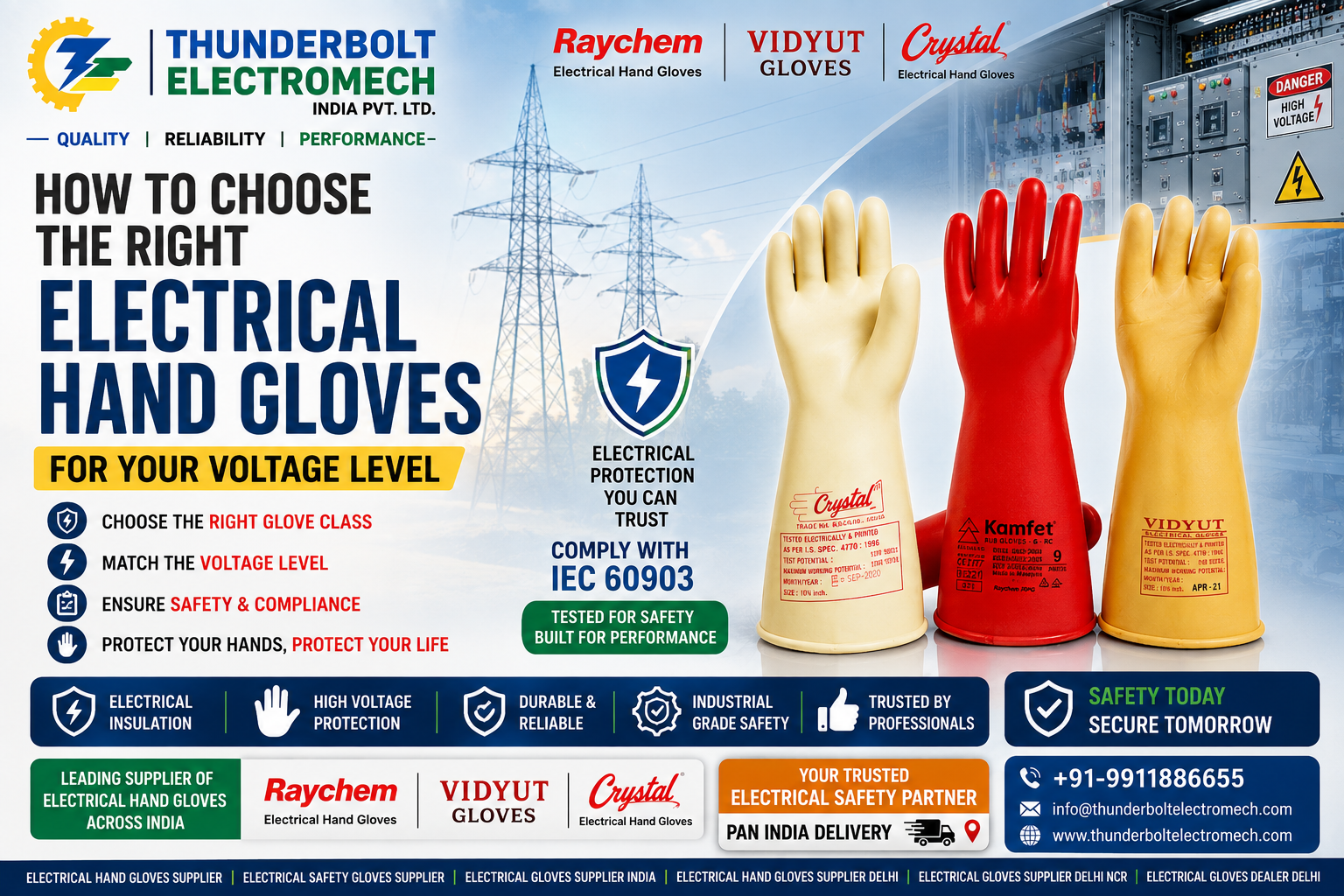
By Thunderbolt Electromech India Pvt. Ltd. — Delhi-based Distributor and Supplier of Raychem, Vidyut and Crystal Electrical Hand Gloves
📞 +91-9911886655 | ✉️ info@thunderboltelectromech.com | 🌐 thunderboltelectromech.com | 📍 Shop No. 3538, Sitaram Bazar Rd, Bazar Sirkiwalan, Chawri Bazar, Chandni Chowk, Delhi – 110006
Quick Answer: The correct electrical hand glove is selected by maximum working voltage, glove class, applicable standard, physical condition, work environment and the mechanical hazards present during the job—not simply by choosing the thickest or most expensive glove.
For IEC 60903 / IS 13774:2021 systems, the commonly used classes range from Class 00 to Class 4. The maximum AC working voltage increases from 500 V for Class 00 to 36,000 V for Class 4. ASTM D120 also recognizes Classes 00, 0, 1, 2, 3 and 4 for rubber insulating gloves.
| IEC/ASTM Class | Maximum AC Working Voltage* | Typical Selection Context |
| Class 00 | 500 V | Low-voltage work |
| Class 0 | 1,000 V | LV systems with higher rating requirement |
| Class 1 | 7,500 V | Medium-voltage work |
| Class 2 | 17,000 V | Higher-voltage distribution |
| Class 3 | 26,500 V | High-voltage applications |
| Class 4 | 36,000 V | Highest class in this series |
*Always verify the marking, certification, test documentation and manufacturer’s current technical data before use. Raychem’s published technical table gives these maximum working-voltage values and corresponding proof/withstand values.
Important: A glove’s class is not the only PPE decision. Electrical isolation, shock boundaries, arc-flash assessment, de-energization/LOTO, inspection and mechanical protection must all be considered.
Why Voltage Matters When Choosing Electrical Hand Gloves
An electrical insulating glove works on a straightforward engineering principle: the glove material must provide sufficient electrical insulation between the worker and a potentially energized conductor or circuit part.
But the selection cannot stop at the nominal system voltage.
A 415 V industrial panel, for example, is not automatically a reason to buy the cheapest glove labelled “electrical.” The purchaser needs to establish:
- What voltage can the worker encounter?
- Is the task energized or de-energized?
- What standard does the project specification require?
- Which glove class is appropriate?
- Will the glove encounter oil, ozone, chemicals, heat or cold?
- Is there a risk of cuts, punctures or abrasion?
- Is an outer mechanical protector required?
- Is the glove within its required inspection/testing cycle?
The Indian standard IS 13774:2021 is identical to IEC 60903:2014 according to the BIS standards preview. That is particularly relevant for Indian procurement teams because it gives a much stronger specification basis than simply writing “rubber electrical gloves” on a purchase order.
Why nominal voltage alone can mislead
Suppose a technician is working around a 6.6 kV motor feeder.
A Class 0 glove rated to 1,000 V is clearly inadequate.
A Class 1 glove, with a maximum working voltage of 7,500 V AC, is within the published class rating—but the final PPE selection still has to account for the actual work procedure, exposed parts, approach distance, system configuration and applicable site safety rules. The class should never be selected by rounding the voltage casually.
This is where an experienced Electrical Hand Gloves Supplier becomes useful.
A good supplier should ask for the system voltage and application, rather than replying to a purchase request with a generic product.
Understanding Electrical Glove Voltage Protection
Electrical insulating gloves are not ordinary industrial hand gloves.
ASTM D120 covers rubber insulating gloves specifically for protection against electrical shock and recognizes six electrical classes. The specification also addresses properties and tests including AC proof, AC breakdown, moisture absorption/proof, DC tests, ozone resistance, tensile strength, tear resistance and puncture resistance.
That distinction matters in procurement.
A general-purpose nitrile-coated glove may offer excellent grip and abrasion resistance. It does not become an electrical insulating glove merely because rubber or polymer appears on its surface.
Class, proof voltage and working voltage are different
This is one of the most common procurement misunderstandings.
Maximum working voltage is the voltage at which the glove class is intended to be used.
Proof test voltage is a test level applied under the applicable standard.
Withstand/breakdown characteristics are different technical parameters and should not be treated as the glove’s permitted operating voltage.
For example, Raychem’s published table lists Class 1 at 7,500 V maximum AC working voltage, 10,000 V proof-test voltage and 20,000 V withstand voltage. These numbers serve different engineering purposes.
Do not buy according to the largest number printed on a datasheet.
Buy according to the working-voltage classification and the applicable standard.
Electrical Hand Gloves Supplier: How to Read a Glove Specification
When comparing products from an Electrical Hand Gloves Supplier, ask for the complete technical identification rather than only the price.
A useful procurement checklist includes:
- Manufacturer/brand
- Product model
- Glove class
- Maximum working voltage
- Applicable standard
- Test/proof voltage
- Manufacturing/test identification
- Size
- Glove length
- Material
- Type and environmental resistance
- Certification/documentation
- Recommended inspection and retest procedure
- Storage requirements
Raychem’s published insulating-glove information, for example, identifies protection across a range from 500 V AC to 36 kV AC and states compliance with EN 60903:2003, IEC 60903:2014 and CE Category III.
Direct evidence vs no direct evidence
Direct evidence found: BIS identifies IS 13774:2021 with IEC 60903:2014, ASTM publishes D120 for rubber insulating gloves, and Raychem publishes its glove classes and voltage table.
No direct evidence found: I did not find a reliable public source establishing one universal Indian rule that every electrical worker must use a particular glove class for every voltage scenario. Therefore, this article does not invent a blanket “240 V = X glove” rule. The actual job, applicable standard, employer safety procedure and glove certification must control the selection.
Electrical Glove Classes Explained
The following table is a practical starting point for technical procurement.
| Class | Maximum AC Working Voltage | Raychem published proof test | Raychem published withstand voltage |
| 00 | 500 V | 2,500 V | 5,000 V |
| 0 | 1,000 V | 5,000 V | 10,000 V |
| 1 | 7,500 V | 10,000 V | 20,000 V |
| 2 | 17,000 V | 20,000 V | 30,000 V |
| 3 | 26,500 V | 30,000 V | 40,000 V |
| 4 | 36,000 V | 40,000 V | 50,000 V |
Source: Raychem’s published technical information.
Class 00
Class 00 is the lowest class in the IEC/ASTM family listed above, with a maximum AC working voltage of 500 V in the Raychem table.
It can be relevant to low-voltage electrical work where the work procedure permits energized work and the appropriate safety assessment has been completed.
It should not be treated as a universal “electrician glove.”
Class 0
Class 0 raises the maximum AC working voltage to 1,000 V.
This gives additional voltage capability compared with Class 00, but it still does not automatically qualify the glove for medium-voltage applications.
Class 1
Class 1 reaches 7,500 V AC maximum working voltage.
This is where purchase specifications become especially important. An industrial plant may have 6.6 kV equipment, but that does not mean the only question is whether the number is below 7.5 kV.
The complete risk assessment remains essential.
Class 2
Class 2 provides a published maximum AC working voltage of 17 kV.
This is relevant to higher-voltage distribution and industrial applications where the equipment and work method demand this level of insulation.
Class 3
Class 3 reaches 26.5 kV AC maximum working voltage.
It belongs to a significantly higher-risk work category and should be controlled through qualified personnel, formal procedures and documented PPE selection.
Class 4
Class 4 reaches 36 kV AC maximum working voltage in the Raychem published table.
This is the highest class in the Class 00–4 sequence.
For these applications, procurement should be specification-driven, not price-driven.
Electrical Hand Gloves Supplier: Low Voltage vs High Voltage Selection
The difference between low-voltage and high-voltage electrical gloves is not merely thickness.
A higher glove class generally involves a different insulation requirement and may have different physical characteristics.
Raychem’s published technical data gives glove lengths of 280 mm, 360 mm and 410 mm, with palm sizes from 7 to 12, and identifies properties such as acid, ozone and oil resistance for its listed products.
That provides an important purchasing lesson:
Voltage rating and physical suitability must be evaluated together.
A glove can have the correct electrical class but still be unsuitable for the job if:
- It is the wrong size.
- The cuff is insufficient for the work.
- It is damaged.
- The work involves mechanical hazards without suitable protection.
- The environment attacks the glove material.
- The glove has not passed the required inspection/testing process.
Rubber Electrical Gloves are not automatically interchangeable
Rubber insulating gloves are engineered PPE.
The ASTM D120 specification differentiates Type I, which is non-ozone-resistant, and Type II, which is ozone-resistant.
For outdoor substations, utilities, industrial switchyards or environments with ozone exposure, material/environmental properties can therefore matter alongside voltage class.
Electrical Glove Classes: A Practical Buying Comparison
| Requirement | What the buyer should check | Procurement mistake to avoid |
| Voltage protection | Maximum working voltage and class | Selecting based on product name |
| Standard | IS 13774 / IEC 60903 / ASTM D120 as specified | Buying an uncertified generic glove |
| Mechanical protection | Leather protector or suitable approved protection where required | Assuming rubber alone prevents cuts |
| Environment | Oil, ozone, acids, temperature and chemicals | Ignoring the plant environment |
| Fit | Hand size and cuff length | Choosing one size for everyone |
| Condition | Surface damage, cuts, punctures and defects | Using visually damaged gloves |
| Testing | Current test/inspection status | Treating purchase date as proof of test validity |
| Traceability | Marking, batch/test information and documents | Buying loose untraceable stock |
How to Match Electrical Gloves to Your Work Environment
Voltage is only one part of the selection equation.
Imagine two technicians working with the same voltage class.
Technician A works inside a clean control room.
Technician B works outdoors near a substation where gloves can encounter sunlight, ozone, dust, moisture and mechanical abrasion.
The electrical class may be similar. The environmental demands are not.
Indoor panel maintenance
For indoor electrical maintenance, focus on:
- Correct electrical class
- Correct size
- Dexterity
- Clean storage
- Inspection
- Test status
- Mechanical protection where required
Outdoor electrical work
Outdoor work introduces additional environmental factors.
A glove specification may need resistance to ozone, oil, acids or low temperatures depending on the manufacturer and application. Raychem specifically lists acid, ozone and oil resistance and extreme-low-temperature testing for the glove range shown on its technical page.
Utility and substation work
For utility work, the procurement file should be more rigorous.
Record:
Equipment voltage → work method → glove class → glove standard → test status → mechanical protector → inspection procedure.
This chain makes an audit easier and prevents a storekeeper from issuing the wrong glove simply because two products look similar.
Electrical Hand Gloves Supplier: What Electricians Should Check Before Use
The purchase decision is only the first control.
NFPA 70E guidance identifies several important maintenance requirements for insulating gloves, including inspection before use and an air test. Its published text also states that maximum use voltages must not exceed the specified table values.
1. Inspect the glove
Look for:
- Cuts
- Punctures
- Cracks
- Abrasion
- Surface deterioration
- Embedded foreign material
- Other physical defects
A tiny defect can have an outsized consequence when the glove is being relied upon as electrical insulation.
2. Perform the required air test
An air test can help identify leakage that may not be obvious from a quick visual inspection. NFPA 70E’s maintenance provisions specifically mention air testing insulating gloves along with inspection.
3. Check the test status
Do not assume that a glove is safe merely because it came from a reputable manufacturer.
Testing and in-service requirements must be managed according to the applicable standard and site procedure.
4. Use appropriate mechanical protection
This is critical.
A rubber insulating glove provides electrical protection; a leather protector is used to provide mechanical protection in applications where the rubber glove could be cut or damaged.
NFPA 70E’s provisions address rubber insulating gloves with leather protectors where there is a shock hazard and explain the mechanical/arc-flash protection role of protectors.
Never substitute a leather protector for a voltage-rated insulating glove.
Customer Problems and Engineering Solutions
Problem 1: “The equipment is 415 V, so any rubber glove should work.”
Solution: Check the glove’s actual electrical classification and standard. A generic rubber-coated work glove is not automatically an electrical insulating glove.
Engineering reason: Electrical insulation is a tested property, not a visual characteristic.
Problem 2: “The glove is Class 1, so we can use it on every system below 7.5 kV.”
Solution: Treat the class rating as one part of the PPE selection. Confirm actual system voltage, work method, exposure, standard and manufacturer’s conditions.
Engineering reason: Maximum working voltage does not replace a complete electrical risk assessment.
Problem 3: “The gloves are new, so testing is unnecessary.”
Solution: Maintain traceability to the applicable inspection/testing requirements.
Engineering reason: Storage, handling and age can affect PPE condition. In-service status and testing requirements must be controlled.
Problem 4: “The rubber glove looks thick enough, so leather protectors aren’t needed.”
Solution: Follow the applicable PPE procedure for mechanical protection.
NFPA 70E specifically addresses leather protectors over rubber insulating gloves where mechanical damage is a concern.
Problem 5: “We buy the same gloves for every electrician.”
Solution: Standardize the selection process, not necessarily one glove for every task.
Different workers may require different sizes. Different electrical tasks may require different classes.
Real-World Use Cases
Case Study 1: 415 V industrial panel maintenance
Situation: A maintenance team works around a low-voltage industrial panel.
Wrong approach: The purchasing team buys general-purpose rubberized gloves because the package says “electrical safety.”
Correct approach: Identify the actual electrical hazard, determine whether energized work is permitted, select an appropriate voltage-rated insulating glove, and use mechanical protection where required.
Lesson: The phrase “electrical glove” is not a technical specification.
Case Study 2: 6.6 kV motor feeder
Situation: An industrial plant maintains 6.6 kV motor feeders.
Procurement question: Should the plant buy Class 0 because it is cheaper?
No.
Class 0 has a maximum AC working voltage of 1,000 V in the published classification. Class 1 reaches 7,500 V AC.
Engineering lesson: The purchasing decision must begin with the maximum working voltage and applicable procedure—not the lowest price.
Case Study 3: Outdoor substation maintenance
Situation: A contractor performs work around outdoor electrical equipment.
The glove sees more than electrical stress. It can face environmental exposure and mechanical handling.
Solution: The specification should address voltage class plus environmental characteristics, physical condition, storage, inspection and mechanical protection.
Raychem’s published glove information specifically identifies resistance to acid, ozone and oil for its listed range.
Lesson: “High voltage” does not mean “ignore the environment.”
Case Study 4: Procurement for a multi-site contractor
A contractor operating across India wants to standardize PPE.
Instead of simply ordering “100 pairs of electrical gloves,” the procurement department should create a matrix:
| Site | Equipment voltage | Work type | Required glove class | Size | Mechanical protection | Documentation |
| Site A | LV | Panel maintenance | Based on risk assessment | 8–10 | As required | Required |
| Site B | 6.6 kV | MV maintenance | Appropriate MV class | 8–11 | As required | Required |
| Site C | 11 kV | Distribution work | Appropriate class | 8–12 | As required | Required |
| Site D | Higher voltage | Utility/substation | Project-specific | As required | As required | Required |
This method reduces the chance of mixing low-voltage and medium/high-voltage PPE in stores.
How a Hand Gloves Electrical Supplier Can Help You Select the Right Product
A capable Hand Gloves Electrical Supplier should not operate like a price-only catalogue.
For an engineer or purchase manager, the useful conversation starts with questions:
What is the voltage?
What equipment will the technician work on?
Is the work energized?
What standard does your project require?
What environmental conditions exist?
What sizes are required?
Do you need mechanical protectors?
What documentation and testing records are required?
Thunderbolt Electromech India Pvt. Ltd. supplies Raychem Electrical Hand Gloves across India and also offers Vidyut and Crystal Electrical Hand Gloves.
For project procurement, buyers should provide:
- Voltage level
- Application
- Required glove class
- Quantity
- Hand sizes
- Required standard
- Delivery location
- Certification/document requirements
This lets the Electrical Safety Gloves Supplier recommend a technically suitable product rather than simply quoting the cheapest pair.
Raychem Electrical Hand Gloves
Raychem’s published range covers insulating rubber gloves from 500 V AC to 36 kV AC and lists Class 00 through Class 4 technical data.
Vidyut Electrical Hand Gloves
Vidyut gloves can be considered when project specifications identify the required class, voltage rating, size and documentation. Buyers should verify the specific model’s current certification and test documentation before purchase.
Crystal Electrical Hand Gloves
Crystal gloves can similarly be evaluated against the project’s voltage class, standard, application and documentation requirements.
Important procurement point: Brand selection should come after technical requirements. Do not reverse that sequence.
Electrical Gloves Supplier India: How Purchase Managers Should Compare Suppliers
When searching for an Electrical Gloves Supplier India, compare suppliers on more than Electrical Gloves Price.
| Procurement factor | Low-quality purchasing approach | Engineering-led approach |
| Price | Lowest quotation | Total value + compliance |
| Voltage | Product title | Verified class |
| Standard | “Rubber glove” | Applicable standard |
| Documentation | Not requested | Requested before PO |
| Size | One size | Worker-specific sizes |
| Test status | Assumed | Documented |
| Delivery | Product availability only | Project schedule |
| Technical help | None | Application-based selection |
| Replacement | Reactive | Planned stock |
This is especially useful when purchasing from an Electrical Gloves Dealer Delhi, Electrical Hand Gloves Supplier Delhi, or an Electrical Gloves Supplier Delhi NCR for projects that later need repeat supply.
Electrical Hand Gloves Supplier: Why Total Cost Matters More Than Glove Price
Searches for Electrical Gloves Price and Electrical Hand Gloves Price are common because procurement departments have budgets to meet.
But comparing only unit price can create a false economy.
Consider the actual procurement cost:
Purchase price + testing + replacement + downtime + logistics + rejected stock + compliance risk.
A glove that is cheaper but unsuitable for the required class is not cheaper.
It is simply the wrong component.
For industrial users, the better question is:
“What is the lowest compliant cost for the required electrical protection and operating conditions?”
That question changes procurement conversations.
Common Mistakes When Buying Electrical Gloves
Mistake 1: Selecting by voltage name only
“11 kV glove” is not enough information.
Ask for the class and applicable standard.
Mistake 2: Confusing proof voltage with working voltage
A glove tested at a high voltage does not mean it can be used continuously at that voltage.
Mistake 3: Treating ordinary rubber gloves as insulating gloves
Material appearance does not establish electrical performance.
Mistake 4: Ignoring glove size
An oversized or undersized glove can interfere with handling and work technique.
Mistake 5: Ignoring mechanical hazards
Electrical insulation does not mean immunity to cuts and punctures.
Mistake 6: Forgetting storage
Rubber insulating PPE requires controlled storage. The current ASTM F496 discussion also highlights storage away from damaging environmental conditions and maintaining gloves in their natural shape.
Mistake 7: Keeping gloves after damage
If inspection reveals damage, the glove should not remain in service simply because “the hole is very small.”
Mistake 8: Buying only on Electrical Hand Gloves Price
The lowest quote does not automatically deliver the lowest project cost.
Electrical Gloves Dealer Delhi: What to Ask Before Placing an Order
If you are comparing an Electrical Gloves Dealer Delhi, ask for these details in writing:
- Brand and model
- Class
- Maximum working voltage
- Applicable standard
- Test/proof voltage
- Manufacturing/test information
- Size
- Length
- Material
- Environmental resistance
- Required protector glove
- Availability
- Delivery schedule
- Certification/documentation
- Storage and testing recommendations
A professional supplier should be comfortable answering technical questions.
Frequently Asked Questions
1. What class of electrical gloves is used for 230 V or 415 V work?
The correct class cannot be selected from voltage alone. The applicable standard, work method, energized exposure and site safety procedure must be considered. Under the IEC/ASTM classification, Class 00 has a maximum AC working voltage of 500 V, but users must confirm that the particular glove and procedure are appropriate.
Research status: Direct evidence found for class voltage; no direct evidence found for a universal “230/415 V = always Class 00” rule.
2. What is the difference between Class 00 and Class 0 gloves?
The published maximum AC working voltage is 500 V for Class 00 and 1,000 V for Class 0.
The higher class is not automatically “better” for every job; it must match the task and applicable requirements.
3. Which gloves are suitable for 6.6 kV work?
The voltage falls above Class 0’s 1,000 V maximum working voltage. Class 1 is listed at 7,500 V AC maximum working voltage in Raychem’s published table.
However, the final selection must be validated against the equipment, work procedure, standard and risk assessment.
4. Are electrical gloves and rubber gloves the same?
No.
Only appropriately manufactured, tested and rated insulating gloves should be relied upon for electrical shock protection. ASTM D120 specifically covers rubber insulating gloves for electrical protection.
5. Can leather gloves replace electrical insulating gloves?
No.
Leather protectors are intended to provide mechanical protection over insulating gloves in relevant applications. They are not a substitute for voltage-rated electrical insulation.
6. Should electrical gloves be worn with leather protectors?
Where the applicable electrical-safety procedure requires mechanical protection, yes. NFPA 70E specifically addresses rubber insulating gloves with leather protectors for shock-related hand protection.
7. How often should electrical insulating gloves be tested?
The answer depends on the governing standard and workplace procedure. For users following ASTM-based programs, the in-service inspection/testing requirements should be controlled through the current applicable edition and qualified testing process.
Do not establish a testing interval from a supplier’s marketing page alone.
Research status: Direct evidence found that testing/maintenance is governed by applicable standards; exact interval should be verified against the current standard/procedure applicable to the project.
8. Can damaged electrical gloves still be used?
They should not be treated as acceptable PPE after damage is identified. Inspection is an essential part of maintaining insulating equipment. NFPA 70E calls for inspection before use and an air test for insulating gloves.
9. What standard should Indian buyers look for?
For Indian procurement, IS 13774:2021 / IEC 60903:2014 is highly relevant. BIS identifies IS 13774:2021 as identical to IEC 60903:2014.
Project specifications can also require other standards such as ASTM D120 depending on the application and contract.
10. Are Class 4 gloves always safer than Class 0?
Not necessarily.
Class 4 provides a much higher maximum working voltage, but that does not make it the correct choice for every task. Glove class, dexterity, size, work environment, mechanical hazards and the overall PPE system must be considered.
More insulation is not a substitute for correct risk assessment.
11. What should an Electrical Gloves Supplier India provide with the product?
For industrial procurement, ask for product identification, class, voltage rating, applicable standard, test information and any relevant conformity/certification documentation required by the project.
12. How should electrical gloves be stored?
Follow the manufacturer’s instructions and applicable standard. They should be protected from damaging conditions and stored so they do not develop harmful folds, compression or environmental degradation. Current ASTM F496-related guidance also emphasizes cool, dry, dark storage away from ozone, chemicals and oils.
13. Are Raychem gloves suitable for high-voltage work?
Raychem’s published insulating-glove range includes classes from 00 through 4, with maximum AC working voltage information extending to 36 kV.
The exact model must still be selected according to the job’s requirements.
14. Where can I buy electrical safety gloves in Delhi NCR?
Thunderbolt Electromech India Pvt. Ltd. supplies electrical safety products and electrical hand gloves, including Raychem, Vidyut and Crystal options. Buyers should provide their voltage, required class, quantity and application before requesting a quotation.
Trust Signal: Thunderbolt Electromech India Pvt. Ltd.
Thunderbolt Electromech India Pvt. Ltd. is a Delhi-based supplier serving electrical, industrial and project procurement requirements.
Electrical Hand Gloves available:
- Raychem Electrical Hand Gloves
- Vidyut Electrical Hand Gloves
- Crystal Electrical Hand Gloves
Suitable buyer categories:
Electrical contractors • Maintenance departments • EPC companies • Manufacturing plants • Utilities • Infrastructure projects • Purchase managers • Industrial electrical teams
Phone: +91-9911886655
Location: Delhi, India
Website: Thunderbolt Electromech India Pvt. Ltd.
Email: Use the company’s verified business email address here rather than publishing an unverified address.
For quotations, send voltage level + required glove class + quantity + size + delivery location + required standard/documentation. This allows the supplier to respond with a technically useful quotation instead of a generic price.
Conclusion: Choose Electrical Hand Gloves by Engineering Requirement, Not by Price
Choosing the right electrical hand gloves begins with one question: what electrical voltage and work condition will the worker actually face?
From there, the decision becomes systematic.
Identify the maximum working voltage. Select the appropriate glove class. Verify IS 13774/IEC 60903 or another project-required standard. Check the manufacturer’s technical data. Match the glove to the worker’s hand size. Evaluate ozone, oil, chemical and temperature exposure. Consider cuts and punctures. Use mechanical protectors where required. Inspect the gloves before use and follow the applicable testing program.
The Class 00–4 system gives engineers and purchase managers a clear framework, but it should not be reduced to a simple “higher class is always better” rule. A properly selected Class 00 glove for the correct low-voltage task is better engineering than an incorrectly specified Class 4 glove used without proper procedures.
For projects looking for an Electrical Hand Gloves Supplier, Electrical Safety Gloves Supplier, Electrical Gloves Supplier India, or Electrical Insulating Gloves Supplier, Thunderbolt Electromech can support procurement requirements with Raychem, Vidyut and Crystal Electrical Hand Gloves.
For technical selection and quotation: +91-9911886655.