
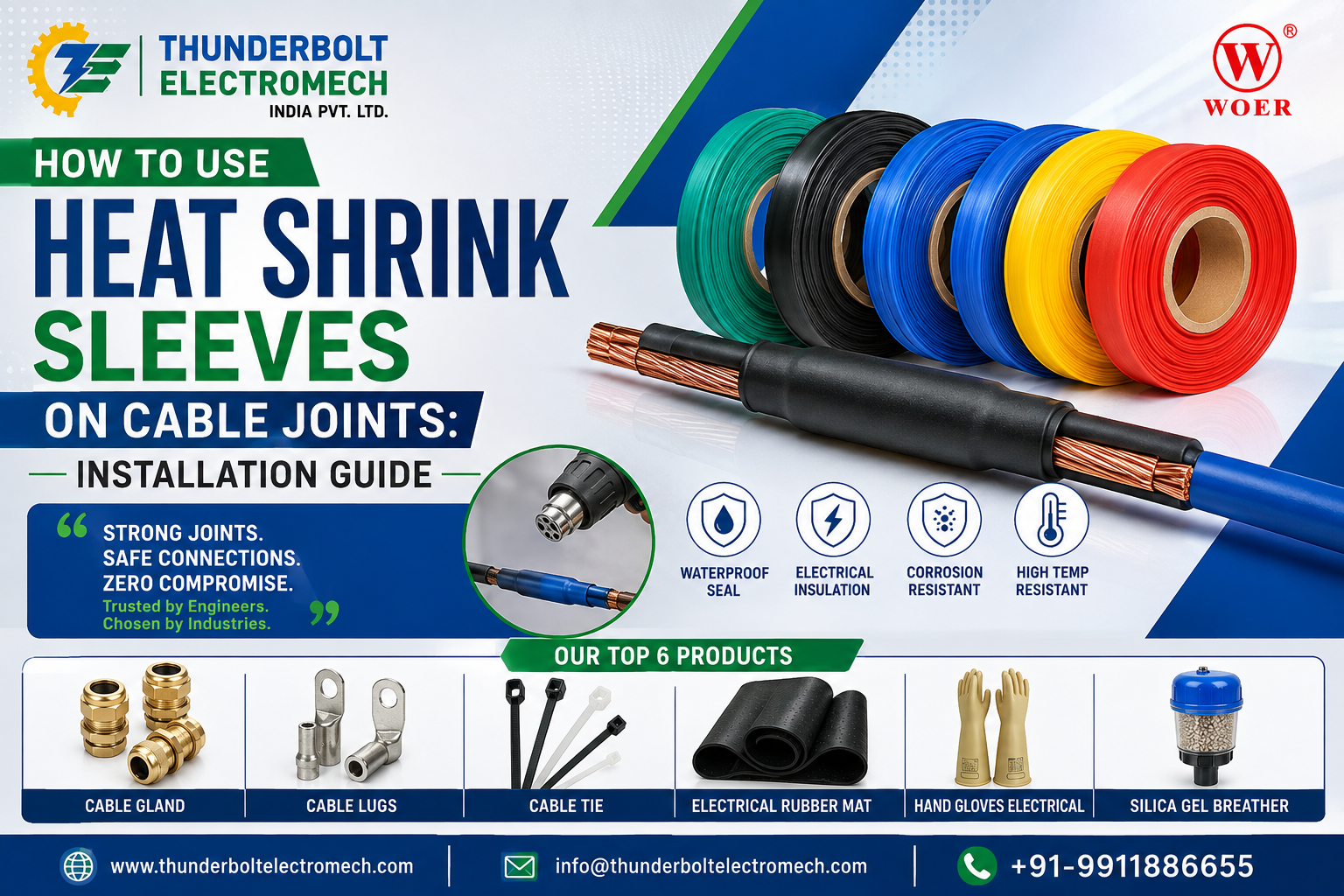
By Thunderbolt Electromech India Pvt. Ltd. — Delhi-Based Supplier & Distributor of the Complete WOER Heat Shrink Sleeve Range
📞 +91-9911886655 | ✉️ info@thunderboltelectromech.com | 🌐 thunderboltelectromech.com | 📍 Shop No. 3538, Sitaram Bazar Rd, Bazar Sirkiwalan, Chawri Bazar, Chandni Chowk, Delhi – 110006
Quick Answer: Heat shrink sleeves protect cable joints by forming a tight insulating and protective layer around the joint after controlled heating. For a reliable installation, select the correct sleeve material and Heat Shrink Sleeve Size, prepare and clean the cable, centre the sleeve, apply heat evenly from the recommended distance, and allow the assembly to cool without movement. Proper recovery should produce uniform contact without scorching, voids, wrinkles, or trapped moisture.
Introduction
A cable joint is only as reliable as the protection applied around it. The electrical connection inside the joint may be mechanically sound, yet the finished assembly can still suffer from moisture ingress, contamination, mechanical abrasion, insulation damage or thermal stress if the outer protection is poorly installed.
That is where Heat Shrink Sleeves become important.
A heat-shrinkable sleeve changes its dimensions when exposed to controlled heat. The installer positions the expanded sleeve over the required area and heats it until it recovers around the cable or joint. Depending on the product construction, the recovered sleeve can provide electrical insulation, mechanical protection and environmental sealing.
However, heat shrinking is not simply a matter of pointing a heat gun at plastic until it becomes tight.
The engineering outcome depends on several variables:
- Cable outside diameter
- Joint diameter
- Sleeve expansion and recovery ratio
- Sleeve material
- Adhesive or non-adhesive construction
- Recovery temperature
- Heating equipment
- Heating speed
- Cable material
- Ambient conditions
- Required electrical performance
- Exposure to moisture, chemicals, UV and mechanical forces
WOER’s published technical information, for example, shows that different heat-shrink families have different shrink ratios, operating temperatures, adhesive constructions and recovery temperatures. Its 3:1 adhesive-lined range is designed for environmental sealing, while other families are engineered for different applications.
For Indian electrical contractors, EPC companies, panel builders, maintenance departments and purchase teams, choosing a technically suitable Heat Shrink Sleeve Supplier India is therefore as important as choosing the sleeve itself.
Thunderbolt Electromech India Pvt. Ltd. is a Delhi-based distributor and supplier of WOER heat shrink products, serving electrical contractors, industrial users and procurement teams across Delhi/NCR and India. Its published product range includes heat shrink sleeves alongside cable lugs, cable glands, cable ties and other electrical accessories.
This guide focuses on the engineering process behind installing a Heat Shrink Sleeve for Cable Joint, including preparation, sizing, heating, inspection, common failures and situations where a simple sleeve should not be treated as a complete cable-joint repair.
Heat Shrink Sleeve Supplier: When Should You Use Heat Shrink Sleeves?
Heat shrink sleeves are useful when an electrical assembly needs an additional layer of insulation, mechanical protection, environmental protection or identification.
Typical applications include:
- Cable joints
- Cable terminations
- Cable-to-connector transitions
- Exposed conductor insulation
- Busbar insulation
- Cable repair protection where the underlying cable remains technically sound
- Industrial wiring
- Automotive and control wiring
- Outdoor electrical connections
- Low-voltage cable accessories
WOER describes adhesive-lined heat-shrink products for wire splices, breakouts and connector-to-cable transitions, with certain product families providing sealing against water and other contaminants.
Why use heat shrink rather than ordinary insulating tape?
Tape can be useful for particular applications, but a properly selected heat-shrink product can provide a more controlled and repeatable finished geometry.
A recovered sleeve can:
- Maintain a defined wall thickness.
- Provide mechanical protection.
- Cover irregular joint profiles.
- Reduce exposure of the connection to contaminants.
- Provide electrical insulation where the product is rated for the application.
- Improve strain protection in suitable assemblies.
- Provide environmental sealing when an adhesive-lined product is specified.
The important qualification is “where the product is rated for the application.”
A low-voltage general-purpose tube should not automatically be treated as a medium-voltage cable-joint system. Medium-voltage joints and terminations require carefully engineered insulation, stress control, screening and sealing systems.
WOER’s published medium-voltage termination information illustrates this distinction: its MV termination systems combine insulation, electrical stress control, anti-tracking components, creepage design and moisture sealing rather than relying on a generic tube alone.
Engineering problem: trapped moisture
Moisture is one of the most overlooked installation risks.
If moisture remains between the cable surface and sleeve before recovery, the sleeve may seal the moisture inside. The outer surface can look excellent while the interface underneath remains contaminated.
This is particularly important in:
- Outdoor installations
- Underground cable work
- Damp electrical rooms
- Monsoon conditions
- Coastal environments
- Cable trenches
- Transformer yards
An adhesive-lined Electrical Heat Shrink Sleeve can provide environmental sealing when the product is specifically designed for it. WOER’s technical literature identifies adhesive-lined products for sealing against water, moisture and contaminants.
The principle is simple:
Do not seal contamination into the joint.
Tools Required for Installation
The quality of installation depends partly on the tools used.
A professional installation normally requires:
| Tool / Material | Purpose |
| Heat shrink sleeve | Primary insulation/protection |
| Heat gun or suitable heating equipment | Controlled heating |
| Cable cutter | Clean cable preparation |
| Cable stripping tools | Remove insulation where required |
| Measuring tape/vernier | Dimension verification |
| Cleaning wipes | Surface preparation |
| Approved solvent | Removing compatible contaminants |
| Marker | Position reference |
| Gloves/PPE | Installer protection |
| Temperature indicator, where specified | Process control |
| Inspection light | Final examination |
Heat source selection
A heat gun offers controllable heat and airflow. It is generally preferable to an uncontrolled flame when the product manufacturer’s installation procedure permits hot-air installation.
Direct flame creates a difficult thermal environment.
The flame can produce a very high local temperature while the surrounding sleeve remains relatively cool. That creates a temperature gradient across the material.
The result can be:
- Local scorching
- Surface blistering
- Uneven recovery
- Material degradation
- Premature ageing
- Damage to cable insulation
- Adhesive burning
- Reduced mechanical performance
The installer should therefore follow the manufacturer’s recommended heating method and recovery temperature.
WOER product specifications demonstrate why this matters: different products have different fully-shrink temperatures. For example, published 3:1 and 2:1 adhesive-lined families specify full-shrink temperatures around or above 125°C, while other heat-shrink families are designed for different thermal ranges.
Customer problem: “Can I use any heat gun?”
Not necessarily.
Solution: Match the heating equipment to the sleeve manufacturer’s installation instructions. A heat gun with adjustable temperature and airflow provides better process control than improvised heating.
How to Prepare the Cable
Preparation is one of the most important stages of the installation.
A poor surface cannot be corrected by a good sleeve.
Step 1: Isolate the electrical system
Before working on any cable, follow the site’s approved isolation, lockout/tagout, verification and discharge procedures.
Never treat heat shrink installation as a substitute for electrical safety procedures.
Step 2: Inspect the joint
Check for:
- Damaged cable insulation
- Cracked jacket
- Oil contamination
- Moisture
- Sharp edges
- Burrs
- Loose mechanical components
- Incorrect connector positioning
- Excessive joint diameter
- Evidence of overheating
If the underlying joint is electrically or mechanically defective, installing a sleeve over it does not make the joint safe.
Step 3: Clean the surface
Remove:
- Dust
- Grease
- Oil
- Moisture
- Dirt
- Loose particles
Use a compatible cleaning method recommended for the cable insulation and sleeve material.
Avoid aggressive solvents that can attack PVC, XLPE, PE or other cable materials.
Step 4: Remove sharp edges
A sharp metallic edge can cut or puncture a recovering sleeve.
The sleeve should pass over the joint without encountering an unnecessarily sharp projection.
Step 5: Mark the sleeve position
Before heating, mark reference points where necessary.
This is particularly useful when the sleeve needs to cover equal lengths on both sides of a joint.
Heat Shrink Sleeve Supplier: Selecting the Correct Sleeve Size
Correct sizing is not based simply on the conductor cross-sectional area.
The installer should consider the finished joint diameter and the sleeve’s expanded and recovered dimensions.
This distinction matters.
A cable may be described as 70 mm², 120 mm² or 240 mm², but the relevant dimension for a sleeve is often the outside diameter of the assembly being covered.
Understand shrink ratio
Common heat-shrink ratios include:
- 2:1
- 3:1
- 4:1
A 3:1 sleeve has greater dimensional coverage than a basic 2:1 sleeve.
For example, a product designed with a 3:1 ratio can accommodate a larger difference between the initial expanded diameter and the final recovered diameter.
WOER publishes 2:1, 3:1 and 4:1 product families, confirming that selection depends on the required dimensional range and application.
Practical sizing process
Measure:
Minimum sleeve diameter required after recovery
and
Maximum diameter over which the sleeve must initially pass.
Then compare those dimensions with the manufacturer’s dimensional chart.
Do not select solely by nominal product name.
Heat Shrink Sleeve Size example
Suppose a cable joint has:
- Minimum covered diameter: 28 mm
- Maximum installation diameter: 45 mm
A 2:1 sleeve may not provide adequate installation clearance depending on the manufacturer’s actual expanded dimensions.
A 3:1 sleeve may offer greater flexibility.
But the final decision must come from the product’s actual dimensional specification.
Adhesive-lined versus non-adhesive
A non-adhesive sleeve primarily provides insulation and mechanical protection.
An adhesive-lined sleeve adds an internal sealing function.
WOER’s published dual-wall products use an adhesive inner layer designed to improve environmental sealing, with some products specifying bonding to materials such as plastics, steel and polyethylene.
Therefore, when buying from a Heat Shrink Sleeve Supplier Delhi, tell the supplier:
- Cable type
- Cable diameter
- Joint diameter
- Required sleeve length
- Indoor/outdoor application
- Voltage
- Temperature
- Moisture exposure
- Required shrink ratio
- Adhesive requirement
- Quantity
That information makes product selection much more accurate.
Positioning the Sleeve
Slide the sleeve into position before applying heat.
This sounds obvious, but incorrect positioning is one of the most common field errors.
Centre the sleeve
If the sleeve protects a central cable joint, position it so that the required overlap or coverage exists on both sides.
Use the previously made reference marks.
Check for obstruction
The sleeve should not be trapped against:
- Cable clamps
- Connector projections
- Sharp hardware
- Other sleeves
- Unintended mechanical restrictions
Avoid premature heating
Once heat is applied, repositioning becomes difficult.
The installer should confirm:
Position → alignment → coverage → heat.
Not:
Heat → discover incorrect position → attempt correction.
Sleeve movement during heating
A sleeve can move when the polymer softens.
This becomes especially important on vertical or angled installations.
If the sleeve moves before recovery, one end may become inadequately covered.
A simple engineering control is to start heating at the appropriate location and allow the sleeve to begin gripping the assembly before progressing through the remaining area, following the manufacturer’s instructions.
Heat Shrink Sleeve Supplier: Applying Heat Correctly
Heating is the stage where many otherwise good installations fail.
The objective is not maximum heat.
The objective is controlled recovery.
Heat from a controlled distance
Keep the heat source moving.
Do not hold the nozzle stationary over one location.
A moving heat source distributes energy over the polymer and reduces the chance of overheating.
Work progressively
For many products, the installer can heat progressively from one end toward the other while observing the recovery process.
The exact sequence should follow the manufacturer’s installation instructions.
Watch the material
The sleeve should recover progressively.
Warning signs include:
- Smoke
- Charring
- Severe bubbling
- Glossy burnt patches
- Discoloration
- Excessive adhesive burning
- Cable insulation deformation
These are not signs of “better shrinkage.”
They indicate excessive or poorly controlled heating.
Uneven heating
Uneven heating can create an asymmetric recovered sleeve.
One side may be tightly recovered while another remains loose.
This can produce:
- Voids
- Poor sealing
- Mechanical weakness
- Uneven wall thickness
- Water pathways
- Local stress concentrations
Excessive heat exposure
More heat does not automatically produce a stronger joint.
Polymeric materials have thermal limits. The installer must respect the manufacturer’s specified recovery and operating temperatures.
For example, WOER lists operating and shrink-temperature data for individual product families rather than providing one universal temperature for all heat-shrink products.
That is an important engineering point:
Heat-shrink installation is product-specific.
How to Recognize Proper Shrinkage
A correctly installed sleeve should be visually and physically consistent with the manufacturer’s installation guidance.
Look for:
1. Uniform recovery
The sleeve should have recovered around the intended surface without obvious loose sections.
2. No significant wrinkles
Minor surface texture may occur depending on product and substrate geometry, but major folds can indicate poor heating or positioning.
3. No scorching
Brown, blackened or burnt areas are warning signs.
4. Correct end coverage
The sleeve should reach the intended coverage points.
5. Adhesive flow where applicable
With adhesive-lined products, the adhesive may flow at the sleeve ends as the product reaches its designed installation temperature.
However, the exact visual appearance varies by construction, so the manufacturer’s instructions remain the controlling reference.
6. No trapped contamination
A clean installation starts with a clean interface.
7. No sleeve movement
After recovery and cooling, the sleeve should remain correctly positioned.
Do not immediately mechanically disturb a hot sleeve.
Allow the assembly to cool according to the manufacturer’s instructions.
Common Installation Mistakes
Mistake 1: Choosing the sleeve by cable conductor size alone
A 95 mm² cable does not automatically tell you the correct sleeve size.
Better approach: measure the actual diameter of the assembly and use the manufacturer’s dimensional chart.
Mistake 2: Heating one point too long
This creates localized overheating.
Solution: keep the heat moving.
Mistake 3: Shrinking over moisture
The sleeve can seal moisture inside.
Solution: clean and dry the cable before installation.
Mistake 4: Using the wrong material
Different polymers and constructions have different electrical, mechanical and thermal properties.
Solution: verify material compatibility.
Mistake 5: Using a generic tube on a medium-voltage joint
A generic sleeve is not automatically an MV joint system.
Solution: use an engineered cable-joint kit specified for the voltage, cable construction and installation environment.
Mistake 6: Ignoring compatibility
The sleeve must be compatible with the cable jacket, insulation, joint components and environmental conditions.
Mistake 7: Moving the sleeve while hot
Movement can create uneven coverage.
Solution: position carefully and allow controlled cooling.
Mistake 8: Using excessive heat
A sleeve can look recovered while the underlying cable insulation has already experienced unnecessary thermal stress.
Mistake 9: Ignoring operating temperature
The sleeve’s continuous operating temperature must suit the application.
WOER product families show different continuous operating limits, reinforcing the need to select the exact product rather than assuming all heat-shrink materials behave identically.
Safety Precautions
Heat shrink installation combines electrical, thermal and chemical hazards.
Electrical safety
The cable should be properly isolated before installation.
Follow the site’s:
- Isolation procedure
- Lockout/tagout procedure
- Voltage verification
- Discharge procedure
- Earthing procedure
- Permit-to-work system
Thermal safety
The heat source can cause severe burns.
Use:
- Suitable gloves
- Eye protection
- Appropriate work clothing
- Correct ventilation
- Fire-safe working practices
Fire safety
Do not use uncontrolled flame near combustible materials.
Before heating, inspect the surrounding work area.
Remove unnecessary combustible materials.
Product safety
Read the product manufacturer’s installation instructions.
Do not assume the recovery temperature, operating temperature or compatible substrate is the same for every product.
When Heat Shrink Should Not Be Used as a Repair
This distinction is essential.
A heat shrink sleeve can protect a suitable underlying assembly. It cannot compensate for every cable defect.
Do not treat a sleeve as a solution for:
- Severely damaged conductor
- Failed insulation
- Incorrect crimp
- Loose connector
- Burnt cable
- Significant cable jacket destruction
- Incorrect joint design
- Internal moisture damage
- Medium-voltage insulation failure
- Electrical stress-control failure
- Excessive conductor heating
- Mechanically unstable joints
If a connector is loose, shrinking plastic over it does not create a reliable electrical connection.
If the insulation system has failed, adding an outer sleeve does not automatically restore its original dielectric design.
For medium- and high-voltage applications, use a complete engineered joint or termination system appropriate to the cable voltage and construction. WOER’s MV termination documentation demonstrates the additional components involved, including stress control, anti-tracking protection, creepage management and moisture sealing. (Woer)
Customer Problems and Solutions
| Customer Problem | Likely Cause | Engineering Solution |
| Sleeve does not shrink sufficiently | Wrong size or inadequate heat | Verify dimensions and manufacturer recovery requirements |
| Sleeve burns | Excessive heat | Reduce thermal exposure and keep heat moving |
| One side remains loose | Uneven heating | Apply controlled, progressive heat |
| Sleeve slides after installation | Incorrect positioning or insufficient recovery | Check product selection and installation procedure |
| Moisture appears under sleeve | Poor cleaning/drying | Prepare the substrate correctly |
| Adhesive does not flow | Insufficient recovery temperature or wrong product | Follow product-specific installation instructions |
| Cable jacket softens | Excessive heat | Control temperature and distance |
| Sleeve cracks later | Material incompatibility or environmental stress | Verify material and operating conditions |
| Joint remains electrically unreliable | Underlying connection defect | Repair the joint; do not rely on sleeve alone |
| Sleeve will not pass over joint | Insufficient expanded diameter | Select an appropriate shrink ratio |
Comparison Table
| Feature | Non-Adhesive Heat Shrink | Adhesive-Lined Heat Shrink | Engineered Cable Joint Kit |
| Electrical insulation | Yes, when rated | Yes, when rated | Yes |
| Mechanical protection | Yes | Yes | Yes |
| Moisture sealing | Limited | Stronger when designed for sealing | Engineered |
| Installation complexity | Low | Moderate | Higher |
| Suitable for simple LV insulation | Often | Often | Sometimes unnecessary |
| Suitable for environmental sealing | Application-dependent | Strong option | Yes |
| Medium-voltage joint replacement | No, not automatically | No, not automatically | Yes, where specifically rated |
| Stress control | Generally no | Generally no | Designed into appropriate MV systems |
| Selection basis | Diameter/application | Diameter/application/environment | Voltage/cable/joint engineering |
The table illustrates an important procurement principle: the most sophisticated product is not always the correct product, but the simplest product is not always adequate.
Heat Shrink Sleeves vs Heat Shrink Tubing
The terms are often used interchangeably in commercial searches.
Heat Shrink Tubing commonly refers to continuous tubular material supplied in various diameters and wall constructions.
Heat Shrink Sleeves can refer broadly to heat-shrinkable tubular products or application-specific sleeves.
Searches such as Heat Shrink Tube Supplier, Heat Shrink Tubing Supplier India, and Electrical Heat Shrink Sleeve may therefore describe overlapping product categories.
For procurement, the technical specification is more important than the search phrase.
Ask for:
- Material
- Shrink ratio
- Expanded diameter
- Recovered diameter
- Wall thickness
- Adhesive construction
- Operating temperature
- Recovery temperature
- Electrical properties
- Application rating
- Standard/test information
Real Use Cases
Use Case 1: Industrial LV cable joint
An industrial plant has an LV power cable joint inside a controlled electrical area.
The joint requires additional insulation and mechanical protection.
A correctly selected heat shrink sleeve can provide the required outer protection when compatible with the joint and cable materials.
The engineering priority is:
Correct diameter + clean surface + controlled recovery.
Use Case 2: Outdoor cable connection
An outdoor cable connection faces rain, humidity and contamination.
An adhesive-lined product designed for environmental sealing can be considered.
WOER specifically identifies adhesive-lined heat-shrink products for moisture and contaminant sealing in suitable applications.
The critical installation issue becomes moisture management.
The installer must ensure that the surfaces are clean and dry before sealing.
Use Case 3: Cable-to-connector transition
A connector creates a large change in diameter between the cable and connector body.
A higher-ratio heat shrink product can be advantageous where its specified recovered dimensions suit the application.
WOER’s 4:1 product family is specifically described as useful for sealing applications with larger diameter differences.
Use Case 4: Medium-voltage termination
This is different.
A generic sleeve should not replace an engineered termination.
WOER’s MV termination systems include stress-control and anti-tracking components in addition to insulation and moisture sealing.
That is the engineering boundary contractors must understand.
Research and Evidence Note
Primary research / manufacturer evidence
Direct evidence found: WOER’s technical documentation provides product-specific information on shrink ratios, operating temperatures, recovery temperatures, adhesive sealing, mechanical properties and dimensional specifications.
Direct evidence found: WOER documentation describes adhesive-lined products for wire splices, connector transitions and environmental sealing.
Direct evidence found: WOER’s MV termination information demonstrates that higher-voltage cable systems require more than generic insulation tubing, including electrical stress control, anti-tracking and moisture sealing.
Peer / industry evidence
TE Connectivity’s power-transmission documentation describes heat-shrink products as providing mechanical protection, electrical insulation and moisture sealing in appropriate low-voltage applications.
Its cable-accessory documentation also describes heat-induced adhesive flow as part of moisture and corrosion protection in engineered cable-joint systems.
No direct evidence found
No direct independent field-study evidence was found that supports a universal heating distance, universal heat-gun temperature or universal installation time for every heat shrink sleeve.
Therefore, this article deliberately does not prescribe one temperature or heating distance for every product.
The manufacturer’s product-specific installation instructions should control.
That is particularly important because different WOER products have different shrink ratios, materials and thermal specifications.
Heat Shrink Sleeve Price: What Actually Determines Cost?
Customers searching for Heat Shrink Sleeve Price or Heat Shrink Tube Price often compare products solely by length or diameter.
That can produce a misleading comparison.
Price can vary according to:
- Material
- Shrink ratio
- Wall thickness
- Adhesive lining
- Flame-retardant construction
- Operating temperature
- Electrical rating
- Manufacturer
- Product certification
- Diameter
- Length
- Packaging
- Quantity
- Application-specific design
A 2:1 general-purpose tube and a 3:1 adhesive-lined product should not be compared as though they were identical products.
For industrial purchasing, the better question is:
What technical requirement does the sleeve need to satisfy?
Then compare price among products that satisfy that requirement.
Choosing a Heat Shrink Sleeve Supplier
A dependable Heat Shrink Sleeve Supplier should do more than quote a diameter.
The supplier should be able to understand the application.
Ask:
- What is the cable diameter?
- What is the joint diameter?
- What is the voltage?
- Is the installation indoor or outdoor?
- Is moisture sealing required?
- Is adhesive lining required?
- What shrink ratio is appropriate?
- What operating temperature is expected?
- What quantity is required?
- Is project documentation required?
Thunderbolt Electromech positions itself as an industrial electrical product supplier serving engineers, contractors, industries, utilities and purchase teams. Its published range includes WOER heat shrink sleeves and other cable accessories.
For buyers searching Heat Shrink Sleeve Supplier Delhi, Heat Shrink Sleeve Dealer Delhi or Heat Shrink Sleeve Supplier India, application information should accompany the enquiry.
Why Thunderbolt Electromech for WOER Heat Shrink Sleeves?
Thunderbolt Electromech India Pvt. Ltd. is a Delhi-based distributor and supplier of WOER heat shrink products.
The company’s published electrical product range includes:
- WOER Heat Shrink Sleeves
- Cable Lugs
- Cable Glands
- Cable Ties
- Electrical Safety Products
- Silica Gel Breathers
- Other industrial electrical accessories
Its published cable-lug guide also identifies multiple heat-shrink categories, including thin-wall, dual-wall, flame-retardant and heavy-duty products.
For procurement teams, this broader product ecosystem can simplify sourcing because heat shrink products are frequently purchased alongside cable lugs, glands and other cable accessories.
Trust Signals
Company: Thunderbolt Electromech India Pvt. Ltd.
Location: Delhi, India
Address: Shop No. 3538, Sitaram Bazar Rd, Bazar Sirkiwalan, Chawri Bazar, Chandni Chowk, Delhi – 110006
Phone: +91-9911886655
Email: info@thunderboltelectromech.com
Website: thunderboltelectromech.com
Thunderbolt’s current website also presents the company as a Delhi-based supplier of electrical products for industrial, utility and infrastructure requirements.
Customer Buying Checklist
Before requesting a quotation from a Heat Shrink Sleeve Supplier Delhi, send the following:
Application: Cable joint / termination / connector / insulation
Cable type: PVC / XLPE / other
Cable OD: ___ mm
Joint OD: ___ mm
Required sleeve length: ___ mm
Voltage: ___ V / kV
Indoor or outdoor: ___
Moisture exposure: Low / Medium / High
Adhesive lined: Yes / No
Required shrink ratio: ___
Quantity: ___
Project location: ___
Required documentation: Datasheet / test report / compliance documentation
This takes only a few minutes and can prevent an unsuitable quotation.
Frequently Asked Questions
What is a heat shrink sleeve used for?
A heat shrink sleeve is used to provide insulation, mechanical protection and, for suitable adhesive-lined products, environmental sealing around electrical cables, joints and transitions.
How do I select Heat Shrink Sleeve Size?
Measure the diameter of the assembly that the sleeve must cover and compare it with the manufacturer’s expanded and recovered dimensions. Consider the shrink ratio and installation clearance.
Is adhesive-lined heat shrink better?
Not universally. Adhesive-lined products are useful when environmental sealing is required. A non-adhesive product may be appropriate where insulation or mechanical protection is the primary requirement.
Can heat shrink repair a damaged cable?
It depends on the damage. A sleeve can protect a suitable underlying repair, but it should not be used to conceal a defective conductor, failed joint, severe insulation damage or an incorrectly engineered medium-voltage termination.
What causes incomplete recovery?
Common causes include incorrect sleeve selection, insufficient heating, uneven heating, obstruction, poor installation technique or failure to follow the manufacturer’s recovery requirements.
Can excessive heating damage a cable?
Yes. Excessive heat can damage the sleeve and potentially affect the cable insulation or other components. Use controlled heating and follow the product-specific installation procedure.
Is a 3:1 sleeve better than a 2:1 sleeve?
Not automatically. A 3:1 sleeve provides a greater dimensional recovery range, which can be useful for larger diameter variations. The correct ratio depends on the actual application.
What should I tell a Heat Shrink Sleeve Supplier India?
Provide the cable diameter, joint diameter, voltage, application, indoor/outdoor condition, required length, environmental conditions, adhesive requirement and quantity.
Conclusion: How to Use Heat Shrink Sleeves on Cable Joints
Installing a heat shrink sleeve correctly is a controlled engineering process, not simply a heating operation.
The installer must first establish that the underlying cable joint is sound. Then the correct sleeve material, shrink ratio and dimensions must be selected. The cable surface must be clean and dry, the sleeve must be correctly positioned, and heating must be progressive and controlled.
The most important failure mechanisms are predictable: overheating, uneven heating, trapped moisture, incomplete recovery, sleeve movement, material incompatibility and excessive heat exposure.
Avoid them through measurement, preparation and process control.
For standard LV insulation and protection, an appropriately selected Heat Shrink Sleeve for Cable Joint can provide a practical and durable protective layer. For environmental sealing, an adhesive-lined construction may be appropriate. For medium-voltage systems, use a complete engineered cable-joint or termination system rather than treating generic heat shrink tubing as a substitute for electrical stress control.
For businesses searching for a Heat Shrink Sleeve Supplier, Heat Shrink Sleeve Supplier India, Heat Shrink Sleeve Supplier Delhi, Heat Shrink Sleeve Dealer Delhi, Heat Shrink Tubing Supplier India, or Heat Shrink Tube Supplier, Thunderbolt Electromech India Pvt. Ltd. supplies WOER heat-shrink products and related industrial electrical accessories.
Thunderbolt Electromech India Pvt. Ltd.
Shop No. 3538, Sitaram Bazar Rd, Bazar Sirkiwalan, Chawri Bazar, Chandni Chowk, Delhi – 110006
Phone: +91-9911886655
Email: info@thunderboltelectromech.com
Website: thunderboltelectromech.com
The right sleeve protects more than a cable joint. It protects the reliability of the installation around it.
[…] still heat shrink sleeves first — the correct heating technique detailed in Thunderbolt’s installation guide applies identically here, and a poorly shrunk colour sleeve that wrinkles or scorches is both a […]