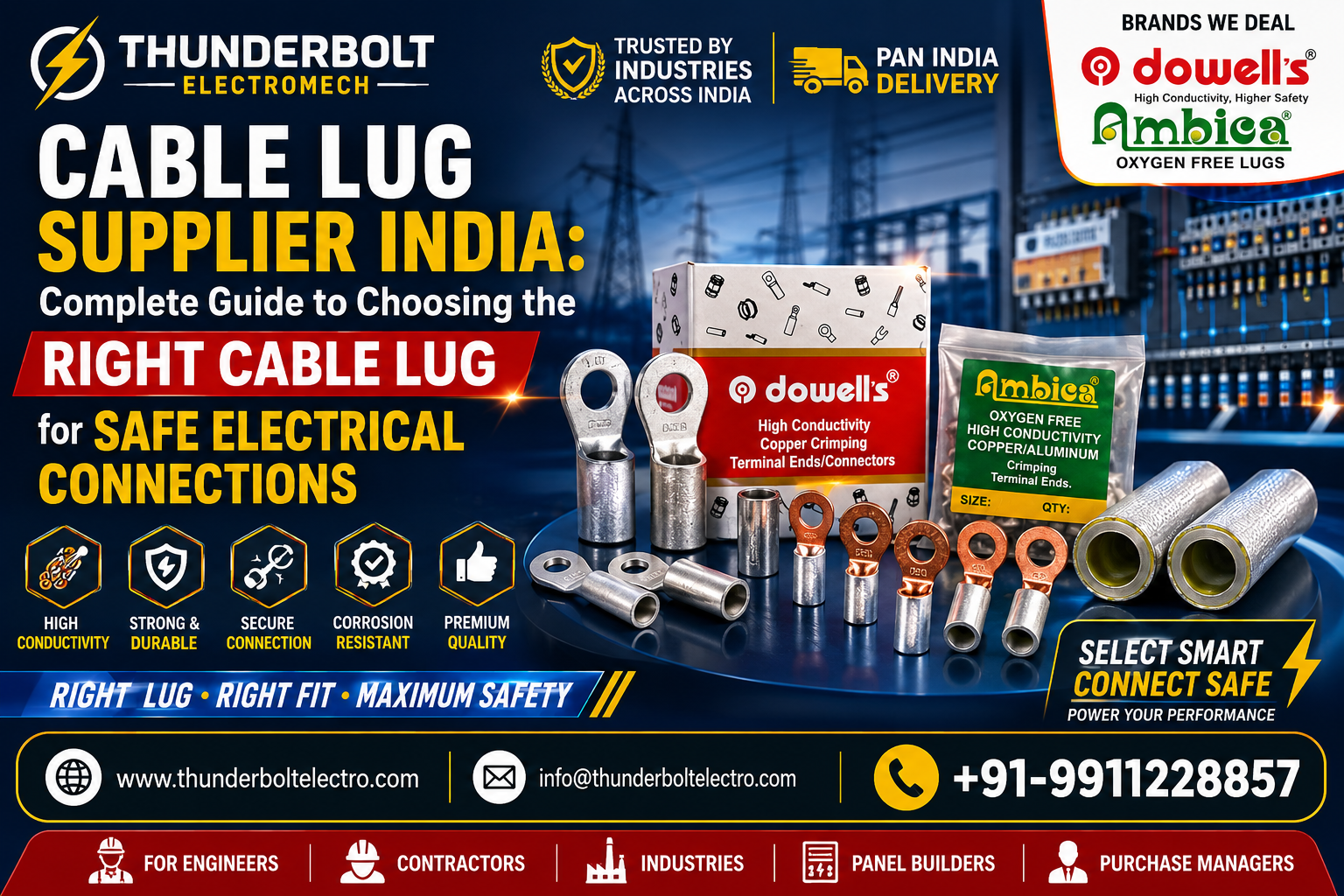
Thunderbolt Electromech is a trusted Cable Lug Supplier India, providing industrial-quality cable lugs for various electrical applications. Thunderbolt Electromech is a distributor of Dowell’s cable lugs and manufacturer & distributor of Ambica cable lugs, supplying a wide range of copper, aluminium, bimetallic, compression, tubular, and customized cable lugs.
Choosing the correct cable lug is one of the most important decisions in electrical installation because a wrong selection can create loose connections, overheating, voltage drop, equipment failure, and safety risks. Cable lugs are small electrical components, but they play a major role in maintaining a reliable connection between cables and electrical equipment.
Industries, electrical contractors, panel builders, engineers, and purchase managers require cable lugs that provide high conductivity, mechanical strength, corrosion resistance, and long service life. Selecting the right lug depends on multiple factors including cable size, conductor material, lug design, hole size, application, and installation method.
With pan India delivery capability, Thunderbolt Electromech supports industries, contractors, OEMs, and electrical professionals with reliable cable lug solutions.
Understanding Cable Lugs and Their Importance in Electrical Systems
A cable lug is an electrical connector used to terminate cables and connect them securely with electrical equipment such as:
- Switchgear panels
- Distribution boards
- Transformers
- Motors
- Generators
- MCC panels
- Busbars
- Industrial machines
A properly selected cable lug ensures:
- Low electrical resistance
- Better current flow
- Strong mechanical grip
- Reduced heating
- Longer equipment life
- Safer electrical operation
Modern industries are moving towards higher current loads and compact electrical systems. Therefore, selecting the correct cable lug has become more important than ever.
Cable Lug Supplier India: Complete Guide to Select the Right Cable Lug Size
A professional Cable Lug Supplier India helps customers select the correct lug according to their cable and application requirement. Engineers and contractors should never select cable lugs only by appearance. The selection process requires technical checking.
The following steps help identify which cable lug is suitable for which cable.
1. Check the Cable Size (Cross Section Area)
The first and most important step is checking the cable cross-section area.
Cable size is measured in:
Square millimetre (sq.mm / mm²)
Examples:
| Cable Size | Suitable Lug Size |
| 1.5 sq.mm Cable | 1.5 sq.mm Lug |
| 2.5 sq.mm Cable | 2.5 sq.mm Lug |
| 6 sq.mm Cable | 6 sq.mm Lug |
| 16 sq.mm Cable | 16 sq.mm Lug |
| 35 sq.mm Cable | 35 sq.mm Lug |
| 95 sq.mm Cable | 95 sq.mm Lug |
| 240 sq.mm Cable | 240 sq.mm Lug |
Example:
If cable marking shows:
1C x 120 sq.mm Copper XLPE Cable
It means:
- Single core cable
- Conductor size = 120 sq.mm
Required:
120 sq.mm Copper Cable Lug
Selecting a smaller lug creates difficulty during insertion and causes poor crimping.
Selecting a larger lug creates loose contact and increases resistance.
How to Identify Cable Size From Cable Marking
Cable manufacturers usually print details on cable insulation.
Example:
3.5C x 70 sq.mm AL Cable
Meaning:
- 3.5 core cable
- Aluminium conductor
- Each conductor size = 70 sq.mm
Required lug:
70 sq.mm Aluminium Cable Lug
2. Check Cable Type
The second important step is identifying the cable conductor material.
Cable lugs are mainly selected according to:
- Copper conductor
- Aluminium conductor
- Copper-aluminium connection
Copper Cable
Copper cables have excellent conductivity and are widely used in:
- Industrial panels
- Motors
- Control systems
- Power connections
Copper cable requires:
Copper Cable Lug
Advantages:
- High conductivity
- Strong connection
- Better current carrying capacity
- Long service life
Aluminium Cable
Aluminium cables are lightweight and commonly used in:
- Power distribution
- Large industrial installations
- Underground cables
Required:
Aluminium Cable Lug
Advantages:
- Lightweight
- Cost-effective
- Suitable for large conductor sizes
Bimetallic Cable Connection
When aluminium cable needs connection with copper terminals, direct connection can create corrosion problems.
Solution:
Bimetallic Cable Lug
It combines:
- Aluminium barrel
- Copper palm
Used in:
- Transformers
- Switchgear
- Power distribution systems
Cable Lug Supplier India: Types of Cable Lugs Available for Industrial Applications
A professional Cable Lug Supplier India provides different lug designs according to electrical requirements.
Thunderbolt Electromech supplies:
- Copper Cable Lugs
- Aluminium Cable Lugs
- Bimetallic Cable Lugs
- Compression Lugs
- Tubular Lugs
- Ring Type Lugs
- Pin Type Lugs
- Fork Type Lugs
- Heavy Duty Lugs
- Earthing Lugs
- Custom Size Cable Lugs
Copper Cable Lugs
Copper cable lugs are one of the most commonly used industrial cable termination products.
Features:
- High conductivity
- Excellent electrical performance
- Strong mechanical strength
- Corrosion resistance
Applications:
- LT panels
- HT panels
- Motors
- Transformers
- Switchgear
Copper lugs are available in:
- Standard barrel type
- Long barrel type
- Heavy duty type
- Two-hole type
Aluminium Cable Lugs
Aluminium cable lugs are designed for aluminium conductors.
Features:
- Lightweight
- Economical
- Suitable for large cables
Applications:
- Distribution networks
- Power cables
- Industrial plants
Bimetallic Cable Lugs
Bimetallic lugs are specially designed for connecting aluminium cables to copper terminals.
Why required?
Copper and aluminium have different electrical properties. Direct connection may cause:
- Oxidation
- Heating
- Poor conductivity
Bimetallic lugs solve this problem.
Applications:
- Transformer terminals
- Electrical panels
- Power systems
Types of Cable Lugs Used in Industrial Electrical Applications
A professional Cable Lug Supplier India understands that every electrical project has different requirements. A power plant, manufacturing unit, commercial building, and electrical panel manufacturer may require different lug designs according to current capacity, installation environment, and cable type.
Thunderbolt Electromech supplies a complete range of industrial cable lugs including Ambica Cable Lugs and Dowell’s Cable Lugs for different applications.
Compression Cable Lugs
Compression cable lugs are designed for permanent cable termination using crimping tools.
The lug is compressed onto the conductor using mechanical or hydraulic pressure.
Features:
- Strong mechanical connection
- Low contact resistance
- High current carrying capacity
- Reliable long-term performance
Applications:
- Industrial panels
- Power distribution systems
- Transformers
- Motors
- Heavy electrical equipment
Advantages:
Compression creates a tight connection between cable and lug, reducing chances of:
- Loose connection
- Heating
- Spark generation
- Voltage drop
Tubular Cable Lugs
Tubular cable lugs have a cylindrical barrel design where the cable conductor enters inside the tube.
They are commonly used in industrial electrical systems.
Features:
- Better conductor grip
- High conductivity
- Suitable for heavy cables
- Excellent mechanical strength
Applications:
- MCC panels
- Switchgear
- Industrial machinery
- Power plants
Tubular lugs are available in:
- Copper tubular lugs
- Aluminium tubular lugs
- Long barrel tubular lugs
Ring Type Cable Lugs
Ring type lugs have a closed circular hole on the palm section.
They are one of the most commonly used cable lug designs.
Advantages:
- Secure bolted connection
- Cannot come out easily after tightening
- Suitable for vibration areas
Applications:
- MCCB connections
- Busbar connections
- Electrical panels
- Motors
Example:
70-10 Cable Lug means:
70 = Cable size 70 sq.mm
10 = 10 mm bolt hole
Pin Type Cable Lugs
Pin type cable lugs are designed for terminal block connections.
They convert stranded wires into a solid pin shape.
Applications:
- Automation panels
- PLC panels
- Control wiring
- Instrumentation systems
Benefits:
- Easy installation
- Better terminal contact
- Prevents wire damage
Fork Type Cable Lugs
Fork type lugs have an open U-shaped design.
They allow quick installation without completely removing terminal screws.
Applications:
- Control panels
- Electrical devices
- Small terminal connections
Advantages:
- Fast installation
- Easy maintenance
- Suitable for small wires
Heavy Duty Cable Lugs
Heavy duty cable lugs are designed for high current industrial applications.
They have:
- Increased barrel thickness
- Higher mechanical strength
- Better current carrying capability
Applications:
- Steel plants
- Power plants
- Heavy machinery
- Large transformers
Earthing Cable Lugs
Earthing lugs are used for grounding electrical equipment.
They provide a safe path for fault current.
Applications:
- Electrical panels
- Machines
- Industrial structures
- Earthing systems
Importance:
A proper earthing connection protects:
- Equipment
- Operators
- Electrical systems
Custom Size Cable Lugs
Some industrial applications require special lug sizes.
Thunderbolt Electromech supports customized requirements depending on:
- Cable size
- Hole size
- Palm design
- Barrel length
- Material requirement
Custom lugs are useful for:
- OEM manufacturers
- Special machinery
- Large industrial projects
Complete Process to Find Which Cable Lug Fits Which Cable
Selecting the correct cable lug requires technical checking.
The formula is:
Cable Size + Cable Material + Hole Size + Application = Correct Cable Lug
Step 1: Check Cable Size
First identify cable conductor size.
Example:
Cable:
95 sq.mm Copper Cable
Requirement:
95 sq.mm Copper Lug
Never select based only on physical appearance.
Step 2: Check Cable Material
Identify:
Copper Cable
Use:
Copper Lug
Aluminium Cable
Use:
Aluminium Lug
Aluminium Cable to Copper Terminal
Use:
Bimetallic Lug
Step 3: Match Lug Barrel Size With Cable
The barrel inside diameter must match the conductor size.
Incorrect selection causes:
Small Barrel
Problems:
- Cable cannot enter properly
- Poor crimping
- Damage to strands
Large Barrel
Problems:
- Loose connection
- Higher resistance
- Heating
Step 4: Check Stud Hole Size (Palm Hole)
The hole size must match equipment terminal.
Common sizes:
| Lug Hole Size | Bolt Used |
| 6 mm | M6 |
| 8 mm | M8 |
| 10 mm | M10 |
| 12 mm | M12 |
| 16 mm | M16 |
Example:
95-12 Lug:
95 = Cable size
12 = M12 bolt hole
Step 5: Check Number of Holes
Cable lugs are available in:
Single Hole Lug
Used for:
- Normal connections
- Small panels
Two Hole Lug
Used for:
- Heavy current applications
- High vibration areas
Advantages:
- Better mechanical stability
- Prevents rotation
Step 6: Check Compression Type
Compression depends on:
- Cable size
- Application
- Current requirement
Common types:
- Standard compression lug
- Heavy duty compression lug
- Long barrel lug
Step 7: Verify With Crimping Tool
Correct crimping is equally important.
Example:
95 sq.mm lug requires:
95 sq.mm crimping die
Wrong tool selection may cause:
- Loose connection
- Heating
- Cable failure
Quick Reference Chart: Cable Dimension and Lug Selection
Copper Cable Lug Chart
| Cable Size | Lug Hole | Application |
| 2.5 sq.mm | M6 | Control wiring |
| 6 sq.mm | M6/M8 | Small power |
| 16 sq.mm | M8 | Motors |
| 35 sq.mm | M10 | Panels |
| 70 sq.mm | M12 | Industrial feeders |
| 120 sq.mm | M12/M16 | Heavy power |
| 240 sq.mm | M16 | High current |
Aluminium Cable Lug Chart
| Cable Size | Lug Type | Application |
| 16 sq.mm | Aluminium Lug | Distribution |
| 35 sq.mm | Aluminium Lug | Industrial supply |
| 70 sq.mm | Aluminium Lug | Power cables |
| 120 sq.mm | Aluminium Lug | Heavy feeders |
| 240 sq.mm | Aluminium Lug | Large installations |
Bimetallic Lug Chart
| Cable Size | Application |
| 35 sq.mm | Transformer connection |
| 70 sq.mm | LT panels |
| 120 sq.mm | Power distribution |
| 240 sq.mm | Heavy electrical systems |
Ambica vs Dowell’s Cable Lug Comparison
| Feature | Ambica Cable Lugs | Dowell’s Cable Lugs |
| Manufacturer | Thunderbolt manufactured/distributed | Distributor |
| Quality | Industrial quality | Premium industrial quality |
| Application | Industrial + commercial | Heavy industrial |
| Range | Wide range | Wide range |
| Availability | Pan India | Pan India |
| Suitable For | Contractors & industries | Critical applications |
Real Industrial Use Cases
Manufacturing Plant
Requirement:
Motor connections
Solution:
Copper compression lugs
Benefit:
- Less heating
- Better reliability
Transformer Installation
Requirement:
Aluminium cable connection with copper terminal
Solution:
Bimetallic cable lugs
Benefit:
- Prevent corrosion
- Improve safety
Electrical Panel Manufacturing
Requirement:
Multiple control connections
Solution:
Pin and tubular lugs
Benefit:
- Easy installation
- Professional finishing
Customer Buying Problems and Solutions
Problem: Wrong Lug Size
Solution:
Share:
- Cable size
- Cable photo
- Terminal size
Supplier can suggest correct lug.
Problem: Heating Issue
Solution:
Check:
- Correct lug size
- Correct crimping
- Proper tightening
Problem: Bulk Requirement
Solution:
Choose supplier with:
- Stock availability
- Multiple brands
- Pan India delivery
Customer Problems and Solutions
1. Problem: Customer Does Not Know Which Cable Lug Size Fits Their Cable
Customer Problem:
Many customers purchase cable lugs by only looking at cable size written on the cable.
For example:
A customer sees:
95 sq.mm Cable
and thinks:
“I need a 95 sq.mm cable lug.”
But this is only the first step.
The correct cable lug selection also depends on:
- Cable material (Copper or Aluminium)
- Cable construction
- Terminal bolt size
- Application type
- Crimping method
A wrong cable lug can create:
- Loose connection
- Heating problem
- Power loss
- Equipment failure
- Safety risk
A cable lug that is too small will not fit properly.
A cable lug that is too large will not create proper contact with the cable.
Solution:
The correct selection process is:
Cable Size + Cable Material + Hole Size + Application = Correct Cable Lug
Example:
Customer requirement:
Cable:
120 sq.mm Aluminium cable
Terminal:
M12 bolt
Application:
Transformer connection
Correct solution:
Bimetallic 120 sq.mm × M12 Cable Lug
This ensures:
- Proper connection
- Better current flow
- Long service life
Thunderbolt Electromech helps customers select the correct lug according to their actual application instead of only selling a product.
2. Problem: Customer Faces Heating and Burning Issues After Installation
Customer Problem:
One of the most common electrical problems in industries is cable lug heating.
Customers often experience:
- Cable terminal becoming hot
- Burning smell
- Discoloration of lug
- Machine stopping suddenly
The reason is usually:
- Wrong lug size
- Poor crimping
- Loose tightening
- Low-quality material
A cable connection carries heavy electrical current. Even a small resistance at the connection point can generate heat.
Solution:
Use a high-quality cable lug with proper installation.
Steps:
Step 1:
Match cable size with lug size
Example:
70 sq.mm cable requires:
70 sq.mm lug
Step 2:
Use correct crimping tool
Example:
70 sq.mm lug requires:
70 sq.mm crimping die
Step 3:
Ensure proper tightening
The lug hole should match:
- M8
- M10
- M12
- M16
bolt size.
Using quality cable lugs from trusted suppliers like Ambica Cable Lugs and Dowell’s Cable Lugs helps improve electrical reliability.
3. Problem: Customer Gets Confused Between Copper, Aluminium and Bimetallic Lugs
Customer Problem:
Many buyers are confused:
“Which lug should I use for my cable?”
They see different options:
- Copper lug
- Aluminium lug
- Bimetallic lug
Selecting the wrong material can create connection problems.
Solution:
Understand the application:
Copper Cable
Use:
Copper Cable Lug
Best for:
- Motors
- Panels
- Industrial machines
- Electrical equipment
Benefits:
- Excellent conductivity
- Strong connection
Aluminium Cable
Use:
Aluminium Cable Lug
Best for:
- Power cables
- Distribution systems
Benefits:
- Lightweight
- Cost-effective
Aluminium Cable Connecting With Copper Terminal
Use:
Bimetallic Cable Lug
Example:
Transformer connection
Why?
Because copper and aluminium directly connected together can create corrosion problems.
Bimetallic lugs provide a safer transition between both materials.
4. Problem: Customer Selects Wrong Lug Hole Size
Customer Problem:
Many customers focus only on cable size but ignore the palm hole size.
Example:
Customer buys:
95 sq.mm lug
but equipment requires:
M12 bolt
and customer receives:
M10 hole
Result:
- Lug cannot fit properly
- Installation delay
- Additional replacement cost
Solution:
Always check:
Cable Size
Example:
95 sq.mm
Hole Size
Example:
M12
Correct lug:
95 sq.mm × 12 mm hole
Common hole sizes:
| Hole Size | Bolt Size |
| 6 mm | M6 |
| 8 mm | M8 |
| 10 mm | M10 |
| 12 mm | M12 |
| 16 mm | M16 |
Before ordering bulk quantity, purchase managers should confirm terminal requirements.
5. Problem: Customer Needs Reliable Supply for Large Industrial Projects
Customer Problem:
Industries and contractors often face:
- Product availability issues
- Delivery delays
- Wrong product supply
- Lack of technical support
For large projects, even a small delay can affect installation schedules.
Solution:
Choose a supplier who provides:
Product Knowledge
Supplier should understand:
- Cable size
- Application
- Industry requirement
Multiple Product Options
Example:
Thunderbolt Electromech supplies:
- Ambica Cable Lugs
- Dowell’s Cable Lugs
Range includes:
- Copper Cable Lugs
- Aluminium Cable Lugs
- Bimetallic Cable Lugs
- Compression Lugs
- Tubular Lugs
- Ring Type Lugs
- Pin Type Lugs
- Heavy Duty Lugs
Pan India Delivery Support
For contractors and industries working in different locations, reliable delivery support helps maintain project timelines.
Customer Buying Checklist Before Ordering Cable Lugs
Before purchasing, check:
Cable size (sq.mm)
Cable material (Copper/Aluminium)
Lug material
Hole size
Number of holes
Application type
Crimping requirement
Required quantity
FAQ Section
1. How do I select the correct cable lug?
Check cable size, material, hole size, and application.
2. Is cable lug size same as cable size?
Yes, generally lug size matches conductor size.
Example:
70 sq.mm cable requires 70 sq.mm lug.
3. Which lug is used for aluminium cable?
Use aluminium cable lug or bimetallic lug depending on connection.
4. Which is better copper or aluminium lug?
Copper provides higher conductivity. Aluminium is lightweight and economical.
5. Why are bimetallic lugs used?
They prevent problems between copper and aluminium connections.
6. Which cable lugs are supplied by Thunderbolt Electromech?
Thunderbolt supplies:
- Ambica Cable Lugs
- Dowell’s Cable Lugs
7. Do you supply cable lugs across India?
Yes, Thunderbolt Electromech provides Pan India delivery.
8. What information should customers provide before buying?
Provide:
- Cable size
- Cable material
- Hole size
- Application
9. Which lug is used in transformers?
Usually:
- Bimetallic lugs
- Heavy duty copper/aluminium lugs
10. Why is correct crimping important?
Proper crimping ensures:
- Safety
- Better conductivity
- Long life
Thunderbolt Electromech Trust Signals
Thunderbolt Electromech supports electrical industries with reliable cable connection solutions.
Our advantages:
✔ Distributor of Dowell’s Cable Lugs
✔ Manufacturer and distributor of Ambica Cable Lugs
✔ Wide industrial range
✔ Pan India delivery
✔ Support for engineers and contractors
✔ Product guidance before purchase
We help customers select the correct lug instead of simply selling products.
Conclusion: Choosing the Right Cable Lug Supplier India
Choosing the correct cable lug is essential for safe and reliable electrical connections. A cable lug may look like a small component, but its performance directly affects electrical system safety.
The correct selection process is:
Cable Size + Cable Material + Hole Size + Application = Correct Cable Lug
Thunderbolt Electromech provides complete cable lug solutions with Ambica and Dowell’s cable lugs for industries, contractors, engineers, and purchase managers across India.
With technical understanding, product availability, and pan India delivery support, Thunderbolt Electromech helps customers select the right cable lug for every electrical application.