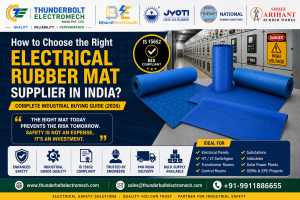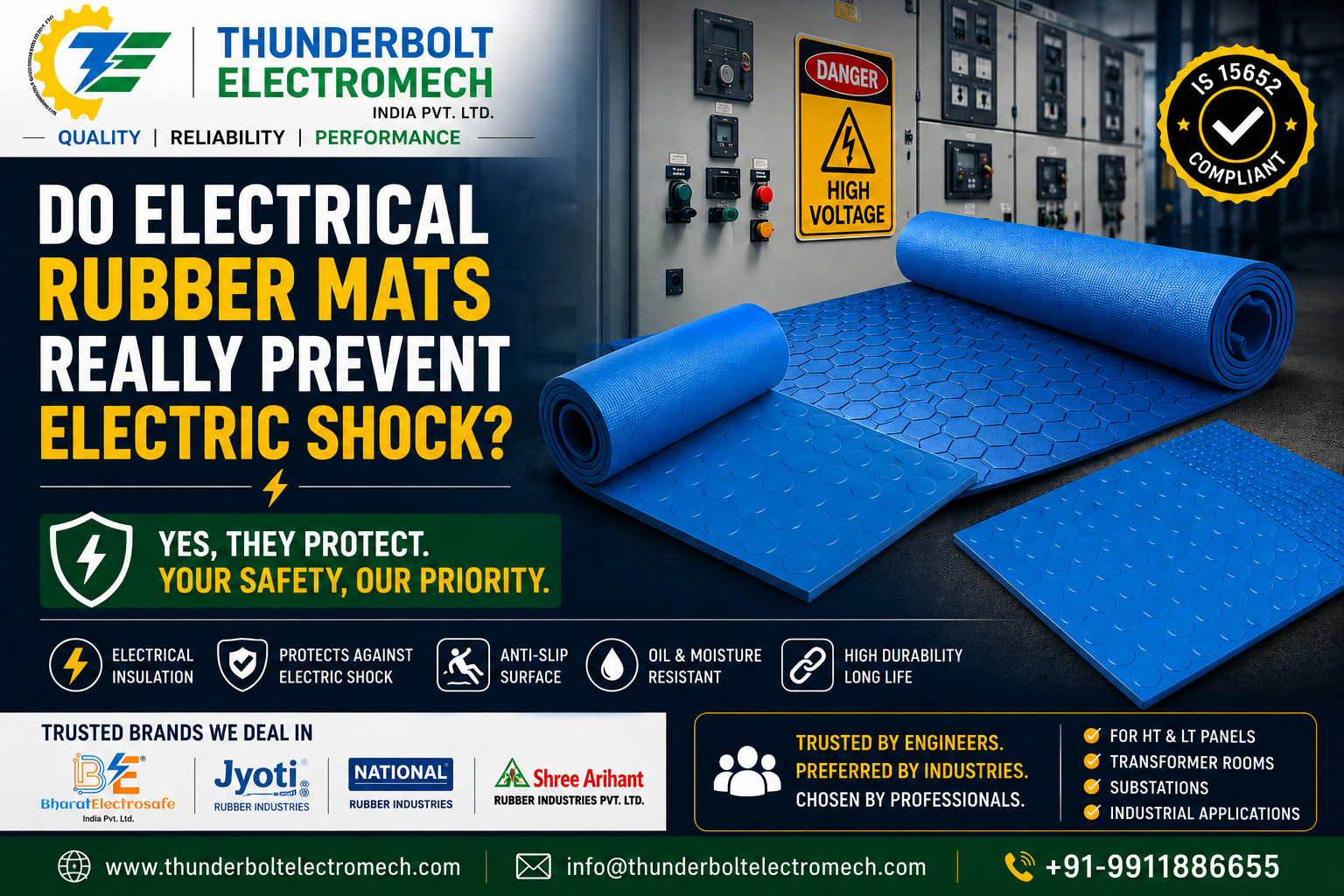
Quick Answer: Yes, Electrical Rubber Mats significantly reduce the risk of electric shock when they are manufactured according to IS 15652 standards, installed correctly, and regularly inspected. These mats act as an insulating barrier between personnel and the ground, preventing electrical current from passing through the human body during accidental contact with live electrical equipment. However, they are only one part of an overall electrical safety system and should always be used alongside insulated tools, PPE, lockout/tagout procedures, and proper maintenance practices.
For industries operating HT and LT panels, transformers, substations, switchyards, DG sets, and electrical control rooms, investing in high-quality insulating mats from a trusted Electrical Rubber Mat Supplier is one of the simplest and most effective ways to improve workplace safety and comply with electrical safety standards.
Introduction
Every day, thousands of engineers, electricians, contractors, and maintenance technicians work in environments where electrical hazards are present. A single insulation failure, loose conductor, moisture ingress, or accidental contact with a live panel can result in severe injury or even loss of life.
This is why electrical safety starts from the ground up.
One of the first safety accessories installed in front of electrical panels is an Electrical Safety Rubber Mat. Although it appears to be just a sheet of rubber, its engineering purpose is far more critical. It provides electrical insulation between the operator and the floor, helping interrupt the path of current through the body.
Many purchase managers ask an important question before buying:
“Do Electrical Rubber Mats actually prevent electric shock, or are they simply mandatory safety accessories?”
The answer depends on three factors:
- The quality of the rubber mat
- Compliance with IS 15652 standards
- Proper installation and maintenance
A certified insulating mat performs far differently from an ordinary rubber sheet. High-voltage insulation, dielectric strength, resistance to moisture, flame resistance, and long service life all contribute to making the mat an effective safety barrier.
Thunderbolt Electromech is a trusted Electrical Rubber Mat Supplier in Delhi, supplying industries across India with a complete range of Bharat Electrical Insulating Mats. We also supply premium insulating mats from Jyoti, National, and Shree Arihant, ensuring customers receive reliable products for every voltage class and industrial application.
Whether you manage a manufacturing facility, commercial building, power plant, transformer yard, railway project, or electrical panel workshop, choosing the correct insulating mat directly affects workplace safety, equipment reliability, and statutory compliance.
In this guide, we explain the science behind electrical rubber mats, when they work, where they should be installed, how to choose the right voltage rating, and why purchasing from a reliable Electrical Rubber Mat Supplier Delhi makes a significant difference over the product’s service life.
Electrical Rubber Mat Supplier – How Electrical Rubber Mats Protect Against Electric Shock
Electric current always follows the path of least resistance. If an operator accidentally touches a live conductor while standing on a conductive surface such as concrete, wet flooring, or steel, electricity may travel through the body to the ground.
An Electrical Safety Rubber Mat interrupts this path.
Instead of allowing electrical current to pass through the worker’s feet, the insulating rubber provides extremely high electrical resistance. This dramatically reduces the possibility of dangerous current flow.
Working Principle
Electrical rubber mats function through dielectric insulation.
Their specially formulated rubber compound has very high electrical resistance, enabling it to withstand high voltages without allowing current to pass through.
When placed in front of electrical equipment, the mat creates an insulated standing surface that helps protect workers from ground faults and accidental contact.
Where Rubber Mats Are Installed
Industries commonly install insulating mats in:
- LT Panel Rooms
- HT Switchgear Rooms
- Transformer Rooms
- Electrical Control Panels
- DG Control Panels
- MCC Rooms
- PCC Panels
- Substations
- Switchyards
- Industrial Power Distribution Rooms
- Electrical Laboratories
- Utility Rooms
Every one of these locations presents a potential electrical hazard.
Proper insulation significantly improves worker safety.
Why Industries Choose Certified Rubber Mats
Certified products supplied by a reliable Electrical Rubber Mat Supplier Delhi provide:
- High dielectric strength
- Oil resistance
- Moisture resistance
- Flame resistance
- Long operational life
- Slip-resistant surface
- Excellent flexibility
- Low maintenance
These features make insulating mats suitable for demanding industrial environments.
Different Voltage Classes
Electrical rubber mats are manufactured for different operating voltages.
| Voltage Level | Typical Application |
| Class A | Up to 3.3 kV Panels |
| Class B | Up to 11 kV Switchgear |
| Class C | Up to 33 kV Installations |
| Higher Classes | Power Stations & Substations |
Selecting the correct voltage rating is essential.
Using a lower-rated mat in a higher-voltage application can compromise safety.
Why Material Quality Matters
Not all rubber sheets are insulating mats.
Ordinary rubber may contain impurities, recycled materials, or inconsistent thickness, reducing its insulating capability.
Premium mats supplied by an experienced Insulating Rubber Mat Supplier are manufactured using carefully controlled rubber compounds and tested to meet electrical insulation requirements.
Thunderbolt Electromech supplies premium brands including:
- Bharat Electrical Insulating Mats
- Jyoti Electrical Insulating Mats
- National Electrical Insulating Mats
- Shree Arihant Electrical Insulating Mats
Each brand is selected to meet the demanding requirements of industrial users.
Electrical Rubber Mat Supplier – Choosing the Right Insulating Mat for Industrial Applications
Buying an insulating mat should never be based only on price.
A purchase manager must evaluate several engineering parameters before making a decision.
1. Voltage Rating
Always match the mat with the operating voltage.
Example:
- 440 V Control Panel
- 11 kV Switchgear
- 33 kV Transformer
- 66 kV Substation
Each application requires the appropriate insulation class.
2. Compliance with IS 15652
One of the most important buying criteria is compliance with IS 15652.
This Indian Standard specifies performance requirements including:
- Dielectric strength
- Thickness
- Tensile strength
- Elongation
- Aging resistance
- Water absorption
- Electrical insulation performance
An IS 15652 Rubber Mat Supplier helps ensure the product is suitable for industrial electrical safety applications.
3. Thickness
Thicker mats generally provide higher insulation levels.
However, the thickness should always correspond to the required voltage class rather than assuming that thicker is always better.
4. Surface Design
Industrial rubber mats usually feature:
- Ribbed surface
- Anti-slip finish
- Easy cleaning
- Better operator grip
This helps reduce slip hazards in electrical rooms.
5. Chemical Resistance
Electrical rooms often contain:
- Transformer oil
- Hydraulic fluids
- Dust
- Grease
- Cleaning chemicals
High-quality insulating mats resist these contaminants and maintain their insulating properties over time.
Why Delhi Industries Prefer Local Suppliers
Choosing an Electrical Rubber Mat Dealer Delhi provides several operational advantages.
These include:
- Faster deliveries
- Easy replacement
- Technical guidance
- Bulk stock availability
- Lower transportation costs
- Immediate support for urgent shutdowns
For industries with planned maintenance schedules, quick availability can prevent costly project delays.
Common Customer Problems & Practical Solutions
| Customer Problem | Practical Solution |
| Workers receive mild electrical shocks near panels | Install certified electrical insulating mats and inspect grounding. |
| Existing rubber mat has cracks | Replace immediately with an IS 15652-compliant mat. |
| Confusion about voltage rating | Select the mat based on system voltage and application. |
| Cheap rubber sheet used instead of insulating mat | Purchase only certified products from a trusted supplier. |
| Moisture in electrical room | Use moisture-resistant insulating mats and improve room ventilation. |
| Difficulty choosing a brand | Compare Bharat, Jyoti, National, and Shree Arihant mats based on application and compliance. |
| Frequent industrial inspections | Maintain certified mats with proper testing records. |
| Large project requiring bulk quantity | Work with an experienced Electrical Rubber Mat Supplier capable of handling bulk orders and timely delivery. |
Comparison Table – Ordinary Rubber Sheet vs Certified Electrical Rubber Mat
| Feature | Ordinary Rubber Sheet | Certified Electrical Rubber Mat |
| Electrical Insulation | Poor | Excellent |
| Designed for Electrical Safety | No | Yes |
| IS 15652 Compliance | No | Yes |
| Dielectric Strength | Low | High |
| Suitable for HT Panels | No | Yes |
| Suitable for LT Panels | Limited | Yes |
| Transformer Applications | No | Yes |
| Industrial Safety Compliance | Poor | Excellent |
| Moisture Resistance | Moderate | High |
| Long-Term Reliability | Low | High |
Engineering Research: Why Insulating Mats Are Essential
Electrical safety studies consistently show that the severity of electric shock depends on three primary factors:
- Voltage level – Higher voltages increase the likelihood of current overcoming the body’s resistance.
- Current path – A hand-to-foot path is especially dangerous because it can pass through the heart.
- Duration of contact – Even relatively small currents can become life-threatening if exposure lasts long enough.
An Electrical Safety Rubber Mat addresses the second factor by increasing the resistance between the worker and the ground. When combined with proper earthing, insulated PPE, circuit protection, and safe work procedures, it forms part of a layered protection strategy used in power plants, substations, manufacturing facilities, and commercial electrical installations.
Engineering best practice is to treat insulating mats as preventive safety equipment—not as a replacement for safe electrical isolation. Before commissioning, reputable manufacturers also recommend periodic visual inspections for cuts, cracks, oil contamination, and surface damage, along with replacement whenever the mat no longer meets safety requirements.
Real Use Case #1 – Preventing Downtime in a Manufacturing Plant
A manufacturing facility in Delhi NCR experienced repeated maintenance work on its LT motor control center (MCC). During a safety audit, inspectors observed that technicians were standing on bare concrete while troubleshooting energized control panels. Although no serious accident had occurred, the risk level was considered unacceptable.
The maintenance team replaced the flooring in front of all electrical panels with IS 15652-compliant electrical insulating rubber mats supplied through a reliable Electrical Rubber Mat Supplier Delhi. They selected the appropriate voltage-rated mats, marked safe standing zones, and incorporated regular inspection into their preventive maintenance schedule.
Within months, the plant reported:
- Improved compliance during safety audits.
- Greater confidence among maintenance personnel.
- Better housekeeping in electrical rooms.
- Reduced risk exposure during routine panel inspections.
- A standardized safety approach across all production areas.
This example demonstrates that insulating mats are not simply accessories—they are a practical engineering control that enhances electrical safety when used as part of a comprehensive safety system.
Electrical Rubber Mat Supplier – How to Select the Right Electrical Rubber Mat for Maximum Safety
Choosing the right insulating mat is more technical than many buyers realize. Engineers often focus on panel ratings, circuit breakers, and protective relays, but overlook the insulating surface where operators stand. An unsuitable rubber mat can create a false sense of security, while a certified insulating mat becomes an essential part of the electrical protection system.
As a trusted Electrical Rubber Mat Supplier, Thunderbolt Electromech recommends evaluating every insulating mat based on its intended application rather than price alone. The operating voltage, environment, maintenance schedule, and applicable safety standards all influence the selection process.
Identify Your Voltage Level
Every electrical installation has different insulation requirements.
Examples include:
- 415V Distribution Panels
- LT PCC Panels
- MCC Panels
- 11kV Switchgear
- 22kV Switchgear
- 33kV Substations
- Transformer Rooms
- Power Distribution Stations
The insulating mat should always match the voltage classification specified under IS 15652. Using a lower-rated mat for a higher-voltage installation compromises operator safety and may violate safety regulations.
Consider the Working Environment
Environmental conditions significantly affect the service life of insulating mats.
Factors include:
- Continuous foot traffic
- Transformer oil exposure
- Dust accumulation
- Chemical vapors
- High humidity
- Direct sunlight
- Industrial heat
- Heavy equipment movement
Facilities exposed to oil and chemicals should choose premium-grade insulating mats with excellent resistance to industrial contaminants.
Inspect Before Installation
Before placing a new mat in service, check for:
- Surface cracks
- Cuts or punctures
- Uneven thickness
- Manufacturing defects
- Damaged edges
- Improper storage marks
Even a certified mat should be visually inspected before use.
Maintenance Recommendations
Routine maintenance extends product life.
Recommended inspection intervals include:
- Daily visual inspection in critical areas
- Monthly cleaning
- Quarterly safety inspection
- Annual dielectric testing where required
- Immediate replacement if damaged
Preventive maintenance costs very little compared to the consequences of electrical accidents.
Industries That Require Electrical Rubber Mats
Nearly every industry handling electrical equipment benefits from insulating mats.
Common applications include:
- Electrical Panel Manufacturers
- Transformer Manufacturers
- Solar Power Plants
- Wind Power Projects
- Metro Rail Projects
- Railway Electrification
- Cement Plants
- Steel Plants
- Chemical Industries
- Pharmaceutical Plants
- Food Processing Industries
- Data Centres
- Hospitals
- Airports
- Commercial Buildings
- Government Utilities
- Power Distribution Companies
These industries prioritize employee safety, equipment protection, and compliance with electrical safety regulations.
Why Thunderbolt Electromech is preferred by Engineers
Thunderbolt Electromech supplies a complete range of premium insulating mats from leading manufacturers, including:
- Bharat Electrical Insulating Mat
- Jyoti Electrical Insulating Mat
- National Electrical Insulating Mat
- Shree Arihant Electrical Insulating Mat
Customers choose Thunderbolt because they receive:
- Genuine products
- Bulk order support
- Competitive pricing
- Fast dispatch across India
- Technical assistance for product selection
- Reliable after-sales support
Whether you need a single roll or bulk quantities for a large infrastructure project, Thunderbolt provides dependable supply backed by technical expertise.
Electrical Rubber Mat Supplier – Does Investing in Quality Rubber Mats Save Money?
Many procurement teams compare only the Electrical Rubber Mat Price when purchasing insulating mats. While cost matters, the lowest-priced product is not always the most economical over its lifetime.
A certified Electrical Safety Rubber Mat helps reduce hidden costs associated with workplace accidents, equipment damage, and compliance failures.
Long-Term Financial Benefits
Investing in quality insulating mats can help reduce:
- Workplace accident costs
- Equipment downtime
- Safety audit observations
- Insurance risks
- Replacement frequency
- Emergency maintenance
- Legal liabilities
For engineers and purchase managers, this makes insulating mats a preventive investment rather than an operational expense.
Why Cheap Rubber Sheets Are a Risk
Some buyers mistakenly install ordinary rubber sheets instead of certified electrical insulating mats.
Ordinary rubber sheets may:
- Lack dielectric testing
- Contain recycled fillers
- Absorb moisture more easily
- Crack prematurely
- Fail under high-voltage conditions
Certified mats supplied by an Electrical Insulation Rubber Mat Manufacturer are specifically designed for electrical safety applications and undergo testing to meet industry standards.
Additional Engineering Comparison Table – Premium vs Low-Quality Electrical Rubber Mats
| Feature | Premium IS 15652 Mat | Low-Quality Rubber Sheet |
| Electrical Insulation | Excellent | Unverified |
| Voltage Classification | Certified | Not Specified |
| Surface Finish | Anti-slip | Smooth/Variable |
| Oil Resistance | High | Moderate |
| Moisture Resistance | Excellent | Low |
| Industrial Durability | Long Service Life | Short Service Life |
| Safety Compliance | Meets Standards | Not Guaranteed |
| Recommended for HT/LT Panels | Yes | No |
| Suitable for Transformer Rooms | Yes | No |
| Overall Value | High | Low |
Additional Engineering Comparison Table – Choosing the Right Supplier
| Buying Factor | Trusted Electrical Rubber Mat Supplier | Unknown Seller |
| Product Authenticity | Genuine Brands | Uncertain |
| Technical Support | Available | Limited |
| Bulk Order Capability | Yes | Often Limited |
| Multiple Brand Options | Yes | Few Choices |
| Delivery Across India | Yes | May Vary |
| Industry Experience | Strong | Unknown |
| Customer Assistance | Professional | Basic |
| Long-Term Reliability | High | Inconsistent |
Real-World Use Case #2 – Transformer Maintenance Contractor
A transformer maintenance contractor in Delhi NCR regularly serviced outdoor distribution transformers. During maintenance, technicians stood on worn-out rubber sheets that had become brittle due to prolonged UV exposure.
Before the annual shutdown season, the contractor replaced them with certified insulating mats supplied by Thunderbolt Electromech. The new mats provided improved grip, better insulation, and greater confidence during maintenance activities. The upgrade also helped the contractor meet client safety requirements during project inspections.
Real-World Use Case #3 – Electrical Panel Manufacturer
A panel manufacturing company assembling LT and MCC panels wanted to standardize safety across its testing area. Instead of using generic rubber sheets, it installed certified electrical insulating mats in front of every testing panel.
Benefits included:
- Improved workplace safety
- Better housekeeping
- Faster compliance during customer inspections
- Increased confidence among technicians
- Enhanced professional appearance of the testing area
Trust Thunderbolt Electromech
When selecting an Electrical Rubber Mat Supplier, reliability matters as much as product quality.
Thunderbolt Electromech supplies premium electrical insulating mats for industries across India.
Why Choose Thunderbolt?
- Complete range of Bharat Electrical Insulating Mats
- Jyoti Electrical Insulating Mats
- National Electrical Insulating Mats
- Shree Arihant Electrical Insulating Mats
- Bulk industrial supply
- Competitive pricing
- PAN India delivery
- Technical product guidance
- Support for engineers, contractors, industries, and purchase managers
Contact Details
Thunderbolt Electromech
📍 Address: Delhi, India
📞 Phone: +91-9911886655
🌐 Website: www.thunderboltelectromech.com
📧 Email: info@thunderboltelectromech.com
Frequently Asked Questions (FAQ)
1. Do electrical rubber mats completely prevent electric shock?
They significantly reduce the risk by insulating the user from the ground, but they should always be used together with proper PPE, insulated tools, safe work practices, and correctly maintained electrical systems.
2. Which standard should an electrical insulating mat comply with?
In India, insulating mats are commonly selected according to IS 15652, which specifies requirements for electrical insulating mats used in industrial applications.
3. Where should electrical rubber mats be installed?
They are typically installed in front of HT and LT panels, MCCs, PCCs, transformers, switchgear, substations, DG panels, and electrical control rooms.
4. How often should insulating mats be inspected?
A visual inspection should be performed regularly, with more detailed inspections during preventive maintenance schedules. Replace any mat showing cuts, cracks, swelling, or excessive wear.
5. Can ordinary rubber sheets be used instead of electrical insulating mats?
No. Ordinary rubber sheets are not designed or tested for electrical insulation and should not replace certified insulating mats in electrical installations.
6. Which brand is best for electrical insulating mats?
The best choice depends on your application and compliance needs. Thunderbolt Electromech supplies trusted brands including Bharat, Jyoti, National, and Shree Arihant.
7. What thickness should I choose?
Thickness depends on the required voltage class and application. Always match the product specification with the operating voltage rather than selecting based solely on thickness.
8. Are insulating mats resistant to transformer oil?
Quality industrial insulating mats are designed to resist common industrial contaminants, including transformer oil, helping maintain their performance over time.
9. How long does an electrical rubber mat last?
Service life varies depending on environmental conditions, usage, and maintenance. With proper care and regular inspections, certified mats can provide reliable performance for many years.
10. Can these mats be used outdoors?
Yes, provided they are suitable for outdoor conditions and protected from prolonged environmental degradation. Regular inspections are especially important for outdoor installations.
11. Why should I buy from a local Electrical Rubber Mat Supplier Delhi?
Local suppliers can provide faster delivery, technical guidance, easier replacements, and better support for urgent industrial requirements.
12. Are electrical rubber mats mandatory in industries?
Many industrial facilities install insulating mats as part of their electrical safety practices to help protect personnel and support compliance with applicable workplace safety requirements.
13. How do I know when a rubber mat should be replaced?
Replace the mat if you notice cracks, cuts, surface hardening, swelling, loss of flexibility, significant wear, or if it no longer meets your inspection or testing requirements.
14. Can insulating mats improve safety audit results?
Yes. Properly selected and maintained insulating mats demonstrate a proactive approach to electrical safety and are commonly viewed positively during workplace safety inspections.
15. Does the price of an electrical rubber mat indicate its quality?
Not always. Evaluate compliance with standards, material quality, brand reputation, and supplier support instead of making decisions based solely on price.
Conclusion
Electrical rubber mats are far more than simple floor coverings—they are a vital component of an effective electrical safety program. When correctly selected, installed, and maintained, they help reduce the risk of electric shock by providing an insulating barrier between personnel and the ground. For engineers, contractors, industries, and purchase managers, investing in certified insulating mats is an investment in worker safety, operational continuity, and regulatory compliance.
Whether your project involves LT panels, HT switchgear, transformer rooms, substations, or industrial control systems, choosing a trusted Electrical Rubber Mat Supplier ensures you receive products that meet demanding industrial requirements. By selecting high-quality Electrical Safety Rubber Mats, following IS 15652 recommendations, and performing regular inspections, you can build a safer workplace and protect both people and equipment.
Contact Thunderbolt Electromech Today
Looking for a dependable Electrical Rubber Mat Supplier Delhi for your next project?
Thunderbolt Electromech offers a complete range of Bharat Electrical Insulating Mats, along with Jyoti, National, and Shree Arihant insulating mats for diverse industrial applications.
Whether you need a single mat or bulk quantities for power plants, substations, panel manufacturing, EPC projects, or industrial maintenance, our team is ready to help you choose the right solution.
Call: +91-9911886655
Email: info@thunderboltelectromech.com
Website: www.thunderboltelectromech.com
Partner with Thunderbolt Electromech to equip your facility with reliable electrical insulation solutions designed for the safety of your engineers, technicians, contractors, and maintenance teams.