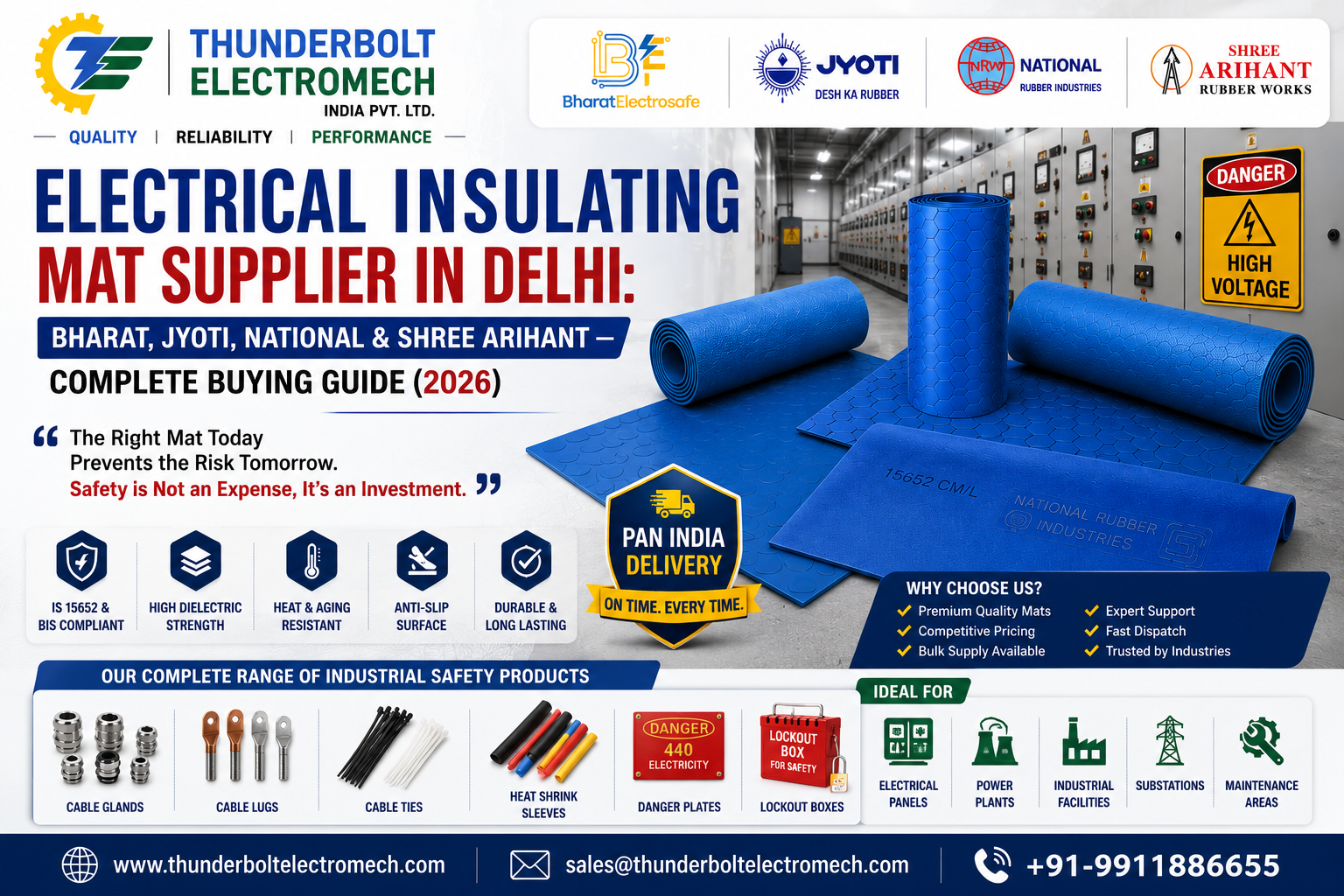
By Thunderbolt Electromech India Pvt. Ltd. — Delhi-based Authorised Stockist of Bharat, Jyoti, National & Shree Arihant Electrical Insulating Mats
📞 +91-9911886655 | ✉️ info@thunderboltelectromech.com | 🌐 thunderboltelectromech.com | 📍 Shop No. 3538, Sitaram Bazar Rd, Bazar Sirkiwalan, Chawri Bazar, Chandni Chowk, Delhi – 110006
Quick Answer
If you’re buying electrical insulating mats for a panel room, substation, or switchgear installation in India, here’s the short version:
- Standard/compliance: Any mat you buy should be manufactured and tested to IS 15652 (the current governing Indian standard), not the outdated IS 5424:1969 that some sellers still quote. Ask for the test certificate — don’t assume “ISI marked” alone proves current compliance.
- Brand matters more than most buyers realise. Bharat, Jyoti, National, and Shree Arihant are all established, IS 15652-compliant brands sold across India — but they differ in available thickness range, voltage-class stock depth, and regional availability. The “best” brand depends on your specific voltage class and site, not a single universal answer.
- Thickness ≠ arbitrary. 2mm, 2.5mm, and 3mm map to specific voltage classes (Class 0 through Class 4) — buying by thickness alone without checking the voltage class is the single most common mistake we see.
- Location matters for delivery reliability. A Delhi-NCR based supplier shortens replenishment time for urgent panel-room completions or safety-audit deadlines compared to a distant distributor.
- One multi-brand supplier beats four separate vendor relationships — if your organisation uses (or wants to compare) more than one brand, sourcing them all from a single stockist simplifies procurement, invoicing, and bulk pricing.
Thunderbolt Electromech India Pvt. Ltd., based in Delhi, is building out exactly this — a single multi-brand source for Bharat, Jyoti, National, and Shree Arihant electrical insulating mats, so you can compare and order across brands without juggling four vendors.
The sections below cover brand comparison, IS 15652 compliance, voltage-class selection, pricing, and how to choose the right supplier for a recurring industrial order.
Introduction
Electrical insulating mats are one of those purchases where the product itself is simple — a rubber sheet — but the specification behind it is not. The wrong voltage class, an outdated standard, or an uncertified “ISI marked” claim can mean the difference between a mat that protects a worker and one that offers no real insulation at all under a fault condition. For safety officers, EPC contractors, panel OEMs, and facility managers across Delhi-NCR and pan-India, the real question isn’t “where do I buy a rubber mat” — it’s “which brand, which class, and which supplier can I trust to deliver a genuinely compliant mat, consistently, for a recurring safety-stock requirement.”
This guide compares the four major brands available through Thunderbolt Electromech — Bharat, Jyoti, National, and Shree Arihant — against the specification points that actually matter: IS 15652 compliance, voltage class, thickness, and price, so you can make an informed brand choice rather than defaulting to whichever name is most heavily advertised on a directory listing.
1. Electrical Insulating Mat Supplier: Why Brand Choice Matters as Much as the Supplier
Most buyers searching for an “electrical insulating mat supplier” focus entirely on finding a vendor and treat the brand as an afterthought — whatever the vendor happens to stock. This is backwards for a safety-critical product.
Here’s why brand-level differences are worth your attention:
- Manufacturing consistency. Established brands run repeat batch testing against IS 15652, which means the mat you order this month should test identically to the one you ordered last year. Lesser-known or unbranded mats sourced opportunistically by a trader can vary batch to batch, since there’s no consistent manufacturing accountability behind them.
- Voltage-class stock depth. Not every brand stocks every class in ready inventory at all times — a supplier who only carries one brand may not have your required class in stock when you need it, forcing a wait or a compromise on spec.
- Regional availability and freshness. Rubber compounds can age in storage; a brand with strong regional distribution (rather than mats sitting in a distant warehouse for months) generally means fresher stock reaching you.
- Price-performance trade-offs. As covered in Section 6, the four brands are not identically priced for the same class — knowing the brand landscape lets you make a genuine cost-vs-spec decision rather than accepting whatever a single-brand seller quotes.
Because Thunderbolt Electromech stocks (or is actively expanding into) all four brands — Bharat, Jyoti, National, and Shree Arihant — buyers get a real basis for comparison from one supplier relationship, rather than requesting quotes from four separate vendors just to compare brands.
2. Bharat, Jyoti, National & Shree Arihant: How the Four Brands Compare
| Brand | Known for | Typical thickness range | Notes for buyers |
| Bharat (Bharat Electrosafe) | Widely available IS 15652 & IEC 61111 certified range, established BIS/ERDA-type test documentation | 2mm, 2.5mm, 3mm (commonly stocked) | Strong choice when certificate documentation is a priority for audit compliance |
| Jyoti | Long-standing manufacturer presence in the Indian insulating mat market | Varies by class ordered | Worth confirming current batch test certificate at order time, as with any brand |
| National | Established brand recognised in industrial safety product circles | Varies by class ordered | Often preferred by buyers replacing/renewing an existing National-brand installation |
| Shree Arihant | Regional manufacturer presence with growing distribution | Varies by class ordered | Confirm regional stock availability before committing to a tight delivery timeline |
(Exact current thickness/class stock varies by batch and season — always confirm live availability and the batch test certificate at the time of your enquiry rather than relying on a general brand reputation alone.)
The practical takeaway: there is no single “best” brand across the board — the right choice depends on which voltage class you need, how urgently you need it, and whether you’re standardising on a brand you already use elsewhere in your facility. A supplier who can quote you multiple brands side by side for the same specification removes the guesswork.
3. IS 15652 Compliance: What Every Brand Must Meet
Regardless of brand, a genuinely compliant electrical insulating mat sold in India today should meet IS 15652, which superseded the older IS 5424:1969 standard. This distinction matters because some sellers — particularly on general trading directories — still market mats against the outdated standard, which does not reflect current classification or testing requirements.
What IS 15652 actually specifies:
- Voltage classification — mats are classified into Class 0 through Class 4, each corresponding to a maximum working voltage the mat is rated to insulate against.
- Dielectric (proof) testing — each class must withstand a specified test voltage without breakdown, tested under controlled laboratory conditions.
- Physical property testing — tensile strength, elongation at break, and resistance to ageing, oils, and chemicals, depending on the mat’s intended environment.
- Marking and documentation — compliant mats should carry batch-level test certification, not just a generic “ISI marked” label without a traceable test report.
What to ask any supplier before ordering:
- Is this mat tested to IS 15652 (not the older IS 5424)?
- Can you provide the batch test certificate, not just a general compliance claim?
- Which class does this correspond to, and what is the maximum working voltage for that class?
A supplier who can answer all three clearly — across any of the four brands above — is a safer long-term partner than one who simply confirms “yes it’s compliant” without documentation.
4. Electrical Insulating Mat Supplier Delhi: Why Location Matters for Delivery & Trust
For Delhi-NCR based buyers — panel fabricators in Wazirpur and Naraina, EPC contractors working sites in Faridabad and Manesar, or facilities teams anywhere across the capital region — sourcing from a Delhi-based supplier has practical advantages beyond simple convenience:
- Faster replenishment for audit deadlines. Safety audits often flag a mat for replacement with a defined compliance window; a local supplier can typically turn around a replacement order faster than a distant distributor shipping from another state.
- Easier sample verification before bulk commitment. It’s simpler to arrange a physical sample check or site visit with a local supplier than to coordinate that across state lines.
- Consolidated ordering with other electrical safety consumables. Many Delhi-based panel and EPC buyers already source cable ties, cable glands, and cable lugs locally — adding insulating mats to the same supplier relationship reduces the number of vendors a procurement team has to manage.
This is the practical case for treating “Electrical Insulating Mat Supplier Delhi” as a distinct, valuable search — not just a geographic modifier, but a real proxy for delivery reliability and audit-readiness.
5. How to Choose the Right Brand for Your Voltage Class & Application
Rather than starting from “which brand,” the more reliable approach is to start from your actual application and work backwards to the class and brand:
Step 1 — Identify your panel/site’s working voltage. LT panels (up to 1kV), 11kV/22kV switchgear rooms, and 33kV+ substations each require a different mat class.
Step 2 — Match voltage to class, using the IS 15652 classification (Class 0 for lower voltage applications through Class 4 for the highest), not thickness alone — thickness is a proxy for class, not a substitute for checking it.
Step 3 — Confirm which brands currently stock that class at the thickness and roll length you need — this is where a multi-brand supplier saves real time, since a single-brand vendor may simply not have your required class in stock.
Step 4 — Compare price and certificate quality across available brands for that same class (see Section 6), rather than defaulting to whichever brand is most aggressively marketed.
Step 5 — Standardise once you’ve made a choice, so that reorders and replacements (see the Testing & Replacement guidance linked below) stay consistent across your facility rather than mixing classes and brands ad hoc.
6. Electrical Insulating Mat Supplier: Pricing Across Brands
Pricing for electrical insulating mats in India is driven primarily by:
- Voltage class — higher classes (rated for higher working voltages) generally cost more per metre due to thicker rubber compound and more rigorous testing requirements.
- Thickness — within the same class, thicker mats use more raw material and cost proportionally more.
- Brand and certification depth — brands with more comprehensive third-party test documentation (BIS licence, CPRI/ERDA type-test reports) can carry a modest premium over less-documented alternatives, which is generally a worthwhile trade-off for audit-facing installations.
- Format — continuous roll vs. cut-to-size sheet affects wastage and therefore effective per-metre cost for large installations (see the roll-vs-sheet guidance below).
- Order volume — as with most industrial consumables, per-metre pricing improves meaningfully moving from small retail-length orders to bulk roll orders, and further with annual rate contracts for recurring safety-stock replenishment.
A pricing trap to watch for: two quotes for the “same” thickness (e.g., 2.5mm) can differ significantly in price if one is a genuinely IS 15652-tested batch and the other is unverified or tested only to the older IS 5424 standard — always confirm the standard and test documentation before comparing price, not after.
For an accurate quote across Bharat, Jyoti, National, or Shree Arihant for your specific class and quantity, request a formal quotation rather than relying on a generic per-metre figure quoted for a different specification.
7. Electrical Insulating Mat Supplier: Thunderbolt Electromech’s Multi-Brand Range
Thunderbolt Electromech India Pvt. Ltd. is a Delhi-based stockist building out a genuine multi-brand electrical insulating mat range:
- Bharat Electrosafe Electrical Insulating Mats — currently available in 2mm, 2.5mm, and 3mm thickness, IS 15652 compliant.
- Jyoti, National, and Shree Arihant Electrical Insulating Mats — being added to our live product range shortly, giving buyers a genuine side-by-side brand choice from a single supplier.
Alongside insulating mats, Thunderbolt Electromech supplies the full range of panel and electrical safety consumables covered elsewhere on this site — cable ties (Venus, Tycab, Bestrap, KSS), cable lugs, cable glands, and electrical safety equipment — so panel-room buyers can consolidate their full consumables order with a single Delhi-based supplier.
8. FAQs on Choosing an Electrical Insulating Mat Supplier
Q1. What’s the difference between IS 15652 and the older IS 5424 standard? IS 15652 is the current governing standard for electrical insulating mats in India, with updated voltage classification and testing requirements; IS 5424:1969 is the outdated predecessor still referenced by some sellers — always confirm which standard your mat is actually tested to.
Q2. Which brand is best — Bharat, Jyoti, National, or Shree Arihant? There’s no single universal answer — the right brand depends on your required voltage class, urgency of delivery, and whether you’re standardising on a brand already in use at your facility. Comparing available stock and pricing across brands for your specific class is more reliable than choosing by brand reputation alone.
Q3. How do I know what voltage class my panel room needs? Match your panel or substation’s actual working voltage to the IS 15652 class table (Class 0 through Class 4) rather than choosing by thickness alone — thickness is a rough proxy for class, not a substitute for checking it directly.
Q4. Why does location (Delhi-based supplier) matter for this product? A local supplier generally means faster replacement turnaround for audit deadlines and easier physical sample verification before a bulk commitment, compared to a distant distributor.
Q5. Can I buy multiple brands from one supplier? Yes — this is precisely the advantage of working with a multi-brand stockist rather than a single-brand vendor, since it lets you compare specification and pricing across brands without managing separate vendor relationships.
Conclusion
Choosing an electrical insulating mat is a compliance decision as much as a purchasing one — the right voltage class, a genuinely IS 15652-tested batch, and a brand with consistent manufacturing accountability matter more than which name happens to be easiest to find on a trading directory. Bharat, Jyoti, National, and Shree Arihant each have a legitimate place in the Indian market, and the right choice depends on your specific voltage class, urgency, and existing facility standards — not a single universal recommendation.
For Delhi-NCR based safety officers, EPC contractors, and panel OEMs, working with a single multi-brand supplier who can compare these options honestly — and back every recommendation with genuine IS 15652 test documentation — removes both the compliance risk of an under-specified mat and the friction of managing multiple vendor relationships for a product that sits on every panel-room safety checklist.
Thunderbolt Electromech India Pvt. Ltd. is building exactly that: a Delhi-based, multi-brand electrical insulating mat range across Bharat, Jyoti, National, and Shree Arihant, backed by full IS 15652 documentation and the same panel-wiring consumables expertise covered across our cable tie, cable lug, and cable gland guides.