Quick Answer: Choosing the right Danger Plate Supplier is not just about finding the lowest price. It is about ensuring workplace safety, legal compliance, long-term durability, and uninterrupted operations. A reliable supplier should offer products manufactured from high-quality materials such as powder-coated metal or aluminium, provide standard and custom sizes, ensure clear and durable printing, maintain ready stock for quick dispatch, and understand industrial safety requirements.
For engineers, contractors, industries, and purchase managers, the best supplier should also provide multiple options such as Powder Coated Danger Plates, Aluminium Danger Plates, Danger Stickers, and Custom Danger Plates suitable for LT and HT electrical installations. If your facility operates transformers, electrical panels, switchyards, solar plants, substations, or industrial machinery, selecting an experienced Danger Plate Supplier India can reduce maintenance costs while improving electrical safety.
Introduction
Every industrial project begins with engineering drawings, quality materials, and safety planning. Yet one small component often receives attention only during inspections—the danger plate.
Although it occupies very little space on an electrical panel or transformer, a properly designed danger plate communicates critical information that can prevent electrical accidents, equipment damage, and even fatalities. It warns electricians, maintenance engineers, contractors, and visitors about high-voltage hazards before any work begins.
Unfortunately, many businesses treat danger plates as ordinary printed labels. They choose the cheapest supplier without considering weather resistance, material quality, readability, paint durability, or compliance with industrial standards. Within a few months, the plate fades, rusts, peels, or becomes unreadable, defeating its entire purpose.
That is why choosing the right Danger Plate Supplier deserves careful evaluation.
Whether you are installing an LT panel in a commercial building, commissioning an HT transformer in a manufacturing plant, expanding a solar power project, or upgrading an electrical distribution network, your supplier should understand industrial applications—not just printing.
As a Delhi-based industrial supplier, Thunderbolt Electromech supplies a complete range of electrical safety products, including:
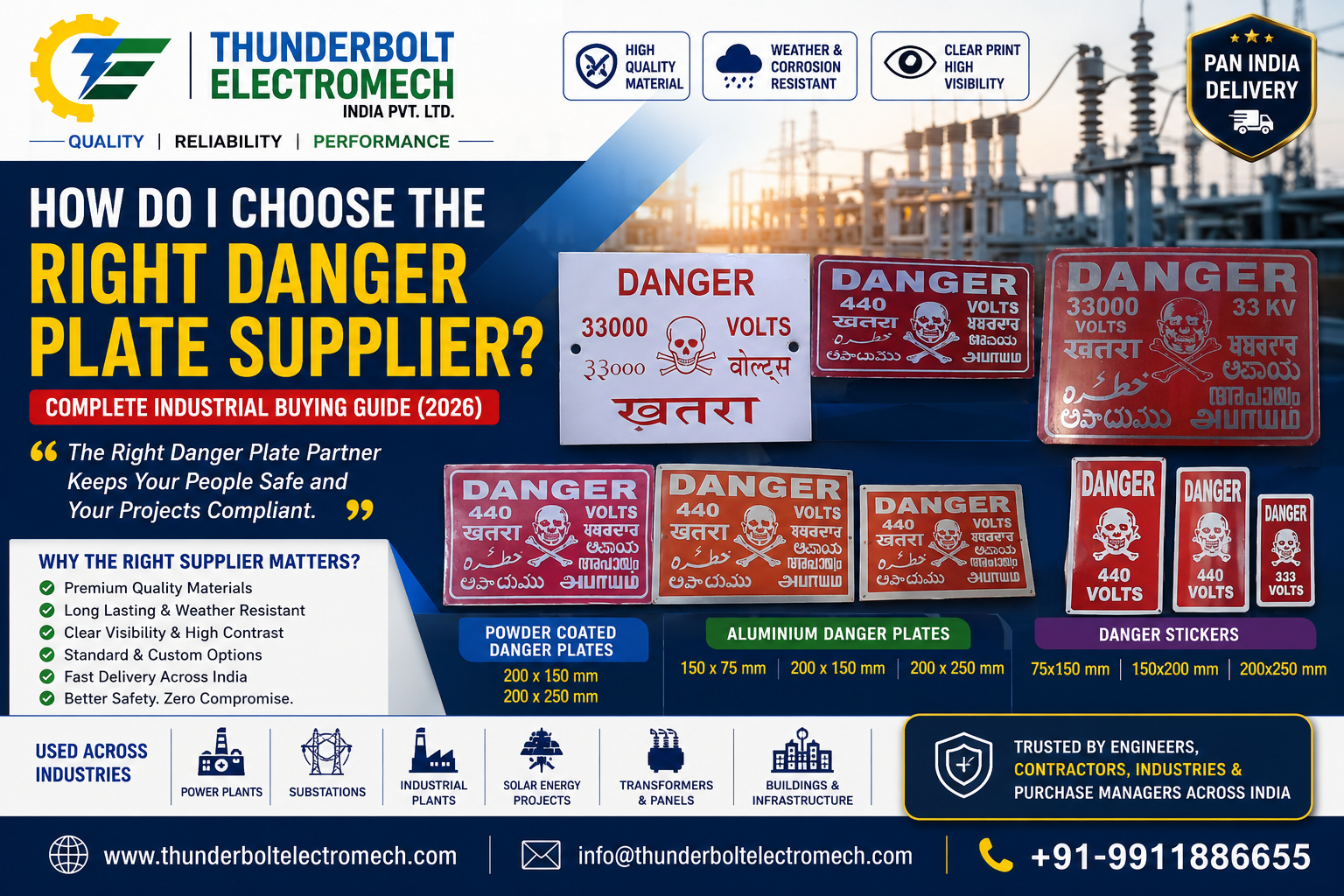
- Powder Coated Danger Plate – 200 × 150 mm
- Powder Coated Danger Plate – 200 × 250 mm
- Aluminium Danger Plate – 150 × 75 mm
- Aluminium Danger Plate – 200 × 150 mm
- Aluminium Danger Plate – 200 × 250 mm
- Danger Sticker – 75 × 150 mm
- Danger Sticker – 150 × 200 mm
- Danger Sticker – 200 × 250 mm
The company serves engineers, EPC contractors, industries, OEMs, infrastructure projects, utilities, and purchase managers across India with dependable industrial safety solutions.
Danger Plate Supplier: Why Your Choice Impacts Safety, Compliance, and Project Success
Selecting a Danger Plate Supplier is much more than choosing someone who can print warning signs. It is a decision that affects operational safety, maintenance efficiency, inspection readiness, and even your company’s reputation.
In many industrial audits, faded or missing danger plates are treated as safety non-conformities. Electrical inspectors expect hazard markings to remain clearly visible throughout the service life of the equipment.
A professional Danger Plate Manufacturer understands these requirements and designs products that remain legible despite exposure to:
- Rain
- Heat
- UV radiation
- Dust
- Oil vapours
- Industrial chemicals
- Mechanical vibration
- Outdoor weather
Cheap alternatives often fail within a year, leading to repeated replacements and additional maintenance costs.
What Makes a Reliable Danger Plate Supplier?
A dependable supplier should provide:
- Multiple material options
- Accurate dimensions
- Durable powder coating
- Corrosion-resistant aluminium
- Weather-resistant printing
- Fast production
- Bulk supply capability
- Custom branding
- Pan India delivery
- Technical assistance
Instead of treating danger plates as accessories, experienced suppliers consider them an essential part of electrical safety systems.
Engineering View: Why Engineers Specify Certified Safety Signage
Electrical engineers understand that hazard communication follows the hierarchy of risk control.
Before someone opens a panel, disconnects a transformer, or enters a restricted electrical area, they first see the warning sign.
That means the danger plate becomes the first layer of protection.
Good suppliers therefore focus on:
- High colour contrast
- Proper font size
- Weather-resistant inks
- Accurate voltage indication
- Long service life
- Secure mounting
These small engineering details dramatically improve workplace safety.
What Should Every Danger Plate Include?
A professionally manufactured Electrical Safety Sign Board generally contains:
| Requirement | Importance |
| High Voltage Warning | Immediate hazard identification |
| Voltage Rating | Identifies electrical risk level |
| Danger Symbol | Universal hazard recognition |
| Durable Paint | Long outdoor life |
| Permanent Printing | Prevents fading |
| Corrosion Resistance | Essential for industrial environments |
| Correct Size | Maximum visibility |
Common Industries Using Danger Plates
A trusted Electrical Danger Plate Supplier regularly supplies products for:
- Power generation plants
- Solar power projects
- Wind energy farms
- Transmission substations
- Distribution utilities
- Electrical panel manufacturers
- Transformer manufacturers
- Metro rail projects
- Infrastructure contractors
- Commercial buildings
- Pharmaceutical plants
- Food processing units
- Steel industries
- Cement plants
- Data centres
- Oil & gas facilities
Each application demands different material and mounting options.
Danger Plate Supplier: Understanding Different Types of Danger Plates Before Buying
Not every installation requires the same type of danger plate. Choosing the correct material improves durability while reducing maintenance costs.
1. Powder Coated Danger Plates
Powder-coated danger plates are widely used where mechanical strength and weather resistance are important.
Advantages
- Excellent corrosion resistance
- Strong adhesion of coating
- Better scratch resistance
- Suitable for outdoor installations
- Professional appearance
- Long service life
Thunderbolt Electromech supplies:
| Product | Size | Typical Applications |
| Powder Coated Danger Plate | 200 × 150 mm | Electrical Panels |
| Powder Coated Danger Plate | 200 × 250 mm | Transformers, HT Installations |
These products are suitable for industrial plants, substations, factories, and infrastructure projects.
2. Aluminium Danger Plate
An Aluminium Danger Plate combines lightweight construction with outstanding corrosion resistance.
Unlike ordinary steel, aluminium naturally forms a protective oxide layer, making it suitable for coastal, humid, and chemical environments.
Thunderbolt offers:
| Product | Size |
| Aluminium Danger Plate | 150 × 75 mm |
| Aluminium Danger Plate | 200 × 150 mm |
| Aluminium Danger Plate | 200 × 250 mm |
Best Applications
- Outdoor transformers
- Solar plants
- Switchyards
- Chemical industries
- Coastal projects
- Utility poles
3. Danger Stickers
Not every installation allows drilling or riveting.
For indoor electrical panels and smooth surfaces, high-quality danger stickers provide a practical solution.
Thunderbolt supplies:
| Product | Size |
| Danger Sticker | 75 × 150 mm |
| Danger Sticker | 150 × 200 mm |
| Danger Sticker | 200 × 250 mm |
These stickers are commonly used on:
- Indoor panels
- Distribution boards
- MCC panels
- Control cabinets
- OEM equipment
- Industrial machines
Comparison Table
| Feature | Powder Coated | Aluminium | Sticker |
| Outdoor Use | Excellent | Excellent | Moderate |
| Corrosion Resistance | High | Very High | Depends on adhesive |
| Weight | Medium | Light | Very Light |
| Life Expectancy | Long | Very Long | Medium |
| Mechanical Strength | Excellent | Good | Low |
| Installation | Screw/Rivet | Screw/Rivet | Peel & Stick |
| Best For | Heavy Industry | Coastal & Outdoor | Indoor Panels |
Customer Problems and Practical Solutions
Choosing the wrong danger plate often creates recurring safety and maintenance issues. Below are common challenges faced by industrial buyers and practical ways to address them.
| Customer Problem | Practical Solution |
| Plate fades within months | Use powder-coated or aluminium plates with UV-resistant printing. |
| Rust develops in outdoor areas | Select corrosion-resistant aluminium or properly powder-coated plates. |
| Text becomes unreadable | Choose permanent, high-contrast printing designed for industrial environments. |
| Incorrect size for equipment | Match plate dimensions to panel, transformer, or installation requirements. |
| Delayed project completion due to stock shortages | Work with a supplier that maintains ready inventory and supports bulk orders. |
| Difficulty sourcing custom warning text | Choose a supplier capable of producing Custom Danger Plate solutions to your specifications. |
Real Industrial Use Case #1 – Solar Power Plant
An EPC contractor installing a 10 MW solar power project used ordinary printed labels on outdoor combiner boxes to reduce procurement costs.
After one monsoon season and prolonged UV exposure, many labels became faded and partially detached. During a maintenance audit, technicians struggled to identify voltage warnings quickly, resulting in additional inspection time and mandatory replacement of all warning labels.
The contractor replaced them with powder-coated and aluminium danger plates designed for outdoor service. The upgraded signage remained legible through harsh weather conditions, improving maintenance efficiency and reducing repeat replacement costs.
Engineering Insight: Outdoor solar installations benefit from rigid, weather-resistant danger plates rather than standard adhesive labels because continuous sunlight, temperature cycling, and moisture accelerate adhesive failure.
Real Industrial Use Case #2 – Manufacturing Plant Upgrade
A manufacturing facility expanded its electrical distribution network by installing new LT and HT panels. Initially, the procurement team ordered generic safety labels without verifying dimensions or durability.
During commissioning, several labels failed to meet the required visibility standards because the text was too small for operators working from a safe distance. Maintenance personnel also reported peeling labels in areas exposed to heat and oil vapours.
The engineering team reviewed the installation and replaced the labels with appropriately sized powder-coated danger plates matched to each panel type. Clear identification improved operator awareness, simplified inspections, and ensured consistent hazard communication throughout the plant.
Engineering Insight: The right plate size and material are as important as the warning message itself. Proper visibility reduces the chance of human error during routine operation and emergency maintenance.
Engineering Insights: Why Industrial Safety Signage Deserves More Attention
Safety signage is often considered a finishing item, but from an engineering perspective it is a critical control measure. Effective danger plates should remain readable for years despite UV exposure, vibration, dust, moisture, and routine cleaning. High-contrast colours, durable coatings, and correctly sized lettering improve recognition time, particularly in high-risk electrical environments where every second matters.
Modern industrial projects increasingly specify materials and dimensions during the design stage rather than leaving signage decisions until installation. This approach reduces inconsistencies across sites and helps maintain compliance during future inspections.
Research on Industrial Safety Signage
Studies in industrial safety and human factors consistently show that clear visual warnings reduce the likelihood of accidental contact with hazardous equipment. Signs positioned at eye level, using standardized colours and concise wording, are recognized more quickly than cluttered or faded labels.
For electrical systems, durable danger plates contribute to:
- Faster hazard recognition during maintenance.
- Improved compliance with workplace safety procedures.
- Better consistency across multiple facilities.
- Reduced replacement frequency when quality materials are selected.
- Increased confidence during internal and third-party safety audits.
Investing in well-manufactured danger plates is therefore not just a procurement decision—it is part of an effective electrical safety strategy.
Internal Buying Checklist Before Selecting a Danger Plate Supplier
Before placing an order, evaluate the supplier against the following checklist:
- Does the supplier offer powder-coated, aluminium, and sticker options?
- Are standard sizes readily available for LT and HT applications?
- Can custom danger plates be manufactured if required?
- Is the printing durable and suitable for outdoor exposure?
- Are the materials corrosion-resistant?
- Does the supplier maintain stock for urgent industrial requirements?
- Can bulk orders be fulfilled consistently?
- Does the supplier understand electrical safety applications rather than simply printing labels?
- Is technical guidance available for selecting the correct size and material?
- Does the supplier provide reliable Pan India delivery?
Using this checklist helps engineers, contractors, and procurement teams choose a supplier that delivers long-term value instead of short-term savings.
Danger Plate Supplier: How to Evaluate a Supplier Before You Place an Order
Choosing the right Danger Plate Supplier requires more than comparing prices. Engineers and procurement teams should evaluate whether the supplier understands industrial safety requirements, maintains product consistency, and can support projects over the long term. A dependable supplier helps reduce installation delays, minimizes replacement costs, and ensures that safety signage remains effective throughout the equipment’s service life.
In industrial projects, a danger plate is often the first visual warning an operator sees before working on energized equipment. If the plate fades, corrodes, or becomes unreadable, it compromises both safety and compliance. That is why procurement decisions should be based on technical capability, product quality, and supply reliability rather than price alone.
Supplier Evaluation Checklist
Before finalizing a supplier, verify the following:
- Does the supplier specialize in industrial electrical safety products?
- Are Powder Coated Danger Plates available in standard sizes such as 200 × 150 mm and 200 × 250 mm?
- Are Aluminium Danger Plates available in multiple sizes, including 150 × 75 mm, 200 × 150 mm, and 200 × 250 mm?
- Are industrial-grade Danger Stickers available for indoor applications?
- Can the supplier manufacture Custom Danger Plate designs with company logos, multilingual text, or project-specific voltage information?
- Are the materials resistant to UV exposure, moisture, corrosion, and industrial chemicals?
- Does the supplier maintain ready stock for urgent requirements?
- Can they supply large quantities consistently?
- Do they offer Pan India delivery?
- Can they provide technical guidance on selecting the appropriate material and size?
A supplier that answers “yes” to these questions is far more likely to support your project successfully than one focused solely on low-cost production.
Comparison Table: Good Supplier vs. Poor Supplier
| Evaluation Criteria | Good Danger Plate Supplier | Poor Supplier |
| Product Range | Powder Coated, Aluminium, Stickers, Custom Plates | Limited options |
| Material Quality | Industrial-grade materials | Low-cost materials |
| Printing Quality | UV-resistant, permanent printing | Fades quickly |
| Standard Sizes | Multiple standard dimensions available | Few or inconsistent sizes |
| Customisation | Supports custom voltage, logos, and languages | Limited or unavailable |
| Technical Support | Helps select correct product | No application guidance |
| Inventory | Maintains ready stock | Frequent stock shortages |
| Delivery | Reliable Pan India dispatch | Long lead times |
| Quality Consistency | Uniform finish and dimensions | Variable quality |
| Long-Term Cost | Lower maintenance and replacement | Higher lifecycle cost |
Procurement Guide for Engineers and Purchase Managers
Procurement decisions should align with the operating environment, equipment type, and expected service life.
Step 1: Identify the Application
Different installations require different signage. For example:
- Indoor control panels often use danger stickers.
- Outdoor switchyards benefit from powder-coated plates.
- Coastal or chemical environments typically require aluminium plates due to their corrosion resistance.
Step 2: Select the Correct Size
Choose a plate size that remains visible from a safe working distance.
| Equipment | Recommended Size |
| Small Distribution Boards | 150 × 75 mm |
| LT Panels | 200 × 150 mm |
| HT Panels | 200 × 250 mm |
| Transformers | 200 × 250 mm |
| Solar Combiner Boxes | 200 × 150 mm |
Step 3: Consider Environmental Conditions
Questions to ask include:
- Will the plate be exposed to direct sunlight?
- Is the installation outdoors?
- Will chemicals, oil, or moisture be present?
- Is the location prone to vibration or dust?
These factors determine whether a sticker, powder-coated plate, or aluminium plate is the most appropriate choice.
Step 4: Evaluate Lifecycle Cost
A lower purchase price does not always result in lower overall costs. Replacing faded or damaged danger plates repeatedly increases labour expenses, downtime, and maintenance budgets. Durable products often provide better value over the life of the equipment.
Danger Plate Supplier: Standards, Compliance, and Engineering Best Practices
Electrical safety signage is an important component of workplace hazard communication. While project specifications and local regulations may differ, danger plates should follow established engineering principles.
Key Engineering Requirements
- Clear and legible text.
- High-contrast colours for easy recognition.
- Permanent marking that resists fading.
- Durable materials suitable for the installation environment.
- Secure mounting to prevent accidental removal.
- Appropriate sizing for viewing distance.
Why Compliance Matters
Properly installed danger plates help:
- Warn personnel before approaching energized equipment.
- Support routine maintenance activities.
- Improve safety audit outcomes.
- Reduce the likelihood of accidental contact with hazardous electrical systems.
- Promote consistent safety practices across facilities.
For projects involving LT HT Danger Plate applications, ensuring the warning remains visible throughout the equipment’s operational life is particularly important.
Why Industries Choose Thunderbolt Electromech
Thunderbolt Electromech is a Delhi-based supplier serving engineers, contractors, OEMs, EPC companies, industries, and purchase managers across India.
Product Range
Powder Coated Danger Plates
- 200 × 150 mm
- 200 × 250 mm
Aluminium Danger Plates
- 150 × 75 mm
- 200 × 150 mm
- 200 × 250 mm
Danger Stickers
- 75 × 150 mm
- 150 × 200 mm
- 200 × 250 mm
Why Customers Choose Thunderbolt Electromech
- Delhi-based industrial supplier.
- Pan India delivery.
- Standard and custom danger plates.
- Fast dispatch for bulk orders.
- Technical support for product selection.
- Focus on industrial electrical safety products.
Contact Details
Thunderbolt Electromech India Pvt. Ltd.
Phone: +91-9911886655
Website: www.thunderboltelectromech.com
Email: info@thunderboltelectromech.com
Frequently Asked Questions
1. How do I know if a Danger Plate Supplier is reliable?
Evaluate product quality, available materials, inventory levels, customization capabilities, delivery performance, and technical expertise. Customer reviews and industry experience are also valuable indicators.
2. What is the best material for outdoor danger plates?
For outdoor installations, powder-coated steel and aluminium are both strong choices. Aluminium generally performs better in coastal or corrosive environments due to its natural resistance to rust.
3. Are aluminium danger plates better than stickers?
Yes, for outdoor or harsh industrial environments. Stickers are better suited to clean indoor surfaces where mechanical damage and weather exposure are minimal.
4. What size danger plate should I use?
The appropriate size depends on the equipment and required viewing distance. Common sizes include 150 × 75 mm, 200 × 150 mm, and 200 × 250 mm.
5. Can I order a custom danger plate?
Yes. Many suppliers offer custom voltage ratings, multilingual text, company logos, and project-specific wording.
6. What information should appear on a danger plate?
Typically, it should include the danger symbol, hazard message, voltage information where applicable, and any mandatory safety instructions specified by the project.
7. How long do quality danger plates last outdoors?
High-quality powder-coated and aluminium danger plates can provide years of service when correctly installed and maintained. Actual lifespan depends on environmental conditions.
8. What is the difference between an Electrical Safety Sign Board and a danger plate?
A danger plate specifically warns of electrical hazards, while an Electrical Safety Sign Board may provide broader safety instructions, mandatory actions, or emergency information.
9. Should I choose a local supplier or a national supplier?
A supplier with nationwide logistics and technical support often provides greater flexibility, especially for projects across multiple locations.
10. Can danger stickers be used on transformers?
Generally, rigid powder-coated or aluminium plates are preferred for transformers because they offer greater durability in outdoor conditions.
11. What is an LT HT Danger Plate?
It is a warning plate designed for low-tension (LT) and high-tension (HT) electrical installations, helping personnel identify electrical hazards before maintenance or operation.
12. How can I verify the print quality before ordering in bulk?
Request product samples or detailed photographs and confirm that the printing is resistant to UV exposure, abrasion, and weathering.
13. Are multilingual danger plates available?
Yes. Custom plates can be produced in English, Hindi, or other languages to meet project or regional requirements.
14. Why do some danger plates fade quickly?
Low-quality inks, poor coatings, and unsuitable materials can degrade rapidly when exposed to sunlight, moisture, or industrial chemicals.
15. What is the difference between a Danger Plate Manufacturer and a supplier?
A manufacturer produces the plates, while a supplier may distribute products from one or more manufacturers. Many suppliers also offer customization, inventory management, and technical support.
16. Can I install a danger plate using adhesive instead of screws?
This depends on the product and application. Stickers use adhesive, whereas metal danger plates are generally secured with screws or rivets for long-term reliability.
17. How often should danger plates be inspected?
Include them in routine electrical maintenance inspections. Replace any plate that has become damaged, faded, loose, or difficult to read.
18. Are custom colours allowed on danger plates?
Project specifications may permit certain customizations, but warning colours should always remain clear, highly visible, and consistent with applicable safety requirements.
Conclusion: Choose a Danger Plate Supplier That Supports Safety, Quality, and Long-Term Performance
Selecting the right Danger Plate Supplier is an investment in workplace safety, regulatory compliance, and operational efficiency. A supplier that offers durable materials, multiple product options, technical expertise, and dependable delivery can help prevent costly replacements and improve the reliability of your electrical safety systems.
Whether you need Powder Coated Danger Plates, Aluminium Danger Plates, or Danger Stickers, focus on product performance rather than simply comparing prices. Evaluate the supplier’s ability to support your projects today and as your business grows.
For engineers, contractors, industries, and purchase managers, partnering with an experienced Danger Plate Supplier India ensures that every warning sign performs its job when it matters most.
Request a Quote from Thunderbolt Electromech
Looking for a trusted Danger Plate Supplier, Danger Plate Manufacturer, or Electrical Danger Plate Supplier for your next project?
Thunderbolt Electromech offers:
- Powder Coated Danger Plates
- Aluminium Danger Plates
- Danger Stickers
- Custom Danger Plates
- Standard industrial sizes
- Bulk supply for projects
- Pan India delivery
- Technical support for engineers and procurement teams
Contact Thunderbolt Electromech India Pvt. Ltd. today for expert guidance, competitive pricing, and dependable industrial safety solutions tailored to your requirements.