
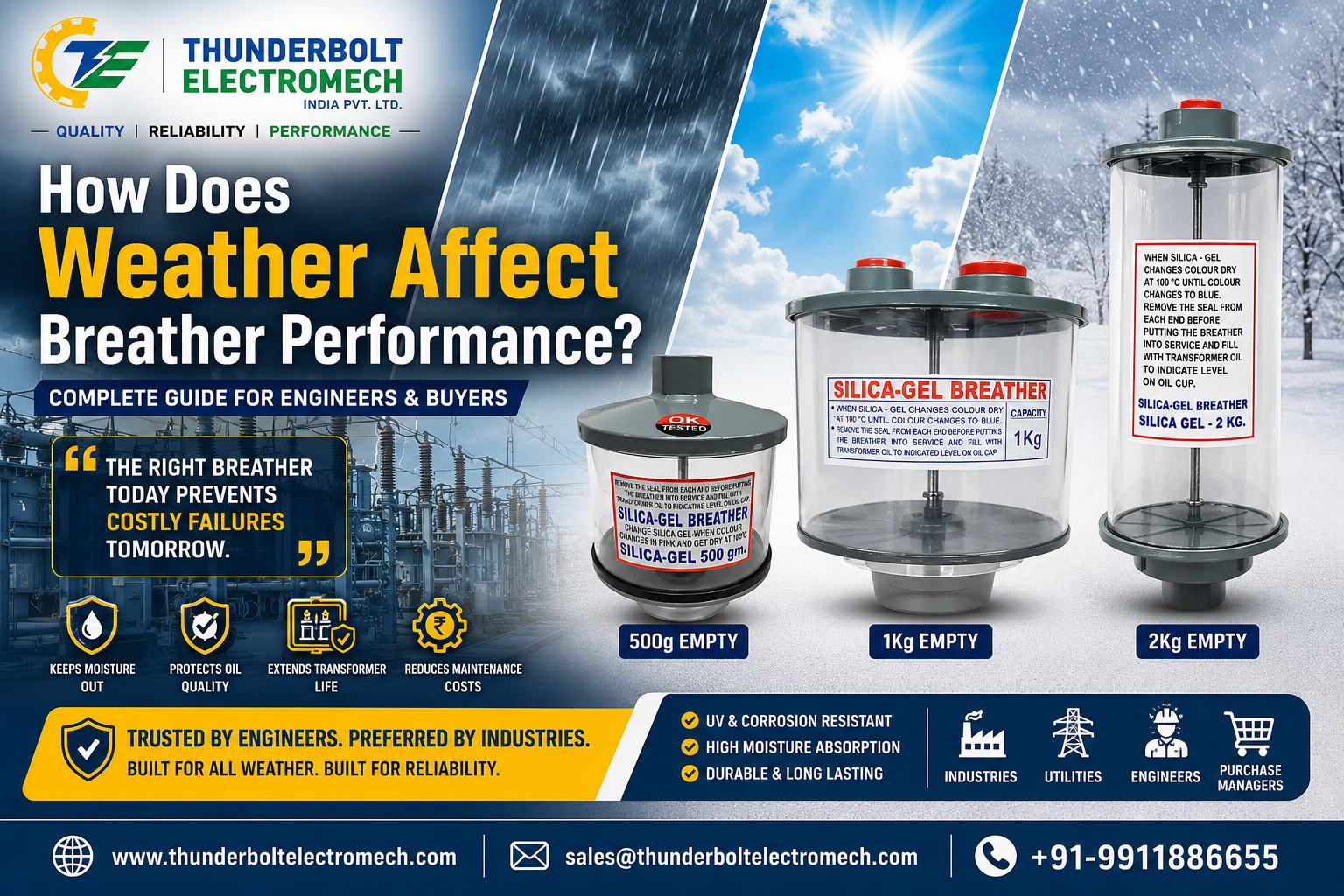
Quick Answer: Weather has a direct impact on the performance and service life of a silica gel breather. High humidity causes silica gel to absorb moisture faster, reducing its lifespan. Extreme heat accelerates oil evaporation from the sealing cup and can damage low-quality breather housings. Heavy rainfall may allow water ingress if the oil cup or seals are poorly designed. Coastal environments expose metallic parts to corrosion, while freezing temperatures can block airflow through moisture condensation or frozen oil traps.
Choosing the correct Silica Gel Breather Supplier is just as important as selecting the right transformer. A high-quality breather with UV-resistant housing, corrosion-resistant flanges, properly sized silica gel capacity, and reliable sealing protects transformer insulating oil from moisture contamination, maintains dielectric strength, reduces maintenance costs, and extends transformer life.
Thunderbolt Electromech supplies Silica Gel Breather 500g Empty, Silica Gel Breather 1Kg Empty and Silica Gel Breather 2Kg Empty for transformers across utilities, substations, industries, renewable energy projects, and electrical panel manufacturers throughout India.
Introduction
Every transformer continuously breathes. Although this process is invisible, it has a significant impact on transformer reliability. Whenever transformer oil expands because of increasing temperature or electrical loading, air is pushed out of the conservator tank. As the transformer cools, fresh atmospheric air is drawn back inside.
This incoming air contains more than oxygen. It also carries moisture, dust, industrial pollutants, salt particles, and airborne contaminants. Without an effective silica gel breather, these impurities enter the transformer oil and gradually reduce insulation performance.
Weather conditions make this challenge even greater. During the Indian monsoon, humidity can exceed 90%, causing silica gel to become saturated much faster than expected. In hot regions such as Rajasthan, Gujarat, and parts of Delhi NCR, prolonged UV exposure weakens inferior plastic housings. Coastal environments like Mumbai, Chennai, and Visakhapatnam expose breathers to corrosive salt spray, while colder regions experience condensation and freezing problems.
This is why engineers, electrical contractors, EPC companies, and power utilities increasingly search for reliable suppliers using keywords such as:
- Silica Gel Breather Supplier
- Silica Gel Breather Supplier Delhi
- Silica Gel Breather Delhi NCR
- Transformer Breather Supplier
- Silica Gel Breather Dealer Delhi
- Silica Gel Breather Price
- Silica Gel Breather for Transformer
Selecting the right supplier is no longer only about price. It is about ensuring long-term transformer protection under real operating conditions.
Silica Gel Breather Supplier
Selecting a dependable Silica Gel Breather Supplier is one of the most important decisions for transformer maintenance teams. A quality supplier provides products designed to withstand changing weather conditions while maintaining reliable moisture removal.
Thunderbolt Electromech supplies a complete range of transformer breathers, including:
- Silica Gel Breather 500g Empty
- Silica Gel Breather 1Kg Empty
- Silica Gel Breather 2Kg Empty
These products are suitable for distribution transformers, power transformers, substations, industrial plants, renewable energy installations, manufacturing facilities, and electrical utilities.
A professional supplier focuses on more than selling equipment. They help customers select the correct breather capacity based on transformer oil volume, environmental conditions, maintenance intervals, and operating location.
The Mechanics of Transformer Breathing in Changing Climates
Many people assume that transformers are completely sealed systems. In reality, conservator-type transformers continuously exchange air with the atmosphere.
This breathing process is driven by thermal expansion and contraction of transformer oil.
Daytime Operation
As transformer load increases:
- Oil temperature rises.
- Oil expands.
- Internal pressure increases.
- Warm air exits through the silica gel breather.
During this stage, the silica gel remains mostly inactive because air is flowing outward.
Night-Time Cooling
As the transformer cools:
- Oil contracts.
- Internal pressure decreases.
- Fresh atmospheric air is drawn inside.
This incoming air must pass through:
- Oil sealing cup
- Silica gel chamber
- Conservator tank
The oil trap removes dust and larger airborne particles. The silica gel removes moisture before the air reaches the transformer oil.
Without this protection, atmospheric moisture enters the transformer every day.
The breathing cycle repeats thousands of times throughout the transformer’s operational life.
Why Temperature Variations Force Air Exchange
Temperature fluctuations are the primary reason transformers breathe.
Several factors influence this process:
Electrical Load
Higher electrical demand generates additional heat inside transformer windings.
Examples include:
- Industrial manufacturing
- Steel plants
- Solar power stations
- Metro rail systems
- Commercial complexes
Greater loading increases oil expansion and breathing frequency.
Ambient Temperature
Even without load changes, outdoor temperature significantly affects breathing.
Examples:
| Weather Condition | Transformer Response |
| Cool winter morning | Oil contracts rapidly |
| Hot afternoon | Oil expands significantly |
| Summer heat wave | Continuous expansion |
| Monsoon evening | Frequent contraction and moisture intake |
Daily thermal cycles can cause hundreds of breathing events every month.
Seasonal Changes
India experiences dramatic seasonal differences.
Summer
- High temperatures
- Strong UV exposure
- Increased oil evaporation
- Higher breathing frequency
Monsoon
- Extremely high humidity
- Faster silica gel saturation
- Increased moisture absorption
Winter
- Heavy condensation
- Slower oil flow
- Moisture accumulation
Each season creates unique maintenance challenges.
How Ambient Humidity Degrades Transformer Oil Breakdown Voltage (BDV)
One of the biggest threats to transformer reliability is moisture contamination.
Transformer insulating oil serves two critical functions:
- Electrical insulation
- Heat dissipation
Even a small amount of dissolved water reduces its insulating capability.
What is Breakdown Voltage (BDV)?
BDV represents the maximum voltage transformer oil can withstand before electrical failure occurs.
Higher BDV indicates healthier transformer insulation.
Lower BDV increases the likelihood of:
- Internal arcing
- Flashovers
- Partial discharge
- Winding failure
- Transformer outages
Why Moisture is Dangerous
Water molecules change the dielectric characteristics of insulating oil.
As moisture content increases:
- Dielectric strength decreases.
- Partial discharge becomes more likely.
- Insulation ages faster.
- Paper insulation deteriorates.
- Maintenance costs increase.
Research in transformer insulation engineering consistently shows that even small increases in moisture can significantly reduce dielectric performance and accelerate cellulose insulation aging. This is why utilities prioritize keeping incoming air as dry as possible.
Role of Silica Gel
Silica gel acts as a desiccant.
Instead of allowing moisture to enter the transformer, silica gel captures water vapor inside millions of microscopic pores.
Indicator silica gel provides a visual indication of saturation.
Typical color changes include:
| Indicator Type | Dry | Saturated |
| Blue Indicator | Blue | Pink |
| Orange Indicator | Orange | Green |
Rapid color changes usually indicate:
- Extremely humid weather
- Undersized breather
- Air leakage
- Damaged gaskets
- Excessive transformer breathing
Real Customer Pain Points During Buying & Selection
Many transformer failures begin with small purchasing mistakes.
Below are the most common issues engineers report.
1. Buying an Undersized Breather
A 500g breather installed on a transformer requiring a 2Kg unit saturates quickly.
Result:
- Frequent replacement
- Moisture ingress
- Higher maintenance cost
Solution
Choose breather capacity based on transformer oil volume and local climate rather than price alone.
2. High Humidity During Monsoon
Many facilities underestimate the impact of monsoon conditions.
During extended rainy periods:
- Silica gel absorbs moisture rapidly.
- Color changes occur within weeks instead of months.
- Transformer maintenance frequency increases.
Solution
Use larger-capacity breathers in regions with consistently high humidity.
3. Poor Oil Cup Quality
Inferior oil cups often develop:
- Cracks
- Leakage
- Poor sealing
- Water ingress
Heavy rainfall allows water to enter directly through the bottom.
Solution
Purchase breathers with robust sealing systems and inspect oil levels regularly.
4. UV Damage
Low-grade plastic becomes:
- Yellow
- Brittle
- Cracked
Eventually, air bypasses the silica gel completely.
Solution
Select UV-stabilized housings suitable for outdoor installations.
5. Coastal Corrosion
Salt-laden air corrodes ordinary steel components.
This causes:
- Air leakage
- Loose flanges
- Gasket failure
Solution
Choose corrosion-resistant flange materials for coastal and chemical environments.
Engineering Research: Why Weather Cannot Be Ignored
Field experience and transformer maintenance studies consistently highlight weather as a major factor affecting breather life.
Key engineering observations include:
- High humidity significantly shortens desiccant service life due to increased moisture loading.
- UV radiation accelerates the aging of non-UV-stabilized plastic housings.
- Salt spray promotes corrosion, compromising flange seals and allowing unfiltered air to enter.
- Large day–night temperature swings increase breathing cycles, resulting in more frequent moisture exposure.
- Properly sized breathers can reduce maintenance frequency and help preserve transformer oil quality over longer operating periods.
Rather than selecting the lowest-cost option, engineers increasingly evaluate total lifecycle performance under actual site conditions.
Engineering Comparison Table
| Parameter | Standard Breather | Weather-Resistant Breather |
| High Humidity Performance | Moderate | Excellent |
| UV Resistance | Low | High |
| Oil Cup Quality | Basic | Heavy-duty |
| Corrosion Resistance | Standard | Enhanced |
| Outdoor Suitability | Limited | Excellent |
| Service Life | Shorter | Longer |
| Maintenance Frequency | Higher | Lower |
| Transformer Protection | Basic | Superior |
Silica Gel Breather Supplier – How Weather Factors Impact Silica Gel Breather Efficiency
A transformer continuously exchanges air with the atmosphere as its oil expands and contracts during operation. Every time air enters the conservator, moisture, dust, salt particles, and industrial contaminants try to enter with it. The job of an electrical Silica Gel Breather Supplier is not simply to provide a container filled with silica gel. The supplier must provide a breather capable of maintaining reliable performance in the environmental conditions where the transformer operates.
This becomes especially important in India because transformers experience extreme monsoons, hot summers exceeding 50°C, coastal humidity, dust storms, and in some northern regions, freezing winter temperatures. Selecting the wrong breather can shorten silica gel life from several months to only a few days.
Thunderbolt Electromech supplies weather-resistant:
- Silica Gel Breather 500g Empty
- Silica Gel Breather 1 Kg Empty
- Silica Gel Breather 2 Kg Empty
These products are suitable for utility substations, industrial transformers, renewable energy plants, manufacturing facilities, commercial buildings, and power distribution networks.
How Different Weather Conditions Affect Breather Performance
Every climate creates a different challenge. Understanding these challenges helps engineers choose the correct breather size, housing material, and maintenance schedule.
Monsoon & High Humidity
India’s monsoon season is one of the biggest challenges for transformer breathing systems.
Relative humidity frequently exceeds 90%, meaning the incoming air contains significantly more moisture than during dry seasons.
Each breathing cycle forces this moisture through the silica gel.
As humidity increases:
- Silica gel absorbs moisture faster
- Indicator beads change colour quickly
- Replacement frequency increases
- Transformer maintenance cost rises
Many industries mistakenly install the same breather throughout the country without considering local humidity levels.
Common Customer Problem
“We replaced the silica gel only two weeks ago, but it has already turned pink.”
This usually indicates:
- undersized breather
- excessive breathing cycles
- damaged oil seal
- unusually high atmospheric humidity
The silica gel is often blamed when the real issue is improper sizing.
Why High Capacity Matters
High-quality silica gel can absorb approximately 20–40% of its own weight in water, depending on the desiccant grade and environmental conditions.
Example:
| Breather Capacity | Approximate Moisture Holding Capacity |
| 500 g | Suitable for small transformers |
| 1 Kg | Medium industrial transformers |
| 2 Kg | Large transformers with frequent breathing cycles |
Larger breathers reduce replacement frequency during the rainy season.
Engineering Recommendation
For transformers operating in:
- Mumbai
- Chennai
- Kochi
- Kolkata
- Visakhapatnam
- Guwahati
always evaluate humidity levels before selecting breather capacity.
Simply choosing the lowest-cost breather often results in significantly higher annual maintenance costs.
How Moisture Travels Through the Breather
During transformer cooling:
Transformer Oil Contracts
↓
Internal Vacuum Forms
↓
Outside Air Enters
↓
Air Passes Through Oil Cup
↓
Dust Gets Trapped
↓
Moisture Reaches Silica Gel
↓
Dry Air Enters Conservator
If the silica gel becomes saturated, moisture passes directly into the transformer.
Summer Heat & UV Exposure
Summer temperatures across India often exceed 45–50°C.
Outdoor transformers remain exposed to direct sunlight throughout the day.
High temperatures affect almost every component of the breather.
Problems Caused by Extreme Heat
- Oil cup evaporation
- Faster breathing cycles
- Plastic ageing
- Housing deformation
- UV damage
- Seal hardening
- Increased maintenance frequency
Many inexpensive breathers use ordinary transparent plastic that becomes brittle after prolonged UV exposure.
Within a few years:
- cracks appear
- water enters directly
- silica gel fails prematurely
Customer Pain Point
“Our breather body cracked even though the silica gel was still usable.”
In most cases:
The desiccant was perfectly healthy,
But the housing material had degraded due to sunlight.
UV-Stabilized Housing Makes a Difference
Professional transformer breathers often use:
- UV-stabilized polycarbonate
- UV-resistant acrylic
- heavy-duty glass
- aluminium body construction
These materials resist:
- sunlight
- temperature cycling
- thermal expansion
- outdoor ageing
Heat Also Affects the Oil Seal Cup
The oil cup performs two important functions:
- traps dust
- blocks humid outside air
During hot weather:
- oil evaporates faster
- oil level drops
- dust bypasses the oil seal
- silica gel becomes contaminated
Routine inspection during summer is therefore essential.
Coastal Salt Spray & Industrial Pollution
Coastal environments create completely different problems.
The challenge is no longer just humidity.
It becomes corrosion.
Salt-laden air attacks:
- aluminium
- steel
- fasteners
- flange joints
- mounting hardware
Industrial chemical plants add:
- sulphur compounds
- acidic vapours
- chlorine
- corrosive gases
These contaminants gradually damage breather assemblies.
Typical Failure Sequence
Salt Deposits
↓
Corrosion Begins
↓
Flange Weakens
↓
Gasket Leakage
↓
Outside Air Bypasses Silica Gel
↓
Moisture Enters Transformer
This failure often remains unnoticed until oil testing reveals increasing moisture content.
Recommended Materials
| Environment | Recommended Material |
| Inland | Powder-coated aluminium |
| Coastal | Stainless Steel |
| Chemical Plants | Stainless Steel with corrosion-resistant seals |
| Marine Applications | Heavy-duty aluminium alloy |
Engineering Insight
Even premium silica gel cannot protect a transformer if humid air bypasses damaged flange seals.
Mechanical integrity is just as important as desiccant quality.
Industrial Pollution
Power transformers installed near:
- cement plants
- fertilizer plants
- refineries
- steel mills
- thermal power stations
Must deal with airborne particles.
Dust blocks airflow.
Chemical vapours reduce component life.
Fine contaminants eventually coat silica gel surfaces, reducing adsorption efficiency.
This is why routine inspection is necessary even if colour indicators appear normal.
Winter & Freezing Conditions
Although much of India experiences moderate winters, transformers in northern states and mountainous regions face freezing temperatures.
Common locations include:
- Himachal Pradesh
- Jammu & Kashmir
- Uttarakhand
- Ladakh
Cold weather introduces another challenge.
Condensation.
What Happens During Winter?
Warm transformer oil cools overnight.
Moisture condenses inside:
- breathing pipe
- oil cup
- breather housing
In sub-zero temperatures:
Water freezes.
Ice blocks airflow.
Transformer breathing becomes restricted.
Internal vacuum pressure increases.
This stresses:
- conservator seals
- gaskets
- pipe joints
Customer Complaint
“The breather looks normal but oil leakage started during winter.”
Sometimes the real cause is blocked breathing rather than faulty seals.
Engineering Recommendation
For cold climates:
- inspect oil cup regularly
- remove condensed water
- ensure breathing pipe remains clear
- verify unrestricted airflow
Material Selection Guide
Material quality determines long-term reliability.
Below are the major components engineers should evaluate before purchasing.
Breather Body Materials
| Material | Advantages | Best Application |
| Acrylic | Clear visibility | Indoor |
| UV Stabilized Polycarbonate | Excellent impact resistance | Outdoor |
| Glass | High chemical resistance | Industrial |
| Aluminium Housing | Maximum durability | Heavy-duty installations |
Flange Material Guide
| Material | Corrosion Resistance | Suitable Environment |
| Mild Steel | Low | Indoor only |
| Powder-Coated Aluminium | High | Most outdoor installations |
| Stainless Steel | Excellent | Coastal & chemical industries |
Seal Materials
High-quality gaskets should withstand:
- UV
- ozone
- oil
- temperature cycling
Poor-quality rubber hardens rapidly and creates air leakage paths.
Blue vs Orange Silica Gel
Selecting the correct desiccant indicator is equally important.
Blue Indicator Silica Gel
Advantages:
- clear colour change
- widely available
- economical
Colour Transition:
Blue
↓
Pink
Indicates moisture saturation.
Orange Indicator Silica Gel
Advantages:
- environmentally safer
- cobalt-free
- modern alternative
- increasingly preferred internationally
Colour Transition:
Orange
↓
Green
Many industries now prefer orange silica gel due to environmental regulations regarding cobalt chloride.
Comparison Table
| Feature | Blue Silica Gel | Orange Silica Gel |
| Indicator Type | Blue → Pink | Orange → Green |
| Visibility | Excellent | Excellent |
| Environmental Preference | Traditional | Eco-friendly |
| Industrial Acceptance | High | Rapidly Increasing |
| Moisture Detection | Easy | Easy |
Which One Should You Choose?
If your organization follows modern environmental procurement standards,
Orange indicating silica gel is generally preferred.
Where existing maintenance procedures specify blue indicator beads,
Replacement should follow plant standards unless environmental policies require otherwise.
Engineering Performance Table
| Weather Condition | Main Risk | Recommended Solution |
| Heavy Monsoon | Rapid saturation | Higher-capacity breather |
| Extreme Summer | UV damage | UV-stabilized housing |
| Coastal Area | Corrosion | Stainless steel flange |
| Chemical Plant | Acidic atmosphere | Corrosion-resistant construction |
| Dust Storm | Particle contamination | Proper oil seal maintenance |
| Freezing Climate | Ice blockage | Regular winter inspection |
Real Industrial Use Case #1
A food processing plant in Delhi NCR operated multiple outdoor distribution transformers exposed to intense summer heat followed by heavy monsoon rainfall. The maintenance team noticed that the silica gel in several breathers changed from dry to saturated within a few weeks, requiring frequent replacement. Oil quality tests also showed a gradual decline in transformer oil BDV.
After reviewing the installation, engineers found that the original breathers were undersized for the transformer oil volume and lacked adequate UV resistance for continuous outdoor exposure.
The plant upgraded to appropriately sized 1Kg and 2Kg empty silica gel breathers supplied by a trusted Silica Gel Breather Supplier and implemented a scheduled inspection program before the monsoon season. Within the following maintenance cycle, silica gel replacement intervals increased, transformer oil maintained healthier dielectric properties, and unscheduled maintenance related to moisture ingress was significantly reduced.
This case demonstrates that selecting the correct breather capacity, housing material, and supplier can improve transformer reliability while lowering long-term maintenance costs.
Real Industrial Use Case #2 – Coastal Power Distribution Company
A coastal utility operating multiple 11 kV and 33 kV distribution transformers experienced frequent silica gel replacement during the monsoon season. Maintenance teams initially assumed poor desiccant quality was responsible. A detailed inspection showed the real issues were undersized 500 g breathers on larger transformers, corroded flanges allowing humid air to bypass the desiccant, and UV-damaged breather bodies with fine cracks.
The utility upgraded to higher-capacity 2 kg breathers with UV-resistant housings, corrosion-resistant flanges, and improved sealing. They also introduced a preventive inspection schedule before the rainy season. Within the following maintenance cycle, silica gel replacement intervals increased significantly, transformer oil moisture levels stabilized, and emergency maintenance visits were reduced.
This case demonstrates that breather performance depends on the complete assembly—including sizing, housing, seals, and materials—not just the silica gel itself.
Throughout harsh environmental conditions, partnering with an experienced Silica Gel Breather Supplier, Transformer Breather Supplier, Silica Gel Breather Supplier Delhi, and Silica Gel Breather Dealer Delhi helps ensure the right breather capacity and construction are selected for each application. Thunderbolt Electromech supplies weather-resistant Silica Gel Breather for Transformer models in 500 g, 1 kg, and 2 kg capacities to support industrial facilities, utilities, OEMs, EPC contractors, and maintenance teams across Delhi NCR and throughout India.
Silica Gel Breather Supplier – Common Buying Mistakes, Sizing Guide & Maintenance Best Practices
Selecting the right silica gel breather is far more important than simply choosing the lowest-priced product. In transformer maintenance, a breather that costs a little more but performs reliably in harsh environments can prevent expensive transformer oil contamination, insulation failure, and unplanned shutdowns. Unfortunately, many procurement teams focus only on the purchase price while overlooking critical engineering factors such as transformer oil volume, breathing frequency, climate, and maintenance requirements.
As an experienced Silica Gel Breather Supplier, Thunderbolt Electromech helps industries, EPC contractors, utilities, and transformer manufacturers choose the correct breather based on operating conditions rather than guesswork. We supply Silica Gel Breather 500g Empty, Silica Gel Breather 1Kg Empty, and Silica Gel Breather 2Kg Empty for transformers installed across Delhi NCR and India.
Common Buying Mistakes When Purchasing Silica Gel Breathers
Many transformer failures begin with small procurement mistakes. The following are the most common errors engineers and buyers make during selection.
1. Buying Based Only on Price
The lowest-cost breather may use:
- Low-grade silica gel
- Thin acrylic housing
- Poor-quality gaskets
- Inferior oil cups
- Corrosion-prone hardware
Although the initial purchase cost is lower, the replacement frequency and maintenance expenses increase significantly.
Engineering Recommendation: Always evaluate the total lifecycle cost rather than the initial purchase price.
2. Choosing the Wrong Capacity
One of the most frequent mistakes is installing the same breather size on every transformer.
For example:
- A 500 g breather installed on a 5 MVA transformer in a humid region will saturate rapidly.
- A 2 kg breather installed on a small distribution transformer may be unnecessary and increase procurement costs.
Breather capacity should match:
- Transformer oil volume
- Daily breathing cycles
- Ambient humidity
- Installation environment
3. Ignoring Local Weather Conditions
Weather directly affects breather performance.
Many buyers overlook whether the transformer operates in:
- Coastal areas
- High-humidity regions
- Desert environments
- Industrial zones
- High-temperature outdoor installations
Environmental conditions should influence both breather capacity and construction material.
4. Not Verifying Housing Material
Transparent housings allow operators to monitor silica gel condition. However, low-quality plastics often crack after prolonged exposure to sunlight.
Preferred materials include:
- UV-stabilized polycarbonate
- High-quality acrylic
- Glass (for specific industrial environments)
5. Ignoring the Oil Sealing Cup
The oil cup is often considered a minor component, but it plays a vital role by:
- Preventing dust entry
- Acting as the first moisture barrier
- Filtering incoming air
Poor-quality oil cups increase contamination and reduce silica gel life.
6. Buying Without Technical Support
A reliable Transformer Breather Supplier should assist with:
- Capacity selection
- Installation guidance
- Maintenance schedules
- Replacement recommendations
- Spare parts availability
Technical support helps reduce long-term maintenance costs.
Transformer KVA vs Oil Volume vs Recommended Breather Capacity
Breather sizing depends primarily on transformer oil volume and breathing frequency. The following table provides a practical selection guide for common transformer ratings.
| Transformer Rating | Approximate Oil Volume | Recommended Breather Capacity |
| Up to 100 kVA | 50–100 Litres | 500 g |
| 100–250 kVA | 100–250 Litres | 500 g |
| 250–500 kVA | 250–500 Litres | 1 Kg |
| 500 kVA–1 MVA | 500–900 Litres | 1 Kg |
| 1–2.5 MVA | 900–1800 Litres | 2 Kg |
| 2.5–5 MVA | 1800–3500 Litres | 2 Kg |
| Above 5 MVA | Site-specific calculation | Multiple 2 Kg or custom arrangement |
Note: These values are general engineering guidelines. Actual selection should also consider climate, transformer loading, and breathing frequency.
500g vs 1Kg vs 2Kg Empty Comparison
Thunderbolt Electromech offers empty silica gel breather assemblies in multiple capacities to suit different transformer sizes.
| Feature | 500 g Empty | 1 Kg Empty | 2 Kg Empty |
| Suitable Transformer | Small Distribution | Medium Industrial | Large Power Transformers |
| Silica Gel Capacity | Low | Medium | High |
| Maintenance Frequency | More Frequent | Moderate | Lowest |
| Initial Cost | Lowest | Medium | Higher |
| Humid Climate Performance | Fair | Good | Excellent |
| Outdoor Use | Good | Excellent | Excellent |
| Heavy Industrial Areas | Limited | Recommended | Highly Recommended |
| Large Utility Applications | No | Limited | Yes |
Which Capacity Should You Buy?
Choose 500 g when:
- Small distribution transformers
- Indoor installation
- Low humidity
- Light breathing cycles
Choose 1 Kg when:
- Medium industrial transformers
- Outdoor installations
- Moderate humidity
- Commercial facilities
Choose 2 Kg when:
- Utility substations
- Coastal environments
- Heavy industrial plants
- Large transformer oil volume
- High breathing frequency
Maintenance Guide
Even the highest-quality breather requires periodic inspection. Preventive maintenance extends both breather and transformer life.
Daily Visual Inspection
- Check silica gel colour.
- Ensure no cracks in the housing.
- Verify oil level in the oil cup.
- Confirm there is no water accumulation.
Monthly Inspection
- Inspect flange bolts.
- Check for gasket leakage.
- Verify unrestricted airflow.
- Clean external dust deposits.
Quarterly Maintenance
- Measure silica gel saturation.
- Replace damaged seals.
- Clean the oil cup.
- Tighten mounting hardware.
Annual Maintenance
- Replace worn gaskets.
- Inspect breathing pipe.
- Check mounting brackets.
- Evaluate breather capacity for changing load conditions.
Regeneration Guide
Silica gel does not always need immediate replacement. If the beads are in good physical condition, regeneration can restore their moisture-absorbing capability.
When Should Silica Gel Be Regenerated?
Regenerate the silica gel when:
- Most indicator beads have changed colour.
- There is no oil contamination.
- The beads remain intact and free-flowing.
Discard the silica gel if:
- Beads are broken or powdered.
- Oil has contaminated the desiccant.
- Chemical contamination is present.
Safe Regeneration Procedure
- Remove the silica gel from the breather.
- Spread the beads evenly in a heat-resistant tray.
- Heat in an oven at 120°C–150°C until the original indicator colour returns.
- Allow the beads to cool completely in a dry environment.
- Refill the breather and ensure all seals are properly secured.
Avoid overheating, as excessive temperatures may damage the indicator coating and reduce adsorption efficiency.
Oil Cup Maintenance
The oil cup is the first line of defense against dust and airborne contaminants. Neglecting it can shorten silica gel life dramatically.
Best Practices
- Maintain the recommended oil level.
- Replace contaminated oil promptly.
- Inspect the cup for cracks or leaks.
- Ensure the breather tube remains immersed in the oil.
- Use clean insulating or mineral oil as specified by the manufacturer.
Common Oil Cup Problems
| Problem | Possible Cause | Solution |
| Low Oil Level | High summer evaporation | Refill with clean oil |
| Dirty Oil | Dust ingress | Drain and replace |
| Water in Oil Cup | Heavy rainfall or seal failure | Clean, dry, and refill |
| Cracked Oil Cup | UV ageing or impact | Replace immediately |
Troubleshooting Guide
| Problem | Likely Cause | Recommended Action |
| Silica gel changes colour too quickly | Undersized breather or high humidity | Increase breather capacity |
| Moisture in transformer oil | Saturated silica gel | Replace or regenerate desiccant |
| Housing cracks | UV degradation | Install UV-resistant housing |
| Frequent oil loss | High ambient temperature | Inspect and refill oil cup |
| Dust inside breather | Damaged oil seal | Replace oil cup and seals |
| Air leakage | Loose flange or gasket | Tighten fasteners and replace gasket |
| Uneven colour change | Air bypass or channeling | Check internal packing and seals |
Procurement Checklist
Before placing a purchase order, verify the following:
✔ Transformer KVA rating
✔ Transformer oil volume
✔ Installation location (Indoor/Outdoor)
✔ Ambient humidity
✔ Maximum operating temperature
✔ UV exposure
✔ Coastal or industrial atmosphere
✔ Required breather capacity
✔ Housing material
✔ Flange material
✔ Oil cup quality
✔ Availability of spare parts
✔ Supplier technical support
✔ Delivery schedule
✔ Warranty and after-sales service
A structured procurement process helps reduce maintenance costs and improves transformer reliability over the long term.
Cost vs Lifecycle Analysis
Many buyers compare only the purchase price of breathers. However, the true cost includes maintenance, downtime, labour, and transformer protection.
| Parameter | Low-Cost Breather | Premium Breather |
| Initial Purchase Cost | Low | Moderate |
| Service Life | Shorter | Longer |
| Replacement Frequency | High | Low |
| Maintenance Cost | High | Lower |
| Downtime Risk | Higher | Reduced |
| Moisture Protection | Basic | Superior |
| Total Lifecycle Cost | Higher | More Economical |
Engineering Insight
A premium breather may cost more initially, but it can significantly reduce silica gel replacement frequency, labour costs, transformer oil contamination, and unplanned outages. For utilities and industrial plants, this often results in a lower total cost of ownership over the equipment’s service life.
For buyers searching online using terms such as Silica Gel Breather Supplier, Silica Gel Breather Supplier Delhi, Silica Gel Breather Delhi NCR, Transformer Breather Supplier, Silica Gel Breather Dealer Delhi, Silica Gel Breather Price, or Silica Gel Breather for Transformer, Thunderbolt Electromech offers technical guidance along with 500 g, 1 Kg, and 2 Kg Empty Silica Gel Breather models to help engineers and procurement managers select the most suitable solution for their transformer applications across Delhi NCR and throughout India.
Silica Gel Breather Supplier – Why Choose Thunderbolt Electromech for Reliable Transformer Protection
Choosing a reliable Silica Gel Breather Supplier is about much more than buying a desiccant-filled container. Your supplier should understand transformer breathing cycles, environmental challenges, maintenance requirements, and long-term equipment reliability. A high-quality breather protects one of the most expensive assets in any power distribution system—the transformer.
Thunderbolt Electromech has established itself as a trusted supplier of industrial electrical safety products, offering dependable silica gel breather solutions for utilities, EPC contractors, OEMs, transformer manufacturers, industrial plants, renewable energy projects, commercial facilities, and maintenance contractors across India.
Whether your transformer operates in the humid coastal regions of Chennai, the industrial corridors of Gujarat, the deserts of Rajasthan, or the monsoon-prone areas of Northeast India, selecting the correct breather capacity and construction can significantly improve transformer reliability and reduce maintenance costs.
Why Engineers Choose Thunderbolt Electromech
Thunderbolt Electromech understands that every transformer operates under different environmental and loading conditions. Instead of recommending a one-size-fits-all solution, we help customers choose the right breather based on technical requirements.
Our Advantages
✔ Complete range of Empty Silica Gel Breathers
✔ Technical assistance before purchase
✔ Products suitable for utilities, industries, OEMs, and EPC projects
✔ Fast dispatch across India
✔ Support for bulk procurement
✔ Competitive industrial pricing
✔ Reliable after-sales assistance
✔ Experienced electrical product team
Complete Product Range
Thunderbolt Electromech supplies multiple breather capacities suitable for various transformer sizes.
Silica Gel Breather 500g Empty
The 500 g Empty Silica Gel Breather is suitable for:
- Distribution transformers
- Small substations
- Commercial buildings
- Industrial control transformers
- Indoor installations
Recommended Applications
- Up to approximately 250 kVA transformers
- Dry climate installations
- Moderate breathing cycles
- Low maintenance environments
Benefits
- Compact design
- Easy installation
- Lower initial investment
- Simple maintenance
- Clear silica gel visibility
Silica Gel Breather 1Kg Empty
The 1 Kg Empty Silica Gel Breather is designed for medium-sized transformers requiring greater moisture absorption.
Recommended Applications
- Manufacturing plants
- Hospitals
- Shopping complexes
- Solar power projects
- Commercial substations
Benefits
- Higher moisture absorption capacity
- Reduced replacement frequency
- Better performance during monsoon
- Suitable for outdoor applications
Silica Gel Breather 2Kg Empty
Large transformers experience higher breathing volumes and require larger desiccant capacity.
The 2 Kg Empty Breather is recommended for:
- Utility substations
- Steel plants
- Cement plants
- Renewable energy farms
- Heavy industries
- Process industries
Benefits
- Extended service intervals
- Better moisture control
- Ideal for humid environments
- Reduced maintenance downtime
- Suitable for continuous operation
Product Comparison Table
| Feature | 500g Empty | 1Kg Empty | 2Kg Empty |
| Small Distribution Transformers | ✔ | ✔ | – |
| Medium Industrial Transformers | – | ✔ | ✔ |
| Large Power Transformers | – | – | ✔ |
| Outdoor Installations | Good | Excellent | Excellent |
| High Humidity Areas | Moderate | Good | Excellent |
| Coastal Applications | Limited | Good | Excellent |
| Maintenance Frequency | High | Medium | Low |
| Large Utilities | No | Limited | Yes |
Which Industries Use Silica Gel Breathers?
Thunderbolt Electromech supplies transformer breathers to numerous industries.
Power Utilities
- Transmission substations
- Distribution substations
- Grid stations
Manufacturing
- Automotive plants
- Pharmaceutical units
- Textile industries
- Food processing
Renewable Energy
- Solar parks
- Wind farms
- Battery Energy Storage Systems
Infrastructure
- Airports
- Metro rail
- Railway electrification
- Smart city projects
Commercial
- IT parks
- Hospitals
- Shopping malls
- Hotels
Delhi NCR Supply Network
Thunderbolt Electromech serves customers across Delhi NCR and delivers products throughout India.
Areas Served
- Delhi
- Noida
- Greater Noida
- Ghaziabad
- Gurugram
- Faridabad
- Bahadurgarh
- Sonipat
- Manesar
We also support customers in:
- Uttar Pradesh
- Haryana
- Punjab
- Rajasthan
- Gujarat
- Maharashtra
- Karnataka
- Tamil Nadu
- Telangana
- Andhra Pradesh
- West Bengal
- Odisha
- Assam
- Kerala
- Madhya Pradesh
- Chhattisgarh
- Bihar
- Jharkhand
- Uttarakhand
- Himachal Pradesh
- Jammu & Kashmir
Trust Signals
When selecting an industrial supplier, trust is built through technical capability, product quality, and responsive service. Thunderbolt Electromech supports customers with:
- Quality-focused product sourcing
- Pan India supply network
- Technical assistance for product selection
- Support for bulk and project orders
- Prompt dispatch and logistics coordination
- Assistance for EPC contractors and utilities
Contact Details
Thunderbolt Electromech
📞 Phone: +91-9911886655
🌐 Website: https://thunderboltelectromech.com
📧 Email: info@thunderboltelectromech.com (update if your official email differs)
📍 Location: Delhi NCR, India
Frequently Asked Questions
1. What does a silica gel breather do in a transformer?
A silica gel breather removes moisture from the air entering a transformer conservator, helping to maintain the dielectric strength of transformer oil and reduce the risk of insulation failure.
2. How often should silica gel be replaced?
Replacement depends on humidity, transformer loading, and breather capacity. Inspect the indicator regularly and replace or regenerate the silica gel when it becomes saturated.
3. Can silica gel be reused?
Yes. If the beads are clean and undamaged, they can typically be regenerated by heating them at 120°C–150°C until the original indicator colour returns.
4. Why does silica gel turn pink or green?
Indicator silica gel changes colour as it absorbs moisture. Blue indicator beads generally turn pink, while orange indicator beads typically turn green, signaling that regeneration or replacement is needed.
5. Which breather size is best for my transformer?
The correct size depends on transformer oil volume, KVA rating, ambient humidity, and breathing frequency. A technical evaluation is recommended rather than selecting by price alone.
6. Can I use a larger breather than recommended?
Yes. A larger breather generally provides a longer service interval, although the selection should still be based on engineering requirements.
7. What happens if the silica gel is fully saturated?
Moisture can pass through the breather and enter the transformer, reducing transformer oil insulation performance and potentially shortening equipment life.
8. What oil should be used in the oil cup?
Use the oil recommended by the equipment manufacturer. Keep it clean and maintain the correct level to ensure proper dust filtration.
9. Does a silica gel breather protect against dust?
Yes. The oil cup helps trap dust while the silica gel removes moisture from incoming air.
10. Which is better: Blue or Orange silica gel?
Both indicate moisture saturation effectively. Orange indicating silica gel is increasingly preferred because it is cobalt-free and considered more environmentally friendly.
11. Can a breather be installed outdoors?
Yes. Outdoor installations should use weather-resistant housings with UV-stabilized materials and corrosion-resistant hardware.
12. Why does my silica gel change colour within a few days?
This may indicate high humidity, an undersized breather, excessive breathing cycles, damaged seals, or air bypass around the housing.
13. Can I install a breather myself?
Installation is straightforward, but it should be performed according to the transformer manufacturer’s recommendations to ensure proper sealing and airflow.
14. How do I know if my breather is leaking?
Signs include rapid silica gel saturation, moisture in transformer oil, damaged seals, loose flanges, or visible cracks in the housing.
15. What maintenance is required?
Routine inspection should include checking the silica gel colour, oil level, housing condition, gasket integrity, and flange tightness.
16. Are silica gel breathers suitable for solar power transformers?
Yes. They are commonly used in solar parks and renewable energy installations to protect transformers from moisture ingress.
17. Can silica gel breathers be used in coastal areas?
Yes. Choose corrosion-resistant flanges, UV-resistant housings, and an appropriate breather capacity for high-humidity conditions.
18. Why should I buy from an experienced supplier?
An experienced supplier helps you select the right capacity, material, and configuration, reducing maintenance costs and improving transformer reliability.
19. Do you supply bulk quantities for EPC and utility projects?
Yes. Thunderbolt Electromech supports bulk procurement for EPC contractors, industries, utilities, OEMs, and infrastructure projects.
20. Do you deliver across India?
Yes. Thunderbolt Electromech supplies silica gel breathers throughout Delhi NCR and across India with support for project-based and bulk orders.
Conclusion – Invest in the Right Silica Gel Breather for Long-Term Transformer Reliability
Weather, humidity, transformer loading, and environmental conditions all have a direct impact on breather performance. Choosing the correct capacity—whether 500 g, 1 Kg, or 2 Kg—along with durable materials and a structured maintenance program can significantly reduce moisture ingress, extend transformer oil life, and minimize unplanned outages.
Working with an experienced Silica Gel Breather Supplier ensures that engineers and procurement teams receive not only the right product but also the technical guidance needed to optimize transformer protection. From sizing recommendations to maintenance support, every detail contributes to lower lifecycle costs and improved system reliability.
If you’re looking for a trusted Silica Gel Breather Supplier India, Transformer Breather Supplier, Silica Gel Breather Supplier Delhi, Silica Gel Breather Dealer Delhi, or need guidance on Silica Gel Breather Price and Silica Gel Breather for Transformer applications, Thunderbolt Electromech offers dependable solutions backed by technical expertise and nationwide supply.
Contact Thunderbolt Electromech Today
Whether you are an Engineer, EPC Contractor, Utility Company, Industrial Maintenance Manager, Transformer OEM, or Purchase Manager, our team can help you select the right silica gel breather for your application.
Thunderbolt Electromech
- Products: 500 g Empty, 1 Kg Empty, 2 Kg Empty Silica Gel Breathers
- Phone: +91-9911886655
- Website: https://thunderboltelectromech.com
- Location: Delhi NCR, India
Protect your transformers before moisture becomes a costly problem. Choose the right breather, maintain it properly, and partner with a supplier that understands industrial electrical reliability.


[…] all directly affect how fast a breather’s gel saturates — a topic our dedicated piece, How Does Weather Affect Breather Performance?, covers in full. The short version worth flagging here: a breather sized correctly for a […]