
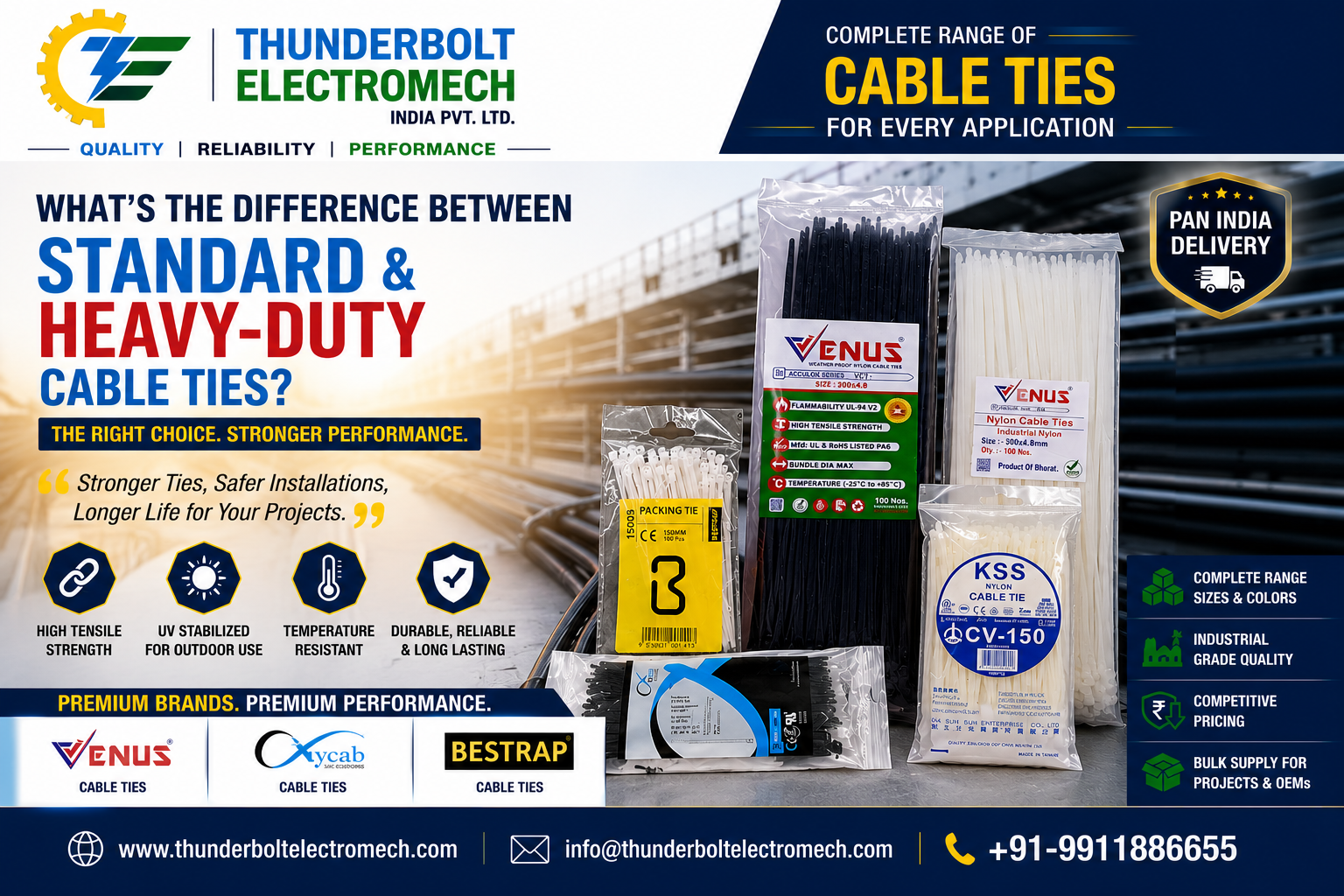
Quick Answer: Choosing between standard and heavy-duty cable ties depends on the cable weight, environmental conditions, vibration, and service life required. Standard cable ties are ideal for light-duty indoor applications such as electrical panels, PLC wiring, and communication cables. Heavy-duty cable ties are engineered for outdoor installations, solar power plants, cable trays, industrial machinery, heavy electrical cables, and infrastructure projects where higher tensile strength and long-term durability are essential.
If you are working on solar power systems, heavy electrical installations, industrial automation, or infrastructure projects, heavy-duty cable ties are usually the better investment because they offer:
- Higher tensile strength (55 kg to 114 kg+)
- Better UV resistance
- Greater resistance to vibration
- Larger bundle capacity
- Longer outdoor service life
- Better safety for critical cable routing
Thunderbolt Electromech is a leading Cable Ties Supplier India, offering a complete range of Venus Cable Ties while also supplying Tycab, Bestrap, and KSS Cable Ties for industrial, commercial, infrastructure, EPC, and renewable energy projects across India.
Introduction
Cable ties look simple, but engineers know they are among the most important accessories in an electrical installation.
A poor-quality cable tie can snap after a few months, allowing heavy cables to sag or fall. This may increase stress on cable glands, loosen terminations, damage insulation, or even create safety hazards inside electrical panels and industrial plants.
On the other hand, selecting the correct cable tie can improve cable management, increase installation life, reduce maintenance costs, and enhance overall electrical safety.
Many procurement managers ask questions such as:
- Should I buy standard or heavy-duty cable ties?
- Is paying extra for heavy-duty cable ties worth it?
- Can two standard cable ties replace one heavy-duty tie?
- Which cable tie brand offers the best long-term performance?
- Which cable tie is recommended for solar projects?
These are practical questions because cable ties are no longer used only for organizing wires. Today they secure:
- Solar DC cables
- LT & HT power cables
- Instrumentation cables
- Fiber optic cables
- Heavy conduit runs
- Cable trays
- Industrial machinery wiring
- Telecom infrastructure
- Automotive harnesses
- Process plant pipelines
The increasing growth of renewable energy, smart factories, metro rail projects, data centers, and industrial automation has made cable tie selection more technical than ever before.
This guide explains the engineering differences between standard and heavy-duty cable ties, supported by research, real-world examples, customer problems, and practical solutions.
Cable Ties Supplier India: Understanding Standard vs Heavy-Duty Cable Ties
Selecting a cable tie based only on price often results in premature failures. Engineers instead evaluate cable ties using multiple technical parameters, including tensile strength, environmental resistance, material quality, bundle diameter, and installation conditions.
A quality Cable Ties Supplier India should help customers choose products based on application rather than simply offering the cheapest option.
What Are Standard Cable Ties?
Standard cable ties are designed for light to medium-duty applications.
Typical applications include:
- Control panels
- Switchboards
- Instrumentation wiring
- Home electrical wiring
- Office networking
- Data racks
- Indoor automation systems
They are generally manufactured using Nylon 6.6 and are available in natural (white) or black UV-resistant variants.
Typical specifications include:
| Parameter | Standard Cable Tie |
| Width | 2.5 mm – 4.8 mm |
| Tensile Strength | 18–22 kg (40–50 lbs) |
| Bundle Diameter | Small to Medium |
| Typical Use | Indoor installations |
| Installation | Manual |
What Are Heavy-Duty Cable Ties?
Heavy-duty cable ties are engineered for applications where higher mechanical loads and environmental exposure are expected.
Common applications include:
- Solar plants
- Outdoor cable trays
- Industrial machinery
- Process industries
- Oil & gas installations
- Mining equipment
- Infrastructure projects
- Large electrical cables
Heavy-duty cable ties feature:
- Thicker body profile
- Reinforced locking head
- Larger cross-section
- Higher tensile strength
- Better resistance to vibration
Typical specifications include:
| Parameter | Heavy-Duty Cable Tie |
| Width | 7.6–12 mm |
| Tensile Strength | 55–114 kg+ |
| Bundle Diameter | Large |
| Outdoor Performance | Excellent |
| Recommended Tool | Cable tie gun |
Why Choosing the Right Cable Tie Matters
Replacing a failed cable tie in a residential panel is simple.
Replacing hundreds of failed cable ties on a solar farm spread across several acres is expensive.
Improper cable management can lead to:
- Cable sagging
- Increased mechanical stress
- Damaged insulation
- Maintenance shutdowns
- Reduced equipment life
- Higher labor costs
That is why professional engineers always match cable ties with installation conditions.
Cable Ties Supplier India: Engineering Factors That Influence Performance
Professional buyers evaluate cable ties using engineering parameters instead of appearance.
1. Tensile Strength
This determines how much pulling force a cable tie can withstand before failure.
Approximate ratings:
| Cable Tie Width | Tensile Strength |
| 2.5 mm | 8 kg |
| 3.6 mm | 18 kg |
| 4.8 mm | 22 kg |
| 7.6 mm | 55 kg |
| 9 mm | 79 kg |
| 12 mm | 114 kg+ |
Higher tensile strength does not simply mean stronger material. It results from:
- Increased cross-sectional area
- Improved locking design
- Better polymer formulation
- Reinforced head construction
2. Bundle Diameter
Cable tie selection also depends on cable bundle size.
Large XLPE cables require:
- Larger loop diameter
- Higher holding force
- Better resistance against vibration
Using undersized cable ties increases stress concentration near the locking head.
3. Locking Mechanism
The locking pawl is often the first component to fail.
Standard cable ties usually have:
- Single locking tooth
- Smaller contact area
Heavy-duty cable ties generally include:
- Reinforced head
- Multi-point locking
- Better resistance against slipping
This becomes critical in industrial plants where cable movement occurs continuously.
Engineering Comparison Table
| Feature | Standard Cable Tie | Heavy-Duty Cable Tie |
| Tensile Strength | Medium | Very High |
| Cable Weight Capacity | Light | Heavy |
| Outdoor Use | Limited | Excellent |
| UV Resistance | Moderate | High |
| Solar Projects | Suitable for light wiring | Recommended |
| Cable Tray Installation | Limited | Excellent |
| Industrial Machinery | Moderate | Ideal |
| Vibration Resistance | Medium | High |
| Long-Term Reliability | Good | Excellent |
| Service Life | Moderate | Long |
Material Science: Virgin Nylon 6.6 vs UV-Stabilized Nylon
Material quality directly influences cable tie performance.
Many low-cost cable ties use recycled plastic to reduce manufacturing costs.
Although inexpensive, recycled material may contain impurities that reduce strength and flexibility.
Virgin Nylon 6.6
Premium cable ties are manufactured using virgin Nylon 6.6.
Advantages include:
- High mechanical strength
- Excellent flexibility
- Good fatigue resistance
- Better dimensional stability
- Higher impact resistance
Virgin Nylon 6.6 is widely preferred for industrial electrical installations because it maintains consistent mechanical properties.
UV-Stabilized Nylon
Outdoor installations face constant exposure to:
- UV radiation
- Rain
- Dust
- Humidity
- Temperature changes
UV stabilizers are added to black cable ties to reduce polymer degradation caused by sunlight.
This significantly increases service life in:
- Solar plants
- Telecom towers
- Outdoor electrical panels
- Street lighting
- Infrastructure projects
UV-resistant cable ties are generally black because carbon black acts as an effective UV stabilizer.
Why Thin Cable Ties Fail Outdoors
Many users complain that black cable ties crack after six months.
In most cases, the issue is not the color but:
- Low UV stabilizer content
- Recycled raw material
- Thin wall thickness
- Poor manufacturing quality
Heavy-duty UV cable ties have thicker profiles, allowing slower degradation and better load distribution over time.
Tensile Strength Research: Why Heavy-Duty Cable Ties Perform Better
Engineering research shows that cable ties fail through three primary mechanisms:
1. Mechanical Creep
Continuous loading causes nylon to stretch gradually.
Standard cable ties experience creep more quickly under heavy loads.
2. Thermal Cycling
Daily expansion and contraction caused by temperature changes weakens thin cable ties.
Heavy-duty ties contain more material, making them less susceptible to thermal fatigue.
3. Vibration
Motor-driven equipment produces continuous vibration.
Over time this causes:
- Micro movement
- Locking wear
- Material fatigue
Heavy-duty cable ties are designed to resist these conditions far better than standard variants.
Customer Problems & Practical Solutions
Problem 1: Standard Cable Ties Breaking on Solar Plants
Customer
A solar EPC contractor secured DC cable strings using standard 4.8 mm cable ties.
Within one year, several ties became brittle due to prolonged UV exposure, causing cable sagging across the module structure.
Solution
The contractor replaced them with UV-stabilized heavy-duty cable ties featuring a wider profile and higher tensile strength. The upgraded installation significantly improved cable retention and reduced maintenance visits.
Lesson: Outdoor solar installations should prioritize UV-stabilized heavy-duty cable ties for long-term reliability.
Problem 2: Heavy Power Cables Slipping on Cable Trays
Customer
An industrial facility bundled large XLPE power cables using multiple standard cable ties placed side by side.
Under continuous vibration, individual ties loosened, allowing the bundle to shift.
Solution
Instead of increasing the number of standard ties, the maintenance team installed heavy-duty cable ties with higher loop tensile strength. The single reinforced tie distributed the load more effectively and prevented movement.
Lesson: Two standard cable ties do not provide the same performance as one correctly rated heavy-duty cable tie because the load is not shared equally.
Real Use Case #1: Solar Power Plant Installation
A 15 MW solar project required secure routing of DC string cables exposed to direct sunlight, wind, and seasonal temperature changes.
The engineering team selected UV-stabilized heavy-duty cable ties for module-to-combiner box routing. Their higher tensile strength and thicker wall profile minimized cable movement, reduced abrasion against mounting structures, and lowered maintenance requirements.
Result: Improved cable stability, fewer replacements during inspections, and increased confidence in long-term outdoor performance.
Real Use Case #2: Industrial Cable Tray Upgrade
A manufacturing facility experienced repeated cable tie failures on vibrating cable trays carrying heavy motor power cables.
After reviewing the installation, engineers replaced the existing standard ties with heavy-duty variants and introduced proper installation spacing along the tray.
Outcome:
- Better cable support
- Reduced vibration-induced wear
- Improved maintenance safety
- Longer service intervals
- Lower overall replacement costs
Cable Lug Research for Solar & Industrial Projects
While cable ties organize and secure cables, cable lugs ensure dependable electrical termination. Both components work together to create a safe, reliable installation.
In solar and industrial systems, choosing high-quality copper or bimetallic cable lugs is just as important as selecting the right cable tie.
Key engineering considerations include:
- Use tinned copper lugs for superior corrosion resistance in outdoor environments.
- Match lug size precisely to conductor size (for example, 35 sq.mm cable with a 35 sq.mm lug).
- Apply the correct crimping method using calibrated hex or indent dies.
- For aluminium conductors, use bimetallic lugs with anti-oxidant compound to reduce galvanic corrosion.
- Avoid mixing undersized lugs with oversized cable ties; secure cables without placing excessive strain on the termination point.
In solar inverter panels, combiner boxes, MCCs, and industrial switchboards, premium cable lugs combined with properly selected cable ties create installations that are mechanically stable, electrically efficient, and easier to maintain. This integrated approach reduces hot spots, minimizes downtime, and improves the overall reliability of the electrical system.
Cable Ties Supplier India – Brand Comparison, Procurement Guide & Industrial Buying Strategy
Selecting the right cable tie brand is no longer just about price. Engineers and procurement teams now evaluate tensile strength, UV stability, material quality, certifications, temperature resistance, installation speed, and long-term reliability.
As a Cable Ties Supplier India, Thunderbolt Electromech supplies a complete range of:
- Venus Cable Ties
- Tycab Cable Ties
- Bestrap Cable Ties
- KSS Cable Ties
These brands serve different industries including:
- Solar EPC
- Electrical Contractors
- Panel Builders
- Railways
- Telecom
- Manufacturing Plants
- Process Industries
- Infrastructure Projects
- Oil & Gas
- Automotive
Let’s compare them from an engineering perspective.
Venus Cable Ties Guide
Venus has become one of the most preferred cable tie brands among electrical contractors because it balances quality and affordability.
Available Types
- Natural Nylon Cable Ties
- UV Black Cable Ties
- Heavy Duty Cable Ties
- Releasable Cable Ties
- Mountable Cable Ties
- Identification Cable Ties
- Marker Cable Ties
Venus Engineering Advantages
✓ Virgin Nylon 6.6
✓ Smooth insertion
✓ Strong locking pawl
✓ Uniform teeth spacing
✓ Excellent flexibility
✓ Good tensile consistency
✓ Available from 100 mm to 1200 mm
Best Applications
- LT Panels
- MCC Panels
- PLC Cabinets
- Solar Junction Boxes
- Indoor Cable Routing
- Industrial Automation
Venus Cable Tie Comparison Chart
| Feature | Venus Standard | Venus Heavy Duty |
| Width | 2.5–4.8 mm | 7.6–12 mm |
| Tensile Strength | 18–22 kg | 55–114 kg |
| UV Resistance | Optional | Excellent |
| Outdoor Use | Limited | Recommended |
| Solar Projects | Small Arrays | Large Installations |
| Cable Tray | No | Yes |
| Industrial Machinery | Medium | Excellent |
Tycab Cable Ties Guide
Tycab is widely trusted in infrastructure, utilities, and industrial electrical installations.
Its manufacturing quality focuses on consistency.
Engineering Benefits
- High-grade Nylon 6.6
- Better mold precision
- Excellent locking reliability
- Wide operating temperature
- Superior fatigue resistance
Recommended For
- EPC Projects
- Metro Rail
- Airports
- Smart Cities
- Data Centers
- Manufacturing Units
Tycab Cable Tie Comparison Chart
| Feature | Tycab Standard | Tycab Heavy Duty |
| UV Grade | Available | High UV |
| Tensile Strength | Up to 22 kg | Up to 114 kg |
| Temperature Range | -40°C to +85°C | -40°C to +85°C |
| Chemical Resistance | Good | Better |
| Outdoor Life | Good | Excellent |
| Installation Speed | Fast | Moderate |
Bestrap Cable Ties Guide
Bestrap products are increasingly selected by industries looking for economical but dependable fastening solutions.
Major Advantages
- Competitive pricing
- Stable tensile values
- Good flexibility
- Reliable locking
- Large inventory availability
Best Applications
- Warehouses
- Packaging
- Electrical Contractors
- Small Industries
- Building Projects
- HVAC
Bestrap Cable Tie Comparison Chart
| Feature | Standard | Heavy Duty |
| Cost | Low | Medium |
| Strength | Moderate | High |
| UV Grade | Available | Available |
| Indoor | Excellent | Excellent |
| Outdoor | Moderate | Good |
| Flexibility | High | Medium |
KSS Cable Ties Guide
KSS is internationally recognized for precision manufacturing and high-performance cable management products.
Many automation companies specify KSS products where reliability is critical.
Advantages
- Excellent molding quality
- Premium Nylon
- Better dimensional tolerance
- Long service life
- Strong locking mechanism
Best Applications
- Semiconductor Industry
- Control Panels
- Telecom
- Instrumentation
- Automation
- Export Projects
KSS Cable Tie Comparison Chart
| Feature | Standard | Heavy Duty |
| Precision | Excellent | Excellent |
| UV Resistance | Excellent | Excellent |
| Tensile Strength | High | Very High |
| Automation Projects | Excellent | Excellent |
| Outdoor Use | Good | Excellent |
Cable Ties Supplier India – Installation Guide, Procurement Tips & Best Practices
Buying the right cable tie is only half the job. Improper installation can reduce its service life significantly.
Common Installation Mistakes
1. Pulling Too Tight
Many electricians use pliers.
This damages the locking head.
It also crushes cable insulation.
Solution
Use calibrated cable tie guns.
2. Leaving Sharp Ends
Improper cutting leaves razor-sharp edges.
Maintenance engineers frequently suffer hand injuries.
Solution
Always use flush-cut cable tie tools.
3. Using Indoor Cable Ties Outdoors
White cable ties degrade quickly under sunlight.
Solution
Choose UV Black Heavy Duty Cable Ties.
4. Ignoring Bundle Diameter
Small cable ties stretched beyond their limit lose strength.
Always calculate the cable bundle diameter before ordering.
Manual Tightening vs Cable Tie Gun
| Feature | Manual Installation | Cable Tie Gun |
| Speed | Medium | Very Fast |
| Consistency | Poor | Excellent |
| Operator Fatigue | High | Low |
| Cable Damage Risk | High | Low |
| Finish | Uneven | Professional |
| Recommended For | Small Jobs | Industrial Projects |
For projects involving thousands of cable ties, investing in a cable tie gun significantly improves productivity and reduces operator fatigue.
Heavy Duty Nylon vs Stainless Steel Cable Ties
One common procurement question is when to move from heavy-duty nylon ties to stainless steel ties.
| Parameter | Heavy Duty Nylon | Stainless Steel |
| UV Resistance | Excellent | Excellent |
| Temperature | Up to ~85–120°C (grade dependent) | Much Higher |
| Chemical Resistance | Good | Excellent |
| Corrosion | Good | Excellent |
| Cost | Lower | Higher |
| Flexibility | High | Moderate |
| Marine Use | Limited | Excellent |
| Refineries | Limited | Recommended |
| Fire Resistance | Moderate | Excellent |
Upgrade to stainless steel cable ties when:
- Ambient temperatures regularly exceed nylon limits.
- Installations involve chemical immersion.
- Offshore, marine, or coastal corrosion is a concern.
- Severe vibration or mechanical abuse is expected.
Procurement Guide for Engineers & Purchase Managers
Before issuing a purchase order, verify:
- Required tensile strength
- Bundle diameter
- Indoor vs. outdoor application
- UV exposure
- Temperature range
- Chemical exposure
- Fire safety requirements
- Certification needs
- Quantity and packaging
- Delivery schedule
- Availability of installation tools
Choosing solely on price often leads to higher maintenance costs and premature replacements.
Trust Thunderbolt Electromech
Thunderbolt Electromech supplies a complete range of cable ties across India, including Venus, Tycab, Bestrap, and KSS brands.
Why customers choose Thunderbolt Electromech:
- Complete range of cable ties
- Bulk stock availability
- Support for OEMs, EPCs, contractors, and industries
- Technical product guidance
- Competitive pricing
- Fast Pan India delivery
Contact Details
Phone: +91-9911886655
Email: sales@thunderboltelectromech.com
Address: Thunderbolt Electromech, Delhi NCR, India
Frequently Asked Questions (Google, Reddit & Quora Inspired)
1. How much weight can a heavy-duty cable tie hold?
Most heavy-duty nylon cable ties are rated between 55 kg and 114 kg (120–250 lbs) depending on their width, material grade, and manufacturer.
2. Can heavy-duty nylon cable ties replace steel banding?
Not always. For chemical plants, offshore installations, or very high-temperature environments, stainless steel banding remains the preferred solution.
3. What is the main difference between standard and heavy-duty cable ties?
Heavy-duty cable ties are wider, thicker, and feature stronger locking mechanisms, enabling them to secure larger and heavier cable bundles.
4. Why do standard cable ties snap outdoors?
Continuous UV exposure, thermal cycling, and insufficient wall thickness accelerate degradation. UV-stabilized black ties are recommended for outdoor use.
5. Is using two standard cable ties together equivalent to one heavy-duty tie?
No. Two standard ties do not distribute dynamic loads like a single heavy-duty tie and can fail independently under vibration or shock.
6. Do heavy-duty cable ties require special installation tools?
They can be installed manually, but tensioning tools provide consistent force, reduce hand fatigue, and prevent over-tightening.
7. Are heavy-duty cable ties reusable?
Most self-locking heavy-duty nylon ties are designed for single use. Releasable variants are available for applications requiring frequent maintenance.
8. Which cable ties are best for solar power systems?
UV-stabilized heavy-duty nylon cable ties are commonly used for PV string management. Stainless steel ties are preferred in extreme climates or corrosive environments.
9. What causes cable ties to loosen over time?
Improper installation, thermal expansion and contraction, mechanical creep under continuous load, and vibration can all reduce clamping force.
10. How do I choose the correct cable tie length?
Measure the bundle diameter, add enough length to wrap around it comfortably, and allow extra length for secure engagement with the locking head.
11. Are colored cable ties suitable for outdoor use?
Only if they are specifically UV-stabilized. Standard colored nylon ties may fade and become brittle under prolonged sunlight.
12. Can cable ties damage cable insulation?
Yes. Excessive tightening can deform insulation and, over time, contribute to conductor damage. Proper tensioning tools help avoid this.
13. What standards should I look for when buying cable ties?
Look for products made from high-quality Nylon 6.6, appropriate flammability ratings (such as UL94 V-2 where applicable), and compliance with relevant industry specifications.
14. Which industries rely most on heavy-duty cable ties?
Solar energy, power distribution, oil & gas, automotive, telecom, construction, railways, mining, and heavy manufacturing all commonly use heavy-duty cable ties.
15. How should cable ties be stored?
Store them in sealed packaging, away from direct sunlight, excessive heat, and very dry conditions to maintain the nylon’s mechanical properties.
16. Can heavy-duty cable ties be used on vibrating machinery?
Yes, provided they are correctly sized and rated. High-vibration applications may also require periodic inspection.
17. When should I switch to stainless steel cable ties?
When exposure to high temperatures, corrosive chemicals, marine environments, or fire resistance requirements exceeds the capabilities of nylon.
18. Why is Virgin Nylon 6.6 preferred?
Virgin Nylon 6.6 provides more consistent tensile strength, flexibility, and long-term durability than recycled material, making it the preferred choice for critical installations.
19. Are UV-stabilized black cable ties different from standard black ties?
Yes. UV-stabilized grades contain additives designed to resist degradation from prolonged sunlight, extending outdoor service life.
20. What factors influence cable tie lifespan?
Material quality, UV exposure, temperature fluctuations, chemical contact, mechanical loading, vibration, and proper installation all play significant roles.
Conclusion
Choosing between standard and heavy-duty cable ties is not simply a matter of size—it is an engineering decision that affects installation safety, maintenance costs, and long-term reliability. Standard cable ties are ideal for indoor control panels, telecom racks, and light-duty wiring, while heavy-duty variants are designed for demanding environments such as solar PV systems, outdoor cable trays, industrial machinery, and infrastructure projects where higher tensile strength and superior UV resistance are essential.
As a trusted Cable Ties Supplier India, Thunderbolt Electromech offers a comprehensive portfolio from Venus, Tycab, Bestrap, and KSS, ensuring engineers, contractors, industries, and purchase managers can source the right cable tie for every application.
Contact Thunderbolt Electromech
Whether you’re procuring for a single panel or a nationwide EPC project, our technical team can help you select the correct cable tie based on load, environment, and application.
📞 Phone: +91-9911886655
📧 Email: sales@thunderboltelectromech.com
📍 Location: Delhi NCR, India
Get in touch today for expert product recommendations, competitive pricing, and fast Pan India delivery of industrial cable ties.
[…] “what’s the difference between standard and heavy-duty ties” (Thunderbolt’s earlier guide already covers that comparison well), but specifically: how is Nylon Cable Tie Tensile Strength […]
[…] a genuinely separate question from the standard-versus-heavy-duty comparison Thunderbolt has covered elsewhere, and conflating the two leads to a specific, avoidable buying mistake: choosing based on strength […]