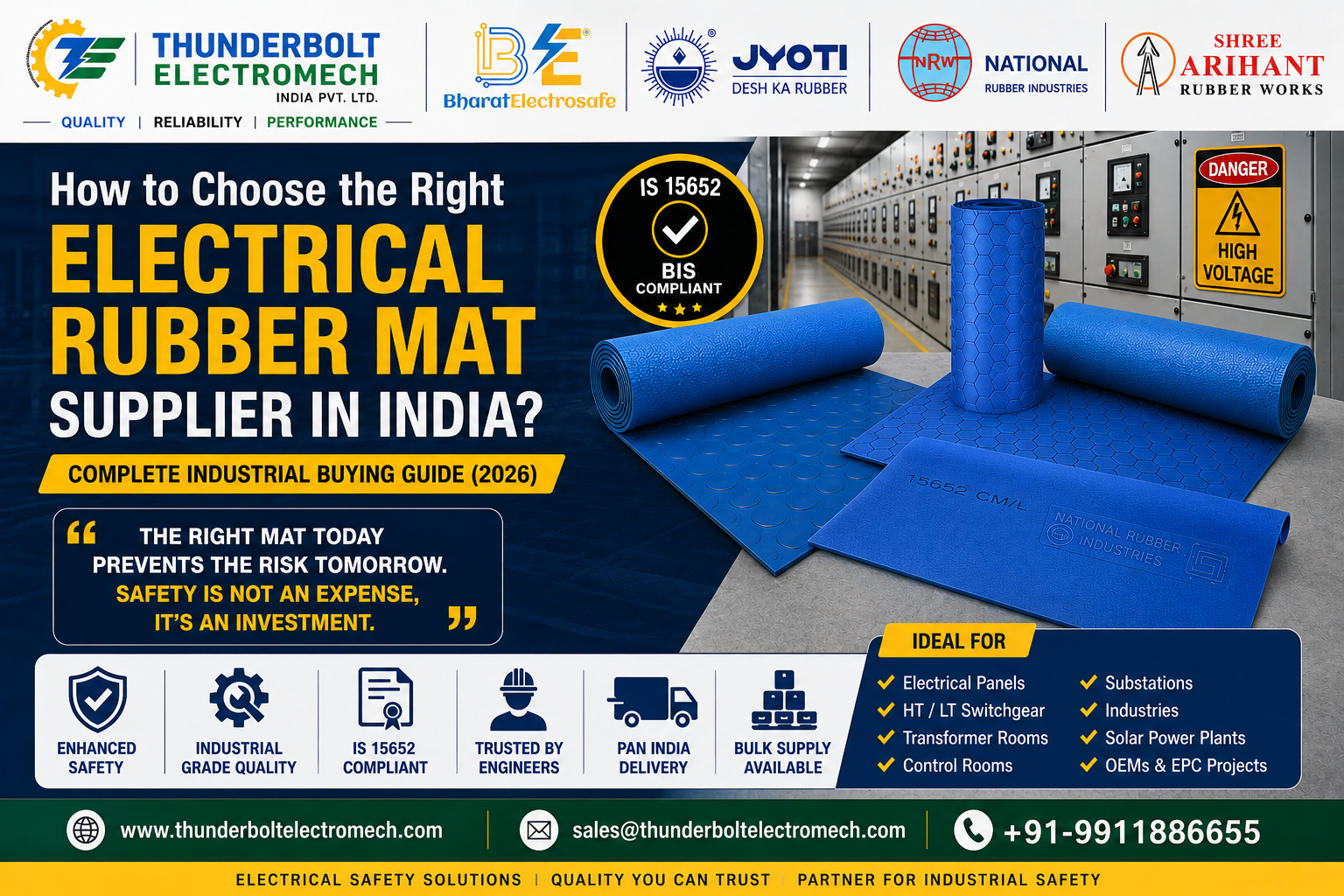
Quick Answer: Choosing the right Electrical Rubber Mat Supplier is one of the most important decisions for electrical safety in any industrial facility. A quality Electrical Safety Rubber Mat helps reduce the risk of electric shock by providing an insulating barrier for personnel working near energized electrical equipment. However, the mat alone is not a complete safety solution—it should always be used alongside proper PPE, lockout/tagout procedures, and safe electrical work practices.
When selecting an Electrical Rubber Mat Supplier India, don’t compare products only by price. Instead, evaluate whether the supplier offers IS 15652-compliant Electrical Insulating Mats, provides product specifications and test documentation where applicable, stocks multiple voltage classes, supports bulk industrial orders, and delivers consistently across India.
If you are searching for an Electrical Rubber Mat Supplier Delhi, Electrical Rubber Mat Dealer Delhi, or Electrical Rubber Mat Delhi NCR, Thunderbolt Electromech supplies a complete range of Bharat Electrical Insulating Mats, Jyoti Electrical Insulating Mats, National Electrical Insulating Mats, and Shree Arihant Electrical Insulating Mats for industrial, commercial, and utility applications.
Introduction
Electrical accidents rarely happen because of one major mistake. Most incidents occur when several small safety failures combine at the wrong time.
A maintenance engineer stands in front of an energized switchboard. The PPE is correct. The tools are insulated. The lockout procedure is followed wherever possible. Yet one important layer of protection is missing—an appropriate Electrical Rubber Mat beneath the technician’s feet.
That single omission can increase risk.
Across factories, substations, hospitals, commercial buildings, solar power plants, and manufacturing facilities, Electrical Insulation Rubber Mats form a critical part of an electrical safety program. They are installed in front of LT panels, HT switchgear, transformer rooms, PCC panels, MCC panels, control rooms, and generator panels to provide an insulating working surface.
Despite their importance, many organizations still purchase insulating mats based only on price.
That approach often leads to problems such as:
- Incorrect voltage selection
- Non-compliant products
- Rapid wear and tear
- Lack of documentation
- Delayed project completion
- Higher replacement costs
- Failed safety inspections
This guide is written specifically for:
- Electrical Engineers
- EPC Contractors
- Consultants
- Industries
- Government Departments
- Utility Companies
- Purchase Managers
- Electrical Contractors
- Solar EPC Companies
- Maintenance Teams
Rather than repeating generic product information, this guide explains how experienced procurement professionals evaluate an Electrical Rubber Mat Supplier, what technical factors influence product performance, and how to avoid costly purchasing mistakes.
Whether you are sourcing a Rubber Mat for Electrical Panel, an HT LT Electrical Rubber Mat, a Transformer Rubber Mat, or a BIS Certified Electrical Rubber Mat, this buying guide will help you make informed decisions.
Electrical Rubber Mat Supplier – Why Choosing the Right Supplier Matters More Than the Lowest Price
Most buyers compare three things:
- Price
- Delivery
- Availability
Experienced engineers compare something entirely different.
They evaluate:
- Compliance
- Material quality
- Electrical performance
- Supplier expertise
- Documentation
- Technical support
- Long-term reliability
That is why selecting the right Electrical Rubber Mat Supplier has a direct impact on workplace safety and maintenance efficiency.
A professional supplier does not simply sell rubber sheets.
They help customers choose the correct insulating mat according to:
- System voltage
- Application
- Working environment
- Safety requirements
- Installation location
- Maintenance practices
Thunderbolt Electromech supplies a complete range of industrial insulating mats from leading brands including:
- Bharat Electrical Insulating Mat
- Jyoti Electrical Insulating Mat
- National Electrical Insulating Mat
- Shree Arihant Electrical Insulating Mat
This allows engineers to select products suitable for various industrial applications instead of relying on a one-size-fits-all solution.
What Makes a Good Electrical Rubber Mat Supplier?
A reliable supplier should provide:
- Multiple voltage grades
- Different roll widths
- Technical product information
- Prompt quotation support
- Bulk project supply
- Pan India delivery
- Industrial application guidance
- Assistance with product selection
Choosing an experienced Electrical Safety Mat Supplier can reduce procurement delays and help ensure that products match project requirements.
Industries That Require Electrical Rubber Mats
Electrical insulating mats are commonly used in:
- Power generation plants
- Transmission substations
- Electrical switchyards
- Transformer rooms
- Manufacturing industries
- Food processing plants
- Chemical industries
- Pharmaceutical plants
- Automobile manufacturing
- Steel plants
- Cement industries
- Metro rail projects
- Airports
- Data centres
- Hospitals
- Commercial buildings
- Solar power plants
- Wind energy projects
Electrical Rubber Mat Supplier – Complete Product Selection Guide
One of the most common mistakes buyers make is assuming that every insulating mat offers the same level of protection.
They don’t.
Selecting the correct Electrical Safety Rubber Mat depends on several technical factors.
Step 1 – Understand Your Electrical System
Before contacting an Electrical Rubber Mat Supplier India, gather the following information:
- Maximum operating voltage
- Installation location
- Indoor or outdoor use
- Type of electrical equipment
- Maintenance frequency
- Environmental conditions
This information helps determine the appropriate insulating mat.
Step 2 – Select the Right Application
Different industrial areas require different types of insulating mats.
| Application | Recommended Product |
| LT Panel | Electrical Rubber Mat |
| HT Panel | HT LT Electrical Rubber Mat |
| PCC Panel | Electrical Safety Rubber Mat |
| MCC Panel | Electrical Insulation Rubber Mat |
| Transformer Room | Transformer Rubber Mat |
| Switchboard | Switchboard Rubber Mat |
| DG Control Panel | Industrial Electrical Rubber Mat |
| Solar Inverter Room | Anti-Skid Electrical Rubber Mat |
Step 3 – Choose the Correct Brand
Thunderbolt Electromech supplies multiple trusted brands.
Bharat Electrical Insulating Mat
Suitable for:
- Industrial panels
- Electrical rooms
- Commercial buildings
- Manufacturing plants
Jyoti Electrical Insulating Mat
Preferred for:
- Utility projects
- Electrical contractors
- Switchgear installations
- Industrial maintenance
National Electrical Insulating Mat
Commonly used in:
- Factories
- Process industries
- Electrical panel manufacturing
- Government projects
Shree Arihant Electrical Insulating Mat
Suitable for:
- OEM installations
- Heavy industries
- Engineering projects
- Infrastructure developments
Selecting a reputable brand with appropriate specifications helps support long-term performance.
Voltage Class Guide
The next important decision is selecting the appropriate voltage class.
Many procurement teams simply ask for an “electrical rubber mat.”
That isn’t sufficient.
Voltage selection should be based on the electrical system where the mat will be installed.
Typical Applications
| Installation | Recommended Category |
| Distribution Panel | Electrical Rubber Mat |
| LT Switchboard | Electrical Safety Rubber Mat |
| MCC | Industrial Electrical Rubber Mat |
| Transformer Room | HT LT Electrical Rubber Mat |
| Utility Substation | High-voltage insulating mat |
Always verify the product specifications with the supplier to ensure suitability for your application.
Thickness Selection Guide
Another question frequently asked by engineers is:
Which thickness should I buy?
The answer depends on several factors:
- Voltage requirements
- Mechanical wear
- Maintenance frequency
- Installation environment
- Equipment location
- Traffic intensity
Instead of choosing the lowest-cost option, evaluate the overall operating conditions.
Thickness Selection Factors
| Condition | Selection Consideration |
| Indoor panel room | Standard industrial grade |
| Outdoor switchyard | Enhanced weather resistance |
| Transformer area | Heavy-duty construction |
| Chemical plant | Oil-resistant material |
| High foot traffic | Durable anti-skid surface |
IS 15652 vs IS 5424 – Understanding the Standards
Many engineers still ask:
What is the difference between IS 5424 and IS 15652?
This question appears regularly in procurement discussions.
IS 5424
IS 5424 was the earlier Indian Standard covering insulating mats. It was widely referenced for many years in electrical installations.
IS 15652
IS 15652 is the current Indian Standard for insulating mats used around electrical equipment. It specifies performance requirements such as dielectric properties, physical characteristics, workmanship, and testing criteria.
For new industrial projects, procurement teams generally specify IS 15652-compliant products.
Comparison Table
| Parameter | IS 5424 | IS 15652 |
| Status | Earlier standard | Current standard |
| Typical Use | Older installations | New industrial projects |
| Performance Requirements | Earlier specifications | Updated requirements |
| Procurement Preference | Legacy applications | Modern projects |
When working with an IS 15652 Rubber Mat Supplier, request documentation demonstrating compliance with the applicable standard.
Customer Problems & Practical Solutions
| Customer Problem | Practical Solution |
| Wrong voltage class ordered | Confirm system voltage before purchasing |
| Mats wear out quickly | Select products suitable for the installation environment |
| No documentation available | Purchase from suppliers who provide technical information |
| Delayed delivery | Work with suppliers maintaining ready stock |
| Slippery working area | Choose anti-skid insulating mats where appropriate |
| Uncertainty about standards | Verify whether the supplied product conforms to IS 15652 |
Engineering Research – Why Electrical Rubber Mats Matter
An electrical insulating mat is not designed to replace protective equipment or safe work procedures. Instead, it acts as an additional insulating layer that can reduce risk when personnel are working near energized equipment.
Material quality plays a significant role in long-term performance. Industrial environments expose mats to mechanical abrasion, oil, cleaning chemicals, temperature changes, and continuous foot traffic. Higher-quality compounds are generally better able to retain their physical and insulating properties under these demanding conditions.
From a lifecycle perspective, choosing a durable product can reduce replacement frequency and maintenance costs, making it a more economical choice over time than purchasing lower-cost alternatives that require more frequent replacement.
Engineering Comparison Table
| Feature | Premium Industrial Mat | Low-Quality Mat |
| Material Consistency | High | Variable |
| Surface Finish | Uniform | Uneven |
| Anti-Skid Performance | Better | Basic |
| Abrasion Resistance | Higher | Lower |
| Oil Resistance | Better | Limited |
| Documentation | Typically Available | Often Limited |
| Bulk Supply | Yes | May Be Limited |
| Industrial Support | Technical Guidance | Product Only |
Electrical Rubber Mat Supplier – How to Evaluate a Reliable Supplier Before You Buy
Purchasing an Electrical Rubber Mat is not simply about comparing prices or selecting the first supplier you find online. For engineers, EPC contractors, purchase managers, and maintenance teams, the supplier plays an important role in ensuring the product matches the application, complies with applicable standards, and arrives on schedule.
A dependable Electrical Rubber Mat Supplier should understand industrial safety requirements and assist customers in selecting suitable insulating mats for LT panels, HT switchgear, transformer rooms, control panels, substations, data centers, solar plants, and manufacturing facilities.
If you are searching for an Electrical Rubber Mat Supplier India, Electrical Rubber Mat Supplier Delhi, Electrical Rubber Mat Dealer Delhi, or Electrical Rubber Mat Delhi NCR, evaluate the supplier on technical capability rather than price alone.
Thunderbolt Electromech supplies a complete range of:
- Bharat Electrical Insulating Mat
- Jyoti Electrical Insulating Mat
- National Electrical Insulating Mat
- Shree Arihant Electrical Insulating Mat
This wide product portfolio enables customers to select insulating mats suited to different industrial applications and project requirements.
Bharat vs Jyoti vs National vs Shree Arihant Electrical Insulating Mats
Each manufacturer offers products designed for industrial electrical safety. The right choice depends on project specifications, operating environment, and procurement requirements rather than brand name alone.
Comparison Table
| Feature | Bharat | Jyoti | National | Shree Arihant |
| Industrial Applications | Excellent | Excellent | Excellent | Excellent |
| Electrical Panels | ✔ | ✔ | ✔ | ✔ |
| Transformer Rooms | ✔ | ✔ | ✔ | ✔ |
| HT/LT Installations | ✔ | ✔ | ✔ | ✔ |
| Factory Use | ✔ | ✔ | ✔ | ✔ |
| Commercial Buildings | ✔ | ✔ | ✔ | ✔ |
| Available in Multiple Sizes | ✔ | ✔ | ✔ | ✔ |
| Suitable for Bulk Projects | ✔ | ✔ | ✔ | ✔ |
| Industrial Procurement | ✔ | ✔ | ✔ | ✔ |
Which Brand Should You Choose?
Bharat Electrical Insulating Mat
A preferred option for manufacturing plants, commercial facilities, utilities, and infrastructure projects requiring dependable insulating solutions.
Jyoti Electrical Insulating Mat
Suitable for EPC contractors, electrical panel builders, industrial maintenance teams, and power distribution projects.
National Electrical Insulating Mat
Commonly selected for factories, government tenders, OEM installations, and electrical contractors handling medium to large-scale projects.
Shree Arihant Electrical Insulating Mat
Frequently used in heavy engineering, industrial automation, switchgear manufacturing, and infrastructure developments where durable insulating mats are required.
Instead of asking, “Which brand is the best?”, ask:
- Which voltage class matches my installation?
- Which dimensions fit the panel area?
- Does the product meet the required specifications?
- Can the supplier support future requirements and repeat orders?
Electrical Rubber Mat Supplier – BIS Certification & Test Certificate Guide
One of the first questions procurement teams ask is:
“Is BIS certification mandatory?”
The answer depends on the product category and applicable regulations. For insulating mats, buyers should verify whether the supplied product complies with the relevant Indian Standard specified for the project and request supporting documentation where applicable.
Why Compliance Matters
Industrial projects often undergo:
- Safety audits
- Third-party inspections
- Consultant approvals
- Client acceptance checks
- Internal maintenance reviews
During these processes, documentation becomes as important as the product itself.
A professional Electrical Safety Mat Supplier should be able to provide product specifications and relevant compliance information.
What Should You Ask Before Purchasing?
Before placing an order, request the following information:
✔ Product specification sheet
✔ Applicable standard reference
✔ Voltage class details
✔ Thickness information
✔ Roll width and length
✔ Surface finish details
✔ Product identification
✔ Batch information (where available)
These details help procurement teams verify that the supplied product matches project requirements.
Understanding a Test Certificate
A product test certificate generally provides technical information relating to product characteristics and performance as specified by the manufacturer or testing laboratory.
Depending on the product and supplier, it may include:
- Product description
- Material identification
- Dimensions
- Electrical properties
- Physical characteristics
- Applicable standard references
- Test observations
Always review the documentation supplied with the product and confirm it aligns with your project’s technical specifications.
Customer Questions About Certification
Is BIS certification mandatory?
Many government and industrial projects specify compliance with applicable Indian Standards. Confirm the project requirements before procurement.
How can I verify an ISI-marked mat?
Review the product markings, packaging, documentation, and information provided by the supplier.
Should I ask for a test certificate?
Yes. Technical documentation helps procurement teams, consultants, and auditors verify product specifications and maintain project records.
Indoor vs Outdoor Applications
Another common procurement mistake is assuming the same insulating mat can be used in every environment.
Installation conditions vary significantly.
Indoor Applications
Indoor installations include:
- MCC Panels
- PCC Panels
- PLC Rooms
- Electrical Control Rooms
- Switchboards
- Data Centers
- UPS Rooms
- Industrial Automation Panels
These environments generally have lower exposure to weather but may experience dust, oil, and continuous foot traffic.
Outdoor Applications
Outdoor installations include:
- Transformer yards
- Solar plants
- Outdoor switchgear
- Utility substations
- Pumping stations
- Renewable energy installations
Outdoor applications may expose insulating mats to:
- Rain
- UV radiation
- Temperature fluctuations
- Dust
- Moisture
- Oil contamination
Selecting a product suitable for the intended environment helps improve service life and maintain performance.
Indoor vs Outdoor Comparison
| Parameter | Indoor | Outdoor |
| UV Exposure | Low | High |
| Rain | No | Yes |
| Dust | Medium | High |
| Temperature Variation | Moderate | Significant |
| Foot Traffic | Medium | High |
| Maintenance Frequency | Lower | Higher |
Installation Guide
Proper installation is essential for effective use of insulating mats.
Before Installation
✔ Clean the floor surface.
✔ Remove oil, grease, water, and debris.
✔ Inspect the mat for visible damage.
✔ Verify the correct dimensions.
✔ Confirm placement based on equipment layout.
Recommended Installation Areas
- Electrical Panels
- LT Panels
- HT Switchgear
- Transformer Rooms
- DG Control Panels
- Switchboards
- Motor Control Centers
- PCC Panels
- MCC Panels
- Substations
- Solar Inverter Rooms
- Battery Rooms
Common Installation Mistakes
| Mistake | Potential Impact |
| Installing on uneven floors | Reduced stability |
| Using undersized mats | Incomplete coverage |
| Folding or sharply bending mats | Premature wear |
| Ignoring damaged sections | Reduced serviceability |
| Installing without cleaning the surface | Poor placement and faster deterioration |
Maintenance & Inspection Schedule
Even high-quality Electrical Insulation Rubber Mats require regular inspection and maintenance.
Routine checks help identify wear before it becomes a larger issue.
Suggested Inspection Schedule
| Activity | Recommended Frequency |
| Visual inspection | Before use and periodically thereafter |
| Surface cleaning | As needed based on site conditions |
| Check for cuts, cracks, or abrasion | Monthly |
| Verify placement | Monthly |
| Review maintenance records | Quarterly |
| Replace damaged mats | Immediately upon detection |
The appropriate inspection frequency should be based on the operating environment, traffic levels, and the organization’s maintenance procedures.
Engineering Comparison Tables
Selection Guide by Application
| Application | Recommended Product |
| LT Panel | Electrical Safety Rubber Mat |
| HT Panel | HT LT Electrical Rubber Mat |
| Transformer | Transformer Rubber Mat |
| Switchboard | Switchboard Rubber Mat |
| Solar Plant | Anti-Skid Electrical Rubber Mat |
| Data Center | Electrical Insulating Mat |
| Factory | Industrial Electrical Rubber Mat |
| Control Room | Rubber Mat for Electrical Panel |
Procurement Checklist
| Requirement | Check |
| Correct Voltage Class | ✔ |
| Appropriate Dimensions | ✔ |
| Suitable Thickness | ✔ |
| Applicable Standard Compliance | ✔ |
| Technical Documentation | ✔ |
| Reliable Supplier | ✔ |
| Delivery Schedule | ✔ |
| Bulk Supply Capability | ✔ |
Real Industrial Use Case #1 – Improving Safety During a Factory Expansion
A manufacturing company in North India expanded its production facility and installed new MCCs, PCCs, and transformer panels. During procurement, the purchase team received quotations from several vendors, including lower-priced options that offered minimal technical documentation.
After consulting the engineering department, the company selected a supplier capable of providing products aligned with IS 15652, along with product specifications and support for selecting the appropriate insulating mats for each installation area.
The mats were installed in front of electrical panels, transformer control sections, and maintenance workstations. During subsequent internal safety audits, the documented product information simplified verification and reduced procurement-related queries.
The project demonstrated that choosing the right Electrical Rubber Mat Supplier contributes not only to safer working conditions but also to smoother project execution and easier compliance management.
Real Industrial Use Case #2 – Modernizing a Commercial Data Center
A data center operator planned to upgrade multiple electrical distribution rooms. The engineering team needed insulating mats for UPS panels, switchboards, and backup power systems while ensuring consistent product quality across all locations.
Instead of sourcing different products from multiple vendors, the procurement department partnered with a supplier capable of providing multiple approved brands, technical guidance, and coordinated deliveries.
By selecting the correct insulating mats for each application, the project team simplified procurement, maintained consistent specifications across facilities, and reduced the risk of installation delays caused by mismatched products.
Real Industrial Use Case #3 – Electrical Safety Upgrade at a Solar Manufacturing Facility
A solar equipment manufacturer expanded its production line with additional transformer rooms, control panels, and testing stations. During the initial site assessment, engineers observed that several older insulating mats showed signs of wear after years of heavy use.
The maintenance team replaced them with appropriately specified Electrical Insulating Mats sourced through Thunderbolt Electromech. The procurement team selected products from the available Bharat, Jyoti, National, and Shree Arihant range based on installation requirements and project timelines.
The standardized procurement approach offered several operational benefits:
- Consistent product specifications across production areas
- Simplified future maintenance and replacement planning
- Better inventory management through standardized sizes
- Timely delivery to avoid project delays
- Improved confidence during internal electrical safety inspections
The project demonstrated that selecting the right Electrical Rubber Mat Supplier is not only about purchasing a product—it is about building a reliable, long-term sourcing strategy that supports electrical safety, operational continuity, and efficient maintenance planning.
Electrical Rubber Mat Supplier – Complete Procurement Guide for Industrial Buyers
Selecting an Electrical Rubber Mat Supplier is no longer just a purchasing activity. For today’s industries, it is part of electrical risk management. Procurement teams are expected to source products that satisfy engineers, safety officers, consultants, auditors, and end users alike. A low-priced insulating mat that fails prematurely can increase downtime, require unexpected replacement, and complicate safety inspections.
If you are searching for an Electrical Rubber Mat Supplier India, Electrical Rubber Mat Supplier Delhi, or Electrical Rubber Mat Dealer Delhi, begin by evaluating the supplier’s technical expertise, stock availability, delivery capability, and documentation rather than focusing only on price.
Thunderbolt Electromech supplies Bharat Electrical Insulating Mats, Jyoti Electrical Insulating Mats, National Electrical Insulating Mats, and Shree Arihant Electrical Insulating Mats for electrical panels, substations, transformer rooms, industrial plants, commercial buildings, and infrastructure projects across India.
Procurement Guide for Engineers & Purchase Managers
Professional procurement starts long before requesting a quotation.
Step 1: Understand the Application
Ask the engineering team:
- Is the mat for an LT panel or HT switchgear?
- Will it be installed indoors or outdoors?
- Is it for a transformer room?
- Does the area experience heavy foot traffic?
- Is oil or chemical exposure expected?
Different applications require different insulating mat characteristics.
Step 2: Identify the Correct Voltage Class
Never order an insulating mat based solely on dimensions.
Always verify:
- Operating voltage
- Maximum system voltage
- Installation environment
- Safety requirements
- Client specifications
Selecting the wrong voltage class can result in project delays if the supplied product does not meet the project’s engineering requirements.
Step 3: Evaluate the Supplier
A professional Electrical Safety Mat Supplier should provide:
✔ Multiple brands
✔ Different roll widths
✔ Industrial stock availability
✔ Technical guidance
✔ Product specifications
✔ Timely delivery
✔ Bulk order capability
✔ Pan India logistics support
Step 4: Compare Total Value
Do not compare suppliers only by price.
Instead compare:
- Product quality
- Availability
- Technical assistance
- Delivery time
- Project support
- Repeat supply capability
- Industrial reputation
The lowest quotation is not always the lowest lifecycle cost.
Industrial Buying Checklist
Before issuing a Purchase Order, verify the following:
| Checklist Item | Verified |
| Voltage class confirmed | ✔ |
| Installation area identified | ✔ |
| Indoor/Outdoor application verified | ✔ |
| Required dimensions confirmed | ✔ |
| Thickness selected | ✔ |
| Applicable standard specified | ✔ |
| Product documentation requested | ✔ |
| Delivery timeline confirmed | ✔ |
| Quantity finalized | ✔ |
| Future repeat orders considered | ✔ |
Following a structured checklist reduces procurement errors and improves coordination between engineering and purchasing teams.
Industrial Case Study #1 – Automotive Manufacturing Plant
An automotive component manufacturer planned to expand its electrical control room by installing twelve new Motor Control Centers (MCCs) and two Power Control Centers (PCCs).
Initially, procurement requested quotations based only on price.
The engineering department intervened and requested a technical evaluation.
The team compared suppliers based on:
- Available voltage classes
- Industrial experience
- Technical documentation
- Delivery schedule
- Product consistency
After evaluation, they selected a supplier capable of supporting future expansion projects rather than simply supplying one shipment.
Results
- Standardized insulating mats throughout the facility
- Simplified maintenance planning
- Easier procurement for future projects
- Better coordination between engineering and purchasing
The project demonstrated that procurement decisions affect long-term operational efficiency.
Industrial Case Study #2 – Metro Rail Electrical Substation
A metro rail contractor needed insulating mats for multiple substations across different project locations.
The challenge was maintaining consistency while meeting tight construction deadlines.
Instead of purchasing locally for each site, the procurement team centralized sourcing through one supplier.
Benefits included:
- Uniform specifications
- Simplified logistics
- Better inventory planning
- Reduced purchasing effort
- Easier replacement management
The contractor completed installations without material shortages or inconsistent product specifications.
LT vs HT Rubber Mats
One of the most frequently asked questions is:
Can the same electrical rubber mat be used for both LT and HT installations?
The answer depends on the installation’s voltage class and project requirements.
LT Rubber Mats
Typical applications:
- Distribution panels
- MCC panels
- PCC panels
- Control panels
- Electrical rooms
- Switchboards
HT Rubber Mats
Commonly installed in:
- HT switchgear
- Transformer rooms
- Utility substations
- Power generation facilities
- Industrial switchyards
HT installations typically require insulating mats selected according to higher electrical performance requirements and the project’s technical specifications.
LT vs HT Comparison Table
| Feature | LT Rubber Mat | HT Rubber Mat |
| Typical Application | LT Panels | HT Panels |
| Distribution Boards | ✔ | — |
| Transformer Rooms | Limited | ✔ |
| Utility Substations | — | ✔ |
| Heavy Industrial Use | ✔ | ✔ |
| Electrical Infrastructure | Moderate | Extensive |
Thickness Comparison Guide
Another common buying question is:
Which thickness is best?
There is no universal answer.
Thickness should be selected based on:
- Voltage class
- Mechanical wear
- Foot traffic
- Equipment type
- Working conditions
- Engineering specifications
Thickness Selection Table
| Installation | Recommended Selection Criteria |
| Control Panels | Standard industrial grade |
| Electrical Rooms | Standard insulating mat |
| Transformer Rooms | Heavy-duty insulating mat |
| Outdoor Installations | Weather-resistant construction |
| Industrial Plants | Durable anti-skid profile |
Choosing a mat solely because it is thicker does not automatically make it the right choice. The product must also be appropriate for the electrical and environmental conditions.
Anti-Skid Surface Guide
Slip resistance is an important consideration, particularly in areas where personnel work frequently around energized equipment.
An Anti-Skid Electrical Rubber Mat provides improved footing compared with a smooth surface, especially in environments where dust, moisture, or light oil contamination may occur.
Advantages of Anti-Skid Surfaces
- Better grip for maintenance staff
- Reduced slip risk
- Improved operator confidence
- Suitable for high-traffic electrical rooms
- Enhanced durability in industrial environments
Common installation areas include:
- Electrical panel rooms
- Transformer rooms
- DG control rooms
- Industrial workshops
- Manufacturing plants
- Utility substations
Electrical Panel Applications
Electrical panels are among the most common locations where insulating mats are installed.
Typical Panel Types
- PCC Panels
- MCC Panels
- LT Distribution Panels
- HT Switchgear
- PLC Panels
- Synchronization Panels
- Capacitor Panels
- Generator Control Panels
- VFD Panels
- UPS Panels
Using Rubber Mats for Electrical Panels provides an additional insulating surface for personnel working in front of electrical equipment and supports safer maintenance practices when combined with proper procedures.
Transformer Applications
Transformer rooms present demanding operating conditions due to:
- Higher electrical loads
- Continuous operation
- Heat generation
- Maintenance activities
- Limited working space
For these environments, engineers often specify Transformer Rubber Mats designed for industrial applications and selected according to project requirements.
Recommended Installation Areas
- In front of transformer control panels
- Around HT switchgear
- Control rooms
- Metering sections
- Relay protection panels
- Incoming and outgoing feeder panels
Research-Backed Engineering Insights
Modern electrical safety follows the principle of layered protection. Insulating mats are one layer in a broader safety strategy that also includes:
- Lockout/Tagout (LOTO)
- Personal Protective Equipment (PPE)
- Insulated tools
- Arc-flash assessments
- Regular equipment maintenance
- Operator training
Engineering studies consistently emphasize that relying on a single protective measure is insufficient. Combining multiple safety controls significantly improves workplace protection.
From a maintenance perspective, high-quality insulating mats also contribute to:
- Better housekeeping in electrical rooms
- Clearly defined operator standing areas
- Reduced surface wear around frequently accessed panels
- Consistent safety practices across facilities
Cost vs Lifecycle Analysis
Many buyers focus only on the purchase price.
Experienced engineers evaluate the total lifecycle cost.
Comparison Table
| Factor | Low-Cost Mat | Quality Industrial Mat |
| Initial Cost | Lower | Higher |
| Service Life | Shorter | Longer |
| Replacement Frequency | More Frequent | Less Frequent |
| Downtime During Replacement | Higher | Lower |
| Long-Term Value | Lower | Higher |
| Procurement Effort | Repeated Purchases | Fewer Repeat Orders |
A product with a slightly higher upfront cost may provide better value over its service life by reducing replacement frequency and maintenance effort.
Common Procurement Mistakes
Many purchasing problems arise from avoidable mistakes.
Mistake 1: Buying Only on Price
Lowest cost rarely equals best long-term value.
Mistake 2: Ignoring Application Requirements
Not every insulating mat is suitable for every environment.
Mistake 3: Selecting Incorrect Dimensions
Improper sizing can leave working areas insufficiently covered.
Mistake 4: Overlooking Technical Documentation
Always request product specifications and relevant compliance information.
Mistake 5: Choosing an Inexperienced Supplier
A knowledgeable supplier helps prevent specification errors, delivery delays, and unsuitable product selection.
Mistake 6: Not Planning for Future Expansion
Industrial facilities often expand. Selecting a supplier with reliable stock and repeat supply capability simplifies future procurement.
Engineering Comparison Tables
Supplier Evaluation Matrix
| Evaluation Parameter | Reliable Supplier | Average Supplier |
| Technical Product Knowledge | Excellent | Limited |
| Multiple Brand Availability | ✔ | May be Limited |
| Industrial Project Support | ✔ | Basic |
| Bulk Supply Capability | ✔ | Limited |
| Pan India Delivery | ✔ | Depends on Region |
| Technical Documentation | Available | May Vary |
| After-Sales Assistance | Good | Limited |
Application Selection Guide
| Industrial Area | Recommended Mat Type |
| Electrical Control Room | Electrical Insulating Mat |
| MCC & PCC Panels | Electrical Safety Rubber Mat |
| Transformer Yard | Transformer Rubber Mat |
| HT Switchgear | HT Electrical Rubber Mat |
| Data Center | Anti-Skid Electrical Rubber Mat |
| Manufacturing Plant | Industrial Electrical Rubber Mat |
By following a structured procurement process, comparing suppliers on technical merit, and selecting the appropriate insulating mat for each application, engineers and purchase managers can improve safety, streamline maintenance, and achieve better long-term value for industrial electrical installations.
Why Engineers Across India Trust Thunderbolt Electromech
When selecting an Electrical Rubber Mat Supplier, buyers should evaluate more than price. Reliable suppliers provide certified products, technical guidance, dependable stock, and timely delivery. Thunderbolt Electromech supports electrical contractors, EPC companies, industries, OEMs, consultants, and government organizations with industrial electrical safety products across India.
Why Thunderbolt Electromech?
✔ Complete range of Electrical Rubber Mats for LT and HT applications
✔ Available brands:
- Bharat Electrical Insulating Mat
- Jyoti Electrical Insulating Mat
- National Electrical Insulating Mat
- Shree Arihant Electrical Insulating Mat
✔ Available for:
- Electrical Panels
- PCC Panels
- MCC Panels
- Transformer Rooms
- HT Switchgear
- Control Rooms
- Substations
- Industrial Plants
- Power Projects
✔ Delhi-based supplier with Pan India delivery
✔ Bulk supply for industrial and government projects
✔ Support for EPC contractors, electrical consultants, OEMs, maintenance contractors, and procurement teams
✔ Competitive pricing for wholesale orders
✔ Fast dispatch for urgent project requirements
✔ Technical support before purchase
✔ Industrial-grade electrical safety products
Why Choose Thunderbolt Electromech as Your Electrical Rubber Mat Supplier?
Thousands of industrial buyers search for an Electrical Rubber Mat Supplier India every month. However, only a few suppliers understand the technical requirements of industrial electrical safety.
Thunderbolt Electromech focuses on supplying products that meet the practical needs of engineers, contractors, industries, and purchase managers.
1. Complete Brand Portfolio
Unlike suppliers limited to a single manufacturer, Thunderbolt offers multiple trusted brands to suit different project specifications and budgets.
Available Brands:
- Bharat Electrical Insulating Mat
- Jyoti Electrical Insulating Mat
- National Electrical Insulating Mat
- Shree Arihant Electrical Insulating Mat
This allows customers to compare products and select the most appropriate solution for their application.
2. Technical Product Guidance
Many buyers know they need an insulating mat but are unsure about:
- Voltage class
- Thickness
- Roll size
- Standard
- Application
Thunderbolt’s technical team helps customers identify the right product before ordering, reducing specification errors.
3. Bulk Supply Capability
Thunderbolt regularly supplies materials for:
- Manufacturing industries
- Solar projects
- Metro rail projects
- Data centers
- Commercial buildings
- Hospitals
- Airports
- Power plants
- Infrastructure projects
- Government tenders
Bulk orders receive coordinated logistics support to help meet project timelines.
4. Pan India Delivery
Whether your project is in:
- Delhi
- Noida
- Gurgaon
- Faridabad
- Ghaziabad
- Jaipur
- Lucknow
- Mumbai
- Pune
- Ahmedabad
- Hyderabad
- Bengaluru
- Chennai
- Kolkata
Thunderbolt Electromech can arrange delivery across India.
5. Competitive Industrial Pricing
Procurement teams appreciate transparent pricing, especially for repeat and bulk purchases. Thunderbolt aims to provide competitive rates while maintaining consistent product quality and availability.
6. One-Stop Source for Electrical Safety Products
In addition to electrical insulating mats, Thunderbolt Electromech also supplies:
- Cable Glands
- Cable Lugs
- Cable Ties
- Heat Shrink Sleeves
- Danger Plates
- Lockout Boxes
- Silica Gel Breathers
- Soldering Materials
- Electrical Safety Accessories
This helps buyers consolidate sourcing through a single supplier.
Bharat vs Jyoti vs National vs Shree Arihant – Brand Overview
Choosing the right brand depends on the application’s voltage class, installation environment, durability requirements, and project specifications.
Bharat Electrical Insulating Mat
Suitable for:
- Industrial electrical panels
- Manufacturing facilities
- Power distribution rooms
- Commercial buildings
- Utility applications
Advantages
- Reliable insulation performance
- Durable construction
- Suitable for routine industrial use
- Available in multiple dimensions
- Widely used across industries
Jyoti Electrical Insulating Mat
Recommended for:
- Electrical contractors
- Industrial maintenance
- OEM panel builders
- Commercial installations
Advantages
- Good wear resistance
- Flexible handling during installation
- Consistent quality
- Suitable for medium to heavy-duty applications
National Electrical Insulating Mat
National insulating mats are commonly selected for projects requiring dependable performance in demanding electrical environments.
Common Applications
- Transformer rooms
- Power control centers
- Switchgear rooms
- Utility substations
- Industrial plants
Advantages
- Industrial-grade performance
- Long service life
- Suitable for continuous operation
- Available for a range of electrical installations
Shree Arihant Electrical Insulating Mat
Shree Arihant products are used in a variety of industrial environments where durability and reliability are important.
Suitable Applications
- Control panels
- Industrial automation
- Electrical maintenance areas
- Manufacturing facilities
- Commercial electrical rooms
Advantages
- Consistent surface finish
- Good mechanical durability
- Suitable for daily industrial use
- Easy installation and maintenance
Brand Comparison Table
| Feature | Bharat | Jyoti | National | Shree Arihant |
| Industrial Applications | ✔ | ✔ | ✔ | ✔ |
| Electrical Panels | ✔ | ✔ | ✔ | ✔ |
| Transformer Rooms | ✔ | ✔ | ✔ | ✔ |
| Commercial Buildings | ✔ | ✔ | ✔ | ✔ |
| Manufacturing Plants | ✔ | ✔ | ✔ | ✔ |
| Industrial Safety | Excellent | Excellent | Excellent | Excellent |
| Bulk Availability | ✔ | ✔ | ✔ | ✔ |
Trust Through Technical Support
Beyond supplying products, Thunderbolt Electromech assists customers with:
- Product selection
- Brand comparison
- Bulk quotations
- Delivery planning
- Industrial procurement support
- Repeat order management
This consultative approach helps reduce purchasing errors and supports long-term project success.
Frequently Asked Questions
1. Which Electrical Rubber Mat Supplier is best in India?
Choose a supplier that offers multiple brands, technical guidance, industrial stock, reliable delivery, and support for bulk orders rather than selecting solely on price.
2. Is BIS certification mandatory for Electrical Rubber Mats?
Many industrial projects specify compliance with applicable Indian standards. Always review your project requirements and request supporting documentation from the supplier where required.
3. What is IS 15652?
IS 15652 is the Indian Standard that specifies requirements for electrical insulating mats used to improve safety in electrical installations.
4. What is the difference between IS 5424 and IS 15652?
IS 5424 is an older standard that has been superseded. Modern projects generally reference IS 15652 for insulating mats.
5. Which voltage class should I select?
The correct voltage class depends on the system voltage and the installation environment. Consult the equipment specifications and your electrical engineer before purchase.
6. Can one rubber mat be used for all voltages?
No. The insulating mat should be selected according to the intended electrical application and relevant project specifications.
7. How often should electrical rubber mats be inspected?
Regular visual inspections are recommended, along with testing and replacement intervals based on site conditions, usage, and the manufacturer’s guidance.
8. Can electrical rubber mats be used outdoors?
Some installations may require mats with properties suitable for outdoor exposure. Consider environmental factors such as sunlight, moisture, oil, and chemicals when selecting a product.
9. Are electrical rubber mats resistant to oil and chemicals?
Resistance varies by product. Confirm the required properties with the supplier before purchase if the installation environment includes oils, chemicals, or other contaminants.
10. Can insulating mats be cut to size?
Many insulating mats can be trimmed to meet installation requirements. Ensure that cutting does not compromise the intended application or safety requirements.
11. Which thickness is best?
There is no universal answer. Thickness should be chosen based on voltage class, application, expected foot traffic, and project specifications.
12. Which colour should I buy?
Colour is generally a secondary consideration. The priority should be selecting a mat that meets the required electrical and mechanical performance for the application.
13. Do you supply custom sizes?
Custom dimensions may be available depending on the product range and order quantity. Contact the supplier to discuss project-specific requirements.
14. Can I get bulk discounts?
Bulk pricing is often available for industrial, OEM, contractor, and project orders.
15. Which industries use Electrical Rubber Mats?
Typical users include:
- Manufacturing
- Power generation
- Solar plants
- Oil & Gas
- Chemical plants
- Data centres
- Railways
- Infrastructure projects
- Commercial buildings
- Hospitals
16. What documents should I request before purchasing?
Request product specifications, applicable compliance documentation, test information (where available), warranty details, and delivery commitments relevant to your project.
17. How quickly can Thunderbolt Electromech deliver?
Delivery timelines depend on stock availability, product type, order quantity, and destination. Standard products are generally dispatched promptly after order confirmation.
18. Why should I buy from a Delhi-based supplier?
A supplier based in Delhi can provide quicker service to customers in Delhi NCR while also supporting projects across India through established logistics networks.
Conclusion
Choosing the right Electrical Rubber Mat Supplier is about more than comparing quotations. Engineers and procurement professionals should evaluate technical knowledge, product range, applicable standards, delivery capability, and long-term support. A reliable supplier helps ensure that insulating mats are appropriate for the installation, reducing procurement risks and supporting workplace safety.
Thunderbolt Electromech supplies a complete range of Bharat, Jyoti, National, and Shree Arihant Electrical Insulating Mats, along with other electrical safety products for industries across India. With pan-India delivery, technical assistance, and support for bulk orders, the company aims to help engineers, contractors, industries, and purchase managers source dependable solutions for electrical panel rooms, substations, transformer installations, and industrial facilities.
Ready to Source Electrical Rubber Mats?
Whether you’re specifying mats for a new project or replacing existing installations, Thunderbolt Electromech can help you:
- Select the appropriate electrical insulating mat
- Compare Bharat, Jyoti, National, and Shree Arihant brands
- Obtain competitive quotations for bulk requirements
- Receive technical guidance before purchase
- Arrange pan-India delivery for industrial projects
Contact Thunderbolt Electromech
- Phone: +91-9911886655
- Website: thunderboltelectromech.com
- Email: sales@thunderboltelectromech.com
- Location: Bhagirath Palace, Delhi
From industrial electrical panels and transformer rooms to large-scale infrastructure projects, Thunderbolt Electromech provides reliable electrical safety products backed by technical support and nationwide supply.