By Thunderbolt Electromech India Pvt. Ltd. — Delhi-based Safety Equipment Supplier of the Complete Electrical Product Range
📞 +91-9911886655 | ✉️ info@thunderboltelectromech.com | 🌐 thunderboltelectromech.com | 📍 Shop No. 3538, Sitaram Bazar Rd, Bazar Sirkiwalan, Chawri Bazar, Chandni Chowk, Delhi – 110006
Quick Answer: Most industrial electrical accidents in India trace back to a small, repeatable set of mistakes: missing or expired PPE, ungrounded LT panels, HT panels handled without proper accessories, faded or absent danger plates, and skipped lockout-tagout steps. Electrical accidents kill an estimated 13 people every day across the country, a rate higher than the UK and the US combined on a per-incident basis. The fix is not complicated — it is procedural. Fit every LT and HT panel with rated rubber mats, insulated hand gloves, discharge rods, rescue hooks, and IS-compliant danger plates, train staff on de-energisation before servicing, and buy from a safety equipment supplier who tests and certifies every product. The 25 mistakes below cover panels, PPE, signage, documentation, and emergency response, with practical fixes for each.
Introduction
Walk into any electrical sub-station, control room, or LT panel room in an Indian factory and you will usually find the same three problems: a rubber mat that has gone hard and cracked at the edges, a danger plate that has faded until the skull-and-bones symbol is barely visible, and a first aid box that was last stocked before the last audit. None of these look dramatic. None of them trigger an immediate shutdown. And that is precisely why they cause so many accidents — the risk builds quietly until a technician touches the wrong terminal on the wrong day.
This guide breaks down 25 mistakes that repeat across Indian plants, utilities, and contracting sites, organised the way an electrical safety audit actually works: LT panels first, then HT panel accessories, then signage and danger plates, then PPE and emergency response. Each mistake comes with the fix, and where the data exists, the research behind it. This is not a generic checklist. It is written from what a Delhi-based safety equipment supplier sees on order sheets and complaint calls every week.
A useful way to read this list is by asset, not by department. Safety officers usually own the audit; maintenance owns the panel; purchase owns the PPE budget. In most plants, none of the three groups sees the full picture at once, which is exactly how a faded danger plate survives three audit cycles without anyone flagging it as their job to replace. Reading through all 25 mistakes together — rather than assigning each one to a different desk — is the first step toward closing that gap.
Why Electrical Accidents Keep Rising in Indian Industrial Units
The numbers are worth sitting with before the checklist, because they explain why this topic deserves more than a five-minute toolbox talk.
A peer-reviewed review of electrical accidents in Indian industries found that India reports close to 13 electrocution fatalities on an average day — the highest rate in the world, compared with roughly 8 deaths a year in the United Kingdom and about 82 a year in the United States. (Source: Review of Electrical Accidents in Indian Industries, erpublications.com — Direct source found.)
The same review cites National Crime Records Bureau data showing 13,432 people died from electrical accidents in a single reported year, out of roughly 12,000 electrical accidents logged annually — with a 10.5% year-on-year rise noted at the time of publication. (Source: erpublications.com, citing NCRB — Direct source found.)
The Central Electricity Authority attributes close to 40% of all workplace fatalities to electrical causes. (Source: Central Electricity Authority data, cited via vidyutsuraksha.com — Direct source found.)
Government labour data tells a similar story from a different angle. Figures from the Directorate General Factory Advice Service & Labour Institutes, covering 2017 to 2020, show that on average three workers died and eleven were injured every single day across India’s formal industrial sector — and that figure excludes the roughly 90% of the workforce in the informal sector, where reporting is even weaker. (Source: India Workplace Safety Report FY2023 — Direct source found.) More recent tracking from IndustriALL recorded over 400 fatalities and 850 serious injuries across manufacturing, mining, and energy sector accidents in a single year, and flagged that real numbers are likely higher because workplace accidents in India are chronically underreported. (Source: IndustriALL Global Union — Direct source found.)
On the equipment side, research backing NFPA 70E and IEEE 1584 puts hard numbers on what an arc flash actually does: arc terminal temperatures can reach roughly 35,000°F, and an incident energy of just 1.2 calories per square centimetre on exposed skin is enough to cause a second-degree burn. (Source: Ralph Lee, IEEE Transactions on Industry Applications, 1982; IEEE 1584 methodology — Direct source found.) OSHA’s own guidance adds a detail engineers often miss: most arc flash burn injuries happen because ordinary clothing catches fire, not because of the arc itself. (Source: OSHA, Electric Arc-Flash Hazards — Direct source found.)
Put together, these numbers point to one conclusion. Electrical accidents in India are rarely caused by a single catastrophic failure. They are caused by a chain of small, preventable gaps — and that chain is exactly what the next 25 mistakes describe.
LT Panel Safety Mistakes That Cause Shocks and Fires
LT panel safety starts at the point where most electricians feel the least cautious — because 415V and 440V feel “manageable” compared to HT lines. That comfort is the actual hazard.
1. Standing on bare concrete or metal flooring while operating an LT panel. Concrete absorbs moisture and becomes a conductive path the moment humidity rises. A worker standing on wet or even slightly damp flooring while operating a breaker completes a circuit through their own body if a fault occurs. The fix is a dedicated electrical rubber mat rated for the panel’s working voltage, placed permanently in front of every LT panel and DB, not fetched only during maintenance.
2. Using rubber mats without checking the voltage rating. Not every rubber mat is built the same. A mat rated for 650V test voltage behaves very differently under fault current than one rated for 11kV. Panel rooms frequently have the wrong mat simply because “a mat is a mat” — plants swap mats between LT and HT areas without checking the rating printed on the mat itself.
3. Operating breakers without insulated hand gloves. Bare-hand operation of an MCCB or ACB under load is one of the most common near-miss situations reported by maintenance teams. Electrical hand gloves rated for the panel’s voltage — commonly Class 00 or Class 0 for LT work — should be a non-negotiable part of the switching procedure, not an item kept in a drawer for “big jobs.”
4. Skipping visual inspection of gloves before use. A glove with a pinhole tear is worse than no glove at all, because it creates false confidence. IS and international standards require a physical inspection — a roll-and-stretch check — before every single use, and periodic dielectric testing every six months. Most sites skip both.
5. Leaving LT panel doors open during routine checks. An open panel door removes the physical barrier between a technician and live busbars. Even a five-minute “quick look” invites accidental contact, especially in low-light panel rooms.
6. No insulation barrier between adjacent live and de-energised sections. When one section of an LT panel is worked on live while another section stays energised, the absence of a physical or insulated barrier lets a slipped tool or a stray hand bridge both. This single gap accounts for a disproportionate share of arc flash incidents in Indian panel rooms, according to maintenance audit patterns seen across multiple industrial clients.
LT panel safety, in short, is less about exotic equipment and more about discipline — the mat is down, the gloves are on, the door is shut, and the barrier is in place, every single time.
HT Panel Accessories Every Safety Equipment Supplier Should Stock
HT panel accessories carry a different risk profile entirely. At 11kV, 33kV, and above, the margin for error nearly disappears, and the accessories used matter as much as the procedure itself.
7. De-energising an HT panel without a discharge rod. Capacitors and long cable runs inside HT switchgear retain residual charge even after the breaker opens. Skipping the discharge rod step — grounding the conductor with a properly rated discharge rod before hands-on work — is one of the most dangerous shortcuts in HT maintenance, because the panel looks dead on a voltage indicator while still holding stored charge.
8. Using a discharge rod without checking its earth continuity. A discharge rod is only as good as its earth connection. If the earthing lead is frayed, loose, or missing its clamp, the rod cannot safely bleed off stored energy — it just becomes another piece of metal near a charged conductor.
9. No rescue hook stationed near HT switchgear. If a worker becomes part of a live circuit, the first responder’s instinct is to pull them away — and touching them directly turns one casualty into two. A rescue hook, kept mounted and visible near every HT panel, lets a colleague separate the victim from the source without becoming a second casualty. Most HT rooms in smaller industrial units simply do not have one within reach.
10. Treating LT-rated gloves as acceptable for HT switching. This mistake shows up more often than it should: a plant buys one batch of gloves and uses them across both LT and HT work because “gloves are gloves.” HT switching requires higher-class gloves — Class 2, 3, or 4 depending on system voltage — tested to a proportionally higher voltage than the working voltage, with a wide safety margin built in.
11. No documented HT switching sequence at the panel. HT switchgear operation follows a strict sequence — isolate, discharge, earth, verify, then work. When that sequence lives only in one senior technician’s memory and not on a laminated card at the panel, a substitute worker or a night-shift crew can easily get the order wrong.
12. HT panel accessories stored away from the panel itself. Discharge rods, rescue hooks, and rated gloves kept in a central store room, several minutes’ walk from the actual HT panel, defeat their own purpose during an emergency. Every HT installation needs its accessories mounted or racked within arm’s reach, inspected on a fixed schedule.
Any safety equipment supplier worth working with should be able to walk a plant engineer through discharge rod ratings, glove classes, and rescue hook reach lengths without reading off a catalogue — this is equipment where the wrong spec is not a minor inconvenience, it is a direct safety gap.
Electrical Panel Safety Mistakes Around Danger Plates and Signage
Electrical panel safety is not only about what happens inside the panel — it is about what a person sees before they ever open the door. Signage is where a huge share of preventable incidents actually begin.
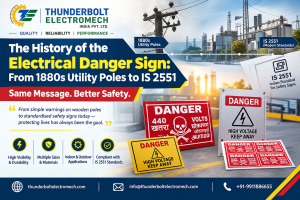
13. No danger plate at all on HT and MV installations. Rule 35 of the Indian Electricity Rules requires every medium, high, and extra-high voltage installation to permanently display a danger notice with the skull-and-bones symbol, in Hindi, English, and the local language. (Source: IS 2551:1982, Danger Notice Plates — Direct source found.) Yet in practice, danger plates are among the first items skipped during quick installations or temporary setups — “temporary” that often stays in place for years.
14. Using the wrong size danger plate for the voltage class. IS 2551 specifies two standard sizes: 200×150mm for medium voltage installations, and 250×200mm for high and extra-high voltage installations, each with lettering dimensions fixed by the standard. (Source: IS 2551:1982 — Direct source found.) A plate sized for MV displayed on an HT installation may technically satisfy “a plate exists” while failing the actual visibility and compliance requirement.
15. Danger plates faded past legibility. Delhi’s summer heat and monsoon humidity strip paint and fade printed enamel within a couple of years. A danger plate that a worker can no longer read at a glance is functionally the same as no danger plate — the whole point is instant recognition, not close inspection.
16. Danger plates mounted where they cannot be seen from the approach path. A plate fixed on the side wall of a panel room, rather than directly on the door or the approach route, misses the moment it matters most — before someone opens the panel, not after.
17. No lockout tags accompanying the danger plate. A permanent danger plate tells people “this is always hazardous.” A lockout tag tells them “this specific unit is currently isolated for work, right now.” Plants that rely on the danger plate alone, without a lockout-tagout system layered on top, leave a gap during maintenance windows — the exact time when accidental re-energisation causes the worst injuries.
18. Treating danger plates as a one-time purchase instead of a maintenance item. Like any signage exposed to weather and industrial grime, danger plates need periodic replacement. Bundling them into the same annual PPE and safety-equipment review as rubber mats and gloves — rather than buying once and forgetting them — keeps electrical panel safety visible in the literal sense.
PPE, Documentation and Emergency Response Mistakes
The final group of mistakes covers what happens around the panel — the PPE a worker wears, the paperwork behind a job, and what happens in the sixty seconds after something goes wrong.
19. No first aid box near high-risk electrical areas. Electrical burns and shock injuries need immediate response — burn dressings, saline, and CPR barrier equipment specifically, not a generic first aid kit built for cuts and headaches. Panel rooms and substations need a first aid box stocked for electrical trauma, positioned within seconds of every high-risk work area.
20. Fire buckets left empty or filled with the wrong material. Sand-filled fire buckets near electrical installations are a basic requirement, yet buckets often sit empty, rusted through, or filled with debris instead of dry sand. An electrical fire fought with water instead of sand or a CO2 extinguisher turns a contained incident into a conductive, spreading one.
21. Cable glands and lugs installed without matching the cable’s insulation rating. This one is easy to overlook because it happens at installation, long before any “safety inspection” takes place. A cable gland or lug undersized for the cable, or mismatched in material, creates a hot spot at the termination point — a slow-building fire risk that shows up months later as insulation failure.
22. Heat shrink sleeves skipped or applied without proper heating. An improperly shrunk sleeve leaves air gaps and moisture paths at cable joints. Over time, especially in humid Delhi NCR conditions, this becomes a tracking path for leakage current, and eventually a fault.
23. Silica gel breathers ignored on transformers and switchgear. Silica gel breathers keep moisture out of transformer oil and switchgear compartments. When the gel turns pink and nobody replaces it, moisture ingress accelerates insulation breakdown — a slow mistake that eventually produces a fast failure.
24. No documented permit-to-work system for HT jobs. Verbal permission from a supervisor is not a permit-to-work. A written, signed permit — recording isolation points, discharge confirmation, and the names of everyone authorised to be near the panel — is what prevents two separate crews from working the same circuit under different assumptions.
25. Buying safety gear once and never re-testing it. Rubber mats, hand gloves, and discharge rods all degrade with use and age, regardless of how good they looked on day one. Dielectric strength drops well before a mat or glove shows visible damage. Gear needs scheduled re-testing — every six to twelve months depending on usage — not a single purchase treated as a lifetime solution.
LT Panel vs HT Panel Safety Equipment: Quick Comparison Table
Plants often ask what actually changes between LT and HT safety equipment. The honest answer: almost everything except the basic category.
| Safety Equipment | LT Panel Requirement | HT Panel Requirement |
| Rubber Mat | Test voltage 3,300V–5,000V class, for panels up to 650V | Higher-class mat rated 11kV+ working voltage, thicker gauge |
| Hand Gloves | Class 00/0, working potential up to 1,000V | Class 2/3/4, working potential 11kV–36kV+ |
| Discharge Rod | Rarely mandatory below 1,000V | Mandatory before every hands-on job |
| Danger Plate | 200×150mm, medium voltage marking | 250×200mm, HT/EHT marking per IS 2551 |
| Rescue Hook | Recommended near main LT panels | Mandatory within reach of HT switchgear |
| Inspection Frequency | Every 6 months | Every 3–6 months, plus post-fault checks |
This table is exactly why an untrained purchase team occasionally orders the wrong class of gloves or the wrong size danger plate — the categories sound the same on a purchase order, but the ratings underneath are not interchangeable.
Customer Problems Our Safety Equipment Supplier Team Solves Every Week
Working as a safety equipment supplier to factories, contractors, and utilities across Delhi NCR means hearing the same handful of problems on repeat calls.
Problem: “Our audit failed because the danger plates are unreadable.”
This is the single most common compliance call. The fix is straightforward — replace faded plates with IS 2551-compliant plates sized correctly for the installation’s voltage class, and add them to the annual maintenance budget rather than treating them as a one-off capital purchase.
Problem: “We bought gloves online, and they don’t feel right.”
Generic e-commerce gloves rarely list a tested Class rating or a genuine test certificate. A safety equipment supplier who can produce a test certificate on demand — and who stocks recognised brands rather than unbranded stock — removes the guesswork from a purchase that should never be guessed on.
Problem: “Our HT panel room has no rescue hook or discharge rod.”
Newer installations sometimes get the panel commissioned and the accessories forgotten, especially when electrical contracting and safety-equipment procurement happen as separate line items. Bundling HT panel accessories into the same order as the switchgear closes this gap before commissioning, not after an incident.
Problem: “We don’t know how often to replace our rubber mats.”
Most plants have no fixed replacement schedule, only a reactive one — “replace when it looks bad.” Dielectric strength degrades before visible cracking appears, so a fixed testing interval matters more than a visual check alone.
Problem: “Our first aid box is expired and half-empty.”
This surfaces almost every audit season. Pairing first aid box restocking with the same visit as PPE inspection — instead of treating it as facilities’ responsibility separate from electrical safety — keeps it from falling through organisational cracks.
Real Use Cases From Delhi NCR Factories and Substations
Use case 1 — A garment export unit in Delhi NCR.
A mid-sized garment export facility running multiple LT distribution panels had never standardised its rubber mat inventory — different sections used mats bought at different times, from different sources, with no visible rating markings. During a pre-audit walkthrough, half the mats failed a basic voltage-rating check. The unit standardised on rated electrical rubber mats across all panel rooms and added a testing schedule tied to their existing preventive-maintenance calendar. The next statutory audit passed without a single mat-related non-conformance.
Use case 2 — A power distribution contractor working on 11kV feeder lines.
A contracting team handling 11kV feeder maintenance had discharge rods in their toolkit but no rescue hooks mounted at any of their work sites — accessories lived in a central van, several kilometres from some job sites on a given day. After a near-miss where a technician received a minor shock from residual capacitance, the contractor equipped every active work site with a dedicated discharge rod and rescue hook set, rather than sharing a single set across multiple locations. Site-level accessory availability, not just company-wide inventory, closed the actual gap.
Use case 3 — A small manufacturing unit renewing its factory license.
A steel fabrication unit applying for factory license renewal discovered during the inspector’s visit that its danger plates, installed at commissioning nearly eight years earlier, no longer matched current IS 2551 lettering requirements and had faded to the point of illegibility. Replacing the plates with correctly sized, IS-compliant signage — alongside a fresh first aid box and functioning fire buckets — resolved the inspector’s objections within a single follow-up visit.
Use case 4 — A cold-storage facility with mixed LT and HT infrastructure.
A cold-storage plant running both an LT distribution panel for refrigeration units and an 11kV incoming HT feeder had, for years, purchased a single batch of insulated gloves for the entire site. Maintenance staff moved between the LT panel and the HT yard using the same pair, unaware that the gloves were rated for low-voltage work only. A routine electrical safety audit flagged the mismatch before an incident occurred. The facility split its PPE inventory by voltage class, colour-coded the storage racks for LT and HT gloves separately, and added a laminated reference card at each panel showing the required glove class. The change cost very little; the risk it removed was significant, since a Class 00 glove offers no meaningful protection against an 11kV fault.
Across all four cases, the pattern repeats: none of these plants had a single obvious “big” failure. Each had a small mismatch between what the panel needed and what was actually on site — the wrong glove class, an accessory left in the van, signage that outlived its legibility. That is the nature of electrical panel safety risk. It rarely announces itself loudly until the day it does.
How to Choose the Right Safety Equipment Supplier for Your Plant
Not every vendor selling PPE understands electrical work. A few questions separate a genuine electrical safety equipment supplier from a general industrial-supplies reseller:
- Can they produce a test certificate on demand for gloves and mats?
- A supplier who cannot provide dielectric test documentation is selling you a guess, not a rating.
- Do they stock both LT and HT accessories, or only one? Plants running mixed-voltage installations need a single supplier who understands the difference between a Class 0 glove and a Class 4 glove, not two separate vendors giving conflicting advice.
- Do they carry recognised brands alongside their own range? A supplier stocking established names — the kind an auditor recognises on sight — alongside their core catalogue signals they understand what inspectors actually look for.
- Can they explain IS 2551 danger plate sizing without looking it up? This single question filters out suppliers who sell signage as a generic product from those who understand it as a compliance item.
- Do they deliver across Delhi NCR on a schedule that matches your maintenance calendar? Emergency PPE replacement after a failed inspection is a different service than routine annual restocking — a supplier should handle both.
None of these questions are difficult for a genuine electrical safety equipment supplier to answer on the spot. If a vendor hesitates on glove classes or cannot describe the difference between a 200×150mm and a 250×200mm danger plate, that hesitation is itself useful information — it tells a purchase team the supplier is reselling PPE the way they’d resell stationery, without understanding what any of it protects against.
Thunderbolt Electromech: Delhi’s Trusted Safety Equipment Supplier for LT and HT Panels
Thunderbolt Electromech India Pvt. Ltd. is a Delhi-based safety equipment supplier working with engineers, contractors, industrial units, utilities, and purchase teams across the National Capital Region and beyond. The company’s product range is built around the exact gaps described in this guide — not a generic industrial-supplies catalogue, but a cluster of products specifically for LT panel safety, HT panel accessories, and electrical panel safety compliance.
The core range includes:
- Electrical Rubber Mats, rated for LT and HT panel rooms
- Electrical Hand Gloves, including Hand Gloves Electrical 1100 Volt Crystal, tested to an 11,000V test potential with 1,100V working potential, made from seamless natural latex rubber
- Danger Plates sized and lettered per IS 2551 for medium and high-voltage installations
- Rescue Hooks for HT switchgear and substation emergency response
- Discharge Rods with proper earth-continuity fittings for HT de-energisation
- First Aid Boxes, both stocked kits and empty boxes for custom fitting
- Fire Buckets with stands, sized correctly for electrical fire response
- Cable Glands across multiple brands and sizes
- Cable Lugs, including tubular, long barrel, XLPE, and inline types
- Heat Shrink Sleeves for cable joint insulation
- Silica Gel Breathers for transformer and switchgear moisture protection
Every one of these products maps directly to a mistake covered earlier in this guide — the danger plate that failed an audit, the discharge rod missing at a job site, the rubber mat with no traceable rating.
Visit or contact Thunderbolt Electromech India Pvt. Ltd.: 📍 Shop no. 3538, Sitaram Bazar Rd, Bazar Sirkiwalan, Chawri Bazar, Chandni Chowk, Delhi, 110006 📞 +91-9911886655 / +91-9911228857 / +91-6391217408 ✉️ info@thunderboltelectromech.com 🕒 Monday to Saturday, 11:00 AM – 7:00 PM
Frequently Asked Questions
What is the biggest cause of industrial electrical accidents in India?
Research points to a combination of missing or degraded PPE, ungrounded or improperly isolated HT equipment, and residual charge left in switchgear after de-energisation — not single catastrophic equipment failures.
How often should electrical rubber mats be tested?
Every six months is the common industry practice, more frequently in high-humidity environments like much of Delhi NCR, since dielectric strength degrades before visible damage appears.
Is a danger plate legally required on every panel?
Rule 35 of the Indian Electricity Rules requires danger notices on every medium, high, and extra-high voltage installation, sized and lettered according to IS 2551. LT distribution boards below medium voltage thresholds are not always covered by the same rule, but most safety audits expect visible warning signage regardless.
What voltage class of gloves does HT panel work require?
It depends on the system voltage, but HT work typically requires Class 2, 3, or 4 gloves, each tested to a voltage well above the actual working voltage to provide a safety margin — not the same Class 00/0 gloves used for LT panels.
Does a discharge rod replace the need for lockout-tagout?
No. A discharge rod removes residual/stored charge after isolation. Lockout-tagout prevents the circuit from being re-energised while work is in progress. Both are required; neither substitutes for the other.
How long does an electrical rubber mat actually last?
There is no fixed shelf life, because degradation depends on usage, storage conditions, and exposure to oil, sunlight, and ozone. What matters more than age is a fixed testing interval — most plants re-test every six months — since dielectric strength can drop well before a mat shows visible cracking or hardening.
Can one safety equipment supplier really cover both LT and HT needs, or should plants use separate vendors?
A single supplier who genuinely understands both voltage classes is usually the better choice, not the compromise it might sound like. Splitting LT and HT procurement across two vendors often creates the exact mismatch problem described in Mistake 10 above — gloves or mats ordered without anyone cross-checking the voltage class against the panel they’re meant for. One supplier, one specification sheet per panel, removes that ambiguity.
Conclusion
Twenty-five mistakes sound like a long list until you notice how few root causes sit behind them: equipment that was never rated correctly for the job, signage nobody replaced, and procedures that lived in someone’s memory instead of on paper. None of that requires a large budget to fix. It requires treating LT panel safety, HT panel accessories, and electrical panel safety as one connected system — rubber mats, gloves, discharge rods, rescue hooks, danger plates, first aid boxes, and cable accessories working together, inspected on a schedule, sourced from a supplier who can back every product with a test certificate. Thunderbolt Electromech India Pvt. Ltd. supplies that entire cluster from one place in Delhi, so plants across the NCR do not have to piece safety compliance together from five different vendors. Call +91-9911886655 or write to info@thunderboltelectromech.com to get a panel-by-panel safety audit started.