
By Thunderbolt Electromech India Pvt. Ltd. — Delhi-based Electrical Rubber Mat Supplier of Bharat, Jyoti, National, Vardhman & Shree Arihant
📞 +91-9911886655 | ✉️ info@thunderboltelectromech.com | 🌐 thunderboltelectromech.com | 📍 Shop No. 3538, Sitaram Bazar Rd, Bazar Sirkiwalan, Chawri Bazar, Chandni Chowk, Delhi – 110006
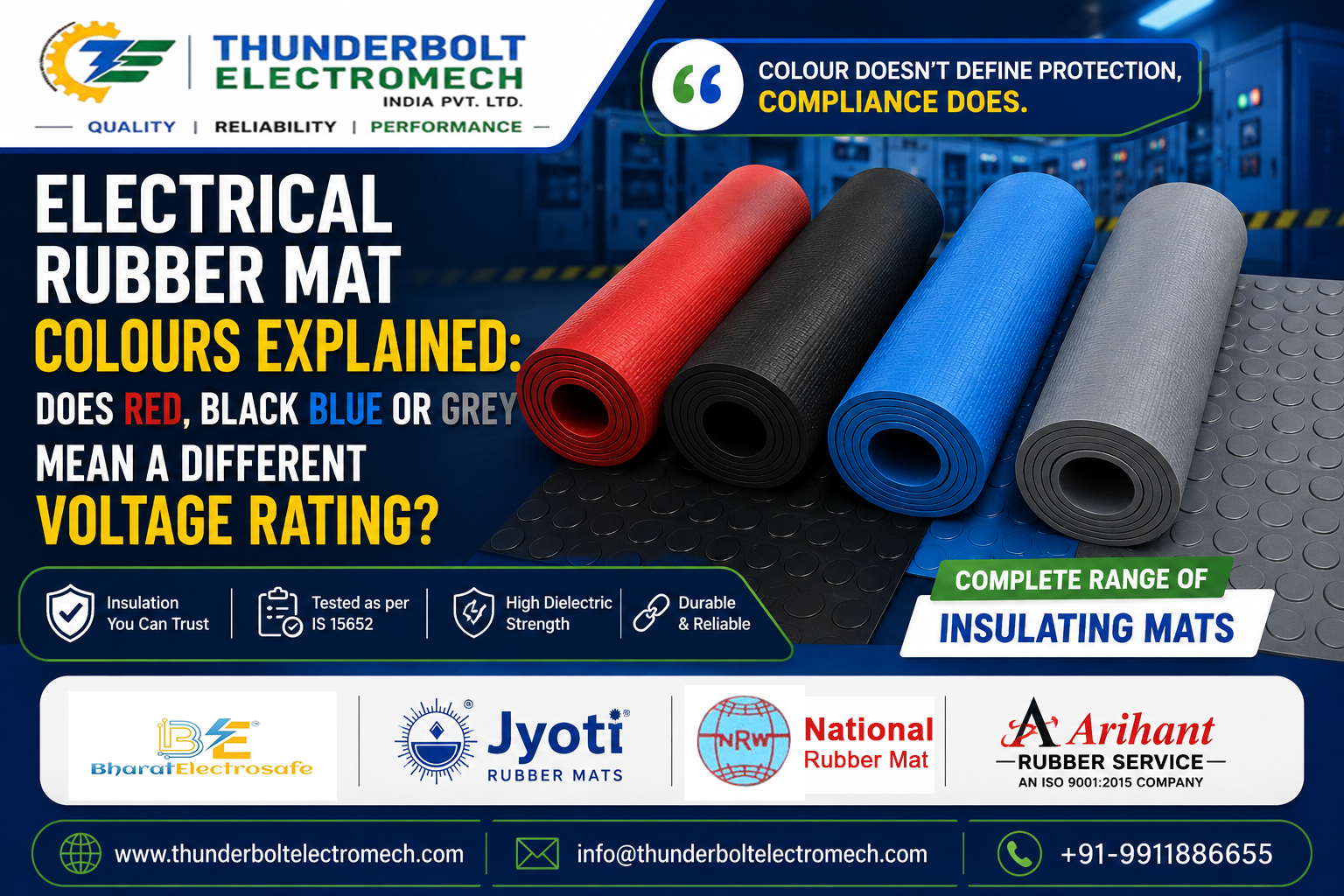
Quick Answer: No. Colour has no connection to voltage class under IS 15652, India’s governing standard for electrical rubber mats. A red mat, a black mat, and a blue mat can all be Class A, B, or C — class comes from thickness and dielectric test data, not the shade of rubber. Even the US equivalent, ASTM D178, defaults to black while allowing custom colours, with zero link to rating. Some large utilities do adopt internal colour conventions for inventory purposes, but that’s a site habit, never a national rule.
Introduction
Walk into enough panel rooms and you’ll hear the same confident, wrong claim repeated: “the red mats are for high voltage, black ones are for low voltage.” It sounds plausible. Colour-coding is everywhere in electrical work — earth wires are green and yellow, phase indicators follow fixed colours, cable cores get colour-sorted by function. So why wouldn’t a rubber mat follow the same logic?
Because it doesn’t. And believing it does is a genuinely dangerous assumption, not a harmless quirk. This piece exists to settle the question properly, with the actual standard text behind it, and to explain why mats come in different colours at all if colour isn’t carrying safety information. For the full breakdown of IS 15652’s actual voltage classes, thickness specs, and buying guidance, Thunderbolt’s pillar guide covers that ground in depth — this piece stays narrowly focused on the one question nobody else seems to answer directly.
Does Rubber Mat Colour Indicate Voltage Class? The Short Answer, Explained Properly
IS 15652 defines voltage class by thickness and dielectric performance — not appearance. A Class A mat is 2.0mm thick, rated up to 3.3kV, tested to a 30kV breakdown voltage. A Class C mat is 3.0mm, rated 11kV to 33kV, tested to 65kV. Nowhere in that specification does colour enter the picture (Source: IS 15652:2006 class specifications, cross-referenced across Duratuf Products and Bureau of Indian Standards documentation — Direct source found).
Manufacturers choose colour based on their own production line, compound recipe, and customer requests — not the mat’s electrical rating. Two mats sitting side by side, one black and one red, can be the exact same Class B mat from the exact same production batch, simply run through the mixer with a different pigment added.
What IS 15652 Actually Says About Colour (Spoiler: Almost Nothing)
This is worth stating plainly, because it’s the detail that ends the debate. IS 15652 specifies material composition, thickness tolerances, dielectric test voltage, tensile strength, and ISI marking requirements. It does not specify a mandatory colour, nor does it assign different colours to different classes anywhere in its text (Source: IS 15652:2006, full specification scope — Direct source found).
Compare that to how the standard treats marking. The ISI mark, BIS licence number, and class designation must be printed or embossed at regular intervals along the roll — that’s the standard’s actual mechanism for communicating class, and it’s a printed mark, not a paint colour. If a supplier or a site safety officer is reading colour as a substitute for checking that printed marking, they’re relying on information the standard never put there.
Why Rubber Mats Come in Different Colours At All
If colour doesn’t carry safety information, why does it vary at all? Three real, practical reasons explain almost every colour choice in the market.
Carbon black changes the rubber compound’s behaviour, not just its appearance. Carbon black is one of the most effective stabilisers against ozone and UV degradation in rubber compounds, which is exactly why it shows up so often in outdoor-rated rubber products across totally unrelated categories — tyres, cable jacketing, and industrial matting alike. A black electrical rubber mat isn’t black by tradition alone; the pigment itself is frequently the same additive doing double duty as an environmental stabiliser, particularly relevant for mats destined for outdoor switchyards or uncovered substation platforms.
Red oxide and other mineral pigments are simply cheaper and more established in Indian rubber manufacturing. Red rubber matting has a long manufacturing history across general industrial rubber goods in India, well beyond electrical mats specifically, and that existing supply chain for red pigment compounds makes it an easy, low-cost default for many manufacturers.
Customisation and brand identity drive the rest. Some manufacturers offer blue or grey mats specifically to differentiate their product line visually in a crowded market, or because a specific institutional buyer — a utility, a PSU, a large EPC contractor — requested a particular colour to match their internal site standards.
None of these three reasons has anything to do with dielectric performance. They’re manufacturing, cost, and branding decisions layered on top of a product whose actual safety rating lives in the class marking, not the pigment.
Black Rubber Mats: Why They’re the Industry Default
Black remains the most common colour across Indian and international electrical rubber matting for a reason grounded in material science rather than convention alone. ASTM D178, the American standard for rubber insulating matting, states plainly that its standard colour is black, with customised dimensions and colours available on request (Source: Duratuf Products, “ASTM D178 Switchboard Mats” — Direct source found). That’s the international market independently arriving at the same default India’s manufacturers favour — not because black is somehow electrically superior, but because carbon-black-stabilised compounds have historically been the most cost-effective way to build in UV and ozone resistance at scale.
Red, Blue, and Grey Rubber Mats: When and Why Manufacturers Offer Them
Red mats are widely available across Indian manufacturers and often sit at a similar price point to black, making the choice largely aesthetic or driven by a buyer’s existing site colour scheme rather than any functional difference.
Blue and grey mats appear less frequently and are more often a custom or made-to-order option than a standard catalogue item — worth confirming lead time and minimum order quantity before specifying either colour for a large project, since off-catalogue colours can carry longer production timelines than black or red.
None of these colours change the underlying test requirement. A blue Class C mat still needs the same 65kV breakdown voltage test result as a black Class C mat from the same manufacturer. If a colour variant is offered at a lower price than the standard colour for the identical class, that’s worth questioning directly — a genuine price difference should trace to material cost or order volume, not to some implied “lesser” class hidden behind a different shade.
The One Place Colour Does Matter: Internal Utility and Facility Colour-Coding Conventions
Here’s a nuance worth being honest about, because a flat “colour means nothing, ever” answer would actually be incomplete. While no national standard ties colour to class, some individual utilities, PSUs, and large industrial facilities do adopt their own internal colour conventions for inventory and visual management — for example, a facility might standardise on black mats for all LT panel rooms and red mats for all HT switchyards, purely as an internal visual-sorting system to help staff at a glance.
This is a site-specific habit, not a regulatory requirement, and it varies completely from one organisation to the next. A contractor moving between sites should never assume a colour convention from one facility applies at another — the only reliable source of a mat’s actual class is its printed marking and accompanying test certificate, checked fresh at every site, not a colour memory carried over from the last project.
IS 15652 vs ASTM D178: How India and the US Both Treat Colour the Same Way
| Aspect | IS 15652 (India) | ASTM D178 (US) |
| Governing body | Bureau of Indian Standards | ASTM International |
| Class system | Class A, B, C (by thickness/voltage) | Class 0 through 4 (by voltage) |
| Standard/default colour | Not specified | Black (default), custom on request |
| Colour tied to class? | No | No |
| How class is actually identified | ISI mark, printed class designation | Manufacturer marking, test certificate |
| Working voltage range covered | Up to 66kV (per standard’s scope) | 1kV to 36kV |
Two independently developed standards, from two different countries, arrived at the identical position: colour is not a safety specification. That convergence is worth noting on its own — if colour genuinely mattered for electrical safety, it’s a near certainty that at least one of these two widely referenced standards would have codified it by now.
The Real Risk: Buyers Who Assume Colour = Class
The danger in the colour myth isn’t abstract. A buyer who assumes “black means low voltage, so this must be safe for our LT panel” without checking the actual printed class marking can end up installing an under-rated mat in front of equipment it was never tested to protect against. The reverse mistake also happens — a facility over-specifying an expensive colour variant assuming it signals a higher class, when the actual class marking shows otherwise, and paying a premium for nothing beyond the pigment.
Both mistakes trace back to the same root cause: treating a visual cue as a substitute for reading the actual specification. The fix costs nothing — check the class letter printed on the mat and the accompanying test certificate, every time, regardless of what colour the roll happens to be.
Electrical Rubber Mat Supplier India — How to Verify Class Without Relying on Colour
A genuine Electrical Rubber Mat Supplier India buyers can trust should never let colour substitute for documentation. Practically, that means:
- Checking the ISI mark and class letter (A, B, or C) printed repeatedly along the roll, not assuming it from the mat’s appearance
- Requesting the dielectric test certificate for the specific batch being purchased, matched against the class actually needed for the panel’s working voltage
- Confirming lead time separately for any custom colour request, since off-catalogue colours often carry longer production schedules than standard black or red stock
- Treating colour as a cosmetic or site-convention choice during ordering, made after class and thickness are already confirmed — never before
Bharat, Jyoti, National, Vardhman & Shree Arihant: Colour Options Across Each Brand
Thunderbolt Electromech India Pvt. Ltd. stocks all five major brands, and colour availability varies slightly by manufacturer, though class certification standards remain consistent across the range.
Bharat electrical rubber mat — standard black and red variants across Class A and B, with class documentation available on request for every batch.
Jyoti electrical rubber mat — offered under Jyoti’s Electrasafe line, typically in black as the primary catalogue colour across its full class range up to the standard’s higher voltage scope.
National electrical rubber mat — commonly stocked in black, with red available on select sizes, suited to general industrial Class A and B applications.
Vardhman electrical rubber mat — one of the broader Indian manufacturers, offering colour flexibility including custom options for larger institutional orders, alongside its full A/B/C class range.
Shree Arihant electrical rubber mat — typically supplied in black, with CPRI/ERDA-backed test certification available for buyers who want third-party verification regardless of the colour ordered.
Whichever brand and colour a project settles on, the certificate and printed class marking — not the catalogue photo — should be the final word on what’s actually being installed.
Common Customer Problems and Solutions
Problem: “Our previous supplier told us red mats are for higher voltage — is that true?”
No. This is a widespread but incorrect claim. Colour carries no class information under IS 15652; the class letter printed on the mat and the accompanying certificate are the only reliable indicators.
Problem: “We ordered black mats assuming they were Class A, but our panel needs Class B.”
This is exactly the risk this guide addresses — always confirm class from the printed marking and certificate, regardless of colour, before installation rather than after a mismatch is discovered.
Problem: “We need a specific colour to match our facility’s internal safety convention — can you supply it?”
Yes, though custom colours outside a manufacturer’s standard catalogue (typically black and red) may carry a longer lead time and, on some brands, a minimum order quantity — worth confirming before finalising a delivery date tied to a commissioning deadline.
Problem: “A vendor offered us a cheaper ‘special colour’ mat at the same class rating — is this a red flag?”
It’s worth a direct question, not an automatic rejection. Ask specifically why the price differs at an identical class and thickness — a legitimate answer traces to order volume or leftover stock, not a quietly downgraded material.
Comparison Table: Colour vs Class vs What Actually Determines Safety
| Factor | Does It Determine Safety Rating? | What Actually Matters |
| Mat colour (black, red, blue, grey) | No | Cosmetic/manufacturing choice only |
| Thickness (2.0mm, 2.5mm, 3.0mm) | Yes | Directly tied to voltage class under IS 15652 |
| ISI mark and printed class letter | Yes | The actual, standard-mandated indicator of class |
| Dielectric test certificate | Yes | Confirms breakdown voltage matches the claimed class |
| Manufacturer brand name | Indirectly | Affects documentation quality and consistency, not the class itself |
| Price | Indirectly | Should track class, thickness, and certification depth — not colour |
Real Use Cases
Use case 1 — A Delhi NCR manufacturing plant’s failed internal audit.
A plant’s internal safety team had assumed, based on colour alone, that its black mats across the panel room were all Class A, appropriate for the site’s 415V distribution boards. A routine audit checked the printed class marking directly and found several rolls were actually unmarked, unbranded stock with no verifiable class at all — the black colour had simply been assumed to mean “standard” rather than checked. Switching to documented Bharat electrical rubber mat stock with visible class marking on every metre resolved the audit finding.
Use case 2 — A utility standardising colour for internal site identification.
A regional utility wanted to introduce a colour convention across its depots — black for LT panel rooms, red for HT switchyards — purely for staff visual identification during routine walkthroughs. Working with a supplier who could confirm this was a site convention layered on top of standard class certification, not a replacement for it, the utility documented both the colour convention and the underlying class requirement separately in its internal procurement spec, avoiding the risk of a future depot manager assuming colour alone was sufficient.
Use case 3 — A panel-building workshop questioned by a client over mat colour.
A panel fabrication workshop received a client query asking why their supplied mats were red instead of the black the client’s previous supplier had used, with an implied concern that this meant a lower safety rating. The workshop was able to produce the dielectric test certificate showing an identical Class B rating regardless of colour, resolving the client’s concern with documentation rather than reassurance alone — exactly the kind of moment where having a certificate on hand, not just a colour explanation, closes the conversation.
Common Buying Mistakes Tied to Colour Assumptions
Mistake 1 — Assuming colour indicates class without checking the printed marking.
The single most common version of this mistake, and the one this entire guide exists to correct.
Mistake 2 — Paying a premium for a colour assuming it signals better performance.
Colour alone never justifies a price premium at an identical class and thickness.
Mistake 3 — Carrying a colour convention from one site to another.
Internal facility conventions are not standardised nationally — a red mat at one site’s HT yard says nothing about a red mat’s class at a different site.
Mistake 4 — Not asking about lead time for custom colours before committing to a project deadline.
Off-catalogue colours can extend production schedules in ways that catch a commissioning-date-driven order off guard.
Mistake 5 — Accepting unmarked stock because “it’s the right colour.”
Marking and certification, not appearance, are what an audit or an Electrical Inspector will actually check.
How to Choose the Right Electrical Rubber Mat Supplier India When Colour Isn’t the Deciding Factor
Since colour tells a buyer nothing about class, the real selection criteria for an Electrical Rubber Mat Supplier India should centre on:
- Whether class documentation and ISI marking are available and verifiable for every colour and batch offered
- Whether the supplier can explain plainly, without hesitation, that colour and class are unrelated — a supplier who perpetuates the colour myth is a warning sign about their broader technical knowledge
- Whether custom colour requests come with clear lead time and MOQ information upfront
- Whether pricing differences across colours are explained transparently, tied to real cost factors rather than left ambiguous
Why Choose Thunderbolt Electromech India Pvt. Ltd. for Buying Electrical Rubber Mat
Thunderbolt Electromech India Pvt. Ltd. stocks Bharat, Jyoti, National, Vardhman, and Shree Arihant electrical rubber mat — genuinely ISI-marked, IS 15652-certified stock across every class and available colour, with documentation provided as standard rather than something a buyer has to ask twice for. The reason to buy here isn’t a colour catalogue; it’s that every roll, whatever shade it ships in, comes with the class marking and test backing that actually determines whether it protects the person standing on it. For buyers who also need IS 2551-compliant Danger Plate signage for the same panel room, Thunderbolt supplies both from the same Delhi base, on the same order.
Why Thunderbolt Is Delhi’s Trusted Electrical Rubber Mat Supplier India
As a Delhi-based Electrical Rubber Mat Supplier India engineers and purchase managers rely on, Thunderbolt holds regular stock across Class A, B, and C in both standard and select custom colours, rather than sourcing per order. Buyers searching to buy electrical rubber mat online, or looking for an electrical rubber mat near me for same-day collection from the Chandni Chowk and Chawri Bazar trading belt, get the same class documentation regardless of which colour or brand they choose.
Contact Thunderbolt Electromech India Pvt. Ltd.: 📍 Shop No. 3538, Sitaram Bazar Rd, Bazar Sirkiwalan, Chawri Bazar, Chandni Chowk, Delhi – 110006 📞 +91-9911886655 ✉️ info@thunderboltelectromech.com
Electrical Rubber Mat Supplier India: Frequently Asked Colour Questions
Does black mean low voltage and red mean high voltage?
No. This is a common but incorrect assumption. Neither colour is tied to voltage class under IS 15652 or the US equivalent, ASTM D178. Class is determined by thickness and dielectric test data, shown through printed marking and certification.
Why do most electrical rubber mats default to black?
Carbon black, a common pigment in rubber compounds, also improves resistance to UV and ozone degradation, making it a practical default for mats that may see outdoor or high-exposure use — not because black carries any special electrical property beyond what the same compound would offer in another colour.
Can I request a custom colour for a bulk order?
Yes, most manufacturers accommodate custom colour requests, though lead time and minimum order quantity often increase for off-catalogue shades compared to standard black or red stock.
If two mats are different colours but the same price, does that mean they’re the same class?
Not necessarily — price should be checked against the actual class and thickness stated on the certificate, not inferred from colour or price alone. Always confirm the printed class marking directly.
Should our facility create its own colour convention for different panel types?
You can, and some utilities do, purely for internal visual identification — but this must be documented as a site-specific practice layered on top of proper class verification, never as a replacement for checking the actual marking and certificate.
Is there any country where mat colour is officially linked to voltage class?
Not among the standards most commonly referenced by Indian and international buyers — IS 15652 and ASTM D178 both leave colour unspecified for safety purposes, tying class exclusively to thickness, dielectric performance, and marking.
Conclusion
The colour of an electrical rubber mat tells you nothing about how much voltage it can safely handle — that’s the finding this entire guide has walked through, backed by both IS 15652 and its American counterpart, ASTM D178, which independently arrived at the same position. What actually determines class is thickness, dielectric test performance, and the printed ISI marking that IS 15652 specifically requires — not the pigment mixed into the rubber during manufacturing. Black remains common mostly because carbon black doubles as a genuine UV and ozone stabiliser, red persists through manufacturing tradition and cost, and blue or grey usually reflect custom orders or brand differentiation rather than any electrical distinction. The one exception worth remembering is that individual utilities sometimes build their own internal colour conventions for inventory purposes — useful on their own site, meaningless anywhere else. Thunderbolt Electromech India Pvt. Ltd. supplies Bharat, Jyoti, National, Vardhman, and Shree Arihant electrical rubber mat with full class documentation behind every colour and every batch, because the certificate — not the catalogue photo — is what actually protects the person standing on the mat. Call +91-9911886655 or write to info@thunderboltelectromech.com to confirm the right class for your panel, whatever colour you choose to order it in.
[…] backup beyond the invoice — our own cluster content covers IS 15652 vs IEC 61111 standards, what mat colour actually signals about voltage class, and whether these mats genuinely prevent electric shock — so a buyer researching before purchase […]