By Thunderbolt Electromech India Pvt. Ltd. — Delhi-based Distributor and Supplier of Raychem, Vidyut and Crystal Electrical Hand Gloves
📞 +91-9911886655 | ✉️ info@thunderboltelectromech.com | 🌐 thunderboltelectromech.com | 📍 Shop No. 3538, Sitaram Bazar Rd, Bazar Sirkiwalan, Chawri Bazar, Chandni Chowk, Delhi – 110006
Quick Answer: Electrical insulating gloves are divided into six classes—00, 0, 1, 2, 3 and 4—according to their electrical protection characteristics. Under the ASTM D120 system, commonly referenced maximum AC working voltages range from 500 V for Class 00 to 36,000 V for Class 4. BIS documentation for India identifies IS 13774:2014 / IEC 60903:2002 and lists the same six classes. The correct class should be selected from the actual system voltage, applicable standard, glove marking and manufacturer’s technical documentation—not simply from the nominal voltage printed on equipment.
Editorial note: This article uses the ASTM D120 voltage table because it is widely used in technical documentation for insulating rubber gloves. For Indian procurement, Thunderbolt should also ask buyers to verify the applicable IS 13774 / IEC 60903 marking and product documentation. The BIS product manual explicitly lists Classes 00, 0, 1, 2, 3 and 4 under IS 13774:2014 / IEC 60903:2002.
Introduction
A worker looking for electrical hand gloves usually starts with one question:
“Which class of electrical glove should I buy?”
The answer depends on the voltage and the standard under which the glove is tested.
A Class 00 glove is not simply a cheaper version of a Class 4 glove. Each class represents a different electrical protection range. Choosing a glove class that is too low for the application defeats the purpose of using insulating PPE in the first place.
For a purchasing manager, electrician, maintenance contractor or electrical safety professional, the class marking is therefore one of the first specifications to check.
Thunderbolt Electromech India Pvt. Ltd. supplies electrical hand gloves in India, including Raychem electrical hand gloves, and also offers Vidyut and Crystal electrical hand gloves. The company is based in Delhi and supplies electrical safety products to customers across India.
This guide focuses on the part buyers frequently find confusing: what Class 00, 0, 1, 2, 3 and 4 actually mean, how their voltage ratings differ, and how to choose between them.
Electrical Hand Gloves Supplier: How the Class System Works
The first thing to understand is that the class number is an electrical-performance classification.
ASTM D120 specifies six classes of rubber insulating gloves: Class 00, Class 0, Class 1, Class 2, Class 3 and Class 4. ASTM also distinguishes Type I and Type II gloves based on ozone resistance. Its scope includes electrical and physical tests such as AC proof testing, AC breakdown testing, moisture absorption/proof testing, DC testing, ozone resistance and mechanical tests.
India has its own applicable framework. BIS identifies IS 13774:2014 / IEC 60903:2002 for live working gloves of insulating material. The BIS product manual lists the six classes and also identifies different glove types, special categories, sizes and standard lengths.
That gives buyers two important lessons.
First: do not judge a glove only by its appearance.
Second: do not judge it only by a number printed by a seller.
Look for the actual classification, standard, maximum use voltage, testing information and product marking.
Electrical glove class is not the same as glove size
This sounds obvious, but buyers sometimes mix the two.
Class tells you about electrical protection.
Size tells you whether the glove fits your hand.
BIS documentation separately identifies size options such as 8, 9, 10 and 11, while class is identified as 00, 0, 1, 2, 3 or 4.
A Class 2 glove in the wrong size is still the wrong glove for the worker.
What does the class number tell you?
In practical terms:
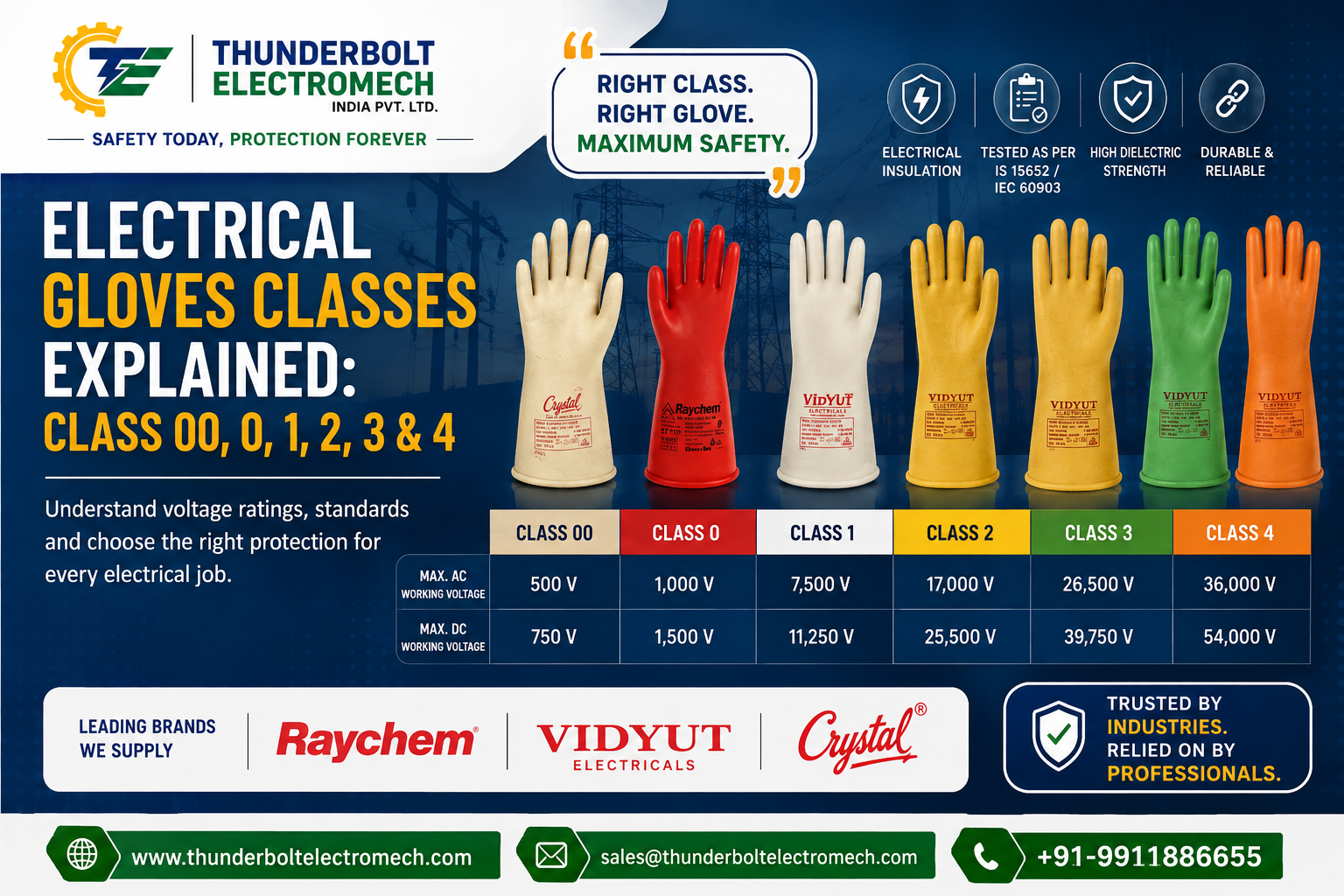
| Glove Class | Common Maximum AC Working Voltage | Common Maximum DC Working Voltage | Typical Position in the Range |
| Class 00 | 500 V | 750 V | Lowest class |
| Class 0 | 1,000 V | 1,500 V | Low voltage |
| Class 1 | 7,500 V | 11,250 V | Higher voltage |
| Class 2 | 17,000 V | 25,500 V | Medium/high voltage range |
| Class 3 | 26,500 V | 39,750 V | High voltage |
| Class 4 | 36,000 V | 54,000 V | Highest class |
These values are consistent with technical tables published for ASTM D120/IEC 60903-type insulating gloves. Raychem’s own technical information, for example, lists maximum working voltages from 500 V AC for Class 00 through 36,000 V AC for Class 4.
Important: maximum use voltage is not the same thing as proof-test voltage.
That distinction is one of the most important parts of this article.
Proof-Test Voltage vs Maximum Working Voltage
Suppose a glove has a 5,000 V AC proof-test value.
That does not mean you should use that glove on a 5,000 V AC system.
For example, commonly published ASTM D120 tables show:
- Class 0: 5,000 V AC proof test
- Class 0: 1,000 V AC maximum AC use
The higher number is associated with testing. The lower number is the maximum working voltage.
IEC terminology also distinguishes a proof test voltage from a withstand test voltage. The proof-test voltage is a specified test voltage applied under defined conditions to check the electrical strength of the insulation.
So, when comparing products, never make this mistake:
“This glove is tested at 20 kV, therefore it is a 20 kV working glove.”
That conclusion can be wrong.
Evidence status
Direct evidence found: ASTM D120 identifies the gloves by class and specifies electrical testing requirements.
Direct evidence found: BIS documentation identifies Classes 00–4 under IS 13774:2014 / IEC 60903:2002.
Recommendation/inference: Buyers should compare the manufacturer’s maximum-use voltage with the actual system voltage rather than using the proof-test figure as the working rating.
Electrical Hand Gloves Supplier: Class 00 and Class 0
Class 00 and Class 0 sit at the lower end of the six-class system.
That does not make them unimportant.
A large amount of electrical maintenance happens on equipment operating at lower voltages, where the right insulating glove still provides an essential barrier against electrical shock.
Class 00 electrical gloves
Class 00 is commonly specified for a maximum AC working voltage of 500 V and a maximum DC working voltage of 750 V in ASTM D120/IEC 60903 technical tables. Its commonly published AC proof-test value is 2,500 V.
Class 00 is therefore relevant to applications such as:
- low-voltage electrical maintenance
- control-panel work
- electrical equipment servicing
- certain industrial maintenance activities
- work around circuits within the glove’s rated voltage
But there is a major condition:
The actual job must fall within the glove’s permitted working voltage and the employer’s electrical safety procedure.
Class 0 electrical gloves
Class 0 increases the maximum commonly specified AC working voltage to 1,000 V, with a commonly specified DC maximum of 1,500 V. The AC proof-test value is commonly listed as 5,000 V.
This makes Class 0 a logical option for applications above the Class 00 range, provided the actual electrical work and applicable safety requirements match the glove’s rating.
Class 00 vs Class 0
| Feature | Class 00 | Class 0 |
| Maximum AC working voltage | 500 V | 1,000 V |
| Maximum DC working voltage | 750 V | 1,500 V |
| Common AC proof-test value | 2,500 V | 5,000 V |
| Position in class system | Lower | Higher |
| Typical buyer concern | Low-voltage protection | Higher low-voltage protection |
A practical buying example
Imagine a maintenance team works on a control system where the electrical risk assessment identifies a working voltage within the Class 00 limit.
The team should not automatically move to Class 2 simply because a higher class sounds safer.
Higher class does not automatically mean better for every job.
The glove still has to fit, remain flexible enough for the work, match the manufacturer’s instructions and be maintained correctly.
Conversely, if the system exceeds the permitted Class 00 working voltage, the solution is not to “work carefully” with Class 00.
The solution is to select equipment appropriate to the actual voltage and safety procedure.
Electrical Hand Gloves Supplier: Classes 1 and 2
Classes 1 and 2 move into substantially higher voltage applications.
This is where purchasing mistakes become more serious because the difference between a proof-test number and a maximum working number becomes particularly important.
Class 1
Class 1 commonly has:
- 10,000 V AC proof-test voltage
- 7,500 V AC maximum working voltage
- 11,250 V DC maximum working voltage
These figures are published in technical documentation for ASTM D120/IEC 60903-type insulating gloves.
Class 1 can therefore be relevant to electrical work at substantially higher voltages than Class 0.
But do not interpret 7,500 V as a blanket permission to work on any installation whose nominal voltage happens to be below 7,500 V.
System configuration, phase-to-ground exposure, work method, other PPE and the applicable electrical safety rules all matter.
Class 2
Class 2 commonly provides:
- 20,000 V AC proof-test voltage
- 17,000 V AC maximum working voltage
- 25,500 V DC maximum working voltage
Raychem’s published technical information gives the same maximum working voltage values.
Class 2 is therefore intended for substantially higher electrical exposure than Class 1.
This is the point where a buyer should stop thinking only in terms of “which glove is thicker?”
The correct question is:
What voltage, work method and standard does this glove actually cover?
Class 1 vs Class 2
| Specification | Class 1 | Class 2 |
| AC proof-test voltage | 10,000 V | 20,000 V |
| Maximum AC working voltage | 7,500 V | 17,000 V |
| Maximum DC working voltage | 11,250 V | 25,500 V |
| Relative electrical class | Higher than 0 | Higher than 1 |
| Buyer focus | System voltage + standard | System voltage + standard + work method |
Why this matters to procurement teams
A purchase order that simply says:
“Electrical gloves – 11 kV”
is incomplete.
The purchasing team should identify:
- Required standard.
- Glove class.
- Maximum working voltage.
- AC/DC requirement.
- Size.
- Length.
- Special chemical/environmental requirements.
- Manufacturer or approved brand.
- Inspection/testing requirements.
BIS documentation itself separates class, special category, size and standard length as separate product parameters.
That is a much better purchasing specification than simply writing “high-voltage gloves.”
Electrical Hand Gloves Supplier: Classes 3 and 4
Classes 3 and 4 occupy the highest end of the six-class system.
These gloves are designed for much higher electrical working voltages and should only be selected after the electrical work has been properly assessed.
Class 3
Technical tables commonly specify:
- 30,000 V AC proof-test voltage
- 26,500 V AC maximum working voltage
- 39,750 V DC maximum working voltage
Class 3 can therefore be relevant to high-voltage electrical work where the applicable system voltage and work procedure fall within the permitted range.
Class 4
Class 4 is the highest class in the ASTM D120/IEC 60903 six-class system.
Commonly published values are:
- 40,000 V AC proof-test voltage
- 36,000 V AC maximum working voltage
- 54,000 V DC maximum working voltage
That does not mean a Class 4 glove is suitable for every high-voltage task.
It still has to be the correct product, correctly marked, correctly maintained and used according to the applicable safety procedure.
Complete Class 00 to Class 4 comparison
| Class | AC Proof Test | Max AC Working Voltage | Max DC Working Voltage | Common Label Colour |
| 00 | 2,500 V | 500 V | 750 V | Beige |
| 0 | 5,000 V | 1,000 V | 1,500 V | Red |
| 1 | 10,000 V | 7,500 V | 11,250 V | White |
| 2 | 20,000 V | 17,000 V | 25,500 V | Yellow |
| 3 | 30,000 V | 26,500 V | 39,750 V | Green |
| 4 | 40,000 V | 36,000 V | 54,000 V | Orange |
The colour coding is documented in IEC 60903 material, while the numerical voltage values are reproduced in technical manufacturer documentation.
Do not use colour alone to identify the class. Read the marking.
How the class system relates to Indian standards
For an Indian buyer, this is an important distinction.
BIS lists IS 13774:2014 / IEC 60903:2002 for live working gloves of insulating material. Its product manual identifies:
- Class 00
- Class 0
- Class 1
- Class 2
- Class 3
- Class 4
It also lists special categories such as A, H, Z, R and C, along with sizes and standard lengths.
So a buyer in Delhi, Mumbai, Bengaluru or another Indian market should not ask only:
“Is this an electrical glove?”
Ask:
“Which class is it, which standard is it certified/marked to, and what is its maximum working voltage?”
That three-part question gives the purchasing department much better information.
What Do the Special Categories Mean?
The class tells you about electrical characteristics.
Special categories describe additional properties.
IEC 60903 material identifies categories including:
| Category | Property |
| A | Acid resistance |
| H | Oil resistance |
| Z | Ozone resistance |
| R | Acid + oil + ozone resistance |
| C | Extremely low-temperature resistance |
This distinction is useful in industrial environments.
A worker may need a glove with the correct electrical class and a suitable environmental category.
For example, selecting the correct voltage class does not automatically make a glove appropriate for every chemical or environmental condition.
Why Glove Length Matters
Voltage class is not the only specification.
BIS documentation identifies standard glove lengths including 280, 360, 410, 460 and 800 mm, depending on the product configuration.
IEC documentation also specifies different standard lengths according to glove class.
Why does this matter?
Because electrical work is not performed with the hand floating in empty space.
The worker’s wrist, forearm and surrounding equipment affect how the PPE is used.
A glove that provides the required electrical protection but is unsuitable for the physical task can create practical problems:
- restricted movement
- poor dexterity
- difficulty reaching controls
- uncomfortable cuff position
- incorrect layering with protective gloves
The buyer should therefore specify class + size + length, rather than class alone.
Customer Problems and Practical Solutions
Problem 1: “The seller says the glove is tested at 10 kV.”
Solution
Ask for the maximum working voltage.
A 10,000 V AC proof-test value appears in commonly published Class 1 specifications, while the maximum AC working voltage is 7,500 V.
The two numbers have different meanings.
Problem 2: “We work on a 415 V system. Should we buy Class 4?”
Solution
Do not select the class simply because it has a higher number.
The correct selection depends on the applicable safety assessment, glove standard and working voltage.
If the application falls within the permitted Class 00 range, that class may be the appropriate starting point. But the employer’s safety procedure and product documentation remain the deciding factors.
Problem 3: “The glove looks new, so it must be safe.”
Solution
Appearance is not enough.
Insulating gloves are subject to inspection and electrical testing requirements. ASTM F496 covers in-service care, inspection, testing and use voltage for insulating gloves and sleeves.
A visually clean glove can still have damage that affects its suitability.
Problem 4: “We purchased the correct class but the glove is uncomfortable.”
Solution
Check size and length.
BIS treats size and standard length as separate product parameters.
A correct class with the wrong fit is still poor PPE selection.
Real Use Cases: How Buyers Should Think About Classes
Use Case 1 — Low-voltage panel maintenance
A maintenance team works on equipment within the Class 00 maximum AC working-voltage range.
The buyer should evaluate a Class 00 glove, subject to the site’s electrical safety procedure and applicable product standard.
The purchase specification should include the required class, size and length.
Use Case 2 — Electrical maintenance around 1 kV
A facility requires protection around equipment within the Class 0 working-voltage range.
Class 0 becomes relevant.
The buyer should then verify the actual system voltage and the manufacturer’s technical documentation before placing the order.
Use Case 3 — Higher-voltage electrical maintenance
A contractor works on an installation requiring protection within the Class 1 or Class 2 range.
This is where the distinction between maximum working voltage and proof-test voltage becomes particularly important.
The purchase order should identify the required class rather than simply saying “high-voltage gloves.”
Use Case 4 — Utility or high-voltage work
For applications that fall within Classes 3 or 4, procurement should be much more controlled.
The glove class should be matched to the electrical work method, applicable standard, voltage and employer safety program.
At this level, guessing is not a procurement strategy.
How to Choose an Electrical Glove Class
Use this process before ordering.
Step 1: Identify the actual system voltage
Do not start with the glove.
Start with the electrical installation.
Step 2: Determine whether the exposure is AC or DC
Maximum use values differ between AC and DC.
For example, commonly published Class 2 values are 17,000 V AC and 25,500 V DC.
Step 3: Select the appropriate class
Compare the application against the manufacturer’s maximum working voltage and applicable standard.
Step 4: Verify the standard
For Indian procurement, check whether the product documentation identifies the applicable IS 13774 / IEC 60903 requirements. BIS lists IS 13774:2014 / IEC 60903:2002 for live working gloves of insulating material.
Step 5: Check the glove marking
Look for:
- Class
- Standard
- Size
- Length
- Manufacturer/supplier identification
- Relevant category
- Test/inspection information where applicable
IEC 60903 material specifically addresses marking and packaging information.
Step 6: Check environmental conditions
Does the worker face oil?
Acid?
Ozone?
Low temperatures?
The special category may matter as much as the electrical class.
Step 7: Check physical protection
Electrical insulating gloves should not automatically be treated as complete mechanical protection.
Some manufacturers explicitly state that insulating gloves should be used with suitable leather over-gloves for mechanical hazard protection.
The required combination should follow the applicable product instructions and safety procedure.
How to Buy Electrical Hand Gloves in India
A good Electrical Hand Gloves Supplier should be able to answer technical questions before the order is confirmed.
Ask the supplier:
1. What is the glove class?
Do not accept “high voltage” as the answer.
2. What is the maximum AC working voltage?
This is more useful for selection than simply quoting a proof-test voltage.
3. What is the maximum DC working voltage?
Ask this if DC work is involved.
4. Which standard applies?
For Indian buyers, ask about the applicable IS/IEC documentation.
5. What sizes are available?
Poor fit can interfere with the work.
6. What length is available?
BIS documentation recognizes multiple standard lengths.
7. What special category does the glove have?
This matters in oil, acid, ozone or low-temperature environments.
8. What testing or inspection documentation accompanies the product?
Do not treat this as paperwork that nobody needs to read.
It is part of the purchasing decision.
Why Buying from an Electrical Hand Gloves Supplier Matters
The supplier’s job should not end with:
“Here is the price per pair.”
A professional Electrical Safety Gloves Supplier should help the buyer identify the appropriate specification.
For industrial purchasing, the difference between a Class 0 and Class 1 glove is not a marketing detail. It affects the intended electrical working range.
Thunderbolt Electromech India Pvt. Ltd. supplies electrical hand gloves across India and offers brands including Raychem, Vidyut and Crystal, subject to product availability and specification.
For buyers who need help choosing the correct class, size or product specification, the company can be approached before ordering.
Electrical Gloves Class Selection: Quick Comparison
| Buyer Requirement | What to Check | Why It Matters |
| Low-voltage work | Class 00 or 0 range | Avoid selecting a class below the required working voltage |
| Higher-voltage work | Class 1 or 2 range | Working voltage increases substantially |
| High-voltage work | Class 3 or 4 range | Requires controlled selection |
| AC application | Maximum AC working voltage | AC rating must match the application |
| DC application | Maximum DC working voltage | DC rating differs from AC |
| Industrial chemicals | Special category | Electrical class alone does not address every environment |
| Different hand sizes | Glove size | Fit affects usability |
| Longer reach requirements | Glove length | Cuff/forearm coverage matters |
| Procurement verification | Standard + marking | Helps verify what is actually being purchased |
| In-service PPE | Inspection/testing | A new-looking glove is not automatically acceptable |
Common Mistakes When Buying Electrical Safety Gloves
Mistake 1: Using proof-test voltage as the working voltage
This is probably the most important technical mistake to avoid.
Fix: Always look for the maximum use/working voltage.
Mistake 2: Buying based only on “kV”
A product advertised as “10 kV gloves” is not sufficiently specified.
Fix: Ask for the class and standard.
Mistake 3: Ignoring DC voltage
AC and DC working limits are not necessarily the same.
Fix: Check both where DC work is involved.
Mistake 4: Ignoring the special category
A glove’s electrical class does not automatically describe its resistance to acid, oil, ozone or extreme cold.
Fix: Check the category marking.
Mistake 5: Buying one size for everyone
Electrical hand gloves are available in different sizes.
Fix: Match the glove to the worker.
Mistake 6: Treating electrical insulation as complete PPE
Electrical insulating gloves address electrical hazards within their specified application. They do not automatically eliminate every mechanical or arc-related hazard.
Fix: Follow the complete site PPE assessment.
Research Notes: What the Standards Actually Support
Source 1 — ASTM D120
Evidence type: Primary standard source
ASTM D120 covers manufacturing and testing of rubber insulating gloves and identifies six electrical classes: 00, 0, 1, 2, 3 and 4. It also identifies Type I and Type II gloves and lists multiple electrical and physical tests.
Direct evidence found: Yes.
Source 2 — BIS / IS 13774
Evidence type: Primary Indian standards/certification source
BIS identifies IS 13774:2014 / IEC 60903:2002 for live working gloves of insulating material. Its product manual lists Classes 00, 0, 1, 2, 3 and 4, plus glove type, special category, size and standard length.
Direct evidence found: Yes.
Source 3 — IEC 60903
Evidence type: Standards text
IEC 60903 documentation identifies the six classes and special properties such as acid, oil, ozone and low-temperature resistance. It also specifies marking requirements.
Direct evidence found: Yes.
Source 4 — Raychem technical information
Evidence type: Manufacturer technical documentation
Raychem publishes maximum working voltages and proof-test voltages for Classes 00 through 4 and gives additional technical information such as sizes, lengths and environmental characteristics.
Direct evidence found: Yes.
Frequently Asked Questions
What are Class 00 electrical gloves used for?
Class 00 gloves are commonly specified for applications up to a maximum AC working voltage of 500 V and maximum DC working voltage of 750 V in the referenced technical tables.
What is the difference between Class 00 and Class 0?
Class 00 has a commonly specified maximum AC working voltage of 500 V, while Class 0 is 1,000 V. Their corresponding commonly published DC maximum working voltages are 750 V and 1,500 V.
What voltage is Class 1 electrical gloves rated for?
Class 1 is commonly specified for a maximum AC working voltage of 7,500 V and maximum DC working voltage of 11,250 V.
What voltage is Class 2 electrical gloves rated for?
Class 2 is commonly specified for a maximum AC working voltage of 17,000 V and maximum DC working voltage of 25,500 V.
What is the highest electrical glove class?
Class 4 is the highest of the six classes identified by ASTM D120 and IEC 60903. Commonly published maximum working voltages are 36,000 V AC and 54,000 V DC.
Is a 20 kV tested glove suitable for 20 kV working voltage?
Not necessarily. A proof-test voltage and maximum working voltage are different specifications. Always check the glove’s stated maximum working voltage and applicable standard.
Does India use Class 00 to Class 4?
Yes. BIS documentation for IS 13774:2014 / IEC 60903:2002 lists Classes 00, 0, 1, 2, 3 and 4.
What does the R category mean?
Under IEC 60903 terminology, Category R combines resistance to acid, oil and ozone.
Do electrical gloves need inspection and testing?
Yes. In-service care and testing are addressed by ASTM F496, which covers inspection, testing, care and use voltage for insulating gloves and sleeves.
Can I select gloves only by voltage?
No. Voltage is a major factor, but the buyer should also check the standard, class, AC/DC requirement, size, length, special properties, marking and applicable safety procedure.
Should electrical insulating gloves be worn with leather gloves?
Where mechanical protection is required, suitable protective over-gloves may be required. The exact combination should follow the glove manufacturer’s instructions and the applicable safety procedure. Raychem’s technical information, for example, specifies use with leather over-gloves for mechanical hazard protection for the listed insulating gloves.
Where can I buy electrical hand gloves in India?
Thunderbolt Electromech India Pvt. Ltd. supplies electrical hand gloves in India and offers Raychem, Vidyut and Crystal electrical hand gloves, subject to the required product specification and availability.
Conclusion: Choose the Electrical Glove Class From the Work, Not the Marketing Label
Class 00, 0, 1, 2, 3 and 4 are not six names for the same product.
They represent different electrical protection classes.
The commonly referenced maximum AC working voltages move from 500 V in Class 00 to 36,000 V in Class 4, while the corresponding DC values range from 750 V to 54,000 V.
But the most important purchasing lesson is simpler:
Do not confuse proof-test voltage with maximum working voltage.
A glove tested at a particular voltage is not automatically intended to be used at that voltage.
For Indian buyers, the applicable IS 13774 / IEC 60903 requirements should also be checked. BIS documentation directly identifies the six classes and separates class, size, length and special categories as product parameters.
Thunderbolt Electromech India Pvt. Ltd. can be considered when you need an Electrical Hand Gloves Supplier for industrial and electrical safety requirements. The company supplies Raychem electrical hand gloves and also offers Vidyut and Crystal electrical hand gloves across India.
Before ordering, give the supplier the system voltage, AC/DC requirement, required class, size, length and applicable standard.
That makes the purchase specification much clearer—and gives the safety team something concrete to verify.
Thunderbolt Electromech India Pvt. Ltd.
Delhi-based electrical safety equipment supplier
Phone: +91-9911886655
Email: info@thunderboltelectromech.com
Website: thunderboltelectromech.com