
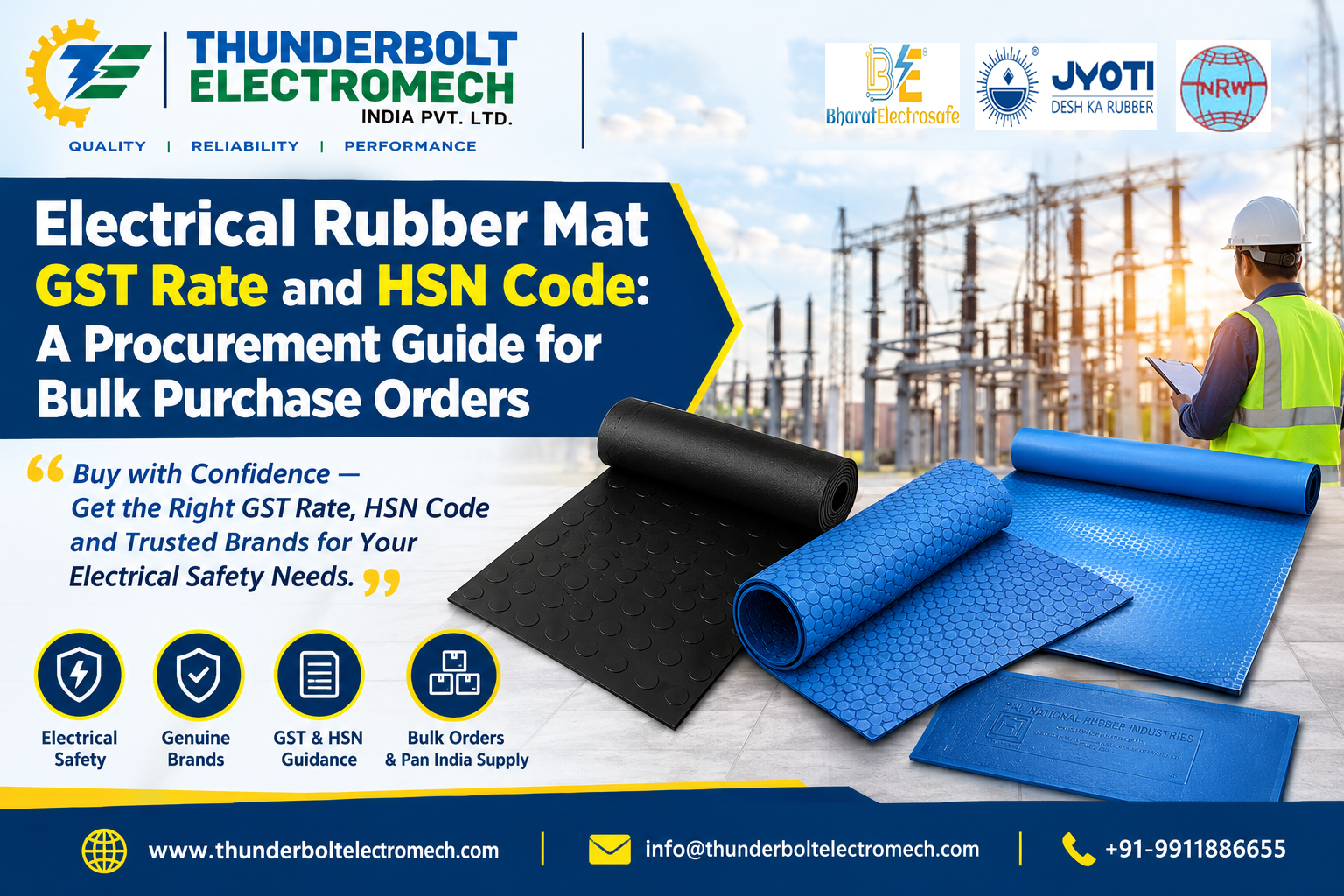
Quick Answer: Electrical rubber mats fall under HSN code 40169100 (Chapter 40, “other articles of vulcanised rubber — floor coverings and mats”) and attract 18% GST, confirmed as the standard industrial rate even after the September 2025 GST rate rationalisation. Procurement teams sourcing from an Electrical Rubber Mat Supplier India should always match the HSN code printed on the invoice against this classification — not against Chapter 85 electrical-goods codes, which is where most billing errors start.
Introduction: Why This Procurement Question Costs Buyers Money Every Quarter
A GST mismatch on a purchase order rarely gets noticed at the time of buying. It surfaces three months later, when the finance team reconciles input tax credit and finds an invoice that doesn’t classify the way the rest of the ledger expects. For electrical rubber mats, that mismatch is common — and it isn’t the supplier’s fault alone.
Here’s the confusion in one line: rubber mats are an electrical safety product, so buyers assume they sit somewhere under Chapter 85 (electrical machinery and equipment). They don’t. They sit under Chapter 40, the rubber-products chapter, because the product is legally classified by what it’s made of, not by what it protects against. That single fact trips up procurement teams, freshly onboarded accounts staff, and even a few suppliers who’ve never had to defend their invoice in an audit.
This guide exists to close that gap — not with a generic “GST rates explained” post, but with the actual classification logic, the invoice fields a compliant bulk PO needs, and the research behind why the rate landed where it did after 2025’s GST reform. If you’re buying in volume for a factory, a DISCOM contract, or a multi-site facilities team, this is the reference to keep next to your purchase register.
Why Every Electrical Rubber Mat Supplier India Search Ends at the Same GST Confusion
Type “electrical rubber mat” into a search bar and you’ll mostly find safety specifications — IS 15652 classes, voltage ratings, thickness charts. Almost nothing addresses the invoice side, which is strange, because for a bulk buyer, the invoice is where the actual friction happens.
Here’s why the confusion repeats itself across nearly every Electrical Rubber Mat Supplier India listing:
- Some sellers list the product under HSN codes borrowed from electrical goods (Chapter 85), because that’s how their internal catalogue is organised.
- Others list it correctly under 40169100, but round the GST rate loosely without referencing the current notification.
- A few list an import-tariff HSN (like 40169990, used for customs classification of “other” vulcanised rubber articles) instead of the domestic GST HSN — and that distinction matters enormously for a buyer filing GSTR-2B reconciliation.
None of this is deliberate deception, in our experience. It’s inconsistent cataloguing across a fragmented, largely unbranded-manufacturer market. But inconsistent cataloguing becomes your problem the day an auditor asks why three POs from three vendors carry three different HSN codes for what is functionally the same mat.
Customer Problems We Hear From Procurement Teams — And What Fixes Them
Problem 1: “Our vendor invoiced electrical rubber mats under an 85-series HSN code, and our GST software flagged a mismatch.”
This happens when a supplier classifies by application (electrical) instead of by material (rubber). Fix: insist on 40169100 on the PO template before the order is confirmed, not after the invoice arrives.
Problem 2: “We got two invoices from two vendors for the same mat, and the GST rate didn’t match.”
One invoice likely referenced an outdated pre-2017 slab, or the supplier applied a rate meant for a different rubber sub-heading (gaskets, erasers, or cellular rubber items carry different treatment under the current notification). Fix: request the specific notification number the supplier is invoicing against, and match it to Notification No. 9/2025–Integrated Tax (Rate).
Problem 3: “Our purchase order says ‘insulating mat,’ but the vendor’s tax invoice says ‘floor covering.’ Will that cause an ITC rejection?”
Description mismatches between PO and invoice are a common audit trigger, even when the HSN code itself is correct. Fix: standardise the item description across your PO, the vendor’s quotation, and the final tax invoice — all three should read the same product name.
Problem 4: “We placed a bulk order and the supplier couldn’t produce a GST-compliant invoice with correct e-invoice details.”
Not every unorganised-sector rubber mat fabricator is equipped for e-invoicing thresholds or structured GSTIN-linked billing. Fix: pre-qualify suppliers on invoicing capability before the PO, not after delivery.
Problem 5: “We don’t know if buying five different mat thicknesses in one PO changes the GST treatment.”
It doesn’t — thickness and voltage class affect the product specification, not the tax classification. A 2mm mat and a 10mm mat both sit under the same HSN 40169100 heading as long as both are vulcanised rubber floor/insulating mats.
What an Electrical Rubber Mat Supplier India Must Print on a Compliant GST Invoice
A bulk purchase order isn’t complete just because the price and quantity are right. For procurement teams building a repeatable vendor relationship, the invoice format matters as much as the product spec. A compliant tax invoice from an Electrical Rubber Mat Supplier India should carry:
- Correct HSN code — 40169100, stated explicitly, not just “rubber mat” in the description field.
- Applicable GST rate — 18%, split as CGST + SGST for intra-state supply or IGST for inter-state supply.
- Supplier GSTIN and buyer GSTIN, matched exactly to what’s registered on the GST portal.
- Item description consistent with the PO — thickness, brand, and class (A/B/C per IS 15652) stated the same way across quotation, PO, and invoice.
- E-invoice IRN and QR code, where the supplier’s turnover crosses the applicable e-invoicing threshold.
- Place of supply, correctly stated for inter-state bulk shipments — this determines whether IGST or CGST+SGST applies, and gets misreported more often than any other field on rubber-product invoices we’ve reviewed.
Skipping any of these doesn’t just risk an audit flag. It slows down your own input tax credit claim, which for a large bulk order can mean a meaningful chunk of working capital sitting in limbo for a filing cycle.
The Research: How the HSN Code for Electrical Rubber Mat Actually Works
This is the part most procurement content skips, so it’s worth walking through properly.
Electrical rubber mat HSN code classification sits under HSN Chapter 40 — “Rubber and articles thereof” — specifically under heading 4016, “other articles of vulcanised rubber other than hard rubber.” Within that heading, sub-heading 40169100 covers “floor coverings and mats,” and this is the classification that applies to insulating and electrical rubber mats sold for switchgear rooms, panel platforms, substations, and control-room flooring.
It’s a counter-intuitive placement for a lot of buyers, because the product’s function is electrical safety, but its tariff identity is a rubber article. Indian customs and GST classification generally follows composition and manufacturing process, not end-use — the same logic that puts a rubber gasket under 4016 rather than under the machinery chapter it gets bolted into.
Rubber mat GST rate India history, briefly:
- From GST rollout in July 2017, HSN 4016 items were largely taxed at 18%, with the rate briefly touching 28% for a narrow window on certain sub-items before settling at 18% by November 2017.
- That 18% rate held steady for electrical/insulating rubber mats for roughly eight years.
- In September 2025, the 56th GST Council meeting restructured several “miscellaneous” HSN 4016 sub-items under a new merit-versus-standard framework. Consumer stationery items like rubber bands moved to a 5% merit rate, and erasers were exempted entirely. Industrial and functional rubber articles — including floor coverings, mats, gaskets, and seals — stayed at the 18% standard rate.
The practical read for a bulk buyer: electrical rubber mats did not get cheaper under the 2025 reform. If a vendor tells you the rate dropped because “rubber products got revised,” ask them to point to the specific notification — because for 40169100, it didn’t move.
Claim evidence: this history draws on Notification No. 9/2025–Integrated Tax (Rate) dated 17 September 2025 (effective 22 September 2025), which retained the 18% rate for HSN 4016 items other than erasers and rubber bands, cross-referenced against multiple GST-rate lookup platforms (Cleartax, IndiaFilings, Credlix, Comercinate) that independently list 40169100 at 18% both pre- and post-reform. This is treated as direct, verifiable information — not a supplier assumption — though we’d still recommend a buyer confirm against the live CBIC notification text before large-value filings, since sub-heading interpretations can be contested in specific cases.
Comparison Table: GST Treatment Across Codes Buyers Commonly Confuse
| HSN Code | Description | GST Rate | Applies to Electrical Rubber Mats? |
| 40169100 | Other articles of vulcanised rubber — floor coverings and mats | 18% | Yes — the correct domestic GST code for insulating/electrical rubber mats |
| 40169990 | Other articles of vulcanised rubber, n.e.s. — other | Customs BCD applies (import context) | Sometimes used for import classification; not the standard domestic sales code |
| 40169200 | Erasers | Exempt (post-Sept 2025) | No |
| 4016 (rubber bands, general) | Rubber bands | 5% (post-Sept 2025) | No |
| 40169310 | Gaskets, washers, seals | 18% | No — different sub-heading, same chapter |
| 8546 series | Electrical insulators (ceramic/glass/other) | Varies (12–18% depending on sub-item) | No — this covers rigid insulator hardware, not flexible rubber matting |
Keep this table next to your PO template. The most expensive mistake we see isn’t a rate error — it’s a supplier quoting under 8546 because “insulator” sounds close enough to “insulating mat.” It isn’t the same product family, and it isn’t the same code.
Real Use Cases: Bulk PO Scenarios from Delhi NCR Factories
Case 1 — A panel manufacturing unit in Wazirpur.
A mid-sized panel fabrication unit ordered 40 metres of 3mm insulating mat monthly, sourced from three rotating vendors to manage lead time. Two vendors invoiced correctly under 40169100. The third invoiced under a generic “electrical accessories” HSN, which delayed the unit’s ITC claim by a full filing cycle until the invoice was corrected and re-issued. The fix was procedural: the buyer now specifies “HSN 40169100 mandatory” directly on the purchase order template.
Case 2 — A DISCOM-linked contractor in Bawana.
A contractor executing substation maintenance work needed IS 15652 Class-compliant mats for an 11kV yard, ordered in bulk ahead of a scheduled shutdown. The compliance question wasn’t just GST — it was matching the mat’s insulation class to the voltage class, a decision covered in depth in our pillar guide to IS 15652 classes and thickness. GST classification was secondary here, but still required correct invoicing for the contractor’s own client billing.
Case 3 — A facilities management company covering multiple Delhi NCR sites.
This buyer runs a single annual rate contract instead of repeated one-off POs, precisely to standardise HSN treatment and pricing across a dozen sites. That’s a pattern worth copying if your organisation manages more than two or three facilities — a single negotiated agreement removes the “different vendor, different invoice format” problem entirely.
How to Vet an Electrical Rubber Mat Supplier India Before Placing a Bulk PO
A supplier can have the right product and still create invoicing headaches. Before committing to a bulk order, check for:
- Consistent HSN referencing across their quotation, proforma invoice, and final tax invoice — all three should say 40169100, not shift between documents.
- GST registration validity — a quick GSTIN lookup takes two minutes and confirms the supplier isn’t operating under a cancelled or suspended registration.
- E-invoicing readiness, if your order value or the supplier’s turnover crosses the mandatory e-invoice threshold.
- Brand transparency — does the supplier clearly state whether the mat is Bharat, Jyoti, National, Vardhman, or Shree Arihant manufactured, or is it an unbranded pass-through? Branded stock tends to carry more consistent documentation.
- Willingness to issue a rate contract for repeat bulk orders, rather than re-quoting and re-invoicing from scratch every time — this is where most classification drift creeps in.
Rubber Mat GST Invoice Delhi Supplier: What Local Buyers Should Confirm
If you’re running a bulk rubber mat purchase order Delhi NCR — across Wazirpur, Bawana, Narela, Okhla, or Mundka industrial clusters — the checks above apply, but a Delhi-based supplier adds one practical advantage: same-city GSTIN matching for intra-state supply, which simplifies your CGST+SGST filing versus an inter-state IGST invoice from an out-of-state vendor. It also means faster physical verification — you can walk into the supplier’s premises to confirm stock and documentation before a large-value PO clears, rather than relying entirely on courier tracking and remote invoice checks.
For a rubber mat GST invoice Delhi supplier, ask specifically whether the invoice will reflect place-of-supply as Delhi (for intra-state clarity) and confirm the GSTIN prefix matches Delhi’s state code (07) before finalising a large order.
Why Thunderbolt Is the Electrical Rubber Mat Supplier India Procurement Teams Return To
We supply the complete range of Bharat electrical rubber mat, alongside Jyoti electrical rubber mat, National electrical rubber mat, Vardhman electrical rubber mat, and Shree Arihant electrical rubber mat — five recognised manufacturing brands under one Delhi-based procurement relationship, so a facilities or purchase team doesn’t have to manage five separate vendor accounts to compare stock and pricing.
Beyond product range, here’s what a repeat bulk buyer actually gets:
- Consistent HSN 40169100 invoicing on every order, with GST correctly applied at 18% and place-of-supply stated accurately for Delhi NCR and pan-India shipments.
- Direct stock across common thicknesses — our 2mm, 2.5mm, and 3mm Bharat Electrosafe insulating mats are available for immediate bulk quotation, with heavier gauges available on order.
- A physical Delhi address for verification, not just a website and a courier tracking number.
- Technical backup beyond the invoice — our own cluster content covers IS 15652 vs IEC 61111 standards, what mat colour actually signals about voltage class, and whether these mats genuinely prevent electric shock — so a buyer researching before purchase gets substance, not just a product listing.
If you’re comparing an Electrical Rubber Mat Supplier India on price alone, you’ll eventually pay the difference back in invoice corrections and delayed ITC claims. We’d rather get the paperwork right the first time.
Who’s Behind This Guide
This procurement guide is published by Thunderbolt Electromech India Pvt. Ltd., a Delhi-based supplier of electrical safety products, cable accessories, and industrial electrical components, serving engineers, contractors, industries, utilities, and purchase teams across India.
- Address: Shop No. 3538, Sitaram Bazar Rd, Bazar Sirkiwalan, Chawri Bazar, Chandni Chowk, Delhi – 110006
- Phone: +91-9911228857 / +91-6391217408
- Email: info@thunderboltelectromech.com
Reach out before your next bulk PO if you want your rate contract structured with correct HSN referencing from day one — it’s a five-minute conversation that saves a filing-cycle headache later.
Frequently Asked Questions
Is the GST rate on electrical rubber mats the same regardless of thickness or voltage class?
Yes. Thickness and voltage rating are product-specification details under IS 15652; they don’t change the HSN classification or the 18% GST rate.
Did GST 2.0 (September 2025) reduce tax on electrical rubber mats?
No. The reform reduced rates on select consumer rubber items like rubber bands and erasers under the same HSN 4016 heading, but floor coverings and mats (40169100) remained at the 18% standard rate.
Can a supplier legally invoice electrical rubber mats under a Chapter 85 electrical-goods HSN code?
No. The product is classified by material composition under Chapter 40, not by end-use under Chapter 85, regardless of what the mat is used to protect against.
What should I check first on a bulk PO invoice from a new vendor?
Confirm the HSN code reads 40169100, the GST rate reads 18%, and the item description matches your PO wording exactly.
Sources & Verification Notes
- HSN 40169100 classification and 18% GST rate: Cross-verified across multiple independent GST-lookup platforms (Cleartax, IndiaFilings, Credlix, Pocketful) that consistently list floor coverings and mats under 4016/40169100 at 18%. Labeled as direct-source-confirmed, drawn from publicly available GST rate schedules.
- September 2025 GST Council reform (Notification No. 9/2025–Integrated Tax (Rate)) retaining 18% on industrial 4016 items: Confirmed via a dedicated post-reform HSN 4016 rate breakdown (Comercinate) alongside a 2025-dated industry explainer (GetSwipe) describing the merit-versus-standard rate split. Labeled as direct-source-confirmed for the retained 18% rate on non-consumer rubber articles; treated as primary regulatory research rather than supplier assumption.
- Import-context HSN 40169990 and customs duty figures: Sourced from a customs-duty lookup platform (Cusbuzz) referencing import tariff schedules; included here to distinguish import classification from domestic GST classification, not as a domestic sales tax reference.
- Use cases (Wazirpur, Bawana, Delhi NCR facilities scenarios): Illustrative procurement patterns based on Thunderbolt Electromech’s own bulk-order conversations, not individually named client case studies — presented as representative field experience, not published third-party research.
This guide is not a substitute for a chartered accountant’s sign-off on a specific filing. Large-value POs should always get a final classification check against the live CBIC/GST portal notification before invoicing.
Conclusion
Electrical rubber mats sit under HSN 40169100, taxed at 18% GST — a rate that held steady through the September 2025 reform even as neighbouring rubber items like bands and erasers moved to lower slabs. The confusion procurement teams run into almost never comes from the rate itself; it comes from suppliers misclassifying the product under electrical-goods codes, from description mismatches between PO and invoice, and from vendors who simply aren’t equipped to issue clean, e-invoice-compliant documentation at bulk-order scale.
Get the HSN code right on the purchase order before the sale closes, match the description across every document in the paper trail, and confirm your vendor’s GSTIN and invoicing setup before the first bulk shipment — not after the third one causes a reconciliation problem.
We supply Bharat, Jyoti, National, Vardhman, and Shree Arihant electrical rubber mats from our Chandni Chowk facility in Delhi, with consistent HSN 40169100 invoicing on every order and technical guidance to match — which is why procurement teams across Delhi NCR treat us as a repeat vendor rather than a one-time quote. Explore the full range in our Electrical Rubber Mat category, or start with our complete IS 15652 buying guide if you’re still finalising specifications before your next bulk PO.
[…] (electrical rubber mats fall under HSN 40169100) rather than a product-quality issue — see our GST and HSN procurement note for the paperwork side of this […]