Quick Answer: IEC 60903 is the international standard for electrical insulating gloves used in live work. It sets six voltage classes — 00 through 4 — covering 500V up to 36,000V, along with the manufacturing rubber grade and proof-test voltage each glove must pass before sale. India’s IS 4770 mirrors it closely. Thunderbolt Electromech supplies Raychem, Crystal, and Vidyut gloves certified to both standards, matched to your actual working voltage rather than guesswork.
Introduction
A lineman touches a live 11kV isolator. His glove is rated Class 2. It holds. Twenty metres away, a maintenance technician grabs a pair of cheap “rubber gloves” off a hardware store shelf to check a 440V panel. That glove was never tested to any voltage standard. It fails in under a second, and there is no warning before it does.
That gap between “looks like a safety glove” and “is a certified safety glove” is exactly what IEC 60903 exists to close. This guide breaks the standard down in plain language: what it tests, how the six voltage classes work, and how to pick a glove that actually matches your job — not just your budget.
Thunderbolt Electromech India Pvt. Ltd. is a Delhi-based Electrical Hand Gloves Supplier supplying Raychem, Vidyut, and Crystal insulating gloves to electricians, contractors, and utility teams across India. Everything below is written from that vantage point — years of moving these gloves from factory to field, and hearing directly from buyers what goes wrong when the wrong class gets ordered.
What Is IEC 60903? The Global Benchmark for Insulating Gloves
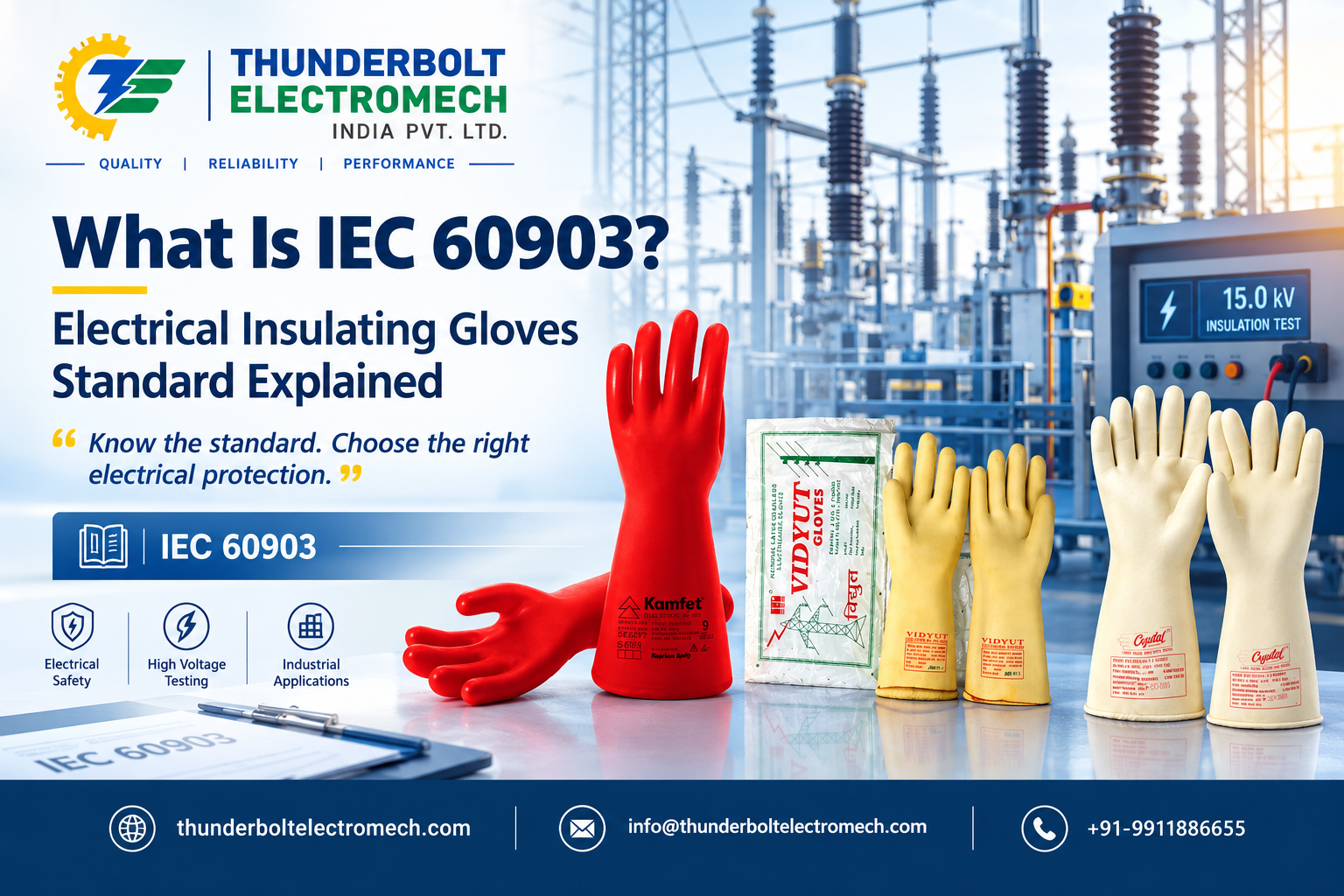
IEC 60903 is the international standard published by the International Electrotechnical Commission for insulating gloves and mitts used in live electrical work. It does not describe comfort or fit. It describes survival. The standard sets out how gloves must be manufactured, how thick the rubber must be at minimum, and — most importantly — how each glove is proof-tested before it ever reaches a technician’s hands.
The standard splits gloves into six classes, Class 00 through Class 4, based on the maximum voltage they are certified to withstand. A higher class means thicker rubber, a higher proof-test voltage, and less finger dexterity. That trade-off is the entire logic of the standard: protection against feel.
India runs its own parallel standard, IS 4770, which mirrors IEC 60903 closely in test potential and working potential values. Most reputable Indian manufacturers — including Raychem, Vidyut, and Crystal — test and certify against both. In the US, the equivalent is ASTM D120, referenced directly by OSHA under 29 CFR 1910.137. The three standards use nearly identical voltage bands, which is why global buyers can cross-reference class numbers without much confusion.
IEC 60903 also defines glove types beyond voltage class, based on chemical resistance: Type I gloves use natural rubber and offer no special ozone resistance, while Type II gloves are made from synthetic compounds that resist ozone degradation, a relevant distinction for sites near transformers, switchgear rooms, or anywhere corona discharge is a routine background condition. A buyer working purely on LT residential panels rarely needs Type II. A buyer stationed permanently inside a switchyard usually should ask for it specifically, because ozone exposure there is constant rather than occasional.
Why Every Electrical Hand Gloves Supplier Must Follow IEC 60903
Not every seller tests what they sell. That’s the uncomfortable truth of this market. A glove that looks identical to a certified one can be missing the internal test entirely, and there’s no way to tell just by touching it.
This is why the certification process matters more than the glove itself. Under IEC 60903, every single glove — not a sample batch, every unit — goes through a routine electrical test called the withstand test. The glove is filled with water or a conductive medium, immersed partly in a tank, and a proof voltage well above its rated working voltage is applied. A Class 0 glove rated for 1,000V AC use is proof-tested at 5,000V. A Class 2 glove rated for 17,000V is tested near 20,000V. That gap is not marketing. It is the margin that absorbs voltage transients, minor material fatigue, and the unpredictability of a live fault.
An honest electrical hand gloves supplier will hand you a test certificate on request, showing the batch’s test potential and date. If a seller can’t produce that, walk away — regardless of price.
There’s a second layer most buyers never think about: rubber ages even sitting in a box. Natural latex rubber, the material most Indian-made gloves use, slowly loses elasticity through oxidation. Heat, sunlight, and ozone from nearby electrical arcing all accelerate this. A glove manufactured two years ago and never used can already have reduced dielectric performance, even if it looks fine. That’s an engineering reality most sales pages skip over, and it’s why retest intervals exist — not just first-use certification.
The Six Voltage Classes of Electrical Insulating Gloves, Explained
Every class under IEC 60903 is built around one number: maximum use voltage. Here is what each class actually covers, and where it fits on a real job site.
Class 00 — Up to 500V AC
The entry-level class. Thin, flexible, close to bare-hand dexterity. Used for control panels, low-voltage residential wiring, and light appliance repair. Do not use Class 00 near three-phase distribution boards — the margin is too thin for anything above household circuits.
Class 0 — Up to 1,000V AC
The most common class among general electricians in India. Covers single-phase installations, switchboards, lighting circuits, and most LT (low tension) panel work up to 440V three-phase, with comfortable safety margin. This is the class Thunderbolt moves in the highest volume, largely because it matches the bulk of commercial and industrial LT work.
Class 1 — Up to 7,500V AC
The step into HV (high tension) territory. Used for small substations, industrial switchgear, and — per several utility live-working manuals — for testing and operating equipment on LV systems where thicker protection is preferred even though the system voltage is lower. Class 1 gloves are noticeably stiffer than Class 0.
Class 2 — Up to 17,000V AC
Standard for 11kV distribution networks, a voltage level extremely common across Indian urban and semi-urban grids. If your team works anywhere near 11kV ring main units, Class 2 is very likely your baseline requirement, not an upgrade.
Class 3 — Up to 26,500V AC
Used on higher-tier substation and transmission-adjacent work. Less common in daily commercial use, more common with state utility maintenance crews and large industrial captive power setups.
Class 4 — Up to 36,000V AC
The thickest, stiffest glove in the range, reserved for extra-high-voltage linework and transmission-level tasks such as 33kV switching. Dexterity is at its lowest here; crews typically pair it with insulated tools rather than fine manual work.
The Two-Glove System: Why Rubber Alone Isn’t Enough
Field crews rarely wear an insulating glove on its own. IEC 60903 gloves are almost always paired with a separate leather protector glove worn over the rubber. The leather does zero electrical work — it carries no dielectric rating at all. Its job is purely mechanical: stopping sharp edges, abrasion, and punctures from reaching the rubber underneath.
This matters because a rubber glove with a pinhole tear stops protecting the instant that tear appears, even if the tear is invisible to the eye. Leather protectors extend the working life of the rubber glove dramatically, and several utility manuals treat the pair as a single unit rather than two separate items. Buying rubber gloves without protectors is a common shortcut, and it’s usually the reason gloves fail air tests months earlier than expected.
Comparison Table: IEC 60903 Glove Classes at a Glance
| Class | Max AC Voltage | Max DC Voltage | Colour Code (typical) | Common Application |
| 00 | 500V | 750V | Beige | Household wiring, low-voltage panels |
| 0 | 1,000V | 1,500V | Red | LT panels, switchboards, lighting circuits |
| 1 | 7,500V | 11,250V | White | Industrial switchgear, small substations |
| 2 | 17,000V | 25,500V | Yellow | 11kV distribution, ring main units |
| 3 | 26,500V | 39,750V | Green | Substation and transmission-adjacent work |
| 4 | 36,000V | 54,000V | Orange | 33kV switching, extra-high-voltage linework |
DC ratings run roughly 1.5 times the AC rating for the same class, a detail buyers frequently miss when specifying gloves for DC-heavy environments like EV charging infrastructure or battery banks. Never assume a glove’s AC number applies to a DC job without checking the DC column.
How Thunderbolt Electromech Works as an Electrical Hand Gloves Supplier Across Delhi and India
Thunderbolt Electromech India Pvt. Ltd. was built on nearly two decades of electrical trading experience out of Bhagirath Palace, Delhi — one of India’s densest electrical component markets, where Mr. Pankaj Pandey’s earlier venture, Simaltia Corporation, supplied insulating gloves and safety gear to contractors and to major power distribution utilities including NDPL and BSES for years. That background shapes how Thunderbolt operates today as an electrical hand gloves supplier: stock the classes that Indian job sites actually need, and know which brand fits which budget and duty cycle.
Three glove lines run through Thunderbolt’s catalogue:
- Raychem — precision-manufactured, available across Class 0 to Class 2 and beyond, generally chosen by industrial buyers who want documented, brand-consistent test records.
- Crystal — the workhorse line for Indian field conditions, including the 1100V working-potential glove referenced earlier and 33kV-rated variants, built for line-men and daily HT handling.
- Vidyut — a cost-efficient option for buyers who need IS 4770-compliant protection without paying for premium-tier packaging.
Every glove ships as part of the wider Electrical Hand Gloves range, and buyers comparing classes side by side can start from the complete buying and safety guide, which walks through sizing, storage, and reordering cycles in more depth than a single standard explainer can.
Engineering Insight: Why Glove Thickness Isn’t the Whole Safety Story
Most buying guides stop at “thicker equals safer.” That’s only half true, and treating it as the whole truth causes real mistakes on-site.
Dielectric breakdown in rubber does not scale in a straight line with thickness. It scales more closely with the material’s internal void structure — microscopic air pockets or inconsistencies left over from vulcanisation. A glove with slightly thinner but more uniform rubber can outperform a thicker glove riddled with tiny voids, because breakdown voltage collapses fast once it reaches one of those weak points. This is exactly why IEC 60903 tests every single glove electrically rather than trusting a thickness spec on a data sheet. Thickness is a manufacturing target. Withstand voltage is a measured outcome. They correlate, but they are not the same number.
There’s a second factor specific to Indian conditions that rarely makes it into generic articles: ozone exposure near arcing equipment and UV exposure from open storage both attack the same molecular bonds in natural rubber, accelerating micro-crack formation years before a glove looks worn. A glove stored near a switchyard or left in a van under direct sun for months can lose measurable dielectric margin invisibly. That’s the practical argument for the routine air test described next — not a bureaucratic formality, but a genuine catch for degradation you cannot see or feel.
Testing, Retesting, and the Air Test: What IEC 60903 Actually Requires
Two separate tests run through the lifecycle of every certified glove.
Factory withstand test. Every glove is tested once during manufacturing at a proof voltage several times its rated maximum. This is a pass/fail gate before the glove is packaged and sold.
Field air test, before every use. This one falls on the user, not the factory. Roll the glove’s cuff to trap air inside, then squeeze to inflate it slightly. Watch and listen for a leak — a hiss, a visible bulge, or a pinhole. A glove that fails an air test has a physical breach and must be pulled from service immediately, regardless of how recently it was purchased.
Periodic retest, typically every six months. Utilities and larger industrial users send gloves back for electrical retesting on a defined cycle — six months is the interval most commonly cited across IEC-based live-working manuals. Gloves that fail retest are destroyed, not repaired. There is no repair process for insulating rubber; a compromised glove is scrap, full stop.
Comparison Table: Raychem vs Vidyut vs Crystal Through Thunderbolt’s Electrical Hand Gloves Supplier Network
| Factor | Raychem | Crystal | Vidyut |
| Positioning | Premium, brand-documented | Field workhorse | Budget-conscious |
| Typical classes stocked | 0 to 2 | 00 to Class 3-equivalent HT | 0 to 1 |
| Best fit for | Industrial buyers, audited sites | Line crews, HT maintenance | Small contractors, repeat bulk orders |
| Certificate on request | Yes | Yes | Yes |
| Where Thunderbolt sees repeat orders | Panel manufacturers, EPC contractors | State utility subcontractors | Local electricians, small firms |
No direct source found for brand-level market positioning; this comparison reflects Thunderbolt’s internal sales pattern, not a third-party study.
Beyond Gloves: Why a Danger Plate Completes an Electrical Safety Setup
A certified glove protects the hand making contact. It does nothing to stop someone else from walking into a live panel while your technician is mid-task. That’s where a Danger Plate earns its place in the same purchase order as your gloves.
On Indian job sites, the pairing shows up constantly: insulating gloves for direct contact protection, plus a mounted danger plate at the panel, pole, or switchyard entrance to warn anyone approaching. Auditors checking compliance for factory or utility sites frequently flag missing warning signage even when PPE stock is otherwise complete. Ordering both together from one electrical hand gloves supplier saves a second procurement cycle and keeps the safety checklist genuinely complete, not just half-covered.
Common Customer Problems — And What Actually Fixes Them
Problem: “We bought Class 0 gloves, but our team works near 11kV equipment.”
Solution: That’s a class mismatch, not a product defect. Move to Class 2 immediately. A lower class glove near higher voltage equipment is not “extra caution” — it’s a direct safety gap.
Problem: “Our gloves passed inspection last year but failed this year’s retest.”
Solution: This is normal ageing, not a manufacturing fault. Rubber degrades with time, heat, and ozone exposure regardless of use frequency. Budget for periodic replacement as a recurring cost, not a one-time purchase.
Problem: “We can’t get a test certificate from our current supplier.”
Solution: Switch suppliers. A supplier unwilling or unable to produce batch test data is not operating to IEC 60903 or IS 4770 in any verifiable way, no matter what the box print claims.
Problem: “Gloves crack within months even though we barely use them.”
Solution: Check storage. Direct sunlight, proximity to arcing equipment, or damp storage bags all accelerate rubber breakdown. Store gloves in their original sealed pouch, away from UV and ozone sources.
Problem: “We need gloves fast for an audit next week and don’t know which class to order.”
Solution: Send your working voltage, not just a class guess, to your supplier. A quick call to Thunderbolt with the panel or line voltage in hand is usually enough to confirm the correct class and get stock moving the same day, rather than guessing and reordering after the audit fails.
Problem: “Our current supplier only sells one brand, and it’s out of stock.”
Solution: Diversify across certified brands rather than locking into one name. Raychem, Crystal, and Vidyut all meet the same IEC 60903 and IS 4770 test requirements, so a stock gap in one brand doesn’t have to stall a project when a supplier carries all three.
Real Use Cases From the Field
An EPC contractor wiring a commercial tower ordered Class 0 Raychem gloves in bulk for LT panel commissioning across multiple floors. The requirement was simple: consistent test documentation across every batch, because the site’s safety audit checked certificates against glove serial ranges.
A state utility subcontractor working 11kV ring main units standardised on Crystal Class 2 gloves after an incident review found an older batch had passed its visual check but failed dielectric retest — a case that reinforced why the six-month retest cycle is not optional paperwork.
A small electrical contracting firm in Delhi NCR switched from unbranded gloves bought locally to Vidyut Class 0 units after a client’s compliance officer rejected uncertified PPE during a site inspection. The switch cost marginally more per pair but resolved the compliance block in a single order.
A facilities management team running a data centre’s LT panel room kept failing internal safety audits over glove documentation, not glove quality. Their gloves were genuine and within class, but nobody had kept the batch certificates on file after purchase. The fix wasn’t a new product — it was asking their supplier to reissue certificates against the original invoice, and building a simple log going forward so every retest date was tracked against a serial range instead of a vague “last year” estimate.
Across all four cases, the pattern repeats: the failure point is rarely the glove itself. It’s a mismatch between voltage and class, a missing document, or a storage habit nobody questioned until an inspection forced the issue.
Choosing the Right Electrical Hand Gloves Supplier for Your Voltage Class
Start with the voltage you actually work on, not the voltage you’d like to be prepared for. Buying Class 4 gloves for LT panel work adds cost and kills dexterity for no safety benefit; buying Class 0 for 11kV work is a genuine hazard.
A dependable electrical hand gloves supplier should be able to answer, without hesitation: which class matches you’re working voltage, whether the batch has a current test certificate, what the retest or replacement cycle should look like for your usage pattern, and whether accessories like leather protectors or a danger plate should ship alongside the order. If a supplier can’t answer those four questions clearly, keep looking. Thunderbolt fields these questions daily across Raychem, Crystal, and Vidyut orders, and the full class-by-class buying logic is laid out in the Hand Gloves Electrical Supplier in India — Complete Buying & Safety Guide for teams who want the deeper sizing and procurement detail.
Search behaviour around this category tells its own story. Buyers rarely type “IEC 60903” into a search bar unless they already work in compliance or procurement. Far more common are practical, high-intent phrases: “11kV rubber gloves price Delhi,” “electrical hand gloves for electricians online,” “Raychem gloves class 2 near me,” “IS 4770 certified gloves supplier,” and “electrical safety kit with danger plate and gloves.” Each of those phrases points to the same underlying need — a supplier who stocks the right class, proves it with a certificate, and ships fast. Thunderbolt structures its catalogue around exactly that pattern, rather than around technical jargon a working electrician has no reason to search for.
Climate is a factor Indian buyers should weigh that international guides rarely mention. Monsoon humidity accelerates surface tackiness and mould growth on stored rubber gloves if they sit in unventilated boxes for months. Coastal regions add salt-air corrosion risk to any metal fittings on gauntlet-style gloves. Neither issue shows up in a lab test written for temperate climates, which is one more reason to buy from a supplier who understands Indian storage conditions rather than one reselling imported stock with no local handling guidance.
For ongoing updates on glove classes, brand comparisons, and safety practice, the Electrical Hand Gloves category hub collects related articles in one place.
Frequently Asked Questions
Is IEC 60903 the same as EN 60903?
Practically, yes. EN 60903 is the European harmonised version of IEC 60903, carrying near-identical class definitions and voltage figures. A glove certified to one is generally accepted under the other.
Can I use a Class 1 glove for both LV and HV switching tasks?
Only within its rated 7,500V AC ceiling. Several utility manuals actually prefer Class 1 over Class 0 for LV switching because the thicker rubber survives rough handling better, but that preference does not extend to anything above the Class 1 voltage limit.
How do I know if a Crystal or Raychem glove is genuine and properly tested?
Ask your electrical hand gloves supplier for the batch test certificate before payment, not after delivery. A genuine IS 4770 or IEC 60903 certificate lists the test potential, working potential, and test date for that specific batch.
Do insulating gloves expire even if never worn?
Yes. Natural rubber oxidises over time regardless of use. Combine that with India’s heat and, in many regions, high ozone exposure near industrial equipment, and unused stock sitting in a warehouse for two-plus years should be retested before issue, not assumed safe.
What size and length do I need?
Most Indian electricians use 14-inch (35.5cm) length gloves for general LT and HT handling, which covers the hand and lower forearm. Jobs with confined-space forearm exposure may call for longer cuffs — check the specific product page or ask Thunderbolt’s team for a size recommendation matched to your task.
Research and Evidence Behind This Guide
- IEC 60903 / EN 60903 class-to-voltage mapping — Direct source, primary/peer-adjacent (standards-referencing technical page): Substation Safety.
- Class 1 field usage and retest cadence — Direct source, primary (utility live-working manual excerpt): Power & Cables IEC 60903 Gloves.
- ASTM D120 / IEC 60903 cross-reference and dual compliance — Direct source, secondary: ProtGuide Electrician Gloves Safety Guide.
- IS 4770 Indian standard test/working potential figures — Direct source, secondary (manufacturer documentation): Kankai Exports glove specification sheet.
- Proof-test voltage margin methodology (5x example on Class 0) — Direct source, secondary: Gloves N Stuff EN 60903 technical page.
- Brand-level sales pattern comparison in the table above — No direct third-party source found; based on Thunderbolt’s own order history.
Conclusion: What IEC 60903 Means for Your Next Glove Order
IEC 60903 is not a label on a box. It is the entire chain of manufacturing tolerance, proof testing, and periodic retesting that decides whether a glove protects a technician or fails silently at the worst possible moment. This guide walked through what the standard covers, why it exists, and how its six classes — 00 through 4 — map directly onto real voltage levels found on Indian job sites, from household panels to 33kV linework.
The comparison tables above give a fast reference for matching class to voltage and for weighing Raychem, Crystal, and Vidyut against your budget and duty cycle. The engineering notes on dielectric breakdown, ozone ageing, and the field air test cover what most product pages leave out — the reasons behind the rules, not just the rules themselves. The customer problems, real use cases, and supplier checklist are there to turn all of this into a decision you can act on this week, not just background reading.
Thunderbolt Electromech India Pvt. Ltd. supplies IEC 60903 and IS 4770 compliant Raychem, Crystal, and Vidyut electrical hand gloves, along with danger plates and related safety accessories, across India from our base at Shop No. 3538, Sitaram Bazar Road, Bazar Sirkiwalan, Chawri Bazar, Chandni Chowk, Delhi – 110006. Call +91-9911886655 / +91-9911228857, or write to info@thunderboltelectromech.com for batch test certificates, bulk pricing, or help matching a glove class to your working voltage. For the complete buying and safety walkthrough, visit our pillar guide, and browse the electrical hand gloves category for more class-specific articles.