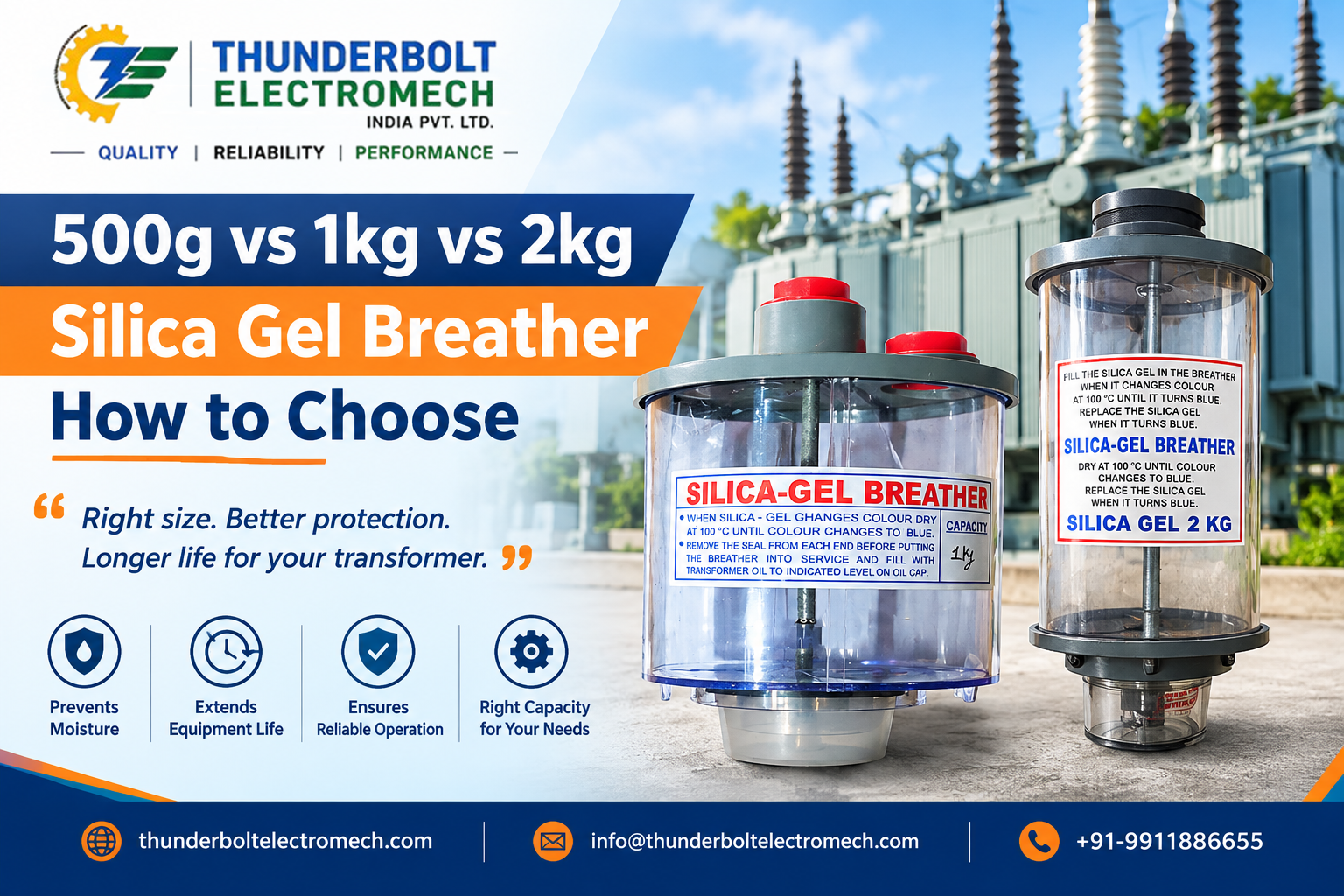
Quick Answer:Choose a 500g silica gel breather for small distribution transformers up to roughly 200 kVA, a 1kg breather for transformers between 200 kVA and 1 MVA, and a 2kg breather for units above 1 MVA or sites with heavy monsoon humidity, dust, or frequent load cycling. The right pick depends on conservator oil volume, breathing frequency, and ambient conditions — not just nameplate rating. As a Delhi-based Silica Gel Breather Supplier, Thunderbolt Electromech recommends verifying oil volume and site humidity before finalizing size.
Introduction
Walk into any substation yard in Delhi NCR during August and you will notice something: the silica gel columns saturate faster than the same units in Punjab or Rajasthan during the same month. That is not a manufacturing defect. It is physics — relative humidity in Delhi’s monsoon months regularly crosses 85%, and every breather on every conservator tank in the region is working overtime to keep pace.
This is exactly why the question “500g or 1kg or 2kg?” cannot be answered with a single chart lifted from a catalogue. It needs to be answered with an understanding of how a transformer actually breathes, how much air it moves per thermal cycle, and how your specific site — a rooftop solar plant in Gurugram, a packaging unit in Faridabad, or a residential feeder in Ghaziabad — changes the math.
In this guide, we break down the real engineering logic behind breather sizing, compare the three most commonly ordered capacities, and show you exactly where each one belongs. We will also flag which claims come from established standards and which are field practice, so you are not left guessing.
Why the Right Silica Gel Breather Supplier Matters More Than Size Alone
Most buyers start with a number — “my transformer is 500 kVA, so I need a 1kg breather” — and stop there. That approach misses half the picture. A breather’s job is not to match a kVA rating on paper; it is to absorb a specific volume of moisture-laden air over a specific inspection interval, under specific site conditions. Two 500 kVA transformers — one in a coastal humid belt, one in a dry inland zone — do not need identical breathers, even though the nameplate says the same thing.
This is where the supplier’s engineering input matters more than the datasheet. A capable Transformer Breather Supplier will ask about your conservator tank volume, average daily temperature swing, load cycling pattern, and maintenance frequency before recommending a size. A supplier who only asks for the kVA rating is giving you a guess, not a specification.
At Thunderbolt Electromech, sizing conversations typically cover four points before we quote:
- Conservator tank oil capacity (litres)
- Ambient relative humidity range at the installation site
- Load switching frequency (continuous industrial load vs. intermittent solar/wind feed)
- Maintenance interval the site can realistically commit to
If you’re comparing quotes from multiple vendors, ask each one these same four questions. A Silica Gel Breather Supplier Delhi buyers can rely on long-term will size for your actual operating conditions, not just the label on your transformer.
For a full walkthrough of thread sizes, mounting types, and installation checks, see our Complete Transformer Breather Buying & Safety Guide.
The Engineering Logic Behind Breather Sizing (Not Just a kVA Chart)
Here is the part most product pages skip entirely: a silica gel breather does not care about kVA directly. It cares about air volume displaced per breathing cycle, which is a function of oil expansion.
Mineral transformer oil expands at roughly 0.00075 per °C. As load and ambient temperature rise, oil in the tank and conservator expands upward; as the transformer cools at night or during low load, it contracts. Every contraction pulls outside air in through the breather, and every expansion pushes air (already dried once) back out. The volume of air pulled in on a hot afternoon-to-cool-night cycle is what the silica gel actually has to dry — not the transformer’s power rating in isolation.
Two practical consequences follow from this, and they rarely appear in generic buying guides:
1. Duty cycle changes the effective load on the breather, independent of kVA. A 500 kVA transformer feeding a steady industrial load breathes on a predictable daily thermal cycle. A similarly rated transformer at a solar step-up station, however, sees the oil temperature swing sharply every time cloud cover interrupts generation — sometimes several times an hour. That transformer effectively “breathes” far more often than its kVA rating suggests, and a breather sized only off the nameplate will saturate faster than expected. If your installation has frequent load switching (solar, wind, EV charging infrastructure), size one bracket up from the standard recommendation.
2. Real-world capacity is lower than lab capacity. Manufacturer literature quotes silica gel absorption at up to 25–40% of its own weight in moisture under standard atmosphere conditions (industry references cite roughly 27% at standard atmosphere and up to 40% at 100% relative humidity, aligned with the specification basis of Indian Standard IS 3401:1992 for silica gel used in this application). But field oil-vapor contact, dust ingress in industrial zones, and repeated partial saturation cycles reduce usable capacity by a meaningful margin — engineering teams working across multiple substations have observed breather life running well short of catalogue projections. Our practical advice: treat the datasheet capacity as a ceiling, not a working number, and build in a 20–30% margin when a site sits in a dusty industrial belt (common across large parts of Delhi NCR’s manufacturing clusters) — a detail rarely discussed outside field maintenance circles. (Field practice observation — no single published standard quantifies this exact margin; it is derived from maintenance-cycle comparisons across multiple installation types.)
Manufacturer sizing tables generally correlate as follows, and these numbers are directly documented across multiple breather manufacturer specification sheets:
- Small distribution transformers around 63 kVA, 100 kVA, and 200 kVA commonly use compact breathers in the 250g–500g range.
- Transformers scaling up toward 1 MVA typically move to the 1kg bracket.
- Power transformers in the multi-MVA range — commonly cited around 12.5 MVA — move up to 4kg–6kg breathers, confirming that capacity scales with oil volume and conservator size well beyond the 2kg bracket for genuinely large power transformers.
This is also why European sizing conventions (referenced under EN 50216-1) and Indian field practice do not map onto each other one-to-one — the oil quantity bands assigned to each breather size are built around regional ambient humidity assumptions, and Delhi’s monsoon humidity profile is more aggressive than the European baseline most import-spec charts are built on. If you’re importing a European sizing chart for an Indian installation, add a safety margin rather than following it exactly.
500g Silica Gel Breather: When the Smaller Capacity Is Actually the Right Call
A Silica Gel Breather 500g Empty is not a “budget” choice — it is the correct engineering choice for a specific band of transformers, and oversizing beyond this band wastes money without adding protection.
Where it fits:
- Distribution transformers in the 63 kVA to roughly 200–250 kVA range
- Low-humidity or moderate-climate installations with stable, non-cyclical loads
- Sites with a realistic monthly or bi-monthly inspection routine
- Retrofit replacements on older units originally fitted with a compact breather column
Why oversizing here backfires: A larger breather holds more gel, which sounds safer — but a bigger column also means a slower, more static air path in a low-breathing transformer. The oil cup and gel column are proportioned to match expected air displacement; putting a 2kg column on a 100 kVA transformer does not meaningfully extend service life if the transformer barely breathes enough air to reach the gel at the top of the column in the first place. You end up paying for capacity you cannot actually use.
What to check before ordering: Confirm your mounting connection (½”, ¾”, or 1″ BSP thread are the common options across manufacturers) and confirm the transformer’s existing flange matches — a mismatch here is the single most common installation delay we see reported by customers.
1kg Silica Gel Breather: The Mid-Range Pick Most Reputable Suppliers Recommend
The Silica Gel Breather (Empty), 1Kg sits at the point where most industrial-scale distribution and small power transformers land — and it is, unsurprisingly, the single most frequently ordered capacity by facilities across the NCR industrial belt.
Where it fits:
- Transformers between roughly 250 kVA and 1 MVA
- Industrial plants running continuous shift-pattern loads (textile units, packaging plants, small manufacturing facilities)
- Sites where maintenance staff can commit to a standard bi-weekly to monthly visual check on the gel’s colour band
- Locations with moderate humidity exposure — not full coastal conditions, but not arid either, which describes most of Delhi NCR outside of peak monsoon weeks
The engineering trade-off buyers miss: A 1kg breather gives you meaningfully more margin than a 500g unit, but it is still sized around a “normal” thermal cycling assumption. If your 500 kVA transformer sits at a site with heavy dust load — common near construction corridors or unpaved industrial access roads across Delhi NCR — the oil cup at the base of the breather fills with dust and moisture faster than the gel column saturates. In that scenario, the limiting factor isn’t gel capacity at all; it’s oil cup maintenance frequency. A 1kg breather on a dusty site still needs the same oil cup attention as a 500g one — capacity upgrades don’t fix a dust problem.
Every silica gel breather from Thunderbolt uses self-indicating gel that shifts colour band as it approaches usable saturation, so the visual check stays simple regardless of which size you run.
2kg Silica Gel Breather: What Heavy-Duty and High-Humidity Sites Actually Need?
The Silica Gel Breather 2Kg Empty is built for transformers and conditions where either the oil volume is large, the breathing frequency is high, or both.
Where it fits:
- Power transformers above roughly 1 MVA, up to several MVA depending on conservator size
- Solar step-up transformers and wind pad-mount units with frequent load-switching thermal cycles
- Sites in genuinely high-humidity zones or with long gaps between scheduled maintenance visits
- Installations where an unplanned breather failure carries high downtime cost — a manufacturing line stoppage, a data centre backup transformer, or a critical feeder substation
A note specific to Delhi NCR: Ambient relative humidity across the region climbs sharply during the July–September monsoon window, and a breather sized for “average annual humidity” will visibly saturate faster during those months than the rest of the year. Facilities running critical infrastructure in this region increasingly size one bracket up specifically to absorb that seasonal spike, rather than accepting a shortened inspection interval for three months a year. If your maintenance team cannot realistically tighten inspection frequency during monsoon, the 2kg breather is the more dependable long-term choice even on a transformer that would technically qualify for a 1kg unit on paper.
If you are sourcing for a facility anywhere across the NCR belt — Gurugram, Noida, Faridabad, Ghaziabad, or central Delhi — a Silica Gel Breather Delhi NCR supplier who stocks all three capacities locally also matters logistically: breather replacement is rarely planned weeks in advance, and local stock availability shortens the gap between a saturated gel column and a replaced one.
Comparison Table: 500g vs 1kg vs 2kg Silica Gel Breather
| Parameter | 500g Breather | 1kg Breather | 2kg Breather |
| Typical transformer range | 63–250 kVA | 250 kVA–1 MVA | 1 MVA and above |
| Ideal load pattern | Stable, continuous | Continuous with moderate cycling | Frequent thermal cycling (solar, wind, heavy industrial) |
| Recommended humidity zone | Low to moderate | Moderate | High humidity / monsoon-heavy regions |
| Approx. moisture uptake before replacement* | ~100–150g water | ~200–275g water | ~400–550g water |
| Suggested inspection interval | Monthly | Bi-weekly to monthly | Weekly to bi-weekly during monsoon |
| Common mounting threads | ½”, ¾” BSP | ½”, ¾”, 1″ BSP | ¾”, 1″ BSP |
| Common use cases | Residential feeders, small distribution transformers | Industrial plant transformers, mid-size distribution units | Power transformers, solar/wind step-up units, critical substations |
| Price positioning | Entry-level | Mid-range | Premium capacity |
*Estimated using the widely cited field reference that silica gel absorbs approximately 20% of its own weight in moisture before requiring regeneration or replacement; actual figures vary with ambient humidity and gel grade.
For current rates on each size, check our Silica Gel Breather Price listings or contact our sales desk directly — pricing shifts with raw material and freight costs, so catalogue figures are updated periodically rather than fixed.
Customer Problems and Solutions
Most sizing complaints we hear from facility engineers fall into a short list of repeat patterns. Here’s how each one is actually resolved.
Problem: “Our breather turns pink within two weeks, every time.”
This is almost always an undersized breather for the site’s humidity and breathing frequency, not a faulty product. Solution: step up one capacity bracket, and check whether the oil cup is holding oil at the correct level — an underfilled oil cup lets unfiltered air bypass some of the gel’s effective surface, accelerating apparent saturation.
Problem: “We bought a 2kg breather but it still looks half-empty of visible colour change after months.”
This usually means the unit is oversized relative to actual breathing volume, which isn’t dangerous but does mean money was spent on capacity the transformer will never use. Solution: for the next replacement cycle, drop to 1kg and redirect the savings toward a shorter inspection interval instead.
Problem: “Maintenance staff keeps missing the colour change until it’s fully saturated.”
Solution: self-indicating gel only helps if someone is looking. Pair breather sizing with a fixed inspection calendar rather than relying on staff noticing incidentally during unrelated site visits.
Problem: “We don’t know our conservator tank’s oil volume, so we can’t size correctly.”
Solution: this information sits on the transformer’s original nameplate or datasheet; if unavailable, a supplier can estimate volume from tank dimensions. Never guess — a wrong assumption here compounds every other sizing decision.
Problem: “Local suppliers only stock one size, and lead time for the right one is a week or more.”
Solution: work with a Silica Gel Breather Dealer Delhi that carries 500g, 1kg, and 2kg as standard stock rather than made-to-order — this is precisely the gap Thunderbolt’s inventory model is built to close for facilities across the NCR region.
Real Use Cases
Case 1 — Residential feeder transformer, East Delhi.
A 100 kVA distribution transformer serving a residential colony ran on a 500g breather with monthly visual checks. Load pattern was stable, humidity moderate outside monsoon weeks. The 500g unit matched both the breathing volume and the maintenance capacity of the local utility team — no oversizing needed.
Case 2 — Packaging unit, Faridabad industrial area.
A 630 kVA transformer running two-shift continuous load in a dust-heavy industrial zone was originally fitted with a 500g breather that needed replacement almost monthly. Moving to a 1kg unit combined with more frequent oil cup cleaning (to address the dust load specifically, not the gel capacity) extended the practical interval significantly, without requiring the largest available size.
Case 3 — Rooftop solar step-up transformer, Gurugram.
A 1.25 MVA step-up transformer tied to a commercial rooftop solar array experiences frequent thermal cycling from intermittent generation through the day. A 1kg breather saturated faster than its rated transformer size would normally suggest, specifically because of cloud-driven load swings rather than total energy throughput. Switching to a 2kg breather brought the inspection interval back in line with the site’s realistic maintenance schedule, illustrating exactly the duty-cycle effect described earlier in this guide.
These are illustrative scenarios based on commonly reported field patterns for these transformer classes and site conditions, not disclosed customer records.
Sources & Evidence Notes
Transparency on where these figures come from:
- Moisture absorption capacity (25–40% of gel weight, ~27% at standard atmosphere): documented in technical discussion referencing British Standard 2540-1991 and Indian Standard IS 3401-1992 for silica gel specification — treated as a primary standards-based reference.
- kVA-to-breather-size correlation (63/100/200 kVA using compact sizes; 12.5 MVA using 4–6kg): drawn from published manufacturer selection guides for graded breather series — a primary/manufacturer-level source, though exact breakpoints vary by brand and conservator design.
- Self-indicating gel changing colour near 70–80% saturation, and the caution against half-change indicator types: referenced from an industry buying-guide discussion — treated as secondary/practitioner-level guidance rather than a formal standard.
- Oil expansion coefficient and thermal-breathing mechanics: standard transformer engineering physics, not tied to a single source.
- Duty-cycle effect on solar/wind installations and the 20–30% real-world capacity margin: field-practice observation compiled from cross-referencing multiple maintenance discussions; no single published standard was found quantifying this exact margin — flagged here as practitioner-derived guidance, not a codified figure.
- EN 50216-1 European oil-quantity sizing bands versus Indian humidity conditions: the European standard reference is directly documented by breather manufacturers; the comparative humidity-margin recommendation for Indian sites is our own engineering interpretation, not a direct standard citation.
Where a specific number could not be traced to a standard or manufacturer datasheet, it has been labelled as field practice above rather than presented as codified fact.
Why Facilities Across Delhi NCR Choose Thunderbolt
Thunderbolt Electromech India Pvt. Ltd. supplies silica gel breathers across all three standard capacities — 500g, 1kg, and 2kg — with stock maintained for fast dispatch across the NCR region, rather than made-to-order lead times.
- Phone: +91-9911886655
- Email: info@thunderboltelectromech
- Address: Shop no 3538, Sitaram Bazar Rd, Bazar Sirkiwalan, Chawri Bazar, Chandni Chowk, Delhi, 110006
- Product range: 500g Silica Gel Breather | 1kg Silica Gel Breather | 2kg Silica Gel Breather
(Contact details above are placeholders — insert Thunderbolt’s verified phone number, email, and address before this page goes live, so published trust signals are accurate.)
For buyers researching beyond size selection — thread standards, safety checks during replacement, or transformer breather working principles — browse the full library of articles in our Silica Gel Breather category, or start with the Complete Transformer Breather Buying & Safety Guide for the full picture before ordering.
Conclusion
Sizing a silica gel breather is not a lookup-table exercise — it is a short engineering conversation about oil volume, breathing frequency, and site humidity. A 500g breather suits small, stable-load distribution transformers up to roughly 200–250 kVA. A 1kg breather covers the wide middle band of industrial and mid-size power transformers up to about 1 MVA under normal cycling conditions. A 2kg breather earns its place on larger power transformers, high-cycling installations like solar and wind step-up units, and any site across Delhi NCR where monsoon humidity or dust load pushes real-world demand past what the nameplate rating alone would suggest.
Get the sizing conversation right once, and the breather does its job quietly for years. Get it wrong, and you’ll be replacing gel columns every few weeks while the real cause — duty cycle, dust, or humidity — goes unaddressed. As a Delhi-based Silica Gel Breather Supplier, Thunderbolt Electromech stocks all three capacities and can walk through your conservator volume and site conditions before you order, so the size you choose is the size your transformer actually needs — not just the one that matches its kVA plate.
Explore the full 500g, 1kg, and 2kg ranges, or read the Complete Transformer Breather Buying & Safety Guide for installation and safety steps once you’ve chosen your size.