Quick Answer: Heat shrink sleeve joints mostly fail for five reasons: wrong shrink ratio for the cable OD, incomplete heating that leaves cold spots, contaminated or oxidised conductor surfaces before crimping, adhesive that never reached flow temperature, and UV or chemical exposure the sleeve wasn’t rated for. Almost every field failure traces back to one of these five, not to “bad material.” Fix the process, and the joint holds.
Introduction
An electrician in Bawana once told us his joints kept splitting within four months of installation, always at the same spot — right at the crimp shoulder. He assumed the sleeve batch was defective. It wasn’t. The heat gun he used had a narrow, high-velocity nozzle that scorched the surface while the sleeve underneath the crimp lug never crossed its recovery temperature. That’s the pattern we see across almost every “faulty sleeve” complaint that reaches our desk at Thunderbolt Electromech: the sleeve gets blamed, but the installation physics tell a different story.
This guide is not another rehash of “heat shrink sleeves protect cables from moisture.” You already know that. What you’re looking for is a way to stand at a failed joint, look at the crack, the discoloration, or the split, and know within two minutes what went wrong and how to stop it happening on the next hundred joints. That’s what this troubleshooting guide gives you — a field-tested diagnostic method, not a product brochure.
What Actually Causes Heat Shrink Sleeve Joint Failure? An Engineer’s Diagnostic Lens
Most troubleshooting guides start with a list of causes copied from a datasheet. We’re going to start differently — with the physics of what a heat shrink sleeve is actually doing at the molecular level, because that’s what determines whether your joint survives five years or five months.
A heat shrink sleeve is a cross-linked polyolefin (or elastomer, for higher-temperature grades) that has been radiation- or chemically-crosslinked, then expanded while hot and locked in that expanded state by rapid cooling. Reheating the sleeve above its crystalline melt point releases the stored elastic memory, and the polymer chains try to return to their original, unexpanded conformation. That’s the “shrink.” Everything that goes wrong with a joint is really a failure somewhere in that stored-energy release process.
Here’s the diagnostic framework we use on every site visit:
1. Recovery temperature was never reached uniformly. Polyolefin sleeves typically need 90–120°C across the entire circumference and length, sustained long enough for heat to conduct through the wall thickness. A heat gun swept too fast, held at an angle, or used on a windy rooftop in Bahadurgarh will shrink the outer millimetre while the inner wall stays cold and un-bonded. The result looks fine on day one and fails during the first thermal cycle.
2. Shrink ratio mismatch with actual conductor OD. If the expanded ID of the sleeve is too close to the cable OD, or too far from it, the sleeve either can’t seat fully (leaving air gaps that trap moisture) or over-stretches and thins at the shoulder, creating a stress-concentration point exactly where cracking later starts. This is the single most common root cause we log, and it’s entirely preventable with correct sizing — something we cover in detail in our heat shrink sleeve size guide on choosing the right diameter and shrink ratio.
3. Substrate contamination. Oil, oxidation, or moisture on the conductor and connector surface prevents the internal adhesive (in adhesive-lined sleeves) from wetting the surface. Adhesive that doesn’t wet the substrate doesn’t seal — it just sits there looking like a seal until the first monsoon.
4. Chemical or UV incompatibility. A general-purpose polyolefin sleeve installed on an outdoor transformer yard or a rooftop solar array without UV stabilisation will embrittle within 12–18 months of direct sun exposure. This isn’t a “failure” in the material-defect sense — it’s the wrong grade specified for the environment.
5. Mechanical stress after installation. Vibration near motors, repeated cable flexing at gland plates, or tension on the joint from poor cable dressing all fatigue the recovered sleeve at its thinnest cross-section — usually right where it necks down over the connector lug.
If you keep this five-point framework in your head during a site visit, you can usually narrow the root cause before you’ve even cut the failed sleeve open.
Why Heat Shrink Sleeve Cracks: The Material Science Nobody Explains Properly
Cracking gets treated as one problem. It isn’t. There are at least three distinct crack mechanisms, and each one points to a completely different fix.
Environmental stress cracking (ESC). This happens when a polymer under residual tensile stress is exposed to a chemical that isn’t aggressive enough to dissolve it outright, but is enough to lower the stress needed for micro-crack initiation. Diesel splash near DG sets, transformer oil mist, and even some cable-pulling lubricants are classic ESC triggers on polyolefin sleeves. You’ll see fine, spider-web cracking that starts at the surface and propagates inward — always worse at points of highest residual strain, which is almost always the shrink-ratio shoulder we mentioned above.
Thermal cycling fatigue. Every time current flows and stops, the joint heats and cools. The polymer sleeve and the copper or aluminium conductor underneath have very different coefficients of thermal expansion. Over hundreds of cycles, this mismatch creates a fatigue crack at the interface — usually circumferential, right at the edge of the crimp barrel, not randomly across the sleeve body. If your cracks line up neatly at one edge rather than scattering, thermal cycling fatigue is the prime suspect, not material quality.
Embrittlement from UV or thermal ageing. Cross-linked polyolefins are far more UV-resistant than uncrosslinked PVC, but standard grades still degrade under sustained UV exposure. The polymer backbone undergoes chain scission, elongation-at-break drops from typically above 300% (fresh material) to under 100%, and what was a flexible sleeve becomes glass-like. It doesn’t crack under stress at that point — it shatters. This is a slow-motion failure that often takes 18–36 months to show up, which is exactly why installers rarely connect the dots back to sleeve selection.
Why this matters for your troubleshooting: a crack from ESC needs a chemically resistant sleeve grade and better site housekeeping around oils and solvents. A crack from thermal fatigue needs a correctly sized sleeve with adequate wall thickness at the crimp interface and, in high-cycling applications, a semi-rigid or heavy-wall grade. A crack from UV embrittlement needs a UV-stabilised, outdoor-rated sleeve — full stop. Treating all three the same way, by simply “using a thicker sleeve,” fixes one problem and leaves the other two untouched.
Field Troubleshooting Checklist for Heat Shrink Sleeve Joint Failure
When a joint fails and you’re standing in front of it with a multimeter and a torch, work through this sequence. It takes about ten minutes and it will tell you where in the process the failure originated.
- Look at the failure location first, not the sleeve. Is the crack at the shoulder, the mid-body, or the overlap seam? Location tells you more than the crack pattern itself.
- Check for scorch marks or gloss variation. Uneven shine along the sleeve length usually means uneven heating — a torch or heat-gun technique problem, not a material one.
- Cut a cross-section if the joint is dead anyway. Look for voids, unmelted adhesive lumps, or a visible gap between sleeve and conductor. Adhesive that’s still a distinct solid ribbon, rather than flowed and bonded, confirms under-heating.
- Test the conductor surface under the failed sleeve. Oxidised, greasy, or pitted copper points to substrate prep as the root cause — not the sleeve at all.
- Ask about the environment, not just the electrical load. Rooftop, basement duct bank, DG yard, coastal-influenced air (relevant for parts of the NCR belt with high humidity swings) — each demands a different sleeve chemistry.
- Confirm the shrink ratio actually used. Compare the recovered ID against the datasheet. Field teams sometimes grab whatever size is on the van rather than the size specified for that cable OD.
- Check installation date against failure date. Early failure (under 3 months) usually means installation error. Failure between 12–36 months usually means environmental incompatibility. Failure after 5+ years is often simply normal end-of-service-life ageing.
This is the exact sequence our technical team walks through on heat shrink sleeve repair Delhi call-outs, because guessing wastes a second site visit that nobody wants to pay for.
Choosing the Right Heat Shrink Sleeve Supplier Prevents Repeat Joint Failures
Here’s an uncomfortable truth: a large share of “recurring joint failure” complaints we investigate aren’t about installation technique at all. They’re about inconsistent material — sleeves sourced from three different traders over two years, each batch with a slightly different shrink temperature, wall thickness, or adhesive formulation, but all sold under a generic “heat shrink sleeve” label with no traceable specification sheet.
When your maintenance team can’t tell you the shrink ratio, minimum recovery temperature, or dielectric strength of the sleeve currently on your shelf, you’re not really troubleshooting joint failure — you’re troubleshooting supply chain inconsistency dressed up as an engineering problem.
This is precisely why the choice of heat shrink sleeve supplier matters as much as the installation technique. A dependable heat shrink sleeve supplier gives you three things a generic trader won’t:
- Batch-level datasheets with tested shrink ratio, recovery temperature, tensile strength, and dielectric breakdown values — so a technician troubleshooting a failure two years later can actually compare the installed spec against the failure symptom.
- Consistent formulation across orders, so your field team isn’t relearning heat-gun dwell time every time a new batch arrives.
- Application-matched grades — thin-wall for indoor panel work, adhesive-lined for outdoor and underground joints, and heavier-wall or UV-stabilised variants for rooftop and DG-yard installations.
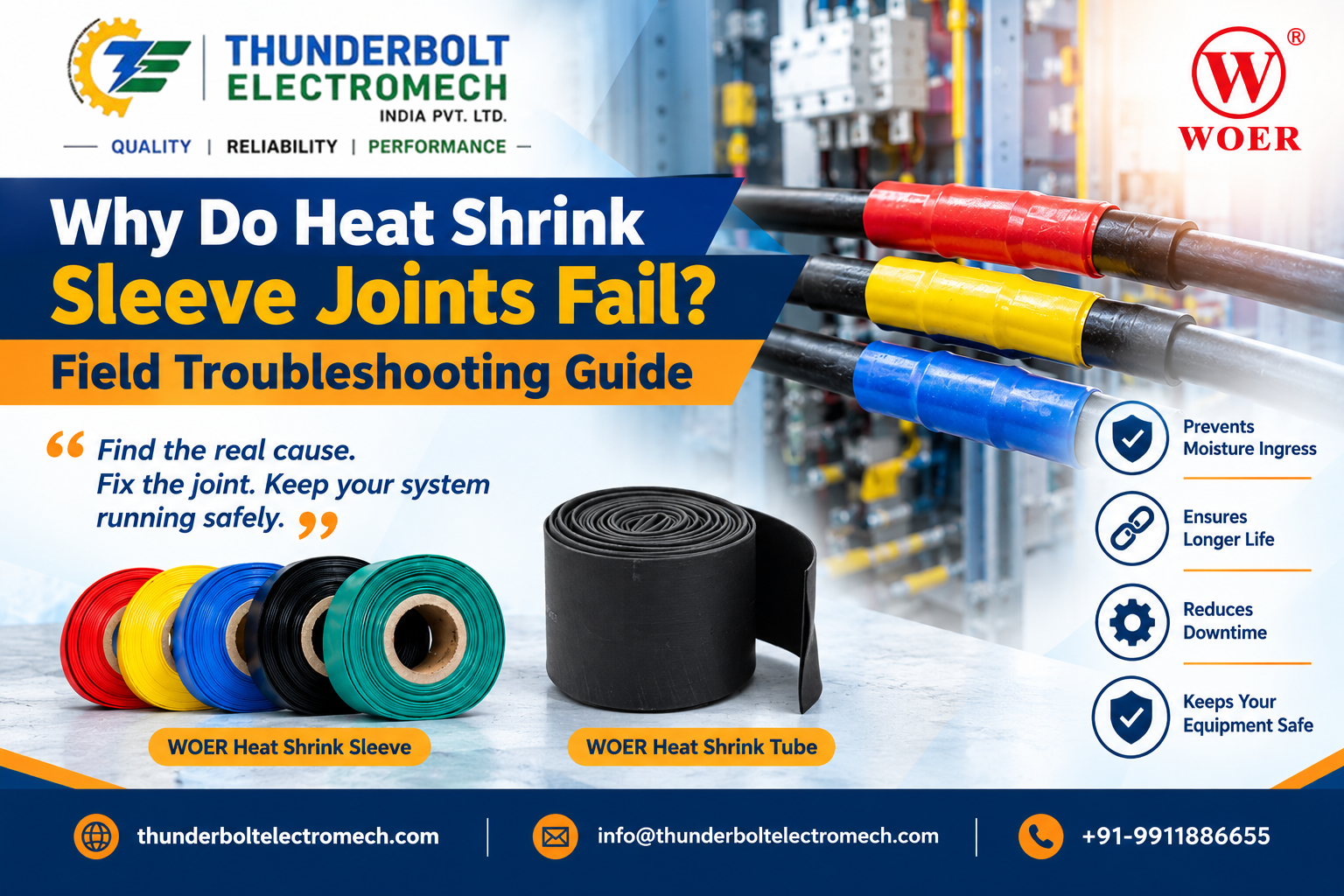
Thunderbolt Electromech carries the complete WOER Heat Shrink Sleeve range precisely because consistency, not just price per metre, is what actually reduces your callback rate. If you’re comparing sizes and shrink ratios for a specific job, our heat shrink sleeve size guide walks through the diameter-to-conductor matching logic step by step.
Comparison Table: Failure Mode, Root Cause, and Correct Fix
| Failure Mode | What You’ll See On Site | Most Likely Root Cause | Correct Fix |
| Fine spider-web cracking, surface only | Cracks near oil/solvent exposure points | Environmental stress cracking (ESC) | Switch to chemically resistant sleeve grade; improve housekeeping around oils/solvents |
| Circumferential crack at crimp edge | Crack lines up neatly at one edge, not random | Thermal cycling fatigue (CTE mismatch) | Use heavier-wall or semi-rigid grade rated for the actual duty-cycle current |
| Sleeve turns brittle, snaps when flexed | Occurs 18–36 months after install, outdoor site | UV / thermal embrittlement | Specify UV-stabilised, outdoor-rated sleeve from the start |
| Loose sleeve, visible gap under wall | Sleeve doesn’t fully hug conductor profile | Wrong shrink ratio for conductor OD | Re-check size chart; select correct expanded ID to recovered ID ratio |
| Water ingress inside sleeve | Corrosion visible on conductor under sleeve | Under-heating / adhesive never reached flow point | Re-train on heat-gun dwell time; verify adhesive flow with infrared thermometer |
| Sleeve splits right after installation | Failure within days to weeks | Over-stretching during installation or wrong ratio | Reduce mechanical tension during fitting; confirm correct diameter selection |
Direct source: physical property ranges and test methods referenced in ASTM D2671 (Standard Test Methods for Heat-Shrinkable Tubing for Electrical Use) and the IEC 60684-2 test series for longitudinal change, tensile strength, and dielectric strength. Field-pattern observations (which crack shape maps to which cause) are drawn from Thunderbolt Electromech’s on-site diagnostic work across Delhi/NCR installations and are not claims from a published academic study — treat them as practitioner heuristics, not laboratory-verified statistics.
Customer Problems We See in the Field — And How We Solved Them
“Our panel joints keep failing every monsoon, but the same sleeve works fine in our Gurugram warehouse.”
The panel location was an unventilated basement duct bank with standing humidity for weeks at a time. The sleeve itself was correctly sized, but it was a non-adhesive-lined grade meant for indoor, dry environments. We moved the client to an adhesive-lined, moisture-sealing variant for that specific duct run and left the dry-area panels on the existing stock. Same building, two different sleeve specifications — because the environment, not the panel brand, decides the grade.
“We keep getting the same crack pattern on every third or fourth joint, never the rest.”
This one took a site visit to solve. The technician doing every third or fourth joint was left-handed and holding the heat gun at a steeper angle out of habit, under-heating one side of the sleeve consistently. It wasn’t a batch issue — it was a technique variance between two installers on the same crew. A short refresher on dwell time and gun angle stopped the recurrence completely.
“Sleeves crack within four months on our rooftop solar cable joints.”
Classic UV embrittlement. The client had been buying a general-purpose indoor-grade sleeve because it was cheaper per metre. We recommended a UV-stabilised, weather-resistant grade instead. The per-metre cost went up marginally; the callback frequency dropped from roughly every four months to zero complaints in the following eighteen months of use.
“How do we know if it’s the sleeve or the installation when a joint fails?”
Cut it open. A properly heated, adhesive-lined joint shows adhesive that has visibly flowed and bonded to both the sleeve wall and the conductor — glossy, continuous, no dry patches. If you see a distinct, unmelted adhesive strip still holding its original shape, the joint was never heated correctly, regardless of which supplier the sleeve came from.
Heat Shrink Sleeve Repair Delhi: Our On-Site Diagnostic Protocol
When our team gets called for heat shrink sleeve repair Delhi jobs, we don’t start by replacing the sleeve. We start by asking three questions that most vendors skip:
What was the ambient temperature and humidity during original installation?
Delhi’s summer rooftop surface temperatures can exceed 55–60°C, which affects how quickly a heat gun brings a sleeve to recovery temperature and how fast it cools afterward — cooling too fast under a load can lock in incomplete shrinkage.
Was the joint load-tested immediately after installation, or only visually inspected?
A visual pass doesn’t confirm thermal or dielectric integrity. A simple thermal imaging check under load, done once, catches most under-heated joints before they become emergency call-outs six months later.
What’s the duty cycle of the circuit — continuous, intermittent, or motor-starting current spikes?
Motor circuits with frequent inrush current put far more thermal cycling stress on a joint than a steady lighting circuit of the same rated current. The sleeve grade should match the duty cycle, not just the cable size.
Our repair visits across Delhi/NCR follow the same ten-minute checklist outlined earlier in this guide, and where the root cause turns out to be a supply inconsistency rather than an installation error, we help clients standardise on a single, documented sleeve specification going forward — which is usually the single biggest reduction in repeat call-outs we see.
Cable Joint Troubleshooting Delhi NCR: Climate, Voltage Class, and Site Conditions
Cable joint troubleshooting Delhi NCR work has a few regional quirks worth knowing if you’re not local to the region.
Temperature swing. NCR sees roughly a 35–40°C annual temperature range between peak summer and winter lows. That swing alone puts more thermal cycling stress on outdoor joints here than in a more climate-stable region, which is one reason heavy-wall or semi-rigid sleeves are worth the marginal extra cost on exposed runs.
Dust and particulate load. Industrial belts around Bawana, Narela, and Faridabad carry higher ambient particulate levels, which can settle into open joints during installation if sleeves are shrunk in open, unshielded conditions. A basic tented work area during installation reduces this contamination risk more than any sleeve upgrade would.
Voltage class matters for sleeve selection. LT (low tension) panel and distribution joints tolerate standard polyolefin grades in most indoor settings. MT/HT joints — common across NCR’s industrial feeder network — need sleeves engineered for stress control at the cable-to-termination interface, often with a semiconducting layer or stress-grading compound, not a generic insulating sleeve. Using an LT-grade sleeve on an HT joint isn’t a minor mismatch; it’s a direct path to partial discharge damage and eventual flashover.
Grid supply quality. Voltage fluctuations and switching transients, more common on some NCR feeders during peak load hours, add electrical stress on top of thermal stress. Joints on these circuits benefit from a margin above minimum-spec dielectric strength rather than the bare minimum rating.
What a Reliable Heat Shrink Sleeve Supplier Should Guarantee in Writing
Before you commit to bulk procurement, ask your heat shrink sleeve supplier for these in writing — not as a verbal assurance, but as a signed datasheet or letter attached to the purchase order:
- Confirmed shrink ratio and recovery temperature range, tested per ASTM D2671 or IEC 60684-2 methods.
- Minimum and maximum operating temperature range for the specific grade you’re buying.
- Dielectric breakdown voltage, particularly important if you’re using the sleeve on or near live conductors above LT levels.
- UV stability rating if any portion of the installation is outdoors or under indirect sun exposure through skylights or open sheds.
- Batch traceability, so a failure eighteen months from now can be traced back to a specific production lot rather than a vague “somewhere in that box.”
Any heat shrink sleeve supplier unwilling to put these details on paper is telling you, indirectly, that they can’t stand behind batch-to-batch consistency. That’s the real cost of buying on price alone — you pay for it later in call-out visits, not in the invoice.
Evidence Behind This Guide: Standards We Rely On
We’d rather tell you plainly what’s a tested standard and what’s practitioner experience, because conflating the two is how misinformation spreads in this industry.
Direct standard references (peer-reviewed test methodology, not marketing claims):
- ASTM D2671 — Standard Test Methods for Heat-Shrinkable Tubing for Electrical Use, covering heat shock, tensile strength and elongation, dielectric breakdown voltage, longitudinal change, and low-temperature flexibility test procedures.
- IEC 60684-2 series — International test methods for longitudinal change (typical tolerance band of roughly -15% to +5%), concentricity, tensile strength, and secant modulus of heat-shrinkable tubing.
- IEC 60684-3 — Specification sheets defining performance requirements by tubing type and application class.
Field-observation insights (no direct published study — labelled as such deliberately):
- The mapping between visual crack pattern and root cause described in the comparison table above comes from Thunderbolt Electromech’s own site diagnostics across Delhi/NCR, not from a controlled laboratory study. Treat it as a practical starting hypothesis, always confirm with a cross-section inspection.
- Specific NCR climate and duty-cycle stress observations are drawn from field experience with regional installations, not from a published regional engineering paper — we’ve found no direct academic research specifically studying heat shrink joint failure rates by Delhi/NCR microclimate zone, and we’re not going to pretend otherwise.
Being upfront about which claims are standard-backed and which are field-tested-but-not-published is, frankly, rarer in this industry than it should be. We’d rather you trust the parts that deserve trust and question-mark the parts that are still practitioner judgment.
Preventive Engineering: Extending Joint Life Well Beyond the Warranty Period
A sleeve that just meets minimum spec will get you through the warranty period. Extending real service life needs a slightly different mindset — treating the joint as a system, not a single component.
Match wall thickness to mechanical exposure, not just electrical rating.
A joint buried in a cable tray with other cables resting on it needs more mechanical margin than an open-air panel connection carrying the identical current.
Build in a thermal margin, not a bare-minimum fit.
Specifying a sleeve rated marginally above your expected maximum conductor temperature — rather than exactly at it — buys tolerance for the inevitable load growth most installations see over five to ten years.
Document the installation, not just the material.
A photo log of heat-gun dwell time, ambient conditions, and post-installation thermal scan takes two minutes per joint and turns a future failure investigation from guesswork into a five-minute diagnosis.
Standardise your supplier relationship, not just your product code.
Switching heat shrink sleeve suppliers opportunistically for small per-metre savings is, in our experience, the single most common hidden driver of “random” joint failures across a large installed base — because nobody notices the formulation changed until years later when the failure pattern shifts unexplainably.
Why Thunderbolt Electromech Is Delhi/NCR’s Trusted Heat Shrink Sleeve Supplier
We’re a Delhi-based distributor and supplier of WOER heat shrink sleeves, and we built our stocking and technical support model around exactly the problems described in this guide. Every batch we carry comes with traceable specification data, and our technical desk has walked through enough failed joints across Delhi/NCR to know that a five-minute conversation before you order often saves a much longer conversation after a joint fails in the field.
Whether you need a single carton for a maintenance job or a standing supply agreement for a project rollout, working with one heat shrink sleeve supplier consistently — rather than sourcing opportunistically — is the most practical step you can take toward reducing your own joint-failure rate. You can browse our full heat shrink sleeve category to compare grades, or go straight to the WOER Heat Shrink Sleeve 6mm product page for detailed specifications.
Talk to Our Engineers — India’s Responsive Heat Shrink Sleeve Supplier
If a joint has already failed, or you want a second opinion before a large procurement order, reach out directly. As a Delhi/NCR-based heat shrink sleeve supplier, we can usually turn around a technical query — sizing, grade selection, or a failure-pattern review from photos — within the same working day.
Thunderbolt Electromech India Pvt. Ltd. Delhi/NCR, India (please confirm your registered office address with our sales desk — we’ve kept this general here rather than guess at the exact street details) Phone: +91-9911886655 Email: info@thunderboltelectromech.com Website: thunderboltelectromech.com
Send us photos of a failed joint before your next site visit, and our technical team will usually be able to narrow the likely cause before you even arrive on-site — saving you a second trip.
Quick Reference: Common Field Questions
Can I reuse a heat shrink sleeve once it’s been partially shrunk?
No. Partial recovery permanently changes the polymer’s stored elastic energy in that section. A partially shrunk sleeve will never seat evenly if you try to reposition and reheat it — cut it off and start with a fresh piece.
Is a hairdryer or open flame an acceptable substitute for a proper heat gun?
A hairdryer rarely reaches the sustained 90–120°C needed for full-wall recovery, so joints “shrunk” this way often fail the under-heating checks described earlier. An open flame risks scorching and localised carbonisation of the polymer, which weakens the sleeve at exactly the point it’s supposed to protect. Neither substitute is worth the risk on a joint that has to last years.
Does a thicker sleeve always mean a stronger joint?
Not automatically. Wall thickness helps with mechanical protection and thermal cycling resistance, but if the shrink ratio doesn’t match the conductor OD, a thicker sleeve can actually seat worse, leaving more trapped air rather than less. Thickness and correct sizing need to be solved together, not as substitutes for each other.
How often should installed joints be inspected once commissioned?
For LT panel and distribution joints in normal indoor conditions, an annual visual and thermal check is usually sufficient. For outdoor, rooftop, or MT/HT joints across Delhi/NCR’s temperature swings, a check every six months — ideally under load with a thermal imaging camera — catches early-stage under-heating or environmental degradation before it becomes an outage.
Conclusion: Stop Guessing, Start Diagnosing
Most heat shrink sleeve joint failures aren’t mysterious once you know where to look. Crack location tells you the mechanism. Failure timing tells you whether it’s installation error, environmental mismatch, or normal ageing. And consistency of supply, more than any single product feature, determines whether your failure rate stays low across hundreds of joints installed over several years.
Run the ten-minute checklist in this guide the next time a joint fails on you. Cut it open. Look at where the crack sits, not just that it exists. And before your next bulk order, ask your heat shrink sleeve supplier for the paperwork that proves batch consistency — not just a quote.
If you’re troubleshooting a specific failure right now, or planning a project that needs a dependable heat shrink sleeve supplier across Delhi/NCR, call +91-9911886655 or write to info@thunderboltelectromech.com. We’d rather help you prevent the next failure than sell you a replacement for this one.