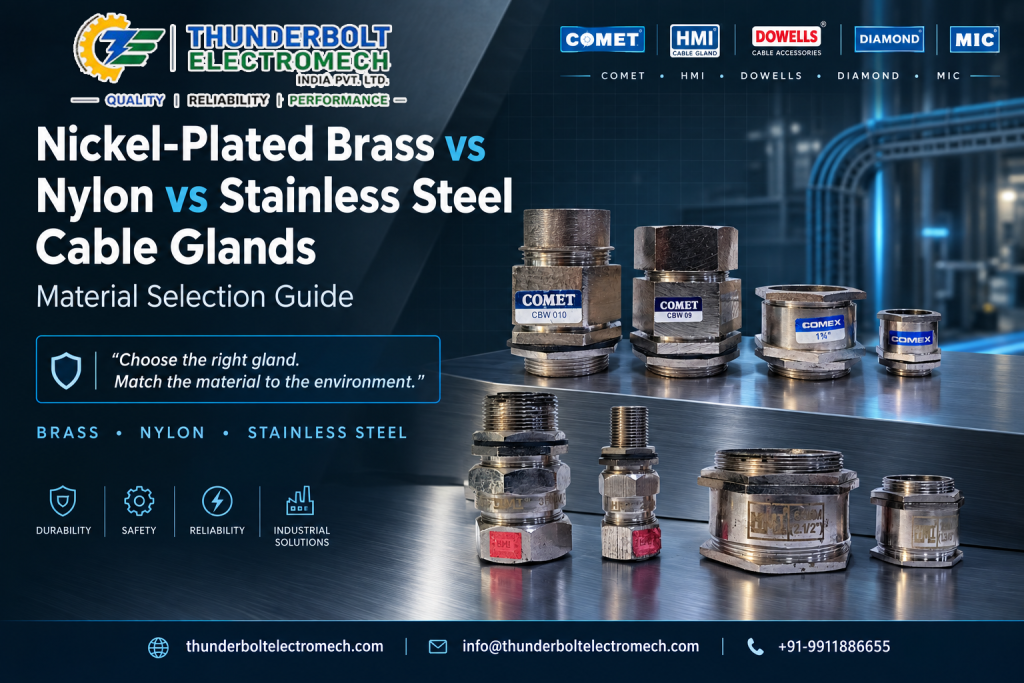
Quick Answer:Choose nickel-plated brass for general indoor/outdoor panels needing earthing continuity and EMI shielding at moderate cost. Choose nylon (PA66) for lightweight, non-conductive, chemical-splash duty where earthing isn’t required. Choose stainless steel (304 or 316) for coastal, chemical, or washdown sites where chloride exposure causes pitting in brass within months. As a Cable Gland Supplier India for Dowells, Comet, HMI, Diamond, and MIC ranges, we match material to your enclosure metal, IP rating target, and site chemistry — not just your budget line.
Introduction
A cable gland costs less than the connector it protects. It also decides whether that connector survives five years or fails in five months. Most buyers treat material choice as a price decision. It isn’t. It’s a corrosion-chemistry decision, a galvanic-compatibility decision, and — in hazardous areas — a certification decision. Get it wrong and you’re not looking at a warranty claim on a fifty-rupee component; you’re looking at moisture ingress into a VFD panel, a tripped earth-fault relay at 2 a.m., or a stalled audit because your IP68 rating doesn’t hold up on paper.
This guide breaks down nickel-plated brass, nylon, and stainless steel cable glands the way a specifying engineer actually needs them broken down: by what corrodes, what conducts, what flexes, and what a real site in Delhi NCR, Gujarat, or coastal Andhra will do to each material over a ten-year asset life. We supply all three ranges — Dowells, Comet, and HMI at the premium end, Diamond and MIC for cost-sensitive mid-range builds — so this isn’t a single-material sales pitch. It’s the comparison we walk buyers through on the phone every week.
What a Cable Gland Actually Has to Survive
Before comparing materials, it helps to know what standard governs them. IEC 62444:2010 (adopted regionally as EN 62444:2013) is the construction and performance standard for cable glands with metric entry threads. It sets requirements for cable retention force, cable anchorage under pull and twist, impact resistance, sealing performance against IEC 60529 IP ratings, and — critically for metallic glands — equipotential bonding and earth continuity current-carrying capability. Non-metallic and composite glands, along with the sealing systems of metallic ones, get pre-conditioned in an oven at 70°C for 168 hours before testing; if a manufacturer declares a higher working temperature, the pre-conditioning temperature rises accordingly.
That single detail already separates the three materials in this guide. A metal gland’s structural strength barely moves with heat. A polymer gland’s does — which is why the temperature and UV data further down matters more for nylon than for either metal option.
Three failure modes account for almost every field complaint we hear from panel builders and EPC contractors:
- Electrochemical corrosion — pitting, galvanic attack, or surface tarnish that eventually breaks the seal or the earth path.
- Mechanical fatigue — cracking or embrittlement from UV exposure, vibration, or repeated thermal cycling.
- Compatibility mismatch — a gland that’s individually excellent but wrong for the enclosure metal, the cable armour, or the hazardous-area zone it’s mounted in.
Everything below maps to one of these three.
Nickel-Plated Brass Cable Glands: The Workhorse Material
Brass (a copper-zinc alloy) is the default cable gland material across Indian industrial installations, and nickel plating over brass is the default finish — not decoration, but a functional corrosion barrier.
Why the nickel layer matters more than the brass underneath
Unplated brass tarnishes and, in humid or industrial-pollutant air, develops a green-black patina (copper carbonate/sulphate) that increases contact resistance at the earth path. Nickel plating interrupts that oxidation. Independent salt-spray data under ASTM B117 places nickel/chrome-type platings in the 8–2,000 hour range depending on plating thickness and layer system, versus roughly 24–1,000 hours for straight copper-based finishes exposed the same way. In a field comparison cited by plating engineers, nickel-plated brass components rated for 1,000+ hours of ASTM B117 exposure have been documented performing 15–25 years in marine and coastal industrial service without base-metal corrosion, against standard unplated brass or aluminium hardware showing visible pitting and verdigris in the same environment within roughly five years. The lab-hour-to-field-year relationship isn’t linear — the often-quoted rule of thumb is that one hour of B117 exposure approximates one to two weeks of moderate marine exposure — but the direction of the data is unambiguous: plating thickness and plating type, not the base brass alloy, decide how long a “brass” gland actually survives outdoors. (Primary source: ASTM B117 test parameter data and salt-spray industry guides; the 15–25 year field figure is a secondary-source industry claim, not an independently audited long-term study — treat it as directional rather than a warranted number.)
The earthing advantage no polymer gland can offer
IEC 62444 explicitly tests metallic glands for equipotential bonding and current-carrying capability during protective earthing. This is the single biggest reason panel builders in Delhi’s Wazirpur, Bawana, and Mangolpuri industrial areas keep specifying brass over nylon for armoured cable terminations: a nickel-plated brass gland with a proper armour clamp becomes part of the earth-fault-loop path. A nylon gland, by design, cannot. If your SWA (steel wire armoured) or aluminium-wire-armoured cable relies on gland earthing rather than a separate earth conductor, brass — or stainless steel — isn’t optional.
Where nickel-plated brass gets it wrong
Two scenarios cause the complaints we field most often:
- Galvanic mismatch with aluminium enclosures. When unplated brass clamping components sit against aluminium gland plates or aluminium-armoured cable, a bimetallic couple forms in the presence of moisture (the electrolyte). Aluminium sits well below brass on the galvanic series, so it corrodes preferentially. Industry FAQs from established gland manufacturers note that the contact area in a typical gland clamp is small enough, and the assembly dry enough once sealed, that this risk is usually manageable — but they still recommend nickel-plated internals specifically to eliminate the risk rather than rely on “usually manageable.” If your enclosure is aluminium-bodied (common in outdoor junction boxes and some HVAC control panels), always specify the nickel-plated version, never bare brass.
- Coastal and high-chloride chemical zones. Nickel plating resists atmospheric corrosion, not chloride immersion or splash-zone exposure at scale. For sites within a few kilometres of the coast, or inside chemical/fertiliser plants with airborne chlorides, stainless steel outperforms even well-plated brass over a multi-decade asset life.
We stock nickel-plated brass across our Dowells, Comet, and HMI ranges for panel builders who need IEC 62444-compliant earthing continuity without stepping up to stainless steel pricing, and Diamond and MIC brass ranges for cost-sensitive OEM and switchgear assembly work where budget per unit matters more than premium plating thickness.
Nylon (Polyamide) Cable Glands: Light, Non-Conductive, Chemical-Resistant
Nylon cable glands are almost always PA66 (polyamide 6.6) or occasionally PA6, sometimes glass-filled for extra rigidity. They are the correct default when the job doesn’t need metallic earthing and does need light weight, chemical resistance, or electrical isolation.
The temperature range buyers get wrong
Standard commercial-grade PA66 cable glands are typically rated from around -40°C to +85°C for continuous service, with UL94 V-2 flame retardancy as the common baseline (self-extinguishing, but not the strictest rating). Heat-stabilised and UV-resistant PA66 grades push continuous service toward 105–120°C and often carry UL94 V-0, the stricter flame-retardancy classification requiring the flame to self-extinguish within 10 seconds without dripping flaming particles. That gap — V-2 versus V-0, 85°C versus 120°C — is exactly where cheap unbranded nylon glands fail buyers who assume “nylon is nylon.” If your gland sits near a motor terminal box, a solar inverter enclosure in direct Rajasthan or Gujarat sun, or inside a control panel with poor ventilation, ask specifically for the heat-stabilised, UV-resistant, V-0 grade — not generic PA66.
UV degradation is real, and it’s not cosmetic
Unstabilised nylon exposed to direct UV over years becomes brittle at the surface, developing microcracks that eventually compromise the IP68 seal at the O-ring interface long before the gland “looks” broken. This is precisely why outdoor solar farm installations, rooftop telecom cabinets, and open-yard switchyards should specify UV-stabilised nylon or move to a metal gland entirely — a distinction most price-driven quotations from unbranded suppliers simply omit.
Where nylon genuinely wins
- Non-conductive by design, which matters in control and instrumentation panels where you deliberately want to avoid creating unintended earth paths between enclosure sections.
- Chemical resistance to oils, most industrial solvents, and mild acids/alkalis, making it a strong fit for machine-tool enclosures and process-area junction boxes where a metal gland would need additional coating.
- Lower weight and lower cost per unit, useful at scale for OEM panel manufacturers running thousands of units per year.
- No galvanic corrosion risk whatsoever — nylon glands are the safe default when you’re not sure what the enclosure metal is, or when the enclosure itself is a polymer (many modern IP66 plastic enclosures are drilled for nylon glands specifically because metal-on-plastic mounting stress and metal-on-metal galvanic pairing both disappear).
We supply nylon cable glands under our Diamond and MIC ranges, and stock UV-stabilised, heat-stabilised variants specifically for outdoor solar, telecom, and rooftop switchgear projects across the Delhi NCR belt — a request we get often enough from EPC contractors in Bawana and Faridabad that we now default-recommend the stabilised grade for any outdoor quote, not just when asked.
Stainless Steel Cable Glands: The Chloride-Resistant Specification
Stainless steel cable glands — almost always SS304 or SS316 in the Indian market — exist for one reason: chloride resistance that nickel plating cannot match over a multi-decade asset life.
The number that actually separates 304 from 316
Engineers compare stainless grades using the Pitting Resistance Equivalent Number (PREN), calculated as:
PREN = %Cr + 3.3 × (%Mo) + 16 × (%N)
SS304 contains no molybdenum and scores a PREN of roughly 18–20. SS316 adds 2–3% molybdenum and scores roughly 24–26. That molybdenum addition is the entire story: it stabilises the passive oxide film against chloride ion penetration, meaning SS316 resists localised pitting at chloride concentrations that will visibly pit SS304 within 12–18 months in continuous salt-fog exposure, according to comparative conduit and hardware corrosion data. For context, general industrial guidance treats roughly 200 ppm chloride as the rough threshold above which SS304’s passive layer starts to lose reliability, while seawater-immersion specifications typically demand a PREN above 30–32 — meaning even SS316 is not automatically “marine-grade enough” for direct seawater immersion, only for splash-zone and coastal-atmosphere duty, which covers the overwhelming majority of cable gland applications.
When SS304 is genuinely sufficient
Don’t over-specify. SS304 performs well in:
- Food and pharmaceutical processing areas with washdown but low chloride content
- General indoor industrial panels where the driver is chemical or aesthetic resistance, not marine exposure
- Fresh-water and low-chloride process environments
When to insist on SS316
- Coastal plants (ports, desalination, offshore-adjacent facilities) within direct salt-spray range
- Chemical, fertiliser, and pharmaceutical plants with airborne chlorides or acidic process gases
- Any installation where chloride-based cleaning agents (common in food processing) contact the gland regularly
A useful field rule we give EPC buyers: if your site specification separately calls out SS316 valves, SS316 fasteners, or SS316 pipework anywhere in the same process area, specify SS316 cable glands too — mixing a lower-grade gland into an otherwise 316-spec installation defeats the purpose and creates a weak point that fails years before the surrounding hardware.
We supply stainless steel cable glands under the Dowells, Comet, and HMI ranges, with SS304 as standard stock and SS316 available for coastal, chemical, and offshore-adjacent project specifications.
Customer Problems and Solutions
Problem 1 — “Our brass glands keep tarnishing at the earthing point within a year.”
This is almost always an unplated-brass-on-aluminium-enclosure mismatch, or an installation near a chemical exhaust stack with airborne chlorides that a standard nickel plating thickness wasn’t specified to handle. Solution: step up to heavier nickel-plating thickness in the same brass gland (a plating-spec change, not a full material change), or move to SS304 if chloride exposure is confirmed.
Problem 2 — “Nylon glands cracked at the cable entry within two summers on our rooftop inverter enclosures.”
This is a UV-stabilisation gap, not a nylon failure. Standard commercial PA66 without UV stabiliser embrittles under sustained direct sun. Solution: switch to UV-stabilised, heat-stabilised PA66 rated to 105–120°C, or move to a metal gland for full-sun rooftop mounting where ambient enclosure temperature regularly exceeds 60°C.
Problem 3 — “We need earth continuity but the client’s spec also demands zero conductive contact with the enclosure body.”
This is a specification conflict, not a gland problem — it usually means the enclosure uses an isolated earth-continuity plate (ECP) rather than gland-to-body bonding. Solution: nickel-plated brass gland bonded to a metallic ECP plate inside a polymer enclosure, per IEC 62444’s equipotential bonding provisions, rather than trying to force continuity through the enclosure itself.
Problem 4 — “Our 304 stainless glands pitted within 18 months near our coastal terminal.”
Textbook chloride-driven localised corrosion below SS304’s PREN threshold. Solution: reorder in SS316 for all new installations and plan a phased replacement of the SS304 units during the next shutdown window rather than waiting for further failures.
Comparison Table: Nickel-Plated Brass vs Nylon vs Stainless Steel Cable Glands
| Parameter | Nickel-Plated Brass | Nylon (PA66) | Stainless Steel (304/316) |
| Earth continuity / EMI shielding | Yes — IEC 62444-compliant bonding | No — non-conductive by design | Yes |
| Typical service temperature | -40°C to +100°C+ | -40°C to +85°C (standard); up to 105–120°C (heat-stabilised) | -40°C to +150°C+ |
| Chloride / salt-spray resistance | Good with plating; degrades near coast/chemical zones | N/A (no metal to corrode; UV is the risk instead) | Very good (304) to excellent (316, PREN 24–26) |
| Flame retardancy | Non-combustible | UL94 V-2 standard; V-0 in FR grades | Non-combustible |
| UV resistance | Excellent (metal) | Poor unless UV-stabilised grade specified | Excellent |
| Relative weight | Medium | Lightest | Heaviest |
| Relative cost | Mid-range | Lowest | Highest |
| Galvanic corrosion risk | Yes, if paired with aluminium enclosures/cable armour | None | Low, but verify compatibility with other metals in assembly |
| Best-fit environment | General industrial, panel builders, armoured cable termination | Indoor/control panels, non-earthed runs, cost-sensitive OEM builds | Coastal, chemical, offshore, washdown, food/pharma |
| Thunderbolt ranges available | Dowells, Comet, HMI (premium); Diamond, MIC (mid-range) | Diamond, MIC | Dowells, Comet, HMI |
How to Choose: A Decision Framework for Buyers
Run through these four questions in order before you finalise a purchase order:
- Does the installation need gland-based earth continuity? If the cable is armoured and the gland is the earth path, brass or stainless steel is mandatory — nylon is out regardless of cost.
- What’s the enclosure material? Aluminium enclosure or aluminium-armoured cable → insist on nickel-plated brass, never bare brass, to eliminate galvanic risk.
- What’s the chloride exposure? Coastal, chemical, or washdown environments push you toward stainless steel; confirm 304 vs 316 against your site’s documented chloride level or existing SS316 specification elsewhere in the plant.
- What’s the UV and temperature exposure? Full-sun rooftop or desert-belt installations rule out standard nylon; specify UV-stabilised, heat-stabilised grades or move to metal.
If you answer all four and still land on “any of the three would technically work,” the deciding factor becomes total installed cost against expected maintenance-interval savings — which is the conversation our technical sales team has with EPC and panel-building clients every day.
Sourcing Cable Glands in Delhi and Delhi NCR
Buyers searching for a brass cable gland supplier Delhi or a nylon cable gland dealer Delhi NCR are usually solving one of two problems: an urgent panel-building shortage during a project deadline, or a long-term vendor consolidation to reduce the number of suppliers on their approved vendor list. Thunderbolt Electromech India Pvt. Ltd. serves both. As a stocking Cable Gland Supplier India with ready inventory across Dowells, Comet, HMI, Diamond, and MIC ranges, we support panel builders and EPC contractors across Delhi’s industrial belts — Wazirpur, Bawana, Mangolpuri, Okhla, and Narela — as well as the wider NCR manufacturing corridor spanning Faridabad, Gurugram, Noida, and Ghaziabad, where control-panel fabrication and switchgear assembly volumes run high and lead-time tolerance runs low.
For stainless steel cable gland India requirements specifically — coastal EPC exports, pharmaceutical washdown areas, or chemical-plant retrofits anywhere in the country — we ship SS304 and SS316 ranges pan-India from the same stock that supplies our Delhi NCR base, so a national project doesn’t need a second vendor relationship for one material grade.
FAQ: Cable Gland Material Questions Buyers Actually Ask
1. Do nickel-plated brass cable glands rust over time?
The brass base doesn’t “rust” in the iron-oxide sense, but it does tarnish and can corrode if the nickel plating is thin, scratched, or breached by chloride exposure. Quality nickel plating with adequate thickness resists atmospheric corrosion for years; thin or low-grade plating fails faster, which is why plating thickness — not just “nickel-plated” as a label — should be part of your purchase spec. (Direct source: ASTM B117 salt-spray industry data on nickel/chrome plating systems.)
2. Is stainless steel cable gland overkill for a normal indoor control panel?
Usually, yes. Indoor panels in low-chloride, climate-controlled environments rarely need SS304, let alone SS316 — nickel-plated brass or even nylon typically covers the requirement at a fraction of the cost. Reserve stainless steel for chloride exposure, chemical contact, or a client specification that explicitly demands it. (No single direct source — this is standard engineering-selection guidance compiled from IEC 62444 material provisions and industry PREN data cited above.)
3. Can nylon cable glands be used with armoured cable?
Nylon glands can mechanically terminate armoured cable, but they cannot provide the earth continuity that armour often relies on for fault protection. If your design uses the armour as an earth conductor, you need a metallic gland (brass or stainless) with a proper armour clamp, not nylon. (Direct source: IEC 62444 equipotential bonding and earth-continuity test requirements.)
4. What’s the actual difference between “brass” and “nickel-plated brass” cable glands?
Bare brass is the base copper-zinc alloy with no additional corrosion barrier; it tarnishes faster in humid or polluted air. Nickel-plated brass has an electroplated nickel layer over the brass, which is the actual corrosion-resistant surface doing the work in outdoor and industrial-atmosphere installations. Functionally, always default to nickel-plated unless the application is fully indoor and dry. (Direct source: manufacturer FAQ guidance and salt-spray comparative data cited above.)
5. Do cable glands need to match the enclosure material to avoid corrosion?
Not a strict match, but compatibility matters. Brass-on-steel or brass-on-brass is generally fine. Brass directly against an aluminium enclosure or aluminium cable armour, with moisture present, creates a galvanic couple that corrodes the aluminium — this is why nickel-plated internals are recommended specifically for aluminium-adjacent installations. (Direct source: manufacturer technical FAQ on galvanic corrosion in aluminium-armoured cable applications.)
6. What IP rating should I choose for an outdoor cable gland in Delhi/NCR conditions?
IP66 or IP68 is the common baseline for outdoor panels in North India, covering monsoon-season water ingress and dust from construction-heavy industrial areas. The gland’s IP rating is only as good as correct installation — under- or over-tightening the compression nut is the single most common cause of IP-rated glands failing their rating in the field. (No single direct source — compiled from IEC 60529 IP classification standards referenced within IEC 62444 and common field-installation guidance.)
7. Is SS304 sufficient, or do I need SS316 for my plant?
If your process area has documented chloride concentration above roughly 200 ppm, handles chloride-based cleaning agents, or sits within coastal salt-spray range, specify SS316. If your existing plant specification already calls for SS316 valves, fittings, or fasteners in the same area, match your cable glands to that spec rather than defaulting to cheaper SS304. (Direct source: PREN comparative data — SS304 ≈18–20, SS316 ≈24–26 — cited from multiple stainless-steel grade-selection guides above.)
8. How long do nylon cable glands actually last outdoors before they crack?
Standard, non-UV-stabilised nylon glands in direct sun can show surface embrittlement and cracking within two to three years in high-UV regions. UV-stabilised, heat-stabilised PA66 grades extend that significantly and are the correct specification for any rooftop, open-yard, or full-sun installation — not the standard commercial grade. (No single direct source — synthesised from PA66 material datasheets on UV-stabilised versus standard grades cited above; treat specific “years” figures as indicative, not a manufacturer-warranted lifespan.)
9. Why do some cable gland quotes for the “same” nylon gland vary so much in price?
The price gap usually comes down to grade: standard PA66 (UL94 V-2, ~85°C) versus heat-stabilised, UV-resistant, flame-retardant PA66 (UL94 V-0, up to 105–120°C). They look identical and are both called “nylon cable glands,” but the polymer additive package is different, and so is the field lifespan. Always ask for the UL94 rating and continuous temperature rating on the datasheet, not just the material name. (Direct source: comparative PA66 grade datasheets cited above.)
10. Can I mix brass and stainless-steel cable glands on the same panel?
Yes, as long as each gland is chosen for the cable and environment it’s terminating rather than for uniformity’s sake — a common and correct practice is stainless steel glands on outdoor coastal-facing cable entries and nickel-plated brass on indoor, protected entries of the same enclosure. (No single direct source — standard mixed-specification practice in multi-environment panel design.)
Sources and Further Reading
- IEC 62444:2010 / EN 62444:2013 — Cable glands for electrical installations (construction, performance, bonding, and IP test requirements) — primary standard document.
- ASTM B117 — Standard Practice for Operating Salt Spray (Fog) Apparatus — primary test-method standard; salt-spray duration and plating-system data drawn from industry testing-lab summaries of this standard.
- Comparative PREN and stainless-steel grade-selection data (SS304 vs SS316 chemistry and pitting resistance) — secondary sources: multiple independent metallurgical and industrial-hardware technical guides, cross-checked for consistency of the 18–20 / 24–26 PREN range.
- PA66 polyamide material datasheets and UL94 flammability comparison data — secondary sources: polymer manufacturer technical datasheets.
- Galvanic corrosion and bimetallic-couple guidance for brass/aluminium cable gland assemblies — secondary source: established cable gland manufacturer technical FAQ.
Figures describing multi-year field-service outcomes (e.g., “15–25 years,” “12–18 months to visible pitting”) are drawn from industry technical articles rather than independently peer-reviewed longitudinal studies. They are presented as directional engineering guidance, consistent across multiple independent sources, not as warranted performance figures for any specific product.
Final Verdict: Which Cable Gland Material Should You Actually Buy?
There’s no single “best” material — only the correct material for what your installation has to survive. Nickel-plated brass remains the right default for general industrial panels needing earth continuity at a sensible cost. Nylon is the right call when you need a lightweight, non-conductive, chemically resistant gland and you specify the UV-stabilised grade for anything outdoors. Stainless steel — 304 for general chemical resistance, 316 when chlorides are documented or coastal exposure is confirmed — is the only defensible choice once corrosion risk moves from “possible” to “expected.”
Thunderbolt Electromech India Pvt. Ltd. stocks all three material families across our premium Dowells, Comet, and HMI ranges and our mid-range Diamond and MIC ranges, so the decision stays about engineering fit, not about which brand happens to be in stock that week. Browse our full range on the Cable Gland category page, or read our detailed 15 Expert Tips to Choose the Right Cable Gland for Industrial Projects — 2026 Guide for the complete specification checklist before you finalise your next purchase order.
Get in touch: Thunderbolt Electromech India Pvt. Ltd. — Cable Gland Supplier India for Dowells, Comet, HMI, Diamond, and MIC ranges. 📞 Phone: +91-9911886655 📍 Address: Shop No. 3538, Sitaram Bazar Rd, Bazar Sirkiwalan, Chawri Bazar, Chandni Chowk, Delhi, 110006 ✉️ For bulk/EPC project quotations, request a callback through our website contact form.